“Is regression hindering your progression?”
#SMARTest #SmartRegression
T Ashok
Founder & CEO, STAG Software
linkedin.com/in/ashokstag
© 2018, STAG Software, www.stagsoftware.com
2
New/incremental features are the focus for
revenue generation & market expansion
whilst
bug fixes are necessary to ensure that
customers stay.
3
3
Whilst on the path of progression
towards revenue enhancement,
the challenge is:
3
Whilst on the path of progression
towards revenue enhancement,
the challenge is:
“Did I break stuff that were working well”?
3
Whilst on the path of progression
towards revenue enhancement,
the challenge is:
As product grows,
so does regression,
increasing costs &
threatening to
slow down releases.
“Did I break stuff that were working well”?
4
the challenge of CHANGE
4
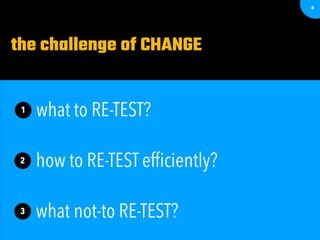
the challenge of CHANGE
what to RE-TEST?1
how to RE-TEST efficiently?2
what not-to RE-TEST?3
5
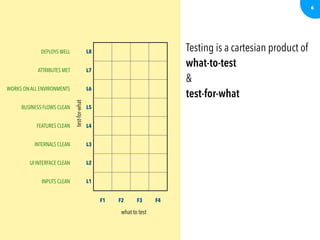
Let us put together a simple model of
“WHAT-is-TESTING”
and use this to TEST/(RE)TEST smartly
6
DEPLOYS WELL L8
ATTRIBUTES MET L7
WORKS ON ALL ENVIRONMENTS L6
BUSINESS FLOWS CLEAN L5
FEATURES CLEAN L4
INTERNALS CLEAN L3
UI INTERFACE CLEAN L2
INPUTS CLEAN L1
F1 F2 F3 F4
what to test
test-for-what
Testing is a cartesian product of
what-to-test 

& 

test-for-what
7
DEPLOYS WELL L8
ATTRIBUTES MET L7
WORKS ON ALL ENVIRONMENTS L6
BUSINESS FLOWS CLEAN L5
FEATURES CLEAN L4
INTERNALS CLEAN L3
UI INTERFACE CLEAN L2
INPUTS CLEAN L1
F1 F2 F3 F4
what to test
test-for-what
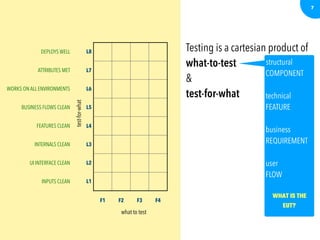
structural
COMPONENT
technical
FEATURE
business
REQUIREMENT
user
FLOW
WHAT IS THE
EUT?
Testing is a cartesian product of
what-to-test 

& 

test-for-what
8
DEPLOYS WELL L8
ATTRIBUTES MET L7
WORKS ON ALL ENVIRONMENTS L6
BUSINESS FLOWS CLEAN L5
FEATURES CLEAN L4
INTERNALS CLEAN L3
UI INTERFACE CLEAN L2
INPUTS CLEAN L1
F1 F2 F3 F4
what to test
test-for-what
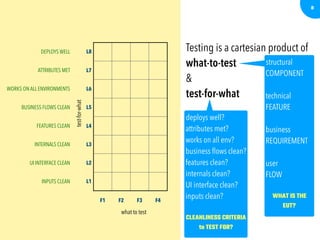
Testing is a cartesian product of
what-to-test 

& 

test-for-what
structural
COMPONENT
technical
FEATURE
business
REQUIREMENT
user
FLOW
WHAT IS THE
EUT?
deploys well?
attributes met?
works on all env?
business flows clean?
features clean?
internals clean?
UI interface clean?
inputs clean?
CLEANLINESS CRITERIA
to TEST FOR?
9
DEPLOYS WELL L8
ATTRIBUTES MET L7
WORKS ON ALL ENVIRONMENTS L6
BUSINESS FLOWS CLEAN L5
FEATURES CLEAN L4
INTERNALS CLEAN L3
UI INTERFACE CLEAN L2
INPUTS CLEAN L1
F1 F2 F3 F4
what to test
test-for-what
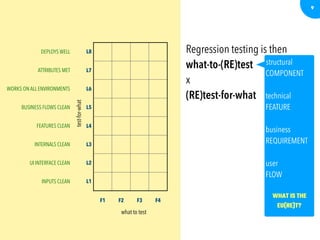
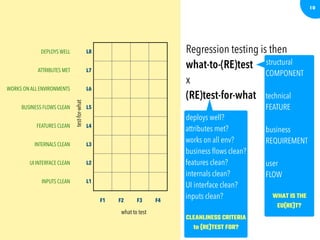
Regression testing is then
what-to-(RE)test 

x 

(RE)test-for-what
structural
COMPONENT
technical
FEATURE
business
REQUIREMENT
user
FLOW
WHAT IS THE
EU(RE)T?
10
DEPLOYS WELL L8
ATTRIBUTES MET L7
WORKS ON ALL ENVIRONMENTS L6
BUSINESS FLOWS CLEAN L5
FEATURES CLEAN L4
INTERNALS CLEAN L3
UI INTERFACE CLEAN L2
INPUTS CLEAN L1
F1 F2 F3 F4
what to test
test-for-what
deploys well?
attributes met?
works on all env?
business flows clean?
features clean?
internals clean?
UI interface clean?
inputs clean?
CLEANLINESS CRITERIA
to (RE)TEST FOR?
Regression testing is then
what-to-(RE)test 

x 

(RE)test-for-what
structural
COMPONENT
technical
FEATURE
business
REQUIREMENT
user
FLOW
WHAT IS THE
EU(RE)T?
11
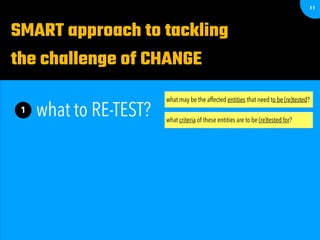
SMART approach to tackling
the challenge of CHANGE
what to RE-TEST?1
what may be the affected entities that need to be (re)tested?
what criteria of these entities are to be (re)tested for?
12
L1
L2
L3
L4
E1
E2
E3
E4
structural component
technical feature
business requirement
user flow
1
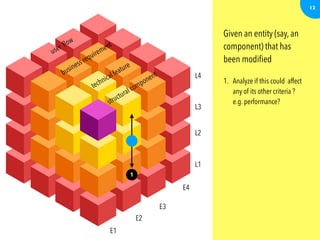
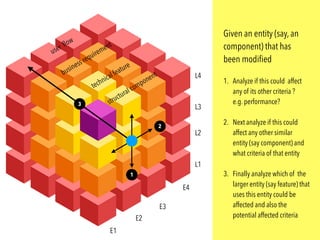
Given an entity (say, an
component) that has
been modified
1. Analyze if this could affect
any of its other criteria ?
e.g. performance?
3. Next analyze if this could
affect any other similar
entity (say component) and
what criteria of that entity
4. Finally analyze which of the
larger entity (say feature)
that uses this entity could be
affected and also the
potential affected criteria
13
L1
L2
L3
L4
E1
E2
E3
E4
structural component
technical feature
business requirement
user flow
1
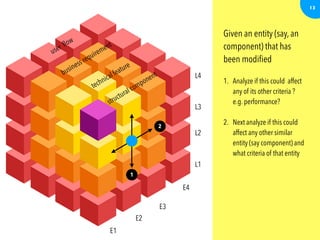
Given an entity (say, an
component) that has
been modified
1. Analyze if this could affect
any of its other criteria ?
e.g. performance?
2. Next analyze if this could
affect any other similar
entity (say component) and
what criteria of that entity
3. Finally analyze which of the
larger entity (say feature)
that uses this entity could be
affected and also the
potential affected criteria
2
14
L1
L2
L3
L4
E1
E2
E3
E4
structural component
technical feature
business requirement
user flow
1
2
3
Given an entity (say, an
component) that has
been modified
1. Analyze if this could affect
any of its other criteria ?
e.g. performance?
2. Next analyze if this could
affect any other similar
entity (say component) and
what criteria of that entity
3. Finally analyze which of the
larger entity (say feature) that
uses this entity could be
affected and also the
potential affected criteria
15
L1
L2
L3
L4
E1
E2
E3
E4
structural component
technical feature
business requirement
user flow
1
2
3
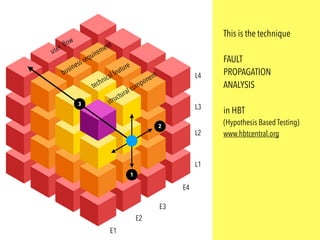
This is the technique
FAULT
PROPAGATION
ANALYSIS
in HBT
(Hypothesis Based Testing)
www.hbtcentral.org
GIVEN THE FOLLOWING
LEVELS OF QUALITY :
L8 DEPLOYS WELL
L7 ATTRIBUTES MET
L6 WORKS ON ALL ENVIRONMENTS
L5 BUSINESS FLOWS CLEAN
L4 FEATURES CLEAN
L3 INTERNALS CLEAN
L2 UI INTERFACE CLEAN
L1 INPUTS CLEAN
To enable focused
purposeful tests that
validates correctness of
inputs, interfaces, going on
to features & flows and
then correctness on all
environments, finally onto
system attributes and
deployment.
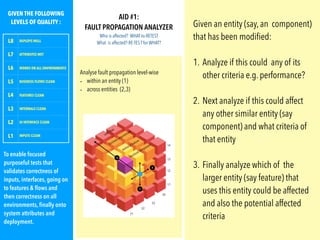
AID #1: 

FAULT PROPAGATION ANALYZER

Who is affected? WHAT-to-RETEST
What is affected?-RE-TES T for WHAT?
Analyse fault propagation level-wise
- within an entity (1)
- across entities (2,3)
Given an entity (say, an component)
that has been modified:
1. Analyze if this could any of its
other criteria e.g. performance?
2. Next analyze if this could affect
any other similar entity (say
component) and what criteria of
that entity
3. Finally analyze which of the
larger entity (say feature) that
uses this entity could be affected
and also the potential affected
criteria
17
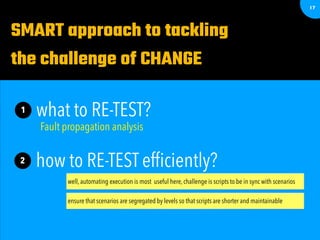
SMART approach to tackling
the challenge of CHANGE
what to RE-TEST?1
how to RE-TEST efficiently?2
well, automating execution is most useful here, challenge is scripts to be in sync with scenarios
ensure that scenarios are segregated by levels so that scripts are shorter and maintainable
Fault propagation analysis
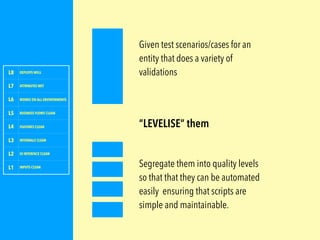
Given test scenarios/cases for an
entity that does a variety of
validations
Segregate them into quality levels
so that that they can be automated
easily ensuring that scripts are
simple and maintainable.


“LEVELISE” them

L8 DEPLOYS WELL
L7 ATTRIBUTES MET
L6 WORKS ON ALL ENVIRONMENTS
L5 BUSINESS FLOWS CLEAN
L4 FEATURES CLEAN
L3 INTERNALS CLEAN
L2 UI INTERFACE CLEAN
L1 INPUTS CLEAN
GIVEN THE FOLLOWING
LEVELS OF QUALITY :
L8 DEPLOYS WELL
L7 ATTRIBUTES MET
L6 WORKS ON ALL ENVIRONMENTS
L5 BUSINESS FLOWS CLEAN
L4 FEATURES CLEAN
L3 INTERNALS CLEAN
L2 UI INTERFACE CLEAN
L1 INPUTS CLEAN
To enable focused
purposeful tests that
validates correctness of
inputs, interfaces, going on
to features & flows and
then correctness on all
environments, finally onto
system attributes and
deployment.
*TC= Test Case
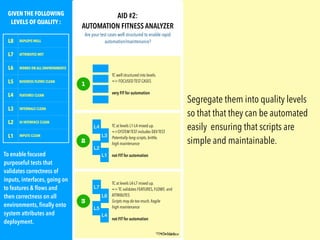
TC well structured into levels.
=> FOCUSED TEST CASES
very FIT for automation
1
TC at levels L1-L4 mixed up.
=>SYSTEM TEST includes DEVTEST
Potentially long scripts, brittle,
high maintenance
not FIT for automation
L4
L3
L2
L1
2
TC at levels L4-L7 mixed up.
=> TC validates FEATURES, FLOWS and
ATTRIBUTES
Scripts may do too much, fragile
high maintenance
not FIT for automation
L7
L6
L5
L4
3
AID #2: 

AUTOMATION FITNESS ANALYZER

Are your test cases well structured to enable rapid
automation/maintenance?
*TC= Test Case
Segregate them into quality levels
so that that they can be automated
easily ensuring that scripts are
simple and maintainable.
P
20
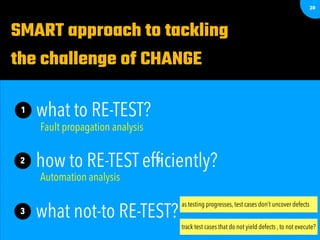
SMART approach to tackling
the challenge of CHANGE
what to RE-TEST?1
how to RE-TEST efficiently?2
what not-to RE-TEST?3
Automation analysis
Fault propagation analysis
as testing progresses, test cases don’t uncover defects
track test cases that do not yield defects , to not execute?
L8 DEPLOYS WELL
L7 ATTRIBUTES MET
L6 WORKS ON ALL ENVIRONMENTS
L5 BUSINESS FLOWS CLEAN
L4 FEATURES CLEAN
L3 INTERNALS CLEAN
L2 UI INTERFACE CLEAN
L1 INPUTS CLEAN
*TC= Test Case
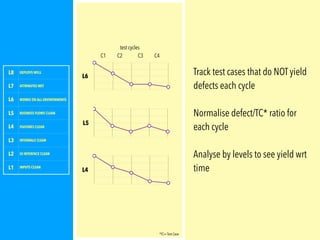
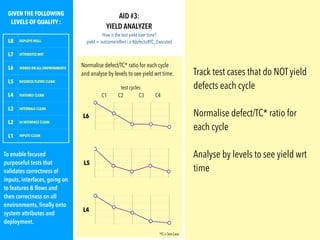
Track test cases that do NOT yield
defects each cycle
Normalise defect/TC* ratio for
each cycle
Analyse by levels to see yield wrt
time
12.5
25
37.5
50
L6
12.5
25
37.5
50
L5
12.5
25
37.5
50
L4
C1 C2 C3 C4
test cycles
GIVEN THE FOLLOWING
LEVELS OF QUALITY :
L8 DEPLOYS WELL
L7 ATTRIBUTES MET
L6 WORKS ON ALL ENVIRONMENTS
L5 BUSINESS FLOWS CLEAN
L4 FEATURES CLEAN
L3 INTERNALS CLEAN
L2 UI INTERFACE CLEAN
L1 INPUTS CLEAN
To enable focused
purposeful tests that
validates correctness of
inputs, interfaces, going on
to features & flows and
then correctness on all
environments, finally onto
system attributes and
deployment.
*TC= Test Case
AID #3: 

YIELD ANALYZER

How is the test yield over time?
yield = outcome/effort i.e #defects/#TC_Executed
Normalise defect/TC* ratio for each cycle
and analyse by levels to see yield wrt time.
12.5
25
37.5
50
L6
12.5
25
37.5
50
L5
12.5
25
37.5
50
L4
C1 C2 C3 C4
test cycles
Track test cases that do NOT yield
defects each cycle
Normalise defect/TC* ratio for
each cycle
Analyse by levels to see yield wrt
time
P
23
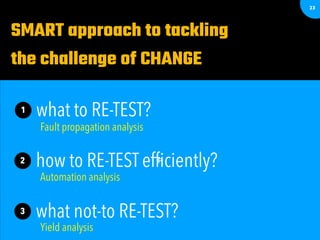
SMART approach to tackling
the challenge of CHANGE
what to RE-TEST?1
how to RE-TEST efficiently?2
what not-to RE-TEST?3
Automation analysis
Fault propagation analysis
Yield analysis
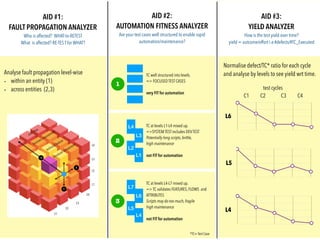
AID #1: 

FAULT PROPAGATION ANALYZER

Who is affected? WHAT-to-RETEST
What is affected?-RE-TES T for WHAT?
Analyse fault propagation level-wise
- within an entity (1)
- across entities (2,3)
AID #3: 

YIELD ANALYZER

How is the test yield over time?
yield = outcome/effort i.e #defects/#TC_Executed
Normalise defect/TC* ratio for each cycle
and analyse by levels to see yield wrt time.
12.5
25
37.5
50
L6
12.5
25
37.5
50
L5
12.5
25
37.5
50
L4
C1 C2 C3 C4
test cycles
TC well structured into levels.
=> FOCUSED TEST CASES
very FIT for automation
1
TC at levels L1-L4 mixed up.
=>SYSTEM TEST includes DEVTEST
Potentially long scripts, brittle,
high maintenance
not FIT for automation
L4
L3
L2
L1
2
TC at levels L4-L7 mixed up.
=> TC validates FEATURES, FLOWS and
ATTRIBUTES
Scripts may do too much, fragile
high maintenance
not FIT for automation
L7
L6
L5
L4
3
AID #2: 

AUTOMATION FITNESS ANALYZER

Are your test cases well structured to enable rapid
automation/maintenance?
*TC= Test Case
25
26
Thank you !
Ash_Thiru

Is regression hindering your progression?

  • 1.
    “Is regression hinderingyour progression?” #SMARTest #SmartRegression T Ashok Founder & CEO, STAG Software linkedin.com/in/ashokstag © 2018, STAG Software, www.stagsoftware.com
  • 2.
    2 New/incremental features arethe focus for revenue generation & market expansion whilst bug fixes are necessary to ensure that customers stay.
  • 3.
  • 4.
    3 Whilst on thepath of progression towards revenue enhancement, the challenge is:
  • 5.
    3 Whilst on thepath of progression towards revenue enhancement, the challenge is: “Did I break stuff that were working well”?
  • 6.
    3 Whilst on thepath of progression towards revenue enhancement, the challenge is: As product grows, so does regression, increasing costs & threatening to slow down releases. “Did I break stuff that were working well”?
  • 7.
  • 8.
    4 the challenge ofCHANGE what to RE-TEST?1 how to RE-TEST efficiently?2 what not-to RE-TEST?3
  • 9.
    5 Let us puttogether a simple model of “WHAT-is-TESTING” and use this to TEST/(RE)TEST smartly
  • 10.
    6 DEPLOYS WELL L8 ATTRIBUTESMET L7 WORKS ON ALL ENVIRONMENTS L6 BUSINESS FLOWS CLEAN L5 FEATURES CLEAN L4 INTERNALS CLEAN L3 UI INTERFACE CLEAN L2 INPUTS CLEAN L1 F1 F2 F3 F4 what to test test-for-what Testing is a cartesian product of what-to-test & test-for-what
  • 11.
    7 DEPLOYS WELL L8 ATTRIBUTESMET L7 WORKS ON ALL ENVIRONMENTS L6 BUSINESS FLOWS CLEAN L5 FEATURES CLEAN L4 INTERNALS CLEAN L3 UI INTERFACE CLEAN L2 INPUTS CLEAN L1 F1 F2 F3 F4 what to test test-for-what structural COMPONENT technical FEATURE business REQUIREMENT user FLOW WHAT IS THE EUT? Testing is a cartesian product of what-to-test & test-for-what
  • 12.
    8 DEPLOYS WELL L8 ATTRIBUTESMET L7 WORKS ON ALL ENVIRONMENTS L6 BUSINESS FLOWS CLEAN L5 FEATURES CLEAN L4 INTERNALS CLEAN L3 UI INTERFACE CLEAN L2 INPUTS CLEAN L1 F1 F2 F3 F4 what to test test-for-what Testing is a cartesian product of what-to-test & test-for-what structural COMPONENT technical FEATURE business REQUIREMENT user FLOW WHAT IS THE EUT? deploys well? attributes met? works on all env? business flows clean? features clean? internals clean? UI interface clean? inputs clean? CLEANLINESS CRITERIA to TEST FOR?
  • 13.
    9 DEPLOYS WELL L8 ATTRIBUTESMET L7 WORKS ON ALL ENVIRONMENTS L6 BUSINESS FLOWS CLEAN L5 FEATURES CLEAN L4 INTERNALS CLEAN L3 UI INTERFACE CLEAN L2 INPUTS CLEAN L1 F1 F2 F3 F4 what to test test-for-what Regression testing is then what-to-(RE)test x (RE)test-for-what structural COMPONENT technical FEATURE business REQUIREMENT user FLOW WHAT IS THE EU(RE)T?
  • 14.
    10 DEPLOYS WELL L8 ATTRIBUTESMET L7 WORKS ON ALL ENVIRONMENTS L6 BUSINESS FLOWS CLEAN L5 FEATURES CLEAN L4 INTERNALS CLEAN L3 UI INTERFACE CLEAN L2 INPUTS CLEAN L1 F1 F2 F3 F4 what to test test-for-what deploys well? attributes met? works on all env? business flows clean? features clean? internals clean? UI interface clean? inputs clean? CLEANLINESS CRITERIA to (RE)TEST FOR? Regression testing is then what-to-(RE)test x (RE)test-for-what structural COMPONENT technical FEATURE business REQUIREMENT user FLOW WHAT IS THE EU(RE)T?
  • 15.
    11 SMART approach totackling the challenge of CHANGE what to RE-TEST?1 what may be the affected entities that need to be (re)tested? what criteria of these entities are to be (re)tested for?
  • 16.
    12 L1 L2 L3 L4 E1 E2 E3 E4 structural component technical feature businessrequirement user flow 1 Given an entity (say, an component) that has been modified 1. Analyze if this could affect any of its other criteria ? e.g. performance? 3. Next analyze if this could affect any other similar entity (say component) and what criteria of that entity 4. Finally analyze which of the larger entity (say feature) that uses this entity could be affected and also the potential affected criteria
  • 17.
    13 L1 L2 L3 L4 E1 E2 E3 E4 structural component technical feature businessrequirement user flow 1 Given an entity (say, an component) that has been modified 1. Analyze if this could affect any of its other criteria ? e.g. performance? 2. Next analyze if this could affect any other similar entity (say component) and what criteria of that entity 3. Finally analyze which of the larger entity (say feature) that uses this entity could be affected and also the potential affected criteria 2
  • 18.
    14 L1 L2 L3 L4 E1 E2 E3 E4 structural component technical feature businessrequirement user flow 1 2 3 Given an entity (say, an component) that has been modified 1. Analyze if this could affect any of its other criteria ? e.g. performance? 2. Next analyze if this could affect any other similar entity (say component) and what criteria of that entity 3. Finally analyze which of the larger entity (say feature) that uses this entity could be affected and also the potential affected criteria
  • 19.
    15 L1 L2 L3 L4 E1 E2 E3 E4 structural component technical feature businessrequirement user flow 1 2 3 This is the technique FAULT PROPAGATION ANALYSIS in HBT (Hypothesis Based Testing) www.hbtcentral.org
  • 20.
    GIVEN THE FOLLOWING LEVELSOF QUALITY : L8 DEPLOYS WELL L7 ATTRIBUTES MET L6 WORKS ON ALL ENVIRONMENTS L5 BUSINESS FLOWS CLEAN L4 FEATURES CLEAN L3 INTERNALS CLEAN L2 UI INTERFACE CLEAN L1 INPUTS CLEAN To enable focused purposeful tests that validates correctness of inputs, interfaces, going on to features & flows and then correctness on all environments, finally onto system attributes and deployment. AID #1: FAULT PROPAGATION ANALYZER Who is affected? WHAT-to-RETEST What is affected?-RE-TES T for WHAT? Analyse fault propagation level-wise - within an entity (1) - across entities (2,3) Given an entity (say, an component) that has been modified: 1. Analyze if this could any of its other criteria e.g. performance? 2. Next analyze if this could affect any other similar entity (say component) and what criteria of that entity 3. Finally analyze which of the larger entity (say feature) that uses this entity could be affected and also the potential affected criteria
  • 21.
    17 SMART approach totackling the challenge of CHANGE what to RE-TEST?1 how to RE-TEST efficiently?2 well, automating execution is most useful here, challenge is scripts to be in sync with scenarios ensure that scenarios are segregated by levels so that scripts are shorter and maintainable Fault propagation analysis
  • 22.
    Given test scenarios/casesfor an entity that does a variety of validations Segregate them into quality levels so that that they can be automated easily ensuring that scripts are simple and maintainable. 
 “LEVELISE” them L8 DEPLOYS WELL L7 ATTRIBUTES MET L6 WORKS ON ALL ENVIRONMENTS L5 BUSINESS FLOWS CLEAN L4 FEATURES CLEAN L3 INTERNALS CLEAN L2 UI INTERFACE CLEAN L1 INPUTS CLEAN
  • 23.
    GIVEN THE FOLLOWING LEVELSOF QUALITY : L8 DEPLOYS WELL L7 ATTRIBUTES MET L6 WORKS ON ALL ENVIRONMENTS L5 BUSINESS FLOWS CLEAN L4 FEATURES CLEAN L3 INTERNALS CLEAN L2 UI INTERFACE CLEAN L1 INPUTS CLEAN To enable focused purposeful tests that validates correctness of inputs, interfaces, going on to features & flows and then correctness on all environments, finally onto system attributes and deployment. *TC= Test Case TC well structured into levels. => FOCUSED TEST CASES very FIT for automation 1 TC at levels L1-L4 mixed up. =>SYSTEM TEST includes DEVTEST Potentially long scripts, brittle, high maintenance not FIT for automation L4 L3 L2 L1 2 TC at levels L4-L7 mixed up. => TC validates FEATURES, FLOWS and ATTRIBUTES Scripts may do too much, fragile high maintenance not FIT for automation L7 L6 L5 L4 3 AID #2: AUTOMATION FITNESS ANALYZER Are your test cases well structured to enable rapid automation/maintenance? *TC= Test Case Segregate them into quality levels so that that they can be automated easily ensuring that scripts are simple and maintainable.
  • 24.
    P 20 SMART approach totackling the challenge of CHANGE what to RE-TEST?1 how to RE-TEST efficiently?2 what not-to RE-TEST?3 Automation analysis Fault propagation analysis as testing progresses, test cases don’t uncover defects track test cases that do not yield defects , to not execute?
  • 25.
    L8 DEPLOYS WELL L7ATTRIBUTES MET L6 WORKS ON ALL ENVIRONMENTS L5 BUSINESS FLOWS CLEAN L4 FEATURES CLEAN L3 INTERNALS CLEAN L2 UI INTERFACE CLEAN L1 INPUTS CLEAN *TC= Test Case Track test cases that do NOT yield defects each cycle Normalise defect/TC* ratio for each cycle Analyse by levels to see yield wrt time 12.5 25 37.5 50 L6 12.5 25 37.5 50 L5 12.5 25 37.5 50 L4 C1 C2 C3 C4 test cycles
  • 26.
    GIVEN THE FOLLOWING LEVELSOF QUALITY : L8 DEPLOYS WELL L7 ATTRIBUTES MET L6 WORKS ON ALL ENVIRONMENTS L5 BUSINESS FLOWS CLEAN L4 FEATURES CLEAN L3 INTERNALS CLEAN L2 UI INTERFACE CLEAN L1 INPUTS CLEAN To enable focused purposeful tests that validates correctness of inputs, interfaces, going on to features & flows and then correctness on all environments, finally onto system attributes and deployment. *TC= Test Case AID #3: YIELD ANALYZER How is the test yield over time? yield = outcome/effort i.e #defects/#TC_Executed Normalise defect/TC* ratio for each cycle and analyse by levels to see yield wrt time. 12.5 25 37.5 50 L6 12.5 25 37.5 50 L5 12.5 25 37.5 50 L4 C1 C2 C3 C4 test cycles Track test cases that do NOT yield defects each cycle Normalise defect/TC* ratio for each cycle Analyse by levels to see yield wrt time
  • 27.
    P 23 SMART approach totackling the challenge of CHANGE what to RE-TEST?1 how to RE-TEST efficiently?2 what not-to RE-TEST?3 Automation analysis Fault propagation analysis Yield analysis
  • 28.
    AID #1: FAULTPROPAGATION ANALYZER Who is affected? WHAT-to-RETEST What is affected?-RE-TES T for WHAT? Analyse fault propagation level-wise - within an entity (1) - across entities (2,3) AID #3: YIELD ANALYZER How is the test yield over time? yield = outcome/effort i.e #defects/#TC_Executed Normalise defect/TC* ratio for each cycle and analyse by levels to see yield wrt time. 12.5 25 37.5 50 L6 12.5 25 37.5 50 L5 12.5 25 37.5 50 L4 C1 C2 C3 C4 test cycles TC well structured into levels. => FOCUSED TEST CASES very FIT for automation 1 TC at levels L1-L4 mixed up. =>SYSTEM TEST includes DEVTEST Potentially long scripts, brittle, high maintenance not FIT for automation L4 L3 L2 L1 2 TC at levels L4-L7 mixed up. => TC validates FEATURES, FLOWS and ATTRIBUTES Scripts may do too much, fragile high maintenance not FIT for automation L7 L6 L5 L4 3 AID #2: AUTOMATION FITNESS ANALYZER Are your test cases well structured to enable rapid automation/maintenance? *TC= Test Case
  • 29.
  • 30.