Task-Based Language Test onWidgetsMichael Roberts, Cathy Taylor, Veronika Timpe
OutlineOur taskWidgets TBLT & TBLAApproach to TBLANeeds Analysis Test design and purposeThe tasks and their assessment criteriaLimitationsReferences2
OurtaskDesign a task-based language test for a group of students who have done the first unit of the task-based course in practical English Widgets+ Appendix C: Video Scriptsdesign decisions
Instrument(s)
tasks will the students have to do
judgmentcriteria
generalisability, task difficulty, and task variability3
Widgetshttp://www.widgets-inc.com/teacher/tblt.php“What makes Widgets truly different from other language teaching textbooks is its focus on creating a believable, “real-life” English-speaking environment in the classroom. Students imagine that they are new employees at an exciting international company, Widgets Incorporated, where they must work together in small groups to perform various practical, yet fun, tasks.”4
Widgets (2)Initial reservations with the course: Are the tasks truly authentic when they often centre round make-believe, weird products
We did not find these fantastical products either fun or motivating
Language is given before a task to be used in that task (not TBL)
There is little evidence of language being fed in when the need arises (this is TBL)
TBL is only one type of methodology for teaching language.
Shouldn’t it be presented with others to provide a balanced syllabus?
Is it desirable that a course book confines itself to one methodology?5
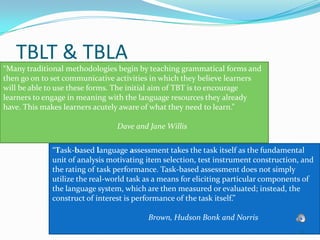
TBLT & TBLA“Many traditional methodologies begin by teaching grammatical forms and then go on to set communicative activities in which they believe learners will be able to use these forms. The initial aim of TBT is to encourage learners to engage in meaning with the language resources they already have. This makes learners acutely aware of what they need to learn.”Dave and Jane Willis“Task-based language assessment takes the task itself as the fundamental unit of analysis motivating item selection, test instrument construction, and the rating of task performance. Task-based assessment does not simply utilize the real-world task as a means for eliciting particular components of the language system, which are then measured or evaluated; instead, the construct of interest is performance of the task itself.”Brown, Hudson Bonk and Norris6
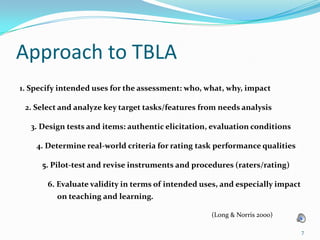
Approach to TBLA71. Specify intended uses for the assessment: who, what, why, impact   2. Select and analyze key target tasks/features from needs analysis      3. Design tests and items: authentic elicitation, evaluation conditions         4. Determine real-world criteria for rating task performance qualities            5. Pilot-test and revise instruments and procedures (raters/rating)               6. Evaluate validity in terms of intended uses, and especially impact                       on teaching and learning.(Long & Norris 2000)
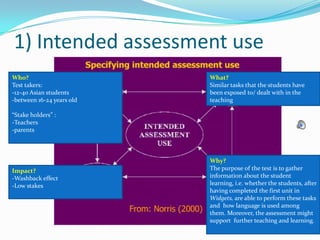
1) Intendedassessmentuse8Who?Test takers:12-40Asian students
between 16-24 years old “Stake holders” :Teachers
parentsWhat?Similar tasks that the students have been exposed to/ dealt with in the teaching Why?The purpose of the test is to gather information about the student learning, i.e. whether the students, after having completed the first unit in Widgets, are able to perform these tasks and  how language is used among them. Moreover, the assessment might support  further teaching and learning. Impact?Washbackeffect
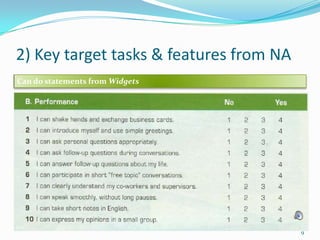
Low stakes2) Key target tasks & features from NA9Can do statements from Widgets
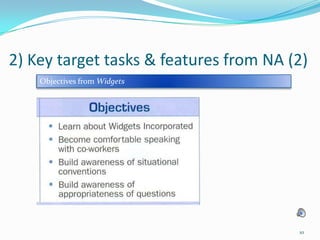
102) Key target tasks & features from NA (2)Objectives from Widgets
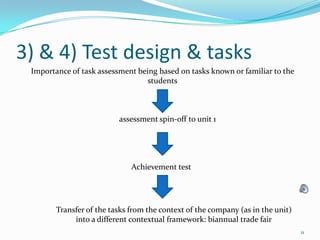
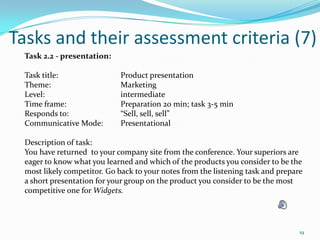
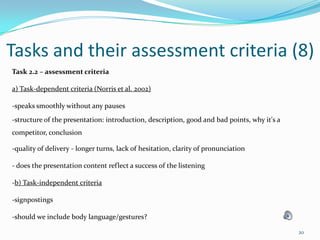
3) & 4) Test design & tasks11Importance of task assessment being based on tasks known or familiar to the studentsassessment spin-off to unit 1Achievement testTransfer of the tasks from the context of the company (as in the unit) into a different contextual framework: biannual trade fair

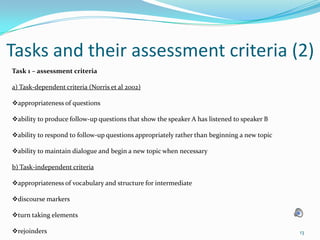
Task based language test

  • 1.
    Task-Based Language TestonWidgetsMichael Roberts, Cathy Taylor, Veronika Timpe
  • 2.
    OutlineOur taskWidgets TBLT& TBLAApproach to TBLANeeds Analysis Test design and purposeThe tasks and their assessment criteriaLimitationsReferences2
  • 3.
    OurtaskDesign a task-basedlanguage test for a group of students who have done the first unit of the task-based course in practical English Widgets+ Appendix C: Video Scriptsdesign decisions
  • 4.
  • 5.
    tasks will thestudents have to do
  • 6.
  • 7.
  • 8.
    Widgetshttp://www.widgets-inc.com/teacher/tblt.php“What makes Widgetstruly different from other language teaching textbooks is its focus on creating a believable, “real-life” English-speaking environment in the classroom. Students imagine that they are new employees at an exciting international company, Widgets Incorporated, where they must work together in small groups to perform various practical, yet fun, tasks.”4
  • 9.
    Widgets (2)Initial reservationswith the course: Are the tasks truly authentic when they often centre round make-believe, weird products
  • 10.
    We did notfind these fantastical products either fun or motivating
  • 11.
    Language is givenbefore a task to be used in that task (not TBL)
  • 12.
    There is littleevidence of language being fed in when the need arises (this is TBL)
  • 13.
    TBL is onlyone type of methodology for teaching language.
  • 14.
    Shouldn’t it bepresented with others to provide a balanced syllabus?
  • 15.
    Is it desirablethat a course book confines itself to one methodology?5
  • 16.
    TBLT & TBLA“Manytraditional methodologies begin by teaching grammatical forms and then go on to set communicative activities in which they believe learners will be able to use these forms. The initial aim of TBT is to encourage learners to engage in meaning with the language resources they already have. This makes learners acutely aware of what they need to learn.”Dave and Jane Willis“Task-based language assessment takes the task itself as the fundamental unit of analysis motivating item selection, test instrument construction, and the rating of task performance. Task-based assessment does not simply utilize the real-world task as a means for eliciting particular components of the language system, which are then measured or evaluated; instead, the construct of interest is performance of the task itself.”Brown, Hudson Bonk and Norris6
  • 17.
    Approach to TBLA71.Specify intended uses for the assessment: who, what, why, impact 2. Select and analyze key target tasks/features from needs analysis 3. Design tests and items: authentic elicitation, evaluation conditions 4. Determine real-world criteria for rating task performance qualities 5. Pilot-test and revise instruments and procedures (raters/rating) 6. Evaluate validity in terms of intended uses, and especially impact on teaching and learning.(Long & Norris 2000)
  • 18.
  • 19.
    between 16-24 yearsold “Stake holders” :Teachers
  • 20.
    parentsWhat?Similar tasks thatthe students have been exposed to/ dealt with in the teaching Why?The purpose of the test is to gather information about the student learning, i.e. whether the students, after having completed the first unit in Widgets, are able to perform these tasks and how language is used among them. Moreover, the assessment might support further teaching and learning. Impact?Washbackeffect
  • 21.
    Low stakes2) Keytarget tasks & features from NA9Can do statements from Widgets
  • 22.
    102) Key targettasks & features from NA (2)Objectives from Widgets
  • 23.
    3) & 4)Test design & tasks11Importance of task assessment being based on tasks known or familiar to the studentsassessment spin-off to unit 1Achievement testTransfer of the tasks from the context of the company (as in the unit) into a different contextual framework: biannual trade fair

Editor's Notes

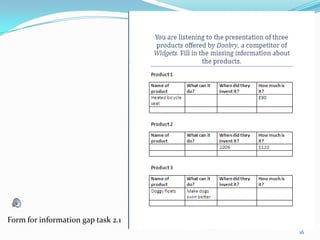
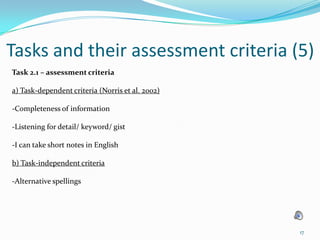
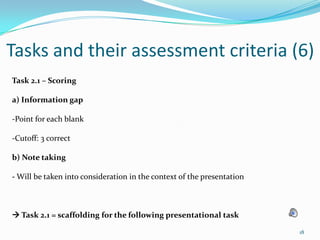
  • #17 This is the form that students have to complete while they are listening and it very much mirrors the information gap activity in first part of the “water cooler chat” outlined in unit 1 of widgets. Students are required to listen for detail helping them to basically structure the information they hearand serve as a scaffolding device. What can be seen from this part of the task is that students are required to integrate skills: listening, writing and speaking as well as to some extent reading from their own notes. This integration of skills is a key feature of TBLA.