PROBLEM STATEMENT
The product was evolving, with enhancements and releases every six months. The client’s India Development Center was
entrusted with the responsibility of making changes in product solutions to suit new environments. However, the
management was not convinced with the testing effort expended by the in-house QA team as against the development
effort. The question the management found itself asking was ‘Is our testing optimized, or are we conducting more tests
than are necessary?’ That is when it decided to seek the help of an independent third party QA expert.
CUSTOMER AND PRODUCT BACKGROUND
The customer is a global leader and award-winning B2B e-commerce company providing managed services to Fortune 100
companies around the world.
The product in question is regarded as a ‘Platform as a Service’ environment, and provides connectivity to numerous
hosted B2B applications that allow companies to deploy scalable trading platforms anywhere in the world. The product
was released over a decade ago, and has more than 42 components.The application used Session Initiation Protocol (SIP)
for signaling and Real Time Protocol (RTP) for streaming.
CASE STUDY
Regression Suite Optimization
STAG’s assessment for test case potency of a
cloud-based trading software helps reduce
regression test cases by 28% and regression cycle
time by 40% for an award-winning B2B
e-commerce company.
Technology - JAVA/J2EE, Oracle, Apache,
IBM WebSphere, HTTPS and FTP
Domain/Category - B2B Integration
for Supply Chain Management
SOLUTION
The main challenge for the STAG team was understanding the product without any specification documents. The client
had not documented any execution test results on any environment, and there were no proper artifacts available except
for test cases and the defect log. The test cases were very old and designed like use cases. They were at a very high level,
and had not been updated with enhancements in application behavior.
The STAG team did a quick assessment of the situation and noted
that the product was in the maintenance stage and that the
number of test cases to be executed to certify the build was
75,000+. The SDLC was followed by smooth product migration
from the QA environment to deployment first in the
pre-production environment and then subsequently in the
production environment. The team also noted that any change in
the product component called for validation of the entire product
suite, which had multiple impacts due to critical factors like the
product components being developed across multiple locations
and lack of consistency when it came to component usage:
different components were being used by different users across
the globe.
The STAG team then proposed a solution that was to be delivered in two parts:
A. Assessing the potency of the existing test cases
The STAG team explored the product independently, using the HBT Landscaping technique for a better understanding
of product functionality. The team also did a rapid qualitative analysis of the existing test assets.
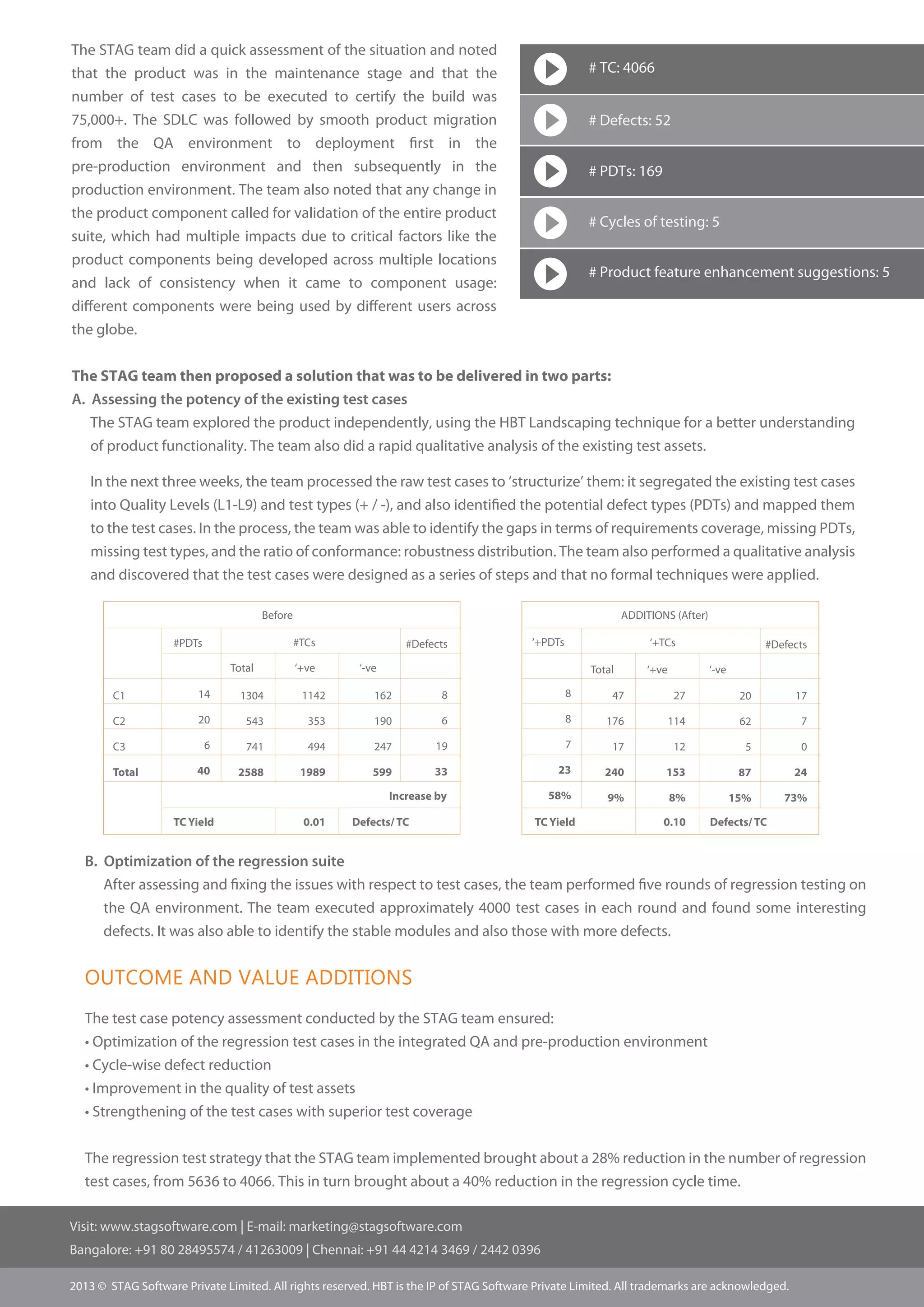
In the next three weeks, the team processed the raw test cases to ‘structurize’ them: it segregated the existing test cases
into Quality Levels (L1-L9) and test types (+ / -), and also identified the potential defect types (PDTs) and mapped them
to the test cases. In the process, the team was able to identify the gaps in terms of requirements coverage, missing PDTs,
missing test types, and the ratio of conformance: robustness distribution. The team also performed a qualitative analysis
and discovered that the test cases were designed as a series of steps and that no formal techniques were applied.
Visit: www.stagsoftware.com | E-mail: marketing@stagsoftware.com
Bangalore: +91 80 28495574 / 41263009 | Chennai: +91 44 4214 3469 / 2442 0396
2013 © STAG Software Private Limited. All rights reserved. HBT is the IP of STAG Software Private Limited. All trademarks are acknowledged.
# Defects: 52
# PDTs: 169
# Cycles of testing: 5
# Product feature enhancement suggestions: 5
# TC: 4066
OUTCOME AND VALUE ADDITIONS
The test case potency assessment conducted by the STAG team ensured:
• Optimization of the regression test cases in the integrated QA and pre-production environment
• Cycle-wise defect reduction
• Improvement in the quality of test assets
• Strengthening of the test cases with superior test coverage
The regression test strategy that the STAG team implemented brought about a 28% reduction in the number of regression
test cases, from 5636 to 4066. This in turn brought about a 40% reduction in the regression cycle time.
B. Optimization of the regression suite
After assessing and fixing the issues with respect to test cases, the team performed five rounds of regression testing on
the QA environment. The team executed approximately 4000 test cases in each round and found some interesting
defects. It was also able to identify the stable modules and also those with more defects.
C1
C2
C3
Total
#PDTs
14
20
6
40
1142
353
494
1989
162
190
247
599
#Defects
8
6
19
33
1304
543
741
2588
Total ‘-ve‘+ve
Increase by
TC Yield 0.01 Defects/ TC
#TCs
Before
‘+PDTs
8
8
7
23
58%
ADDITIONS (After)
47
176
17
240
9%
27
114
12
153
8%
20
62
5
87
15%
#Defects
17
7
0
24
73%
Total ‘-ve‘+ve
TC Yield 0.10 Defects/ TC
‘+TCs

Regression Suite Optimization

  • 1.
    PROBLEM STATEMENT The productwas evolving, with enhancements and releases every six months. The client’s India Development Center was entrusted with the responsibility of making changes in product solutions to suit new environments. However, the management was not convinced with the testing effort expended by the in-house QA team as against the development effort. The question the management found itself asking was ‘Is our testing optimized, or are we conducting more tests than are necessary?’ That is when it decided to seek the help of an independent third party QA expert. CUSTOMER AND PRODUCT BACKGROUND The customer is a global leader and award-winning B2B e-commerce company providing managed services to Fortune 100 companies around the world. The product in question is regarded as a ‘Platform as a Service’ environment, and provides connectivity to numerous hosted B2B applications that allow companies to deploy scalable trading platforms anywhere in the world. The product was released over a decade ago, and has more than 42 components.The application used Session Initiation Protocol (SIP) for signaling and Real Time Protocol (RTP) for streaming. CASE STUDY Regression Suite Optimization STAG’s assessment for test case potency of a cloud-based trading software helps reduce regression test cases by 28% and regression cycle time by 40% for an award-winning B2B e-commerce company. Technology - JAVA/J2EE, Oracle, Apache, IBM WebSphere, HTTPS and FTP Domain/Category - B2B Integration for Supply Chain Management SOLUTION The main challenge for the STAG team was understanding the product without any specification documents. The client had not documented any execution test results on any environment, and there were no proper artifacts available except for test cases and the defect log. The test cases were very old and designed like use cases. They were at a very high level, and had not been updated with enhancements in application behavior.
  • 2.
    The STAG teamdid a quick assessment of the situation and noted that the product was in the maintenance stage and that the number of test cases to be executed to certify the build was 75,000+. The SDLC was followed by smooth product migration from the QA environment to deployment first in the pre-production environment and then subsequently in the production environment. The team also noted that any change in the product component called for validation of the entire product suite, which had multiple impacts due to critical factors like the product components being developed across multiple locations and lack of consistency when it came to component usage: different components were being used by different users across the globe. The STAG team then proposed a solution that was to be delivered in two parts: A. Assessing the potency of the existing test cases The STAG team explored the product independently, using the HBT Landscaping technique for a better understanding of product functionality. The team also did a rapid qualitative analysis of the existing test assets. In the next three weeks, the team processed the raw test cases to ‘structurize’ them: it segregated the existing test cases into Quality Levels (L1-L9) and test types (+ / -), and also identified the potential defect types (PDTs) and mapped them to the test cases. In the process, the team was able to identify the gaps in terms of requirements coverage, missing PDTs, missing test types, and the ratio of conformance: robustness distribution. The team also performed a qualitative analysis and discovered that the test cases were designed as a series of steps and that no formal techniques were applied. Visit: www.stagsoftware.com | E-mail: marketing@stagsoftware.com Bangalore: +91 80 28495574 / 41263009 | Chennai: +91 44 4214 3469 / 2442 0396 2013 © STAG Software Private Limited. All rights reserved. HBT is the IP of STAG Software Private Limited. All trademarks are acknowledged. # Defects: 52 # PDTs: 169 # Cycles of testing: 5 # Product feature enhancement suggestions: 5 # TC: 4066 OUTCOME AND VALUE ADDITIONS The test case potency assessment conducted by the STAG team ensured: • Optimization of the regression test cases in the integrated QA and pre-production environment • Cycle-wise defect reduction • Improvement in the quality of test assets • Strengthening of the test cases with superior test coverage The regression test strategy that the STAG team implemented brought about a 28% reduction in the number of regression test cases, from 5636 to 4066. This in turn brought about a 40% reduction in the regression cycle time. B. Optimization of the regression suite After assessing and fixing the issues with respect to test cases, the team performed five rounds of regression testing on the QA environment. The team executed approximately 4000 test cases in each round and found some interesting defects. It was also able to identify the stable modules and also those with more defects. C1 C2 C3 Total #PDTs 14 20 6 40 1142 353 494 1989 162 190 247 599 #Defects 8 6 19 33 1304 543 741 2588 Total ‘-ve‘+ve Increase by TC Yield 0.01 Defects/ TC #TCs Before ‘+PDTs 8 8 7 23 58% ADDITIONS (After) 47 176 17 240 9% 27 114 12 153 8% 20 62 5 87 15% #Defects 17 7 0 24 73% Total ‘-ve‘+ve TC Yield 0.10 Defects/ TC ‘+TCs