LANGUAGE PLAY, LANGUAGE LEARNING
Kiki Chen
LANGUAGE PLAY, LANGUAGE LEARNING
GUY COOK
Part I
Part II
The forms of language play:
rhythm and repetition in children’s verse
The implications for applied linguistics and
language teaching.
 Most studies in linguistics have tended to
neglect the child’s linguistic environment.
RHYTHM AND REPETITION IN CHILDREN’S VERSE
 Cook suggests that is not right to neglect the
“uselessness’ of verbal play in studying
language.
 How does a pre-linguistic child respond
when he/she listens to rhymes or verses
that are pervasive to their environment?
RHYTHM AND REPETITION IN CHILDREN’S VERSE
KIDS SONGS: THIS LITTLE PIGGY
http://www.youtube.com/watch?v=pMrH47btpV0
KIDS SONGS: ROUND AND ROUND
http://www.youtube.com/watch?v=00N6CXDc2A4&feature=channel&list=UL
 Children are sensitive too, and enjoy playful
language before they can fully understand its
content.
RHYTHM AND REPETITION IN CHILDREN’S VERSE
 Even non-functional uses of language, like
repetition, rhythm, and nonsense words ,are
manifestations of linguistic play.
 Children are predisposed to respond to rhythm,
rhyme, and repetition.
READING PEEPO
http://www.youtube.com/watch?v=x5b8FhY1smQ
 Familiarization through the repetition, rhyme,
and a simple beat help children to memorize
and produce language above their current
ability.
RHYTHM AND REPETITION IN CHILDREN’S VERSE
 Verse provides a model to imitate and practice
control over vocalization.
 Progression from verse as rhythm and
interaction to verse as grammar and its
meaning.
RHYTHM AND REPETITION IN CHILDREN’S VERSE
http://www.youtube.com/watch?v=jxJCsv6qsGc&feature=related
 The functions of verse provide a path into
language acquisition.
RHYTHM AND REPETITION IN CHILDREN’S VERSE
 Help the child to gain control over difficult new
language and ideas.
 Characterized language play has strong
parallels in the rhythms of bodily behavior(heart
beats, breathing) and daily routines.
 Language play should be related to creativity and the
imagination that relates to learning to speak the
language .
COCK A DOODLE DOO!
video
http://www.youtube.com/watch?v=Ic-i8Fazqjo
 Evidence shows that verse rhythm stimulates
the brain to release pleasurable endorphin.
RHYTHM AND REPETITION IN CHILDREN’S VERSE
 Our liking for verse has other advantages for
our species, which continue into adulthood such
as an increased ability for social coordination
and increase in memory power.
 Rhythmic language stimulates a greater co-
ordination of the left and right hemispheres of
the brain and enables richer cerebral activity.
 Examples of Chinese Musical Rhythmic
Material.
(Unit Shopping) (Make your own to fit your
lesson!)
THE IMPLICATIONS FOR APPLIED LINGUISTICS AND
LANGUAGE TEACHING.
 Student’s presentation- Rap
( Encourage students to product)
 Different age students they all enjoy the
language play and able to produce.
 Learning is Fun ! Language teaching is fun!
MUSICAL RHYTHMIC-KIKI ( UNIT SHOPPING)
http://my-ecoach.com/project.php?id=17359&project_step=77854
K-5 GRADE STUDENTS
http://www.youtube.com/watch?v=GUW00eJmWhg&feature=youtu.be
WRITING CHEERS
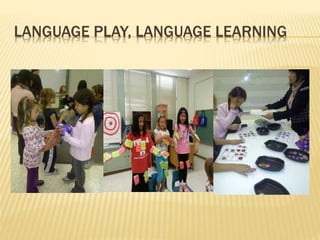
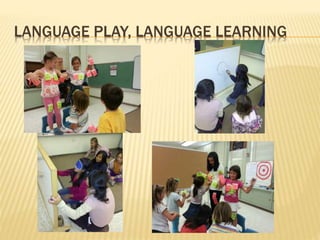
LANGUAGE PLAY, LANGUAGE LEARNING
STUDENT’S PRESENTATION- RAP HIGH SCHOOL
http://www.youtube.com/watch?v=gl9b4Gffuuw
DISCUSSION
 Do you think the playful use of language
does not end with our childhood, but
continues throughout our lives? Why or why
not?
 It fulfills a major function of language,
allowing the human ability to adapt: as
individuals, as societies, and as a species.
DISCUSSION
 Do you agree that language play should not
be thought of as a trivial activity, but as
central to human thought and culture, to
learning, creativity, and intellectual inquiry?
DISCUSSION
 Will you consider adding rhythm or repetition
into your current language lesson plan?

Language play, language learning

  • 1.
    LANGUAGE PLAY, LANGUAGELEARNING Kiki Chen
  • 2.
    LANGUAGE PLAY, LANGUAGELEARNING GUY COOK Part I Part II The forms of language play: rhythm and repetition in children’s verse The implications for applied linguistics and language teaching.
  • 3.
     Most studiesin linguistics have tended to neglect the child’s linguistic environment. RHYTHM AND REPETITION IN CHILDREN’S VERSE  Cook suggests that is not right to neglect the “uselessness’ of verbal play in studying language.
  • 4.
     How doesa pre-linguistic child respond when he/she listens to rhymes or verses that are pervasive to their environment? RHYTHM AND REPETITION IN CHILDREN’S VERSE
  • 5.
    KIDS SONGS: THISLITTLE PIGGY http://www.youtube.com/watch?v=pMrH47btpV0
  • 6.
    KIDS SONGS: ROUNDAND ROUND http://www.youtube.com/watch?v=00N6CXDc2A4&feature=channel&list=UL
  • 7.
     Children aresensitive too, and enjoy playful language before they can fully understand its content. RHYTHM AND REPETITION IN CHILDREN’S VERSE  Even non-functional uses of language, like repetition, rhythm, and nonsense words ,are manifestations of linguistic play.  Children are predisposed to respond to rhythm, rhyme, and repetition.
  • 8.
  • 9.
     Familiarization throughthe repetition, rhyme, and a simple beat help children to memorize and produce language above their current ability. RHYTHM AND REPETITION IN CHILDREN’S VERSE  Verse provides a model to imitate and practice control over vocalization.  Progression from verse as rhythm and interaction to verse as grammar and its meaning.
  • 10.
    RHYTHM AND REPETITIONIN CHILDREN’S VERSE http://www.youtube.com/watch?v=jxJCsv6qsGc&feature=related
  • 11.
     The functionsof verse provide a path into language acquisition. RHYTHM AND REPETITION IN CHILDREN’S VERSE  Help the child to gain control over difficult new language and ideas.  Characterized language play has strong parallels in the rhythms of bodily behavior(heart beats, breathing) and daily routines.  Language play should be related to creativity and the imagination that relates to learning to speak the language .
  • 12.
    COCK A DOODLEDOO! video http://www.youtube.com/watch?v=Ic-i8Fazqjo
  • 13.
     Evidence showsthat verse rhythm stimulates the brain to release pleasurable endorphin. RHYTHM AND REPETITION IN CHILDREN’S VERSE  Our liking for verse has other advantages for our species, which continue into adulthood such as an increased ability for social coordination and increase in memory power.  Rhythmic language stimulates a greater co- ordination of the left and right hemispheres of the brain and enables richer cerebral activity.
  • 14.
     Examples ofChinese Musical Rhythmic Material. (Unit Shopping) (Make your own to fit your lesson!) THE IMPLICATIONS FOR APPLIED LINGUISTICS AND LANGUAGE TEACHING.  Student’s presentation- Rap ( Encourage students to product)  Different age students they all enjoy the language play and able to produce.  Learning is Fun ! Language teaching is fun!
  • 15.
    MUSICAL RHYTHMIC-KIKI (UNIT SHOPPING) http://my-ecoach.com/project.php?id=17359&project_step=77854
  • 16.
  • 17.
  • 18.
  • 19.
  • 20.
    STUDENT’S PRESENTATION- RAPHIGH SCHOOL http://www.youtube.com/watch?v=gl9b4Gffuuw
  • 21.
    DISCUSSION  Do youthink the playful use of language does not end with our childhood, but continues throughout our lives? Why or why not?  It fulfills a major function of language, allowing the human ability to adapt: as individuals, as societies, and as a species.
  • 22.
    DISCUSSION  Do youagree that language play should not be thought of as a trivial activity, but as central to human thought and culture, to learning, creativity, and intellectual inquiry?
  • 23.
    DISCUSSION  Will youconsider adding rhythm or repetition into your current language lesson plan?