Language of Media
An overview
The Outline
•Definition of Language of Media
•Features of Language of Media
•Media Language VS Press Language
•A Sample of Media Language Analysis
Definition
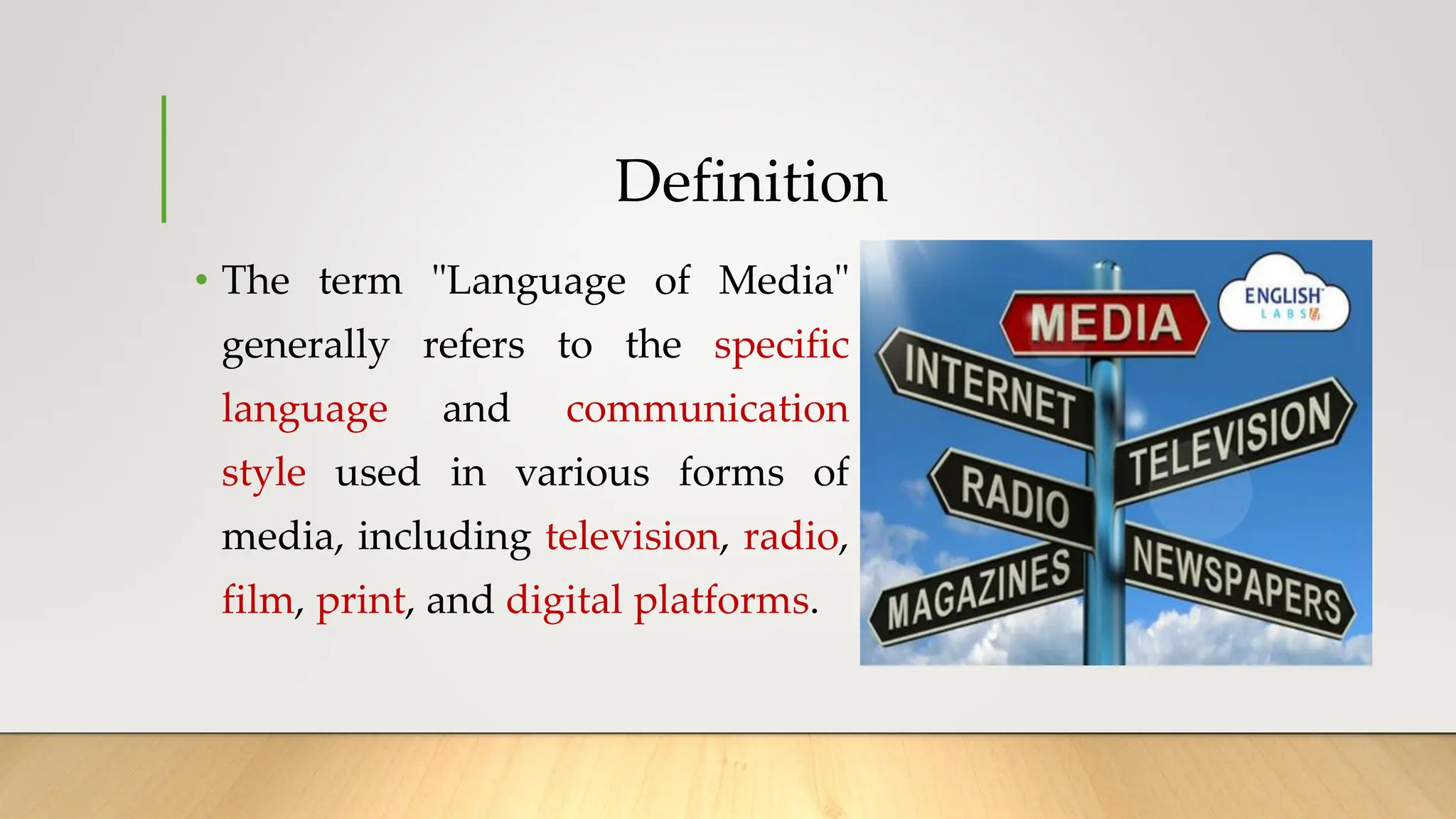
• The term "Language of Media"
generally refers to the specific
language and communication
style used in various forms of
media, including television, radio,
film, print, and digital platforms.
Features of Media Language
• It's important to note that the features of the language of
media are dynamic and can evolve with:
• changes in technology,
• audience preferences, and
• cultural shifts.
• Different forms of media may prioritize certain features over
others based on: their specific goals and target audiences.
•The features of the language of media can
vary across different mediums and
formats, but some common features include:
1. Conciseness
• Media language often favors
briefness and conciseness.
• Messages need to be delivered
quickly and efficiently to capture
audience attention and convey
information within the constraints
of limited time or space.
2. Clarity
Clear and unambiguous communication
is essential in the language of media.
Messages should be easily understood by
a diverse audience, and complex ideas
may be simplified for broader
comprehension.
3. Visual Elements
• Media often relies on visual
elements such as images,
graphics, and videos to
complement and enhance the
communication of information.
• Visuals can aid in storytelling,
engagement, and the overall
impact of the message.
4. Tone and Style
• The tone and style of media
language can vary depending on the
genre and target audience.
• For example, news media may adopt
a more formal and objective tone,
while entertainment media may use
a more casual or dramatic style.
5. Sensationalism
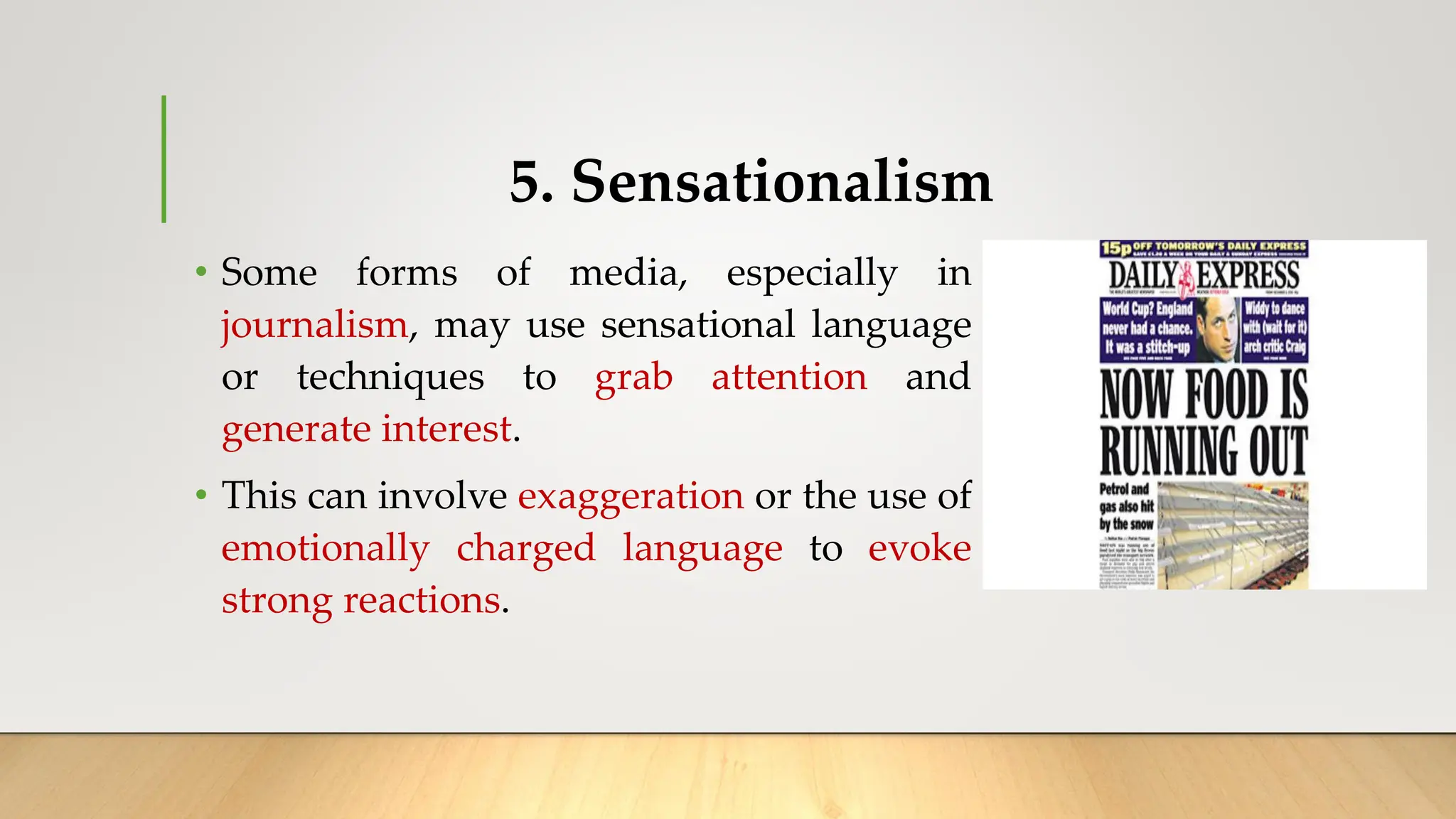
• Some forms of media, especially in
journalism, may use sensational language
or techniques to grab attention and
generate interest.
• This can involve exaggeration or the use of
emotionally charged language to evoke
strong reactions.
6. Audience Engagement
• Media language often aims to
engage the audience actively.
• This can involve techniques such
as addressing the audience
directly, encouraging interaction
through social media, or creating
content that invites audience
participation.
7. Adaptability
• The language of media is adaptable to different
platforms and formats. Whether it's adapting a
story for television, radio, print, or online.
• Media professionals need to tailor their language
to suit the characteristics of each medium.
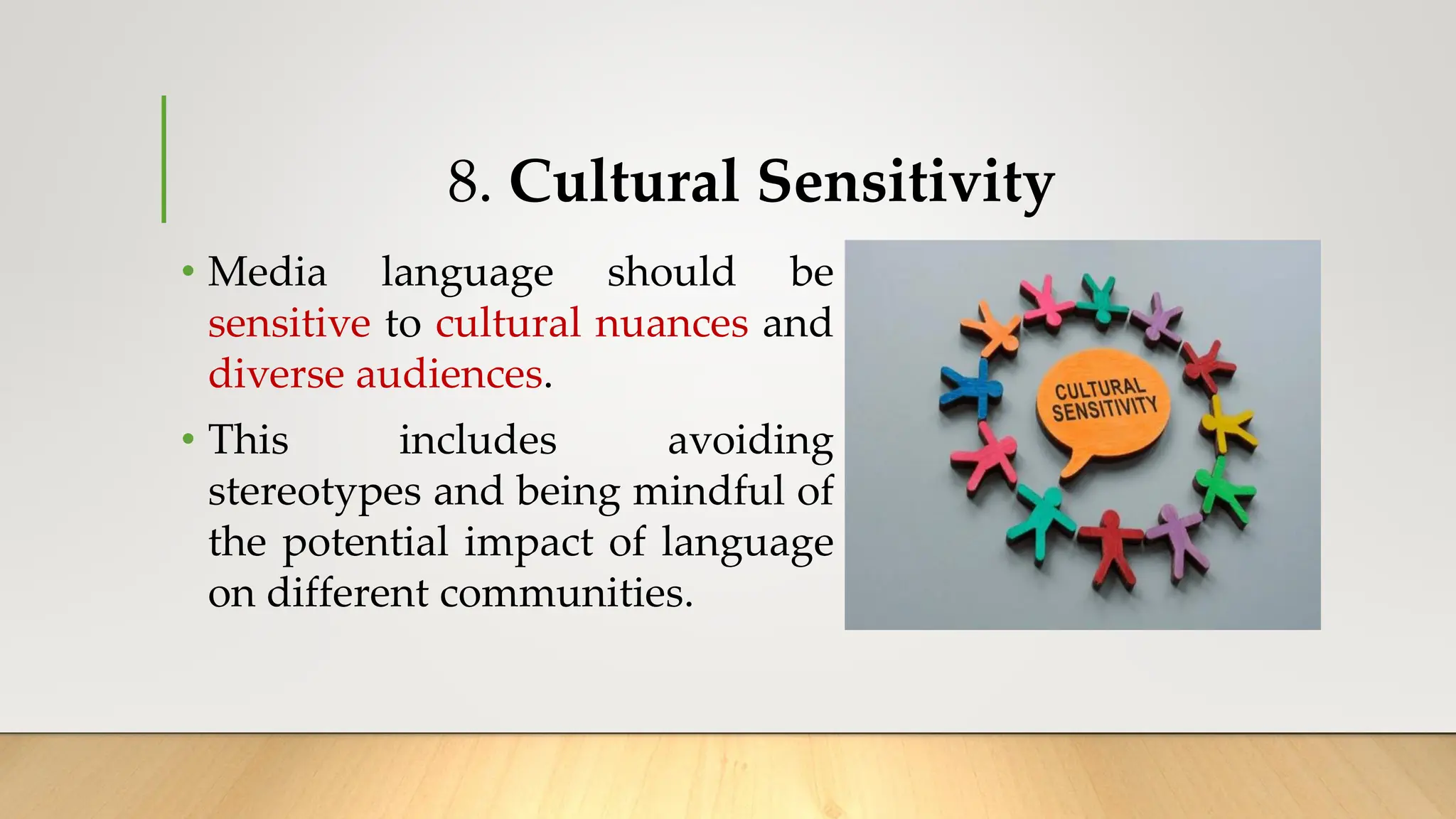
8. Cultural Sensitivity
• Media language should be
sensitive to cultural nuances and
diverse audiences.
• This includes avoiding
stereotypes and being mindful of
the potential impact of language
on different communities.
9. Timeliness
• In the news media, timeliness is
crucial.
• Stories are often presented in a
timely manner to keep the audience
informed about current events.
• This requires quick production and
distribution of content.
10. Storytelling
• Narrative techniques are often
employed in the language of media
to create compelling and memorable
stories.
• Whether it's news reporting or
entertainment, storytelling can
enhance the impact of the message.
Differences between Media Language and Press Language
• "Media language" and “Press language" are terms
that are sometimes used interchangeably, but they
can have specific connotations depending on the
context.
• Generally, both Media Language and Press Language
refer to the language and communication style used
in various forms of media, including newspapers and
other journalistic outlets.
• However, there are some subtle differences that can
be identified:
1. Scope of Coverage:
MEDIA LANGUAGE
• this term is more inclusive and
encompasses a broader range of
communication styles across
various media platforms, such as
television, radio, online content,
and print.
PRESS LANGUAGE
• this term is more specific and
often refers specifically to the
language used in print
journalism, such as
newspapers and magazines.
2. Medium-Specific Emphasis:
MEDIA LANGUAGE
• encompasses a variety of
media, emphasizing
adaptability to different
formats, including
audiovisual and digital
media.
PRESS LANGUAGE
• focuses specifically on
written or printed media,
emphasizing the
conventions and styles
associated with traditional
print journalism.
3. Presentation Styles:
MEDIA LANGUAGE
• includes the language used in
broadcast journalism, online
articles, social media content,
and other multimedia formats.
It often incorporates visual
and auditory elements.
PRESS LANGUAGE
• primarily deals with the written
word, emphasizing clarity,
objectivity, and adherence to
journalistic standards. It may include
headlines, articles, and editorial
content in newspapers and
magazines.
4. Immediacy:
MEDIA LANGUAGE
• tends to prioritize immediacy,
especially in the case of broadcast
and online media where
information is disseminated
quickly to keep the audience
informed about current events.
PRESS LANGUAGE
• while also focused on timeliness,
print journalism may have slightly
longer production cycles, allowing
for more in-depth research and
analysis compared to certain forms
of broadcast media.
5. Interactivity:
MEDIA LANGUAGE
• in the digital age, media
language often involves
interactive elements, such
as user comments, social
media discussions, and
audience participation in
various forms.
PRESS LANGUAGE
• traditionally, print journalism has
been less interactive, with limited
space for reader feedback.
• However, with the advent of online
platforms, interactive elements have
become more common in press
language as well.
6. Audience Engagement:
MEDIA LANGUAGE
• aims for active audience
engagement through various
multimedia elements,
interactive features, and real-
time updates.
PRESS LANGUAGE
• traditionally more focused on one-
way communication from the
journalist to the reader, but
contemporary press language may
also incorporate interactive elements
to engage the audience.
• While these distinctions can be helpful, it's important to note that
the terms "media language" and "press language" are sometimes
used interchangeably, and their meanings can vary based on
context and evolving media landscapes.
• The key features of both involve effective communication,
adherence to journalistic principles, and adaptation to the specific
characteristics of the chosen medium.
A Sample of Media Language Analysis
• Let's consider a sample of media language
analysis.
• In this example, we'll analyze a short news article.
• This is a fictional example created for the purpose
of illustration:
Headline
"Revolutionizing Education: Government Unveils
Bold Reforms for 21st Century Learning"
Article
In a landmark move, the government has introduced a
series of transformative reforms in the education sector,
signaling a new era for 21st-century learning. The
announcement, made by the Minister of Education in a
press conference earlier today, outlines ambitious changes
aimed at equipping students with the skills necessary for
success in an ever-evolving global landscape.
Language Analysis:
• Headline Impact:
• The headline uses powerful and
optimistic language, employing words
like "revolutionizing," "bold reforms,"
and "21st Century Learning."
• These choices are designed to capture
attention and convey a sense of
significant change in the educational
system.
"Revolutionizing
Education: Government
Unveils Bold Reforms for
21st Century Learning"
• Lead Paragraph:
• The lead paragraph concisely introduces the key
information, emphasizing the transformative nature of the
reforms.
• The language is positive and forward-looking, setting the
tone for an article that highlights progress in education.
• Use of Adjectives:
• Positive adjectives such as "transformative,"
"ambitious," and "evolving" are strategically used
throughout the article.
• These adjectives convey a sense of innovation and
progress associated with the government's initiatives.
• Attribution of Actions:
• The language attributes the announcement to a
specific entity, in this case, the government and the
Minister of Education.
• This adds credibility to the information and clarifies
responsibility for the proposed reforms.
• Temporal Markers:
• The article includes a temporal marker,
mentioning that the announcement was made
"earlier today."
• This provides immediacy and suggests that the
information is current and relevant.
• Public Impact:
• Phrases like "equipping students with the skills
necessary for success" indicate a focus on the broader
impact of the reforms on students' futures.
• This aligns with a common media strategy of
highlighting initiatives that benefit the public.
• Forward-Looking Language:
• The language throughout the article is forward-
looking, emphasizing the importance of
preparing students for the future.
• This narrative strategy is intended to generate
interest and support for the government's
vision of 21st-century education.
• Innovation and Global Perspective:
• The language used suggests a focus on
innovation and a global perspective, reflecting
the idea that the educational reforms are
designed to meet the demands of a rapidly
changing world and global economy.
• Inclusive Language:
• The language is inclusive, emphasizing that the
reforms are aimed at benefiting students in general.
• The use of phrases like "21st-century learning"
implies that this is a collective effort to enhance the
overall quality of education.
• This analysis demonstrates how media language can shape
perceptions of educational reforms, emphasizing positivity,
progress, and the broader societal impact of the proposed
changes.
• The language is designed to engage the audience and build
support for the government's vision for the future of
education.
References
• The Cambridge Handbook of Sociolinguistics
• Language in Media: A Tool for Expressing Political Views
• Language and Media: A Resource Book for Students
(Routledge English Language Introductions) 2nd Edition
Language of Media.pdf

Language of Media.pdf

  • 2.
  • 3.
    The Outline •Definition ofLanguage of Media •Features of Language of Media •Media Language VS Press Language •A Sample of Media Language Analysis
  • 4.
    Definition • The term"Language of Media" generally refers to the specific language and communication style used in various forms of media, including television, radio, film, print, and digital platforms.
  • 5.
    Features of MediaLanguage • It's important to note that the features of the language of media are dynamic and can evolve with: • changes in technology, • audience preferences, and • cultural shifts. • Different forms of media may prioritize certain features over others based on: their specific goals and target audiences.
  • 6.
    •The features ofthe language of media can vary across different mediums and formats, but some common features include:
  • 7.
    1. Conciseness • Medialanguage often favors briefness and conciseness. • Messages need to be delivered quickly and efficiently to capture audience attention and convey information within the constraints of limited time or space.
  • 8.
    2. Clarity Clear andunambiguous communication is essential in the language of media. Messages should be easily understood by a diverse audience, and complex ideas may be simplified for broader comprehension.
  • 9.
    3. Visual Elements •Media often relies on visual elements such as images, graphics, and videos to complement and enhance the communication of information. • Visuals can aid in storytelling, engagement, and the overall impact of the message.
  • 10.
    4. Tone andStyle • The tone and style of media language can vary depending on the genre and target audience. • For example, news media may adopt a more formal and objective tone, while entertainment media may use a more casual or dramatic style.
  • 11.
    5. Sensationalism • Someforms of media, especially in journalism, may use sensational language or techniques to grab attention and generate interest. • This can involve exaggeration or the use of emotionally charged language to evoke strong reactions.
  • 12.
    6. Audience Engagement •Media language often aims to engage the audience actively. • This can involve techniques such as addressing the audience directly, encouraging interaction through social media, or creating content that invites audience participation.
  • 13.
    7. Adaptability • Thelanguage of media is adaptable to different platforms and formats. Whether it's adapting a story for television, radio, print, or online. • Media professionals need to tailor their language to suit the characteristics of each medium.
  • 14.
    8. Cultural Sensitivity •Media language should be sensitive to cultural nuances and diverse audiences. • This includes avoiding stereotypes and being mindful of the potential impact of language on different communities.
  • 15.
    9. Timeliness • Inthe news media, timeliness is crucial. • Stories are often presented in a timely manner to keep the audience informed about current events. • This requires quick production and distribution of content.
  • 16.
    10. Storytelling • Narrativetechniques are often employed in the language of media to create compelling and memorable stories. • Whether it's news reporting or entertainment, storytelling can enhance the impact of the message.
  • 17.
    Differences between MediaLanguage and Press Language • "Media language" and “Press language" are terms that are sometimes used interchangeably, but they can have specific connotations depending on the context.
  • 18.
    • Generally, bothMedia Language and Press Language refer to the language and communication style used in various forms of media, including newspapers and other journalistic outlets. • However, there are some subtle differences that can be identified:
  • 19.
    1. Scope ofCoverage: MEDIA LANGUAGE • this term is more inclusive and encompasses a broader range of communication styles across various media platforms, such as television, radio, online content, and print. PRESS LANGUAGE • this term is more specific and often refers specifically to the language used in print journalism, such as newspapers and magazines.
  • 20.
    2. Medium-Specific Emphasis: MEDIALANGUAGE • encompasses a variety of media, emphasizing adaptability to different formats, including audiovisual and digital media. PRESS LANGUAGE • focuses specifically on written or printed media, emphasizing the conventions and styles associated with traditional print journalism.
  • 21.
    3. Presentation Styles: MEDIALANGUAGE • includes the language used in broadcast journalism, online articles, social media content, and other multimedia formats. It often incorporates visual and auditory elements. PRESS LANGUAGE • primarily deals with the written word, emphasizing clarity, objectivity, and adherence to journalistic standards. It may include headlines, articles, and editorial content in newspapers and magazines.
  • 22.
    4. Immediacy: MEDIA LANGUAGE •tends to prioritize immediacy, especially in the case of broadcast and online media where information is disseminated quickly to keep the audience informed about current events. PRESS LANGUAGE • while also focused on timeliness, print journalism may have slightly longer production cycles, allowing for more in-depth research and analysis compared to certain forms of broadcast media.
  • 23.
    5. Interactivity: MEDIA LANGUAGE •in the digital age, media language often involves interactive elements, such as user comments, social media discussions, and audience participation in various forms. PRESS LANGUAGE • traditionally, print journalism has been less interactive, with limited space for reader feedback. • However, with the advent of online platforms, interactive elements have become more common in press language as well.
  • 24.
    6. Audience Engagement: MEDIALANGUAGE • aims for active audience engagement through various multimedia elements, interactive features, and real- time updates. PRESS LANGUAGE • traditionally more focused on one- way communication from the journalist to the reader, but contemporary press language may also incorporate interactive elements to engage the audience.
  • 25.
    • While thesedistinctions can be helpful, it's important to note that the terms "media language" and "press language" are sometimes used interchangeably, and their meanings can vary based on context and evolving media landscapes. • The key features of both involve effective communication, adherence to journalistic principles, and adaptation to the specific characteristics of the chosen medium.
  • 26.
    A Sample ofMedia Language Analysis • Let's consider a sample of media language analysis. • In this example, we'll analyze a short news article. • This is a fictional example created for the purpose of illustration:
  • 27.
    Headline "Revolutionizing Education: GovernmentUnveils Bold Reforms for 21st Century Learning"
  • 28.
    Article In a landmarkmove, the government has introduced a series of transformative reforms in the education sector, signaling a new era for 21st-century learning. The announcement, made by the Minister of Education in a press conference earlier today, outlines ambitious changes aimed at equipping students with the skills necessary for success in an ever-evolving global landscape.
  • 29.
    Language Analysis: • HeadlineImpact: • The headline uses powerful and optimistic language, employing words like "revolutionizing," "bold reforms," and "21st Century Learning." • These choices are designed to capture attention and convey a sense of significant change in the educational system. "Revolutionizing Education: Government Unveils Bold Reforms for 21st Century Learning"
  • 30.
    • Lead Paragraph: •The lead paragraph concisely introduces the key information, emphasizing the transformative nature of the reforms. • The language is positive and forward-looking, setting the tone for an article that highlights progress in education.
  • 31.
    • Use ofAdjectives: • Positive adjectives such as "transformative," "ambitious," and "evolving" are strategically used throughout the article. • These adjectives convey a sense of innovation and progress associated with the government's initiatives.
  • 32.
    • Attribution ofActions: • The language attributes the announcement to a specific entity, in this case, the government and the Minister of Education. • This adds credibility to the information and clarifies responsibility for the proposed reforms.
  • 33.
    • Temporal Markers: •The article includes a temporal marker, mentioning that the announcement was made "earlier today." • This provides immediacy and suggests that the information is current and relevant.
  • 34.
    • Public Impact: •Phrases like "equipping students with the skills necessary for success" indicate a focus on the broader impact of the reforms on students' futures. • This aligns with a common media strategy of highlighting initiatives that benefit the public.
  • 35.
    • Forward-Looking Language: •The language throughout the article is forward- looking, emphasizing the importance of preparing students for the future. • This narrative strategy is intended to generate interest and support for the government's vision of 21st-century education.
  • 36.
    • Innovation andGlobal Perspective: • The language used suggests a focus on innovation and a global perspective, reflecting the idea that the educational reforms are designed to meet the demands of a rapidly changing world and global economy.
  • 37.
    • Inclusive Language: •The language is inclusive, emphasizing that the reforms are aimed at benefiting students in general. • The use of phrases like "21st-century learning" implies that this is a collective effort to enhance the overall quality of education.
  • 38.
    • This analysisdemonstrates how media language can shape perceptions of educational reforms, emphasizing positivity, progress, and the broader societal impact of the proposed changes. • The language is designed to engage the audience and build support for the government's vision for the future of education.
  • 39.
    References • The CambridgeHandbook of Sociolinguistics • Language in Media: A Tool for Expressing Political Views • Language and Media: A Resource Book for Students (Routledge English Language Introductions) 2nd Edition