Infant and Child Development
Inf. Child. Dev. 18: 271–290 (2009)
Published online 18 May 2009 in Wiley InterScience
(www.interscience.wiley.com). DOI: 10.1002/icd.624


Language and Academic Abilities in
Children with Selective Mutism
                 Matilda E. Nowakowskia, Charles C. Cunninghamb,
                 Angela E. McHolmb, Mary Ann Evansc, Shannon Edisonc,
                 Jeff St. Pierred, Michael H. Boyleb and Louis A. Schmidta,Ã
                 a
                   Department of Psychology, Neuroscience and Behaviour, McMaster University,
                 Hamilton, Ont., Canada
                 b
                   Department of Psychiatry and Behavioural Neurosciences, McMaster University,
                 Hamilton, Ont., Canada
                 c
                   Department of Psychology, University of Guelph, Guelph, Ont., Canada
                 d
                   Child and Parent Resource Institute (CPRI), London, Ont., Canada
We examined receptive language and academic abilities in
children with selective mutism (SM; n 5 30; M age 5 8.8 years),
anxiety disorders (n 5 46; M age 5 9.3 years), and community
controls (n 5 27; M age 5 7.8 years). Receptive language and
academic abilities were assessed using standardized tests
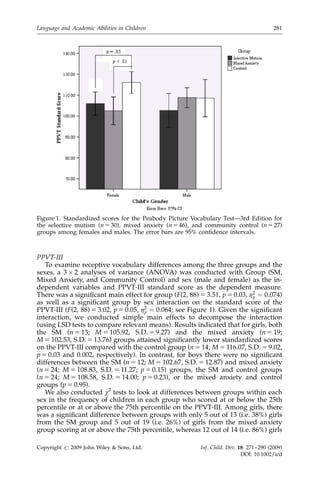
completed in the laboratory. We found a significant group by
sex interaction for receptive vocabulary scores such that within
females, the SM and mixed anxiety groups had significantly
lower receptive vocabulary scores than community controls. We
also found that children with SM and children with anxiety
disorders had significantly lower mathematics scores than

). Language and academic abilities in children with selective mutism

  • 1.
    Infant and ChildDevelopment Inf. Child. Dev. 18: 271–290 (2009) Published online 18 May 2009 in Wiley InterScience (www.interscience.wiley.com). DOI: 10.1002/icd.624 Language and Academic Abilities in Children with Selective Mutism Matilda E. Nowakowskia, Charles C. Cunninghamb, Angela E. McHolmb, Mary Ann Evansc, Shannon Edisonc, Jeff St. Pierred, Michael H. Boyleb and Louis A. Schmidta,Ã a Department of Psychology, Neuroscience and Behaviour, McMaster University, Hamilton, Ont., Canada b Department of Psychiatry and Behavioural Neurosciences, McMaster University, Hamilton, Ont., Canada c Department of Psychology, University of Guelph, Guelph, Ont., Canada d Child and Parent Resource Institute (CPRI), London, Ont., Canada
  • 3.
    We examined receptivelanguage and academic abilities in
  • 4.
    children with selectivemutism (SM; n 5 30; M age 5 8.8 years),
  • 6.
    anxiety disorders (n5 46; M age 5 9.3 years), and community
  • 8.
    controls (n 527; M age 5 7.8 years). Receptive language and
  • 10.
    academic abilities wereassessed using standardized tests
  • 12.
    completed in thelaboratory. We found a significant group by
  • 14.
    sex interaction forreceptive vocabulary scores such that within
  • 15.
    females, the SMand mixed anxiety groups had significantly
  • 17.
    lower receptive vocabularyscores than community controls. We
  • 19.
    also found thatchildren with SM and children with anxiety
  • 21.
    disorders had significantlylower mathematics scores than