A two-year prospective follow-up study of community-based early
intensive behavioral intervention and specialist nursery provision for
children with autism spectrum disorders
Iliana Magiati, Tony Charman, and Patricia Howlin
Presented by: Candice Harley
Many studies report positive outcomes for young children with autism
spectrum disorders (ASD) receiving early intervention.
Particularly impressive results were reported for Early Intensive
Behavioral Intervention (EIBI), beginning around 2-3 years of age, with
claims that up to 47% of participants attain normal intellectual
functioning.
Duration/intensity of intervention, age, IQ, language level and autism
severity have all been reported as predictive variables of response to
intervention.
Very few studies have compared home-based EIBI programs with
autism-specific school-based provision.
This study provides independent outcome data on pre-school
children with ASD after 2 years of either home-based EIBI in a
community setting or autism-specific nursery provision.
Children in the two groups were closely matched at intake
The following questions were addressed:
At follow-up, were EIBI children functioning at a significantly
higher level than nursery children in the areas of IQ, language,
play, adaptive behavior, and severity of autism?
What specific child, family, or treatment characteristics were
related to outcome?
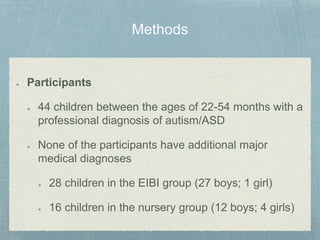
Participants
44 children between the ages of 22-54 months with a
professional diagnosis of autism/ASD
None of the participants have additional major
medical diagnoses
28 children in the EIBI group (27 boys; 1 girl)
16 children in the nursery group (12 boys; 4 girls)
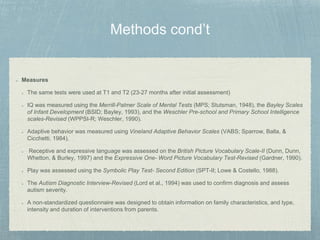
Measures
The same tests were used at T1 and T2 (23-27 months after initial assessment)
IQ was measured using the Merrill-Palmer Scale of Mental Tests (MPS; Stutsman, 1948), the Bayley Scales
of Infant Development (BSID; Bayley, 1993), and the Weschler Pre-school and Primary School Intelligence
scales-Revised (WPPSI-R; Weschler, 1990).
Adaptive behavior was measured using Vineland Adaptive Behavior Scales (VABS; Sparrow, Balla, &
Cicchetti, 1984).
Receptive and expressive language was assessed on the British Picture Vocabulary Scale-II (Dunn, Dunn,
Whetton, & Burley, 1997) and the Expressive One- Word Picture Vocabulary Test-Revised (Gardner, 1990).
Play was assessed using the Symbolic Play Test- Second Edition (SPT-II; Lowe & Costello, 1988).
The Autism Diagnostic Interview-Revised (Lord et al., 1994) was used to confirm diagnosis and assess
autism severity.
A non-standardized questionnaire was designed to obtain information on family characteristics, and type,
intensity and duration of interventions from parents.
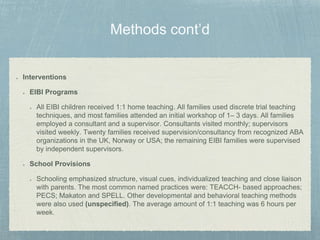
Interventions
EIBI Programs
All EIBI children received 1:1 home teaching. All families used discrete trial teaching
techniques, and most families attended an initial workshop of 1– 3 days. All families
employed a consultant and a supervisor. Consultants visited monthly; supervisors
visited weekly. Twenty families received supervision/consultancy from recognized ABA
organizations in the UK, Norway or USA; the remaining EIBI families were supervised
by independent supervisors.
School Provisions
Schooling emphasized structure, visual cues, individualized teaching and close liaison
with parents. The most common named practices were: TEACCH- based approaches;
PECS; Makaton and SPELL. Other developmental and behavioral teaching methods
were also used (unspecified). The average amount of 1:1 teaching was 6 hours per
week.
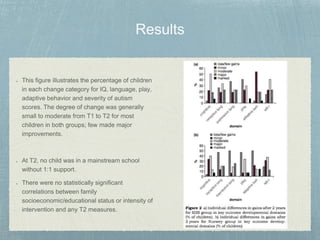
This figure illustrates the percentage of children
in each change category for IQ, language, play,
adaptive behavior and severity of autism
scores. The degree of change was generally
small to moderate from T1 to T2 for most
children in both groups; few made major
improvements.
At T2, no child was in a mainstream school
without 1:1 support.
There were no statistically significant
correlations between family
socioeconomic/educational status or intensity of
intervention and any T2 measures.
The wide variation in progress found in this study is consistent with the
heterogeneous nature of ASD and accords with other recent early
intervention studies, both home- and school-based.
Although conclusions from EIBI research have varied, due to
differences in intake criteria, length, intensity and type of intervention,
and outcome measures, the results of recent EIBI studies do not
support claims that almost 50% of participants achieve normal
educational and intellectual functioning’ (Lovaas, 1987).
Instead, it is important that factors affecting individual children’s
progress are routinely investigated and identified. Group analyses are
important but should not exclude careful study of the variability
of change among individuals.
Data from this study supports the growing
consensus that no one intervention for children
with ASD is universally superior to all others.
Successful interventions may share several
common elements that can help improve the skills
and lives of young children with ASD.
Identification of these key elements is the next
challenge for research in this area.
–Mary Anne Radmacher
“Courage does not always roar.
Sometimes courage is the quiet
voice at the end of the day saying ‘I
will try again tomorrow’”
Thank you

Psy651 presentation

  • 1.
    A two-year prospectivefollow-up study of community-based early intensive behavioral intervention and specialist nursery provision for children with autism spectrum disorders Iliana Magiati, Tony Charman, and Patricia Howlin Presented by: Candice Harley
  • 2.
    Many studies reportpositive outcomes for young children with autism spectrum disorders (ASD) receiving early intervention. Particularly impressive results were reported for Early Intensive Behavioral Intervention (EIBI), beginning around 2-3 years of age, with claims that up to 47% of participants attain normal intellectual functioning. Duration/intensity of intervention, age, IQ, language level and autism severity have all been reported as predictive variables of response to intervention. Very few studies have compared home-based EIBI programs with autism-specific school-based provision.
  • 3.
    This study providesindependent outcome data on pre-school children with ASD after 2 years of either home-based EIBI in a community setting or autism-specific nursery provision. Children in the two groups were closely matched at intake The following questions were addressed: At follow-up, were EIBI children functioning at a significantly higher level than nursery children in the areas of IQ, language, play, adaptive behavior, and severity of autism? What specific child, family, or treatment characteristics were related to outcome?
  • 4.
    Participants 44 children betweenthe ages of 22-54 months with a professional diagnosis of autism/ASD None of the participants have additional major medical diagnoses 28 children in the EIBI group (27 boys; 1 girl) 16 children in the nursery group (12 boys; 4 girls)
  • 5.
    Measures The same testswere used at T1 and T2 (23-27 months after initial assessment) IQ was measured using the Merrill-Palmer Scale of Mental Tests (MPS; Stutsman, 1948), the Bayley Scales of Infant Development (BSID; Bayley, 1993), and the Weschler Pre-school and Primary School Intelligence scales-Revised (WPPSI-R; Weschler, 1990). Adaptive behavior was measured using Vineland Adaptive Behavior Scales (VABS; Sparrow, Balla, & Cicchetti, 1984). Receptive and expressive language was assessed on the British Picture Vocabulary Scale-II (Dunn, Dunn, Whetton, & Burley, 1997) and the Expressive One- Word Picture Vocabulary Test-Revised (Gardner, 1990). Play was assessed using the Symbolic Play Test- Second Edition (SPT-II; Lowe & Costello, 1988). The Autism Diagnostic Interview-Revised (Lord et al., 1994) was used to confirm diagnosis and assess autism severity. A non-standardized questionnaire was designed to obtain information on family characteristics, and type, intensity and duration of interventions from parents.
  • 6.
    Interventions EIBI Programs All EIBIchildren received 1:1 home teaching. All families used discrete trial teaching techniques, and most families attended an initial workshop of 1– 3 days. All families employed a consultant and a supervisor. Consultants visited monthly; supervisors visited weekly. Twenty families received supervision/consultancy from recognized ABA organizations in the UK, Norway or USA; the remaining EIBI families were supervised by independent supervisors. School Provisions Schooling emphasized structure, visual cues, individualized teaching and close liaison with parents. The most common named practices were: TEACCH- based approaches; PECS; Makaton and SPELL. Other developmental and behavioral teaching methods were also used (unspecified). The average amount of 1:1 teaching was 6 hours per week.
  • 7.
    This figure illustratesthe percentage of children in each change category for IQ, language, play, adaptive behavior and severity of autism scores. The degree of change was generally small to moderate from T1 to T2 for most children in both groups; few made major improvements. At T2, no child was in a mainstream school without 1:1 support. There were no statistically significant correlations between family socioeconomic/educational status or intensity of intervention and any T2 measures.
  • 8.
    The wide variationin progress found in this study is consistent with the heterogeneous nature of ASD and accords with other recent early intervention studies, both home- and school-based. Although conclusions from EIBI research have varied, due to differences in intake criteria, length, intensity and type of intervention, and outcome measures, the results of recent EIBI studies do not support claims that almost 50% of participants achieve normal educational and intellectual functioning’ (Lovaas, 1987). Instead, it is important that factors affecting individual children’s progress are routinely investigated and identified. Group analyses are important but should not exclude careful study of the variability of change among individuals.
  • 9.
    Data from thisstudy supports the growing consensus that no one intervention for children with ASD is universally superior to all others. Successful interventions may share several common elements that can help improve the skills and lives of young children with ASD. Identification of these key elements is the next challenge for research in this area.
  • 10.
    –Mary Anne Radmacher “Couragedoes not always roar. Sometimes courage is the quiet voice at the end of the day saying ‘I will try again tomorrow’”
  • 11.