Advances in Life Science and Technology www.iiste.org 
ISSN 2224-7181 (Paper) ISSN 2225-062X (Online) 
Vol.23, 2014 
Development of Phonological Processes in Typically Developing 3- 
4 Year Old Indian Bilingual Children 
Prathamesh Bailoor Maithily Rai Lavanya Krishnan 
Nitte Institute of Speech and Hearing, Nitte University, 
Mangalore, India - 575018 
E-mail: prathameshbailoor@yahoo.com 
ABSTRACT 
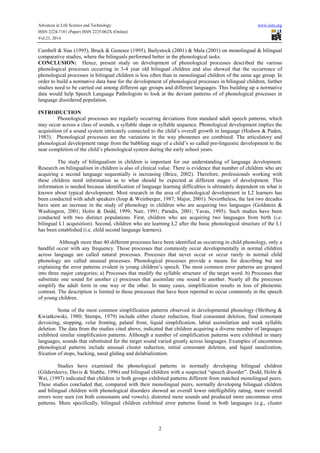
INTRODUCTION: Phonological processes are variations in the way phonemes are combined. Study of 
bilingualism in children is important for our understanding of language development. There is evidence that 
number of children who are acquiring a second language sequentially is increasing (Brice, 2002). Duchar & 
Clark (1992) stated that a Spanish-English bilingual child, who studied languages between the ages of 1.7 year & 
2.3 years, developed separate voicing systems for two languages. Yavas (1995) studied the first 50 word period 
of his Portuguese/Turkish bilingual son. A study by Campbell & Sais (1995) on Italian-English bilingual 
preschool children shows their competency was nearly equal in both the languages. 
In India, a study on simultaneous bilinguals was done by Chengappa & Thirumalai (1972) on a Kodava- 
Kannada bilingual child who shows that the vowel contrasts were similar in Kodava and Kannada. Mala (2001) 
studied development of phonological processes in 3-4 year old Tulu – Kannada normal bilingual children. In 
countries like India, children are often exposed to more than one or two languages. There is a scarcity of studies 
on normative information on development of phonological processes in bilingual children in Indian context. 
Hence, there is a need of the present study. 
AIMS 
 To study the development of phonological processes in typically developing 3-4 year Kannada- English 
1 
bilingual children. 
 To compare the obtained results with the reports of monolingual Kannada speaking children of the same 
age group. 
METHOD: Ten typically developing Kannada- English speaking bilingual children in the age range of 3-3.6  
3.6 to 4 years, served as the subjects. Mother-tongue of the children was Kannada (L1) and the second language, 
English (L2). All children attended English Medium School for their kindergarten education, but the speaking 
language at home was Kannada. All children were exposed to English all the time at school by teachers and their 
peer group. Also children had a regular exposure to English programs on Television. Spontaneous speech 
samples of ten minutes were collected in both the languages (L1  L2). The tasks were; General conversation, 
Story narration and Picture description tasks were given where the clinician used picture books and asked the 
child to describe what was happening in the presented picture. Clinician showed some flash cards of lexical 
items and children were asked to identify it and express the target lexical items. Articulation tests, Kannada 
Articulation Test (Ratna  Bettagiri, 1972)  Goldmann Fristoe Articulation Test (English) [Goldman  
Fristoe, 1986] were administered. Spontaneous speech samples obtained both in L1  L2 was analyzed to study 
various types of phonological processes and the frequency of their occurrence. 
RESULTS: Results revealed a total of 14 phonological processes have been identified to be occurring. The most 
commonly occurring processes were fronting, cluster reduction, Epenthesis, initial consonant deletion, 
affrication, metathesis and final consonant deletion. The least occurring processes were medial consonant 
deletion, backing of stops, alveolar assimilation, stopping  backing of fricatives, and vowel unrounding. Medial 
consonant deletion, stopping and alveolar assimilation were the unique processes found only in one subject each. 
Further, results of the present study were compared with previous findings on Tulu-Kannada bilinguals (Mala, 
2001)  Kannada monolingual speaking children (Sunil, 1995) of the same age group. One sample t-test was 
carried out and results revealed that there was a significant difference seen in Kannada-English bilinguals and 
Tulu-Kannada bilinguals for fronting, cluster reduction, affrication, medial consonant deletion and epenthesis. 
On comparing Kannada-English bilinguals and Kannada monolinguals, there was a significant difference seen in 
fronting, cluster reduction and final consonant deletion. 
DISCUSSION: Results of the present study on commonly occurring phonological processes are in agreement 
with the study done by Stoel-Gammon (1985), Roberts  Foot (1990), Louke (1990)  Mala (2001). As the age 
advanced from 3 -4 years, Fronting, cluster reduction, initial consonant deletion and final consonant deletion 
persisted even at the age of 4 years because the clusters are acquired at a later age and also the acquisition of all 
phonemes is not complete by 4 years of age. As the age advances, the phonological process decreases because 
the acquisition of affricates and stops occur. Most of the phonological processes were less often in bilingual 
children than in monolingual children of the same age group. This supports the findings of Flege et.al (1992),
Advances in Life Science and Technology www.iiste.org 
ISSN 2224-7181 (Paper) ISSN 2225-062X (Online) 
Vol.23, 2014 
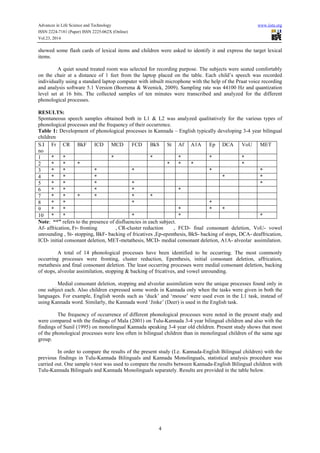
Cambell  Sias (1995), Bruck  Genesee (1995), Bailystock (2001)  Mala (2001) on monolingual  bilingual 
comparative studies, where the bilinguals performed better in the phonological tasks. 
CONCLUSION: Hence, present study on development of phonological processes described the various 
phonological processes occurring in 3-4 year old bilingual children and also showed that the occurrence of 
phonological processes in bilingual children is less often than in monolingual children of the same age group. In 
order to build a normative data base for the development of phonological processes in bilingual children, further 
studies need to be carried out among different age groups and different languages. This building up a normative 
data would help Speech Language Pathologists to look at the deviant patterns of of phonological processes in 
language disordered population. 
2 
INTRODUCTION 
Phonological processes are regularly occurring deviations from standard adult speech patterns, which 
may occur across a class of sounds, a syllable shape or syllable sequence. Phonological development implies the 
acquisition of a sound system intricately connected to the child’s overall growth in language (Hodson  Paden, 
1983). Phonological processes are the variations in the way phonemes are combined. The articulatory and 
phonological development range from the babbling stage of a child’s so called pre-linguistic development to the 
near completion of the child’s phonological system during the early school years. 
The study of bilingualism in children is important for our understanding of language development. 
Research on bilingualism in children is also of clinical value. There is evidence that number of children who are 
acquiring a second language sequentially is increasing (Brice, 2002). Therefore, professionals working with 
these children need information as to what should be expected at different stages of development. This 
information is needed because identification of language learning difficulties is ultimately dependent on what is 
known about typical development. Most research in the area of phonological development in L2 learners has 
been conducted with adult speakers (Ioup  Weinberger, 1987; Major, 2001). Nevertheless, the last two decades 
have seen an increase in the study of phonology in children who are acquiring two languages (Goldstein  
Washington, 2001; Holm  Dodd, 1999; Nair, 1991; Paradis, 2001; Yavas, 1995). Such studies have been 
conducted with two distinct populations. First, children who are acquiring two languages from birth (i.e. 
bilingual L1 acquisition). Second, children who are learning L2 after the basic phonological structure of the L1 
has been established (i.e. child second language learners). 
Although more than 40 different processes have been identified as occurring in child phonology, only a 
handful occur with any frequency. Those processes that commonly occur developmentally in normal children 
across language are called natural processes. Processes that never occur or occur rarely in normal child 
phonology are called unusual processes. Phonological processes provide a means for describing but not 
explaining the error patterns evident in young children’s speech. The most common error patterns are grouped 
into three major categories; a) Processes that modify the syllable structure of the target word. b) Processes that 
substitute one sound for another c) processes that assimilate one sound to another. Nearly all the processes 
simplify the adult form in one way or the other. In many cases, simplification results in loss of phonemic 
contrast. The description is limited to those processes that have been reported to occur commonly in the speech 
of young children. 
Some of the most common simplification patterns observed in developmental phonology (Shriberg  
Kwiatkowski, 1980; Stampe, 1979) include either cluster reduction, final consonant deletion, final consonant 
devoicing, stopping, velar fronting, palatal front, liquid simplification, labial assimilation and weak syllable 
deletion. The data from the studies cited above, indicated that children acquiring a diverse number of languages 
exhibited similar simplification patterns. Although a number of simplification patterns were exhibited in many 
languages, sounds that substituted for the target sound varied greatly across languages. Examples of uncommon 
phonological patterns include unusual cluster reduction, initial consonant deletion, and liquid nasalization, 
frication of stops, backing, nasal gliding and delabialization. 
Studies have examined the phonological patterns in normally developing bilingual children 
(Gildersleeve, Davis  Stubbe, 1996) and bilingual children with a suspected “speech disorder”. Dodd, Holm  
Wei, (1997) indicated that children in both groups exhibited patterns different from matched monolingual peers. 
These studies concluded that, compared with their monolingual peers, normally developing bilingual children 
and bilingual children with phonological disorders showed an overall lower intelligibility rating, more overall 
errors were seen (on both consonants and vowels), distorted more sounds and produced more uncommon error 
patterns. More specifically, bilingual children exhibited error patterns found in both languages (e.g., cluster
Advances in Life Science and Technology www.iiste.org 
ISSN 2224-7181 (Paper) ISSN 2225-062X (Online) 
Vol.23, 2014 
reduction) as well as those, like liquid gliding, that were typical in one language (English) but atypical in the 
other (Spanish) [Gildersleeve et al., 1996]. 
Duchar  Clark (1992) stated that a Spanish-English bilingual child, who studied languages between 
the ages of 1 year 7 months and 2 years 3 months, developed separate voicing systems for the two languages. 
Yavas (1995) studied the first 50 word period of his Portuguese/Turkish bilingual son, found avoidance patterns 
that were clearly language independent. For example, regardless of the language, words with initial fricatives or 
initial liquids were avoided. Such examples support an undifferentiated system that prefers less marked 
phonological patterning at the stage of development regardless of the language. Flege et.al (1992) has pursued 
the acquisition of phonology in second language learners who have begun learning the language at different 
ages. He concluded that the young language learner can create a new phonological category for the foreign 
sound irrespective of its relation to the known sounds in the first language. 
Bruck  Genesee (1995) compared monolinguals  beginning bilinguals longitudinally from 
kindergarten to first grade on a variety of tasks. They found an advantage for the bilingual children on onset time 
segmentation in kindergarten but it disappeared in grade one. Bailystock (2001) says that phonology is a 
relatively transparent feature of spoken language that is, in terms of its structural significance and the fact that 
two spoken languages are based on different phonological structures may be irrelevant in building children’s 
awareness of language. 
A study by Campbell  Sais (1995) on Italian-English bilingual preschool children shows their 
competency was nearly equal in both the languages. In India, a study on simultaneous bilinguals was done by 
Chengappa  Thirumalai (1972) on a Kodava-Kannada bilingual child who shows that the vowel contrasts were 
similar in Kodava and Kannada. It was seen that there was mainly substitution and mixing of Kodava words with 
the Kannada word. Mala (2001) studied the development of phonological processes in 3-4 year old Tulu – 
Kannada normal bilingual children and concluded that bilinguals have fewer phonological processes in some 
patterns such as affrication, fronting, cluster reduction, initial consonant deletion , medial consonant deletion  
stopping whereas monolingual had fewer phonological processes in other categories such as vowel unrounding , 
final consonant deletion and also found that some processes were not found in bilinguals and some were not seen 
in monolinguals. 
In countries like India, children are often exposed to more than one or two languages. As evident from 
the review, there are no studies done which gives the normative information on development of phonological 
processes in normal bilingual children in Indian context. Hence, there is a need of the present study. 
3 
AIMS 
 To study the development of phonological processes in typically developing 3-4 year Kannada- English 
bilingual children. 
 To compare the obtained results with the reports of monolingual Kannada speaking children of the same 
age group. 
METHODOLOGY 
Subjects 
Ten typically developing Kannada- English speaking bilingual children in the age range of 3-3.6  3.6 
to 4 years, served as the subjects. Mother-tongue of the children was Kannada (L1) and the second language, 
English (L2). All children attended English Medium School for their kindergarten education, but the speaking 
language at home was Kannada. All children were exposed to English all the time at school by teachers and their 
peer group. Also children had a regular exposure to English programs on Television. All subjects were screened 
for the structural and functional integrity of the oral speech mechanism, hearing loss and only with those 
adequately functioning oral speech mechanisms were considered for the study. 
Procedure 
Spontaneous speech samples of ten minutes were collected in both the languages (L1  L2). The tasks 
were; General conversation, which involved the topics such as Name of the child, his/her daily routines, hobbies 
of the child, about the parents occupation, about other family members of children and their friends. Articulation 
tests, Kannada Articulation Test (Ratna  Bettagiri, 1972)  Goldmann Fristoe Articulation Test (English) 
[Goldman  Fristoe, 1986] were administered. Story narration task was carried out in both L1  L2, where the 
children were asked to narrate the story of their choice. Picture description tasks were given where the clinician 
used picture books and asked the child to describe what was happening in the presented picture. Clinician
Advances in Life Science and Technology www.iiste.org 
ISSN 2224-7181 (Paper) ISSN 2225-062X (Online) 
Vol.23, 2014 
showed some flash cards of lexical items and children were asked to identify it and express the target lexical 
items. 
A quiet sound treated room was selected for recording purpose. The subjects were seated comfortably 
on the chair at a distance of 1 feet from the laptop placed on the table. Each child’s speech was recorded 
individually using a standard laptop computer with inbuilt microphone with the help of the Praat voice recording 
and analysis software 5.1 Version (Boersma  Weenick, 2009). Sampling rate was 44100 Hz and quantization 
level set at 16 bits. The collected samples of ten minutes were transcribed and analyzed for the different 
phonological processes. 
RESULTS: 
Spontaneous speech samples obtained both in L1  L2 was analyzed qualitatively for the various types of 
phonological processes and the frequency of their occurrence. 
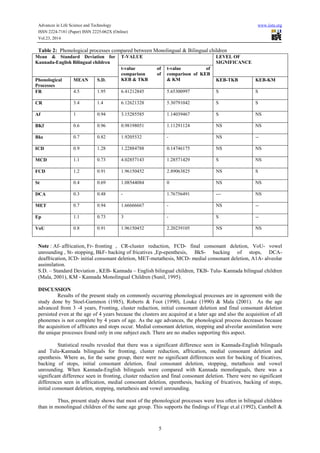
Table 1: Development of phonological processes in Kannada – English typically developing 3-4 year bilingual 
children 
Note: “*” refers to the presence of disfluencies in each subject. 
Af- affrication, Fr- fronting , CR-cluster reduction , FCD- final consonant deletion, VoU- vowel 
unrounding , St- stopping, BkF- backing of fricatives ,Ep-epenthesis, BkS- backing of stops, DCA- deaffrication, 
ICD- initial consonant deletion, MET-metathesis, MCD- medial consonant deletion, A1A- alveolar assimilation. 
A total of 14 phonological processes have been identified to be occurring. The most commonly 
occurring processes were fronting, cluster reduction, Epenthesis, initial consonant deletion, affrication, 
metathesis and final consonant deletion. The least occurring processes were medial consonant deletion, backing 
of stops, alveolar assimilation, stopping  backing of fricatives, and vowel unrounding. 
Medial consonant deletion, stopping and alveolar assimilation were the unique processes found only in 
one subject each. Also children expressed some words in Kannada only when the tasks were given in both the 
languages. For example, English words such as ‘duck’ and ‘mouse’ were used even in the L1 task, instead of 
using Kannada word. Similarly, the Kannada word ‘Jinke’ (Deer) is used in the English task. 
The frequency of occurrence of different phonological processes were noted in the present study and 
were compared with the findings of Mala (2001) on Tulu-Kannada 3-4 year bilingual children and also with the 
findings of Sunil (1995) on monolingual Kannada speaking 3-4 year old children. Present study shows that most 
of the phonological processes were less often in bilingual children than in monolingual children of the same age 
group. 
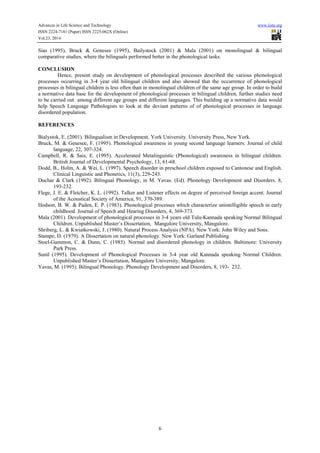
In order to compare the results of the present study (I.e. Kannada-English Bilingual children) with the 
previous findings in Tulu-Kannada Bilinguals and Kannada Monolinguals, statistical analysis procedure was 
carried out. One sample t-test was used to compare the results between Kannada-English Bilingual children with 
Tulu-Kannada Bilinguals and Kannada Monolinguals separately. Results are provided in the table below. 
4 
S.I 
no 
Fr CR BkF ICD MCD FCD BkS St Af A1A Ep DCA VoU MET 
1 * * * * * * * 
2 * * * * * * * 
3 * * * * * * 
4 * * * * * 
5 * * * * * 
6 * * * * * 
7 * * * * * * 
8 * * * * 
9 * * * * * 
10 * * * * *
Advances in Life Science and Technology www.iiste.org 
ISSN 2224-7181 (Paper) ISSN 2225-062X (Online) 
Vol.23, 2014 
Table 2: Phonological processes compared between Monolingual  Bilingual children 
Mean  Standard Deviation for 
Kannada-English Bilingual children 
T-VALUE 
LEVEL OF 
5 
SIGNIFICANCE 
t-value of 
comparison of 
KEB  TKB 
t-value of 
comparison of KEB 
 KM 
Phonological 
Processes 
MEAN S.D. KEB-TKB 
KEB-KM 
FR 4.5 
1.95 
6.41212845 
5.65300997 
S 
S 
CR 3.4 
1.4 
6.12621328 
5.30791042 
S 
S 
Af 1 
0.94 
3.15285585 
1.14039467 
S 
NS 
BKf 0.6 
0.96 
0.98198051 
1.11291124 
NS 
NS 
Bks 0.7 
0.82 
1.9205532 
- 
NS 
-- 
ICD 0.9 
1.28 
1.22884788 
0.14746175 
NS 
NS 
MCD 1.1 
0.73 
4.02857143 
1.28571429 
S 
NS 
FCD 1.2 
0.91 
1.96150452 
2.89063825 
NS 
S 
St 0.4 
0.69 
1.08544084 
0 
NS 
NS 
DCA 0.3 
0.48 
- 
1.76756491 
--- NS 
MET 0.7 
0.94 
1.66666667 
- 
NS 
-- 
Ep 1.1 
0.73 
3 
- 
S 
-- 
VoU 0.8 
0.91 
1.96150452 
2.20239105 
NS 
NS 
Note : Af- affrication, Fr- fronting , CR-cluster reduction, FCD- final consonant deletion, VoU- vowel 
unrounding , St- stopping, BkF- backing of fricatives ,Ep-epenthesis, BkS- backing of stops, DCA-deaffrication, 
ICD- initial consonant deletion, MET-metathesis, MCD- medial consonant deletion, A1A- alveolar 
assimilation. 
S.D. – Standard Deviation , KEB- Kannada – English bilingual children, TKB- Tulu- Kannada bilingual children 
(Mala, 2001), KM - Kannada Monolingual Children (Sunil, 1995). 
DISCUSSION 
Results of the present study on commonly occurring phonological processes are in agreement with the 
study done by Stoel-Gammon (1985), Roberts  Foot (1990), Louke (1990)  Mala (2001). As the age 
advanced from 3 -4 years, Fronting, cluster reduction, initial consonant deletion and final consonant deletion 
persisted even at the age of 4 years because the clusters are acquired at a later age and also the acquisition of all 
phonemes is not complete by 4 years of age. As the age advances, the phonological process decreases because 
the acquisition of affricates and stops occur. Medial consonant deletion, stopping and alveolar assimilation were 
the unique processes found only in one subject each. There are no studies supporting this aspect. 
Statistical results revealed that there was a significant difference seen in Kannada-English bilinguals 
and Tulu-Kannada bilinguals for fronting, cluster reduction, affrication, medial consonant deletion and 
epenthesis. Where as, for the same group, there were no significant differences seen for backing of fricatives, 
backing of stops, initial consonant deletion, final consonant deletion, stopping, metathesis and vowel 
unrounding. When Kannada-English bilinguals were compared with Kannada monolinguals, there was a 
significant difference seen in fronting, cluster reduction and final consonant deletion. There were no significant 
differences seen in affrication, medial consonant deletion, epenthesis, backing of fricatives, backing of stops, 
initial consonant deletion, stopping, metathesis and vowel unrounding. 
Thus, present study shows that most of the phonological processes were less often in bilingual children 
than in monolingual children of the same age group. This supports the findings of Flege et.al (1992), Cambell
Advances in Life Science and Technology www.iiste.org 
ISSN 2224-7181 (Paper) ISSN 2225-062X (Online) 
Vol.23, 2014 
Sias (1995), Bruck  Genesee (1995), Bailystock (2001)  Mala (2001) on monolingual  bilingual 
comparative studies, where the bilinguals performed better in the phonological tasks. 
6 
CONCLUSION 
Hence, present study on development of phonological processes described the various phonological 
processes occurring in 3-4 year old bilingual children and also showed that the occurrence of phonological 
processes in bilingual children is less often than in monolingual children of the same age group. In order to build 
a normative data base for the development of phonological processes in bilingual children, further studies need 
to be carried out among different age groups and different languages. This building up a normative data would 
help Speech Language Pathologists to look at the deviant patterns of of phonological processes in language 
disordered population. 
REFERENCES 
Bialystok, E. (2001). Bilingualism in Development. York University. University Press, New York. 
Bruck, M.  Genesee, F. (1995). Phonological awareness in young second language learners. Journal of child 
language, 22, 307-324. 
Campbell, R.  Sais, E. (1995). Accelerated Metalinguistic (Phonological) awareness in bilingual children. 
British Journal of Developmental Psychology, 13, 61-68. 
Dodd, B., Holm, A.  Wei, L. (1997). Speech disorder in preschool children exposed to Cantonese and English. 
Clinical Linguistic and Phonetics, 11(3), 229-243. 
Duchar  Clark (1992). Bilingual Phonology, in M. Yavas. (Ed). Phonology Development and Disorders. 8, 
193-232. 
Flege, J. E.  Fletcher, K. L. (1992). Talker and Listener effects on degree of perceived foreign accent. Journal 
of the Acoustical Society of America, 91, 370-389. 
Hodson, B. W.  Paden, E. P. (1983). Phonological processes which characterize unintelligible speech in early 
childhood. Journal of Speech and Hearing Disorders, 4, 369-373. 
Mala (2001). Development of phonological processes in 3-4 years old Tulu-Kannada speaking Normal Bilingual 
Children. Unpublished Master’s Dissertation, Mangalore University, Mangalore. 
Shriberg, L.  Kwiatkowski, J. (1980). Natural Process Analysis (NPA). New York: John Wiley and Sons. 
Stampe, D. (1979). A Dissertation on natural phonology. New York: Garland Publishing. 
Stoel-Gammon, C.  Dunn, C. (1985). Normal and disordered phonology in children. Baltimore: University 
Park Press. 
Sunil (1995). Development of Phonological Processes in 3-4 year old Kannada speaking Normal Children. 
Unpublished Master’s Dissertation, Mangalore University, Mangalore. 
Yavas, M. (1995). Bilingual Phonology. Phonology Development and Disorders, 8, 193- 232.
The IISTE is a pioneer in the Open-Access hosting service and academic event 
management. The aim of the firm is Accelerating Global Knowledge Sharing. 
More information about the firm can be found on the homepage: 
http://www.iiste.org 
CALL FOR JOURNAL PAPERS 
There are more than 30 peer-reviewed academic journals hosted under the hosting 
platform. 
Prospective authors of journals can find the submission instruction on the 
following page: http://www.iiste.org/journals/ All the journals articles are available 
online to the readers all over the world without financial, legal, or technical barriers 
other than those inseparable from gaining access to the internet itself. Paper version 
of the journals is also available upon request of readers and authors. 
MORE RESOURCES 
Book publication information: http://www.iiste.org/book/ 
IISTE Knowledge Sharing Partners 
EBSCO, Index Copernicus, Ulrich's Periodicals Directory, JournalTOCS, PKP Open 
Archives Harvester, Bielefeld Academic Search Engine, Elektronische 
Zeitschriftenbibliothek EZB, Open J-Gate, OCLC WorldCat, Universe Digtial 
Library , NewJour, Google Scholar

Development of phonological processes in typically

  • 1.
    Advances in LifeScience and Technology www.iiste.org ISSN 2224-7181 (Paper) ISSN 2225-062X (Online) Vol.23, 2014 Development of Phonological Processes in Typically Developing 3- 4 Year Old Indian Bilingual Children Prathamesh Bailoor Maithily Rai Lavanya Krishnan Nitte Institute of Speech and Hearing, Nitte University, Mangalore, India - 575018 E-mail: prathameshbailoor@yahoo.com ABSTRACT INTRODUCTION: Phonological processes are variations in the way phonemes are combined. Study of bilingualism in children is important for our understanding of language development. There is evidence that number of children who are acquiring a second language sequentially is increasing (Brice, 2002). Duchar & Clark (1992) stated that a Spanish-English bilingual child, who studied languages between the ages of 1.7 year & 2.3 years, developed separate voicing systems for two languages. Yavas (1995) studied the first 50 word period of his Portuguese/Turkish bilingual son. A study by Campbell & Sais (1995) on Italian-English bilingual preschool children shows their competency was nearly equal in both the languages. In India, a study on simultaneous bilinguals was done by Chengappa & Thirumalai (1972) on a Kodava- Kannada bilingual child who shows that the vowel contrasts were similar in Kodava and Kannada. Mala (2001) studied development of phonological processes in 3-4 year old Tulu – Kannada normal bilingual children. In countries like India, children are often exposed to more than one or two languages. There is a scarcity of studies on normative information on development of phonological processes in bilingual children in Indian context. Hence, there is a need of the present study. AIMS To study the development of phonological processes in typically developing 3-4 year Kannada- English 1 bilingual children. To compare the obtained results with the reports of monolingual Kannada speaking children of the same age group. METHOD: Ten typically developing Kannada- English speaking bilingual children in the age range of 3-3.6 3.6 to 4 years, served as the subjects. Mother-tongue of the children was Kannada (L1) and the second language, English (L2). All children attended English Medium School for their kindergarten education, but the speaking language at home was Kannada. All children were exposed to English all the time at school by teachers and their peer group. Also children had a regular exposure to English programs on Television. Spontaneous speech samples of ten minutes were collected in both the languages (L1 L2). The tasks were; General conversation, Story narration and Picture description tasks were given where the clinician used picture books and asked the child to describe what was happening in the presented picture. Clinician showed some flash cards of lexical items and children were asked to identify it and express the target lexical items. Articulation tests, Kannada Articulation Test (Ratna Bettagiri, 1972) Goldmann Fristoe Articulation Test (English) [Goldman Fristoe, 1986] were administered. Spontaneous speech samples obtained both in L1 L2 was analyzed to study various types of phonological processes and the frequency of their occurrence. RESULTS: Results revealed a total of 14 phonological processes have been identified to be occurring. The most commonly occurring processes were fronting, cluster reduction, Epenthesis, initial consonant deletion, affrication, metathesis and final consonant deletion. The least occurring processes were medial consonant deletion, backing of stops, alveolar assimilation, stopping backing of fricatives, and vowel unrounding. Medial consonant deletion, stopping and alveolar assimilation were the unique processes found only in one subject each. Further, results of the present study were compared with previous findings on Tulu-Kannada bilinguals (Mala, 2001) Kannada monolingual speaking children (Sunil, 1995) of the same age group. One sample t-test was carried out and results revealed that there was a significant difference seen in Kannada-English bilinguals and Tulu-Kannada bilinguals for fronting, cluster reduction, affrication, medial consonant deletion and epenthesis. On comparing Kannada-English bilinguals and Kannada monolinguals, there was a significant difference seen in fronting, cluster reduction and final consonant deletion. DISCUSSION: Results of the present study on commonly occurring phonological processes are in agreement with the study done by Stoel-Gammon (1985), Roberts Foot (1990), Louke (1990) Mala (2001). As the age advanced from 3 -4 years, Fronting, cluster reduction, initial consonant deletion and final consonant deletion persisted even at the age of 4 years because the clusters are acquired at a later age and also the acquisition of all phonemes is not complete by 4 years of age. As the age advances, the phonological process decreases because the acquisition of affricates and stops occur. Most of the phonological processes were less often in bilingual children than in monolingual children of the same age group. This supports the findings of Flege et.al (1992),
  • 2.
    Advances in LifeScience and Technology www.iiste.org ISSN 2224-7181 (Paper) ISSN 2225-062X (Online) Vol.23, 2014 Cambell Sias (1995), Bruck Genesee (1995), Bailystock (2001) Mala (2001) on monolingual bilingual comparative studies, where the bilinguals performed better in the phonological tasks. CONCLUSION: Hence, present study on development of phonological processes described the various phonological processes occurring in 3-4 year old bilingual children and also showed that the occurrence of phonological processes in bilingual children is less often than in monolingual children of the same age group. In order to build a normative data base for the development of phonological processes in bilingual children, further studies need to be carried out among different age groups and different languages. This building up a normative data would help Speech Language Pathologists to look at the deviant patterns of of phonological processes in language disordered population. 2 INTRODUCTION Phonological processes are regularly occurring deviations from standard adult speech patterns, which may occur across a class of sounds, a syllable shape or syllable sequence. Phonological development implies the acquisition of a sound system intricately connected to the child’s overall growth in language (Hodson Paden, 1983). Phonological processes are the variations in the way phonemes are combined. The articulatory and phonological development range from the babbling stage of a child’s so called pre-linguistic development to the near completion of the child’s phonological system during the early school years. The study of bilingualism in children is important for our understanding of language development. Research on bilingualism in children is also of clinical value. There is evidence that number of children who are acquiring a second language sequentially is increasing (Brice, 2002). Therefore, professionals working with these children need information as to what should be expected at different stages of development. This information is needed because identification of language learning difficulties is ultimately dependent on what is known about typical development. Most research in the area of phonological development in L2 learners has been conducted with adult speakers (Ioup Weinberger, 1987; Major, 2001). Nevertheless, the last two decades have seen an increase in the study of phonology in children who are acquiring two languages (Goldstein Washington, 2001; Holm Dodd, 1999; Nair, 1991; Paradis, 2001; Yavas, 1995). Such studies have been conducted with two distinct populations. First, children who are acquiring two languages from birth (i.e. bilingual L1 acquisition). Second, children who are learning L2 after the basic phonological structure of the L1 has been established (i.e. child second language learners). Although more than 40 different processes have been identified as occurring in child phonology, only a handful occur with any frequency. Those processes that commonly occur developmentally in normal children across language are called natural processes. Processes that never occur or occur rarely in normal child phonology are called unusual processes. Phonological processes provide a means for describing but not explaining the error patterns evident in young children’s speech. The most common error patterns are grouped into three major categories; a) Processes that modify the syllable structure of the target word. b) Processes that substitute one sound for another c) processes that assimilate one sound to another. Nearly all the processes simplify the adult form in one way or the other. In many cases, simplification results in loss of phonemic contrast. The description is limited to those processes that have been reported to occur commonly in the speech of young children. Some of the most common simplification patterns observed in developmental phonology (Shriberg Kwiatkowski, 1980; Stampe, 1979) include either cluster reduction, final consonant deletion, final consonant devoicing, stopping, velar fronting, palatal front, liquid simplification, labial assimilation and weak syllable deletion. The data from the studies cited above, indicated that children acquiring a diverse number of languages exhibited similar simplification patterns. Although a number of simplification patterns were exhibited in many languages, sounds that substituted for the target sound varied greatly across languages. Examples of uncommon phonological patterns include unusual cluster reduction, initial consonant deletion, and liquid nasalization, frication of stops, backing, nasal gliding and delabialization. Studies have examined the phonological patterns in normally developing bilingual children (Gildersleeve, Davis Stubbe, 1996) and bilingual children with a suspected “speech disorder”. Dodd, Holm Wei, (1997) indicated that children in both groups exhibited patterns different from matched monolingual peers. These studies concluded that, compared with their monolingual peers, normally developing bilingual children and bilingual children with phonological disorders showed an overall lower intelligibility rating, more overall errors were seen (on both consonants and vowels), distorted more sounds and produced more uncommon error patterns. More specifically, bilingual children exhibited error patterns found in both languages (e.g., cluster
  • 3.
    Advances in LifeScience and Technology www.iiste.org ISSN 2224-7181 (Paper) ISSN 2225-062X (Online) Vol.23, 2014 reduction) as well as those, like liquid gliding, that were typical in one language (English) but atypical in the other (Spanish) [Gildersleeve et al., 1996]. Duchar Clark (1992) stated that a Spanish-English bilingual child, who studied languages between the ages of 1 year 7 months and 2 years 3 months, developed separate voicing systems for the two languages. Yavas (1995) studied the first 50 word period of his Portuguese/Turkish bilingual son, found avoidance patterns that were clearly language independent. For example, regardless of the language, words with initial fricatives or initial liquids were avoided. Such examples support an undifferentiated system that prefers less marked phonological patterning at the stage of development regardless of the language. Flege et.al (1992) has pursued the acquisition of phonology in second language learners who have begun learning the language at different ages. He concluded that the young language learner can create a new phonological category for the foreign sound irrespective of its relation to the known sounds in the first language. Bruck Genesee (1995) compared monolinguals beginning bilinguals longitudinally from kindergarten to first grade on a variety of tasks. They found an advantage for the bilingual children on onset time segmentation in kindergarten but it disappeared in grade one. Bailystock (2001) says that phonology is a relatively transparent feature of spoken language that is, in terms of its structural significance and the fact that two spoken languages are based on different phonological structures may be irrelevant in building children’s awareness of language. A study by Campbell Sais (1995) on Italian-English bilingual preschool children shows their competency was nearly equal in both the languages. In India, a study on simultaneous bilinguals was done by Chengappa Thirumalai (1972) on a Kodava-Kannada bilingual child who shows that the vowel contrasts were similar in Kodava and Kannada. It was seen that there was mainly substitution and mixing of Kodava words with the Kannada word. Mala (2001) studied the development of phonological processes in 3-4 year old Tulu – Kannada normal bilingual children and concluded that bilinguals have fewer phonological processes in some patterns such as affrication, fronting, cluster reduction, initial consonant deletion , medial consonant deletion stopping whereas monolingual had fewer phonological processes in other categories such as vowel unrounding , final consonant deletion and also found that some processes were not found in bilinguals and some were not seen in monolinguals. In countries like India, children are often exposed to more than one or two languages. As evident from the review, there are no studies done which gives the normative information on development of phonological processes in normal bilingual children in Indian context. Hence, there is a need of the present study. 3 AIMS To study the development of phonological processes in typically developing 3-4 year Kannada- English bilingual children. To compare the obtained results with the reports of monolingual Kannada speaking children of the same age group. METHODOLOGY Subjects Ten typically developing Kannada- English speaking bilingual children in the age range of 3-3.6 3.6 to 4 years, served as the subjects. Mother-tongue of the children was Kannada (L1) and the second language, English (L2). All children attended English Medium School for their kindergarten education, but the speaking language at home was Kannada. All children were exposed to English all the time at school by teachers and their peer group. Also children had a regular exposure to English programs on Television. All subjects were screened for the structural and functional integrity of the oral speech mechanism, hearing loss and only with those adequately functioning oral speech mechanisms were considered for the study. Procedure Spontaneous speech samples of ten minutes were collected in both the languages (L1 L2). The tasks were; General conversation, which involved the topics such as Name of the child, his/her daily routines, hobbies of the child, about the parents occupation, about other family members of children and their friends. Articulation tests, Kannada Articulation Test (Ratna Bettagiri, 1972) Goldmann Fristoe Articulation Test (English) [Goldman Fristoe, 1986] were administered. Story narration task was carried out in both L1 L2, where the children were asked to narrate the story of their choice. Picture description tasks were given where the clinician used picture books and asked the child to describe what was happening in the presented picture. Clinician
  • 4.
    Advances in LifeScience and Technology www.iiste.org ISSN 2224-7181 (Paper) ISSN 2225-062X (Online) Vol.23, 2014 showed some flash cards of lexical items and children were asked to identify it and express the target lexical items. A quiet sound treated room was selected for recording purpose. The subjects were seated comfortably on the chair at a distance of 1 feet from the laptop placed on the table. Each child’s speech was recorded individually using a standard laptop computer with inbuilt microphone with the help of the Praat voice recording and analysis software 5.1 Version (Boersma Weenick, 2009). Sampling rate was 44100 Hz and quantization level set at 16 bits. The collected samples of ten minutes were transcribed and analyzed for the different phonological processes. RESULTS: Spontaneous speech samples obtained both in L1 L2 was analyzed qualitatively for the various types of phonological processes and the frequency of their occurrence. Table 1: Development of phonological processes in Kannada – English typically developing 3-4 year bilingual children Note: “*” refers to the presence of disfluencies in each subject. Af- affrication, Fr- fronting , CR-cluster reduction , FCD- final consonant deletion, VoU- vowel unrounding , St- stopping, BkF- backing of fricatives ,Ep-epenthesis, BkS- backing of stops, DCA- deaffrication, ICD- initial consonant deletion, MET-metathesis, MCD- medial consonant deletion, A1A- alveolar assimilation. A total of 14 phonological processes have been identified to be occurring. The most commonly occurring processes were fronting, cluster reduction, Epenthesis, initial consonant deletion, affrication, metathesis and final consonant deletion. The least occurring processes were medial consonant deletion, backing of stops, alveolar assimilation, stopping backing of fricatives, and vowel unrounding. Medial consonant deletion, stopping and alveolar assimilation were the unique processes found only in one subject each. Also children expressed some words in Kannada only when the tasks were given in both the languages. For example, English words such as ‘duck’ and ‘mouse’ were used even in the L1 task, instead of using Kannada word. Similarly, the Kannada word ‘Jinke’ (Deer) is used in the English task. The frequency of occurrence of different phonological processes were noted in the present study and were compared with the findings of Mala (2001) on Tulu-Kannada 3-4 year bilingual children and also with the findings of Sunil (1995) on monolingual Kannada speaking 3-4 year old children. Present study shows that most of the phonological processes were less often in bilingual children than in monolingual children of the same age group. In order to compare the results of the present study (I.e. Kannada-English Bilingual children) with the previous findings in Tulu-Kannada Bilinguals and Kannada Monolinguals, statistical analysis procedure was carried out. One sample t-test was used to compare the results between Kannada-English Bilingual children with Tulu-Kannada Bilinguals and Kannada Monolinguals separately. Results are provided in the table below. 4 S.I no Fr CR BkF ICD MCD FCD BkS St Af A1A Ep DCA VoU MET 1 * * * * * * * 2 * * * * * * * 3 * * * * * * 4 * * * * * 5 * * * * * 6 * * * * * 7 * * * * * * 8 * * * * 9 * * * * * 10 * * * * *
  • 5.
    Advances in LifeScience and Technology www.iiste.org ISSN 2224-7181 (Paper) ISSN 2225-062X (Online) Vol.23, 2014 Table 2: Phonological processes compared between Monolingual Bilingual children Mean Standard Deviation for Kannada-English Bilingual children T-VALUE LEVEL OF 5 SIGNIFICANCE t-value of comparison of KEB TKB t-value of comparison of KEB KM Phonological Processes MEAN S.D. KEB-TKB KEB-KM FR 4.5 1.95 6.41212845 5.65300997 S S CR 3.4 1.4 6.12621328 5.30791042 S S Af 1 0.94 3.15285585 1.14039467 S NS BKf 0.6 0.96 0.98198051 1.11291124 NS NS Bks 0.7 0.82 1.9205532 - NS -- ICD 0.9 1.28 1.22884788 0.14746175 NS NS MCD 1.1 0.73 4.02857143 1.28571429 S NS FCD 1.2 0.91 1.96150452 2.89063825 NS S St 0.4 0.69 1.08544084 0 NS NS DCA 0.3 0.48 - 1.76756491 --- NS MET 0.7 0.94 1.66666667 - NS -- Ep 1.1 0.73 3 - S -- VoU 0.8 0.91 1.96150452 2.20239105 NS NS Note : Af- affrication, Fr- fronting , CR-cluster reduction, FCD- final consonant deletion, VoU- vowel unrounding , St- stopping, BkF- backing of fricatives ,Ep-epenthesis, BkS- backing of stops, DCA-deaffrication, ICD- initial consonant deletion, MET-metathesis, MCD- medial consonant deletion, A1A- alveolar assimilation. S.D. – Standard Deviation , KEB- Kannada – English bilingual children, TKB- Tulu- Kannada bilingual children (Mala, 2001), KM - Kannada Monolingual Children (Sunil, 1995). DISCUSSION Results of the present study on commonly occurring phonological processes are in agreement with the study done by Stoel-Gammon (1985), Roberts Foot (1990), Louke (1990) Mala (2001). As the age advanced from 3 -4 years, Fronting, cluster reduction, initial consonant deletion and final consonant deletion persisted even at the age of 4 years because the clusters are acquired at a later age and also the acquisition of all phonemes is not complete by 4 years of age. As the age advances, the phonological process decreases because the acquisition of affricates and stops occur. Medial consonant deletion, stopping and alveolar assimilation were the unique processes found only in one subject each. There are no studies supporting this aspect. Statistical results revealed that there was a significant difference seen in Kannada-English bilinguals and Tulu-Kannada bilinguals for fronting, cluster reduction, affrication, medial consonant deletion and epenthesis. Where as, for the same group, there were no significant differences seen for backing of fricatives, backing of stops, initial consonant deletion, final consonant deletion, stopping, metathesis and vowel unrounding. When Kannada-English bilinguals were compared with Kannada monolinguals, there was a significant difference seen in fronting, cluster reduction and final consonant deletion. There were no significant differences seen in affrication, medial consonant deletion, epenthesis, backing of fricatives, backing of stops, initial consonant deletion, stopping, metathesis and vowel unrounding. Thus, present study shows that most of the phonological processes were less often in bilingual children than in monolingual children of the same age group. This supports the findings of Flege et.al (1992), Cambell
  • 6.
    Advances in LifeScience and Technology www.iiste.org ISSN 2224-7181 (Paper) ISSN 2225-062X (Online) Vol.23, 2014 Sias (1995), Bruck Genesee (1995), Bailystock (2001) Mala (2001) on monolingual bilingual comparative studies, where the bilinguals performed better in the phonological tasks. 6 CONCLUSION Hence, present study on development of phonological processes described the various phonological processes occurring in 3-4 year old bilingual children and also showed that the occurrence of phonological processes in bilingual children is less often than in monolingual children of the same age group. In order to build a normative data base for the development of phonological processes in bilingual children, further studies need to be carried out among different age groups and different languages. This building up a normative data would help Speech Language Pathologists to look at the deviant patterns of of phonological processes in language disordered population. REFERENCES Bialystok, E. (2001). Bilingualism in Development. York University. University Press, New York. Bruck, M. Genesee, F. (1995). Phonological awareness in young second language learners. Journal of child language, 22, 307-324. Campbell, R. Sais, E. (1995). Accelerated Metalinguistic (Phonological) awareness in bilingual children. British Journal of Developmental Psychology, 13, 61-68. Dodd, B., Holm, A. Wei, L. (1997). Speech disorder in preschool children exposed to Cantonese and English. Clinical Linguistic and Phonetics, 11(3), 229-243. Duchar Clark (1992). Bilingual Phonology, in M. Yavas. (Ed). Phonology Development and Disorders. 8, 193-232. Flege, J. E. Fletcher, K. L. (1992). Talker and Listener effects on degree of perceived foreign accent. Journal of the Acoustical Society of America, 91, 370-389. Hodson, B. W. Paden, E. P. (1983). Phonological processes which characterize unintelligible speech in early childhood. Journal of Speech and Hearing Disorders, 4, 369-373. Mala (2001). Development of phonological processes in 3-4 years old Tulu-Kannada speaking Normal Bilingual Children. Unpublished Master’s Dissertation, Mangalore University, Mangalore. Shriberg, L. Kwiatkowski, J. (1980). Natural Process Analysis (NPA). New York: John Wiley and Sons. Stampe, D. (1979). A Dissertation on natural phonology. New York: Garland Publishing. Stoel-Gammon, C. Dunn, C. (1985). Normal and disordered phonology in children. Baltimore: University Park Press. Sunil (1995). Development of Phonological Processes in 3-4 year old Kannada speaking Normal Children. Unpublished Master’s Dissertation, Mangalore University, Mangalore. Yavas, M. (1995). Bilingual Phonology. Phonology Development and Disorders, 8, 193- 232.
  • 7.
    The IISTE isa pioneer in the Open-Access hosting service and academic event management. The aim of the firm is Accelerating Global Knowledge Sharing. More information about the firm can be found on the homepage: http://www.iiste.org CALL FOR JOURNAL PAPERS There are more than 30 peer-reviewed academic journals hosted under the hosting platform. Prospective authors of journals can find the submission instruction on the following page: http://www.iiste.org/journals/ All the journals articles are available online to the readers all over the world without financial, legal, or technical barriers other than those inseparable from gaining access to the internet itself. Paper version of the journals is also available upon request of readers and authors. MORE RESOURCES Book publication information: http://www.iiste.org/book/ IISTE Knowledge Sharing Partners EBSCO, Index Copernicus, Ulrich's Periodicals Directory, JournalTOCS, PKP Open Archives Harvester, Bielefeld Academic Search Engine, Elektronische Zeitschriftenbibliothek EZB, Open J-Gate, OCLC WorldCat, Universe Digtial Library , NewJour, Google Scholar