CENTRAL UNIVERSITY OF ECUADOR
FACULTY OF PHILOSOPHIE LETTERS AND SCIENCES OF THE
EDUCATION
CAREER PLURILINGUE
Subject: Didáctica
Topic: LANGUAGE ACQUISITION
Members:
 Miguel Arízala
 Mauricio Fiallos
 Estela Robalino
 Gabriela Ruiz
LANGUAGE
ACQUISITION
Ability of: getting speaking skills
incorporating
integration and assimilation’s concepts
•What is Language Acquisition, Theories, (2000) http://study.com/academy/lesson/what-is-
language-acquisition-theories-stages-quiz.html
 makes us humans
 bird songs
 it´s remarkable itself.
 Need make us talk
•Definition of language:
http://www.oxforddictionaries.com/definition/english/language
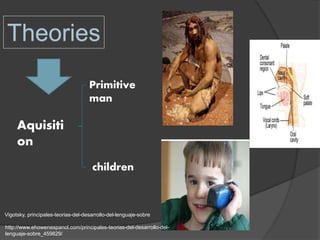
Theories
Aquisiti
on
children
Primitive
man
Vigotsky, principales-teorias-del-desarrollo-del-lenguaje-sobre
http://www.ehowenespanol.com/principales-teorias-del-desarrollo-del-
lenguaje-sobre_459829/
THE LANGUAGE LEARNED BY
CHILDREN AND PASSED FROM ONE
GENERATION TO THE NEXT
ACCORDING TO THE BOOK ¨OXFORD
ADVANCED LEARNERS¨, MOTHER
TONGUE AND FIRST LANGUAGE BOTH
REFER TO THE LANGUAGE YOU ACQUIRE
AS A CHILD AND ARE MOST FLUENT IN.
A LANGUAGE OTHER THAN THE MOTHER TONGUE THAT A
PERSON OR COMMUNITY USES FOR PUBLIC COMMUNICATION,
HIGHER EDUCATION, AND ADMINISTRATION
A NON-NATIVE LANGUAGE OFFICIALLY RECOGNIZED AND
ADOPTED IN A MULTILINGUAL COUNTRY AS A MEANS OF PUBLIC
COMMUNICATION.
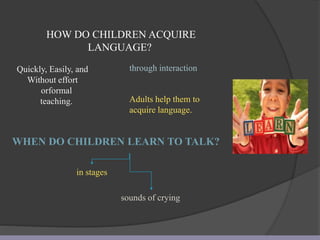
HOW DO CHILDREN ACQUIRE
LANGUAGE?
Quickly, Easily, and
Without effort
orformal
teaching.
through interaction
Adults help them to
acquire language.
WHEN DO CHILDREN LEARN TO TALK?
in stages
sounds of crying
LANGUAGE ACQUISITION
It's a process by which we learn to
speak, write, or even use sign
language in meaningful ways to
communicate
LANGUAGE ACQUISITION IN ADULTS
Adults who learned a second language can have fluent control
of grammar and communicative functions, but also a foreign
accent.
Expect that what they are learning will be immediately useful.
Adult language learners are goal oriented and direct their
learning to fulfill particular needs or demands.
LANGUAGE ACQUISITION
Language acquisition refers to the process of
natural assimilation, involving intuition and
subconscious learning.
It is the product of real interactions between people
in environments of the target language and culture,
where the learner is an active player.
LANGUAGE LEARNING
The concept of ¨language learning¨ is linked to the
traditional approach to the study of languages and today
is still generally practiced in high schools worldwide.
According to Krashen, students who are taught in a
formal, form-focussed way will “learn” the language but
never fully acquire it.
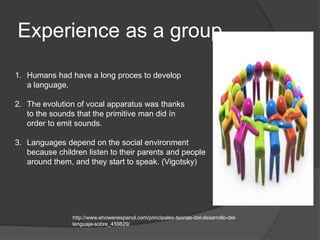
Experience as a group
1. Humans had have a long proces to develop
a language.
2. The evolution of vocal apparatus was thanks
to the sounds that the primitive man did ín
order to emit sounds.
3. Languages depend on the social environment
because children listen to their parents and people
around them, and they start to speak. (Vigotsky)
http://www.ehowenespanol.com/principales-teorias-del-desarrollo-del-
lenguaje-sobre_459829/
Language acquisition

Language acquisition

  • 1.
    CENTRAL UNIVERSITY OFECUADOR FACULTY OF PHILOSOPHIE LETTERS AND SCIENCES OF THE EDUCATION CAREER PLURILINGUE Subject: Didáctica Topic: LANGUAGE ACQUISITION Members:  Miguel Arízala  Mauricio Fiallos  Estela Robalino  Gabriela Ruiz
  • 2.
    LANGUAGE ACQUISITION Ability of: gettingspeaking skills incorporating integration and assimilation’s concepts •What is Language Acquisition, Theories, (2000) http://study.com/academy/lesson/what-is- language-acquisition-theories-stages-quiz.html
  • 3.
     makes ushumans  bird songs  it´s remarkable itself.  Need make us talk •Definition of language: http://www.oxforddictionaries.com/definition/english/language
  • 5.
  • 6.
    THE LANGUAGE LEARNEDBY CHILDREN AND PASSED FROM ONE GENERATION TO THE NEXT ACCORDING TO THE BOOK ¨OXFORD ADVANCED LEARNERS¨, MOTHER TONGUE AND FIRST LANGUAGE BOTH REFER TO THE LANGUAGE YOU ACQUIRE AS A CHILD AND ARE MOST FLUENT IN.
  • 7.
    A LANGUAGE OTHERTHAN THE MOTHER TONGUE THAT A PERSON OR COMMUNITY USES FOR PUBLIC COMMUNICATION, HIGHER EDUCATION, AND ADMINISTRATION A NON-NATIVE LANGUAGE OFFICIALLY RECOGNIZED AND ADOPTED IN A MULTILINGUAL COUNTRY AS A MEANS OF PUBLIC COMMUNICATION.
  • 8.
    HOW DO CHILDRENACQUIRE LANGUAGE? Quickly, Easily, and Without effort orformal teaching. through interaction Adults help them to acquire language. WHEN DO CHILDREN LEARN TO TALK? in stages sounds of crying
  • 9.
    LANGUAGE ACQUISITION It's aprocess by which we learn to speak, write, or even use sign language in meaningful ways to communicate
  • 10.
    LANGUAGE ACQUISITION INADULTS Adults who learned a second language can have fluent control of grammar and communicative functions, but also a foreign accent. Expect that what they are learning will be immediately useful. Adult language learners are goal oriented and direct their learning to fulfill particular needs or demands.
  • 12.
    LANGUAGE ACQUISITION Language acquisitionrefers to the process of natural assimilation, involving intuition and subconscious learning. It is the product of real interactions between people in environments of the target language and culture, where the learner is an active player.
  • 13.
    LANGUAGE LEARNING The conceptof ¨language learning¨ is linked to the traditional approach to the study of languages and today is still generally practiced in high schools worldwide. According to Krashen, students who are taught in a formal, form-focussed way will “learn” the language but never fully acquire it.
  • 14.
    Experience as agroup 1. Humans had have a long proces to develop a language. 2. The evolution of vocal apparatus was thanks to the sounds that the primitive man did ín order to emit sounds. 3. Languages depend on the social environment because children listen to their parents and people around them, and they start to speak. (Vigotsky) http://www.ehowenespanol.com/principales-teorias-del-desarrollo-del- lenguaje-sobre_459829/