






DIDACTICS
Victor Velastegui
Evelyn Mosquera
María Jiménez
Luzvenia Mason
Jhonny Dumancela
Elizabeth Noquez
WHAT IS LANGUAGE?
Language is a human system
of communication that uses
arbitrary signals, such as voice
sounds, gestures, and/or
written symbols.
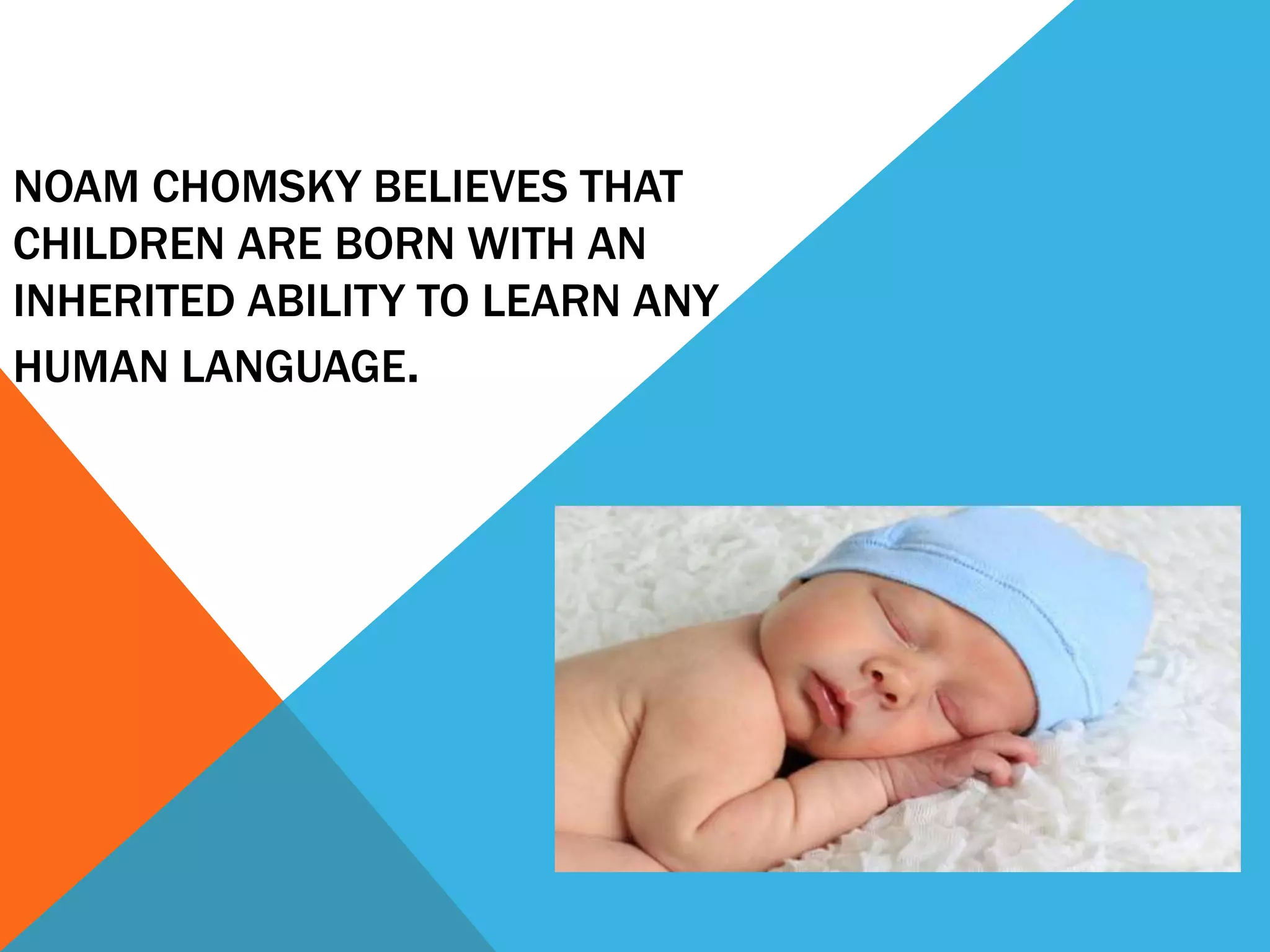
NOAM CHOMSKY BELIEVES THAT
CHILDREN ARE BORN WITH AN
INHERITED ABILITY TO LEARN ANY
HUMAN LANGUAGE.
CHOMSKY BELIEVES THAT EVERY
CHILD HAS A ‘LANGUAGE
ACQUISITION DEVICE’ OR LAD
WHICH ENCODES THE MAJOR
PRINCIPLES OF A LANGUAGE AND
ITS GRAMMATICAL STRUCTURES
INTO THE CHILD’S BRAIN. CHILDREN
HAVE THEN ONLY TO LEARN NEW
VOCABULARY AND APPLY THE
SYNTACTIC STRUCTURES.
CHOMSKY POINTS OUT THAT A CHILD COULD
NOT POSSIBLY LEARN A LANGUAGE THROUGH
IMITATION ALONE BECAUSE THE LANGUAGE
SPOKEN AROUND THEM IS HIGHLY
IRREGULAR – ADULT’S SPEECH IS OFTEN
BROKEN UP AND EVEN SOMETIMES
UNGRAMMATICAL. CHOMSKY’S THEORY
APPLIES TO ALL LANGUAGES AS THEY ALL
CONTAIN NOUNS, VERBS, CONSONANTS AND
VOWELS AND CHILDREN APPEAR TO BE
‘HARD-WIRED’ TO ACQUIRE THE GRAMMAR.
EVERY LANGUAGE IS EXTREMELY
COMPLEX, OFTEN WITH SUBTLE
DISTINCTIONS WHICH EVEN NATIVE
SPEAKERS ARE UNAWARE OF.
HOWEVER, ALL CHILDREN,
REGARDLESS OF THEIR INTELLECTUAL
ABILITY, BECOME FLUENT IN THEIR
NATIVE LANGUAGE WITHIN FIVE OR SIX
YEARS.
CHOMSKY, N. (1977). ASPECTS OF THE THEORY OF
SINTAX. EN N. CHOMSKY, ASPECTS OF THE THEORY OF
SINTAX (PÁG. 48). LONDON: MIT PRESS.
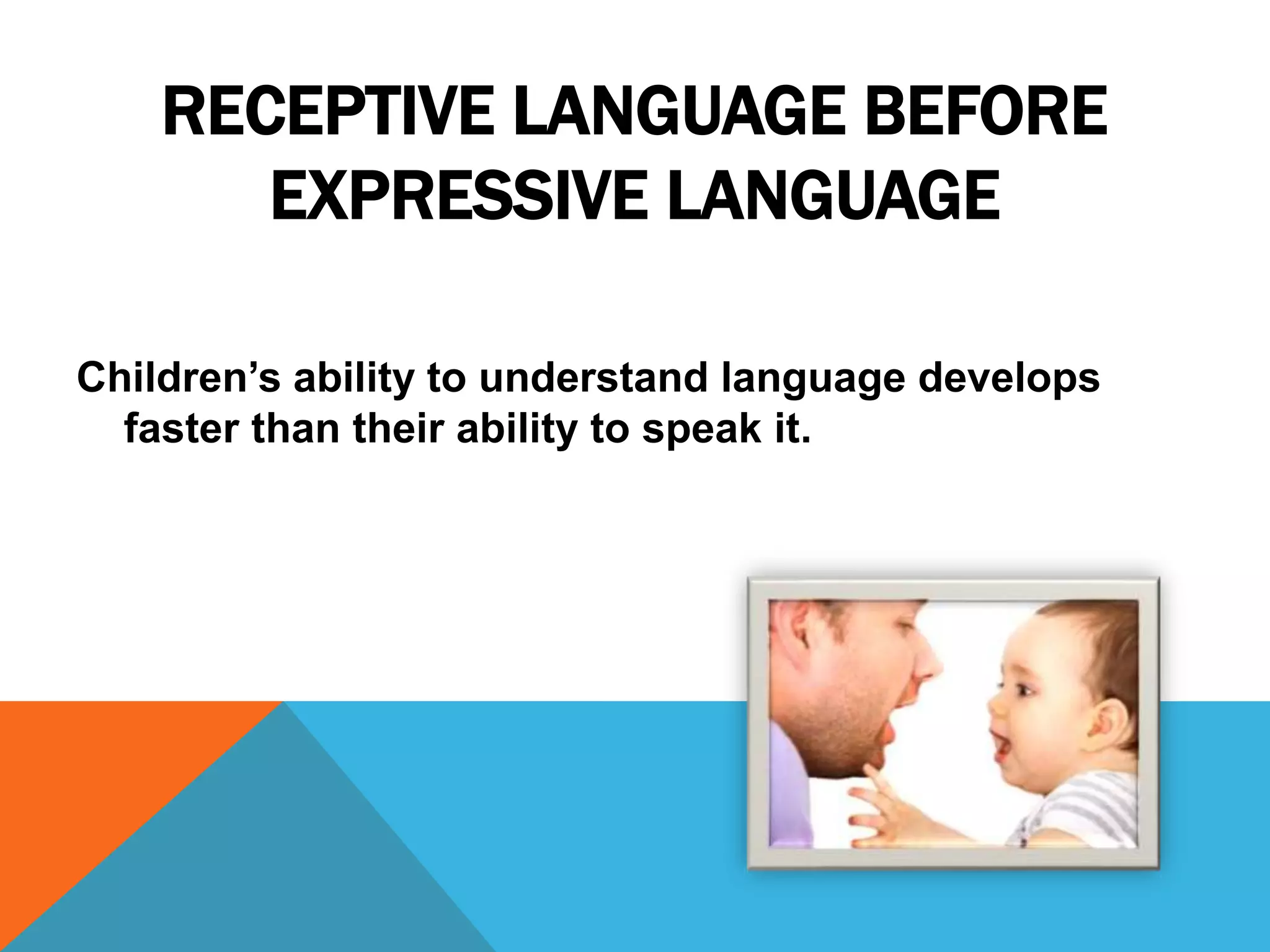
RECEPTIVE LANGUAGE BEFORE
EXPRESSIVE LANGUAGE
Children’s ability to understand language develops
faster than their ability to speak it.
ENVIRONMENTAL INFLUENCES ON LANGUAGE
ACQUISITION
Language is acquired through principles of conditioning, including
association, imitation, and reinforcement.
According to this view, children learn words by associating sounds with
objects, actions, and events.
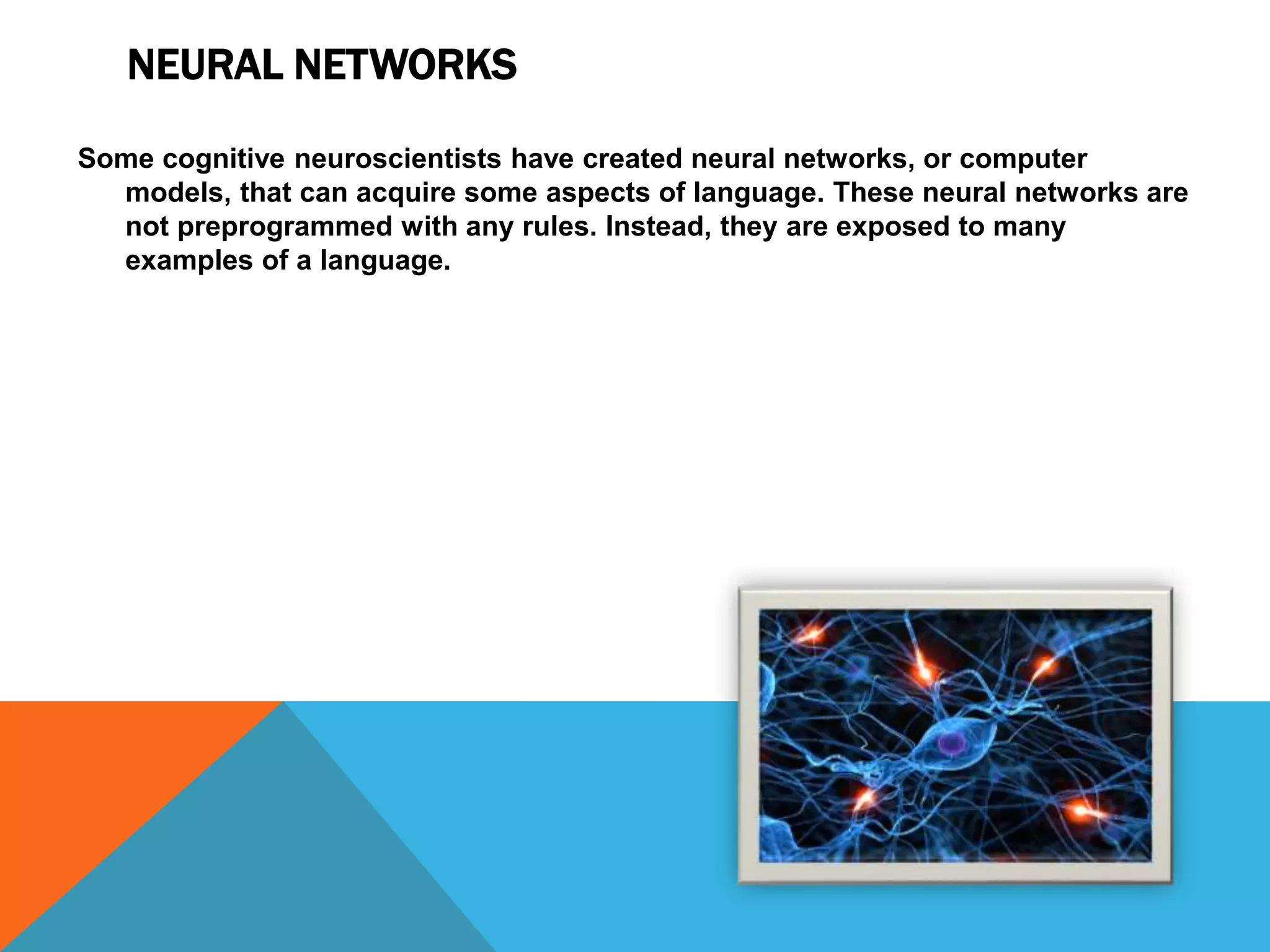
NEURAL NETWORKS
Some cognitive neuroscientists have created neural networks, or computer
models, that can acquire some aspects of language. These neural networks are
not preprogrammed with any rules. Instead, they are exposed to many
examples of a language.
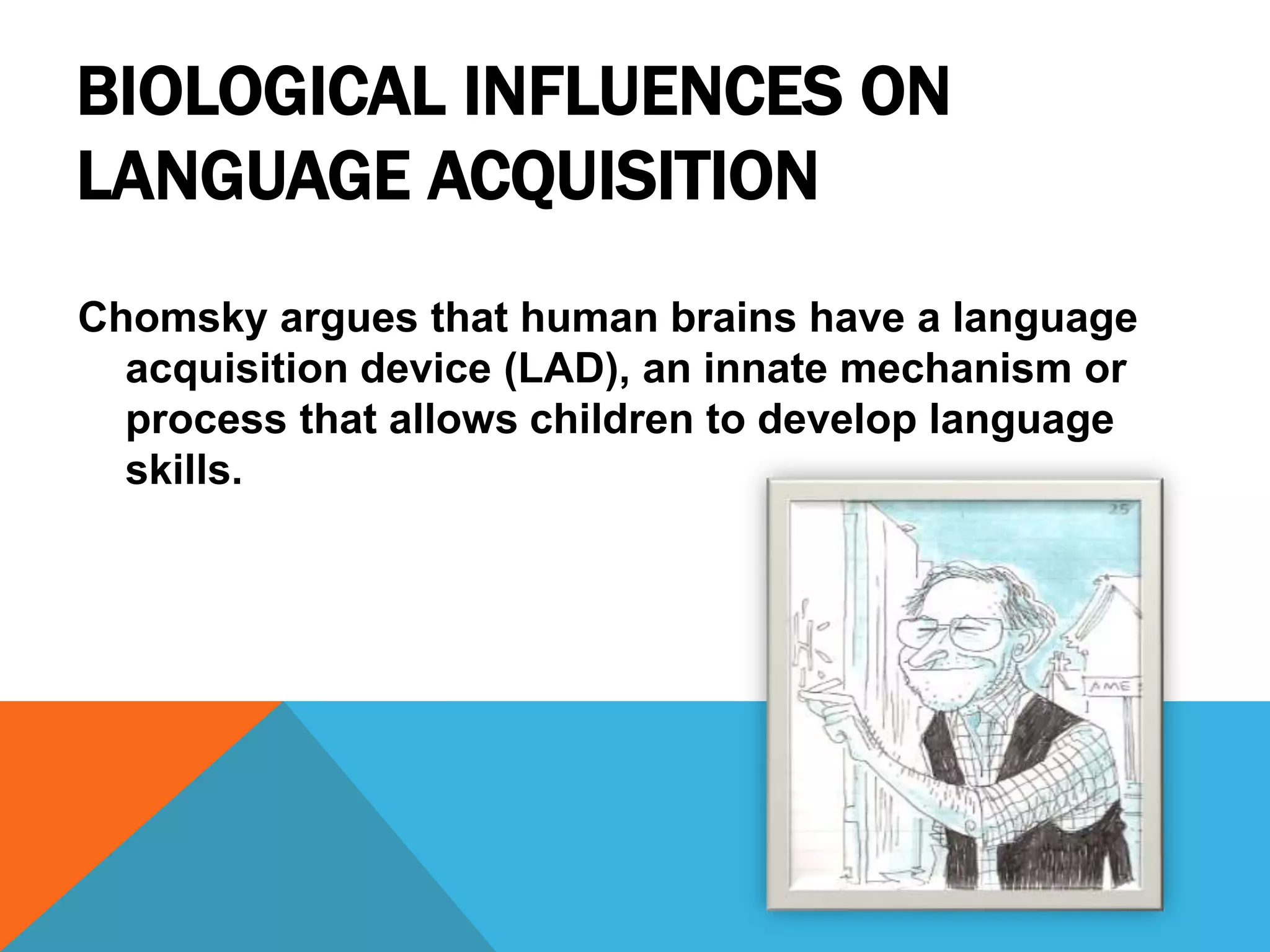
BIOLOGICAL INFLUENCES ON
LANGUAGE ACQUISITION
Chomsky argues that human brains have a language
acquisition device (LAD), an innate mechanism or
process that allows children to develop language
skills.
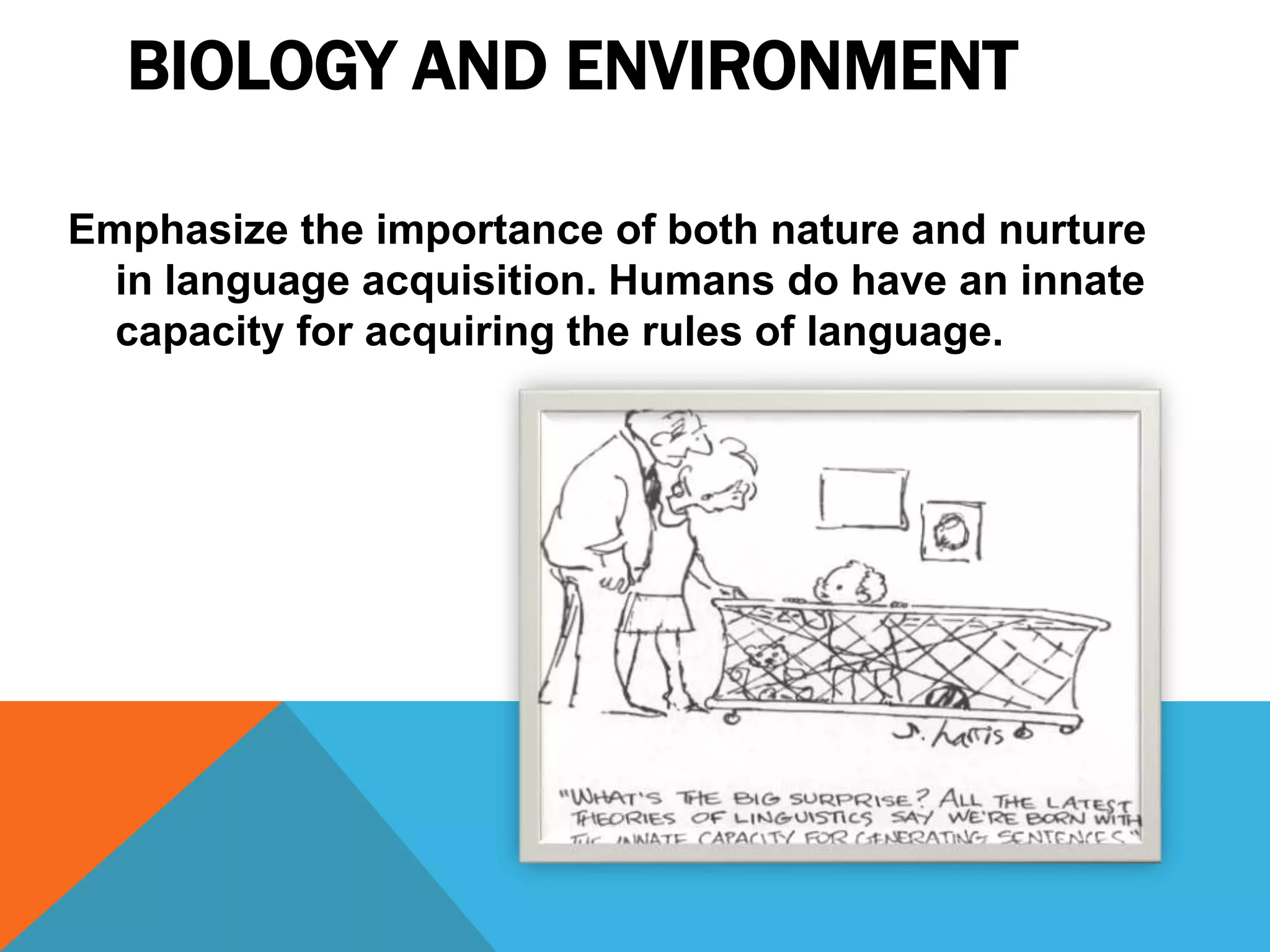
BIOLOGY AND ENVIRONMENT
Emphasize the importance of both nature and nurture
in language acquisition. Humans do have an innate
capacity for acquiring the rules of language.
FIRST
LANGUAGE
ACQUISITION
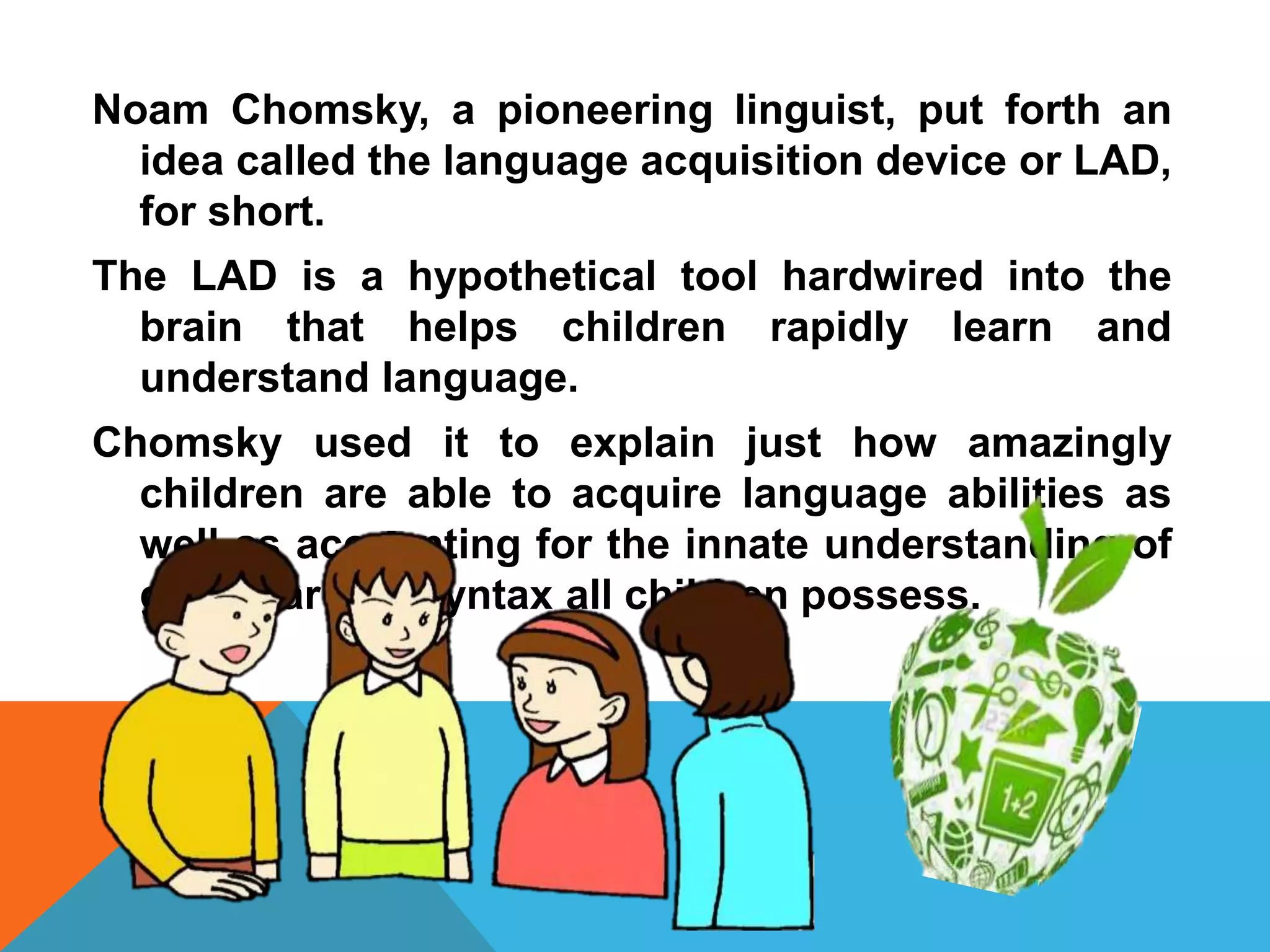
Noam Chomsky, a pioneering linguist, put forth an
idea called the language acquisition device or LAD,
for short.
The LAD is a hypothetical tool hardwired into the
brain that helps children rapidly learn and
understand language.
Chomsky used it to explain just how amazingly
children are able to acquire language abilities as
well as accounting for the innate understanding of
grammar and syntax all children possess.
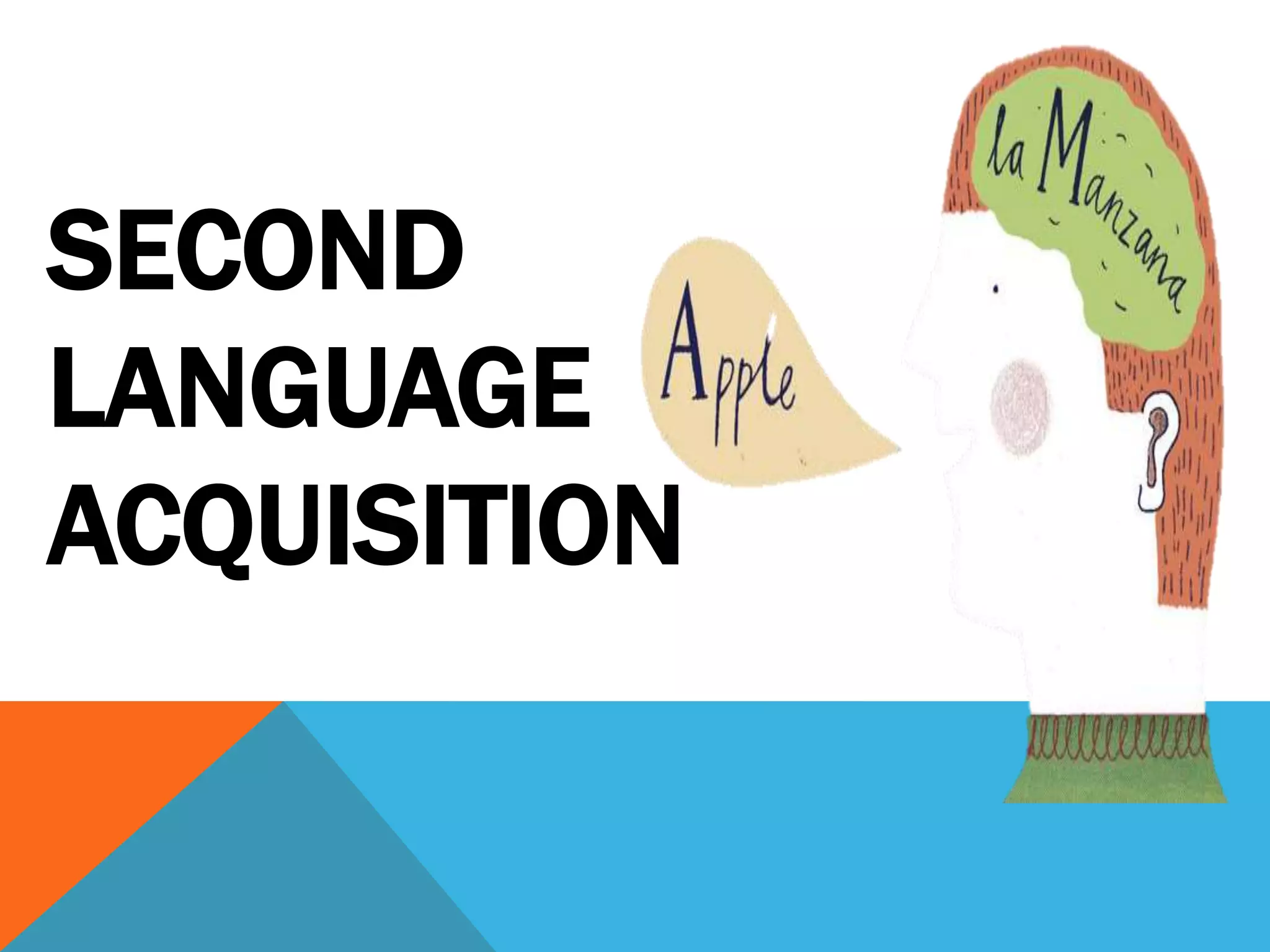
SECOND
LANGUAGE
ACQUISITION
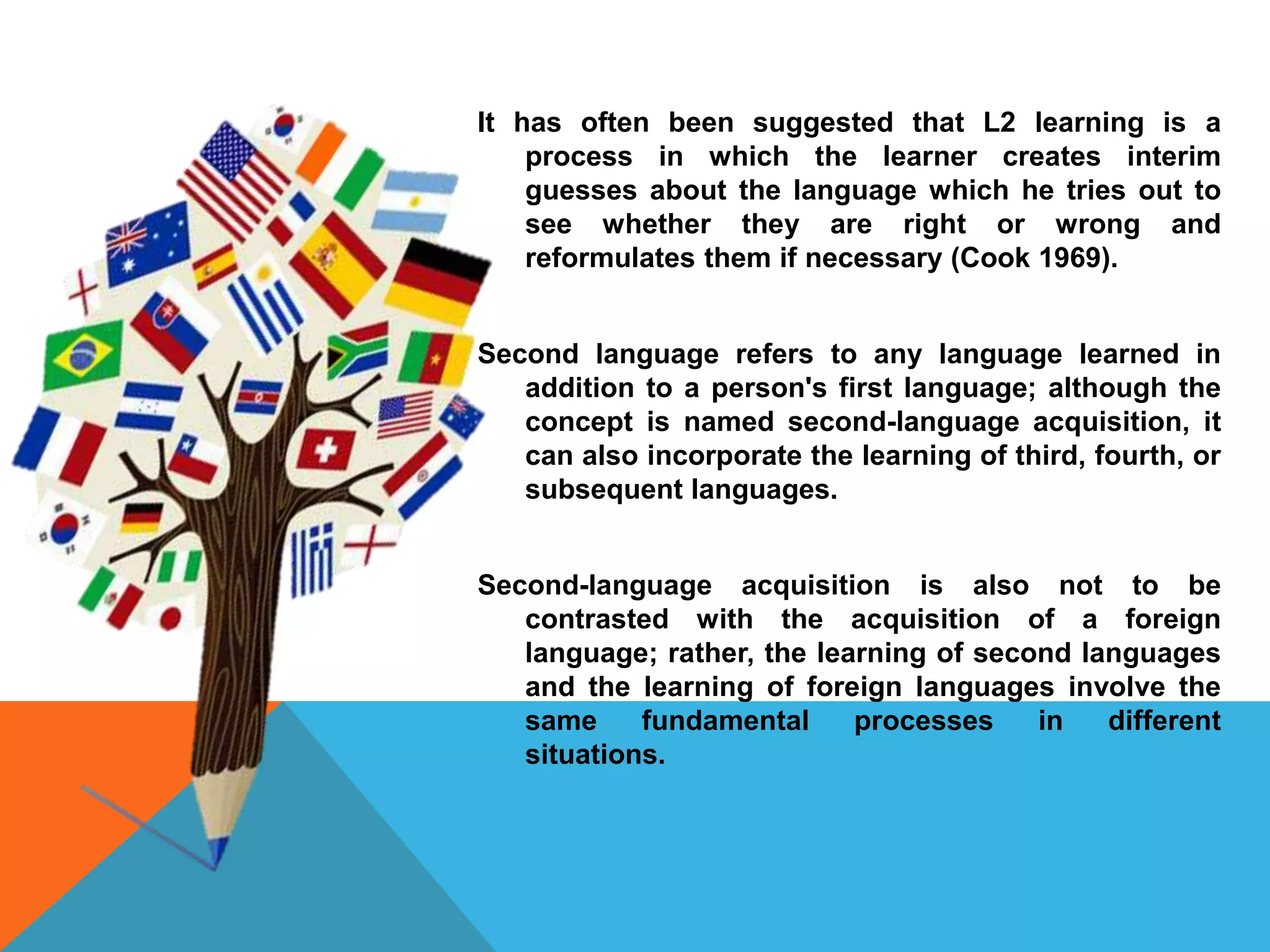
It has often been suggested that L2 learning is a
process in which the learner creates interim
guesses about the language which he tries out to
see whether they are right or wrong and
reformulates them if necessary (Cook 1969).
Second language refers to any language learned in
addition to a person's first language; although the
concept is named second-language acquisition, it
can also incorporate the learning of third, fourth, or
subsequent languages.
Second-language acquisition is also not to be
contrasted with the acquisition of a foreign
language; rather, the learning of second languages
and the learning of foreign languages involve the
same fundamental processes in different
situations.
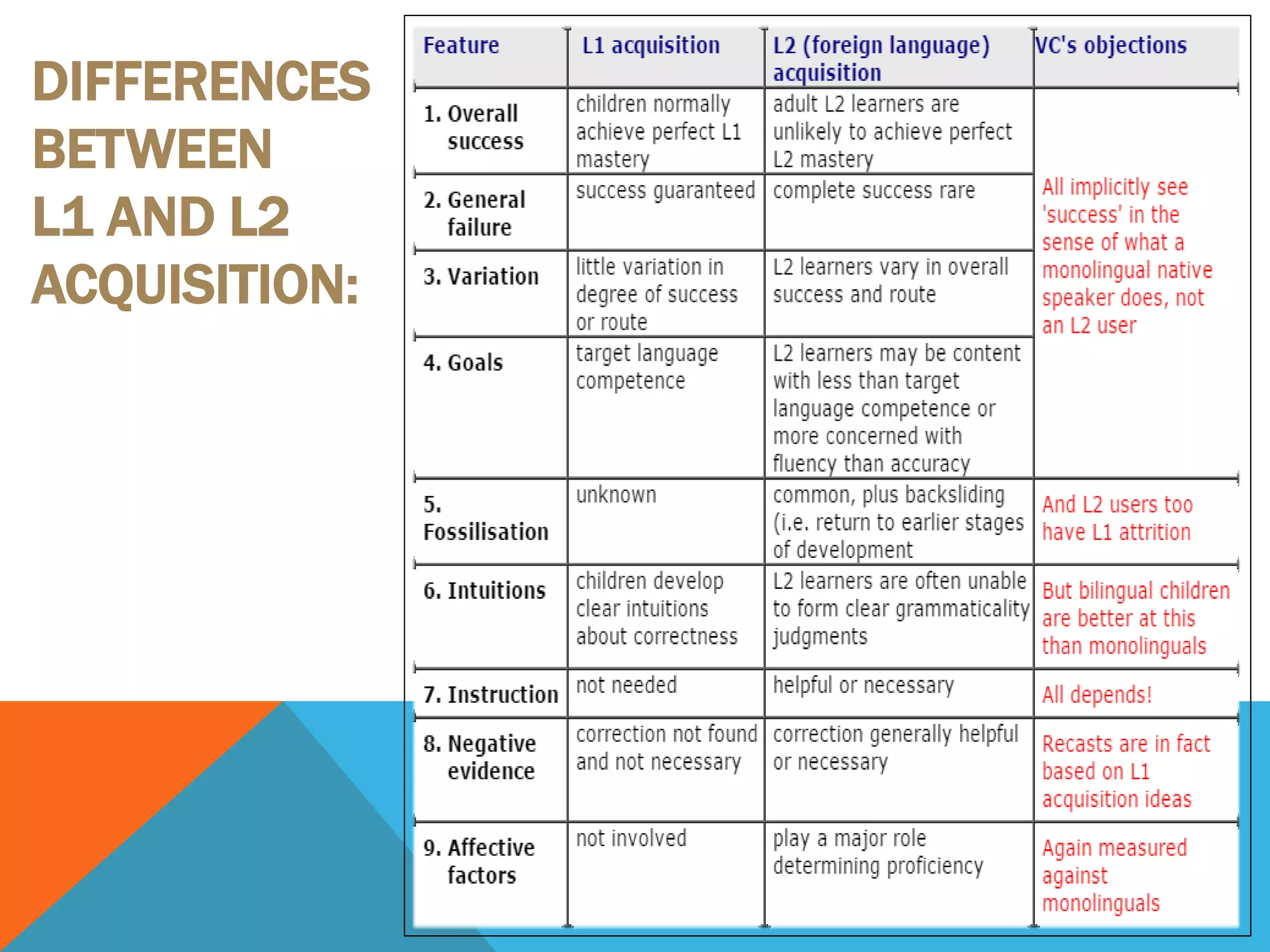
DIFFERENCES
BETWEEN
L1 AND L2
ACQUISITION:
ADULT LANGUAGE
ACQUISITION
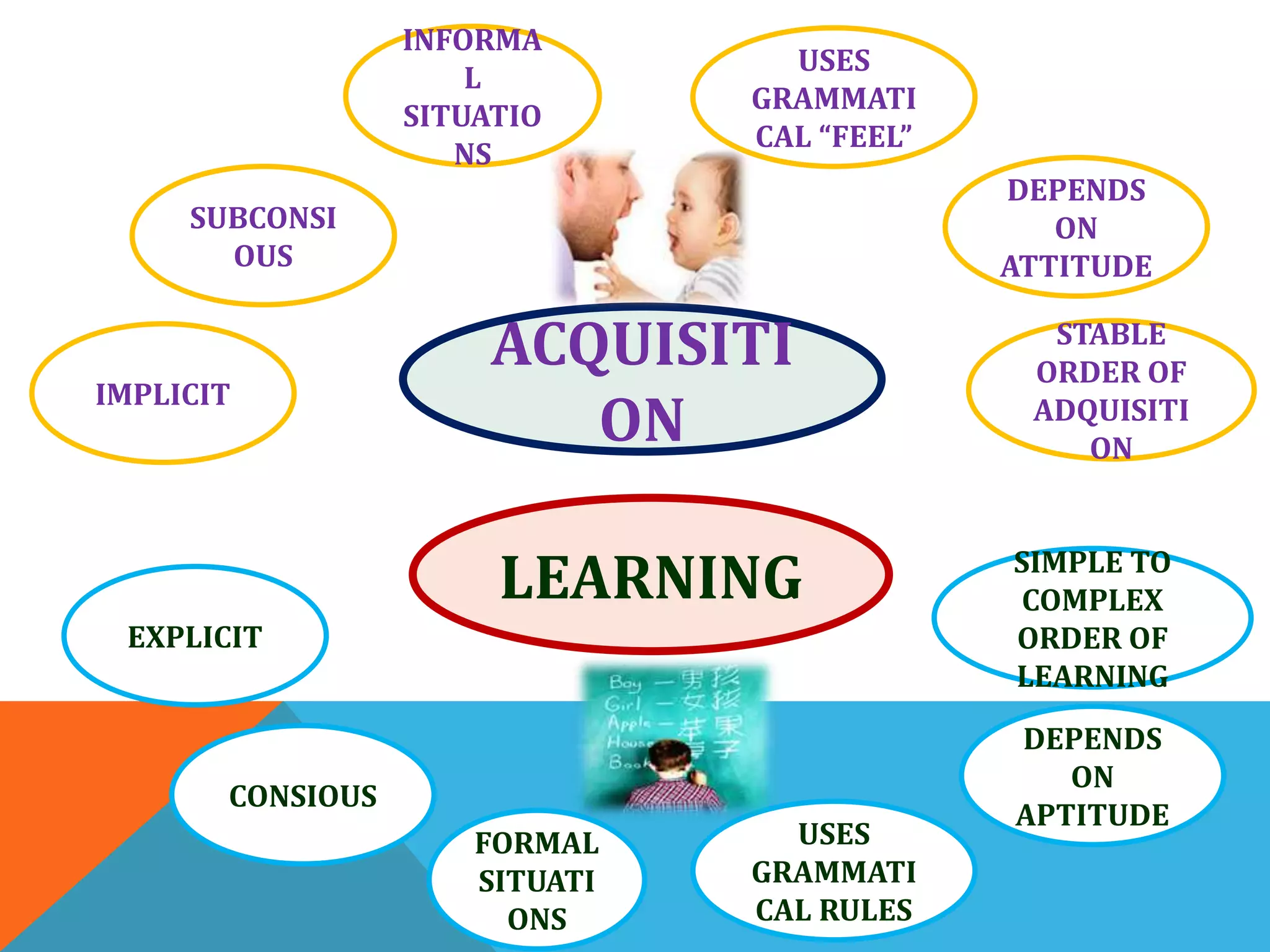
ACQUISITION
VS
LEARNING
ACQUISITI
ON
LEARNING
IMPLICIT
SUBCONSI
OUS
INFORMA
L
SITUATIO
NS
USES
GRAMMATI
CAL “FEEL”
STABLE
ORDER OF
ADQUISITI
ON
DEPENDS
ON
ATTITUDE
EXPLICIT
CONSIOUS
FORMAL
SITUATI
ONS
USES
GRAMMATI
CAL RULES
DEPENDS
ON
APTITUDE
SIMPLE TO
COMPLEX
ORDER OF
LEARNING
LANGUAGE
ACQUISITION
WHAT IS
LANGUAGE
ACQUISITION?
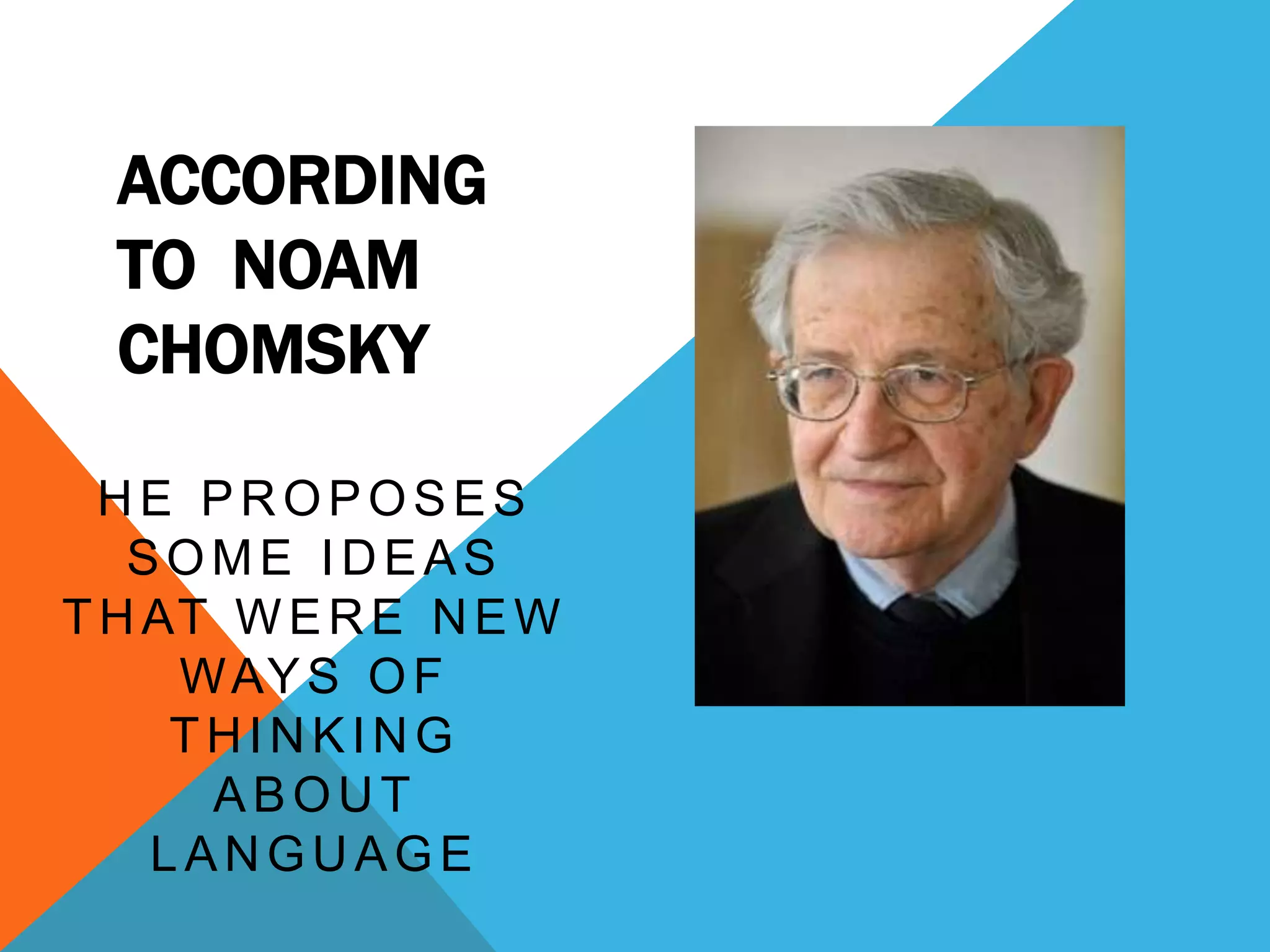
ACCORDING
TO NOAM
CHOMSKY
HE PROPOSES
SOME IDEAS
THAT WERE NEW
WAYS OF
THINKING
ABOUT
LANGUAGE
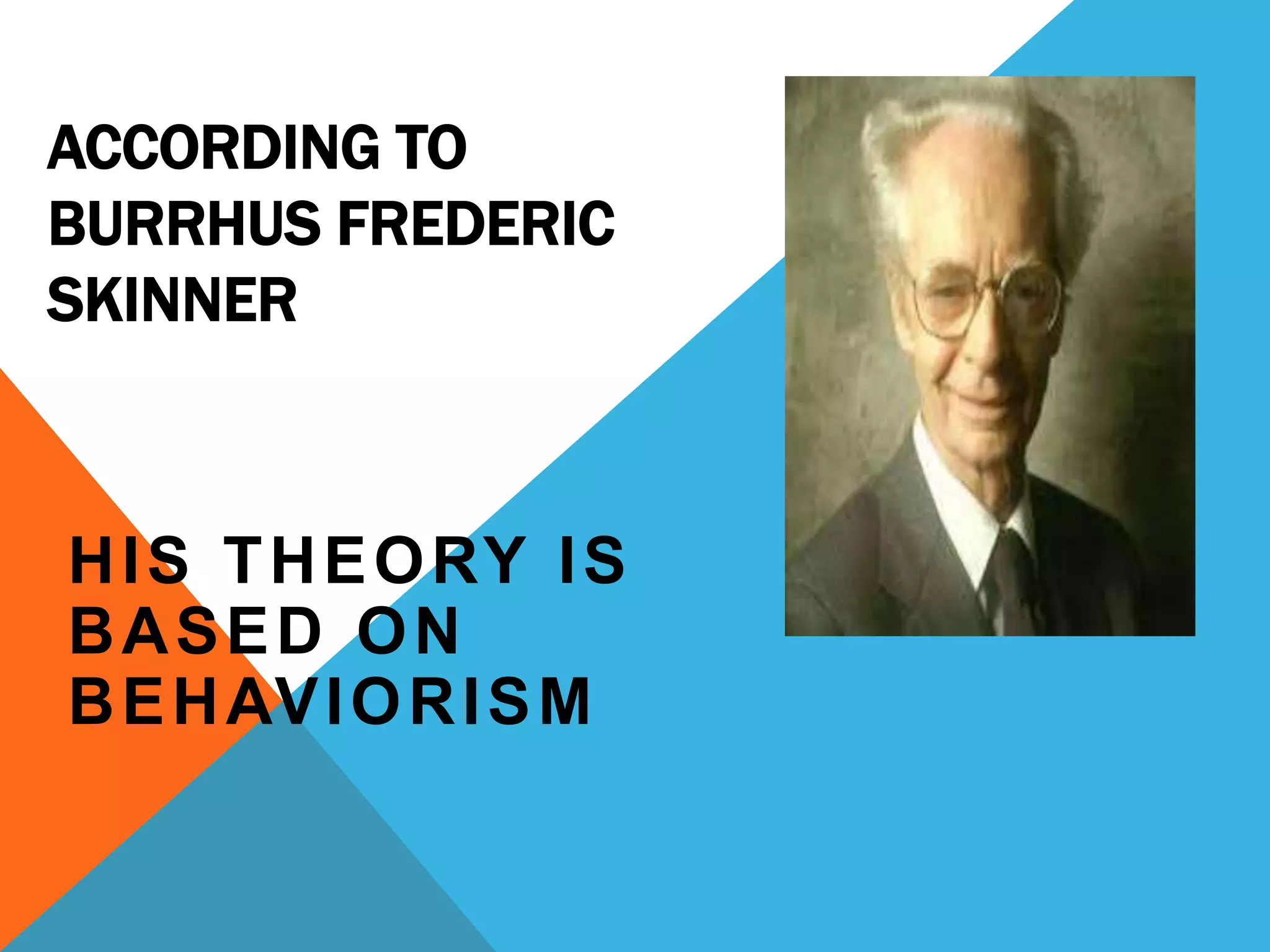
ACCORDING TO
BURRHUS FREDERIC
SKINNER
HIS THEORY IS
BASED ON
BEHAVIORISM
SparkNotes Editors. (2005). SparkNote on Language and Cognition.
Retrieved October 9, 2015, from
http://www.sparknotes.com/psychology/psych101/languageandco
gnition/
Andrea McKay .What Is Language Acquisition? .
http://study.com/academy/lesson/what-is-language-acquisition-
theories-stages-quiz.html
Stephen D Krashen . Second Language Acquisition
and Second Language Learning .University of Southern California
.2012
ESF European Science Foundation .Adult language acquisition:
cross-linguistic perspectives. Cambridge University.(2004 )
Extract from V.Cook (2000) 'Linguistics and Second Language
Acquisition: One Person with Two Languages', in Aronoff & Rees-
Miller, Blackwell Handbook of Linguistics

Didactics Theories about Language

  • 1.
    DIDACTICS Victor Velastegui Evelyn Mosquera MaríaJiménez Luzvenia Mason Jhonny Dumancela Elizabeth Noquez
  • 2.
    WHAT IS LANGUAGE? Languageis a human system of communication that uses arbitrary signals, such as voice sounds, gestures, and/or written symbols.
  • 3.
    NOAM CHOMSKY BELIEVESTHAT CHILDREN ARE BORN WITH AN INHERITED ABILITY TO LEARN ANY HUMAN LANGUAGE.
  • 4.
    CHOMSKY BELIEVES THATEVERY CHILD HAS A ‘LANGUAGE ACQUISITION DEVICE’ OR LAD WHICH ENCODES THE MAJOR PRINCIPLES OF A LANGUAGE AND ITS GRAMMATICAL STRUCTURES INTO THE CHILD’S BRAIN. CHILDREN HAVE THEN ONLY TO LEARN NEW VOCABULARY AND APPLY THE SYNTACTIC STRUCTURES.
  • 6.
    CHOMSKY POINTS OUTTHAT A CHILD COULD NOT POSSIBLY LEARN A LANGUAGE THROUGH IMITATION ALONE BECAUSE THE LANGUAGE SPOKEN AROUND THEM IS HIGHLY IRREGULAR – ADULT’S SPEECH IS OFTEN BROKEN UP AND EVEN SOMETIMES UNGRAMMATICAL. CHOMSKY’S THEORY APPLIES TO ALL LANGUAGES AS THEY ALL CONTAIN NOUNS, VERBS, CONSONANTS AND VOWELS AND CHILDREN APPEAR TO BE ‘HARD-WIRED’ TO ACQUIRE THE GRAMMAR.
  • 8.
    EVERY LANGUAGE ISEXTREMELY COMPLEX, OFTEN WITH SUBTLE DISTINCTIONS WHICH EVEN NATIVE SPEAKERS ARE UNAWARE OF. HOWEVER, ALL CHILDREN, REGARDLESS OF THEIR INTELLECTUAL ABILITY, BECOME FLUENT IN THEIR NATIVE LANGUAGE WITHIN FIVE OR SIX YEARS. CHOMSKY, N. (1977). ASPECTS OF THE THEORY OF SINTAX. EN N. CHOMSKY, ASPECTS OF THE THEORY OF SINTAX (PÁG. 48). LONDON: MIT PRESS.
  • 11.
    RECEPTIVE LANGUAGE BEFORE EXPRESSIVELANGUAGE Children’s ability to understand language develops faster than their ability to speak it.
  • 12.
    ENVIRONMENTAL INFLUENCES ONLANGUAGE ACQUISITION Language is acquired through principles of conditioning, including association, imitation, and reinforcement. According to this view, children learn words by associating sounds with objects, actions, and events.
  • 13.
    NEURAL NETWORKS Some cognitiveneuroscientists have created neural networks, or computer models, that can acquire some aspects of language. These neural networks are not preprogrammed with any rules. Instead, they are exposed to many examples of a language.
  • 14.
    BIOLOGICAL INFLUENCES ON LANGUAGEACQUISITION Chomsky argues that human brains have a language acquisition device (LAD), an innate mechanism or process that allows children to develop language skills.
  • 15.
    BIOLOGY AND ENVIRONMENT Emphasizethe importance of both nature and nurture in language acquisition. Humans do have an innate capacity for acquiring the rules of language.
  • 16.
  • 17.
    Noam Chomsky, apioneering linguist, put forth an idea called the language acquisition device or LAD, for short. The LAD is a hypothetical tool hardwired into the brain that helps children rapidly learn and understand language. Chomsky used it to explain just how amazingly children are able to acquire language abilities as well as accounting for the innate understanding of grammar and syntax all children possess.
  • 18.
  • 19.
    It has oftenbeen suggested that L2 learning is a process in which the learner creates interim guesses about the language which he tries out to see whether they are right or wrong and reformulates them if necessary (Cook 1969). Second language refers to any language learned in addition to a person's first language; although the concept is named second-language acquisition, it can also incorporate the learning of third, fourth, or subsequent languages. Second-language acquisition is also not to be contrasted with the acquisition of a foreign language; rather, the learning of second languages and the learning of foreign languages involve the same fundamental processes in different situations.
  • 20.
  • 22.
  • 23.
  • 24.
  • 25.
  • 26.
  • 27.
    ACCORDING TO NOAM CHOMSKY HE PROPOSES SOMEIDEAS THAT WERE NEW WAYS OF THINKING ABOUT LANGUAGE
  • 28.
    ACCORDING TO BURRHUS FREDERIC SKINNER HISTHEORY IS BASED ON BEHAVIORISM
  • 29.
    SparkNotes Editors. (2005).SparkNote on Language and Cognition. Retrieved October 9, 2015, from http://www.sparknotes.com/psychology/psych101/languageandco gnition/ Andrea McKay .What Is Language Acquisition? . http://study.com/academy/lesson/what-is-language-acquisition- theories-stages-quiz.html Stephen D Krashen . Second Language Acquisition and Second Language Learning .University of Southern California .2012 ESF European Science Foundation .Adult language acquisition: cross-linguistic perspectives. Cambridge University.(2004 ) Extract from V.Cook (2000) 'Linguistics and Second Language Acquisition: One Person with Two Languages', in Aronoff & Rees- Miller, Blackwell Handbook of Linguistics