Academic Libraries in The Future:
         From collections to impact

                    Stephen Abram, MLS
                        Langara College
                         Vancouver, BC
                           Feb. 13, 2012
Change

These slides are available at Stephen’s Lighthouse blog
We Only Get So Many
 Once-in-a-Lifetime
Chances To Do Great
      Things
News Flash
“The Internet and technology have
    now progressed to their infancy”
So how must library and
educator strategies change?
Change can happen very fast
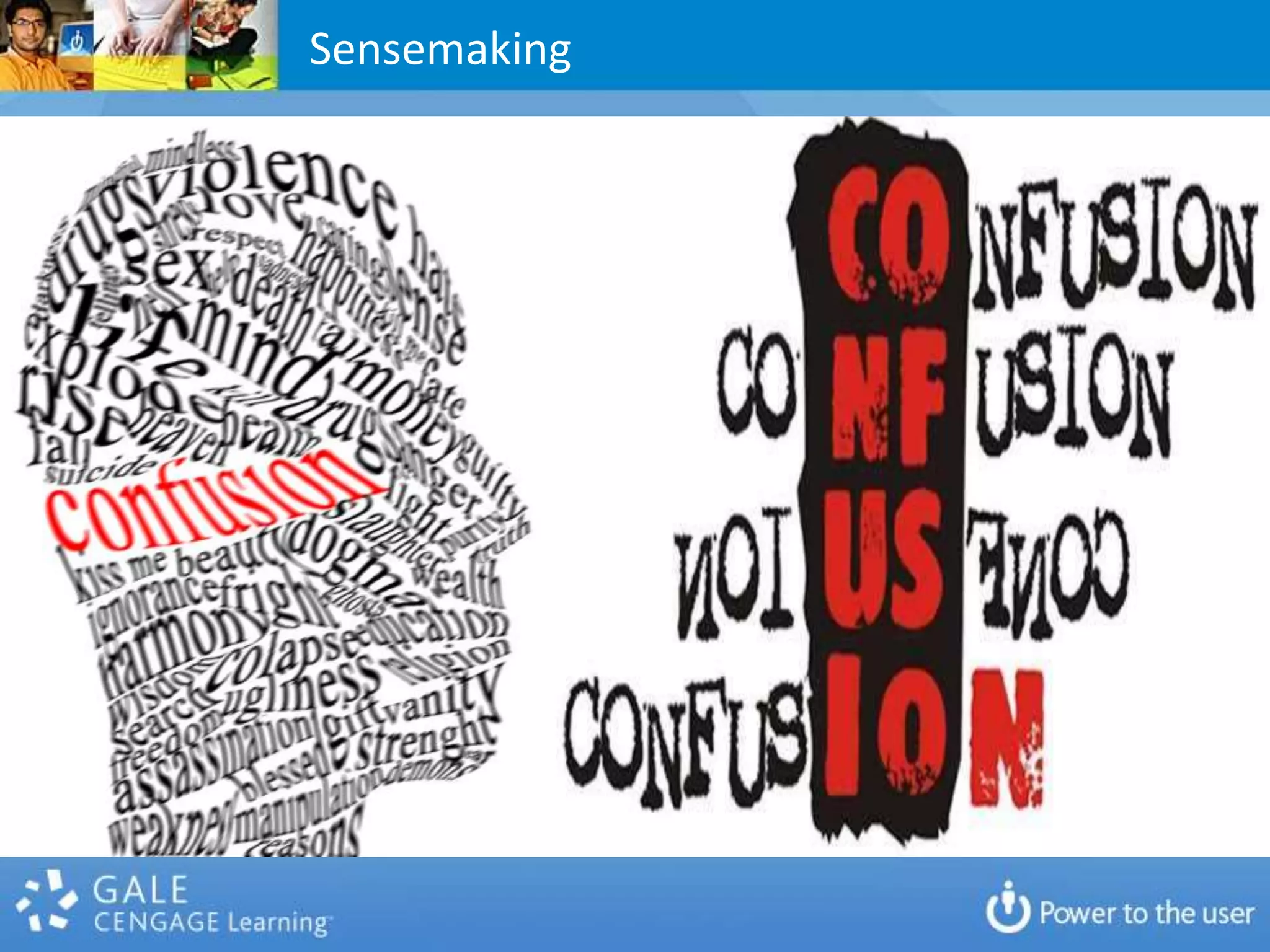
Sensemaking
News Flash

       News Flash


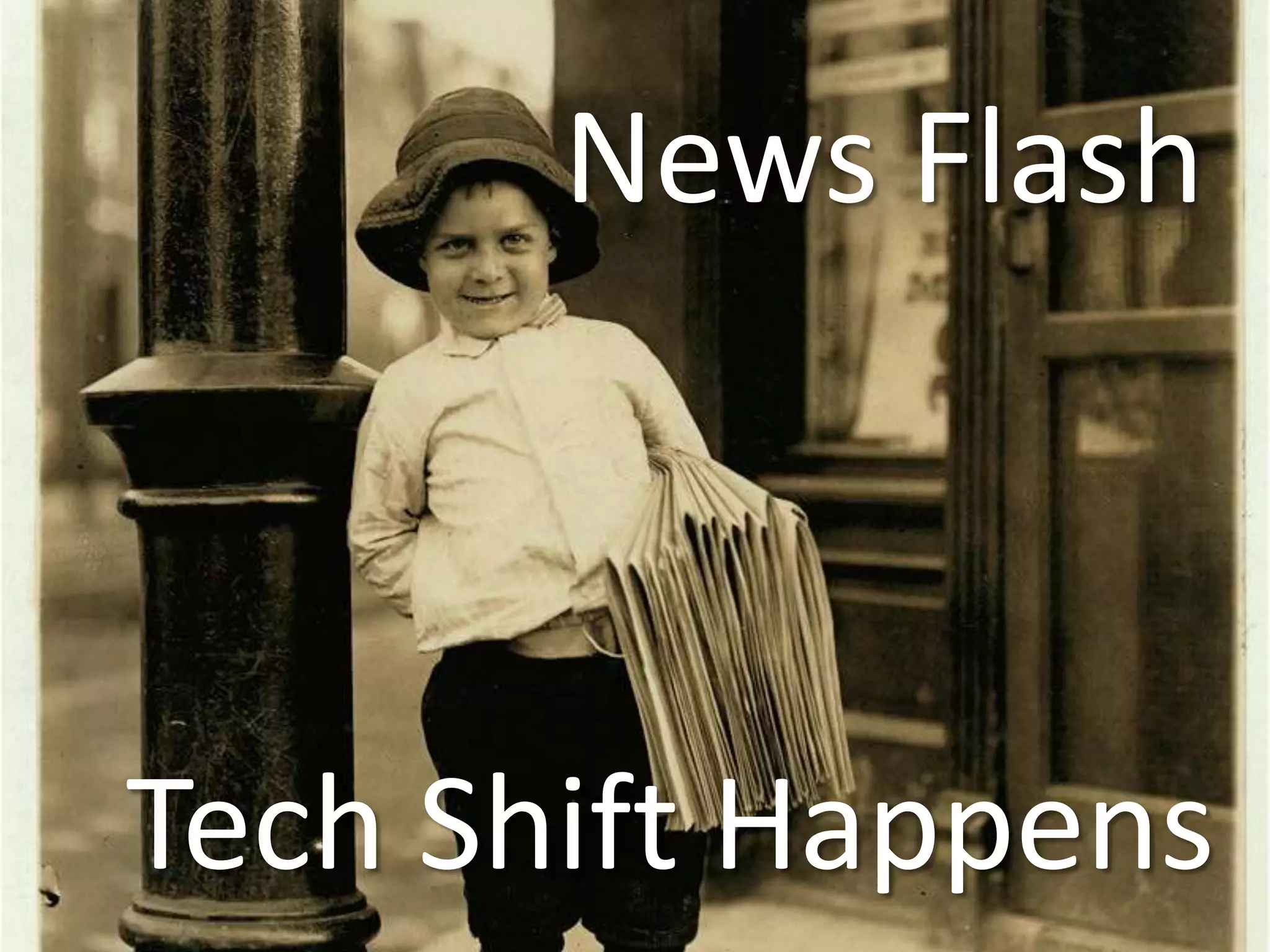
Tech Shift Happens
Seth Godin on Decisions (June 8, 2011)

o Which of the four are getting in the way?
o You don't know what to do
o You don't know how to do it
o You don't have the authority or the resources
  to do it
o You're afraid
o Once you figure out what's getting in the way,
  it's far easier to find the answer (or decide to
  work on a different problem).
o Stuck is a state of mind, and it's curable.
What Are Libraries Really For?

•   Community
•   Learning
•   Discovery
•   Progress
•   Research (Applied and Theoretical)
•   Cultural & Knowledge Custody
•   Economic Impact
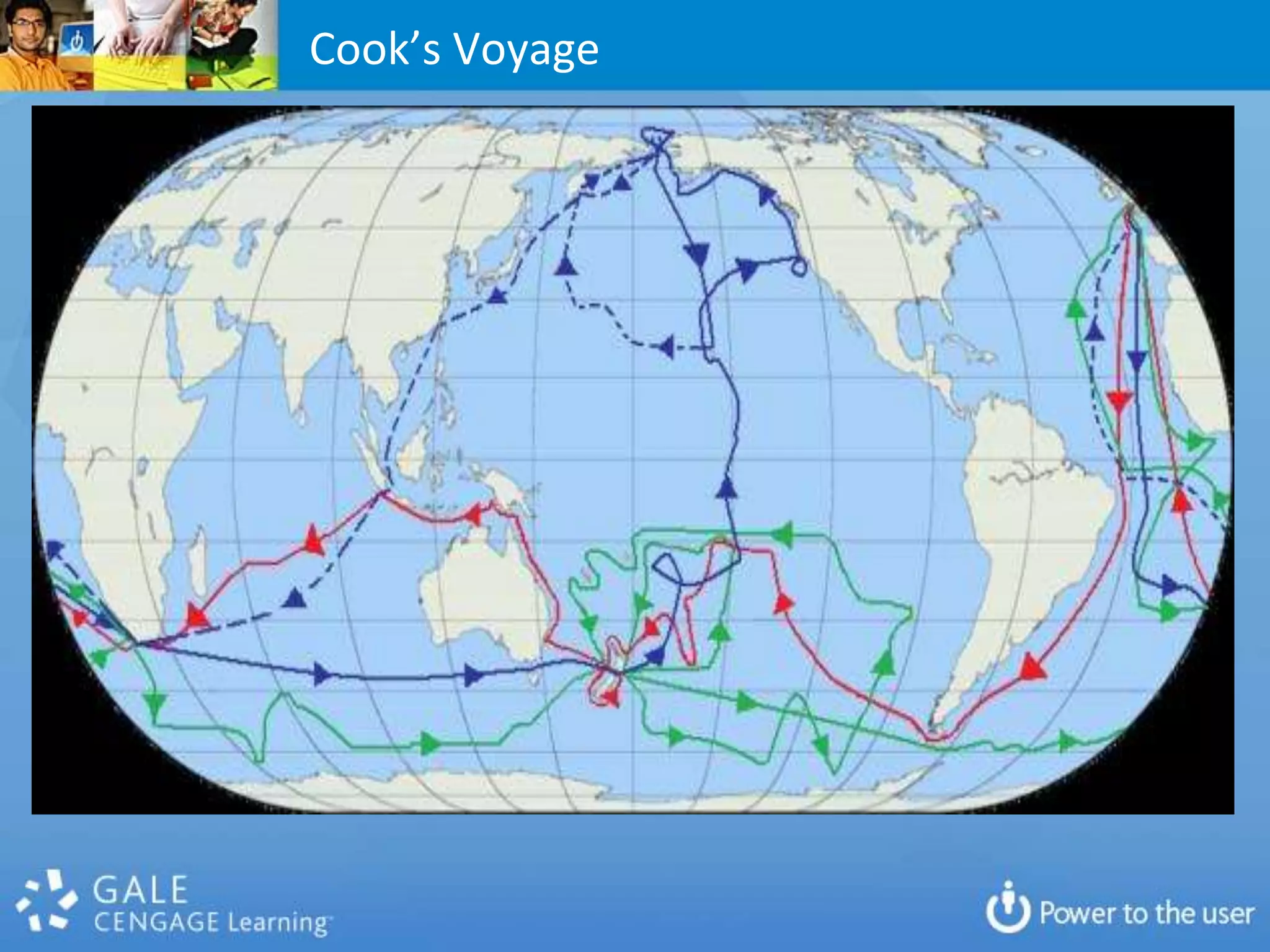
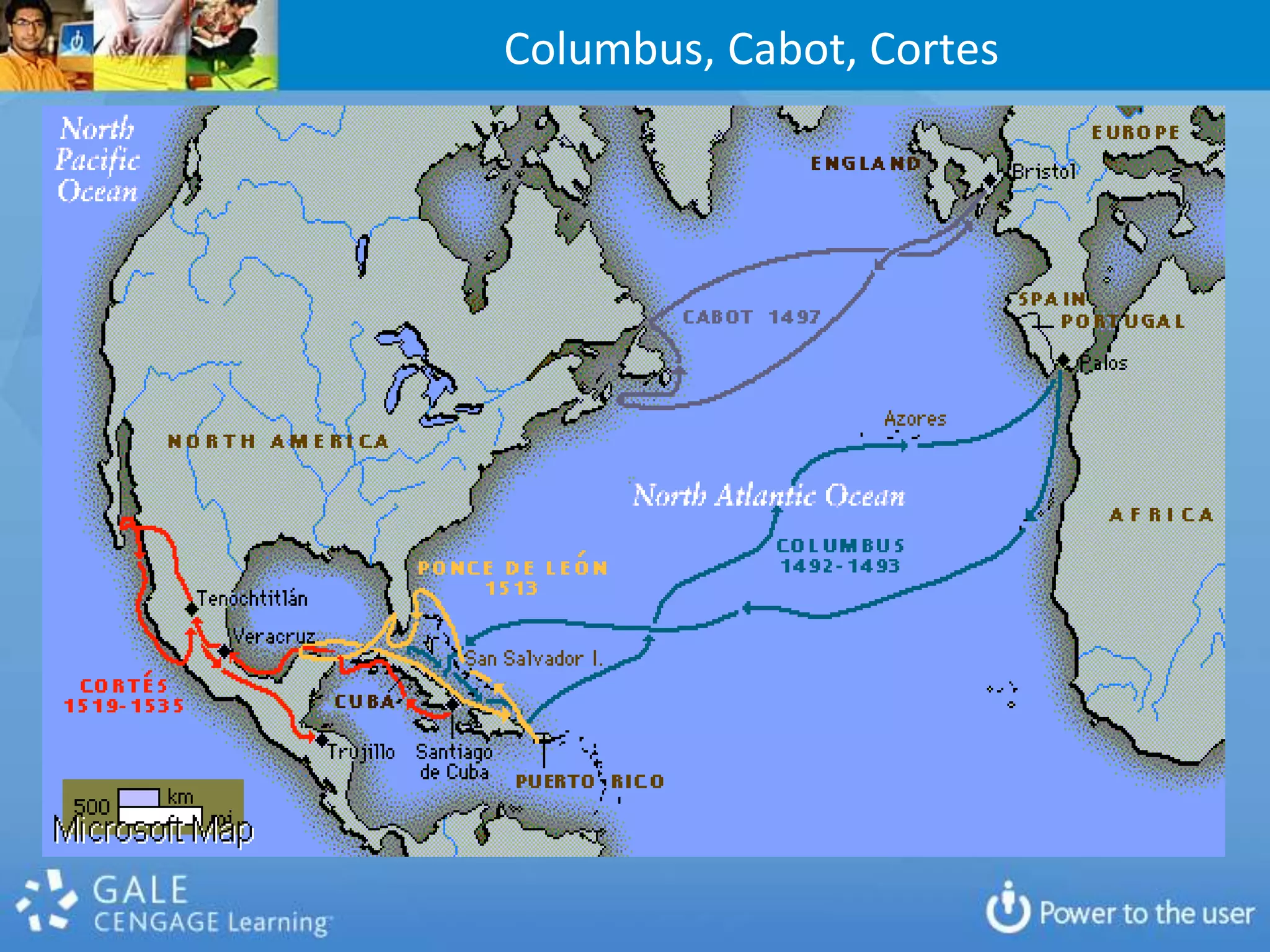
Columbus, Cook, Magellan and Libraries:
Searching for the corners of the earth, the edge of the
         oceans and discovering dragons ...
-
Cook’s Voyage
Columbus, Cabot, Cortes
Magellan   Columbus   Cook
Questions for Libraries Today:

1. Are our priorities right?
2. Are learning, research, discovery changing
   materially and what is actually changing?
3. Books. Meh.
4. What is the role for librarians in the real
   future (that is not an extension of the past)?
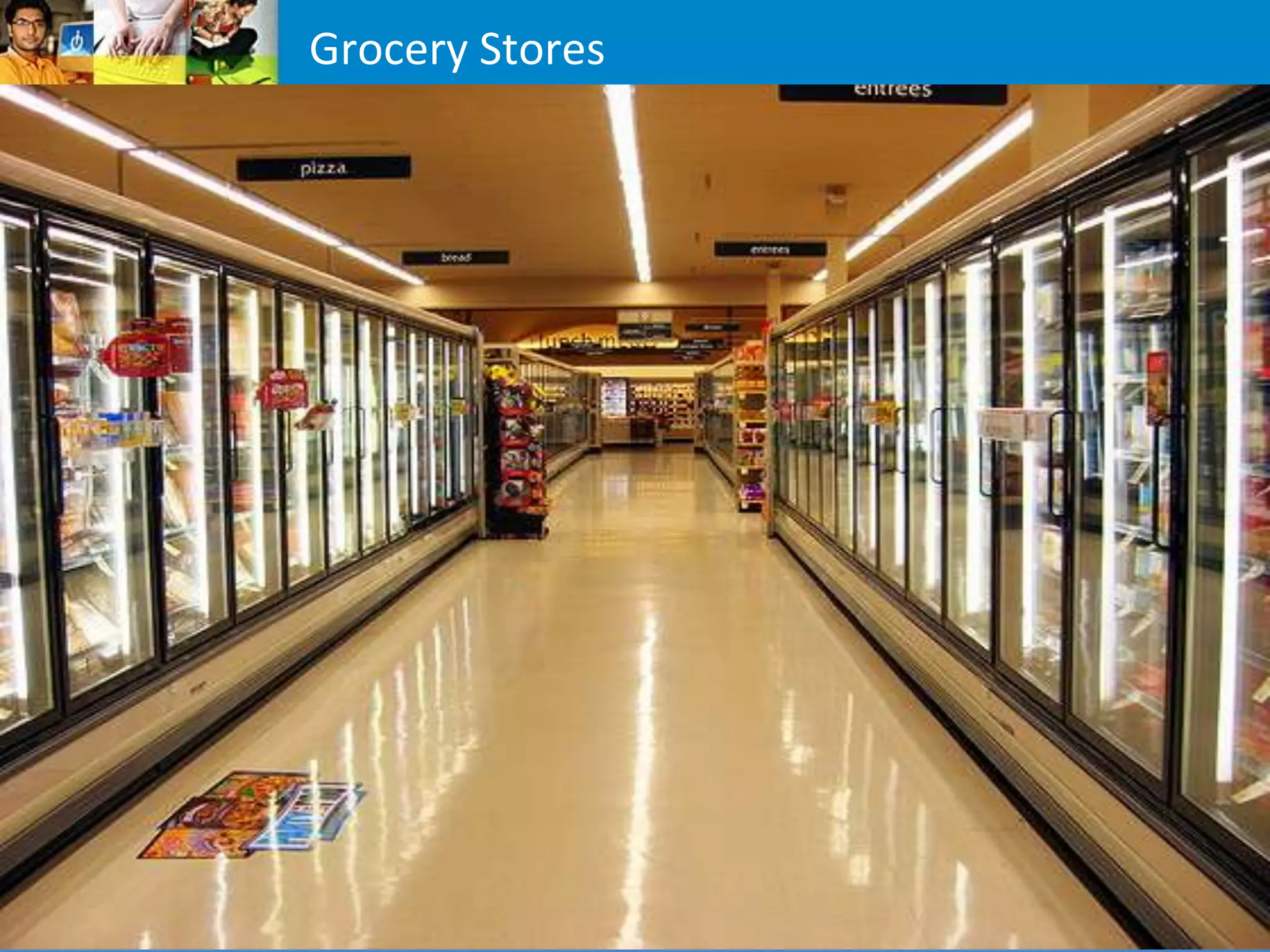
Grocery Stores
Grocery Stores
Grocery Stores
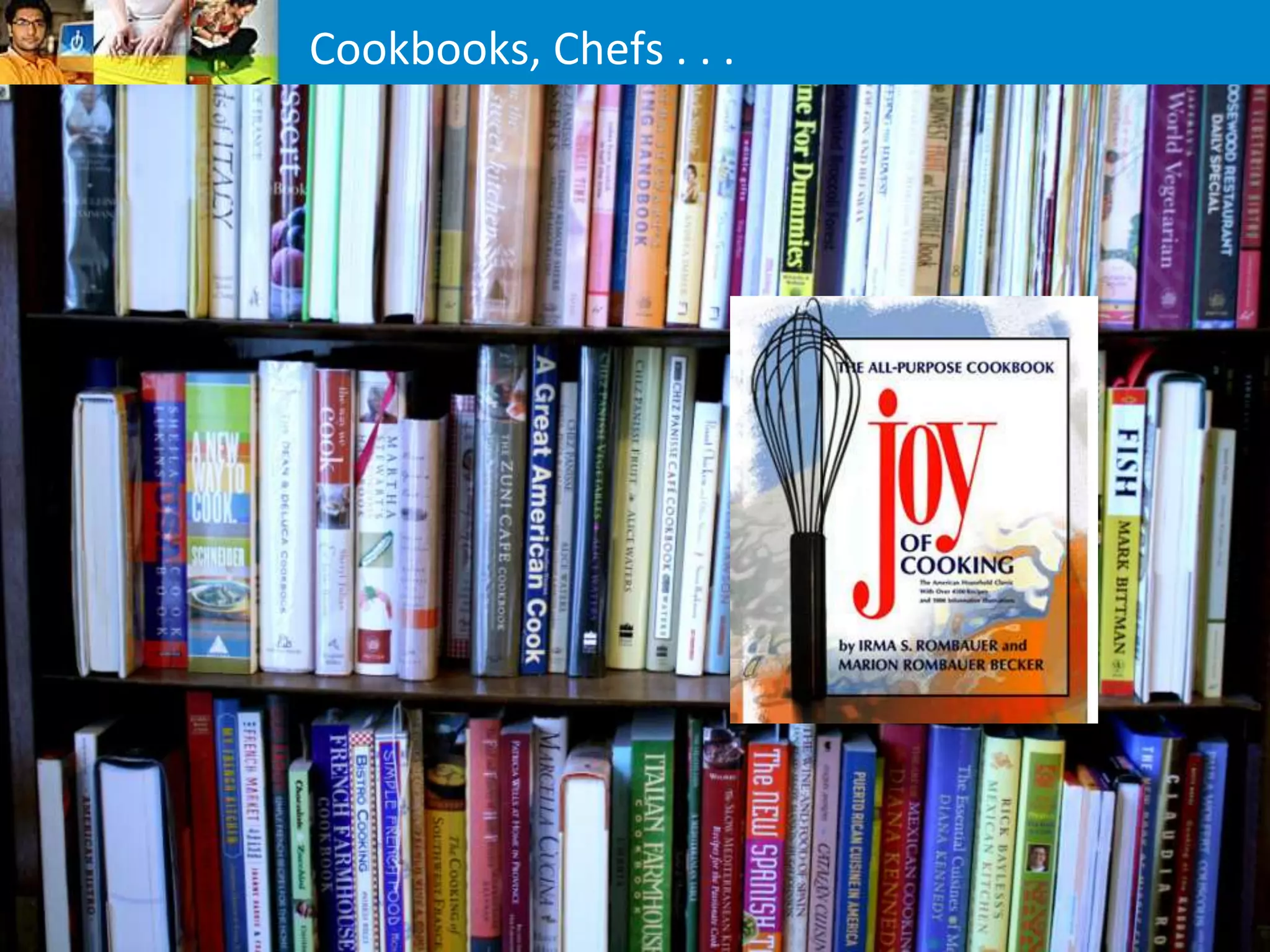
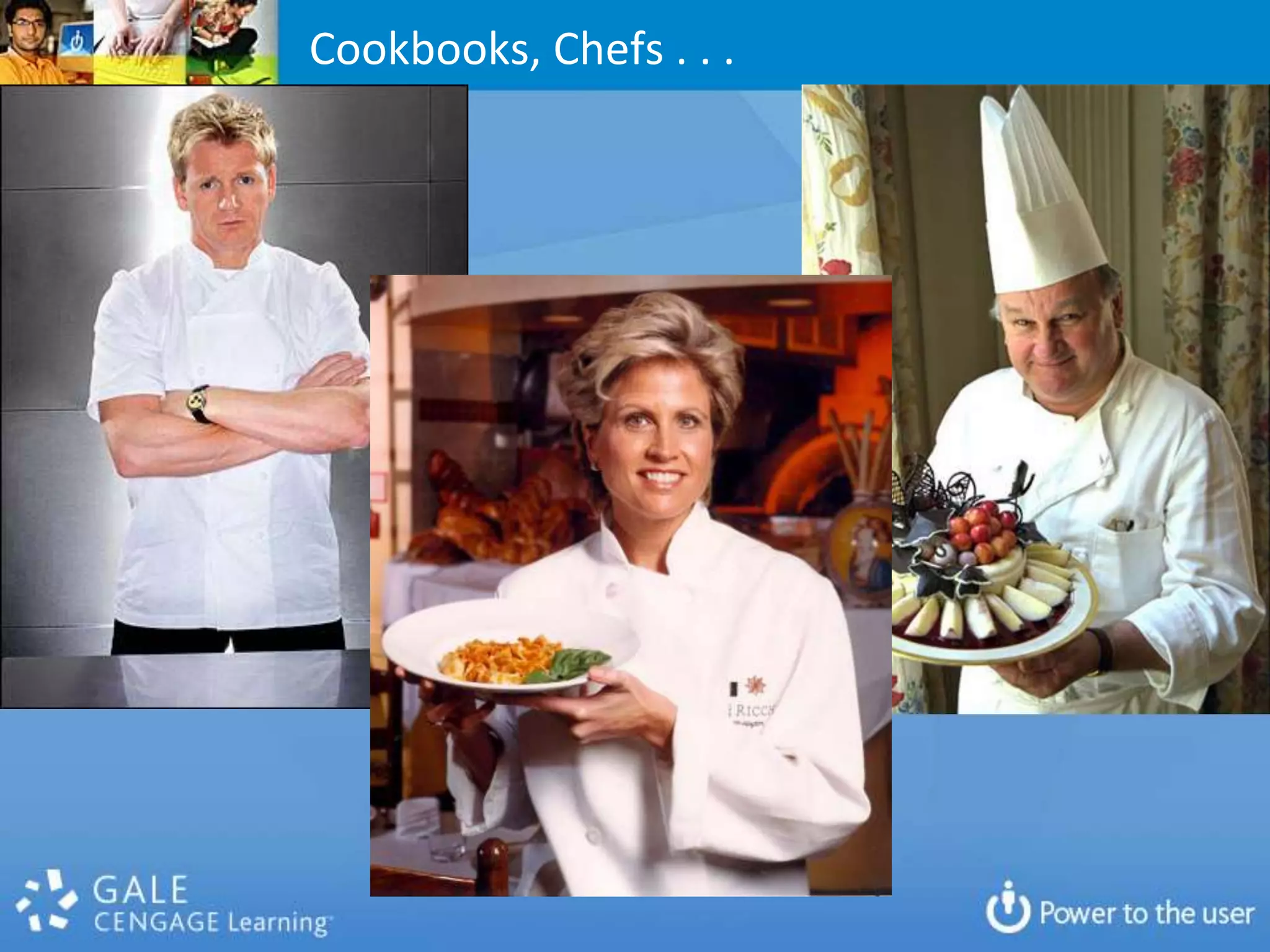
Cookbooks, Chefs . . .
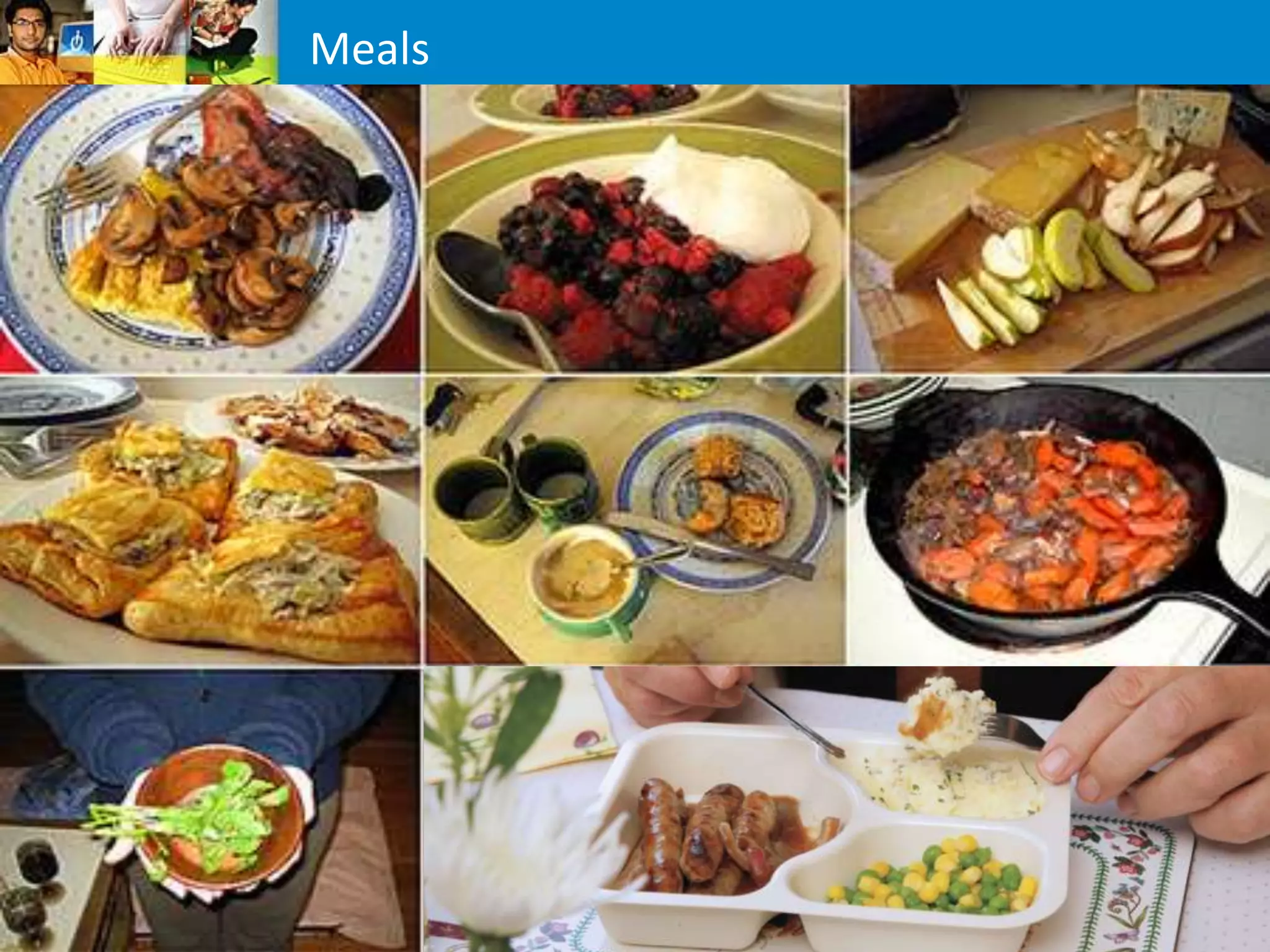
Meals
The new
bibliography and
    collection
  development


                     KNOWLEDGE
                       PORTALS
                    KNOWLEDGE,
                      LEARNING,
                   INFORMATION &
                      RESEARCH
                      COMMONS
Chefs, counsellors, teachers, magicians

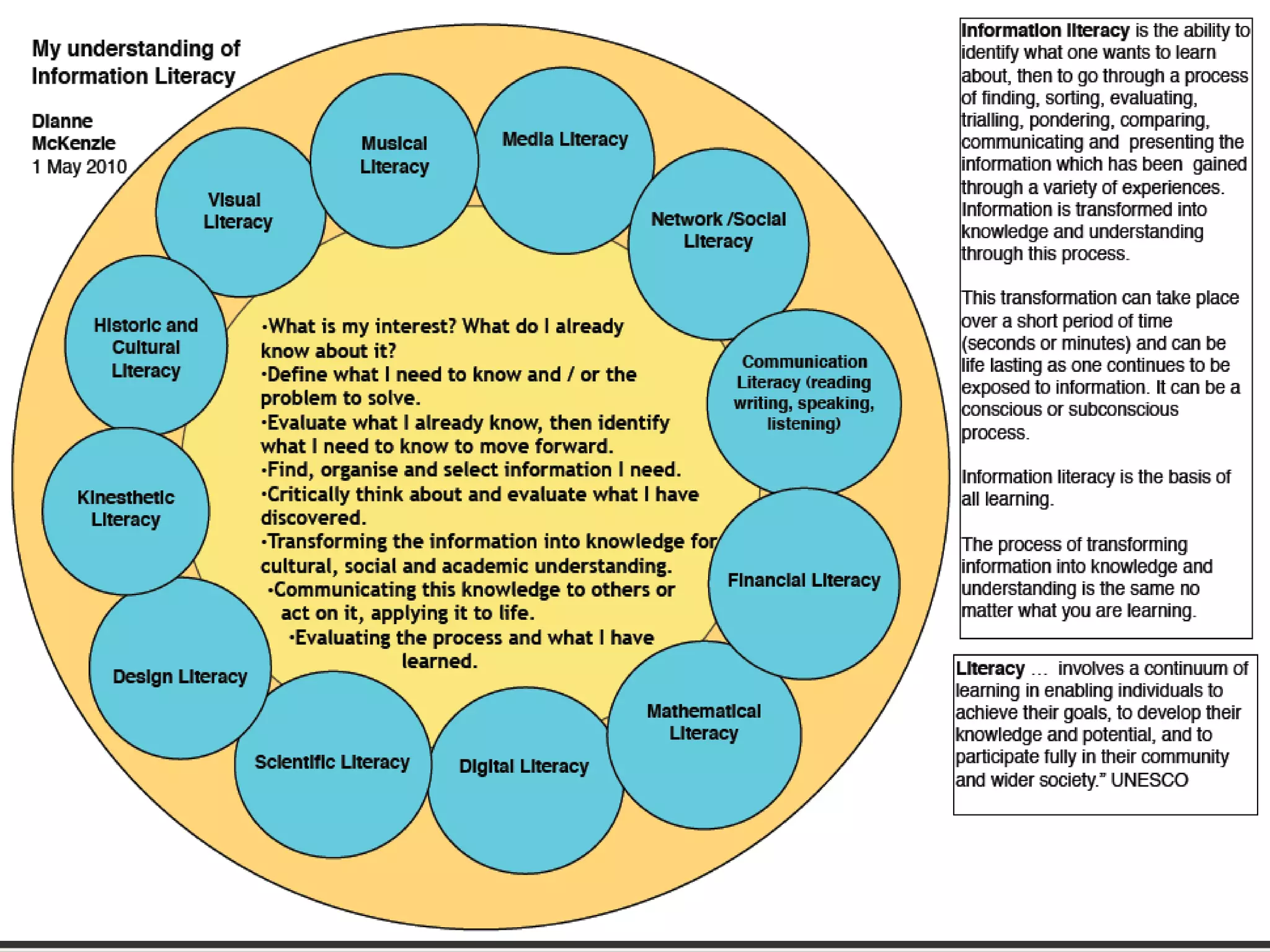
Librarians play a vital role in building the
        critical connections between
   information , knowledge and learning.
Service Metaphor

o Cafeterias
o Take Out
o Private Dining Rooms
o Private Chefs
o Variety
You have the tools.
Stop Making it So Hard!
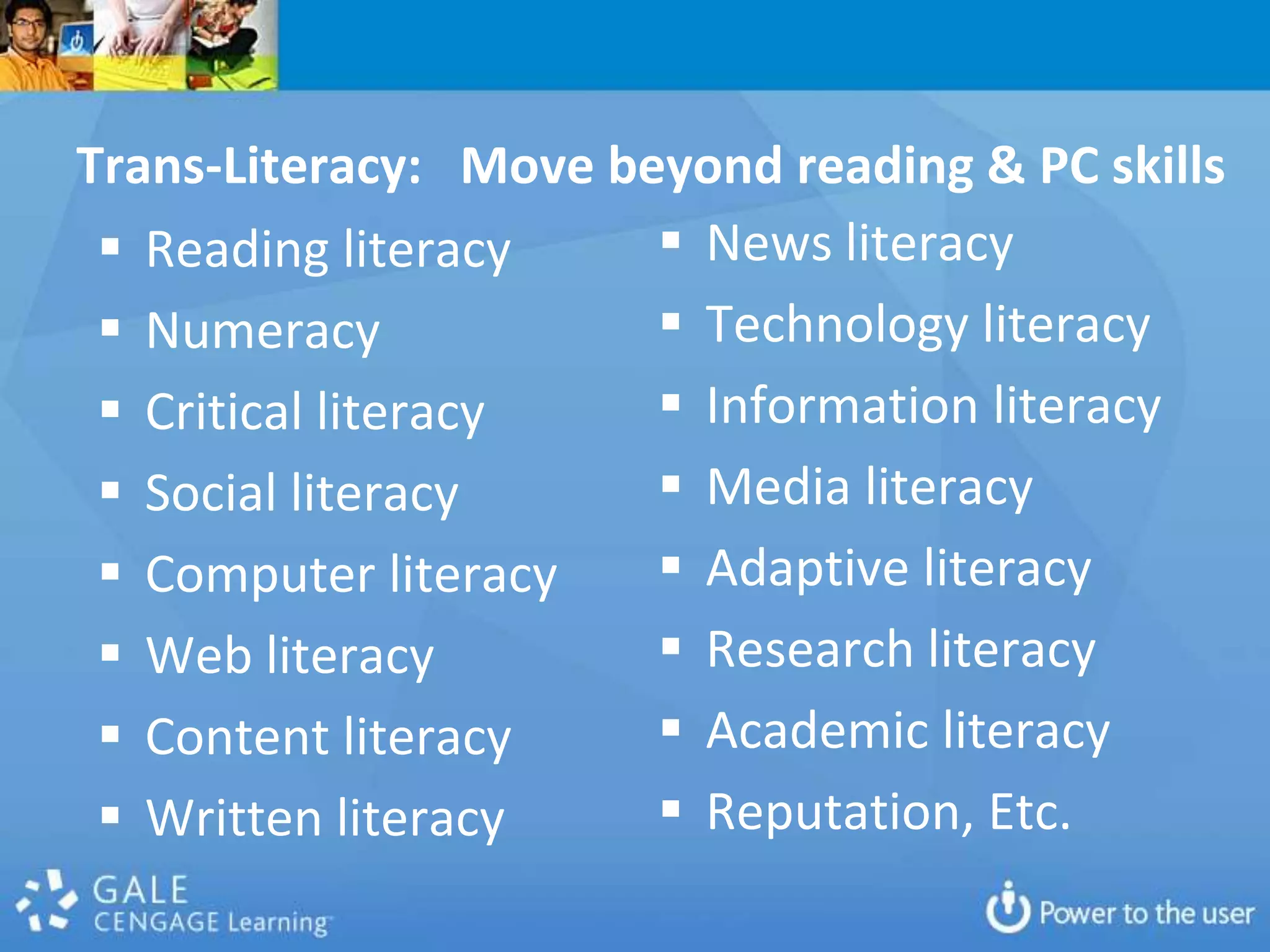
Trans-Literacy: Move beyond reading & PC skills
  Reading literacy     News literacy
  Numeracy             Technology literacy
  Critical literacy    Information literacy
  Social literacy      Media literacy
  Computer literacy    Adaptive literacy
  Web literacy         Research literacy
  Content literacy     Academic literacy
  Written literacy     Reputation, Etc.
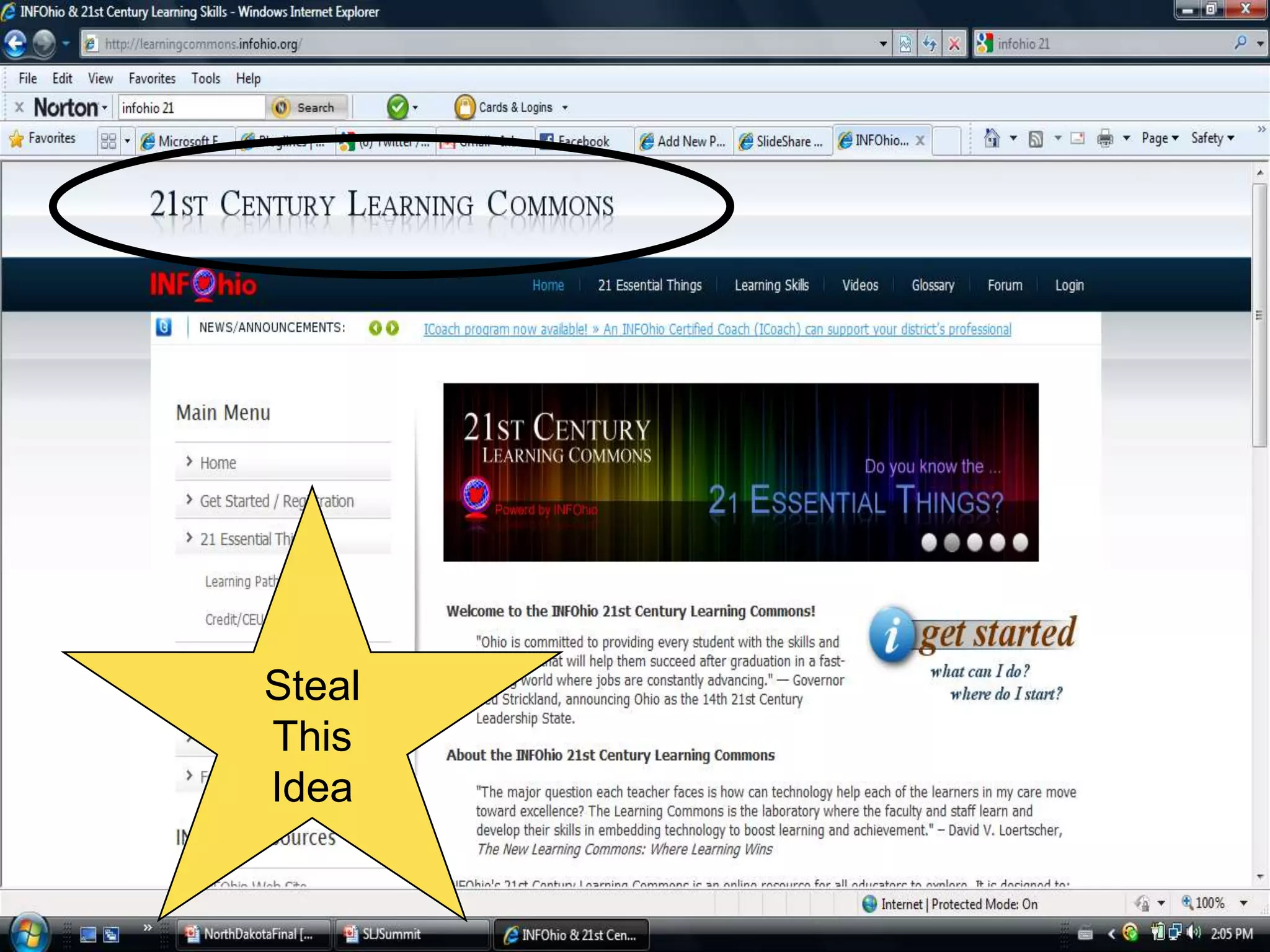
Steal
This
Idea
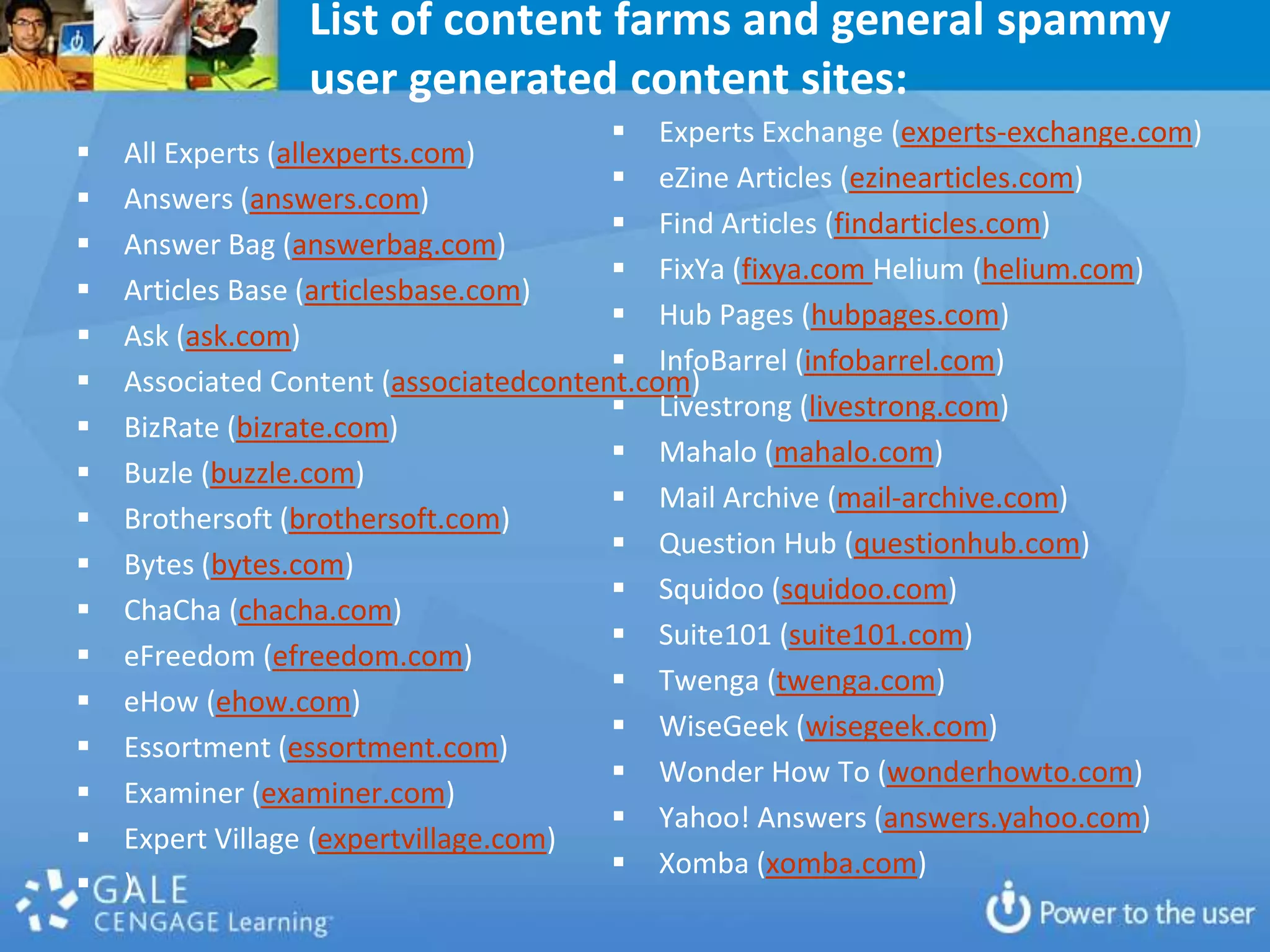
List of content farms and general spammy
                 user generated content sites:
                                         Experts Exchange (experts-exchange.com)
   All Experts (allexperts.com)
                                         eZine Articles (ezinearticles.com)
   Answers (answers.com)
                                         Find Articles (findarticles.com)
   Answer Bag (answerbag.com)
                                         FixYa (fixya.com Helium (helium.com)
   Articles Base (articlesbase.com)
                                         Hub Pages (hubpages.com)
   Ask (ask.com)
                                         InfoBarrel (infobarrel.com)
   Associated Content (associatedcontent.com)
                                         Livestrong (livestrong.com)
   BizRate (bizrate.com)
                                         Mahalo (mahalo.com)
   Buzle (buzzle.com)
                                         Mail Archive (mail-archive.com)
   Brothersoft (brothersoft.com)
                                         Question Hub (questionhub.com)
   Bytes (bytes.com)
                                         Squidoo (squidoo.com)
   ChaCha (chacha.com)
                                         Suite101 (suite101.com)
   eFreedom (efreedom.com)
                                         Twenga (twenga.com)
   eHow (ehow.com)
                                         WiseGeek (wisegeek.com)
   Essortment (essortment.com)
                                         Wonder How To (wonderhowto.com)
   Examiner (examiner.com)
                                         Yahoo! Answers (answers.yahoo.com)
   Expert Village (expertvillage.com)
                                         Xomba (xomba.com)
   )
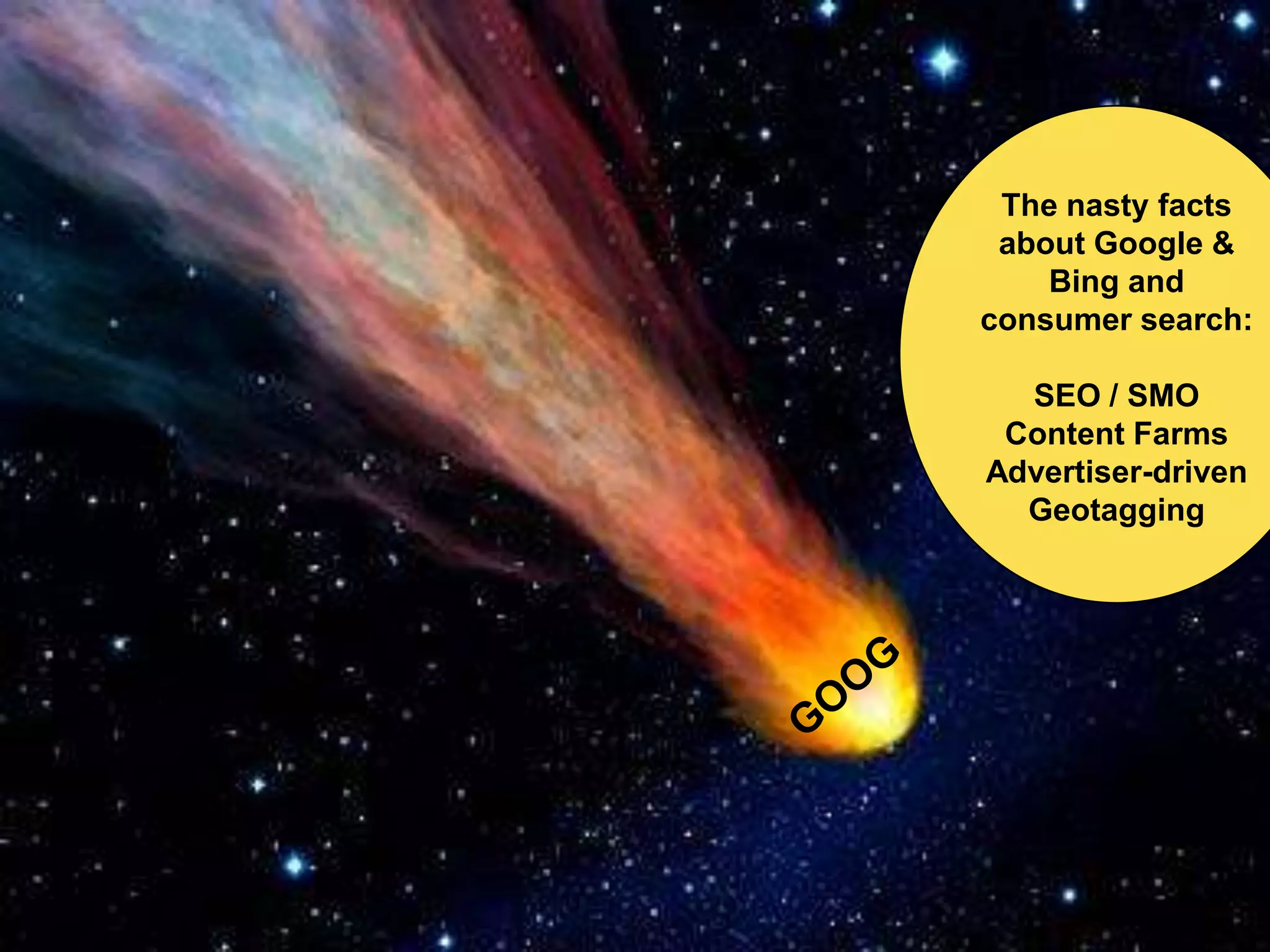
The nasty facts
 about Google &
    Bing and
consumer search:

  SEO / SMO
 Content Farms
Advertiser-driven
  Geotagging
Strategic
Analytics
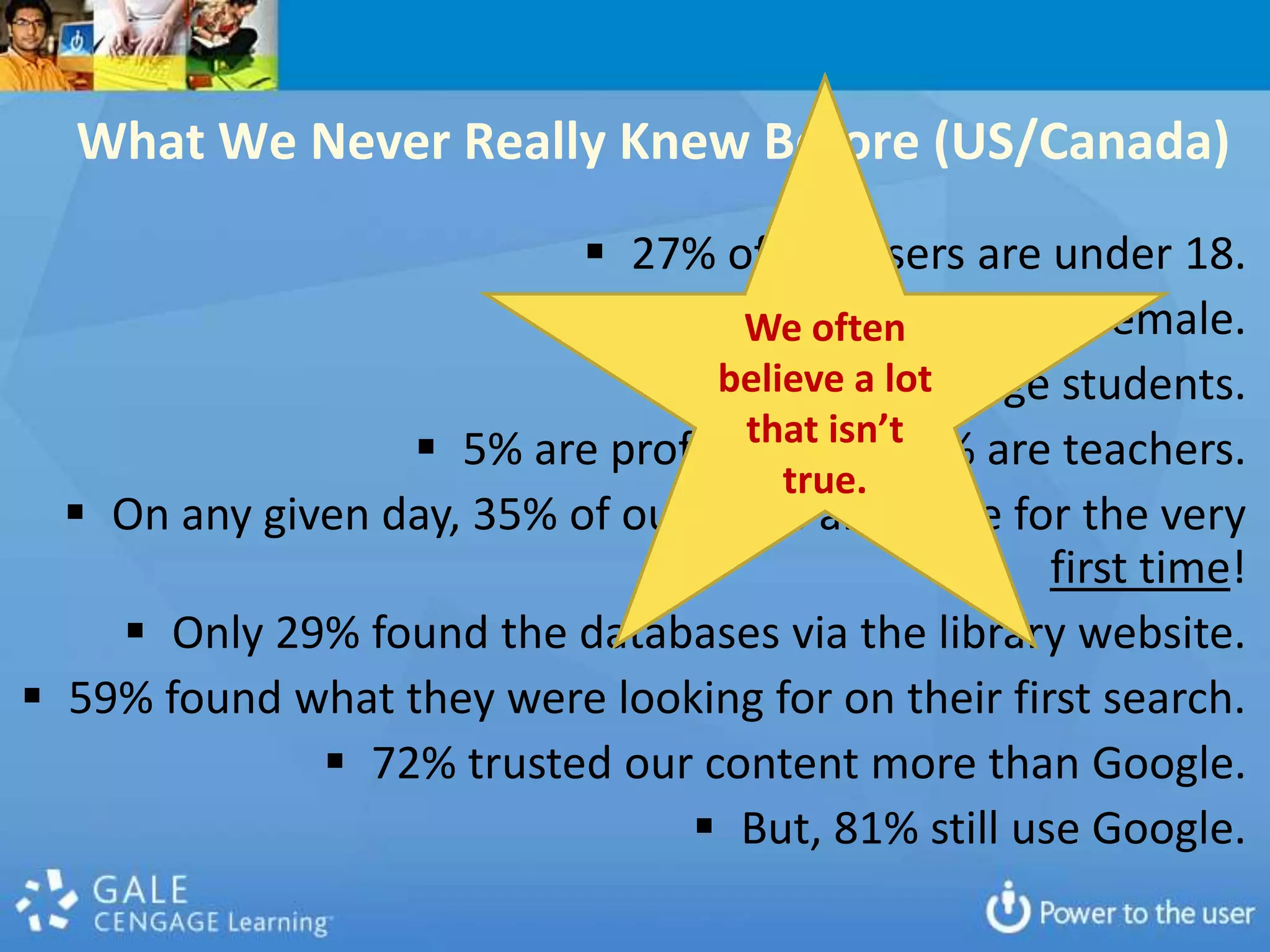
What We Never Really Knew Before (US/Canada)
                            27% of our users are under 18.
                                            
                                   We often 59% are female.
                                 believe a lot
                                   29% are college students.
                                   that isn’t
                   5% are professors and 6% are teachers.
                                      true.
   On any given day, 35% of our users are there for the very
                                                   first time!
     Only 29% found the databases via the library website.
 59% found what they were looking for on their first search.
               72% trusted our content more than Google.
                                 But, 81% still use Google.
2010 Eduventures Research on Investments
 58% of instructors believe that technology in courses positively impacts student engagement.
 71% of instructors that rated student engagement levels as “high” as a result of using technology
  in courses.
 71% of students who are employed full-time and 77% of students who are employed part-time
  prefer more technology-based tools in the classroom.
 79% of instructors and 86 percent of students have seen the average level of engagement improve
  over the last year as they have increased their use of digital educational tools.
 87% of students believe online libraries and databases have had the most significant impact on
  their overall learning.
 62% identify blogs, wikis, and other online authoring tools while 59% identify YouTube and
  recorded lectures.
 E-books and e-textbooks impact overall learning among 50% of students surveyed, while 42% of
  students identify online portals.
 44% of instructors believe that online libraries and databases will have the greatest impact on
  student engagement.
 32% of instructors identify e-textbooks and 30% identify interactive homework solutions as having
  the potential to improve engagement and learning outcomes. (e-readers was 11%)
 49% of students believe that online libraries and databases will have the greatest impact on
  student engagement.
 Students are more optimistic about the potential for technology.
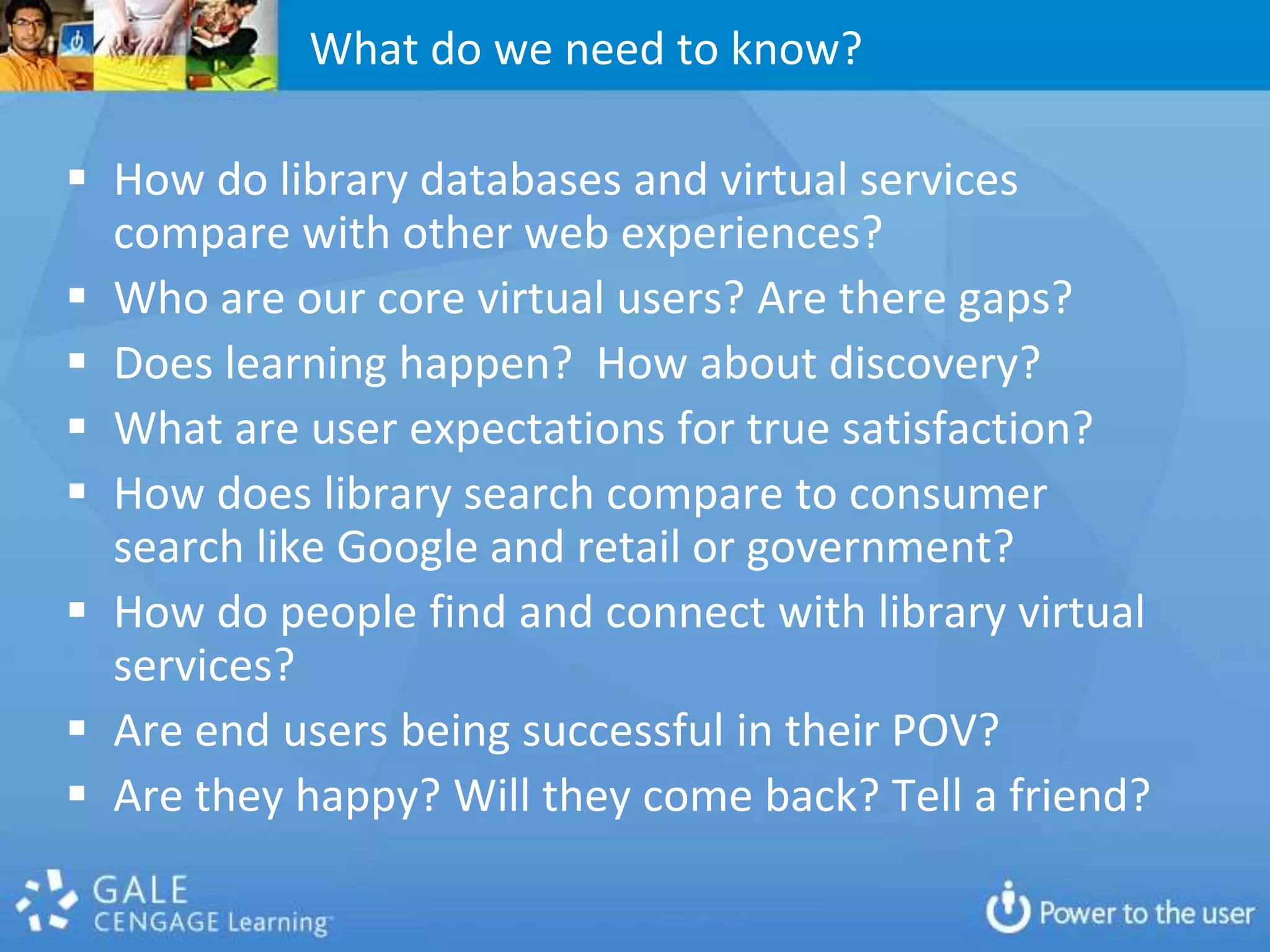
What do we need to know?

 How do library databases and virtual services
  compare with other web experiences?
 Who are our core virtual users? Are there gaps?
 Does learning happen? How about discovery?
 What are user expectations for true satisfaction?
 How does library search compare to consumer
  search like Google and retail or government?
 How do people find and connect with library virtual
  services?
 Are end users being successful in their POV?
 Are they happy? Will they come back? Tell a friend?
Top-Level Benchmarks
     Gale-Cengage Browse Survey
     August 01, 2010 - August 31, 2010


            90      90     90     89          90   90        90        90   90
                                         88             87                            87
                                                                  85             84
                                                                  78                  77
71                                75               76
                           73                                               74   74
     71     72      72                                       72
                                         70             70             69
                                              68
                                                                                 65
                                                                                      62
                                                   59             59

                           48                                               48
                                  41
                                                        37
                                              33
            30      30                   30                  30        30


 0
Emboldened Librarians hold the key
So how must library and
educator strategies change?
Discovery & Ideas
Books
We have a shallow understanding of the
       Codex – the book format(s)

Transition from scrolls – illumination – codex
               – and beyond
Strategic Challenges for Reference and
             Research Work
         in the Coming Decade
The BASICS

   Data
   Information
   Knowledge
   Wisdom NOT
   Behavior
Death of Reference

   Who
   What
   Where
   When
   Why
   How
How & Why Questions

   Now that’s research
   The interview is more involved
   Transformational not Transactional
   Expertise counts
   Expertise is shared mutually
What does all this mean?

 The Article level universe
 The Chapter and Paragraph Universe
 Integrated with Visuals – graphics and charts
 Integrated with ‘video’
 Integrated with Sound and Speech
 Integrated with social web
 Integrated with interaction and not just
  interactivity
 How would you enhance a book?
What is Changing?

1.   Evidence-based Reference Strategies
2.   Experience-based Portals: The New Commons
3.   Personal Service on Steroids
4.   Quality Strategies: Consumer vs. Professional
     Search
5.   Social Networks and Recommendations
6.   Trans-literacy Strategies
7.   People-driven Strategies
8.   Curriculum and Research Agenda
9.   Service and Programs
Recommendations

 Strengthen Your Personal Brand
 Reposition the Library and Librarian
 Don’t Tie Yourself to Collections or Physical
  Space
 Network with Your Users Socially
 Measure, Don’t Count
 Know
 Risk
 Engage
Reimagine Service
Reference and Research
Consider the differences . . .

 Computer Commons
 Mall
 Service Commons
 Information Commons
 Knowledge Commons
 Learning Commons
 Science Commons
 Centre or Central?
 Physical / Virtual Hybrid
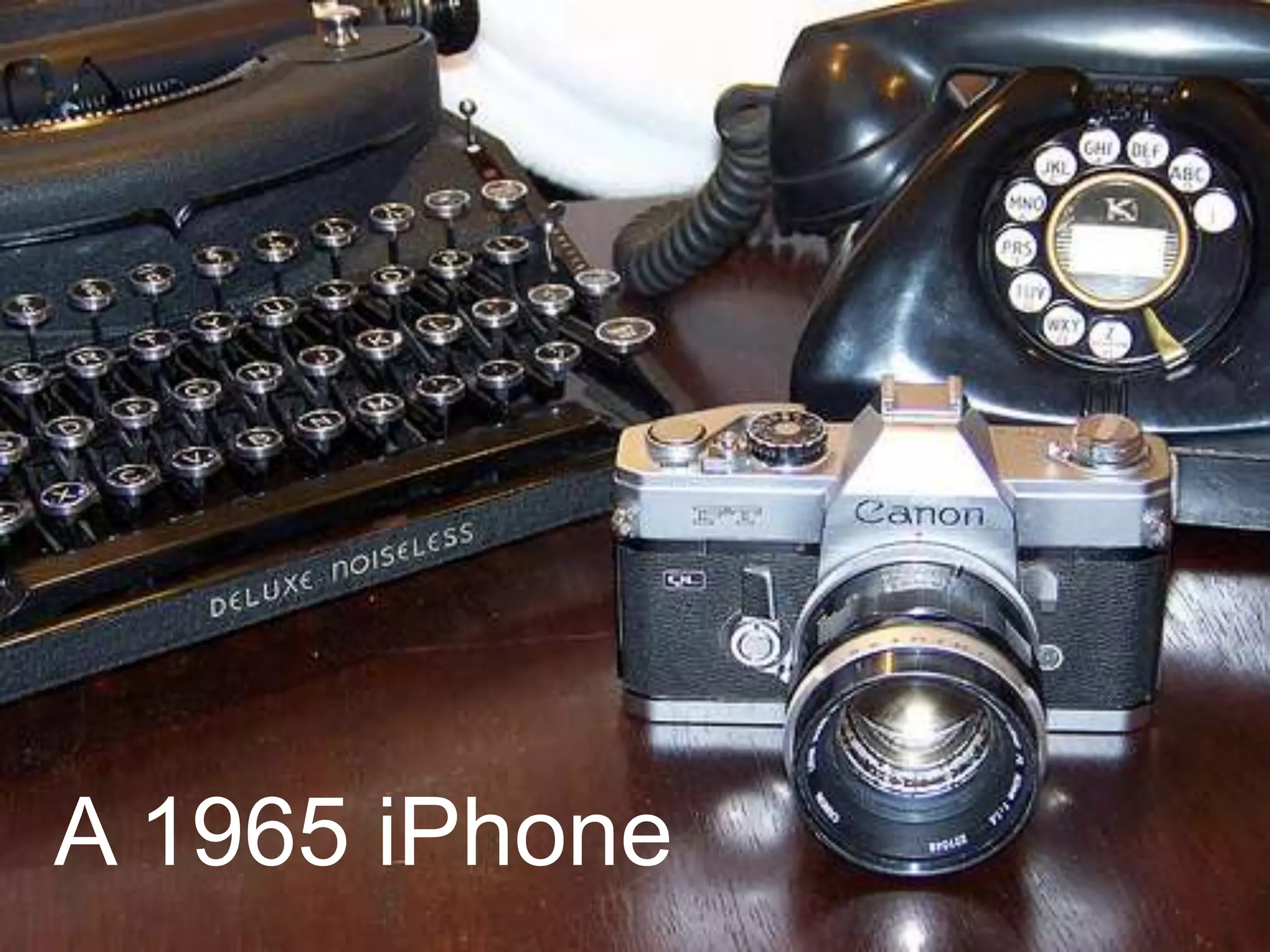
Mobility
A 1965 iPhone
Broadband

 You must clearly understand the latest US FCC
  Whitespace Broadband Decision – THIS IS
  TRANSFORMATIONAL and going global
 Net neutrality, kill switches . . .
 Local wired, mobile access ‘everywhere’ to
  the home and workplace on a personal basis
 Geo-awareness: GIS, GPS, GEO-IP, etc.
 Wireless as a business strategy (Starbucks)
 Mobile dominates the largest generation
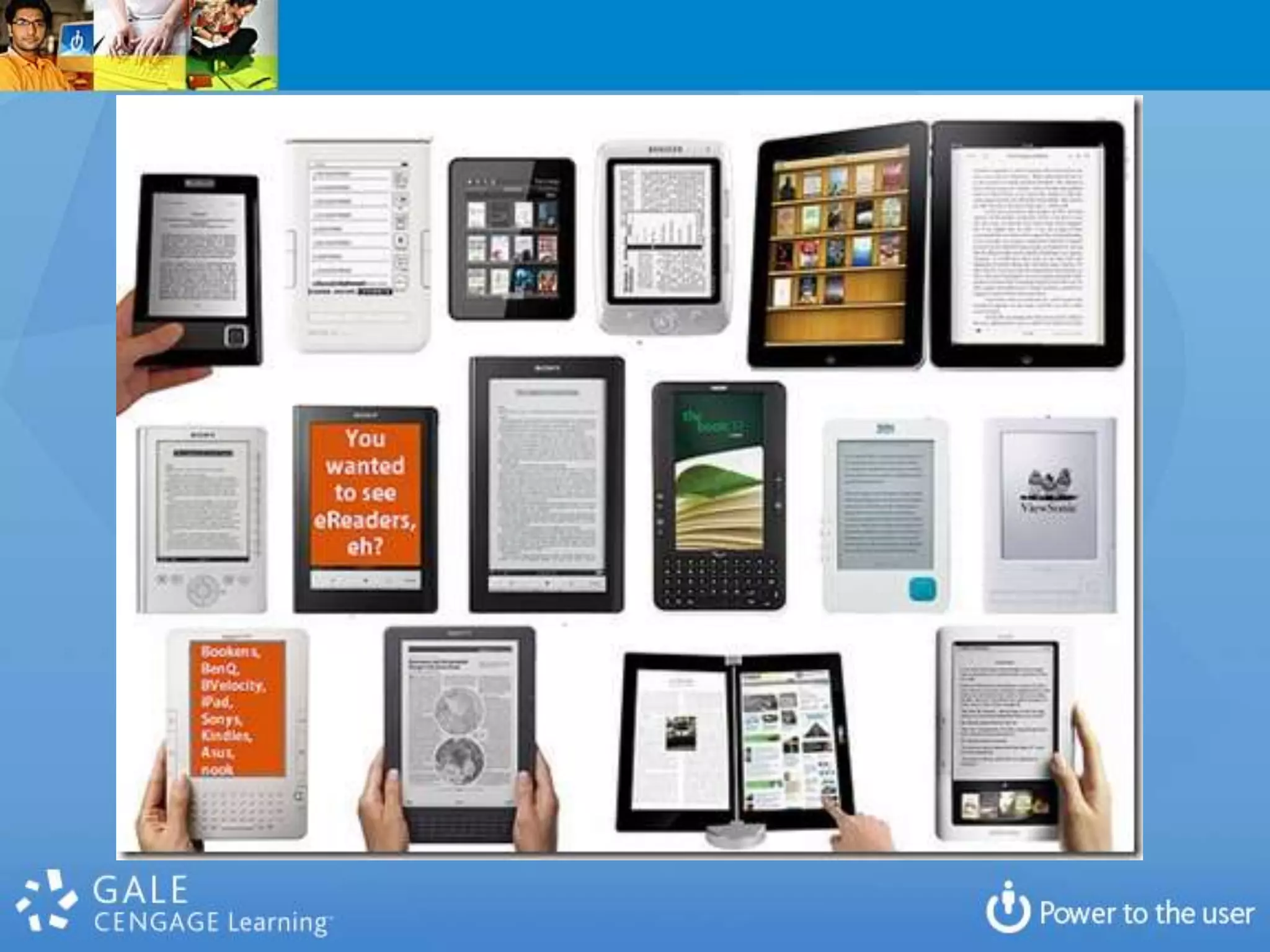
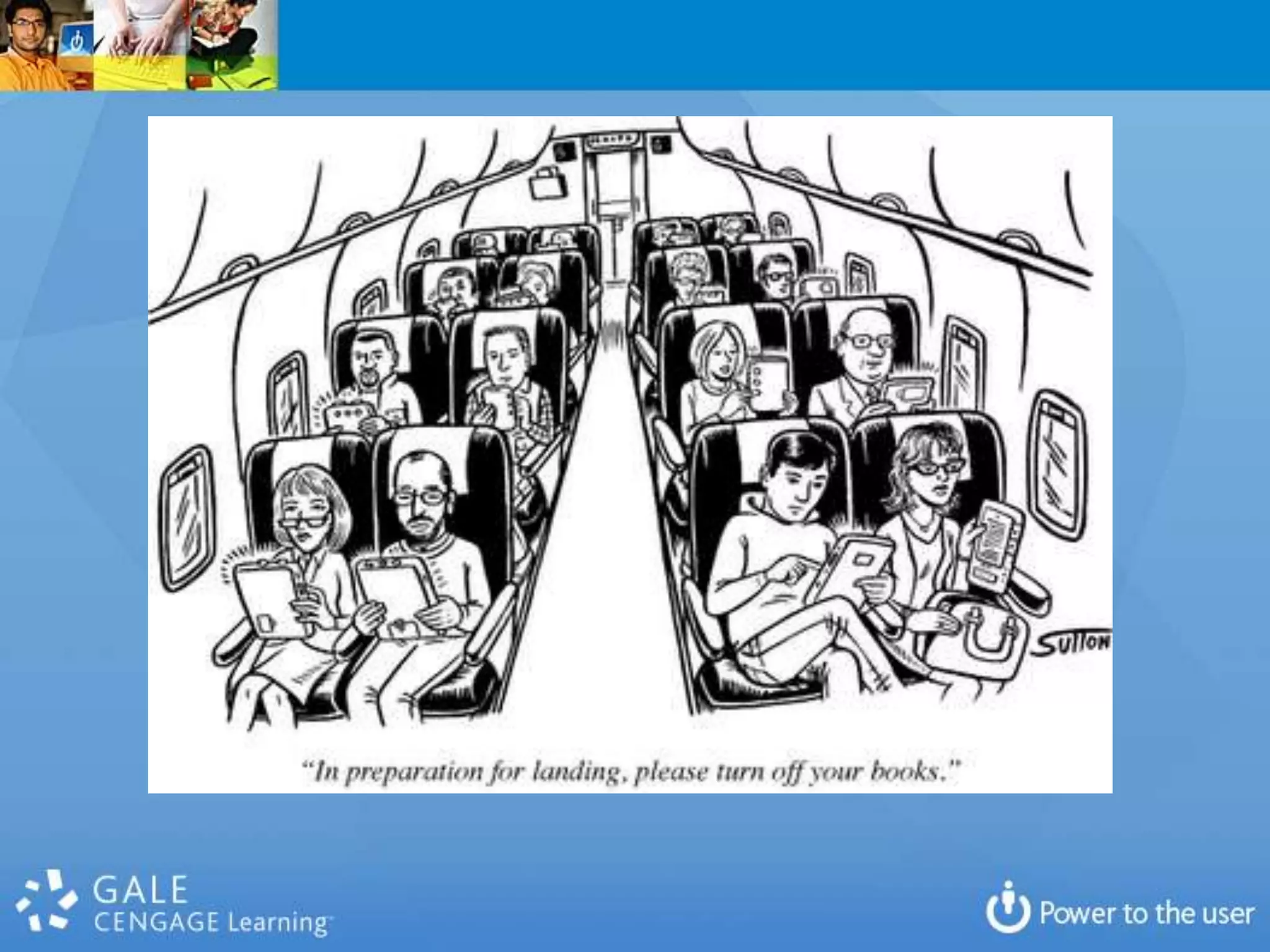
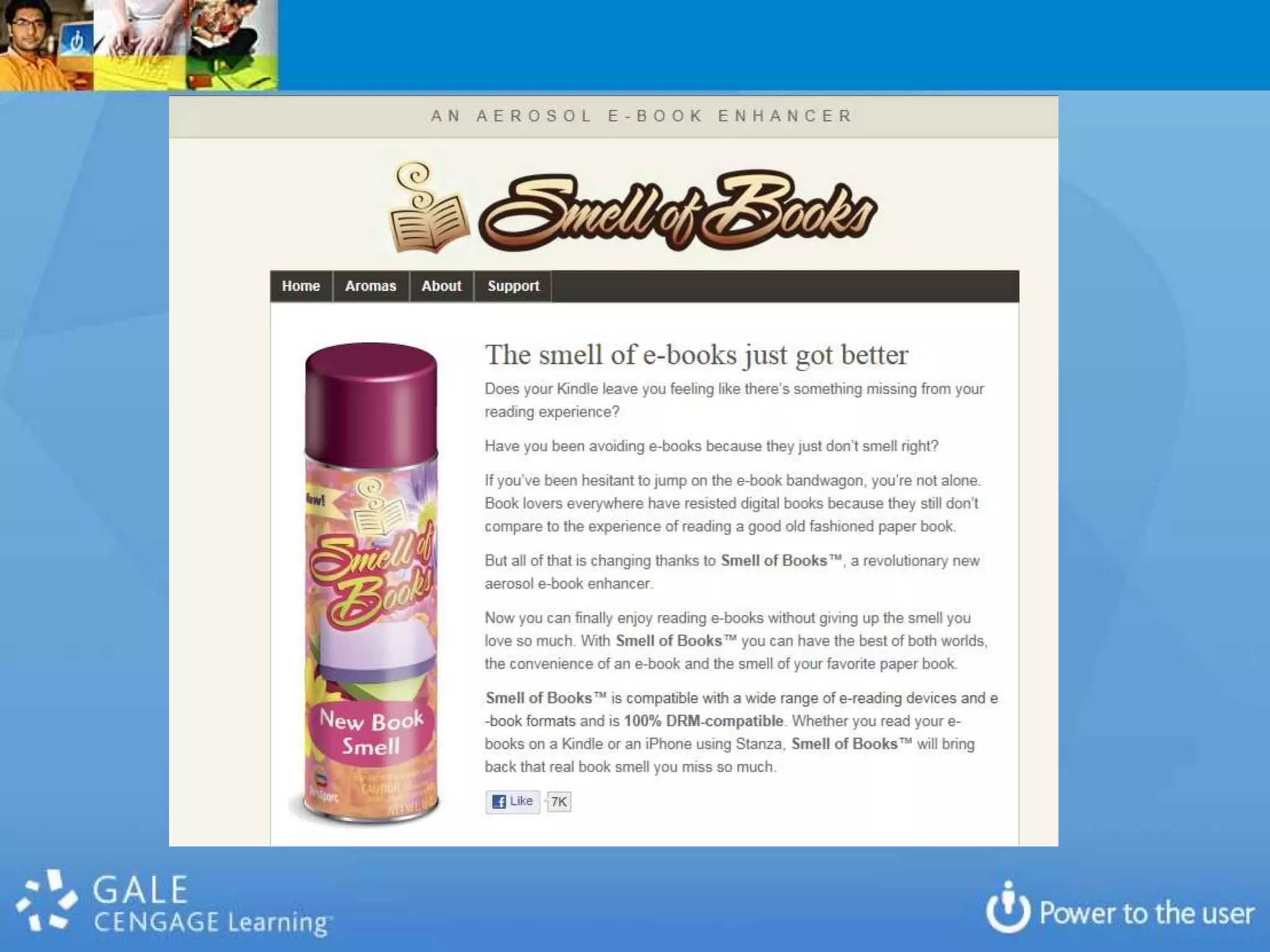
Speaking of e-
 Books...
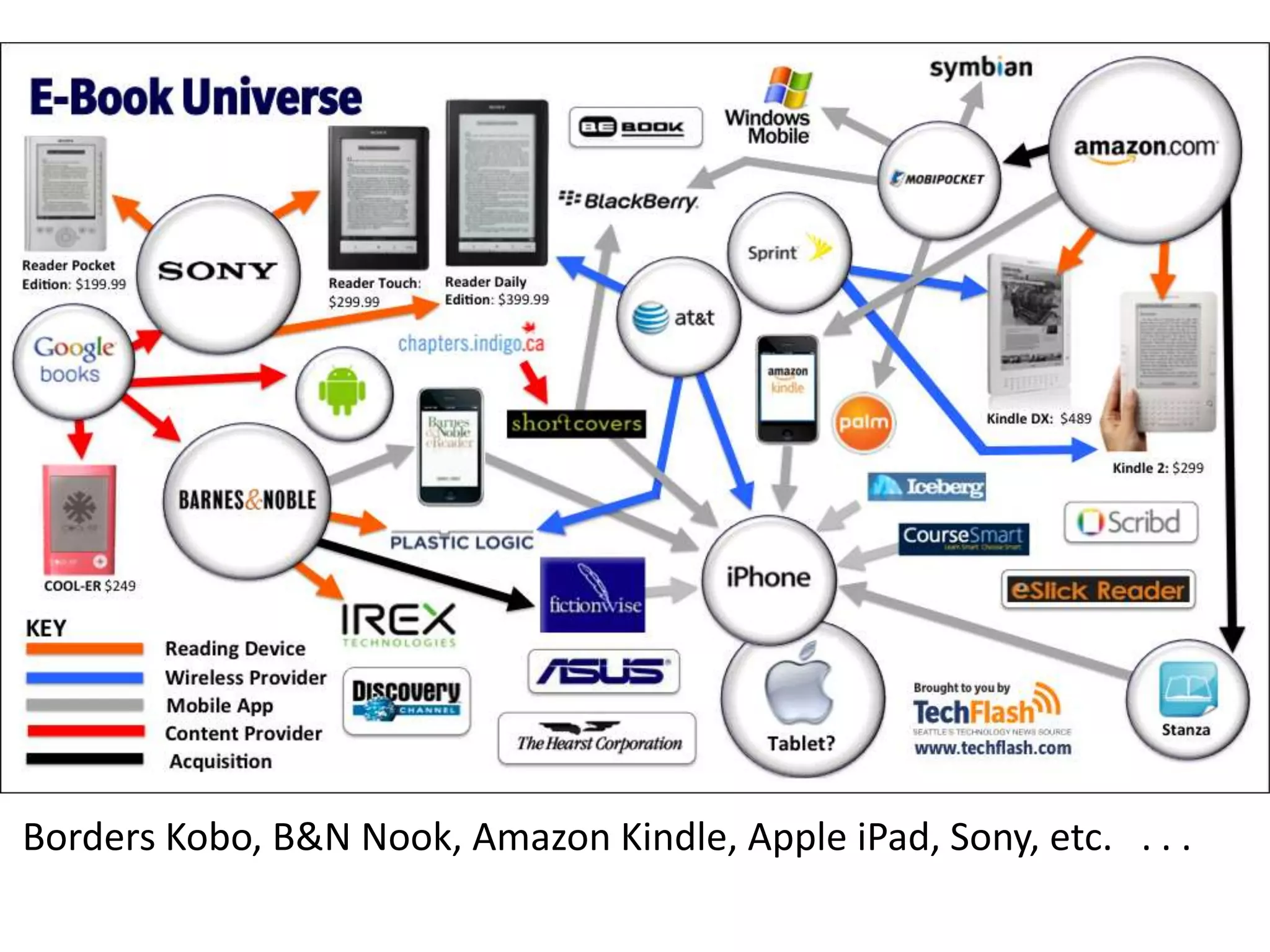
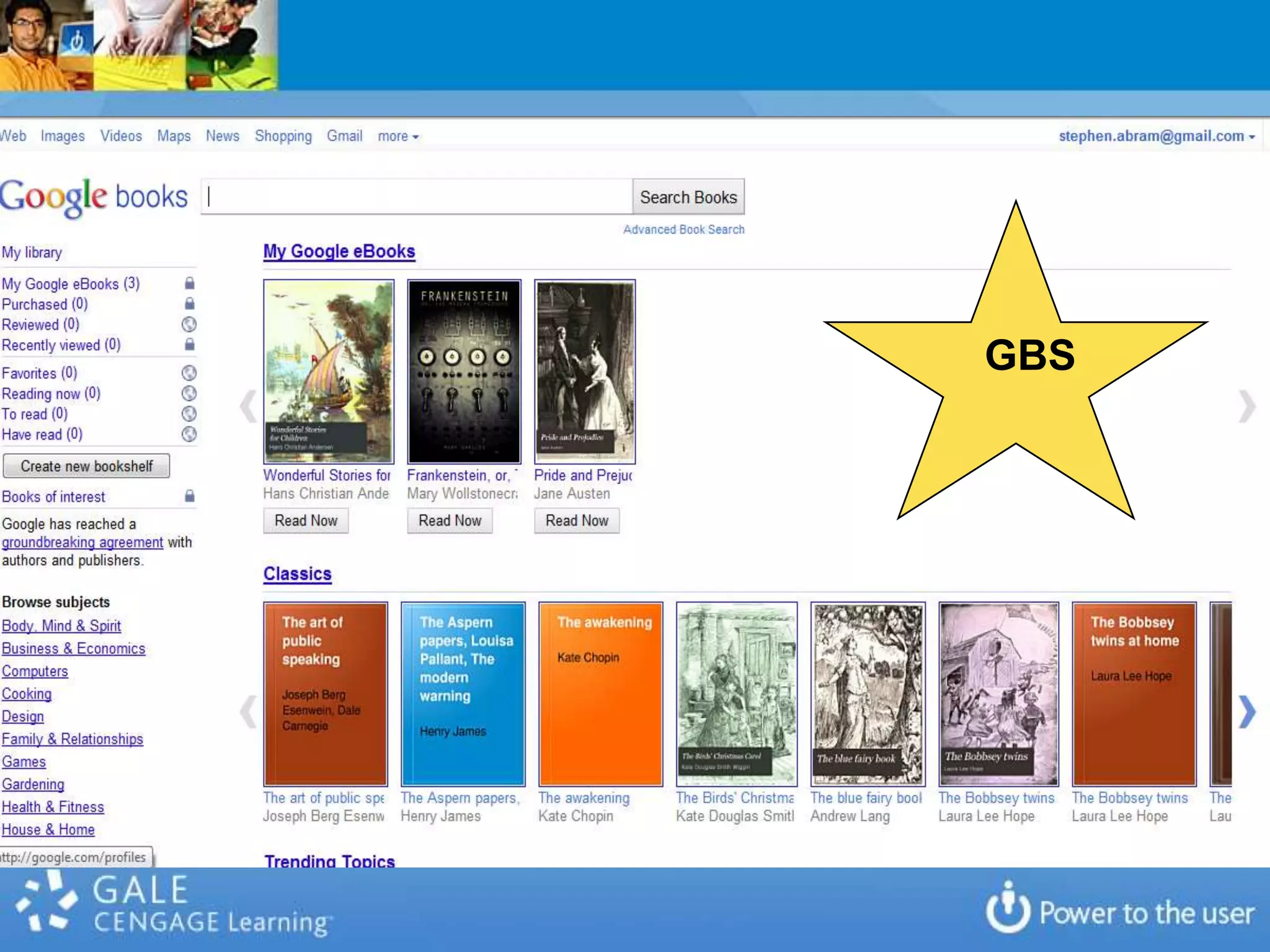
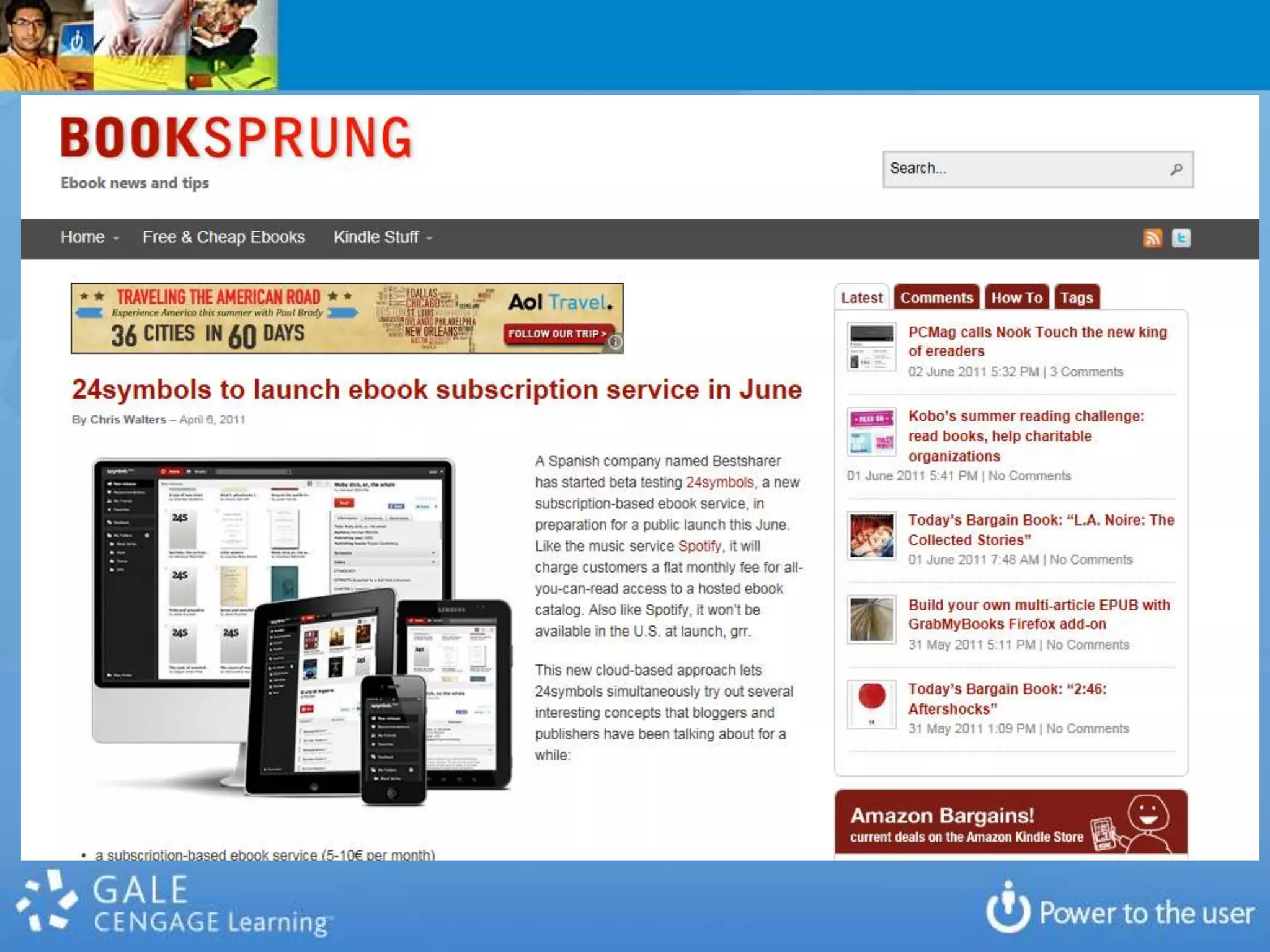
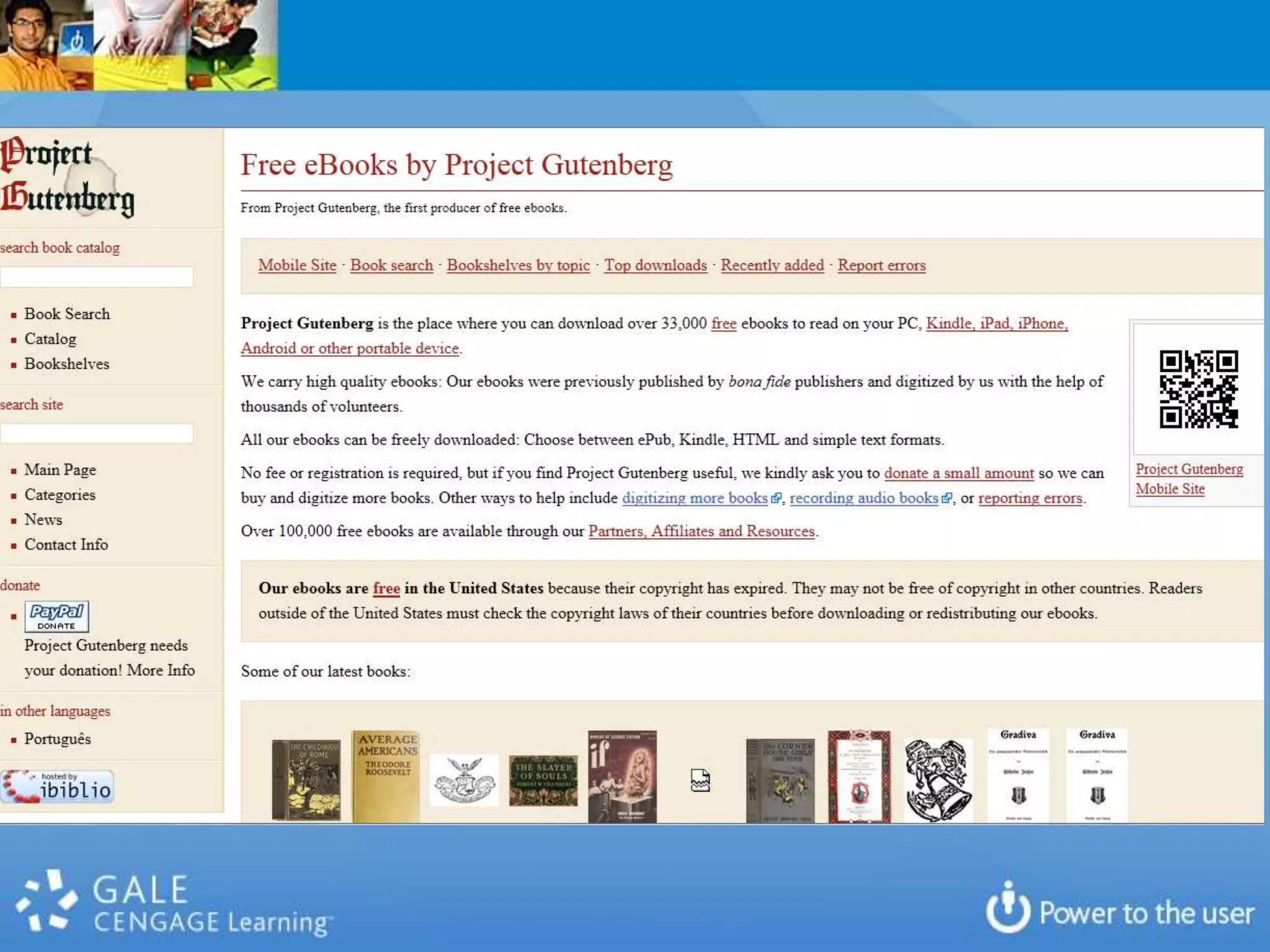
Borders Kobo, B&N Nook, Amazon Kindle, Apple iPad, Sony, etc. . . .
GBS
Context

 Information and Knowledge-based economy
 Globalization
 Canada is a leading education economy
 Stress on core markets (US)
 Changing knowledge about current crop of
  students (genome, eye tracking, gaming, IQ,
  ICT and social behaviours, etc.)
 Information ethics and copyright
Books

   Reception of Reading and Experience
   Fiction – paper, e-paper
   Non-Fiction
   Articles - disaggregation
   Media – physical vs. streaming
   Learning Objects
   Stories vs. Pedagogy
Technology Context

   Cloud (SaaS, PaaS, IaaS)
   Laptops and Tablets
   Mobility / Smartphones
   Bandwidth (Wired, WiFi, Whitespace)
   Learning Management Systems
   Streaming video and audio vs. download
   HTML5 and Apps – the battle
   Advertising auction models and ‘product’
   New(ish) Players (Amazon, Apple, G, B&N, Uni’s,
    states/provinces/nations)
The BASICS

 Containers for Pedagogy
 Created by Teams (e.g. 40,000 authors a year
  for Cengage alone) (yes that’s a lot of lawyers)
 Copyright and complicated layering of millions
  of rights (creators - pictures, graphics, video,
  tests, text, documents, etc.)
 Serious Lawsuits: Feist, Texaco, LSUC, Tasini,
  NatGeo, Authors Guild, GBS, etc.
 Complex extension opportunities (links to
  articles, databases, library assistance, etc.)
Textbook Challenges

 Format Agnosticism
 Browsers: IE, Chrome, Firefox, Safari
 Devices: Macintosh, PC Desktops & Laptops
 Mobile: Laptops, Tablets (iPad, Fire, etc.)
 Mobile: Smartphones (iPhone, Blackberry,
  Android, Windows, etc.)
 Container: PDF, ePub, .mobi, Kindle, etc.
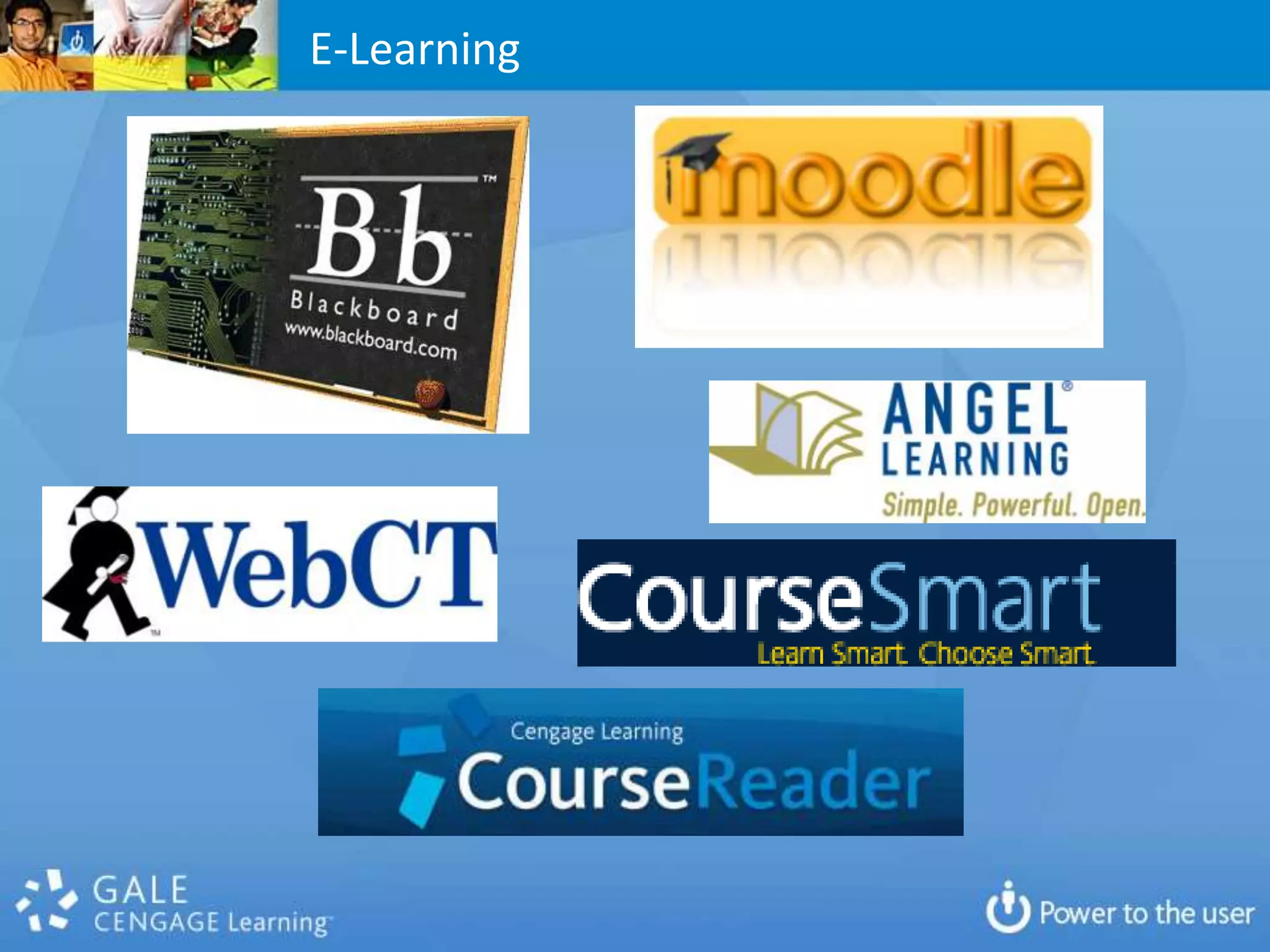
 Learning Management System: Blackboard /
  WebCT, D2L, Moodle, Sakai, etc.
 Purchasing (Amazon, B&N, Chegg, CengageBrain,
  Apple Store, University Textbook Store, etc.)
Should we tie students and professors to
   a specific and proprietary device,
  operating system, browser, or LMS?
What is the priority?
        Price, Cost, Value, ROI
Managing or Mandating the Adoption Curve
        Learning and Progress
   Societal Impact = 17%, 40%, 70%?
Death of the Textbook?

Shallow pool innovation – e-copies
Open Access Textbooks?
Coursepacks and e-coursepacks?
Apple?
Google?
Etc.
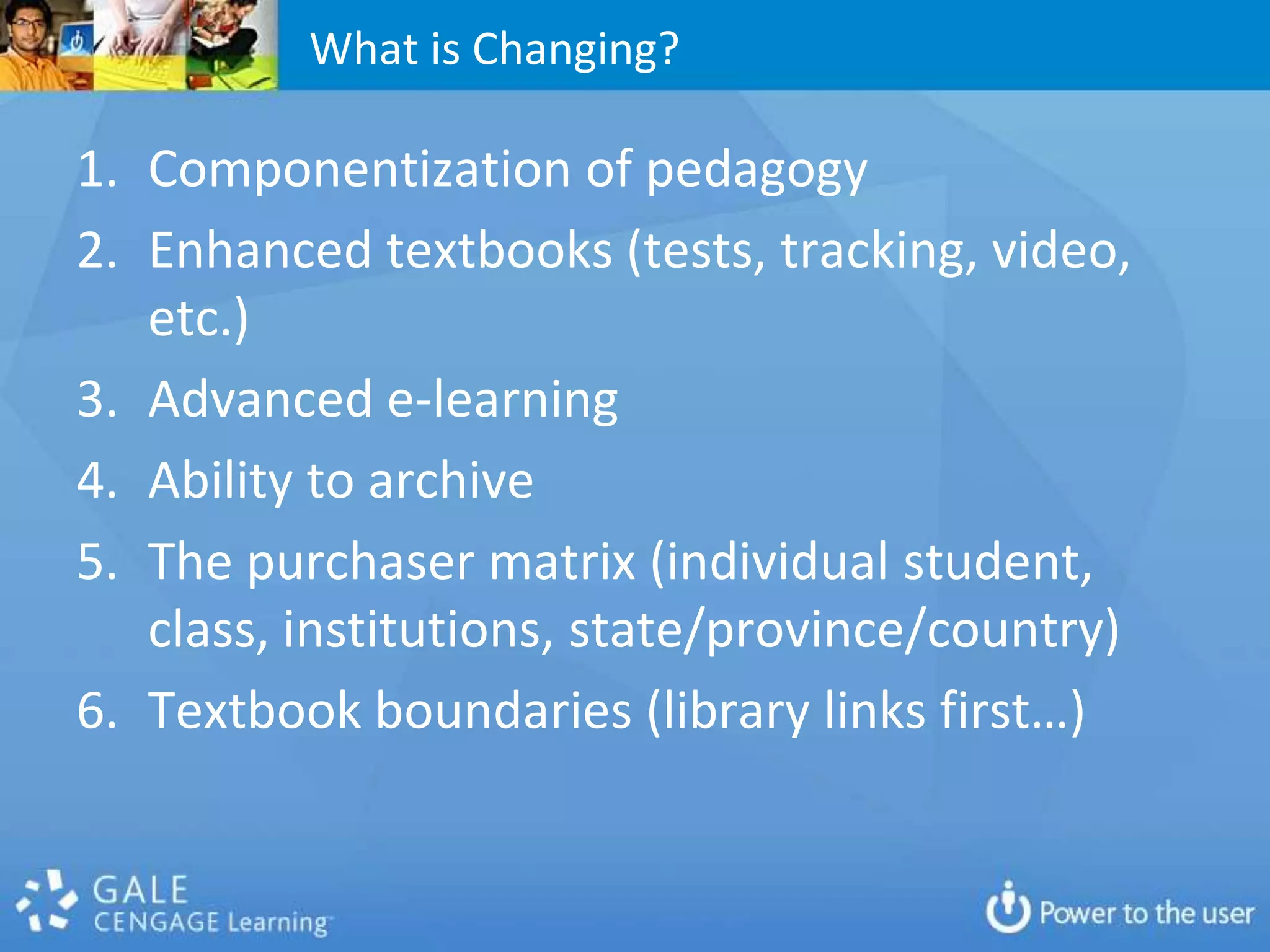
What is Changing?

1. Componentization of pedagogy
2. Enhanced textbooks (tests, tracking, video,
   etc.)
3. Advanced e-learning
4. Ability to archive
5. The purchaser matrix (individual student,
   class, institutions, state/province/country)
6. Textbook boundaries (library links first…)
Pricing Models

Buy the print copy
Buy the exact electronic copy of the print
Buy both (bundling)
Rent the print or e-copy for a specified period
Create custom coursepacks in print or e-copy
Buy at the course level included in fee
Buy at the institution / enterprise level
Buy at the state/province level
Espresso Book Machines
Pay-per-use, micro-payments, ‘Square’ and
 phones
This era will see a Fundamental
  Reimagining the Textbook
For the present there will be those who
   resist and the resisters will be the
                majority.
Can we frame the e-book issue so
that it can be addressed rationally?
Books
Fiction
Non-Fiction
E-Learning
What Would You Attempt If
You Knew You Would Not
         Fail?
A Third Path
Stephen Abram, MLS, FSLA
VP strategic partnerships and markets
               Cengage Learning (Gale)
                     Cel: 416-669-4855
        stephen.abram@cengage.com
              Stephen’s Lighthouse Blog
       http://stephenslighthouse.com
             Facebook: Stephen Abram
      LinkedIn / Plaxo: Stephen Abram
                        Twitter: sabram
           SlideShare: StephenAbram1

Langara

  • 1.
    Academic Libraries inThe Future: From collections to impact Stephen Abram, MLS Langara College Vancouver, BC Feb. 13, 2012
  • 2.
    Change These slides areavailable at Stephen’s Lighthouse blog
  • 3.
    We Only GetSo Many Once-in-a-Lifetime Chances To Do Great Things
  • 4.
    News Flash “The Internetand technology have now progressed to their infancy”
  • 8.
    So how mustlibrary and educator strategies change?
  • 9.
  • 10.
  • 11.
    News Flash News Flash Tech Shift Happens
  • 12.
    Seth Godin onDecisions (June 8, 2011) o Which of the four are getting in the way? o You don't know what to do o You don't know how to do it o You don't have the authority or the resources to do it o You're afraid o Once you figure out what's getting in the way, it's far easier to find the answer (or decide to work on a different problem). o Stuck is a state of mind, and it's curable.
  • 14.
    What Are LibrariesReally For? • Community • Learning • Discovery • Progress • Research (Applied and Theoretical) • Cultural & Knowledge Custody • Economic Impact
  • 15.
    Columbus, Cook, Magellanand Libraries: Searching for the corners of the earth, the edge of the oceans and discovering dragons ...
  • 16.
  • 17.
  • 18.
  • 19.
    Magellan Columbus Cook
  • 21.
    Questions for LibrariesToday: 1. Are our priorities right? 2. Are learning, research, discovery changing materially and what is actually changing? 3. Books. Meh. 4. What is the role for librarians in the real future (that is not an extension of the past)?
  • 23.
  • 24.
  • 25.
  • 26.
  • 27.
  • 28.
  • 29.
    The new bibliography and collection development KNOWLEDGE PORTALS KNOWLEDGE, LEARNING, INFORMATION & RESEARCH COMMONS
  • 33.
    Chefs, counsellors, teachers,magicians Librarians play a vital role in building the critical connections between information , knowledge and learning.
  • 34.
    Service Metaphor o Cafeterias oTake Out o Private Dining Rooms o Private Chefs o Variety
  • 35.
  • 36.
  • 38.
    Trans-Literacy: Move beyondreading & PC skills  Reading literacy  News literacy  Numeracy  Technology literacy  Critical literacy  Information literacy  Social literacy  Media literacy  Computer literacy  Adaptive literacy  Web literacy  Research literacy  Content literacy  Academic literacy  Written literacy  Reputation, Etc.
  • 40.
  • 41.
    List of contentfarms and general spammy user generated content sites:  Experts Exchange (experts-exchange.com)  All Experts (allexperts.com)  eZine Articles (ezinearticles.com)  Answers (answers.com)  Find Articles (findarticles.com)  Answer Bag (answerbag.com)  FixYa (fixya.com Helium (helium.com)  Articles Base (articlesbase.com)  Hub Pages (hubpages.com)  Ask (ask.com)  InfoBarrel (infobarrel.com)  Associated Content (associatedcontent.com)  Livestrong (livestrong.com)  BizRate (bizrate.com)  Mahalo (mahalo.com)  Buzle (buzzle.com)  Mail Archive (mail-archive.com)  Brothersoft (brothersoft.com)  Question Hub (questionhub.com)  Bytes (bytes.com)  Squidoo (squidoo.com)  ChaCha (chacha.com)  Suite101 (suite101.com)  eFreedom (efreedom.com)  Twenga (twenga.com)  eHow (ehow.com)  WiseGeek (wisegeek.com)  Essortment (essortment.com)  Wonder How To (wonderhowto.com)  Examiner (examiner.com)  Yahoo! Answers (answers.yahoo.com)  Expert Village (expertvillage.com)  Xomba (xomba.com)  )
  • 45.
    The nasty facts about Google & Bing and consumer search: SEO / SMO Content Farms Advertiser-driven Geotagging
  • 46.
  • 48.
    What We NeverReally Knew Before (US/Canada)  27% of our users are under 18.  We often 59% are female.  believe a lot 29% are college students. that isn’t  5% are professors and 6% are teachers. true.  On any given day, 35% of our users are there for the very first time!  Only 29% found the databases via the library website.  59% found what they were looking for on their first search.  72% trusted our content more than Google.  But, 81% still use Google.
  • 49.
    2010 Eduventures Researchon Investments  58% of instructors believe that technology in courses positively impacts student engagement.  71% of instructors that rated student engagement levels as “high” as a result of using technology in courses.  71% of students who are employed full-time and 77% of students who are employed part-time prefer more technology-based tools in the classroom.  79% of instructors and 86 percent of students have seen the average level of engagement improve over the last year as they have increased their use of digital educational tools.  87% of students believe online libraries and databases have had the most significant impact on their overall learning.  62% identify blogs, wikis, and other online authoring tools while 59% identify YouTube and recorded lectures.  E-books and e-textbooks impact overall learning among 50% of students surveyed, while 42% of students identify online portals.  44% of instructors believe that online libraries and databases will have the greatest impact on student engagement.  32% of instructors identify e-textbooks and 30% identify interactive homework solutions as having the potential to improve engagement and learning outcomes. (e-readers was 11%)  49% of students believe that online libraries and databases will have the greatest impact on student engagement.  Students are more optimistic about the potential for technology.
  • 51.
    What do weneed to know?  How do library databases and virtual services compare with other web experiences?  Who are our core virtual users? Are there gaps?  Does learning happen? How about discovery?  What are user expectations for true satisfaction?  How does library search compare to consumer search like Google and retail or government?  How do people find and connect with library virtual services?  Are end users being successful in their POV?  Are they happy? Will they come back? Tell a friend?
  • 52.
    Top-Level Benchmarks Gale-Cengage Browse Survey August 01, 2010 - August 31, 2010 90 90 90 89 90 90 90 90 90 88 87 87 85 84 78 77 71 75 76 73 74 74 71 72 72 72 70 70 69 68 65 62 59 59 48 48 41 37 33 30 30 30 30 30 0
  • 53.
  • 54.
    So how mustlibrary and educator strategies change?
  • 55.
  • 56.
  • 57.
    We have ashallow understanding of the Codex – the book format(s) Transition from scrolls – illumination – codex – and beyond
  • 59.
    Strategic Challenges forReference and Research Work in the Coming Decade
  • 60.
    The BASICS  Data  Information  Knowledge  Wisdom NOT  Behavior
  • 61.
    Death of Reference  Who  What  Where  When  Why  How
  • 62.
    How & WhyQuestions  Now that’s research  The interview is more involved  Transformational not Transactional  Expertise counts  Expertise is shared mutually
  • 63.
    What does allthis mean?  The Article level universe  The Chapter and Paragraph Universe  Integrated with Visuals – graphics and charts  Integrated with ‘video’  Integrated with Sound and Speech  Integrated with social web  Integrated with interaction and not just interactivity  How would you enhance a book?
  • 64.
    What is Changing? 1. Evidence-based Reference Strategies 2. Experience-based Portals: The New Commons 3. Personal Service on Steroids 4. Quality Strategies: Consumer vs. Professional Search 5. Social Networks and Recommendations 6. Trans-literacy Strategies 7. People-driven Strategies 8. Curriculum and Research Agenda 9. Service and Programs
  • 65.
    Recommendations  Strengthen YourPersonal Brand  Reposition the Library and Librarian  Don’t Tie Yourself to Collections or Physical Space  Network with Your Users Socially  Measure, Don’t Count  Know  Risk  Engage
  • 66.
  • 67.
    Consider the differences. . .  Computer Commons  Mall  Service Commons  Information Commons  Knowledge Commons  Learning Commons  Science Commons  Centre or Central?  Physical / Virtual Hybrid
  • 68.
  • 69.
  • 71.
    Broadband  You mustclearly understand the latest US FCC Whitespace Broadband Decision – THIS IS TRANSFORMATIONAL and going global  Net neutrality, kill switches . . .  Local wired, mobile access ‘everywhere’ to the home and workplace on a personal basis  Geo-awareness: GIS, GPS, GEO-IP, etc.  Wireless as a business strategy (Starbucks)  Mobile dominates the largest generation
  • 72.
  • 74.
    Borders Kobo, B&NNook, Amazon Kindle, Apple iPad, Sony, etc. . . .
  • 83.
  • 88.
    Context  Information andKnowledge-based economy  Globalization  Canada is a leading education economy  Stress on core markets (US)  Changing knowledge about current crop of students (genome, eye tracking, gaming, IQ, ICT and social behaviours, etc.)  Information ethics and copyright
  • 89.
    Books  Reception of Reading and Experience  Fiction – paper, e-paper  Non-Fiction  Articles - disaggregation  Media – physical vs. streaming  Learning Objects  Stories vs. Pedagogy
  • 90.
    Technology Context  Cloud (SaaS, PaaS, IaaS)  Laptops and Tablets  Mobility / Smartphones  Bandwidth (Wired, WiFi, Whitespace)  Learning Management Systems  Streaming video and audio vs. download  HTML5 and Apps – the battle  Advertising auction models and ‘product’  New(ish) Players (Amazon, Apple, G, B&N, Uni’s, states/provinces/nations)
  • 91.
    The BASICS  Containersfor Pedagogy  Created by Teams (e.g. 40,000 authors a year for Cengage alone) (yes that’s a lot of lawyers)  Copyright and complicated layering of millions of rights (creators - pictures, graphics, video, tests, text, documents, etc.)  Serious Lawsuits: Feist, Texaco, LSUC, Tasini, NatGeo, Authors Guild, GBS, etc.  Complex extension opportunities (links to articles, databases, library assistance, etc.)
  • 92.
    Textbook Challenges  FormatAgnosticism  Browsers: IE, Chrome, Firefox, Safari  Devices: Macintosh, PC Desktops & Laptops  Mobile: Laptops, Tablets (iPad, Fire, etc.)  Mobile: Smartphones (iPhone, Blackberry, Android, Windows, etc.)  Container: PDF, ePub, .mobi, Kindle, etc.  Learning Management System: Blackboard / WebCT, D2L, Moodle, Sakai, etc.  Purchasing (Amazon, B&N, Chegg, CengageBrain, Apple Store, University Textbook Store, etc.)
  • 93.
    Should we tiestudents and professors to a specific and proprietary device, operating system, browser, or LMS?
  • 94.
    What is thepriority? Price, Cost, Value, ROI Managing or Mandating the Adoption Curve Learning and Progress Societal Impact = 17%, 40%, 70%?
  • 95.
    Death of theTextbook? Shallow pool innovation – e-copies Open Access Textbooks? Coursepacks and e-coursepacks? Apple? Google? Etc.
  • 96.
    What is Changing? 1.Componentization of pedagogy 2. Enhanced textbooks (tests, tracking, video, etc.) 3. Advanced e-learning 4. Ability to archive 5. The purchaser matrix (individual student, class, institutions, state/province/country) 6. Textbook boundaries (library links first…)
  • 97.
    Pricing Models Buy theprint copy Buy the exact electronic copy of the print Buy both (bundling) Rent the print or e-copy for a specified period Create custom coursepacks in print or e-copy Buy at the course level included in fee Buy at the institution / enterprise level Buy at the state/province level Espresso Book Machines Pay-per-use, micro-payments, ‘Square’ and phones
  • 98.
    This era willsee a Fundamental Reimagining the Textbook For the present there will be those who resist and the resisters will be the majority.
  • 100.
    Can we framethe e-book issue so that it can be addressed rationally?
  • 101.
  • 102.
  • 103.
  • 104.
  • 105.
    What Would YouAttempt If You Knew You Would Not Fail?
  • 107.
  • 109.
    Stephen Abram, MLS,FSLA VP strategic partnerships and markets Cengage Learning (Gale) Cel: 416-669-4855 stephen.abram@cengage.com Stephen’s Lighthouse Blog http://stephenslighthouse.com Facebook: Stephen Abram LinkedIn / Plaxo: Stephen Abram Twitter: sabram SlideShare: StephenAbram1