Landscaping refers to the ways
people use plants (softscaping) and
objects (hardscaping) to enhance or
change the natural environment
around the exterior of their home.
Well-planned landscaping
enhances the exterior
appearance of the home and
outdoor living spaces. It serves
to provide privacy, safety,
comfort, and beauty.
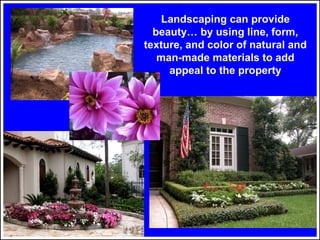
Landscaping can provide
privacy… with certain
types of fencing, hedges, or
plantings to block the view
from neighbors or traffic
Landscaping can provide safety…
Perhaps by lighting walkways and
steps; using hot water or electricity to
heat sidewalks and keep them clear
of snow and ice; enclosing or lighting
pool areas; fencing property lines
Landscaping can provide comfort…
in the form of shade, a windbreak, a
firepit for cooking and warmth, a bench
or patio grouping or gazebo for seating
Landscaping can provide
beauty… by using line, form,
texture, and color of natural and
man-made materials to add
appeal to the property
Soil… The
key to
supplying
nutrients, air,
and water to
plants.
Soil is made up of inorganic material, such as rock particles, as well as organic
matter, such as decaying animals and plants. Air, water and microorganisms are
also present in healthy soil.
Soil texture is determined by the amount of clay, silt or sand particles present.
Clay holds water and nutrients very well, but is tough for roots to penetrate. Clay
is heavy and can become saturated easily. The other extreme is sand, which
drains very well, but loses nutrients and dries quickly. Silty soils are more similar
to clay than sand.
The best type of soil for gardening is called loam. Loam has proportional amounts
of silt, clay and sand that makes it hold its shape when lightly squeezed. When
squeezed harder, it crumbles.
Grasses… Native and ornamental
grasses can be used in landscaping, as
well as grass for lawns. Both the stems
and leaves in grass grow from the
bottom up, so it can be cut repeatedly.
Bluegrass, rye, and fescue are common
grasses in midwest climates.
Soil/lawns should slope away
from the house foundation for
correct drainage.
Ground covers… thick,
low-growing foliage varying
in texture and color; low
maintenance; used in spots
difficult to mow; they
prevent erosion and control
weeds
Flowers… for adding color
and beauty Perennials
never need replanting; more costly
and quite hardy: lilies, roses, cone
flowers, iris, peonies, pansies
Annuals are
more colorful; less
costly but must be
replanted yearly:
petunias,
impatiens, vinca,
marigolds, zinnia
Deciduous trees and shrubs… many have
spectacular fall color and then lose their
leaves in winter; elm, maple, oak, sycamore,
cottonwood, hickory, locust, ash, and walnut
trees are common; lilac, azalea, hydrangea,
forsythia, burning bush are shrubs
tree height: 40-150’ spread: 25-100’
Ornamental trees…
Are usually 15-30’ in height and
15-30’ in spread; they often have
an attractive shape, leaf color, or
blossom; may not all be suitable
for all soil types or climates;
redbud and Japanese maples
are examples
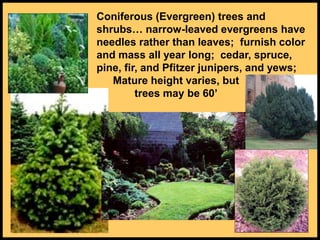
Coniferous (Evergreen) trees and
shrubs… narrow-leaved evergreens have
needles rather than leaves; furnish color
and mass all year long; cedar, spruce,
pine, fir, and Pfitzer junipers, and yews;
Mature height varies, but
trees may be 60’
Vines… decorative and functional;
leaves may have interesting shapes;
some have clusters of flowers; may
reduce the monotony of a wall or be
trained to climb a trellis
Ivy, clematis,
trumpet vine,
morning glory,
sweet pea,
passionflower,
honeysuckle,
wisteria
Paths, Walks, & Steps… they
connect one area with another;
paths may be temporary; safety is a
key factor in designing steps
Permanent
walks
should be
4 ½’ wide
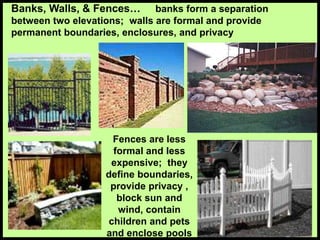
Banks, Walls, & Fences… banks form a separation
between two elevations; walls are formal and provide
permanent boundaries, enclosures, and privacy
Fences are less
formal and less
expensive; they
define boundaries,
provide privacy ,
block sun and
wind, contain
children and pets
and enclose pools
Patios, Decks, and Game Areas… used
for relaxation or recreation; patios are level
with the ground while decks are above
ground; decks and patios should be large
enough to accommodate outdoor furniture
Volleyball, badminton,
croquet, horseshoes,
tennis, basketball, &
tetherball - outdoor
activities needing space
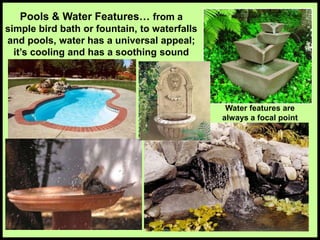
Pools & Water Features… from a
simple bird bath or fountain, to waterfalls
and pools, water has a universal appeal;
it’s cooling and has a soothing sound
Water features are
always a focal point
Wildlife refuge… some landscaping features appeal to or
attract wildlife such as fish, birds, butterflies, or small animals.
Adding landscaping to
your house plans…
use care in foundation
plantings that do not break
up basement walls and in
planting large trees a safe
distance from rooftops
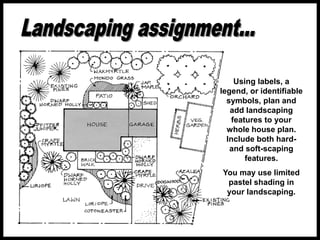
Coniferous trees are usually
represented by jagged
edges, while deciduous
trees are rounded
Using labels, a
legend, or identifiable
symbols, plan and
add landscaping
features to your
whole house plan.
Include both hard-
and soft-scaping
features.
You may use limited
pastel shading in
your landscaping.

150-Landscaping.ppt

  • 2.
    Landscaping refers tothe ways people use plants (softscaping) and objects (hardscaping) to enhance or change the natural environment around the exterior of their home.
  • 3.
    Well-planned landscaping enhances theexterior appearance of the home and outdoor living spaces. It serves to provide privacy, safety, comfort, and beauty.
  • 4.
    Landscaping can provide privacy…with certain types of fencing, hedges, or plantings to block the view from neighbors or traffic
  • 5.
    Landscaping can providesafety… Perhaps by lighting walkways and steps; using hot water or electricity to heat sidewalks and keep them clear of snow and ice; enclosing or lighting pool areas; fencing property lines
  • 6.
    Landscaping can providecomfort… in the form of shade, a windbreak, a firepit for cooking and warmth, a bench or patio grouping or gazebo for seating
  • 7.
    Landscaping can provide beauty…by using line, form, texture, and color of natural and man-made materials to add appeal to the property
  • 8.
    Soil… The key to supplying nutrients,air, and water to plants. Soil is made up of inorganic material, such as rock particles, as well as organic matter, such as decaying animals and plants. Air, water and microorganisms are also present in healthy soil. Soil texture is determined by the amount of clay, silt or sand particles present. Clay holds water and nutrients very well, but is tough for roots to penetrate. Clay is heavy and can become saturated easily. The other extreme is sand, which drains very well, but loses nutrients and dries quickly. Silty soils are more similar to clay than sand. The best type of soil for gardening is called loam. Loam has proportional amounts of silt, clay and sand that makes it hold its shape when lightly squeezed. When squeezed harder, it crumbles.
  • 9.
    Grasses… Native andornamental grasses can be used in landscaping, as well as grass for lawns. Both the stems and leaves in grass grow from the bottom up, so it can be cut repeatedly. Bluegrass, rye, and fescue are common grasses in midwest climates. Soil/lawns should slope away from the house foundation for correct drainage.
  • 10.
    Ground covers… thick, low-growingfoliage varying in texture and color; low maintenance; used in spots difficult to mow; they prevent erosion and control weeds
  • 11.
    Flowers… for addingcolor and beauty Perennials never need replanting; more costly and quite hardy: lilies, roses, cone flowers, iris, peonies, pansies Annuals are more colorful; less costly but must be replanted yearly: petunias, impatiens, vinca, marigolds, zinnia
  • 12.
    Deciduous trees andshrubs… many have spectacular fall color and then lose their leaves in winter; elm, maple, oak, sycamore, cottonwood, hickory, locust, ash, and walnut trees are common; lilac, azalea, hydrangea, forsythia, burning bush are shrubs tree height: 40-150’ spread: 25-100’
  • 13.
    Ornamental trees… Are usually15-30’ in height and 15-30’ in spread; they often have an attractive shape, leaf color, or blossom; may not all be suitable for all soil types or climates; redbud and Japanese maples are examples
  • 14.
    Coniferous (Evergreen) treesand shrubs… narrow-leaved evergreens have needles rather than leaves; furnish color and mass all year long; cedar, spruce, pine, fir, and Pfitzer junipers, and yews; Mature height varies, but trees may be 60’
  • 15.
    Vines… decorative andfunctional; leaves may have interesting shapes; some have clusters of flowers; may reduce the monotony of a wall or be trained to climb a trellis Ivy, clematis, trumpet vine, morning glory, sweet pea, passionflower, honeysuckle, wisteria
  • 16.
    Paths, Walks, &Steps… they connect one area with another; paths may be temporary; safety is a key factor in designing steps Permanent walks should be 4 ½’ wide
  • 17.
    Banks, Walls, &Fences… banks form a separation between two elevations; walls are formal and provide permanent boundaries, enclosures, and privacy Fences are less formal and less expensive; they define boundaries, provide privacy , block sun and wind, contain children and pets and enclose pools
  • 18.
    Patios, Decks, andGame Areas… used for relaxation or recreation; patios are level with the ground while decks are above ground; decks and patios should be large enough to accommodate outdoor furniture Volleyball, badminton, croquet, horseshoes, tennis, basketball, & tetherball - outdoor activities needing space
  • 19.
    Pools & WaterFeatures… from a simple bird bath or fountain, to waterfalls and pools, water has a universal appeal; it’s cooling and has a soothing sound Water features are always a focal point
  • 20.
    Wildlife refuge… somelandscaping features appeal to or attract wildlife such as fish, birds, butterflies, or small animals.
  • 21.
    Adding landscaping to yourhouse plans… use care in foundation plantings that do not break up basement walls and in planting large trees a safe distance from rooftops Coniferous trees are usually represented by jagged edges, while deciduous trees are rounded
  • 23.
    Using labels, a legend,or identifiable symbols, plan and add landscaping features to your whole house plan. Include both hard- and soft-scaping features. You may use limited pastel shading in your landscaping.