



Automatic Landmark Detection 
using Statistical Shape Modelling 
and Template Matching 
Authors 
Habib Baluwala, Duane Malcolm, Jess Jor, 
Poul Nielsen, Martyn Nash
Introduction 
● Research Problem: Develop biomechanical models of 
the human breast 
● Construction of biomechanical model of the torso skin 
surface 
● Objective : 
– Align the mean mesh of the skin surface with new image 
data 
– Match the mesh to the edges of the skin surface of the new 
image
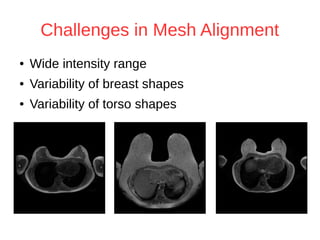
Challenges in Mesh Alignment 
● Wide intensity range 
● Variability of breast shapes 
● Variability of torso shapes
Statistical Shape Modelling (SSM) 
● Most structures of clinical interest have a 
characteristic shape and anatomical location 
relative to other structures 
● Across the normal population the shape varies 
statistically 
● Provides prior knowledge of shape
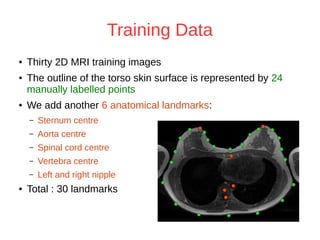
Training Data 
● Thirty 2D MRI training images 
● The outline of the torso skin surface is represented by 24 
manually labelled points 
● We add another 6 anatomical landmarks: 
– Sternum centre 
– Aorta centre 
– Spinal cord centre 
– Vertebra centre 
– Left and right nipple 
● Total : 30 landmarks
Modelling Shape using PCA 
● Compute the mean of the data 
● Compute the covariance of the data 
● Compute the eigenvectors and eigenvalues of the 
covariance matrix, sorted in decreasing order of 
eigenvalue size 
● Remove the small eigenvalues, retaining most of the 
variation 
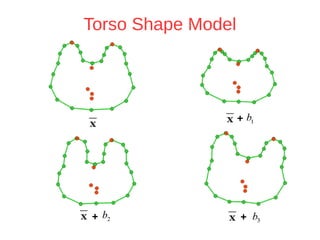
● is the mean shape, is a set of orthogonal modes of 
variation and defines a set of components of 
deformable model.
Torso Shape Model 
+ 
+ +
Template Matching 
● Move a template over an image and calculate 
the similarity between the template and image 
patch 
● Similarity measures 
– Cross Correlation (CC) 
– Normalised Cross correlation (NCC) 
– Sum of Squared Differences (SSD) 
– Normalised Sum of Squared Differences (NSSD)
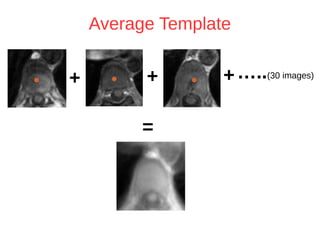
Average Template 
+ + + 
= 
…..(30 images)
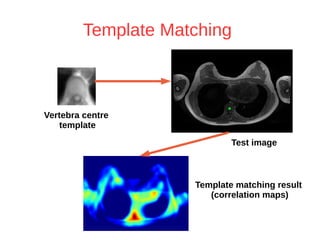
Template Matching 
Vertebra centre 
template 
Test image 
Template matching result 
(correlation maps)
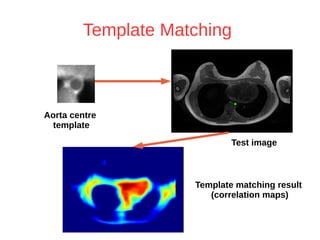
Template Matching 
Aorta centre 
template 
Test image 
Template matching result 
(correlation maps)
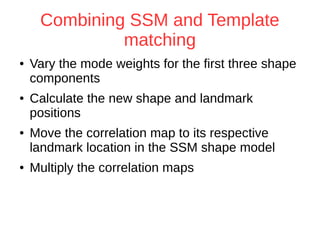
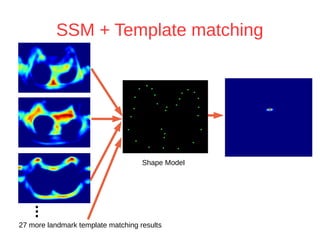
Combining SSM and Template 
matching 
● Vary the mode weights for the first three shape 
components 
● Calculate the new shape and landmark 
positions 
● Move the correlation map to its respective 
landmark location in the SSM shape model 
● Multiply the correlation maps
SSM + Template matching 
... 
Shape Model 
27 more landmark template matching results
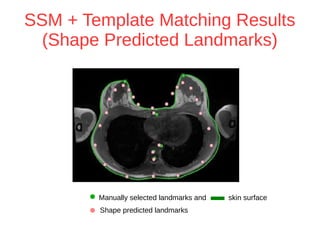
SSM + Template Matching Results 
(Shape Predicted Landmarks) 
Manually selected landmarks and skin surface 
Shape predicted landmarks
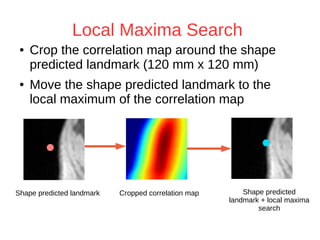
Local Maxima Search 
● Crop the correlation map around the shape 
predicted landmark (120 mm x 120 mm) 
● Move the shape predicted landmark to the 
local maximum of the correlation map 
Shape predicted landmark Cropped correlation map Shape predicted 
landmark + local maxima 
search
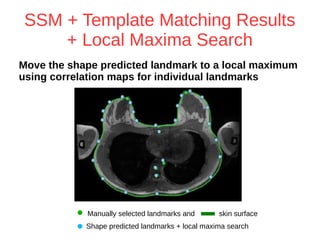
SSM + Template Matching Results 
+ Local Maxima Search 
Move the shape predicted landmark to a local maximum 
using correlation maps for individual landmarks 
Manually selected landmarks and skin surface 
Shape predicted landmarks + local maxima search
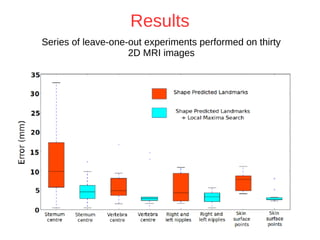
Results 
Series of leave-one-out experiments performed on thirty 
2D MRI images
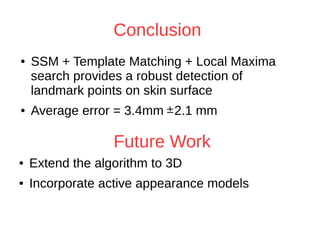
Conclusion 
● SSM + Template Matching + Local Maxima 
search provides a robust detection of 
landmark points on skin surface 
● Average error = 3.4mm 2.1 mm 
Future Work 
● Extend the algorithm to 3D 
● Incorporate active appearance models
Questions !!!

Landmark detection using statistical shape modelling and template matching (MICCAI 2014 CBM workshop)

  • 1.
    Automatic Landmark Detection using Statistical Shape Modelling and Template Matching Authors Habib Baluwala, Duane Malcolm, Jess Jor, Poul Nielsen, Martyn Nash
  • 2.
    Introduction ● ResearchProblem: Develop biomechanical models of the human breast ● Construction of biomechanical model of the torso skin surface ● Objective : – Align the mean mesh of the skin surface with new image data – Match the mesh to the edges of the skin surface of the new image
  • 3.
    Challenges in MeshAlignment ● Wide intensity range ● Variability of breast shapes ● Variability of torso shapes
  • 4.
    Statistical Shape Modelling(SSM) ● Most structures of clinical interest have a characteristic shape and anatomical location relative to other structures ● Across the normal population the shape varies statistically ● Provides prior knowledge of shape
  • 5.
    Training Data ●Thirty 2D MRI training images ● The outline of the torso skin surface is represented by 24 manually labelled points ● We add another 6 anatomical landmarks: – Sternum centre – Aorta centre – Spinal cord centre – Vertebra centre – Left and right nipple ● Total : 30 landmarks
  • 6.
    Modelling Shape usingPCA ● Compute the mean of the data ● Compute the covariance of the data ● Compute the eigenvectors and eigenvalues of the covariance matrix, sorted in decreasing order of eigenvalue size ● Remove the small eigenvalues, retaining most of the variation ● is the mean shape, is a set of orthogonal modes of variation and defines a set of components of deformable model.
  • 7.
  • 8.
    Template Matching ●Move a template over an image and calculate the similarity between the template and image patch ● Similarity measures – Cross Correlation (CC) – Normalised Cross correlation (NCC) – Sum of Squared Differences (SSD) – Normalised Sum of Squared Differences (NSSD)
  • 9.
    Average Template ++ + = …..(30 images)
  • 10.
    Template Matching Vertebracentre template Test image Template matching result (correlation maps)
  • 11.
    Template Matching Aortacentre template Test image Template matching result (correlation maps)
  • 12.
    Combining SSM andTemplate matching ● Vary the mode weights for the first three shape components ● Calculate the new shape and landmark positions ● Move the correlation map to its respective landmark location in the SSM shape model ● Multiply the correlation maps
  • 13.
    SSM + Templatematching ... Shape Model 27 more landmark template matching results
  • 14.
    SSM + TemplateMatching Results (Shape Predicted Landmarks) Manually selected landmarks and skin surface Shape predicted landmarks
  • 15.
    Local Maxima Search ● Crop the correlation map around the shape predicted landmark (120 mm x 120 mm) ● Move the shape predicted landmark to the local maximum of the correlation map Shape predicted landmark Cropped correlation map Shape predicted landmark + local maxima search
  • 16.
    SSM + TemplateMatching Results + Local Maxima Search Move the shape predicted landmark to a local maximum using correlation maps for individual landmarks Manually selected landmarks and skin surface Shape predicted landmarks + local maxima search
  • 17.
    Results Series ofleave-one-out experiments performed on thirty 2D MRI images
  • 18.
    Conclusion ● SSM+ Template Matching + Local Maxima search provides a robust detection of landmark points on skin surface ● Average error = 3.4mm 2.1 mm Future Work ● Extend the algorithm to 3D ● Incorporate active appearance models
  • 19.