MOUNTAINS

 Brian Hyland
What is it, how it forms?
• Mountains are large landforms that stretch above the
  surrounding land in a limited area usually in peak form. They
  are normally very steep.
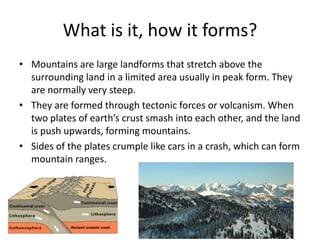
• They are formed through tectonic forces or volcanism. When
  two plates of earth’s crust smash into each other, and the land
  is push upwards, forming mountains.
• Sides of the plates crumple like cars in a crash, which can form
  mountain ranges.
Mountain Formation
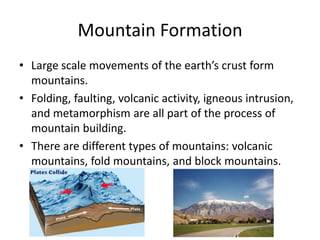
• Large scale movements of the earth’s crust form
  mountains.
• Folding, faulting, volcanic activity, igneous intrusion,
  and metamorphism are all part of the process of
  mountain building.
• There are different types of mountains: volcanic
  mountains, fold mountains, and block mountains.
Mount Fuji
• Located on Honshu Island in Japan.
• Mount Fuji emerged around 100,000 years ago.
• It is 12,388 feet high.
• It is a well known symbol of Japan and is often depicted in
  paintings and photos.
• It is one of Japan’s “three holy mountains”.
• Many people have climbed Mount Fuji, and there have been
  many deaths while attempting to do so.
Environmental Effects
• When air flows over a mountain, it is forced to be lifted
  upward which will cause more precipitation to fall on that side
  of the mountain slope. Then the air will drop back down as
  warm air. This process strips the moisture from the air
  resulting in a rain shadow effect for areas down wind of the
  mountain.
• The mountains also block cold winds from the north,
  increasing temperature further south.
• There is not much global change in climate.
SOURCES
• Chidding Stone
http://www.chiddingstone.kent.sch.uk/homework/mountains/types.htm

• Japan-guide.com
http://www.japan-guide.com/e/e2172.html

• Bgs.ac.uk
http://www.bgs.ac.uk/discoveringGeology/climateChange/general/images/mountainR
ange.jpg

Mountains

  • 1.
  • 2.
    What is it,how it forms? • Mountains are large landforms that stretch above the surrounding land in a limited area usually in peak form. They are normally very steep. • They are formed through tectonic forces or volcanism. When two plates of earth’s crust smash into each other, and the land is push upwards, forming mountains. • Sides of the plates crumple like cars in a crash, which can form mountain ranges.
  • 3.
    Mountain Formation • Largescale movements of the earth’s crust form mountains. • Folding, faulting, volcanic activity, igneous intrusion, and metamorphism are all part of the process of mountain building. • There are different types of mountains: volcanic mountains, fold mountains, and block mountains.
  • 4.
    Mount Fuji • Locatedon Honshu Island in Japan. • Mount Fuji emerged around 100,000 years ago. • It is 12,388 feet high. • It is a well known symbol of Japan and is often depicted in paintings and photos. • It is one of Japan’s “three holy mountains”. • Many people have climbed Mount Fuji, and there have been many deaths while attempting to do so.
  • 5.
    Environmental Effects • Whenair flows over a mountain, it is forced to be lifted upward which will cause more precipitation to fall on that side of the mountain slope. Then the air will drop back down as warm air. This process strips the moisture from the air resulting in a rain shadow effect for areas down wind of the mountain. • The mountains also block cold winds from the north, increasing temperature further south. • There is not much global change in climate.
  • 6.
    SOURCES • Chidding Stone http://www.chiddingstone.kent.sch.uk/homework/mountains/types.htm •Japan-guide.com http://www.japan-guide.com/e/e2172.html • Bgs.ac.uk http://www.bgs.ac.uk/discoveringGeology/climateChange/general/images/mountainR ange.jpg