Presentation of Gully Erosion control measurements
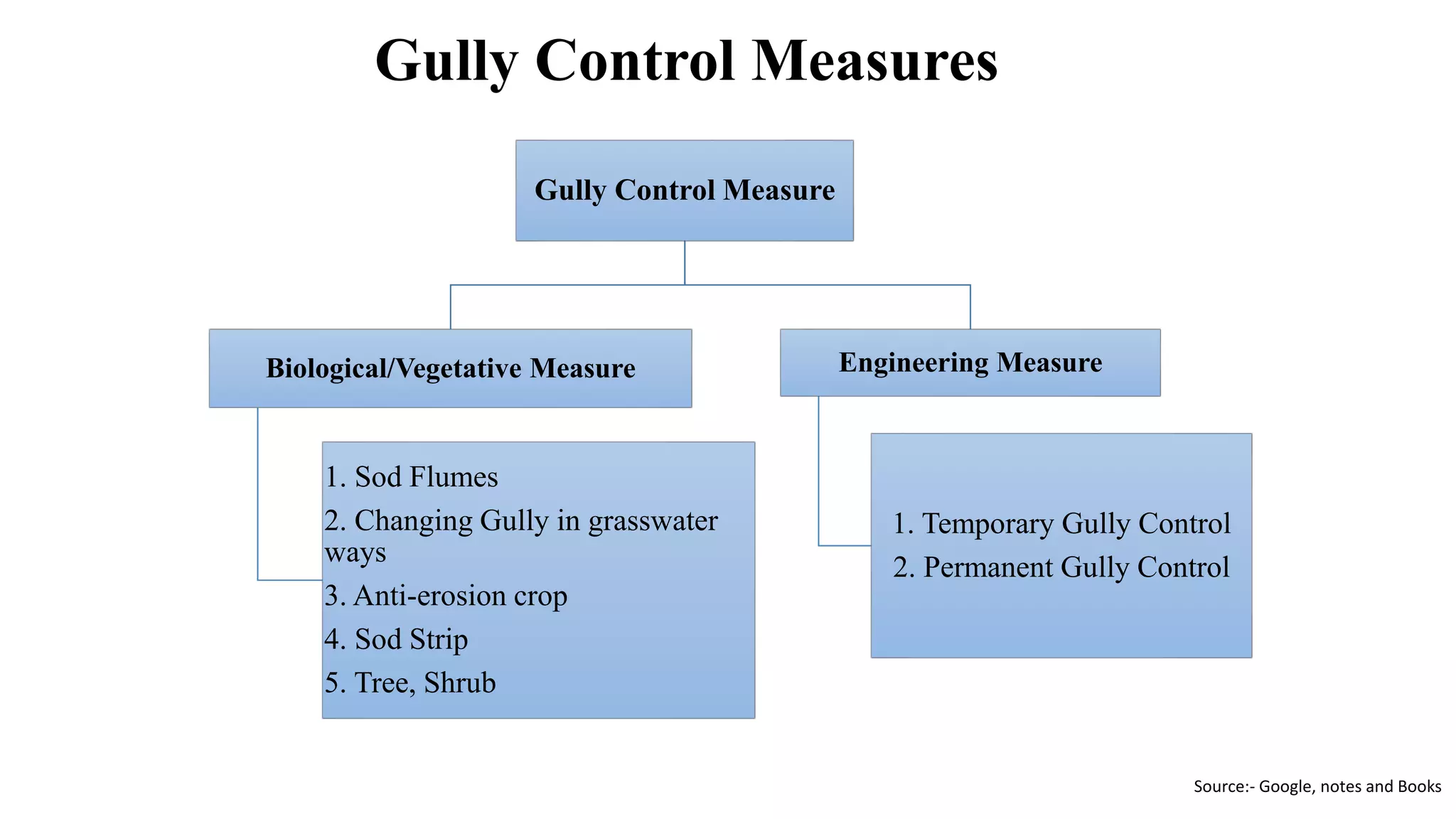
1) There are various biological, engineering, temporary and permanent measures that can be used for gully control. Biological methods use vegetation while engineering methods use structures.
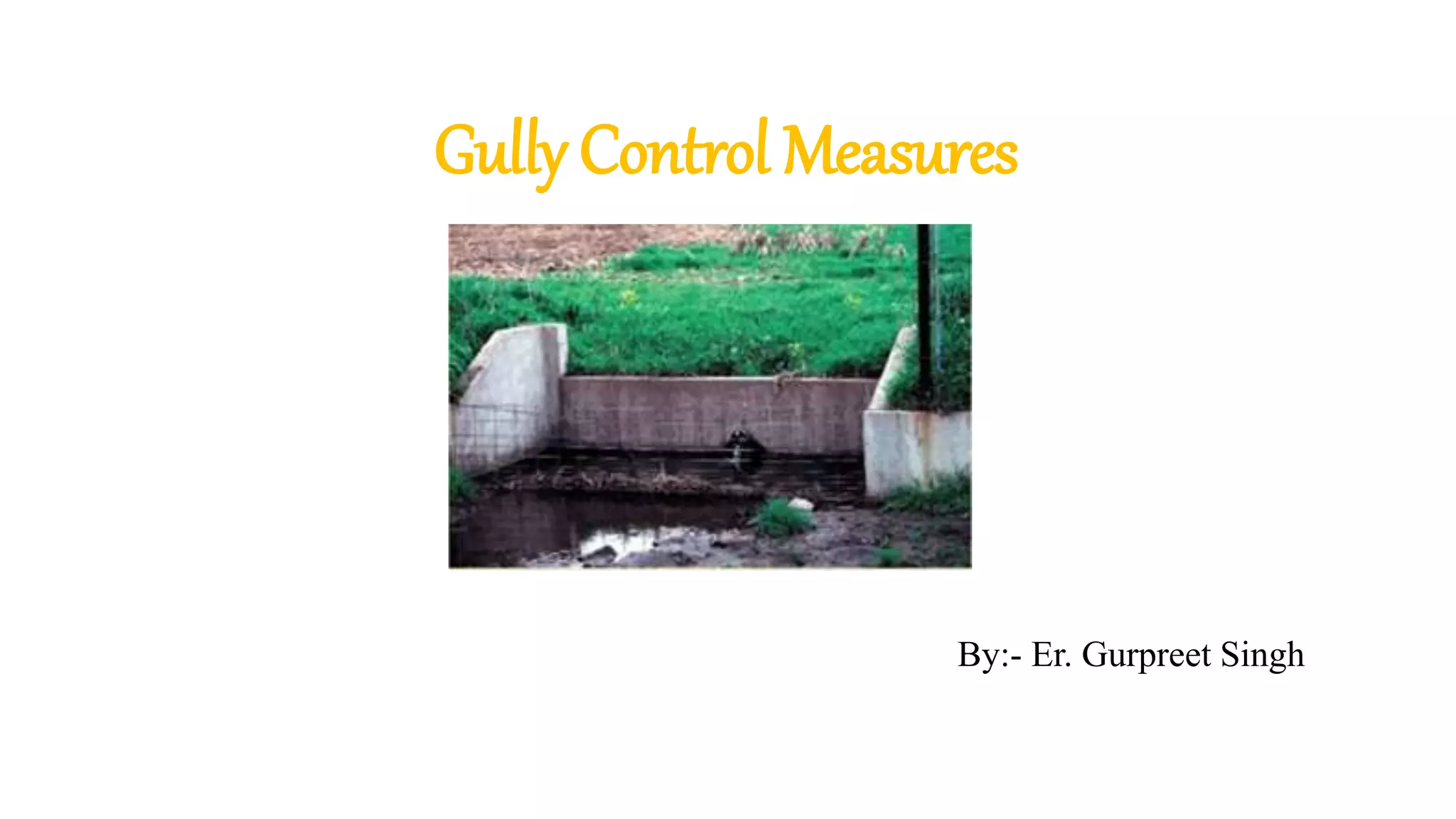
2) Permanent structures for gully control include drop spillways, drop inlet spillways, and chute spillways. These structures are designed based on hydrologic, hydraulic, and structural factors.
3) Drop spillways, drop inlet spillways, and chute spillways each have different characteristics regarding things like maximum drop height and ability to provide upstream storage. Temporary gully control structures are used when locally available materials are suitable and can help establish vegetation until permanent structures are implemented.
Gully Control Measures
GullyControl Measure
Biological/Vegetative Measure
1. Sod Flumes
2. Changing Gully in grasswater
ways
3. Anti-erosion crop
4. Sod Strip
5. Tree, Shrub
Engineering Measure
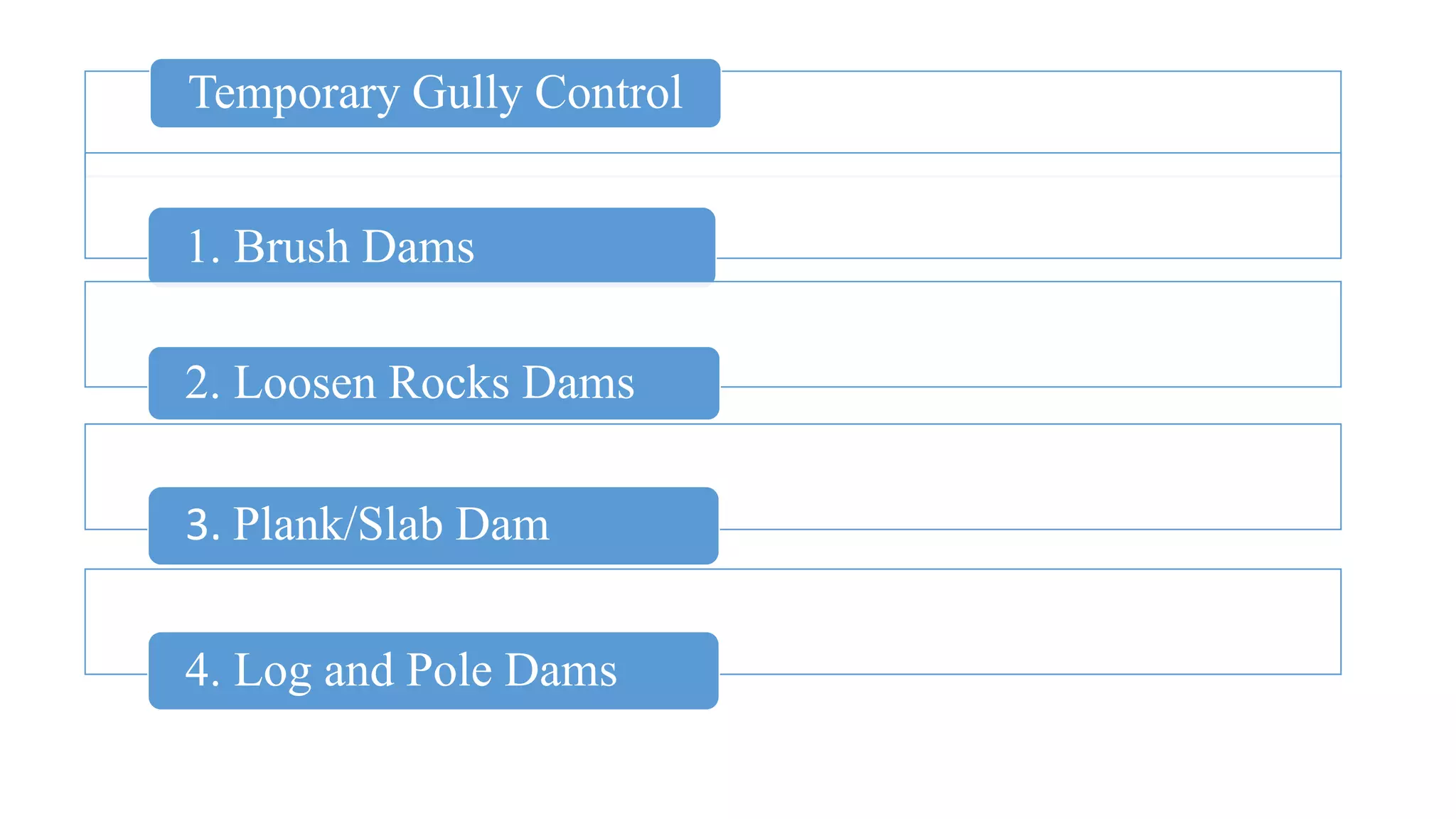
1. Temporary Gully Control
2. Permanent Gully Control
Source:- Google, notes and Books
3.
Design of PermanentStructure
• The design of the gully erosion control structure involves
1) Hydrologic design
2) Hydraulic
3) Structural Design
4.
Permanent Structure
• ThreeBasic type of permanent structures that are employed for stabilizing
gullies
1. Drop spillway
2. Drop inlet spillway
3. Chute spillway
• Used in gullies with medium to large drainage area, i.e in situations where
temporary structure may fail.
• Usually built of masonry or reinforced concrete.
• Proven measures for efficieny erosion control in any soil and conservation
program.
Source: Books
5.
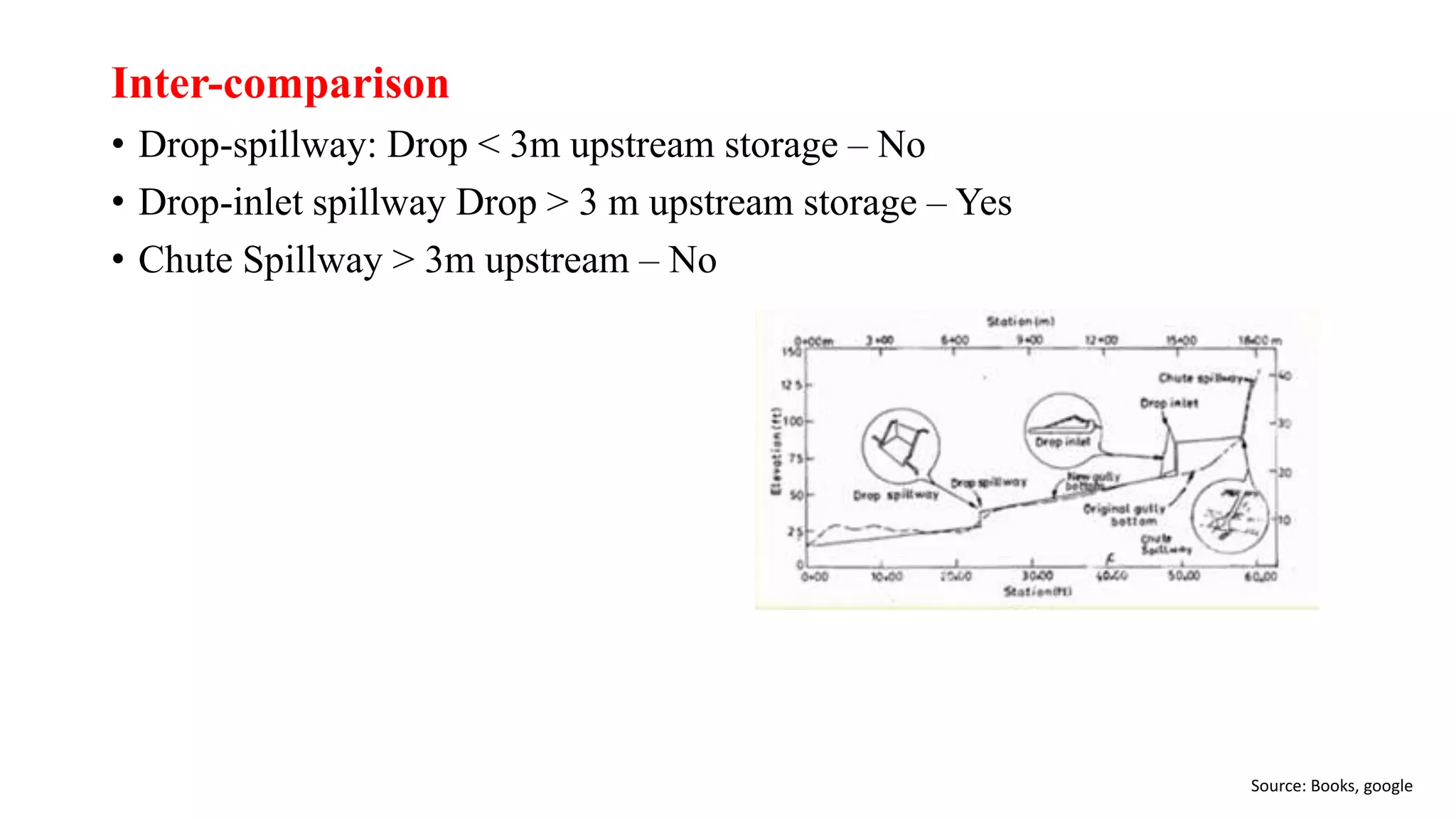
Inter-comparison
• Drop-spillway: Drop< 3m upstream storage – No
• Drop-inlet spillway Drop > 3 m upstream storage – Yes
• Chute Spillway > 3m upstream – No
Source: Books, google
6.
Functions
• The shouldhandle the peak runoff at safe velocity.
• The should be able to stabilize the gully.
• The should store the water for irrigation and other purposes.
• The sediment flow should be controlled.
7.
Purpose of designingGully Control
• Gully stabilisation
• Soil erosion control
• Sediment Control
• Water conservation
• Flood control
• Drainage
8.
Planning for Design
•Permanent structure are constructed when the benefits from such structures
are justification compared to the cost of construction.
• The design after careful investigation of
• Various factors influencing the characteristics of runoff
• The downstream flow characteristic
• Other specific requirement
• An analysis of all the factors affecting the work.
• No standard solution which applied for all problems
9.
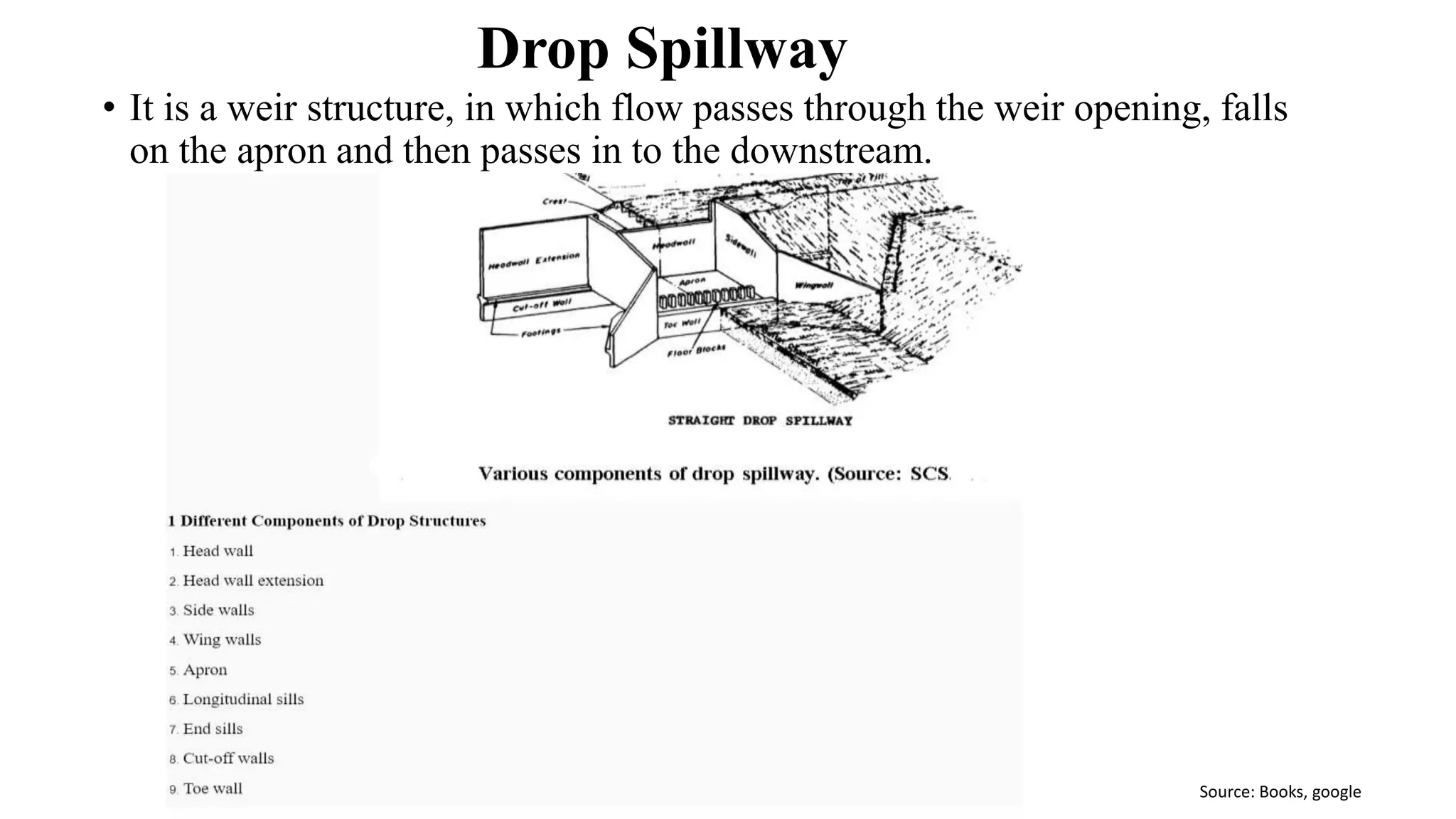
Drop Spillway
• Itis a weir structure, in which flow passes through the weir opening, falls
on the apron and then passes in to the downstream.
Source: Books, google
10.
Functions of components
•Head wall: It acts as a front wall against runoff in the drop spillway.
• The size of the weir should be sufficient to pass the design discharge safety.
• Head wall extension: Permit stable fill and prevents piping.
• Sidewall: Guide the water and protect the fill against erosion.
• Wing wall: Provide stability to fill and give protection to gully bank and surface.
• Apron: Dissipates the kinetic energy of falling water by creating hydraulic jump.
• Longitudinal skill: Provide stability to the apron.
• End sills: Its main function is to obstruct the water from going directly into the channel
below.
• Cut-off wall: Prevents piping under the structure besides reducing uplift and preventing
sliding.
• Toe wall: Prevents undercutting of apron.
Source: Books
11.
Use of dropspillway
• To control gradient in either natural or constructed channel.
• To serve as reservoir spillway where the total drop in relatively low.
• To control tail-water at the outlet of a spillway or conduit.
• To serve as inlet and outlet structures for tile drainage system.
12.
Drop-Inlet Spillway
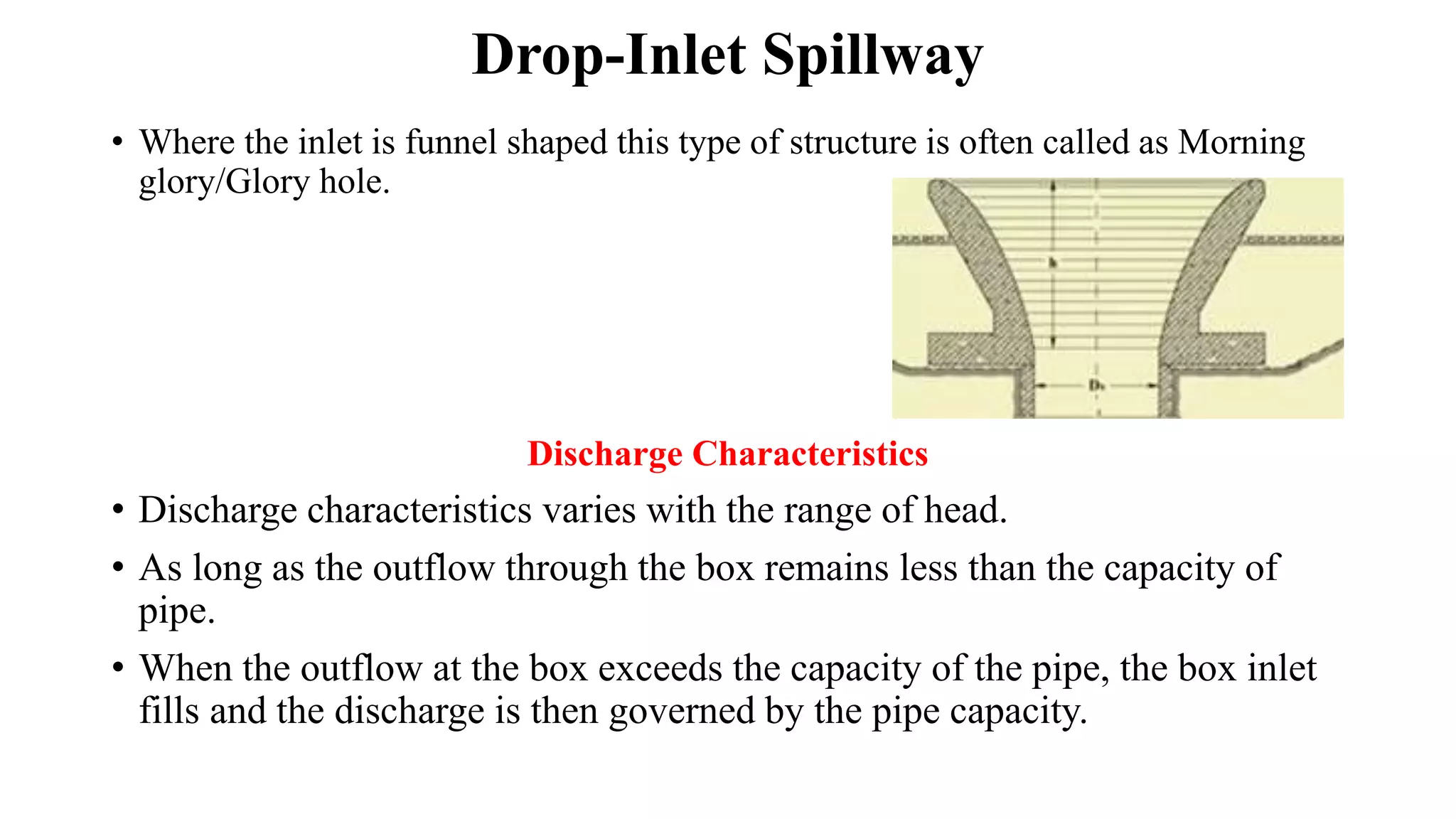
• Wherethe inlet is funnel shaped this type of structure is often called as Morning
glory/Glory hole.
Discharge Characteristics
• Discharge characteristics varies with the range of head.
• As long as the outflow through the box remains less than the capacity of
pipe.
• When the outflow at the box exceeds the capacity of the pipe, the box inlet
fills and the discharge is then governed by the pipe capacity.
13.
Advantages
• Stability
• Itis very stable structure and likelihood of serious structural damage is remote.
• Non-clogging of weir
• Rectangular weir, which is used in this case
• Ease & economy of construction.
• Low maintenance cost.
• Standardization.
Disadvantages
• Maximum drop is limited to 3m
• It is not a favourable structure where temporary spillway storage is desired
to obtain large reduction in the discharge.
14.
Chute Spillway
• Achute spillway is a steeply sloping open channel, which leads the water
from a channel, which leads the water from higher elevation to the
downstream.
• The chute is sometimes of constant width but is usually narrowed for
economy and they widened near the end the reduced the discharge velocity.
• The slope of the chute must conform to the slope at the site, longitudinal
and cross section survey at the site.
•Applicability
• Used when the drop exceed 3 m
• Superior to drop-inlet spillway for large discharge.
• Preferred over drop-inlet spillway when there is no opportunity to provide
temporary storage.
15.
Disadvantage
• There isa considerable danger of undermining due to additional precaution
are required to handle this problem.
• In poorly drained areas, there is a problem of seepage
• Such areas may not be suitable for chute spillway as seepage tends to weaken
foundation
• Constructing chute spillway is essential and no other substitutes are available.
16.
Temporary Gully
• Itis for gully control, construction of brush, wood, rocks, woven wire and
sod/earth.
• It is used where material locally available and labour is cheap.
• It is helpful during the establishment of vegetation.
• Main purpose to control the erosion
• It is suitable with small drainage areas.
• Helpful for collecting soil and conserve moisture in guly bottom for the
growth of vegetation.
• A grade of 0.1 to 0.5% is provided.