
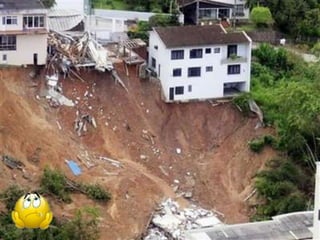
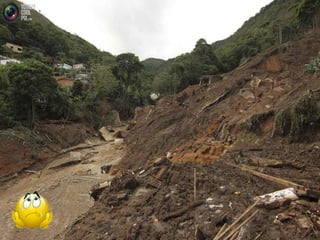
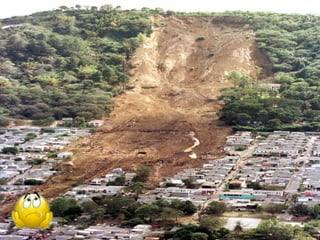
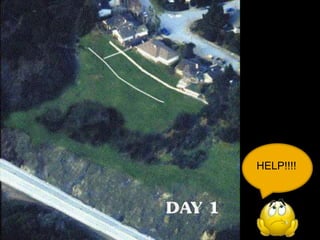
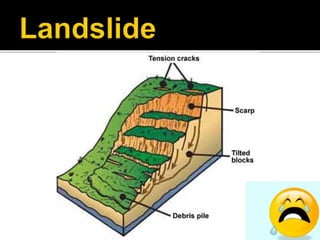
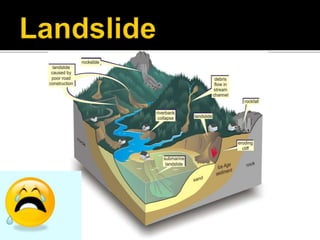



- A landslide or Landslip is
a geological phenomenon which
includes a wide range of ground
movement
HELP!!!!
Landslides occur when the
stability of a slope changes from a
stable to an unstable condition. A
change in the stability of a slope can
be caused by a number of factors,
acting together or alone. Natural
causes of landslides include:
 groundwater pressure acting to destabilize the slope.
 Loss or absence of vertical vegetative structure, soil
nutrients, and soil structure (e.g. after a wildfire).
 erosion of the toe of a slope by rivers or ocean waves.
 weakening of a slope through saturation by
snowmelt, glaciers melting, or heavy rains.
 earthquakes adding loads to barely stable slope.
 Earthquake-caused liquefaction destabilizing slopes.
 volcanic eruptions.
“Landslides are
aggravated by
human activities”
 deforestation, cultivation and construction, which
destabilize the already fragile slopes.
 vibrations from machinery or traffic.
 Blasting.
 earthwork which alters the shape of a slope, or which
imposes new loads on an existing slope
 in shallow soils, the removal of deep-
rooted vegetation that binds colluvium to bedrock.
 Construction, agricultural or forestry activities
(logging) which change the amount of water which
infiltrates the soil.
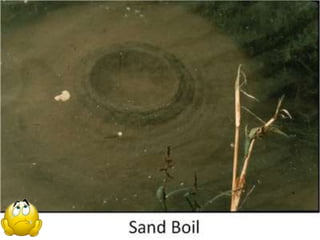
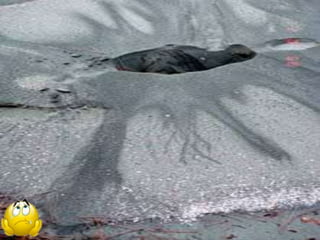
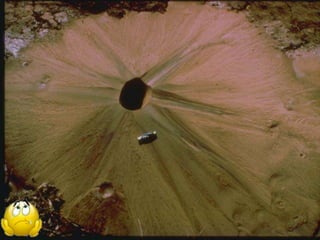
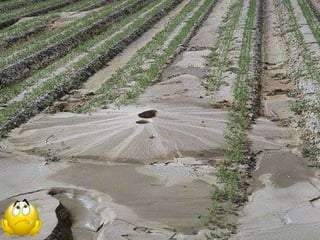
- Sand boils or Sand
Volcanoes occur when water under
pressure wells up through a bed of
sand. The water looks like it is "boiling"
up from the bed of sand
Sand boils can be a mechanism contributing
to levee failure during floods. This effect is
caused by a difference in pressure on two
sides of a levee or dike, most likely during a
flood. This process can result in piping,
whereby the removal of soil particles results in
a pipe through the embankment. The creation
of the pipe will quickly pick up pace and will
eventually result in failure of the embankment.
A sand boil is difficult to stop. The most
effective method is by creating a body of
water above the boil to create enough
pressure to slow the flow of water. A
slower flow will not be able to move soil
particles. The body of water is often
created with sandbags forming a ring
around the boil
land slide

land slide

  • 5.
    - A landslideor Landslip is a geological phenomenon which includes a wide range of ground movement
  • 6.
  • 8.
    Landslides occur whenthe stability of a slope changes from a stable to an unstable condition. A change in the stability of a slope can be caused by a number of factors, acting together or alone. Natural causes of landslides include:
  • 9.
     groundwater pressureacting to destabilize the slope.  Loss or absence of vertical vegetative structure, soil nutrients, and soil structure (e.g. after a wildfire).  erosion of the toe of a slope by rivers or ocean waves.  weakening of a slope through saturation by snowmelt, glaciers melting, or heavy rains.  earthquakes adding loads to barely stable slope.  Earthquake-caused liquefaction destabilizing slopes.  volcanic eruptions.
  • 11.
  • 12.
     deforestation, cultivationand construction, which destabilize the already fragile slopes.  vibrations from machinery or traffic.  Blasting.  earthwork which alters the shape of a slope, or which imposes new loads on an existing slope  in shallow soils, the removal of deep- rooted vegetation that binds colluvium to bedrock.  Construction, agricultural or forestry activities (logging) which change the amount of water which infiltrates the soil.
  • 16.
    - Sand boilsor Sand Volcanoes occur when water under pressure wells up through a bed of sand. The water looks like it is "boiling" up from the bed of sand
  • 18.
    Sand boils canbe a mechanism contributing to levee failure during floods. This effect is caused by a difference in pressure on two sides of a levee or dike, most likely during a flood. This process can result in piping, whereby the removal of soil particles results in a pipe through the embankment. The creation of the pipe will quickly pick up pace and will eventually result in failure of the embankment.
  • 20.
    A sand boilis difficult to stop. The most effective method is by creating a body of water above the boil to create enough pressure to slow the flow of water. A slower flow will not be able to move soil particles. The body of water is often created with sandbags forming a ring around the boil