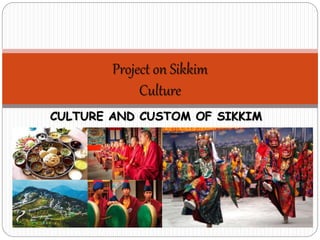
CULTURE AND CUSTOM OF SIKKIM
Project on Sikkim
Culture
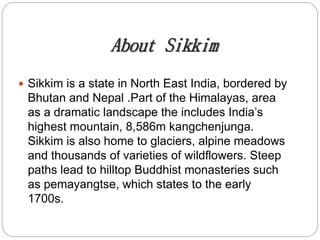
About Sikkim
 Sikkim is a state in North East India, bordered by
Bhutan and Nepal .Part of the Himalayas, area
as a dramatic landscape the includes India’s
highest mountain, 8,586m kangchenjunga.
Sikkim is also home to glaciers, alpine meadows
and thousands of varieties of wildflowers. Steep
paths lead to hilltop Buddhist monasteries such
as pemayangtse, which states to the early
1700s.
Languages of Sikkim
 The sikkimese language, also called sikkimese
Tibetan, bhutia, or Drenjongke, Dranjoke, Denjongka,
Denzongpeke and Denzongke, belongs to the
southern tabetic languages. It is spoken by the bhutia
in Sikkim, India and its parts of Mechie zone, nepal.
 Writing system : Tibetan script
 Official language in India : Sikkim
 Native speakers : 70,000(2001)
 Reason : Sikkim, Nepal (mechi zone), Bhutan
 Ethnicity : sikkimese
 People also search for : lepcha language, limbu
language
 Language family : tibeto-burman languages, sino-
tibetan language
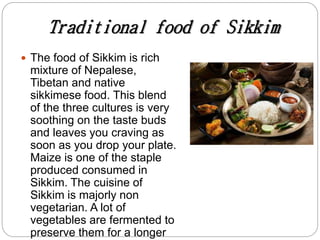
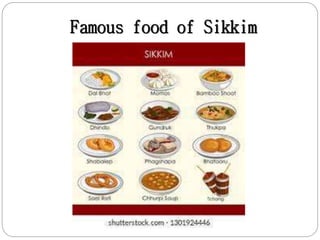
Traditional food of Sikkim
 The food of Sikkim is rich
mixture of Nepalese,
Tibetan and native
sikkimese food. This blend
of the three cultures is very
soothing on the taste buds
and leaves you craving as
soon as you drop your plate.
Maize is one of the staple
produced consumed in
Sikkim. The cuisine of
Sikkim is majorly non
vegetarian. A lot of
vegetables are fermented to
preserve them for a longer
Famous food of Sikkim
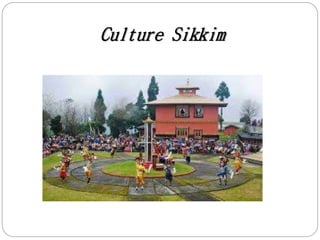
Culture Sikkim
Sikkim dress
 The grandeur of Sikkim as a favourite offbeat
holuday getaway does not lie only in
outstandingly the picturesque sceneries or its lip-
smacking cuisine but also in its extremely warm-
heated populace whick is so diverse yet so
intricately connecred. The clothing of Sikkim
shows this diversity and exemplifies social and
cultural life of the three main resident
communities-the lepchas, Bhutias and the
nepalis.
Sikkim traditional dress
 The main costume donned by bhutias is the
Bakhu(according to the Nepalese dialect) or Kho(
according to the bhutia dialect). Worn by men and women
alike, Bakhu is very similar to the Tibetan chuba, except
that it is sleeveless. It is a loose cloak-like garb which is
tied at the neck and tightened around the waist by a belt
made of silk or cotton.
 2)Thokro-Dum
 The Thokro-Dum is the primary outfit for the lepcha
community members. Usually, the lepcha bread makers
spot this. It consists of a white pyjama streching up to the
calves, almost resembling a karate player’s outfit.
Yenthatese, a lepcha shirt and shambo, an embroidered
cap are paired with it. A multicolored, hand-woven cloth
 3) Dumvum•
 The traditional attire of lepcha women involve a
sari like garment known as Dumvum or Dumyam.
It is an ankle length outfit , silky and smooth
binding comfort and culture together. Underneath,
a loose fitting blouse in a contrasting colour is
worn known as tago. To complete the look, a type
of belt called the Nyamrek and taro, a cap is
worn. A scarf called gorey is often used to cover
the head.
 4) Shuruval
 The Nepalese men of Sikkim wear this outfit. Long
double breasted garment flows below the waist along
with the trouser. The churidar(bottom) is called
Shuruval and the pyjama(shirt) who is known as
daura. Askot, waistcoat and patuki, a belt is worn to
complement the shuruval. They also carry the khukri-
a heavy weapon carried in a leather case known as
daab.
 5) Pharis
 Augmenting the grace of Nepalese women, traditional
attire called pharia is available in a variety of different
hues. Like in the case of the bhutias, an long, loose
blouse fastened on four sides is worn, standing true to
its ame, chaubandi cholo. For extra coverage, the
upper body is wrapped elegantly with the piece of
cloth that comes in beautiful prints known as

Project on sikkim

  • 1.
    CULTURE AND CUSTOMOF SIKKIM Project on Sikkim Culture
  • 2.
    About Sikkim  Sikkimis a state in North East India, bordered by Bhutan and Nepal .Part of the Himalayas, area as a dramatic landscape the includes India’s highest mountain, 8,586m kangchenjunga. Sikkim is also home to glaciers, alpine meadows and thousands of varieties of wildflowers. Steep paths lead to hilltop Buddhist monasteries such as pemayangtse, which states to the early 1700s.
  • 3.
    Languages of Sikkim The sikkimese language, also called sikkimese Tibetan, bhutia, or Drenjongke, Dranjoke, Denjongka, Denzongpeke and Denzongke, belongs to the southern tabetic languages. It is spoken by the bhutia in Sikkim, India and its parts of Mechie zone, nepal.  Writing system : Tibetan script  Official language in India : Sikkim  Native speakers : 70,000(2001)  Reason : Sikkim, Nepal (mechi zone), Bhutan  Ethnicity : sikkimese  People also search for : lepcha language, limbu language  Language family : tibeto-burman languages, sino- tibetan language
  • 4.
    Traditional food ofSikkim  The food of Sikkim is rich mixture of Nepalese, Tibetan and native sikkimese food. This blend of the three cultures is very soothing on the taste buds and leaves you craving as soon as you drop your plate. Maize is one of the staple produced consumed in Sikkim. The cuisine of Sikkim is majorly non vegetarian. A lot of vegetables are fermented to preserve them for a longer
  • 5.
  • 6.
  • 7.
    Sikkim dress  Thegrandeur of Sikkim as a favourite offbeat holuday getaway does not lie only in outstandingly the picturesque sceneries or its lip- smacking cuisine but also in its extremely warm- heated populace whick is so diverse yet so intricately connecred. The clothing of Sikkim shows this diversity and exemplifies social and cultural life of the three main resident communities-the lepchas, Bhutias and the nepalis.
  • 8.
    Sikkim traditional dress The main costume donned by bhutias is the Bakhu(according to the Nepalese dialect) or Kho( according to the bhutia dialect). Worn by men and women alike, Bakhu is very similar to the Tibetan chuba, except that it is sleeveless. It is a loose cloak-like garb which is tied at the neck and tightened around the waist by a belt made of silk or cotton.  2)Thokro-Dum  The Thokro-Dum is the primary outfit for the lepcha community members. Usually, the lepcha bread makers spot this. It consists of a white pyjama streching up to the calves, almost resembling a karate player’s outfit. Yenthatese, a lepcha shirt and shambo, an embroidered cap are paired with it. A multicolored, hand-woven cloth
  • 9.
     3) Dumvum• The traditional attire of lepcha women involve a sari like garment known as Dumvum or Dumyam. It is an ankle length outfit , silky and smooth binding comfort and culture together. Underneath, a loose fitting blouse in a contrasting colour is worn known as tago. To complete the look, a type of belt called the Nyamrek and taro, a cap is worn. A scarf called gorey is often used to cover the head.
  • 10.
     4) Shuruval The Nepalese men of Sikkim wear this outfit. Long double breasted garment flows below the waist along with the trouser. The churidar(bottom) is called Shuruval and the pyjama(shirt) who is known as daura. Askot, waistcoat and patuki, a belt is worn to complement the shuruval. They also carry the khukri- a heavy weapon carried in a leather case known as daab.  5) Pharis  Augmenting the grace of Nepalese women, traditional attire called pharia is available in a variety of different hues. Like in the case of the bhutias, an long, loose blouse fastened on four sides is worn, standing true to its ame, chaubandi cholo. For extra coverage, the upper body is wrapped elegantly with the piece of cloth that comes in beautiful prints known as