Operons – The basic Concept
• Many Genes are switched on or off by changes in the metabolic status
of the cell.
• One basic mechanism for this control of gene expression is described
as the operon model.
• This model was discovered by Jacob and Monod in 1961 in E. Coli
bacteria.
• The entire stretch of DNA required for enzyme production for a
pathway—constitute an operon.
• The stretch contains a promoter, operator and all the genes they
control.
• A key advantage of grouping genes of related function into one
transcription unit is that a single “on-off switch” can control the whole
cluster of functionally related genes;
Operons – The basic Concept
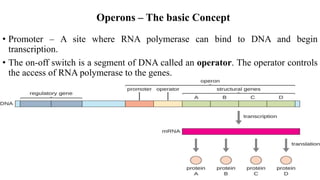
• Promoter – A site where RNA polymerase can bind to DNA and begin
transcription.
• The on-off switch is a segment of DNA called an operator. The operator controls
the access of RNA polymerase to the genes.
Lac - Operon
• Lac-operon is a classic example of inducible operon, where lac stands
for lactose.
• Lactose metabolism begins with hydrolysis of the disaccharide into its
component monosaccharides (glucose and galactose), a reaction
catalysed by the enzyme β-galactosidase.
• In the absence of lactose, only a few molecule of β-galactosidase is
present in the bacterium, but the number increases more than 1000-
fold when lactose is present.
• The gene for β-galactosidase (lacZ) is part of the lac operon, which
includes two other genes coding for enzymes that function in the use
of lactose.
• The entire transcription unit is under the command of one main
operator and promoter.
Lac - Operon
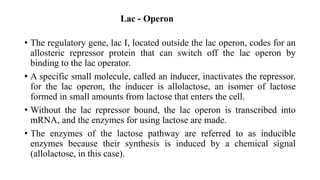
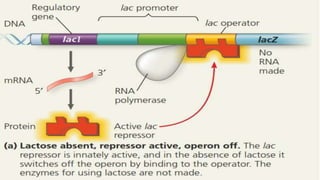
• The regulatory gene, lac I, located outside the lac operon, codes for an
allosteric repressor protein that can switch off the lac operon by
binding to the lac operator.
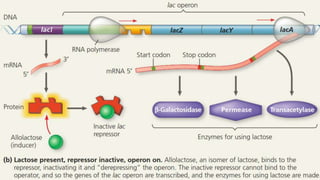
• A specific small molecule, called an inducer, inactivates the repressor.
for the lac operon, the inducer is allolactose, an isomer of lactose
formed in small amounts from lactose that enters the cell.
• Without the lac repressor bound, the lac operon is transcribed into
mRNA, and the enzymes for using lactose are made.
• The enzymes of the lactose pathway are referred to as inducible
enzymes because their synthesis is induced by a chemical signal
(allolactose, in this case).
lac-Operon.pptx
lac-Operon.pptx

lac-Operon.pptx

  • 1.
    Operons – Thebasic Concept • Many Genes are switched on or off by changes in the metabolic status of the cell. • One basic mechanism for this control of gene expression is described as the operon model. • This model was discovered by Jacob and Monod in 1961 in E. Coli bacteria. • The entire stretch of DNA required for enzyme production for a pathway—constitute an operon. • The stretch contains a promoter, operator and all the genes they control. • A key advantage of grouping genes of related function into one transcription unit is that a single “on-off switch” can control the whole cluster of functionally related genes;
  • 2.
    Operons – Thebasic Concept • Promoter – A site where RNA polymerase can bind to DNA and begin transcription. • The on-off switch is a segment of DNA called an operator. The operator controls the access of RNA polymerase to the genes.
  • 3.
    Lac - Operon •Lac-operon is a classic example of inducible operon, where lac stands for lactose. • Lactose metabolism begins with hydrolysis of the disaccharide into its component monosaccharides (glucose and galactose), a reaction catalysed by the enzyme β-galactosidase. • In the absence of lactose, only a few molecule of β-galactosidase is present in the bacterium, but the number increases more than 1000- fold when lactose is present. • The gene for β-galactosidase (lacZ) is part of the lac operon, which includes two other genes coding for enzymes that function in the use of lactose. • The entire transcription unit is under the command of one main operator and promoter.
  • 4.
    Lac - Operon •The regulatory gene, lac I, located outside the lac operon, codes for an allosteric repressor protein that can switch off the lac operon by binding to the lac operator. • A specific small molecule, called an inducer, inactivates the repressor. for the lac operon, the inducer is allolactose, an isomer of lactose formed in small amounts from lactose that enters the cell. • Without the lac repressor bound, the lac operon is transcribed into mRNA, and the enzymes for using lactose are made. • The enzymes of the lactose pathway are referred to as inducible enzymes because their synthesis is induced by a chemical signal (allolactose, in this case).