Background
•Marungko Approach was first introduced in public
elementary school in Marungko, Angat, Bulacan,
devised by Nooraihan Ali and Josefina Urbano.
Background
•According to Nooraihan and Urbano, the method
used is called "phono syllabic“ which is teaching
of correct single sounds and the blending of
sounds into syllables and words.
Marungko Approach
•The Marungko Approach is designed to equip
Grade One pupils the necessary reading skills to
improve their achievement in reading. Likewise, it
seeks to develop a training model to enhance
teachers’ competence in the teaching of reading in
the primary grades most especially in Grade One.
Marungko Approach
•The Marungko approach provides materials to the
success in teaching reading. It starts with letter
sounds rather than name. Instead of the usual
arrangement (order) of letters in the alphabet, it
starts with m, s, a, i, o…
How to use Marungko?
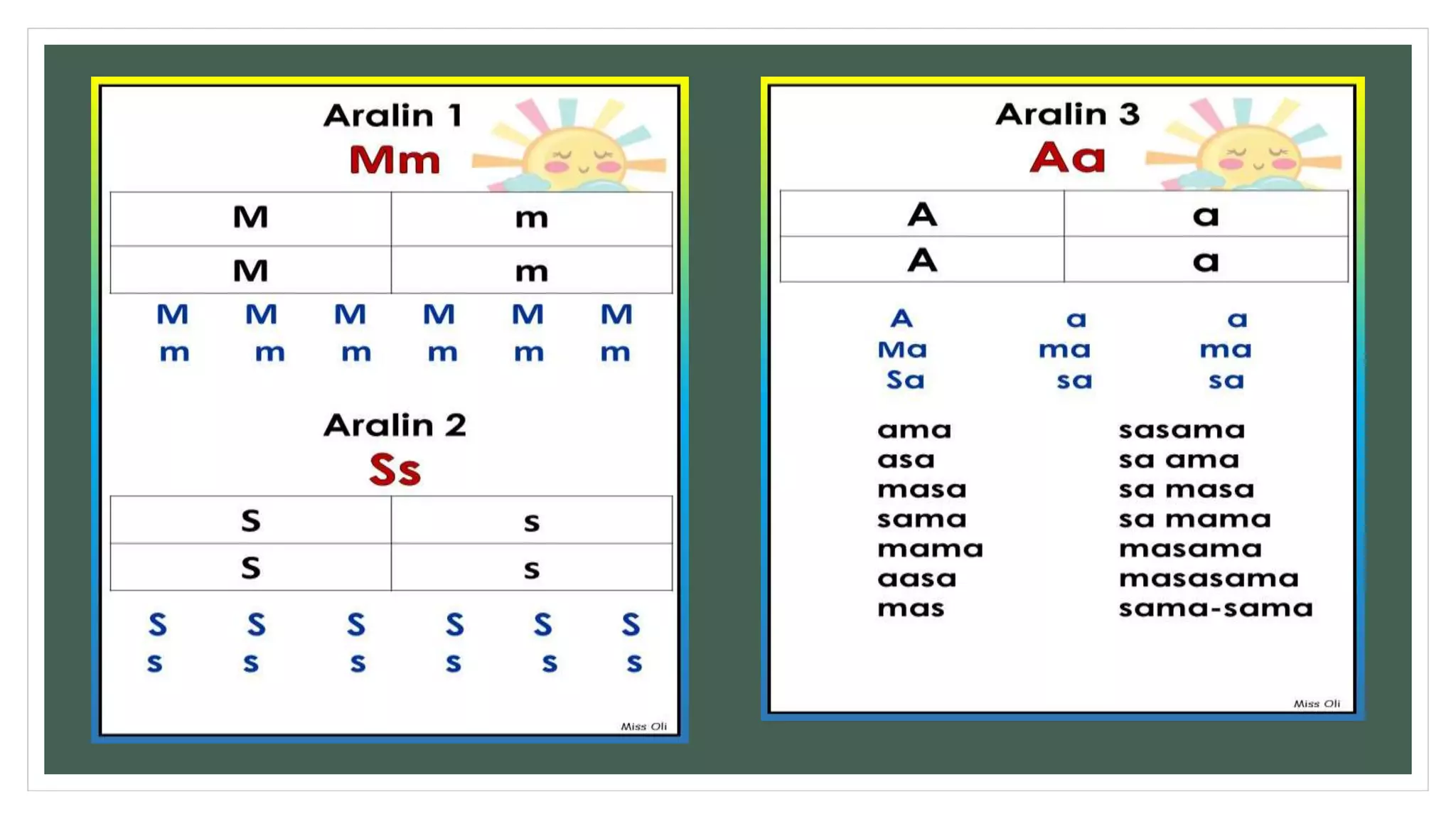
1.The first 5 lessons are as follows: m, s, a , i, o
Teach each sound and form until mastery before a
new sound is introduced:
a) Ask a question to which the response will elicit
the target sound. You can use pictures of words
beginning with m, s, a etc. depending on the current
lesson.
How to use Marungko?
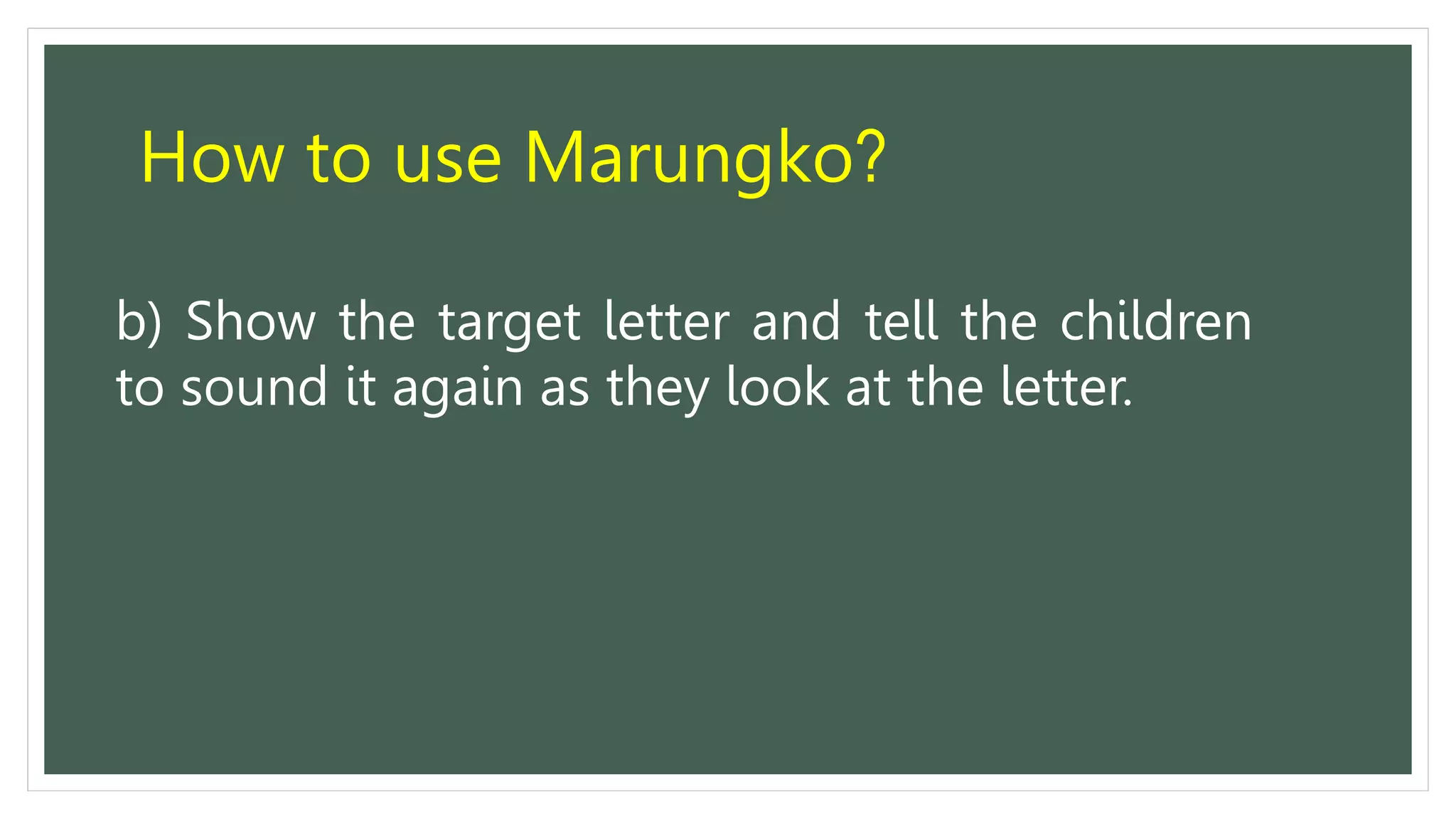
b) Show the target letter and tell the children
to sound it again as they look at the letter.
How to use Marungko?
c) Show them how to write it. Ask them to
write it, with the fingers in the air, on their
palm, on their desks, and on paper as they give
the sound.
How to use Marungko?
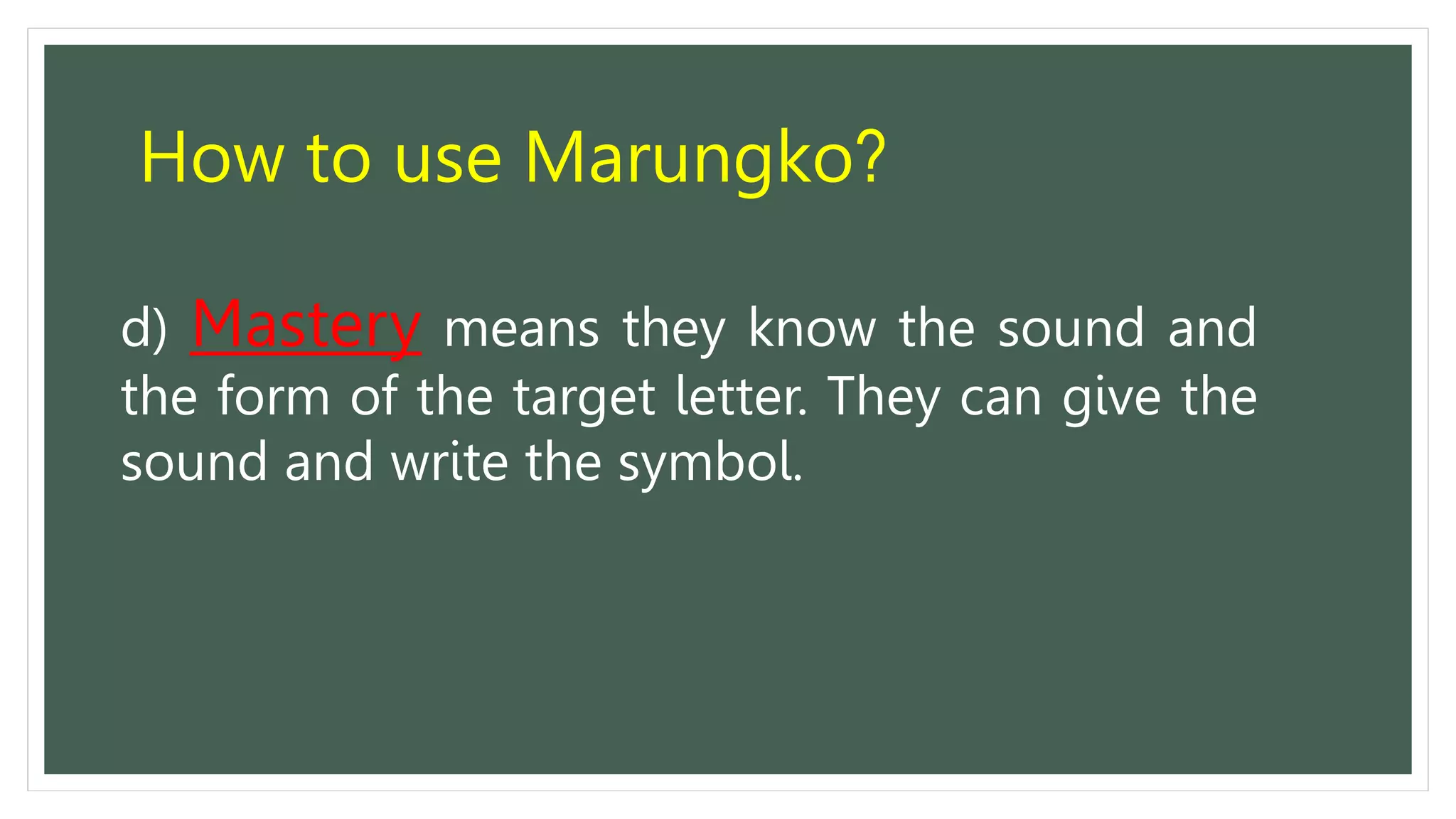
d) Mastery means they know the sound and
the form of the target letter. They can give the
sound and write the symbol.
How to use Marungko?
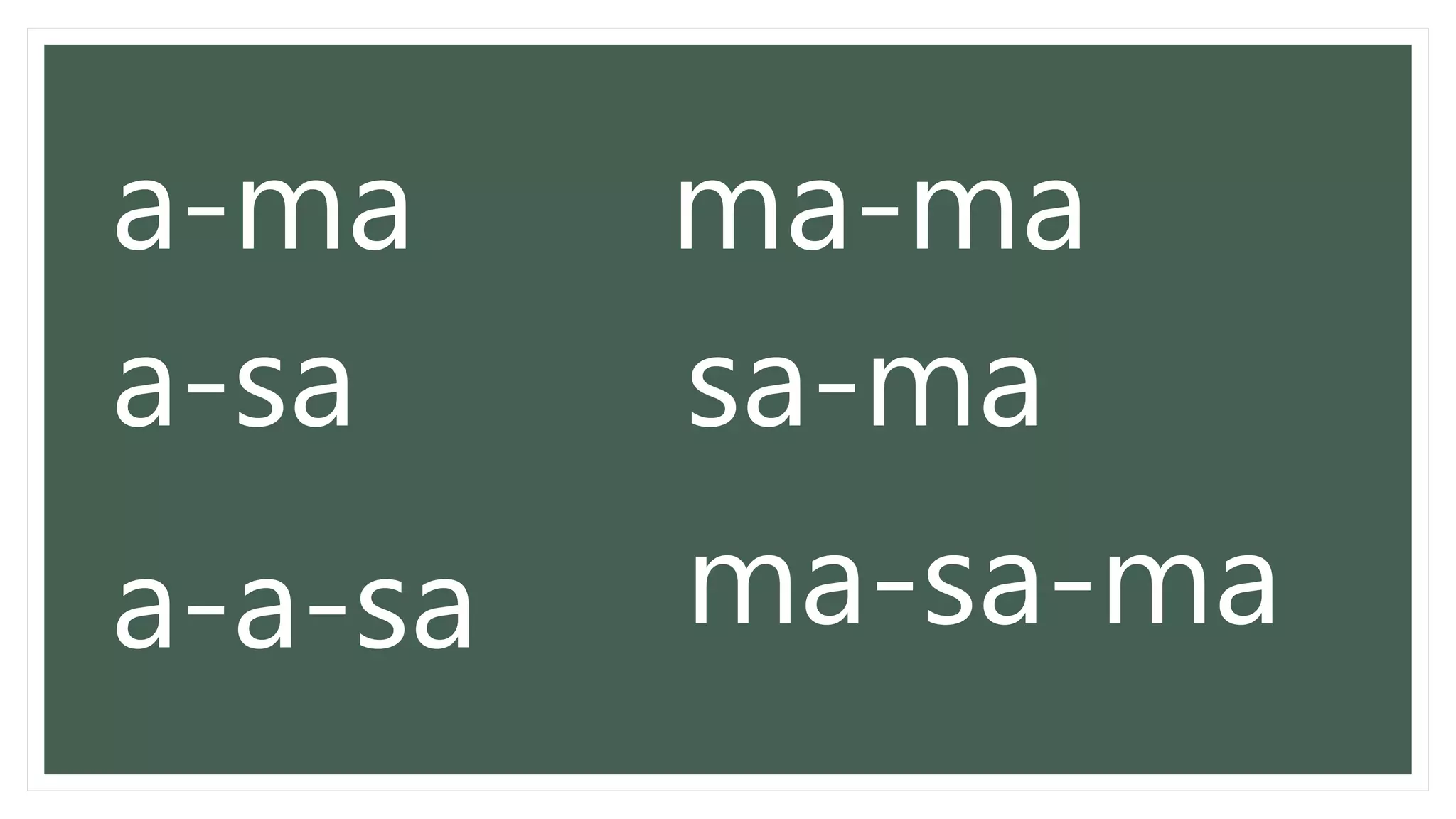
2. After the first 3 sounds have been mastered,
these can be combined to form words, phrases or
sentences. Start blending of sounds. Every new
sound is introduced with previous sounds already
learned and in various combinations into words.
Start blending of sounds.
a-ma
a-sa
ma-ma
sa-ma
a-a-sa ma-sa-ma
3. Introduce function words that cannot be
taught through the phono syllabic method as
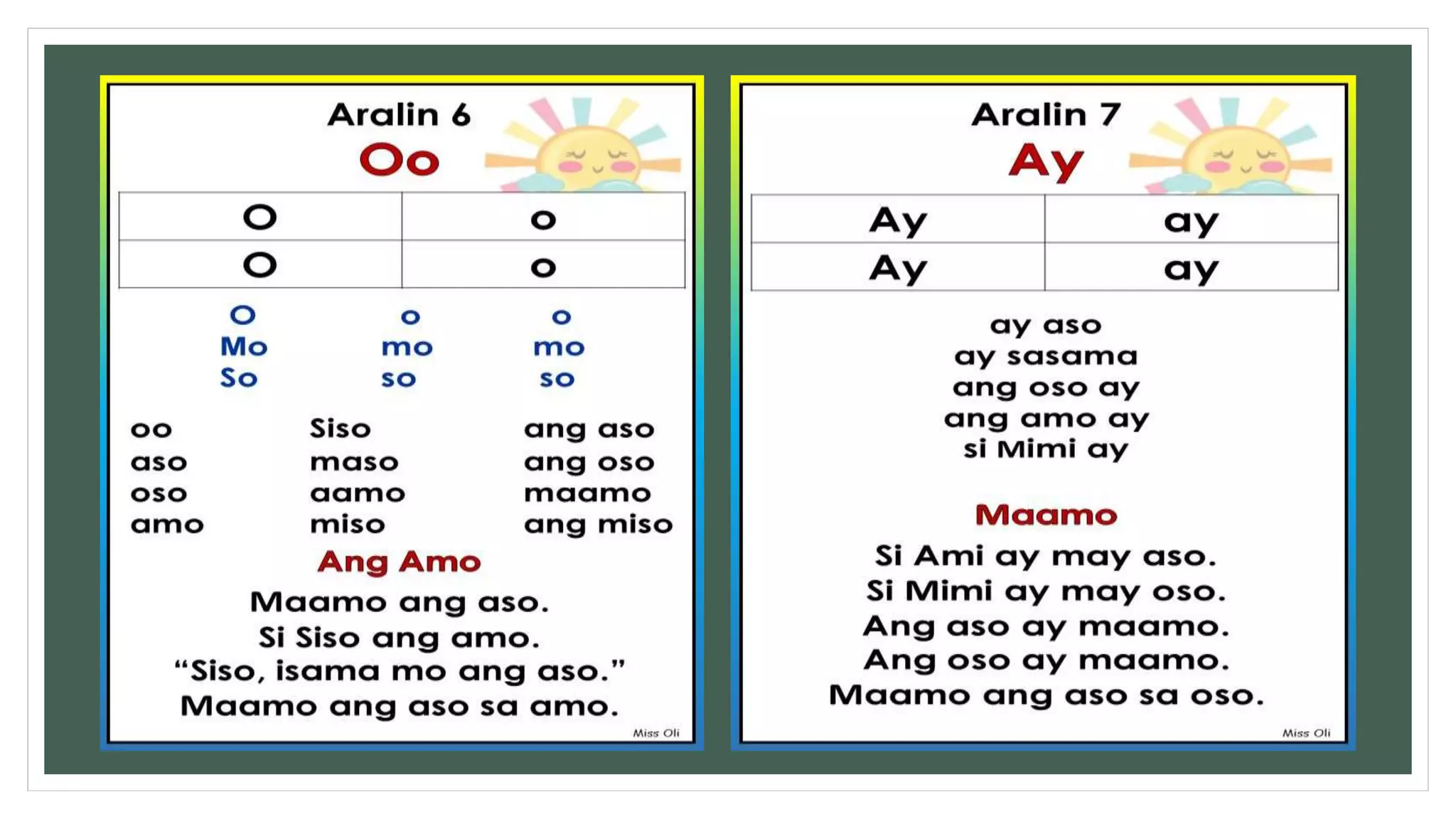
whole words e.g. ang, ng, mga, ay.
How to use Marungko?
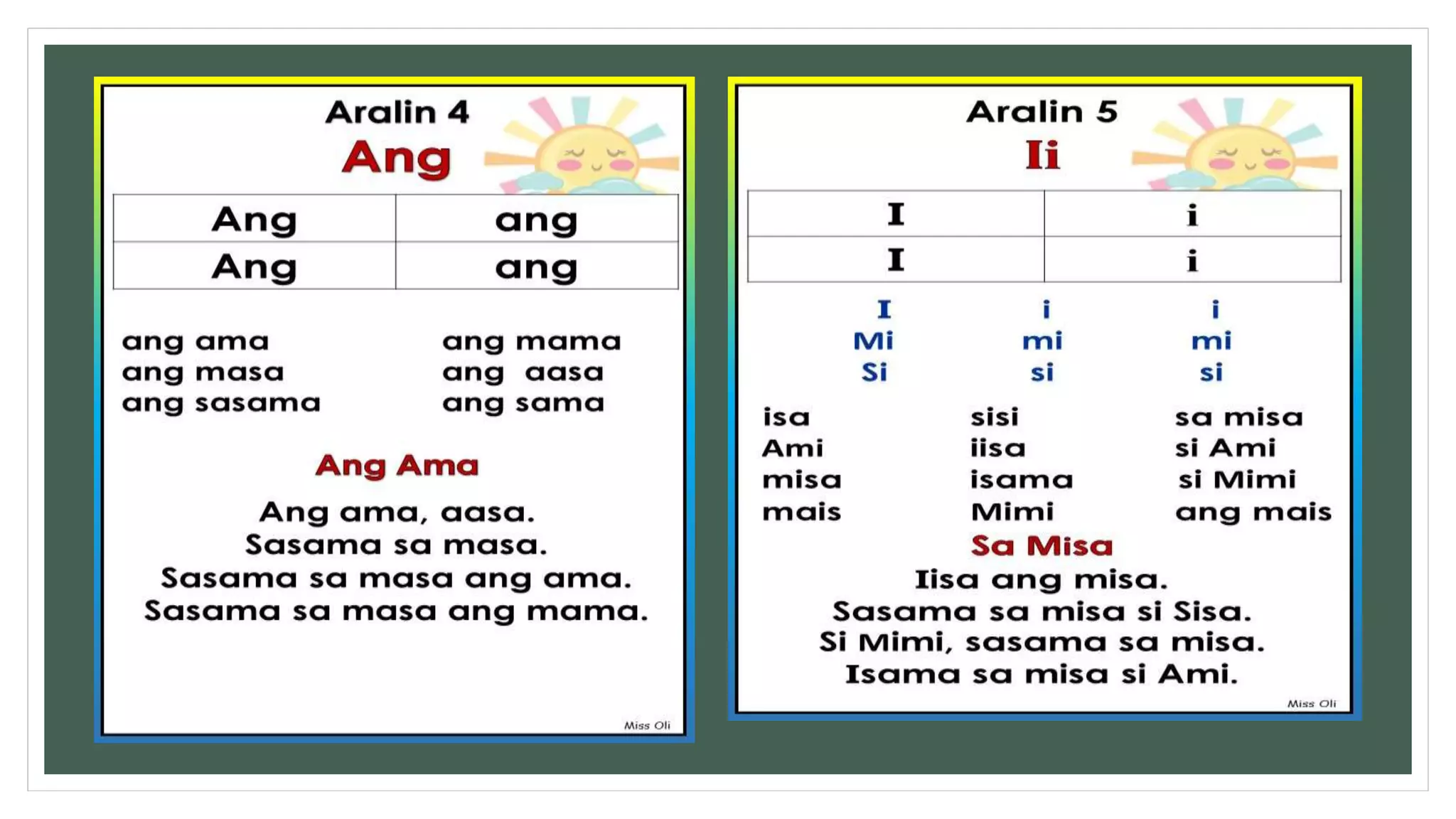
ang ama
mga ma-ma
sa-sa-ma ng
ma-sa-ma ay
4. After the first 5 sounds have been mastered, any
other sound can be taught in relation to sounds
already learned. Suggested sequence is as follows:
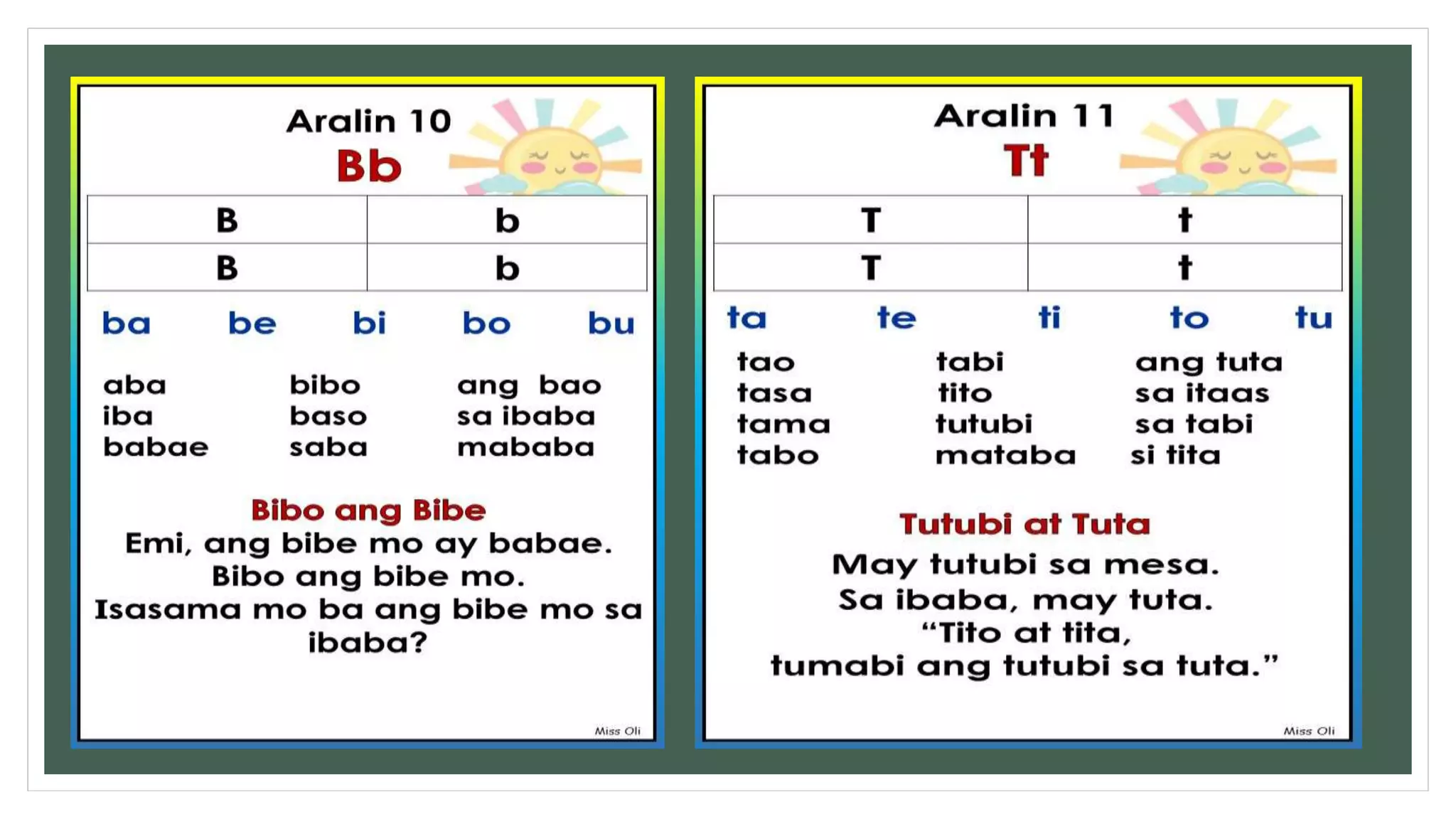
b, e, u, t, k, l, y, n, g, ng, p, r, d, h, w.
How to use Marungko?
LAC-MARUNGKO-APPROACH.pptx

LAC-MARUNGKO-APPROACH.pptx

  • 2.
    Background •Marungko Approach wasfirst introduced in public elementary school in Marungko, Angat, Bulacan, devised by Nooraihan Ali and Josefina Urbano.
  • 3.
    Background •According to Nooraihanand Urbano, the method used is called "phono syllabic“ which is teaching of correct single sounds and the blending of sounds into syllables and words.
  • 4.
    Marungko Approach •The MarungkoApproach is designed to equip Grade One pupils the necessary reading skills to improve their achievement in reading. Likewise, it seeks to develop a training model to enhance teachers’ competence in the teaching of reading in the primary grades most especially in Grade One.
  • 5.
    Marungko Approach •The Marungkoapproach provides materials to the success in teaching reading. It starts with letter sounds rather than name. Instead of the usual arrangement (order) of letters in the alphabet, it starts with m, s, a, i, o…
  • 6.
    How to useMarungko? 1.The first 5 lessons are as follows: m, s, a , i, o Teach each sound and form until mastery before a new sound is introduced: a) Ask a question to which the response will elicit the target sound. You can use pictures of words beginning with m, s, a etc. depending on the current lesson.
  • 8.
    How to useMarungko? b) Show the target letter and tell the children to sound it again as they look at the letter.
  • 10.
    How to useMarungko? c) Show them how to write it. Ask them to write it, with the fingers in the air, on their palm, on their desks, and on paper as they give the sound.
  • 12.
    How to useMarungko? d) Mastery means they know the sound and the form of the target letter. They can give the sound and write the symbol.
  • 13.
    How to useMarungko? 2. After the first 3 sounds have been mastered, these can be combined to form words, phrases or sentences. Start blending of sounds. Every new sound is introduced with previous sounds already learned and in various combinations into words. Start blending of sounds.
  • 14.
  • 15.
    3. Introduce functionwords that cannot be taught through the phono syllabic method as whole words e.g. ang, ng, mga, ay. How to use Marungko?
  • 16.
  • 17.
    4. After thefirst 5 sounds have been mastered, any other sound can be taught in relation to sounds already learned. Suggested sequence is as follows: b, e, u, t, k, l, y, n, g, ng, p, r, d, h, w. How to use Marungko?
Editor's Notes

  • #3 Note that the mastery of letter sounds is very important in this approach.
  • #4 Note that the mastery of letter sounds is very important in this approach.
  • #5 The goal of this strategy in reading is to enable grade one pupils to instill in their minds to appreciate the songs and poems created for Filipino children and eventually to communicate in written and oral forms through effective reading instruction.
  • #18 Remember to blend only the sounds that were taught and mastered.