Sama-sama
sa
tagumpay
National Educators Academyof thePhilippines Department of
Education
M2-13-A, 2/F Mabini Building Department of Education
DepEd Complex, Meralco Avenue PasigCity 1600
Philippines
neap.od@deped.gov.ph
© 2020 National Educators Academyof the Philippines. All rightsreserved.
The viewsexpressedin thiswork are thoseof theauthors and do not necessarily reflect thoseof
theNational Educators Academyof thePhilippines or theDepartment of Education; the
Foundation for Information Technology Education and Development or the International
Development ResearchCentre; or Save theChildren or theAustralian Government.
Module 1: Course Orientation
ACKNOWLEDGEMENTS
The National Educators Academyof thePhilippines (NEAP), Department of Education, is grateful for the
generous support and assistanceof our Education Forum Partners in developing thiscourse. In
particular, wegive special mentionand thanksto:
• Bureau of Curriculum Development (BCD), Department of Education, led by Director Jocelyn D. R.
Andaya;
• Bureau of Learning Delivery (BLD), Department of Education, led by Director Leila
P
.Areola, and theBLD Teaching and Learning Divison, led by Chief Rosalina J. Villaneza;
• Foundation for Information Technology Education and Development (FIT-ED) for the TPD@Scale
Coalition for theGlobal South, led by FIT-ED Executive Director Victoria
L. Tinio and funded by theInternational Development ResearchCentre (Canada);
NEAP also thanksUndersecretary Nepomuceno A. Malaluan, UndersecretaryDiosdado M. San Antonio,
Assistant Secretary Alma Ruby C. Torio, Director Abram Abanil (ICT Service), and Director Roger B.
Masapol (Planning Service) for their invaluable guidanceand support.
Finally, NEAP acknowledgeswiththanksthecontributions of theinstructional designers, consultantsand
module developers whoworked tirelessly to develop thecourse modules and tools.
Module 1: Course Orientation
Instructional Designers and Consultants
Anne T
. Choi, Sylvia A. Garde, Sarah Pouzevara (RTI International), Camille G. Quiambao,
Monalisa T
. Sasing, Maria Regina Corazon Sibal (Deutsche Gesellschaft für Internationale
Zusammenarbeit), John Arnold S. Siena, Victoria L. Tinio and Adelina Velasco (SERG/
Australian Government/Save the Children)
Module Developers
Module 1: NEAP Team Module 2: Rowel Padernal
Module 3A: Julieven R. Abrea, Denn Marc P
. Alayon, Rosalie E. Bongon, Anne T
. Choi, Anna
Lourdes A. Falcon, Sylvia A. Garde, Glenda M. Granadozin, Anna Marlaine V. Litonjua, Camille
G. Quiambao, Jessica C. Rubin, Wanny Milaine N. Santos, Monalisa T
. Sasing, Gaudencio Luis
N. Serrano, Krisha Anne M. Soriano, Victoria L. Tinio, Gemma T
. Valdevia and Rosalina J.
Villaneza
Module 3B, 4, and 5: NEAP Team
Copyeditor
Vanessa D.
Gregorio
Layout Artist
Kriselle A.
de Leon
Module 1: Course Orientation
MODULE 1: COURSE ORIENTATION
Hi, Ma’am/Sir. How are you? We hope that you are doing well despite our current national health
situation. We know that you are busy preparing for the opening of classes this year. Your students
and your country are grateful for your tirelessservice in ensuring safe and quality education.
Welcome to Learning Delivery Modality Course 2 (LDM2) for Teachers. This course aims to
support you in your preparation for thenew learning delivery modality (LDM) in your School.
MODULE OBJECTIVE
By the end of this Module, you will be able to describe what this course is about and how it will help you manage the teaching-
learningprocessinthemodalities.
MODULE CONTENT
Lesson1: CourseOverview
Lesson2: OrganizingyourLearningActionCell (LAC) LACSession 1
ESTIMATED TIME REQUIRED
4 hours
*LAC Sessions are included in the activities but may be optional as determined by the LAC members under the guidance of the LAC Leader
Module 1: Course Orientation
LESSON 1: COURSE OVERVIEW
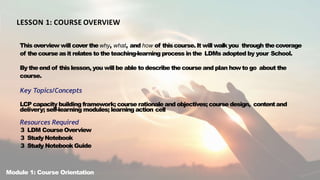
This overview will cover thewhy, what, and how of thiscourse. It will walkyou through thecoverage
of the course asit relates to the teaching-learning process in the LDMs adopted by your School.
By theend of thislesson, you will be able to describe thecourse and plan howto go about the
course.
Key Topics/Concepts
LCP capacity building framework; course rationale and objectives; course design, contentand
delivery; self-learning modules; learning action cell
Resources Required
3 LDM CourseOverview
3 StudyNotebook
3 Study Notebook Guide
Module 1: Course Orientation
ReadtheLDM Course Overview. Reflecton theoverviewby answeringthefollowing questions. Write down
your insightsin your Study Notebook.
1. What isthe main delivery of thiscourse?
2. Howcanthiscoursehelp ensurethatyou will be able todeliver quality instructionin the“newnormal”?
3. What are thetwosupport mechanismsthatwill help you withyour learning in this course?
Answerthefollowing questionsby copyingand filling outthetable in your Study Notebook.
1. Howwill mypersonal characteristicsand circumstancesaffect(positively or negatively)my
participation in thiscourse?
2. HowcanI ensurethatI amable tosustainmystrengthsand address theobstacles thatwill hinder me
from completingthis course?
ACTIVITY 1.
ACTIVITY 2.
Module 1: Course Orientation
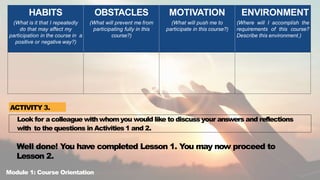
HABITS
(What is it that I repeatedly
do that may affect my
participation in the course in a
positive or negative way?)
OBSTACLES
(What will prevent me from
participating fully in this
course?)
MOTIVATION
(What will push me to
participate in this course?)
ENVIRONMENT
(Where will I accomplish the
requirements of this course?
Describe this environment.)
Look for a colleague with whomyou would like to discuss your answers and reflections
with to the questions in Activities 1 and 2.
Well done! You have completed Lesson 1. You may now proceed to
Lesson 2.
ACTIVITY 3.
Module 1: Course Orientation
LESSON 2: ORGANIZING YOUR LEARNING ACTION CELL (LAC)
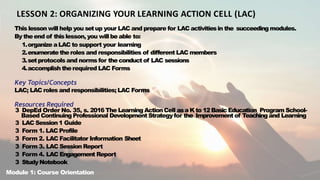
This lesson will help you setup your LAC and prepare for LAC activitiesin the succeeding modules.
By theend of thislesson, you will be able to:
1.organize aLAC to support your learning
2.enumeratetheroles and responsibilities of different LAC members
3.setprotocols and norms for the conduct of LAC sessions
4.accomplish therequired LAC Forms
Key Topics/Concepts
LAC; LAC roles and responsibilities; LAC Forms
Resources Required
3 DepEd Order No. 35, s. 2016 The Learning ActionCell asa K to 12 BasicEducation Program School-
Based Continuing Professional Development Strategyfor the Improvement of Teaching and Learning
3 LAC Session1 Guide
3 Form 1. LAC Profile
3 Form 2. LAC Facilitator Information Sheet
3 Form 3. LAC Session Report
3 Form 4. LAC Engagement Report
3 StudyNotebook
Module 1: Course Orientation
Begin by refreshing your memory on the Learning Action Cell. Read
DepEd Order No. 35 s. 2016 titled “The Learning Action Cell as the K
to 12 Basic Education Program School- Based Continuing Professional
Development Strategy for the Improvement of Teaching and Learning.”
Once you’re done, answer the following questions. Write your responses
and any other ideas and reflections in your Study Notebook.
1. Reflect on the objectives for conducting LAC sessions as listed in
DO 35, s. 2016. Rank the following objectives from easiest to the
most difficult to achieve:
_ To improve the teaching-learning process to improve learning among
students
_ To nurture successful teachers
ACTIVITY 1.
Module 1: Course Orientation
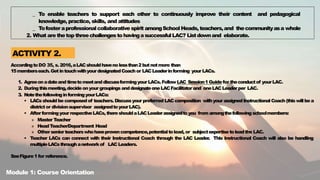
_ To enable teachers to support each other to continuously improve their content and pedagogical
knowledge, practice, skills, and attitudes
_ Tofoster aprofessionalcollaborative spirit amongSchool Heads, teachers,and thecommunityasa whole
2. What are thetop threechallengestohavingasuccessfulLAC? Listdownand elaborate.
AccordingtoDO 35, s. 2016,aLACshouldhavenolessthan2butnotmore than
15memberseach.GetintouchwithyourdesignatedCoachor LACLeaderinforming your LACs.
1. AgreeonadateandtimetomeetanddiscussformingyourLACs.FollowLAC Session1Guidefor theconductof yourLAC.
2. Duringthismeeting,decideonyourgroupingsanddesignateoneLACFacilitatorand oneLACLeaderper LAC.
3. NotethefollowinginformingyourLACs:
• LACsshould be composedof teachers.Discussyour preferred LAC composition withyour assignedInstructional Coach (thiswill be a
districtor divisionsupervisor assignedtoyourLAC).
• AfterformingyourrespectiveLACs,thereshouldaLACLeaderassignedtoyou from amongthefollowingschoolmembers:
» Master Teacher
» HeadTeacher/Department Head
» Otherseniorteacherswhohaveprovencompetence,potentialtolead, or subjectexpertisetoleadthe LAC.
• Teacher LACs can connect with their Instructional Coach through the LAC Leader. This Instructional Coach will also be handling
multipleLACsthroughanetworkof LAC Leaders.
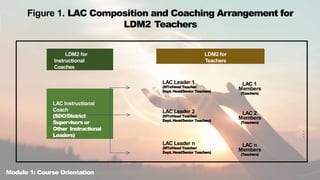
SeeFigure1for reference.
ACTIVITY 2.
Module 1: Course Orientation
LDM2 for
Instructional
Coaches
LAC Instructional
Coach
(SDO/District
Supervisorsor
Other Instructional
Leaders)
LAC Leader 1
(MTs/Head Teacher/
Dept. Head/Senior Teachers)
LAC 1
Members
(Teachers)
LAC 2
Members
(Teachers)
LAC n
Members
(Teachers)
LAC Leader 2
(MTs/Head Teacher/
Dept. Head/Senior Teachers)
LAC Leader n
(MTs/Head Teacher/
Dept. Head/Senior Teachers)
LDM2 for
Teachers
Figure 1. LAC Composition and Coaching Arrangement for
LDM2 Teachers
Module 1: Course Orientation
Congratulations! You have completed Module 1.
You are now ready for Module 2.
List down the members of your LAC and their
respective roles in your Study Notebook.
ACTIVITY 3.
Module 1: Course Orientation

LAC Session on Modules 1 and 2.pptx

  • 1.
  • 6.
    National Educators AcademyofthePhilippines Department of Education M2-13-A, 2/F Mabini Building Department of Education DepEd Complex, Meralco Avenue PasigCity 1600 Philippines neap.od@deped.gov.ph © 2020 National Educators Academyof the Philippines. All rightsreserved. The viewsexpressedin thiswork are thoseof theauthors and do not necessarily reflect thoseof theNational Educators Academyof thePhilippines or theDepartment of Education; the Foundation for Information Technology Education and Development or the International Development ResearchCentre; or Save theChildren or theAustralian Government. Module 1: Course Orientation
  • 7.
    ACKNOWLEDGEMENTS The National EducatorsAcademyof thePhilippines (NEAP), Department of Education, is grateful for the generous support and assistanceof our Education Forum Partners in developing thiscourse. In particular, wegive special mentionand thanksto: • Bureau of Curriculum Development (BCD), Department of Education, led by Director Jocelyn D. R. Andaya; • Bureau of Learning Delivery (BLD), Department of Education, led by Director Leila P .Areola, and theBLD Teaching and Learning Divison, led by Chief Rosalina J. Villaneza; • Foundation for Information Technology Education and Development (FIT-ED) for the TPD@Scale Coalition for theGlobal South, led by FIT-ED Executive Director Victoria L. Tinio and funded by theInternational Development ResearchCentre (Canada); NEAP also thanksUndersecretary Nepomuceno A. Malaluan, UndersecretaryDiosdado M. San Antonio, Assistant Secretary Alma Ruby C. Torio, Director Abram Abanil (ICT Service), and Director Roger B. Masapol (Planning Service) for their invaluable guidanceand support. Finally, NEAP acknowledgeswiththanksthecontributions of theinstructional designers, consultantsand module developers whoworked tirelessly to develop thecourse modules and tools. Module 1: Course Orientation
  • 8.
    Instructional Designers andConsultants Anne T . Choi, Sylvia A. Garde, Sarah Pouzevara (RTI International), Camille G. Quiambao, Monalisa T . Sasing, Maria Regina Corazon Sibal (Deutsche Gesellschaft für Internationale Zusammenarbeit), John Arnold S. Siena, Victoria L. Tinio and Adelina Velasco (SERG/ Australian Government/Save the Children) Module Developers Module 1: NEAP Team Module 2: Rowel Padernal Module 3A: Julieven R. Abrea, Denn Marc P . Alayon, Rosalie E. Bongon, Anne T . Choi, Anna Lourdes A. Falcon, Sylvia A. Garde, Glenda M. Granadozin, Anna Marlaine V. Litonjua, Camille G. Quiambao, Jessica C. Rubin, Wanny Milaine N. Santos, Monalisa T . Sasing, Gaudencio Luis N. Serrano, Krisha Anne M. Soriano, Victoria L. Tinio, Gemma T . Valdevia and Rosalina J. Villaneza Module 3B, 4, and 5: NEAP Team Copyeditor Vanessa D. Gregorio Layout Artist Kriselle A. de Leon Module 1: Course Orientation
  • 9.
    MODULE 1: COURSEORIENTATION Hi, Ma’am/Sir. How are you? We hope that you are doing well despite our current national health situation. We know that you are busy preparing for the opening of classes this year. Your students and your country are grateful for your tirelessservice in ensuring safe and quality education. Welcome to Learning Delivery Modality Course 2 (LDM2) for Teachers. This course aims to support you in your preparation for thenew learning delivery modality (LDM) in your School. MODULE OBJECTIVE By the end of this Module, you will be able to describe what this course is about and how it will help you manage the teaching- learningprocessinthemodalities. MODULE CONTENT Lesson1: CourseOverview Lesson2: OrganizingyourLearningActionCell (LAC) LACSession 1 ESTIMATED TIME REQUIRED 4 hours *LAC Sessions are included in the activities but may be optional as determined by the LAC members under the guidance of the LAC Leader Module 1: Course Orientation
  • 10.
    LESSON 1: COURSEOVERVIEW This overview will cover thewhy, what, and how of thiscourse. It will walkyou through thecoverage of the course asit relates to the teaching-learning process in the LDMs adopted by your School. By theend of thislesson, you will be able to describe thecourse and plan howto go about the course. Key Topics/Concepts LCP capacity building framework; course rationale and objectives; course design, contentand delivery; self-learning modules; learning action cell Resources Required 3 LDM CourseOverview 3 StudyNotebook 3 Study Notebook Guide Module 1: Course Orientation
  • 11.
    ReadtheLDM Course Overview.Reflecton theoverviewby answeringthefollowing questions. Write down your insightsin your Study Notebook. 1. What isthe main delivery of thiscourse? 2. Howcanthiscoursehelp ensurethatyou will be able todeliver quality instructionin the“newnormal”? 3. What are thetwosupport mechanismsthatwill help you withyour learning in this course? Answerthefollowing questionsby copyingand filling outthetable in your Study Notebook. 1. Howwill mypersonal characteristicsand circumstancesaffect(positively or negatively)my participation in thiscourse? 2. HowcanI ensurethatI amable tosustainmystrengthsand address theobstacles thatwill hinder me from completingthis course? ACTIVITY 1. ACTIVITY 2. Module 1: Course Orientation
  • 12.
    HABITS (What is itthat I repeatedly do that may affect my participation in the course in a positive or negative way?) OBSTACLES (What will prevent me from participating fully in this course?) MOTIVATION (What will push me to participate in this course?) ENVIRONMENT (Where will I accomplish the requirements of this course? Describe this environment.) Look for a colleague with whomyou would like to discuss your answers and reflections with to the questions in Activities 1 and 2. Well done! You have completed Lesson 1. You may now proceed to Lesson 2. ACTIVITY 3. Module 1: Course Orientation
  • 13.
    LESSON 2: ORGANIZINGYOUR LEARNING ACTION CELL (LAC) This lesson will help you setup your LAC and prepare for LAC activitiesin the succeeding modules. By theend of thislesson, you will be able to: 1.organize aLAC to support your learning 2.enumeratetheroles and responsibilities of different LAC members 3.setprotocols and norms for the conduct of LAC sessions 4.accomplish therequired LAC Forms Key Topics/Concepts LAC; LAC roles and responsibilities; LAC Forms Resources Required 3 DepEd Order No. 35, s. 2016 The Learning ActionCell asa K to 12 BasicEducation Program School- Based Continuing Professional Development Strategyfor the Improvement of Teaching and Learning 3 LAC Session1 Guide 3 Form 1. LAC Profile 3 Form 2. LAC Facilitator Information Sheet 3 Form 3. LAC Session Report 3 Form 4. LAC Engagement Report 3 StudyNotebook Module 1: Course Orientation
  • 14.
    Begin by refreshingyour memory on the Learning Action Cell. Read DepEd Order No. 35 s. 2016 titled “The Learning Action Cell as the K to 12 Basic Education Program School- Based Continuing Professional Development Strategy for the Improvement of Teaching and Learning.” Once you’re done, answer the following questions. Write your responses and any other ideas and reflections in your Study Notebook. 1. Reflect on the objectives for conducting LAC sessions as listed in DO 35, s. 2016. Rank the following objectives from easiest to the most difficult to achieve: _ To improve the teaching-learning process to improve learning among students _ To nurture successful teachers ACTIVITY 1. Module 1: Course Orientation
  • 15.
    _ To enableteachers to support each other to continuously improve their content and pedagogical knowledge, practice, skills, and attitudes _ Tofoster aprofessionalcollaborative spirit amongSchool Heads, teachers,and thecommunityasa whole 2. What are thetop threechallengestohavingasuccessfulLAC? Listdownand elaborate. AccordingtoDO 35, s. 2016,aLACshouldhavenolessthan2butnotmore than 15memberseach.GetintouchwithyourdesignatedCoachor LACLeaderinforming your LACs. 1. AgreeonadateandtimetomeetanddiscussformingyourLACs.FollowLAC Session1Guidefor theconductof yourLAC. 2. Duringthismeeting,decideonyourgroupingsanddesignateoneLACFacilitatorand oneLACLeaderper LAC. 3. NotethefollowinginformingyourLACs: • LACsshould be composedof teachers.Discussyour preferred LAC composition withyour assignedInstructional Coach (thiswill be a districtor divisionsupervisor assignedtoyourLAC). • AfterformingyourrespectiveLACs,thereshouldaLACLeaderassignedtoyou from amongthefollowingschoolmembers: » Master Teacher » HeadTeacher/Department Head » Otherseniorteacherswhohaveprovencompetence,potentialtolead, or subjectexpertisetoleadthe LAC. • Teacher LACs can connect with their Instructional Coach through the LAC Leader. This Instructional Coach will also be handling multipleLACsthroughanetworkof LAC Leaders. SeeFigure1for reference. ACTIVITY 2. Module 1: Course Orientation
  • 16.
    LDM2 for Instructional Coaches LAC Instructional Coach (SDO/District Supervisorsor OtherInstructional Leaders) LAC Leader 1 (MTs/Head Teacher/ Dept. Head/Senior Teachers) LAC 1 Members (Teachers) LAC 2 Members (Teachers) LAC n Members (Teachers) LAC Leader 2 (MTs/Head Teacher/ Dept. Head/Senior Teachers) LAC Leader n (MTs/Head Teacher/ Dept. Head/Senior Teachers) LDM2 for Teachers Figure 1. LAC Composition and Coaching Arrangement for LDM2 Teachers Module 1: Course Orientation
  • 17.
    Congratulations! You havecompleted Module 1. You are now ready for Module 2. List down the members of your LAC and their respective roles in your Study Notebook. ACTIVITY 3. Module 1: Course Orientation