Energy Low Emission Development Strategies: A Regional Overview of Latin America and the Caribbean and Experiences from Nicaragua 
26 November 2014 
Presenters: 
Ana María Majano – INCAE Business School 
Alexander Ochs - Worldwatch Institute 
Javier Chamorro - ProNicaragua
Welcome & Introduction 
Ana María Majano 
INCAE Business School 
EWG LAC co-Chair
Audio Options for Participants: 
1.Listen through your computer. 
Please select the “mic and speakers” radio button on the right hand audio pane display 
2. Listen by telephone. 
Please select the “telephone” option in the right-hand display, and a phone number and PIN will display 
Panelists: Please mute your audio device when not presenting! 
Technical Difficulties: Contact the GoToWebinars Help Desk: 888.259.3826 
Logistics
To Ask a Question: 
•Select the “questions” pane on your screen and type in your question 
If you are having trouble with the webinar: 
•PDFs of the presentation can be accessed at: http://ledsgp.org/sector/energy 
•A video/audio recording of this webinar and slide decks will be available at: http://ledsgp.org/sector/energy 
Logistics
1.Welcome & Introduction to the LEDS LAC Regional Platform and the Importance of Energy in Latin America and the Caribbean 
Ana María Majano, INCAE Business, LEDS-EWG Co-Chair for LAC 
2.Key Low-Emission Energy Developments in LAC 
Alexander Ochs, Worldwatch Institute, LEDS-EWG Chair 
3.Learning from Nicaragua’s Investment Promotion Age 
Javier Chamorro, ProNicaragua 
4.Q&A 
5.Survey 
Outline
LEDS Global Partnership 
International initiative aiming to harness the collective knowledge and resources of governments, donors, international organizations, and practitioners in scaling up and strengthening implementation of climate-resilient low emission development around the world. 
Launched in 2011, the LEDS GP now catalyzes action and collaboration across more than 120 countries and international organizations.
Energy Working Group (EWG) 
The EWG promotes low-emission and climate- resilient development in the energy sector through a work program focused on learning and information exchange, sharing best practices, advisory services, and providing enhanced opportunities for coordination and collaboration. 
Objectives 
Strengthen support for LEDS in energy sector 
Mobilize capacity and advance peer-to-peer learning and collaboration on low emission energy development 
Improve coordination of energy-related LEDS at the country, regional, and global levels
Energy Working Group Activities 
Current work plan, highlights 
Webinars: 
Events: 
•LEDS GP Annual Event, Addis Ababa, Ethiopia (August 2014): 
- Energy Peer Learning Session For African Countries 
- Energy Sector Strategies and Policy Portfolios Session 
•LEDS LAC Regional Forum 2013 
2015 work plan, highlights: 
•Energy Toolkit 
•Energy Data Crowdsourcing Project 
•Energy & Development World Atlas 
•Energy LEDS Training Camp 
•Energy Policy Development Group 
•Best Practices in Gathering and Using Energy Data for LEDS Development (April) 
•Energy LEDS in Asia (Oct.) 
•Energy LEDS in Africa (Nov./Dec.) 
•Energy LEDS in LAC (Nov./Dec.)
LAC Regional Platform 
-Launched in 2012 at INCAE Campus in Costa Rica 
-More than 250 registered members 
-More than 500 participants in face-to-face and online activities 
-3 regional annual Regional Workshops (Costa Rica, Lima, Santiago). Next: 2015 in the Dominican Republic. 
-Webpage www.ledslac.org
Energy in LEDS LAC 
•Energy issues are very important in the regional discussions, including the LEDS LAC Platform: specific sessions in 2012 and 2013 workshops, 2014 webinars, upcoming case studies. 
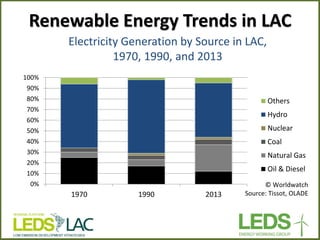
•Overall, LAC has traditionally been a world leader in the use of renewable energy sources for power generation (mainly hydro power), with important sub-regional differences, but the use of fossil fuels grew rapidly in the late 1900s. 
•Many initiatives on renewables and energy efficiency on the part of governments and local organizations, supported by multilateral development banks, UN organizations, international NGOs. 
•The recent development of non-traditional renewable energies (wind, solar, geothermal, modern biomass) is helping meet important development goals (growth, access, affordability) with a lower impact on GHG emissions. 
•There are still important challenges related to investment climate, business model financing, but there are many lessons to share, both on what works and what doesn´t work.
Overview of the Renewable Energy Market in Latin America and the Caribbean 
Alexander Ochs 
Worldwatch Institute
Recent Worldwatch Studies on LAC Region 
Study on the Development of the Renewable Energy Market in Latin America & the Caribbean, IDB 2014 
The Way Forward for Renewable Energy in Central America, EEP 2013 (with INCAE) 
Caribbean Sustainable Energy Roadmap Strategy (CSERMS) Baseline Report Caricom/IDB/GIZ 2013 & 2015 (forthcoming)
Overview of Energy Development in LAC Region 
1. Renewable Energy Trends in LAC 2. Climate Change Vulnerability & Adaptation Strategies 3. RE Barriers in LAC & Opportunities to Overcome Them
1. Renewable Energy Trends in LAC
Renewable Energy Trends in LAC 
Electricity Generation by Source in LAC, 1970, 1990, and 2013 
0% 
10% 
20% 
30% 
40% 
50% 
60% 
70% 
80% 
90% 
100% 
1970 
1990 
2013 
Others 
Hydro 
Nuclear 
Coal 
Natural Gas 
Oil & Diesel 
© Worldwatch Source: Tissot, OLADE
Renewable Energy Trends in LAC: Electrification 
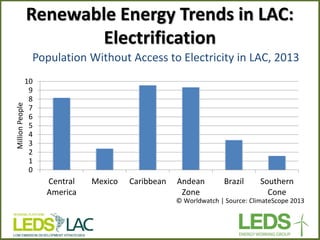
Population Without Access to Electricity in LAC, 2013 
0 
1 
2 
3 
4 
5 
6 
7 
8 
9 
10 
Central 
America 
Mexico 
Caribbean 
Andean 
Zone 
Brazil 
Southern 
Cone 
Million People 
© Worldwatch | Source: ClimateScope 2013
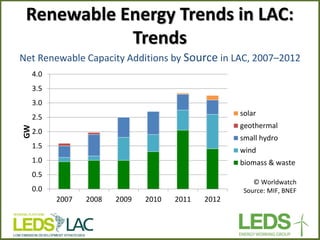
Renewable Energy Trends in LAC: Trends 
Net Renewable Capacity Additions by Source in LAC, 2007–2012 
0.0 
0.5 
1.0 
1.5 
2.0 
2.5 
3.0 
3.5 
4.0 
2007 
2008 
2009 
2010 
2011 
2012 
GW 
solar 
geothermal 
small hydro 
wind 
biomass & waste 
© Worldwatch Source: MIF, BNEF
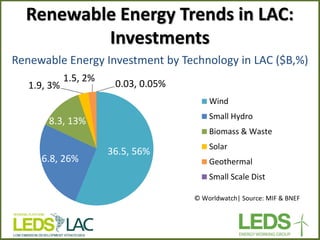
Renewable Energy Trends in LAC: Investments 
Renewable Energy Investment by Technology in LAC ($B,%) 
36.5, 56% 
16.8, 26% 
8.3, 13% 
1.9, 3% 
1.5, 2% 
0.03, 0.05% 
Wind 
Small Hydro 
Biomass & Waste 
Solar 
Geothermal 
Small Scale Dist 
© Worldwatch| Source: MIF & BNEF
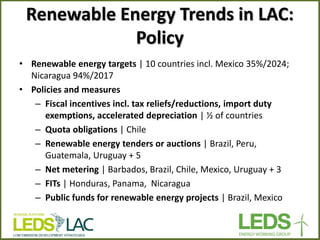
Renewable Energy Trends in LAC: Policy 
•Renewable energy targets | 10 countries incl. Mexico 35%/2024; Nicaragua 94%/2017 
•Policies and measures 
–Fiscal incentives incl. tax reliefs/reductions, import duty exemptions, accelerated depreciation | ½ of countries 
–Quota obligations | Chile 
–Renewable energy tenders or auctions | Brazil, Peru, Guatemala, Uruguay + 5 
–Net metering | Barbados, Brazil, Chile, Mexico, Uruguay + 3 
–FITs | Honduras, Panama, Nicaragua 
–Public funds for renewable energy projects | Brazil, Mexico
2. Climate Change Vulnerability & Adaptation Strategies in the Power Sector in LAC
Climate Change Vulnerability & Adaptation Strategies in the Power Sector in LAC 
•Increase in frequency and strength of extreme weather events 
•Effects 
•Precipitation levels and timing 
•Air and water temperature 
•Glaciers 
•Sea-level 
•Consequences 
•Water scarcity, droughts, floods, ocean acidification, storms 
•Biodiversity loss 
•Human impacts 
•Health, survival of 100,000 of people 
•Significant economic losses
Power Sector Vulnerability 
•Climate change affects entire energy supply chain: 
–Water scarcity affects hydro, biomass, fossil fuels & nuclear power generation 
•Hydropower 50% of LAC electricity; already decreases due to extreme droughts 
–Higher temperatures decrease efficiency for fossil fuels and nuclear power generation; T&D; batteries 
–Extreme weather events and sea level rise put infrastructure at risk 
–Rising temperatures lead to higher energy demand
Power Sector Adaptation Measures 
–Longevity of investments 
•Assessments of cc impacts on existing and future installations 
–In-depth assessments/vulnerability studies of impacts on non- hydro energy sources 
•Need to consider forecasted timelines 
•Investments should be confined to less exposed locations 
–Power sector adaptation measures 
•Improvements in weather and storm forecasting capabilities 
•High quality standards of installations 
•Decentralized energy generation  rapid expansion of REs 
•Energy storage 
•Flood control & coastal defenses
3. RE Barriers in LAC & Opportunities to Overcome Them
RE Barriers in LAC & Opportunities to Overcome Them: Technical Barriers 
•Lack of available data and information 
•Uncertainties regarding the technical feasibility 
•Transmission and distribution challenges; on- or off-grid settings 
Need for integrated resource planning 
•Integrating RE, EE, T&D, storage options 
–Assessing complementarity of different REs resources 
–Taking into account socio-economic factors and consequences 
•Stakeholder consultations
RE Barriers in LAC & Opportunities to Overcome Them: Social Barriers 
•Lack of public acceptance/awareness 
–Feasibility, economics 
–Vested interest in business as usual 
–“Not in my backyard” 
Need for up-to-date, fully inclusive data gathering and communication 
–Need of Full societal costs & benefits assessments
RE Barriers in LAC & Opportunities to Overcome Them: Finance Barriers 
•Macroeconomic risks 
–Political instability, currency risks, credit worthiness 
•Inadequacy of financial products 
•Underdeveloped financial sectors 
Need for financial sector development 
•Creation of specific financial products 
•Capacity building, training in project financing and risk assessment 
•Supporting policies
Learning from Nicaragua’s Clean Energy Investment-Attraction Strategies 
Javier Chamorro PRONicaragua
Energy in Nicaragua: Past and Presence 
-Between June and October of 2007, energy generation in Nicaragua dropped down to 500 MW. 
-As emergency actions in 2007 and 2008, the Government of Nicaragua installed thermal plants producing 120 MW. 
-Oil consumption for power generation accounted for 35% of the approximately 10 million barrels that the country consumes annually. 
-In the period between 2007 and 2008, the Ministry of Energy and Mines developed a strategy to reduce the deficit in power generation while promoting the expansion and diversification of the current energy matrix towards renewable energy.
Energy in Nicaragua: Past and Presence 
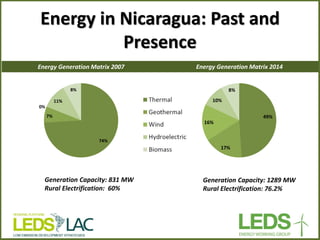
Energy Generation Matrix 2007 
Energy Generation Matrix 2014 
49% 
17% 
16% 
10% 
8% 
Generation Capacity: 1289 MW 
Rural Electrification: 76.2% 
Generation Capacity: 831 MW Rural Electrification: 60% 
74% 
7% 
0% 
11% 
8%
The Future: National Energy Goals 
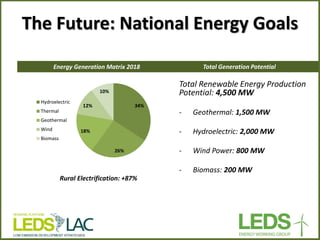
Energy Generation Matrix 2018 
Total Generation Potential 
Total Renewable Energy Production Potential: 4,500 MW 
‐ Geothermal: 1,500 MW 
‐ Hydroelectric: 2,000 MW 
‐ Wind Power: 800 MW 
‐ Biomass: 200 MW 
34% 
26% 
18% 
12% 
10% 
Hydroelectric 
Thermal 
Geothermal 
Wind 
Biomass 
Rural Electrification: +87%
Clean Energy Programs and Policies 
Law for the Promotion of Energy Generation from Renewable Sources (Law 532) 
‐100% Exemption of the income tax for the sale of carbon dioxide bonds. 
‐100% Exemption of the property tax for a 7 year period. 
‐100% Exemption of the import duties and sales tax on construction materials, machinery, and equipment. 
‐100% Exemption of all taxes related to the exploitation of natural riches for a 5 year period. 
‐100% Exemption of all taxes related to fixed investments on machinery, equipment and hydroelectric dams for a 10 year period.
Nicaragua has subscribed many programs through Bilateral and Multilateral Organizations for clean energy development and rural electrification, such as: 
‐National Sustainable Electrification and Renewable Energy Program (PNESER) - Inter- American Development Bank (IDB): the objective was to improve electricity service in Nicaragua by supporting the transformation of the country’s energy matrix and increasing electricity coverage. 
‐Nicaragua Off Grid Rural Electrification Project (PERZA) – World Bank: the program´s objective was to support the sustainable provision of electricity services in selected rural sites in Nicaragua, and strengthen the Government's institutional capacity to implement its national rural electrification strategy. Nicaragua has also received funding through international cooperation agencies from countries such as: - Canada - Norway - Switzerland - Spain -Germany - Japan 
Clean Energy Programs and Policies
Designing the Program 
PRONicaragua is the official Investment and Export Promotion Agency of Nicaragua: 
•It was created in the year 2002 as a project of the United Nations Development Program. The Presidential Decree 75-2002 created the Special Commission for Investment Promotion, adscribed directly to the Presidency of Nicaragua. 
•Decree No. 12-2011, reform of decree 75-2002: the Agency is granted the responsability of promoting exports. 
•The Agency reports to the President of the Republic through the Presidential Delegate for Investments and Trade Facilitation. 
•PRONicaragua has the role of Executive Secretary of the Advisory Council for Trade Facilitation and Promotion. The Advisory Council is composed of 12 Government institutions and 6 chambers from the private sector. 
2007 
PRONicaragua starts to promote foreign investment in the energy sector
Designing the Program 
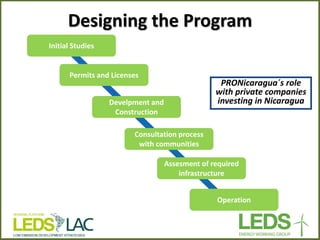
Permits and Licenses 
Develpment and Construction 
Assesment of required infrastructure 
Initial Studies 
Consultation process with communities 
Operation 
PRONicaragua´s role with private companies investing in Nicaragua
Preliminary Results 
•From 2007 to 2014, Nicaragua has successfully reduced the country´s thermal energy dependence from 74 percent to 49 percent. 
•Since the year 2007, generation capacity has grown 55.11%. 
•Rural electrification has increased in 16.2% 
In 2013, Nicaragua´s success was recognized by the Inter-American Development Bank (IDB) and Bloomberg, in the second edition of the Climatescope ranking. Nicaragua placed third among 26 countries in terms of clean energy progress, just behind Brazil and Chile. Nicaragua ranked first in two of the four categories: 
1.Enabling Framework 
2.Clean Energy Investment and Climate Financing
Implementing the Program 
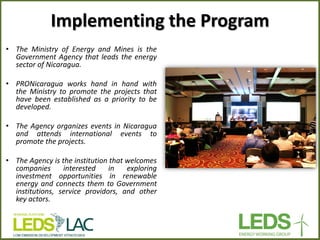
•The Ministry of Energy and Mines is the Government Agency that leads the energy sector of Nicaragua. 
•PRONicaragua works hand in hand with the Ministry to promote the projects that have been established as a priority to be developed. 
•The Agency organizes events in Nicaragua and attends international events to promote the projects. 
•The Agency is the institution that welcomes companies interested in exploring investment opportunities in renewable energy and connects them to Government institutions, service providors, and other key actors.
Monitoring, Verification, Reporting 
•PRONicaragua maintains constant communication with the Ministry of Energy and Mines to inform about the feedback received by private companies in the process of exploring and/or investing in Nicaragua´s renewable energy projects. 
•The feedback received is a tool that enables both the Ministry and the Agency to Monitor and verify the effectiveness of the policies. 
•Since recent years, the Agency is working with institutions that study, rank and publish reports on countries and their renewable energy sector. 
•The Agency aims to be a key institution that promotes and carries out actions to improve the business and investment climate of Nicaragua.
Nicaragua’s Clean Energy Future: What’s Planned? 
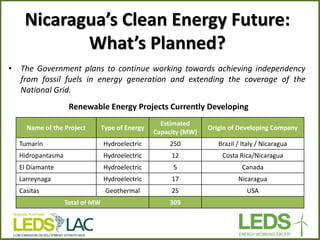
•The Government plans to continue working towards achieving independency from fossil fuels in energy generation and extending the coverage of the National Grid. 
Renewable Energy Projects Currently Developing 
Name of the Project 
Type of Energy 
Estimated Capacity (MW) 
Origin of Developing Company 
Tumarin 
Hydroelectric 
250 
Brazil / Italy / Nicaragua 
Hidropantasma 
Hydroelectric 
12 
Costa Rica/Nicaragua 
El Diamante 
Hydroelectric 
5 
Canada 
Larreynaga 
Hydroelectric 
17 
Nicaragua 
Casitas 
Geothermal 
25 
USA 
Total of MW 
309
Nicaragua’s Clean Energy Future: What’s Planned? 
•The Ministry of Energy and Mines is carrying out an effort to modernize and strengthen the main legislation that provides incentives for companies that want to invest in the country, which includes consultation sessions with the private sector and Multilateral agencies. 
•The Government will continue to promote and attract foreign investment into the country´s renewable energy sector in an effort to continue developing solar, hydroelectric, wind, geothermal and biomass projects. 
•Nicaragua plans to be an active player in the Regional Market providing opportunities for the country and private companies to sell energy in the Central American Electrical Interconnection System.
Nicaragua’s Clean Energy Future: What’s Needed? 
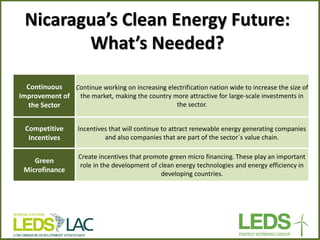
Continuous Improvement of the Sector 
Continue working on increasing electrification nation wide to increase the size of the market, making the country more attractive for large-scale investments in the sector. 
Competitive Incentives 
Incentives that will continue to attract renewable energy generating companies and also companies that are part of the sector´s value chain. 
Green Microfinance 
Create incentives that promote green micro financing. These play an important role in the development of clean energy technologies and energy efficiency in developing countries.
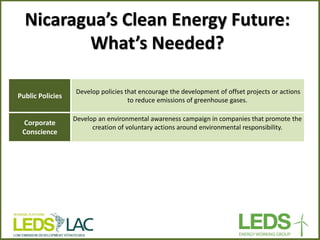
Public Policies 
Develop policies that encourage the development of offset projects or actions to reduce emissions of greenhouse gases. 
Corporate Conscience 
Develop an environmental awareness campaign in companies that promote the creation of voluntary actions around environmental responsibility. 
Nicaragua’s Clean Energy Future: What’s Needed?
Conclusions and Key Lessons 
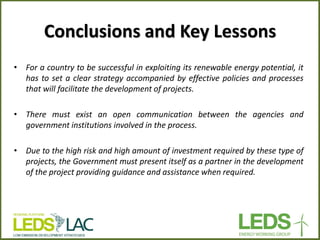
•For a country to be successful in exploiting its renewable energy potential, it has to set a clear strategy accompanied by effective policies and processes that will facilitate the development of projects. 
•There must exist an open communication between the agencies and government institutions involved in the process. 
•Due to the high risk and high amount of investment required by these type of projects, the Government must present itself as a partner in the development of the project providing guidance and assistance when required.
Conclusions and Key Lessons 
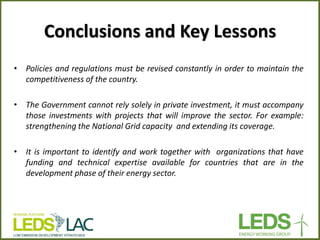
•Policies and regulations must be revised constantly in order to maintain the competitiveness of the country. 
•The Government cannot rely solely in private investment, it must accompany those investments with projects that will improve the sector. For example: strengthening the National Grid capacity and extending its coverage. 
•It is important to identify and work together with organizations that have funding and technical expertise available for countries that are in the development phase of their energy sector.
Questions 
To ask a question, please select the “questions” pane on your screen and type your question into the textbox.
Survey 
Please take a moment to take this short survey to let us know how we did and where we can improve.
Thank you 
Alexander Ochs, aochs@worldwatch.org 
Ana María Majano, ana.majano@incae.edu 
Javier Chamorro, jchamorro@pronicaragua.org.ni 
Stay tuned for our upcoming energy webinar on leaders in the Africa region! 
Membership is open for the Energy Working Group. Contact Max Lander at mlander@worldwatch.org for more information or to join.

Energy Low Emission Development Strategies: A Regional Overview of Latin America and the Caribbean and Experiences from Nicaragua

  • 1.
    Energy Low EmissionDevelopment Strategies: A Regional Overview of Latin America and the Caribbean and Experiences from Nicaragua 26 November 2014 Presenters: Ana María Majano – INCAE Business School Alexander Ochs - Worldwatch Institute Javier Chamorro - ProNicaragua
  • 2.
    Welcome & Introduction Ana María Majano INCAE Business School EWG LAC co-Chair
  • 3.
    Audio Options forParticipants: 1.Listen through your computer. Please select the “mic and speakers” radio button on the right hand audio pane display 2. Listen by telephone. Please select the “telephone” option in the right-hand display, and a phone number and PIN will display Panelists: Please mute your audio device when not presenting! Technical Difficulties: Contact the GoToWebinars Help Desk: 888.259.3826 Logistics
  • 4.
    To Ask aQuestion: •Select the “questions” pane on your screen and type in your question If you are having trouble with the webinar: •PDFs of the presentation can be accessed at: http://ledsgp.org/sector/energy •A video/audio recording of this webinar and slide decks will be available at: http://ledsgp.org/sector/energy Logistics
  • 5.
    1.Welcome & Introductionto the LEDS LAC Regional Platform and the Importance of Energy in Latin America and the Caribbean Ana María Majano, INCAE Business, LEDS-EWG Co-Chair for LAC 2.Key Low-Emission Energy Developments in LAC Alexander Ochs, Worldwatch Institute, LEDS-EWG Chair 3.Learning from Nicaragua’s Investment Promotion Age Javier Chamorro, ProNicaragua 4.Q&A 5.Survey Outline
  • 6.
    LEDS Global Partnership International initiative aiming to harness the collective knowledge and resources of governments, donors, international organizations, and practitioners in scaling up and strengthening implementation of climate-resilient low emission development around the world. Launched in 2011, the LEDS GP now catalyzes action and collaboration across more than 120 countries and international organizations.
  • 7.
    Energy Working Group(EWG) The EWG promotes low-emission and climate- resilient development in the energy sector through a work program focused on learning and information exchange, sharing best practices, advisory services, and providing enhanced opportunities for coordination and collaboration. Objectives Strengthen support for LEDS in energy sector Mobilize capacity and advance peer-to-peer learning and collaboration on low emission energy development Improve coordination of energy-related LEDS at the country, regional, and global levels
  • 8.
    Energy Working GroupActivities Current work plan, highlights Webinars: Events: •LEDS GP Annual Event, Addis Ababa, Ethiopia (August 2014): - Energy Peer Learning Session For African Countries - Energy Sector Strategies and Policy Portfolios Session •LEDS LAC Regional Forum 2013 2015 work plan, highlights: •Energy Toolkit •Energy Data Crowdsourcing Project •Energy & Development World Atlas •Energy LEDS Training Camp •Energy Policy Development Group •Best Practices in Gathering and Using Energy Data for LEDS Development (April) •Energy LEDS in Asia (Oct.) •Energy LEDS in Africa (Nov./Dec.) •Energy LEDS in LAC (Nov./Dec.)
  • 9.
    LAC Regional Platform -Launched in 2012 at INCAE Campus in Costa Rica -More than 250 registered members -More than 500 participants in face-to-face and online activities -3 regional annual Regional Workshops (Costa Rica, Lima, Santiago). Next: 2015 in the Dominican Republic. -Webpage www.ledslac.org
  • 10.
    Energy in LEDSLAC •Energy issues are very important in the regional discussions, including the LEDS LAC Platform: specific sessions in 2012 and 2013 workshops, 2014 webinars, upcoming case studies. •Overall, LAC has traditionally been a world leader in the use of renewable energy sources for power generation (mainly hydro power), with important sub-regional differences, but the use of fossil fuels grew rapidly in the late 1900s. •Many initiatives on renewables and energy efficiency on the part of governments and local organizations, supported by multilateral development banks, UN organizations, international NGOs. •The recent development of non-traditional renewable energies (wind, solar, geothermal, modern biomass) is helping meet important development goals (growth, access, affordability) with a lower impact on GHG emissions. •There are still important challenges related to investment climate, business model financing, but there are many lessons to share, both on what works and what doesn´t work.
  • 11.
    Overview of theRenewable Energy Market in Latin America and the Caribbean Alexander Ochs Worldwatch Institute
  • 12.
    Recent Worldwatch Studieson LAC Region Study on the Development of the Renewable Energy Market in Latin America & the Caribbean, IDB 2014 The Way Forward for Renewable Energy in Central America, EEP 2013 (with INCAE) Caribbean Sustainable Energy Roadmap Strategy (CSERMS) Baseline Report Caricom/IDB/GIZ 2013 & 2015 (forthcoming)
  • 13.
    Overview of EnergyDevelopment in LAC Region 1. Renewable Energy Trends in LAC 2. Climate Change Vulnerability & Adaptation Strategies 3. RE Barriers in LAC & Opportunities to Overcome Them
  • 14.
    1. Renewable EnergyTrends in LAC
  • 15.
    Renewable Energy Trendsin LAC Electricity Generation by Source in LAC, 1970, 1990, and 2013 0% 10% 20% 30% 40% 50% 60% 70% 80% 90% 100% 1970 1990 2013 Others Hydro Nuclear Coal Natural Gas Oil & Diesel © Worldwatch Source: Tissot, OLADE
  • 16.
    Renewable Energy Trendsin LAC: Electrification Population Without Access to Electricity in LAC, 2013 0 1 2 3 4 5 6 7 8 9 10 Central America Mexico Caribbean Andean Zone Brazil Southern Cone Million People © Worldwatch | Source: ClimateScope 2013
  • 17.
    Renewable Energy Trendsin LAC: Trends Net Renewable Capacity Additions by Source in LAC, 2007–2012 0.0 0.5 1.0 1.5 2.0 2.5 3.0 3.5 4.0 2007 2008 2009 2010 2011 2012 GW solar geothermal small hydro wind biomass & waste © Worldwatch Source: MIF, BNEF
  • 18.
    Renewable Energy Trendsin LAC: Investments Renewable Energy Investment by Technology in LAC ($B,%) 36.5, 56% 16.8, 26% 8.3, 13% 1.9, 3% 1.5, 2% 0.03, 0.05% Wind Small Hydro Biomass & Waste Solar Geothermal Small Scale Dist © Worldwatch| Source: MIF & BNEF
  • 19.
    Renewable Energy Trendsin LAC: Policy •Renewable energy targets | 10 countries incl. Mexico 35%/2024; Nicaragua 94%/2017 •Policies and measures –Fiscal incentives incl. tax reliefs/reductions, import duty exemptions, accelerated depreciation | ½ of countries –Quota obligations | Chile –Renewable energy tenders or auctions | Brazil, Peru, Guatemala, Uruguay + 5 –Net metering | Barbados, Brazil, Chile, Mexico, Uruguay + 3 –FITs | Honduras, Panama, Nicaragua –Public funds for renewable energy projects | Brazil, Mexico
  • 20.
    2. Climate ChangeVulnerability & Adaptation Strategies in the Power Sector in LAC
  • 21.
    Climate Change Vulnerability& Adaptation Strategies in the Power Sector in LAC •Increase in frequency and strength of extreme weather events •Effects •Precipitation levels and timing •Air and water temperature •Glaciers •Sea-level •Consequences •Water scarcity, droughts, floods, ocean acidification, storms •Biodiversity loss •Human impacts •Health, survival of 100,000 of people •Significant economic losses
  • 22.
    Power Sector Vulnerability •Climate change affects entire energy supply chain: –Water scarcity affects hydro, biomass, fossil fuels & nuclear power generation •Hydropower 50% of LAC electricity; already decreases due to extreme droughts –Higher temperatures decrease efficiency for fossil fuels and nuclear power generation; T&D; batteries –Extreme weather events and sea level rise put infrastructure at risk –Rising temperatures lead to higher energy demand
  • 23.
    Power Sector AdaptationMeasures –Longevity of investments •Assessments of cc impacts on existing and future installations –In-depth assessments/vulnerability studies of impacts on non- hydro energy sources •Need to consider forecasted timelines •Investments should be confined to less exposed locations –Power sector adaptation measures •Improvements in weather and storm forecasting capabilities •High quality standards of installations •Decentralized energy generation  rapid expansion of REs •Energy storage •Flood control & coastal defenses
  • 24.
    3. RE Barriersin LAC & Opportunities to Overcome Them
  • 25.
    RE Barriers inLAC & Opportunities to Overcome Them: Technical Barriers •Lack of available data and information •Uncertainties regarding the technical feasibility •Transmission and distribution challenges; on- or off-grid settings Need for integrated resource planning •Integrating RE, EE, T&D, storage options –Assessing complementarity of different REs resources –Taking into account socio-economic factors and consequences •Stakeholder consultations
  • 26.
    RE Barriers inLAC & Opportunities to Overcome Them: Social Barriers •Lack of public acceptance/awareness –Feasibility, economics –Vested interest in business as usual –“Not in my backyard” Need for up-to-date, fully inclusive data gathering and communication –Need of Full societal costs & benefits assessments
  • 27.
    RE Barriers inLAC & Opportunities to Overcome Them: Finance Barriers •Macroeconomic risks –Political instability, currency risks, credit worthiness •Inadequacy of financial products •Underdeveloped financial sectors Need for financial sector development •Creation of specific financial products •Capacity building, training in project financing and risk assessment •Supporting policies
  • 28.
    Learning from Nicaragua’sClean Energy Investment-Attraction Strategies Javier Chamorro PRONicaragua
  • 29.
    Energy in Nicaragua:Past and Presence -Between June and October of 2007, energy generation in Nicaragua dropped down to 500 MW. -As emergency actions in 2007 and 2008, the Government of Nicaragua installed thermal plants producing 120 MW. -Oil consumption for power generation accounted for 35% of the approximately 10 million barrels that the country consumes annually. -In the period between 2007 and 2008, the Ministry of Energy and Mines developed a strategy to reduce the deficit in power generation while promoting the expansion and diversification of the current energy matrix towards renewable energy.
  • 30.
    Energy in Nicaragua:Past and Presence Energy Generation Matrix 2007 Energy Generation Matrix 2014 49% 17% 16% 10% 8% Generation Capacity: 1289 MW Rural Electrification: 76.2% Generation Capacity: 831 MW Rural Electrification: 60% 74% 7% 0% 11% 8%
  • 31.
    The Future: NationalEnergy Goals Energy Generation Matrix 2018 Total Generation Potential Total Renewable Energy Production Potential: 4,500 MW ‐ Geothermal: 1,500 MW ‐ Hydroelectric: 2,000 MW ‐ Wind Power: 800 MW ‐ Biomass: 200 MW 34% 26% 18% 12% 10% Hydroelectric Thermal Geothermal Wind Biomass Rural Electrification: +87%
  • 32.
    Clean Energy Programsand Policies Law for the Promotion of Energy Generation from Renewable Sources (Law 532) ‐100% Exemption of the income tax for the sale of carbon dioxide bonds. ‐100% Exemption of the property tax for a 7 year period. ‐100% Exemption of the import duties and sales tax on construction materials, machinery, and equipment. ‐100% Exemption of all taxes related to the exploitation of natural riches for a 5 year period. ‐100% Exemption of all taxes related to fixed investments on machinery, equipment and hydroelectric dams for a 10 year period.
  • 33.
    Nicaragua has subscribedmany programs through Bilateral and Multilateral Organizations for clean energy development and rural electrification, such as: ‐National Sustainable Electrification and Renewable Energy Program (PNESER) - Inter- American Development Bank (IDB): the objective was to improve electricity service in Nicaragua by supporting the transformation of the country’s energy matrix and increasing electricity coverage. ‐Nicaragua Off Grid Rural Electrification Project (PERZA) – World Bank: the program´s objective was to support the sustainable provision of electricity services in selected rural sites in Nicaragua, and strengthen the Government's institutional capacity to implement its national rural electrification strategy. Nicaragua has also received funding through international cooperation agencies from countries such as: - Canada - Norway - Switzerland - Spain -Germany - Japan Clean Energy Programs and Policies
  • 34.
    Designing the Program PRONicaragua is the official Investment and Export Promotion Agency of Nicaragua: •It was created in the year 2002 as a project of the United Nations Development Program. The Presidential Decree 75-2002 created the Special Commission for Investment Promotion, adscribed directly to the Presidency of Nicaragua. •Decree No. 12-2011, reform of decree 75-2002: the Agency is granted the responsability of promoting exports. •The Agency reports to the President of the Republic through the Presidential Delegate for Investments and Trade Facilitation. •PRONicaragua has the role of Executive Secretary of the Advisory Council for Trade Facilitation and Promotion. The Advisory Council is composed of 12 Government institutions and 6 chambers from the private sector. 2007 PRONicaragua starts to promote foreign investment in the energy sector
  • 35.
    Designing the Program Permits and Licenses Develpment and Construction Assesment of required infrastructure Initial Studies Consultation process with communities Operation PRONicaragua´s role with private companies investing in Nicaragua
  • 36.
    Preliminary Results •From2007 to 2014, Nicaragua has successfully reduced the country´s thermal energy dependence from 74 percent to 49 percent. •Since the year 2007, generation capacity has grown 55.11%. •Rural electrification has increased in 16.2% In 2013, Nicaragua´s success was recognized by the Inter-American Development Bank (IDB) and Bloomberg, in the second edition of the Climatescope ranking. Nicaragua placed third among 26 countries in terms of clean energy progress, just behind Brazil and Chile. Nicaragua ranked first in two of the four categories: 1.Enabling Framework 2.Clean Energy Investment and Climate Financing
  • 37.
    Implementing the Program •The Ministry of Energy and Mines is the Government Agency that leads the energy sector of Nicaragua. •PRONicaragua works hand in hand with the Ministry to promote the projects that have been established as a priority to be developed. •The Agency organizes events in Nicaragua and attends international events to promote the projects. •The Agency is the institution that welcomes companies interested in exploring investment opportunities in renewable energy and connects them to Government institutions, service providors, and other key actors.
  • 38.
    Monitoring, Verification, Reporting •PRONicaragua maintains constant communication with the Ministry of Energy and Mines to inform about the feedback received by private companies in the process of exploring and/or investing in Nicaragua´s renewable energy projects. •The feedback received is a tool that enables both the Ministry and the Agency to Monitor and verify the effectiveness of the policies. •Since recent years, the Agency is working with institutions that study, rank and publish reports on countries and their renewable energy sector. •The Agency aims to be a key institution that promotes and carries out actions to improve the business and investment climate of Nicaragua.
  • 39.
    Nicaragua’s Clean EnergyFuture: What’s Planned? •The Government plans to continue working towards achieving independency from fossil fuels in energy generation and extending the coverage of the National Grid. Renewable Energy Projects Currently Developing Name of the Project Type of Energy Estimated Capacity (MW) Origin of Developing Company Tumarin Hydroelectric 250 Brazil / Italy / Nicaragua Hidropantasma Hydroelectric 12 Costa Rica/Nicaragua El Diamante Hydroelectric 5 Canada Larreynaga Hydroelectric 17 Nicaragua Casitas Geothermal 25 USA Total of MW 309
  • 40.
    Nicaragua’s Clean EnergyFuture: What’s Planned? •The Ministry of Energy and Mines is carrying out an effort to modernize and strengthen the main legislation that provides incentives for companies that want to invest in the country, which includes consultation sessions with the private sector and Multilateral agencies. •The Government will continue to promote and attract foreign investment into the country´s renewable energy sector in an effort to continue developing solar, hydroelectric, wind, geothermal and biomass projects. •Nicaragua plans to be an active player in the Regional Market providing opportunities for the country and private companies to sell energy in the Central American Electrical Interconnection System.
  • 41.
    Nicaragua’s Clean EnergyFuture: What’s Needed? Continuous Improvement of the Sector Continue working on increasing electrification nation wide to increase the size of the market, making the country more attractive for large-scale investments in the sector. Competitive Incentives Incentives that will continue to attract renewable energy generating companies and also companies that are part of the sector´s value chain. Green Microfinance Create incentives that promote green micro financing. These play an important role in the development of clean energy technologies and energy efficiency in developing countries.
  • 42.
    Public Policies Developpolicies that encourage the development of offset projects or actions to reduce emissions of greenhouse gases. Corporate Conscience Develop an environmental awareness campaign in companies that promote the creation of voluntary actions around environmental responsibility. Nicaragua’s Clean Energy Future: What’s Needed?
  • 43.
    Conclusions and KeyLessons •For a country to be successful in exploiting its renewable energy potential, it has to set a clear strategy accompanied by effective policies and processes that will facilitate the development of projects. •There must exist an open communication between the agencies and government institutions involved in the process. •Due to the high risk and high amount of investment required by these type of projects, the Government must present itself as a partner in the development of the project providing guidance and assistance when required.
  • 44.
    Conclusions and KeyLessons •Policies and regulations must be revised constantly in order to maintain the competitiveness of the country. •The Government cannot rely solely in private investment, it must accompany those investments with projects that will improve the sector. For example: strengthening the National Grid capacity and extending its coverage. •It is important to identify and work together with organizations that have funding and technical expertise available for countries that are in the development phase of their energy sector.
  • 45.
    Questions To aska question, please select the “questions” pane on your screen and type your question into the textbox.
  • 46.
    Survey Please takea moment to take this short survey to let us know how we did and where we can improve.
  • 47.
    Thank you AlexanderOchs, aochs@worldwatch.org Ana María Majano, ana.majano@incae.edu Javier Chamorro, jchamorro@pronicaragua.org.ni Stay tuned for our upcoming energy webinar on leaders in the Africa region! Membership is open for the Energy Working Group. Contact Max Lander at mlander@worldwatch.org for more information or to join.