Sustainable Energy Roadmap &
Implementation Plan (SERIP)
Alexander Ochs
Senior Director of Climate and Energy
Goal
• An energy system that is socially, economically
and environmentally sustainable
Our role
• Provide the supporting research
• Help government define goals, design strategy
• Advise on implementation
Theory of change
• Overall strategy and individual recommendations only
successful if they get buy-in from key drivers of change
– Decision-makers in policy, business (entrepreneurs, project
developer) and finance (investors, banks, international
funders)
– Media, NGOs and civil society as important communicators
and pressure groups
• Necessitates a paradigm shift
• Requires that we demonstrate that
– the outcome is in the clear interest of the people; allow for
greater prosperity, security, integrity, happiness
– the pathway is technically, socially, economically, politically
and financially feasible
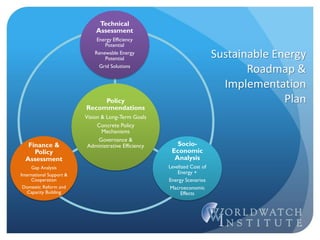
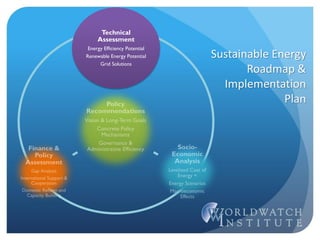
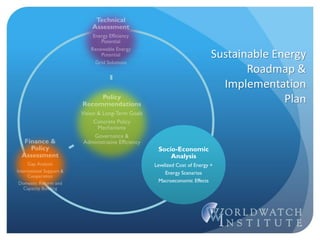
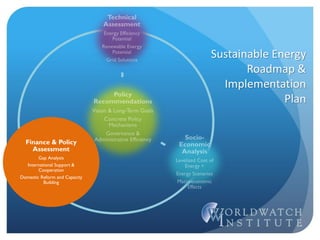
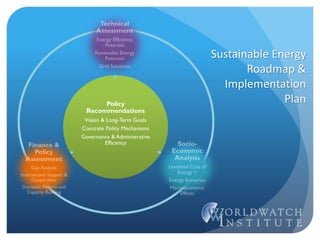
Sustainable Energy
Roadmap &
Implementation
PlanPolicy
Recommendations
Vision & Long-Term Goals
Concrete Policy
Mechanisms
Governance &
Administrative Efficiency
Technical
Assessment
Energy Efficiency
Potential
Renewable Energy
Potential
Grid Solutions
Finance &
Policy
Assessment
Gap Analysis
International Support &
Cooperation
Domestic Reform and
Capacity Building
Socio-
Economic
Analysis
Levelized Cost of
Energy +
Energy Scenarios
Macroeconomic
Effects
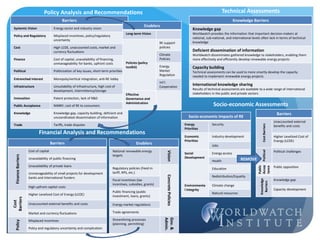
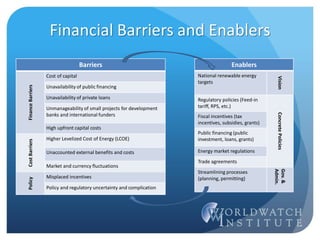
Financial investment barriers and enablers
Barriers
FinanceBarriers
Cost of capital
Unavailability of public financing
Unavailability of private loans
Unmanageability of small projects for development
banks and international funders
High upfront capital costs
Cost
Barriers
Higher Levelized Cost of Energy (LCOE)
Unaccounted external benefits and costs
Market and currency fluctuations
Policy
Misplaced incentives
Policy and regulatory uncertainty and complication
Enablers
National renewable energy
targets
VisionRegulatory policies (Feed-in
tariff, RPS, etc.)
ConcretePolicies
Fiscal incentives (tax
incentives, subsidies, grants)
Public financing (public
investment, loans, grants)
Energy market regulations
Trade agreements
Streamlining processes
(planning, permitting)
Gov.&
Admin.
Socio-economic Assessments
Knowledge Barriers
Knowledge gap
Worldwatch provides the information that important decision-makers at
national, sub-national, and international levels often lack in terms of technical
knowledge
Deficient dissemination of information
Worldwatch disseminates gathered knowledge to stakeholders, enabling them
more effectively and efficiently develop renewable energy projects
Capacity building
Technical assessments can be used to more smartly develop the capacity
needed to implement renewable energy projects
International knowledge sharing
Results of technical assessments are available to a wide range of international
stakeholders in the public and private sectors
Technical Assessments
Socio-economic Impacts of RE
Energy
Priorities
Security
Economic
Priorities
Industry development
Jobs
Social
Development
Energy access
Health
Education
Redistribution/Equality
Environmenta
l Integrity
Climate change
Natural resources
Barriers
CostBarriers
Unaccounted external
benefits and costs
Higher Levelized Cost of
Energy (LCOE)
Political
Political challenges
Public
Accep
tance
Public opposition
Knowledge
Barriers
Knowledge gap
Capacity development
REMOVE
Barriers
Systemic Vision Energy sector and industry vision
Policy and Regulatory Misplaced incentives, policy/regulatory
uncertainty
Cost High LCOE, unaccounted costs, market and
currency fluctuations
Finance Cost of capital, unavailability of financing,
unmanageability for banks, upfront costs
Political Politicization of key issues, short-term priorities
Entrenched Interest Monopoly/vertical integration, anti-RE lobby
Infrastructure Unsuitability of infrastructure, high cost of
development, intermittency/storage
Innovation Patent protection, lack of R&D
Public Acceptance NIMBY, cost of RE to consumers
Knowledge Knowledge gap, capacity building, deficient and
uncoordinated dissemination of information
Trade Tariffs, trade disputes
Enablers
Long-term Vision
Policies (policy
toolkit)
RE support
policies
Climate
Policies
Energy
Market
Regulation
Int’l.
Cooperation
Effective
Governance and
Administration
Policy Analysis and Recommendations
Financial Analysis and Recommendations
Technical
Assessment
Energy Efficiency Potential
Renewable Energy Potential
Grid Solutions
Sustainable Energy
Roadmap &
Implementation
Plan
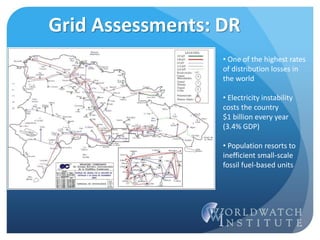
Grid Assessments: DR
• One of the highest rates
of distribution losses in
the world
• Electricity instability
costs the country
$1 billion every year
(3.4% GDP)
• Population resorts to
inefficient small-scale
fossil fuel-based units
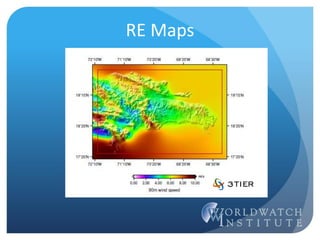
RE Maps
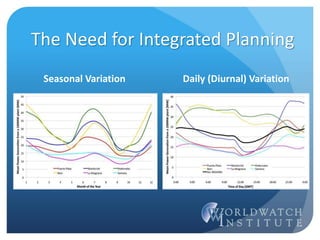
The Need for Integrated Planning
Seasonal Variation Daily (Diurnal) Variation
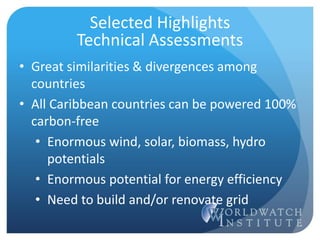
• Great similarities & divergences among
countries
• All Caribbean countries can be powered 100%
carbon-free
• Enormous wind, solar, biomass, hydro
potentials
• Enormous potential for energy efficiency
• Need to build and/or renovate grid
Selected Highlights
Technical Assessments
Socio-Economic
Analysis
Levelized Cost of Energy +
Energy Scenarios
Macroeconomic Effects
Sustainable Energy
Roadmap &
Implementation
Plan
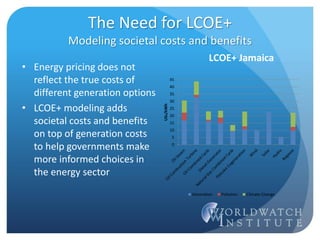
The Need for LCOE+
Modeling societal costs and benefits
LCOE+ Jamaica
• Energy pricing does not
reflect the true costs of
different generation options
• LCOE+ modeling adds
societal costs and benefits
on top of generation costs
to help governments make
more informed choices in
the energy sector
0
5
10
15
20
25
30
35
40
45
USc/kWh
Generation Pollution Climate Change
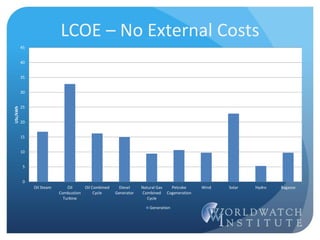
LCOE – No External Costs
0
5
10
15
20
25
30
35
40
45
Oil Steam Oil
Combustion
Turbine
Oil Combined
Cycle
Diesel
Generator
Natural Gas
Combined
Cycle
Petcoke
Cogeneration
Wind Solar Hydro Bagasse
USc/kWh
Generation
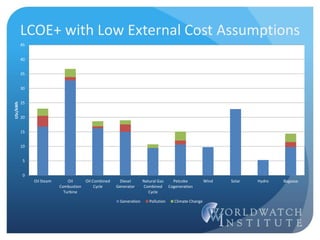
LCOE+ with Low External Cost Assumptions
0
5
10
15
20
25
30
35
40
45
Oil Steam Oil
Combustion
Turbine
Oil Combined
Cycle
Diesel
Generator
Natural Gas
Combined
Cycle
Petcoke
Cogeneration
Wind Solar Hydro Bagasse
USc/kWh
Generation Pollution Climate Change
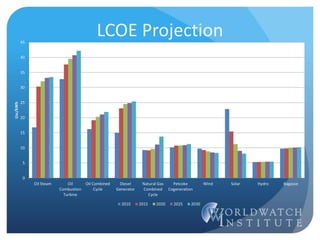
LCOE Projection
0
5
10
15
20
25
30
35
40
45
Oil Steam Oil
Combustion
Turbine
Oil Combined
Cycle
Diesel
Generator
Natural Gas
Combined
Cycle
Petcoke
Cogeneration
Wind Solar Hydro Bagasse
Usc/kWh
2010 2015 2020 2025 2030
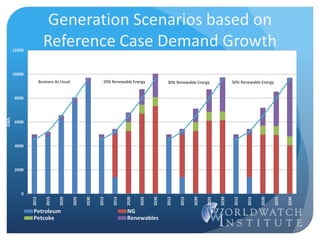
Generation Scenarios based on
Reference Case Demand Growth
0
2000
4000
6000
8000
10000
12000
2012
2015
2020
2025
2030
2012
2015
2020
2025
2030
2012
2015
2020
2025
2030
2012
2015
2020
2025
2030
GWh
Petroleum NG
Petcoke Renewables
Business As Usual 30% Renewable Energy 50% Renewable Energy20% Renewable Energy
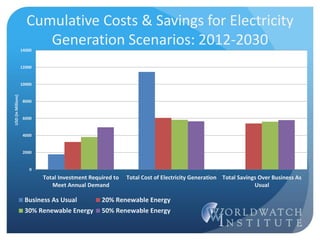
Cumulative Costs & Savings for Electricity
Generation Scenarios: 2012-2030
0
2000
4000
6000
8000
10000
12000
14000
Total Investment Required to
Meet Annual Demand
Total Cost of Electricity Generation Total Savings Over Business As
Usual
USD(InMillions)
Business As Usual 20% Renewable Energy
30% Renewable Energy 50% Renewable Energy
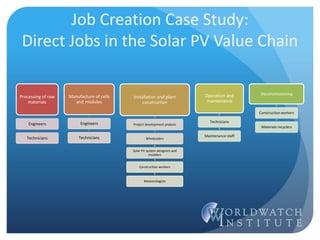
Job Creation Case Study:
Direct Jobs in the Solar PV Value Chain
Processing of raw
materials
Engineers
Technicians
Manufacture of cells
and modules
Engineers
Technicians
Installation and plant
construction
Project development analysis
Wholesalers
Solar PV system designers and
installers
Construction workers
Meteorologists
Operation and
maintenance
Technicians
Maintenance staff
Decommissioning
Construction workers
Materials recyclers
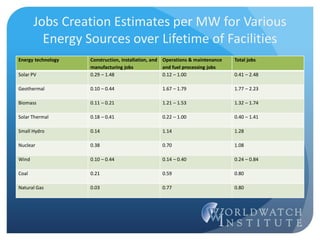
Jobs Creation Estimates per MW for Various
Energy Sources over Lifetime of Facilities
Energy technology Construction, installation, and
manufacturing jobs
Operations & maintenance
and fuel processing jobs
Total jobs
Solar PV 0.29 – 1.48 0.12 – 1.00 0.41 – 2.48
Geothermal 0.10 – 0.44 1.67 – 1.79 1.77 – 2.23
Biomass 0.11 – 0.21 1.21 – 1.53 1.32 – 1.74
Solar Thermal 0.18 – 0.41 0.22 – 1.00 0.40 – 1.41
Small Hydro 0.14 1.14 1.28
Nuclear 0.38 0.70 1.08
Wind 0.10 – 0.44 0.14 – 0.40 0.24 – 0.84
Coal 0.21 0.59 0.80
Natural Gas 0.03 0.77 0.80
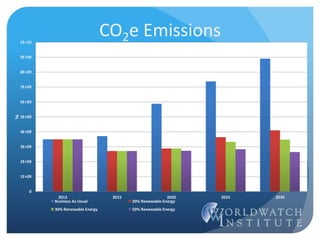
CO2e Emissions
0
1E+09
2E+09
3E+09
4E+09
5E+09
6E+09
7E+09
8E+09
9E+09
1E+10
2012 2015 2020 2025 2030
kg
Business As Usual 20% Renewable Energy
30% Renewable Energy 50% Renewable Energy
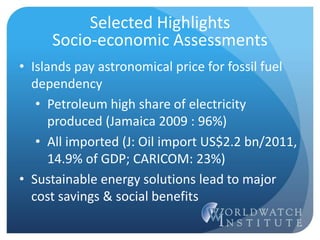
• Islands pay astronomical price for fossil fuel
dependency
• Petroleum high share of electricity
produced (Jamaica 2009 : 96%)
• All imported (J: Oil import US$2.2 bn/2011,
14.9% of GDP; CARICOM: 23%)
• Sustainable energy solutions lead to major
cost savings & social benefits
Selected Highlights
Socio-economic Assessments
Finance & Policy
Assessment
Gap Analysis
International Support &
Cooperation
Domestic Reform and Capacity
Building
Sustainable Energy
Roadmap &
Implementation
Plan
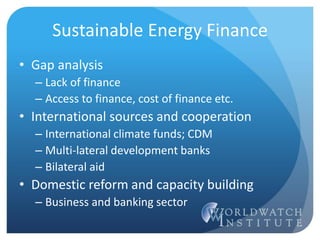
Sustainable Energy Finance
• Gap analysis
– Lack of finance
– Access to finance, cost of finance etc.
• International sources and cooperation
– International climate funds; CDM
– Multi-lateral development banks
– Bilateral aid
• Domestic reform and capacity building
– Business and banking sector
Financial Barriers and Enablers
Barriers
FinanceBarriers
Cost of capital
Unavailability of public financing
Unavailability of private loans
Unmanageability of small projects for development
banks and international funders
High upfront capital costs
CostBarriers
Higher Levelized Cost of Energy (LCOE)
Unaccounted external benefits and costs
Market and currency fluctuations
Policy
Misplaced incentives
Policy and regulatory uncertainty and complication
Enablers
National renewable energy
targets
Vision
Regulatory policies (Feed-in
tariff, RPS, etc.)
ConcretePolicies
Fiscal incentives (tax
incentives, subsidies, grants)
Public financing (public
investment, loans, grants)
Energy market regulations
Trade agreements
Streamlining processes
(planning, permitting)
Gov.&
Admin.
Policy
Recommendations
Vision & Long-Term Goals
Concrete Policy Mechanisms
Governance & Administrative
Efficiency
Sustainable Energy
Roadmap &
Implementation
Plan
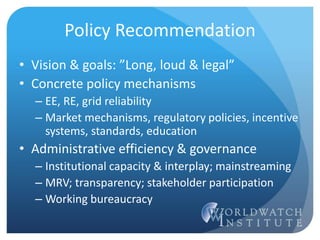
Policy Recommendation
• Vision & goals: ”Long, loud & legal”
• Concrete policy mechanisms
– EE, RE, grid reliability
– Market mechanisms, regulatory policies, incentive
systems, standards, education
• Administrative efficiency & governance
– Institutional capacity & interplay; mainstreaming
– MRV; transparency; stakeholder participation
– Working bureaucracy
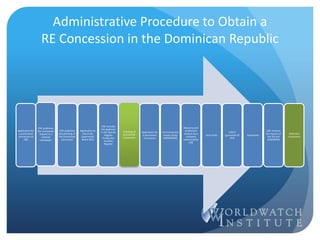
Administrative Procedure to Obtain a
RE Concession in the Dominican Republic
Application for
a provisional
concession at
CNE
CNE publishes
the concession
request in a
national
newspaper
CNE publishes
the granting of
the provisional
concession
Application to
Electricity
Supervision
Board (SIE)
CNE includes
the applicant
in the Special
Regime
Production
Facilities
Register
Granting of
provisional
concession
Application for
a permanent
concession
Environmental
Impact Study
(SEMARENA)
Resource and
production
analysis by a
company
authorized by
CNE
Grid study
CDEEE
guarantee of
PPA
Guarantee
CNE receives
the reports of
the SIE and
SEMARENA
Definitive
concession
• Long-term vision often exists, can be more
ambitious
• Policies & measures exist but often do not
work to their full potential; additional policies
needed
• Governance & administration need to be
strengthened; capacity-building,
mainstreaming, simplification
Selected Highlights
Policy Assessments
aochs@worldwatch.org
Contact:

Sustainable Energy Roadmap & Implementation Plans (SERIP)

  • 1.
    Sustainable Energy Roadmap& Implementation Plan (SERIP) Alexander Ochs Senior Director of Climate and Energy
  • 2.
    Goal • An energysystem that is socially, economically and environmentally sustainable Our role • Provide the supporting research • Help government define goals, design strategy • Advise on implementation
  • 3.
    Theory of change •Overall strategy and individual recommendations only successful if they get buy-in from key drivers of change – Decision-makers in policy, business (entrepreneurs, project developer) and finance (investors, banks, international funders) – Media, NGOs and civil society as important communicators and pressure groups • Necessitates a paradigm shift • Requires that we demonstrate that – the outcome is in the clear interest of the people; allow for greater prosperity, security, integrity, happiness – the pathway is technically, socially, economically, politically and financially feasible
  • 4.
    Sustainable Energy Roadmap & Implementation PlanPolicy Recommendations Vision& Long-Term Goals Concrete Policy Mechanisms Governance & Administrative Efficiency Technical Assessment Energy Efficiency Potential Renewable Energy Potential Grid Solutions Finance & Policy Assessment Gap Analysis International Support & Cooperation Domestic Reform and Capacity Building Socio- Economic Analysis Levelized Cost of Energy + Energy Scenarios Macroeconomic Effects
  • 5.
    Financial investment barriersand enablers Barriers FinanceBarriers Cost of capital Unavailability of public financing Unavailability of private loans Unmanageability of small projects for development banks and international funders High upfront capital costs Cost Barriers Higher Levelized Cost of Energy (LCOE) Unaccounted external benefits and costs Market and currency fluctuations Policy Misplaced incentives Policy and regulatory uncertainty and complication Enablers National renewable energy targets VisionRegulatory policies (Feed-in tariff, RPS, etc.) ConcretePolicies Fiscal incentives (tax incentives, subsidies, grants) Public financing (public investment, loans, grants) Energy market regulations Trade agreements Streamlining processes (planning, permitting) Gov.& Admin. Socio-economic Assessments Knowledge Barriers Knowledge gap Worldwatch provides the information that important decision-makers at national, sub-national, and international levels often lack in terms of technical knowledge Deficient dissemination of information Worldwatch disseminates gathered knowledge to stakeholders, enabling them more effectively and efficiently develop renewable energy projects Capacity building Technical assessments can be used to more smartly develop the capacity needed to implement renewable energy projects International knowledge sharing Results of technical assessments are available to a wide range of international stakeholders in the public and private sectors Technical Assessments Socio-economic Impacts of RE Energy Priorities Security Economic Priorities Industry development Jobs Social Development Energy access Health Education Redistribution/Equality Environmenta l Integrity Climate change Natural resources Barriers CostBarriers Unaccounted external benefits and costs Higher Levelized Cost of Energy (LCOE) Political Political challenges Public Accep tance Public opposition Knowledge Barriers Knowledge gap Capacity development REMOVE Barriers Systemic Vision Energy sector and industry vision Policy and Regulatory Misplaced incentives, policy/regulatory uncertainty Cost High LCOE, unaccounted costs, market and currency fluctuations Finance Cost of capital, unavailability of financing, unmanageability for banks, upfront costs Political Politicization of key issues, short-term priorities Entrenched Interest Monopoly/vertical integration, anti-RE lobby Infrastructure Unsuitability of infrastructure, high cost of development, intermittency/storage Innovation Patent protection, lack of R&D Public Acceptance NIMBY, cost of RE to consumers Knowledge Knowledge gap, capacity building, deficient and uncoordinated dissemination of information Trade Tariffs, trade disputes Enablers Long-term Vision Policies (policy toolkit) RE support policies Climate Policies Energy Market Regulation Int’l. Cooperation Effective Governance and Administration Policy Analysis and Recommendations Financial Analysis and Recommendations
  • 6.
    Technical Assessment Energy Efficiency Potential RenewableEnergy Potential Grid Solutions Sustainable Energy Roadmap & Implementation Plan
  • 7.
    Grid Assessments: DR •One of the highest rates of distribution losses in the world • Electricity instability costs the country $1 billion every year (3.4% GDP) • Population resorts to inefficient small-scale fossil fuel-based units
  • 8.
  • 9.
    The Need forIntegrated Planning Seasonal Variation Daily (Diurnal) Variation
  • 10.
    • Great similarities& divergences among countries • All Caribbean countries can be powered 100% carbon-free • Enormous wind, solar, biomass, hydro potentials • Enormous potential for energy efficiency • Need to build and/or renovate grid Selected Highlights Technical Assessments
  • 11.
    Socio-Economic Analysis Levelized Cost ofEnergy + Energy Scenarios Macroeconomic Effects Sustainable Energy Roadmap & Implementation Plan
  • 12.
    The Need forLCOE+ Modeling societal costs and benefits LCOE+ Jamaica • Energy pricing does not reflect the true costs of different generation options • LCOE+ modeling adds societal costs and benefits on top of generation costs to help governments make more informed choices in the energy sector 0 5 10 15 20 25 30 35 40 45 USc/kWh Generation Pollution Climate Change
  • 13.
    LCOE – NoExternal Costs 0 5 10 15 20 25 30 35 40 45 Oil Steam Oil Combustion Turbine Oil Combined Cycle Diesel Generator Natural Gas Combined Cycle Petcoke Cogeneration Wind Solar Hydro Bagasse USc/kWh Generation
  • 14.
    LCOE+ with LowExternal Cost Assumptions 0 5 10 15 20 25 30 35 40 45 Oil Steam Oil Combustion Turbine Oil Combined Cycle Diesel Generator Natural Gas Combined Cycle Petcoke Cogeneration Wind Solar Hydro Bagasse USc/kWh Generation Pollution Climate Change
  • 15.
    LCOE Projection 0 5 10 15 20 25 30 35 40 45 Oil SteamOil Combustion Turbine Oil Combined Cycle Diesel Generator Natural Gas Combined Cycle Petcoke Cogeneration Wind Solar Hydro Bagasse Usc/kWh 2010 2015 2020 2025 2030
  • 16.
    Generation Scenarios basedon Reference Case Demand Growth 0 2000 4000 6000 8000 10000 12000 2012 2015 2020 2025 2030 2012 2015 2020 2025 2030 2012 2015 2020 2025 2030 2012 2015 2020 2025 2030 GWh Petroleum NG Petcoke Renewables Business As Usual 30% Renewable Energy 50% Renewable Energy20% Renewable Energy
  • 17.
    Cumulative Costs &Savings for Electricity Generation Scenarios: 2012-2030 0 2000 4000 6000 8000 10000 12000 14000 Total Investment Required to Meet Annual Demand Total Cost of Electricity Generation Total Savings Over Business As Usual USD(InMillions) Business As Usual 20% Renewable Energy 30% Renewable Energy 50% Renewable Energy
  • 18.
    Job Creation CaseStudy: Direct Jobs in the Solar PV Value Chain Processing of raw materials Engineers Technicians Manufacture of cells and modules Engineers Technicians Installation and plant construction Project development analysis Wholesalers Solar PV system designers and installers Construction workers Meteorologists Operation and maintenance Technicians Maintenance staff Decommissioning Construction workers Materials recyclers
  • 19.
    Jobs Creation Estimatesper MW for Various Energy Sources over Lifetime of Facilities Energy technology Construction, installation, and manufacturing jobs Operations & maintenance and fuel processing jobs Total jobs Solar PV 0.29 – 1.48 0.12 – 1.00 0.41 – 2.48 Geothermal 0.10 – 0.44 1.67 – 1.79 1.77 – 2.23 Biomass 0.11 – 0.21 1.21 – 1.53 1.32 – 1.74 Solar Thermal 0.18 – 0.41 0.22 – 1.00 0.40 – 1.41 Small Hydro 0.14 1.14 1.28 Nuclear 0.38 0.70 1.08 Wind 0.10 – 0.44 0.14 – 0.40 0.24 – 0.84 Coal 0.21 0.59 0.80 Natural Gas 0.03 0.77 0.80
  • 20.
    CO2e Emissions 0 1E+09 2E+09 3E+09 4E+09 5E+09 6E+09 7E+09 8E+09 9E+09 1E+10 2012 20152020 2025 2030 kg Business As Usual 20% Renewable Energy 30% Renewable Energy 50% Renewable Energy
  • 21.
    • Islands payastronomical price for fossil fuel dependency • Petroleum high share of electricity produced (Jamaica 2009 : 96%) • All imported (J: Oil import US$2.2 bn/2011, 14.9% of GDP; CARICOM: 23%) • Sustainable energy solutions lead to major cost savings & social benefits Selected Highlights Socio-economic Assessments
  • 22.
    Finance & Policy Assessment GapAnalysis International Support & Cooperation Domestic Reform and Capacity Building Sustainable Energy Roadmap & Implementation Plan
  • 23.
    Sustainable Energy Finance •Gap analysis – Lack of finance – Access to finance, cost of finance etc. • International sources and cooperation – International climate funds; CDM – Multi-lateral development banks – Bilateral aid • Domestic reform and capacity building – Business and banking sector
  • 24.
    Financial Barriers andEnablers Barriers FinanceBarriers Cost of capital Unavailability of public financing Unavailability of private loans Unmanageability of small projects for development banks and international funders High upfront capital costs CostBarriers Higher Levelized Cost of Energy (LCOE) Unaccounted external benefits and costs Market and currency fluctuations Policy Misplaced incentives Policy and regulatory uncertainty and complication Enablers National renewable energy targets Vision Regulatory policies (Feed-in tariff, RPS, etc.) ConcretePolicies Fiscal incentives (tax incentives, subsidies, grants) Public financing (public investment, loans, grants) Energy market regulations Trade agreements Streamlining processes (planning, permitting) Gov.& Admin.
  • 25.
    Policy Recommendations Vision & Long-TermGoals Concrete Policy Mechanisms Governance & Administrative Efficiency Sustainable Energy Roadmap & Implementation Plan
  • 26.
    Policy Recommendation • Vision& goals: ”Long, loud & legal” • Concrete policy mechanisms – EE, RE, grid reliability – Market mechanisms, regulatory policies, incentive systems, standards, education • Administrative efficiency & governance – Institutional capacity & interplay; mainstreaming – MRV; transparency; stakeholder participation – Working bureaucracy
  • 27.
    Administrative Procedure toObtain a RE Concession in the Dominican Republic Application for a provisional concession at CNE CNE publishes the concession request in a national newspaper CNE publishes the granting of the provisional concession Application to Electricity Supervision Board (SIE) CNE includes the applicant in the Special Regime Production Facilities Register Granting of provisional concession Application for a permanent concession Environmental Impact Study (SEMARENA) Resource and production analysis by a company authorized by CNE Grid study CDEEE guarantee of PPA Guarantee CNE receives the reports of the SIE and SEMARENA Definitive concession
  • 28.
    • Long-term visionoften exists, can be more ambitious • Policies & measures exist but often do not work to their full potential; additional policies needed • Governance & administration need to be strengthened; capacity-building, mainstreaming, simplification Selected Highlights Policy Assessments
  • 29.