Energy Integration in Latin America : pastEnergy Integration in Latin America : past
experiences,experiences, status quostatus quo and perspectivesand perspectives
CEALCEAL
XXI Assembléia Plenária AnualXXI Assembléia Plenária Anual
São Paulo, BrasilSão Paulo, Brasil
14-17 de outubro de 201014-17 de outubro de 2010
Ericson de Paula
Energy Research Scholar
University of Miami, College of Engineering
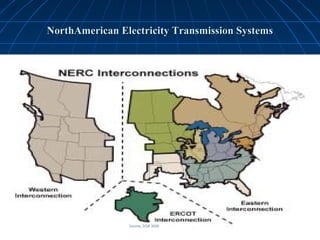
Source, DOE 2002Source, DOE 2002
NorthAmerican Electricity Transmission SystemsNorthAmerican Electricity Transmission Systems
www.dctenergia.com.br
ericsondepaula@dctenergia.com.br
www.dctenergia.com.br
ericsondepaula@dctenergia.com.br
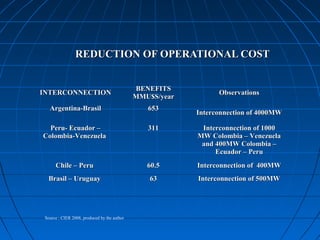
REDUCTION OF OPERATIONAL COSTREDUCTION OF OPERATIONAL COST
INTERCONNECTIONINTERCONNECTION
BENEFITSBENEFITS
MMU$S/yearMMU$S/year
ObservationsObservations
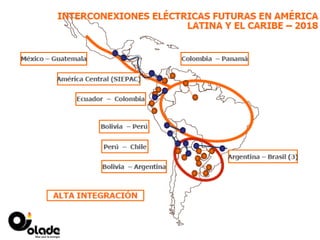
Argentina-BrasilArgentina-Brasil 653653
Interconnection of 4000MWInterconnection of 4000MW
Peru- Ecuador –Peru- Ecuador –
Colombia-VenezuelaColombia-Venezuela
311311 Interconnection of 1000Interconnection of 1000
MW Colombia – VenezuelaMW Colombia – Venezuela
and 400MW Colombia –and 400MW Colombia –
Ecuador – PeruEcuador – Peru
Chile – PeruChile – Peru 60.560.5 Interconnection of 400MWInterconnection of 400MW
Brasil – UruguayBrasil – Uruguay 6363 Interconnection of 500MWInterconnection of 500MW
Source : CIER 2008, produced by the author
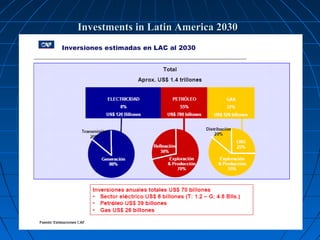
Investments in Latin America 2030Investments in Latin America 2030
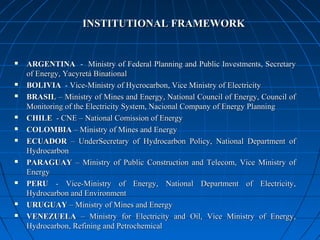
INSTITUTIONAL FRAMEWORKINSTITUTIONAL FRAMEWORK
 ARGENTINAARGENTINA - Ministry of Federal Planning and Public Investments, Secretary- Ministry of Federal Planning and Public Investments, Secretary
of Energy, Yacyretá Binationalof Energy, Yacyretá Binational
 BOLIVIABOLIVIA - Vice-Ministry of Hycrocarbon, Vice Ministry of Electricity- Vice-Ministry of Hycrocarbon, Vice Ministry of Electricity
 BRASILBRASIL – Ministry of Mines and Energy, National Council of Energy, Council of– Ministry of Mines and Energy, National Council of Energy, Council of
Monitoring of the Electricity System, Nacional Company of Energy PlanningMonitoring of the Electricity System, Nacional Company of Energy Planning
 CHILECHILE - CNE – National Comission of Energy- CNE – National Comission of Energy
 COLOMBIACOLOMBIA – Ministry of Mines and Energy– Ministry of Mines and Energy
 ECUADORECUADOR – UnderSecretary of Hydrocarbon Policy, National Department of– UnderSecretary of Hydrocarbon Policy, National Department of
HydrocarbonHydrocarbon
 PARAGUAYPARAGUAY – Ministry of Public Construction and Telecom, Vice Ministry of– Ministry of Public Construction and Telecom, Vice Ministry of
EnergyEnergy
 PERUPERU - Vice-Ministry of Energy, National Department of Electricity,- Vice-Ministry of Energy, National Department of Electricity,
Hydrocarbon and EnvironmentHydrocarbon and Environment
 URUGUAYURUGUAY – Ministry of Mines and Energy– Ministry of Mines and Energy
 VENEZUELAVENEZUELA – Ministry for Electricity and Oil, Vice Ministry of Energy,– Ministry for Electricity and Oil, Vice Ministry of Energy,
Hydrocarbon, Refining and PetrochemicalHydrocarbon, Refining and Petrochemical
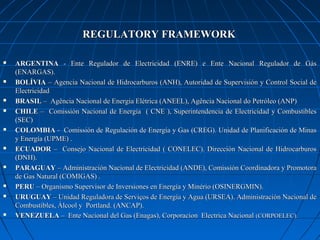
REGULATORY FRAMEWORKREGULATORY FRAMEWORK
 ARGENTINAARGENTINA - Ente Regulador de Electricidad (ENRE) e Ente Nacional Regulador de Gás- Ente Regulador de Electricidad (ENRE) e Ente Nacional Regulador de Gás
(ENARGAS).(ENARGAS).
 BOLÍVIABOLÍVIA – Agencia Nacional de Hidrocarburos (ANH), Autoridad de Supervisión y Control Social de– Agencia Nacional de Hidrocarburos (ANH), Autoridad de Supervisión y Control Social de
ElectricidadElectricidad
 BRASILBRASIL – Agência Nacional de Energia Elétrica (ANEEL), Agência Nacional do Petróleo (ANP)– Agência Nacional de Energia Elétrica (ANEEL), Agência Nacional do Petróleo (ANP)
 CHILECHILE – Comissión Nacional de Energía ( CNE ), Superintendencia de Electricidad y Combustibles– Comissión Nacional de Energía ( CNE ), Superintendencia de Electricidad y Combustibles
(SEC)(SEC)
 COLOMBIACOLOMBIA - Comissión de Regulación de Energía y Gas (CREG). Unidad de Planificación de Minas- Comissión de Regulación de Energía y Gas (CREG). Unidad de Planificación de Minas
y Energía (UPME) .y Energía (UPME) .
 ECUADORECUADOR – Consejo Nacional de Electricidad ( CONELEC). Dirección Nacional de Hidrocarburos– Consejo Nacional de Electricidad ( CONELEC). Dirección Nacional de Hidrocarburos
(DNH).(DNH).
 PARAGUAYPARAGUAY – Administración Nacional de Electricidad (ANDE), Comissión Coordinadora y Promotora– Administración Nacional de Electricidad (ANDE), Comissión Coordinadora y Promotora
de Gas Natural (COMIGAS) .de Gas Natural (COMIGAS) .
 PERUPERU – Organismo Supervisor de Inversiones en Energía y Minério (OSINERGMIN).– Organismo Supervisor de Inversiones en Energía y Minério (OSINERGMIN).
 URUGUAYURUGUAY – Unidad Reguladora de Serviços de Energía y Agua (URSEA). Administración Nacional de– Unidad Reguladora de Serviços de Energía y Agua (URSEA). Administración Nacional de
Combustibles, Álcool y Portland. (ANCAP).Combustibles, Álcool y Portland. (ANCAP).
 VENEZUELAVENEZUELA – Ente Nacional del Gas (Enagas), Corporacion Electrica Nacional– Ente Nacional del Gas (Enagas), Corporacion Electrica Nacional (CORPOELEC).(CORPOELEC).
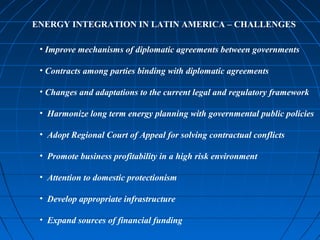
ENERGY INTEGRATION IN LATIN AMERICA – CHALLENGES
• Improve mechanisms of diplomatic agreements between governments
• Contracts among parties binding with diplomatic agreements
• Changes and adaptations to the current legal and regulatory framework
• Harmonize long term energy planning with governmental public policies
• Adopt Regional Court of Appeal for solving contractual conflicts
• Promote business profitability in a high risk environment
• Attention to domestic protectionism
• Develop appropriate infrastructure
• Expand sources of financial funding
ENERGY INTEGRATION IN LATIN AMERICA : BENEFITS
• Eliminate conditions of social and economical isolation of regions
•Provide conditions for new regional initiatives
•Improving the reliability and safety of the operational energy system
•Sharing surplus of electricity and natural gas
•Improving possibilities of energy interchange between countries
•Provide efficient and rational use of energy resources
•Optimize the market with possibilities for supply and demand
ENERGY INTEGRATION IN LATIN AMERICA : PERSPECTIVES
•Stimulus to the regional cooperation and integration
•Commitment with environmental preservation
•Reduction of CO2 emission
•Focusing on sustainable development
•Price volatility because of increasing demand
•High participation of hydrocarbons as primary source
•Incentives to the development of energy efficiency
www.dctenergia.com.br
ericsondepaula@dctenergia.com.br

03-01

  • 1.
    Energy Integration inLatin America : pastEnergy Integration in Latin America : past experiences,experiences, status quostatus quo and perspectivesand perspectives CEALCEAL XXI Assembléia Plenária AnualXXI Assembléia Plenária Anual São Paulo, BrasilSão Paulo, Brasil 14-17 de outubro de 201014-17 de outubro de 2010 Ericson de Paula Energy Research Scholar University of Miami, College of Engineering
  • 3.
    Source, DOE 2002Source,DOE 2002 NorthAmerican Electricity Transmission SystemsNorthAmerican Electricity Transmission Systems
  • 4.
  • 5.
  • 12.
    REDUCTION OF OPERATIONALCOSTREDUCTION OF OPERATIONAL COST INTERCONNECTIONINTERCONNECTION BENEFITSBENEFITS MMU$S/yearMMU$S/year ObservationsObservations Argentina-BrasilArgentina-Brasil 653653 Interconnection of 4000MWInterconnection of 4000MW Peru- Ecuador –Peru- Ecuador – Colombia-VenezuelaColombia-Venezuela 311311 Interconnection of 1000Interconnection of 1000 MW Colombia – VenezuelaMW Colombia – Venezuela and 400MW Colombia –and 400MW Colombia – Ecuador – PeruEcuador – Peru Chile – PeruChile – Peru 60.560.5 Interconnection of 400MWInterconnection of 400MW Brasil – UruguayBrasil – Uruguay 6363 Interconnection of 500MWInterconnection of 500MW Source : CIER 2008, produced by the author
  • 13.
    Investments in LatinAmerica 2030Investments in Latin America 2030
  • 14.
    INSTITUTIONAL FRAMEWORKINSTITUTIONAL FRAMEWORK ARGENTINAARGENTINA - Ministry of Federal Planning and Public Investments, Secretary- Ministry of Federal Planning and Public Investments, Secretary of Energy, Yacyretá Binationalof Energy, Yacyretá Binational  BOLIVIABOLIVIA - Vice-Ministry of Hycrocarbon, Vice Ministry of Electricity- Vice-Ministry of Hycrocarbon, Vice Ministry of Electricity  BRASILBRASIL – Ministry of Mines and Energy, National Council of Energy, Council of– Ministry of Mines and Energy, National Council of Energy, Council of Monitoring of the Electricity System, Nacional Company of Energy PlanningMonitoring of the Electricity System, Nacional Company of Energy Planning  CHILECHILE - CNE – National Comission of Energy- CNE – National Comission of Energy  COLOMBIACOLOMBIA – Ministry of Mines and Energy– Ministry of Mines and Energy  ECUADORECUADOR – UnderSecretary of Hydrocarbon Policy, National Department of– UnderSecretary of Hydrocarbon Policy, National Department of HydrocarbonHydrocarbon  PARAGUAYPARAGUAY – Ministry of Public Construction and Telecom, Vice Ministry of– Ministry of Public Construction and Telecom, Vice Ministry of EnergyEnergy  PERUPERU - Vice-Ministry of Energy, National Department of Electricity,- Vice-Ministry of Energy, National Department of Electricity, Hydrocarbon and EnvironmentHydrocarbon and Environment  URUGUAYURUGUAY – Ministry of Mines and Energy– Ministry of Mines and Energy  VENEZUELAVENEZUELA – Ministry for Electricity and Oil, Vice Ministry of Energy,– Ministry for Electricity and Oil, Vice Ministry of Energy, Hydrocarbon, Refining and PetrochemicalHydrocarbon, Refining and Petrochemical
  • 15.
    REGULATORY FRAMEWORKREGULATORY FRAMEWORK ARGENTINAARGENTINA - Ente Regulador de Electricidad (ENRE) e Ente Nacional Regulador de Gás- Ente Regulador de Electricidad (ENRE) e Ente Nacional Regulador de Gás (ENARGAS).(ENARGAS).  BOLÍVIABOLÍVIA – Agencia Nacional de Hidrocarburos (ANH), Autoridad de Supervisión y Control Social de– Agencia Nacional de Hidrocarburos (ANH), Autoridad de Supervisión y Control Social de ElectricidadElectricidad  BRASILBRASIL – Agência Nacional de Energia Elétrica (ANEEL), Agência Nacional do Petróleo (ANP)– Agência Nacional de Energia Elétrica (ANEEL), Agência Nacional do Petróleo (ANP)  CHILECHILE – Comissión Nacional de Energía ( CNE ), Superintendencia de Electricidad y Combustibles– Comissión Nacional de Energía ( CNE ), Superintendencia de Electricidad y Combustibles (SEC)(SEC)  COLOMBIACOLOMBIA - Comissión de Regulación de Energía y Gas (CREG). Unidad de Planificación de Minas- Comissión de Regulación de Energía y Gas (CREG). Unidad de Planificación de Minas y Energía (UPME) .y Energía (UPME) .  ECUADORECUADOR – Consejo Nacional de Electricidad ( CONELEC). Dirección Nacional de Hidrocarburos– Consejo Nacional de Electricidad ( CONELEC). Dirección Nacional de Hidrocarburos (DNH).(DNH).  PARAGUAYPARAGUAY – Administración Nacional de Electricidad (ANDE), Comissión Coordinadora y Promotora– Administración Nacional de Electricidad (ANDE), Comissión Coordinadora y Promotora de Gas Natural (COMIGAS) .de Gas Natural (COMIGAS) .  PERUPERU – Organismo Supervisor de Inversiones en Energía y Minério (OSINERGMIN).– Organismo Supervisor de Inversiones en Energía y Minério (OSINERGMIN).  URUGUAYURUGUAY – Unidad Reguladora de Serviços de Energía y Agua (URSEA). Administración Nacional de– Unidad Reguladora de Serviços de Energía y Agua (URSEA). Administración Nacional de Combustibles, Álcool y Portland. (ANCAP).Combustibles, Álcool y Portland. (ANCAP).  VENEZUELAVENEZUELA – Ente Nacional del Gas (Enagas), Corporacion Electrica Nacional– Ente Nacional del Gas (Enagas), Corporacion Electrica Nacional (CORPOELEC).(CORPOELEC).
  • 16.
    ENERGY INTEGRATION INLATIN AMERICA – CHALLENGES • Improve mechanisms of diplomatic agreements between governments • Contracts among parties binding with diplomatic agreements • Changes and adaptations to the current legal and regulatory framework • Harmonize long term energy planning with governmental public policies • Adopt Regional Court of Appeal for solving contractual conflicts • Promote business profitability in a high risk environment • Attention to domestic protectionism • Develop appropriate infrastructure • Expand sources of financial funding
  • 17.
    ENERGY INTEGRATION INLATIN AMERICA : BENEFITS • Eliminate conditions of social and economical isolation of regions •Provide conditions for new regional initiatives •Improving the reliability and safety of the operational energy system •Sharing surplus of electricity and natural gas •Improving possibilities of energy interchange between countries •Provide efficient and rational use of energy resources •Optimize the market with possibilities for supply and demand
  • 18.
    ENERGY INTEGRATION INLATIN AMERICA : PERSPECTIVES •Stimulus to the regional cooperation and integration •Commitment with environmental preservation •Reduction of CO2 emission •Focusing on sustainable development •Price volatility because of increasing demand •High participation of hydrocarbons as primary source •Incentives to the development of energy efficiency
  • 19.