Generating Energy through Efficiency   Commonwealth of Virginia   Energy & Sustainability Conference September 18, 2007 Brian T. Castelli Executive Vice President & Chief Operating Officer
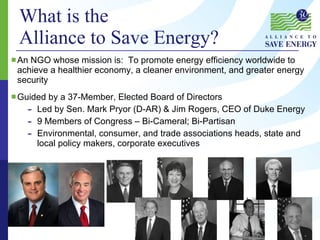
What is the  Alliance to Save Energy?   An NGO whose mission is:  To promote energy efficiency worldwide to achieve a healthier economy, a cleaner environment, and greater energy security Guided by a 37-Member, Elected Board of Directors Led by Sen. Mark Pryor (D-AR) & Jim Rogers, CEO of Duke Energy 9 Members of Congress – Bi-Cameral; Bi-Partisan Environmental, consumer, and trade associations heads, state and local policy makers, corporate executives
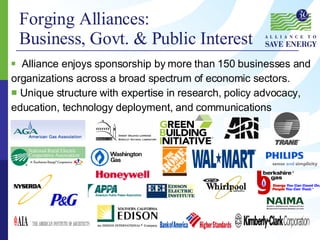
Forging Alliances:  Business, Govt. & Public Interest Alliance enjoys sponsorship by more than 150 businesses and  organizations across a broad spectrum of economic sectors. Unique structure with expertise in research, policy advocacy, education, technology deployment, and communications
What:  The Alliance to Save Energy’s Energy Efficiency Global  Forum & Exposition, better known as “EE Global” When:  April 27-29, 2008 Where:  Palais des Congres de Paris, Paris, France About: EE Global will serve as  the premier gathering and showcase for the energy-efficiency industry,  attracting industry professionals, academics and policy makers from around the world, not only to exchange the latest technical, commercial and policy information, but to forge partnerships and develop “best practices” policies and strategies for global implementation. The conference will feature plenary sessions and in-depth executive dialogue sessions with high-level speakers representing all end-use sectors and regions of the world as well as an exposition hall where attendees can see the latest technological advances in energy efficiency. Web: www.eeglobalforum.org EE Global Forum
Energy Efficiency: an Abundant & Affordable National Resource CHEAPER Each $1 invested in Energy Star program = $75 in energy cost savings and $15 of investment in new efficiency technologies Average cost of utility DSM programs = $0.02 -0.04/kWh QUICKER In 2001, California cut peak electricity use by 10% in less than a year   CLEANER “ Negawatts” produce NO ENVIRONMENTAL FOOTPRINT IMPROVE THE ECONOMY and ENERGY SECURITY Minimize Needs for Imported Energy Create New Jobs Help Keep Energy Prices Lower by Reducing Demand Why Energy Efficiency?
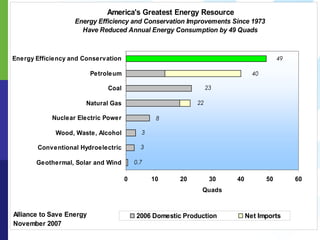
Energy Efficiency: America’s Greatest Resource
America’s Largest Energy Savers to Date* Appliance and Equipment Standards Energy Star Labeling Program Building Energy Codes Electric and Gas Utility Demand-Side  Management (DSM) Programs [Also:] Tax incentives Public sector energy efficiency leadership * Excluding auto efficiency standards
The Action Is in the States 45 Quads savings since 1973 ~ 20% resulting from  intentional  policy 80% from technology advances & market forces So the best policies encourage technology & complement markets Energy efficiency supports many policy objectives Reduce GHG emissions Lower criterion air pollutants (SIPs) Slow demand growth – reduce need to build power plants & transmission lines Reduce energy price increases & price volatility Economic development goals Energy costs for government operations
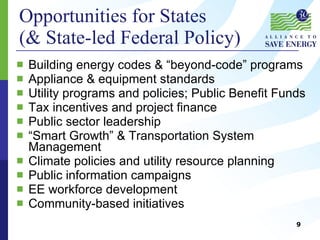
Opportunities for States (& State-led Federal Policy) Building energy codes & “beyond-code” programs Appliance & equipment standards Utility programs and policies; Public Benefit Funds Tax incentives and project finance Public sector leadership “ Smart Growth” & Transportation System Management Climate policies and utility resource planning Public information campaigns EE workforce development Community-based initiatives
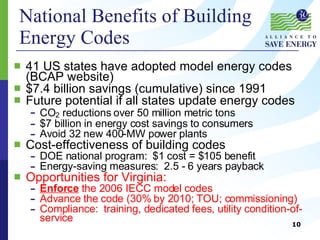
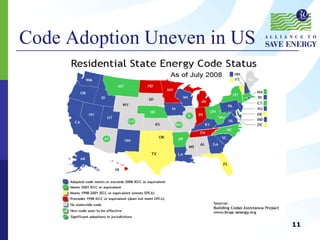
National Benefits of Building Energy Codes 41 US states have adopted model energy codes (BCAP website) $7.4 billion savings (cumulative) since 1991 Future potential if all states update energy codes CO 2  reductions over 50 million metric tons  $7 billion in energy cost savings to consumers Avoid 32 new 400-MW power plants Cost-effectiveness of building codes DOE national program:  $1 cost = $105 benefit Energy-saving measures:  2.5 - 6 years payback Opportunities for Virginia: Enforce  the 2006 IECC model codes Advance the code (30% by 2010; TOU; commissioning) Compliance:  training, dedicated fees, utility condition-of-service
Code Adoption Uneven in US
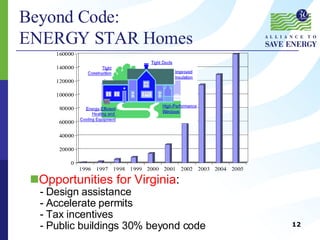
Beyond Code: ENERGY STAR Homes   Opportunities for Virginia : Design assistance Accelerate permits Tax incentives Public buildings 30% beyond code
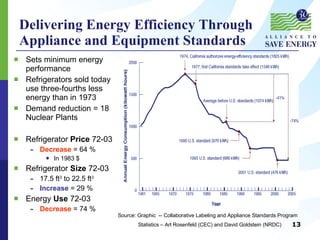
Delivering Energy Efficiency Through Appliance and Equipment Standards Sets minimum energy performance Refrigerators sold today use three-fourths less energy than in 1973 Demand reduction = 18 Nuclear Plants Refrigerator  Price  72-03 Decrease  = 64 % In 1983 $ Refrigerator  Size  72-03 17.5 ft 3  to 22.5 ft 3 Increase  = 29 % Energy  Use  72-03 Decrease  = 74 % Source: Graphic  -- Collaborative Labeling and Appliance Standards Program Statistics – Art Rosenfeld (CEC) and David Goldstein (NRDC)
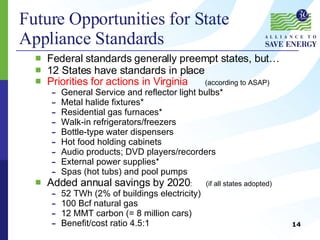
Future Opportunities for State  Appliance Standards Federal standards generally preempt states, but… 12 States have standards in place Priorities for actions in Virginia   (according to ASAP) General Service and reflector light bulbs* Metal halide fixtures* Residential gas furnaces* Walk-in refrigerators/freezers Bottle-type water dispensers Hot food holding cabinets Audio products; DVD players/recorders External power supplies* Spas (hot tubs) and pool pumps Added annual savings by 2020 :  (if all states adopted)   52 TWh (2% of buildings electricity) 100 Bcf natural gas 12 MMT carbon (= 8 million cars) Benefit/cost ratio 4.5:1
Energy Star Voluntary Labeling Program  Environmental Protection Agency (EPA) and Department of Energy (DOE) with private sector partners Labels for energy efficient products: Appliances Lighting Furnaces and Air-Conditioners Computers and electronics Energy Star Homes  Commercial Building Rating High levels of public awareness Actions for Virginia :  information campaigns; incentives; codes & standards (?)
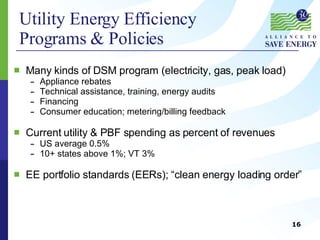
Utility Energy Efficiency Programs & Policies Many kinds of DSM program (electricity, gas, peak load) Appliance rebates Technical assistance, training, energy audits Financing Consumer education; metering/billing feedback Current utility & PBF spending as percent of revenues US average 0.5% 10+ states above 1%; VT 3% EE portfolio standards (EERs); “clean energy loading order”
National Action Plan for  Energy Efficiency Goal One:  Establishing Cost-Effective Energy Efficiency as a High Priority Resource Utilities and applicable state agencies are encouraged to:  Create a process to explore the energy efficiency potential in the state and commit to its full development Regularly identify cost-effective energy efficiency potential in conjunction with state ratemaking bodies. Set energy savings goals consistent with the cost-effective potential Integrate energy efficiency into energy resource plans at the utility, state and regional levels
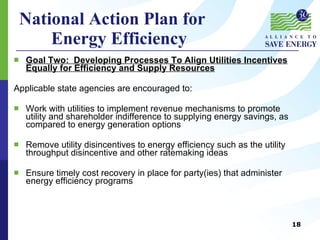
National Action Plan for  Energy Efficiency Goal Two:  Developing Processes To Align Utilities Incentives Equally for Efficiency and Supply Resources Applicable state agencies are encouraged to: Work with utilities to implement revenue mechanisms to promote utility and shareholder indifference to supplying energy savings, as compared to energy generation options Remove utility disincentives to energy efficiency such as the utility throughput disincentive and other ratemaking ideas Ensure timely cost recovery in place for party(ies) that administer energy efficiency programs
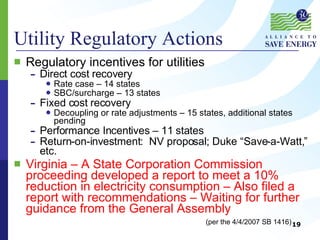
Utility Regulatory Actions Regulatory incentives for utilities Direct cost recovery Rate case – 14 states SBC/surcharge – 13 states Fixed cost recovery  Decoupling or rate adjustments – 15 states, additional states pending Performance Incentives – 11 states Return-on-investment:  NV proposal; Duke “Save-a-Watt,” etc. Virginia – A State Corporation Commission proceeding developed a report to meet a 10% reduction in electricity consumption – Also filed a report with recommendations – Waiting for further guidance from the General Assembly (per the 4/4/2007 SB 1416)
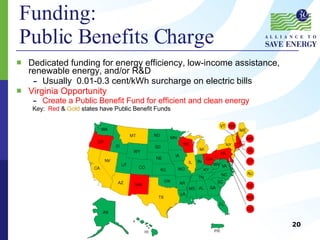
Funding:  Public Benefits Charge Dedicated funding for energy efficiency, low-income assistance, renewable energy, and/or R&D Usually  0.01-0.3 cent/kWh surcharge on electric bills Virginia Opportunity Create a Public Benefit Fund for efficient and clean energy Key:  Red  &  Gold  states have Public Benefit Funds
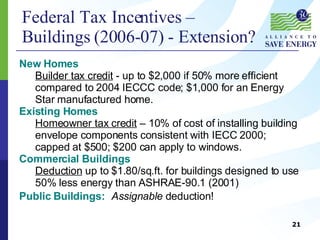
Federal Tax Incentives –  Buildings (2006-07) - Extension? New Homes   Builder tax credit  - up to $2,000 if 50% more efficient compared to 2004 IECCC code; $1,000 for an Energy Star manufactured home. Existing Homes Homeowner tax credit  – 10% of cost of installing building envelope components consistent with IECC 2000; capped at $500; $200 can apply to windows. Commercial Buildings  Deduction  up to $1.80/sq.ft. for buildings designed to use 50% less energy than ASHRAE-90.1 (2001) Public Buildings:   Assignable  deduction!
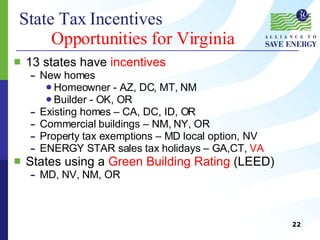
State Tax Incentives Opportunities for Virginia 13 states have  incentives New homes  Homeowner - AZ, DC, MT, NM  Builder - OK, OR Existing homes – CA, DC, ID, OR Commercial buildings – NM, NY, OR Property tax exemptions – MD local option, NV ENERGY STAR sales tax holidays – GA,CT,  VA States using a  Green Building Rating  (LEED) MD, NV, NM, OR
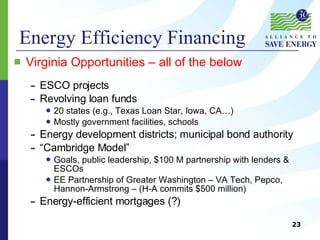
Energy Efficiency Financing Virginia Opportunities – all of the below ESCO projects Revolving loan funds 20 states (e.g., Texas Loan Star, Iowa, CA…) Mostly government facilities, schools Energy development districts; municipal bond authority “ Cambridge Model” Goals, public leadership, $100 M partnership with lenders & ESCOs EE Partnership of Greater Washington – VA Tech, Pepco, Hannon-Armstrong – (H-A commits $500 million) Energy-efficient mortgages (?)
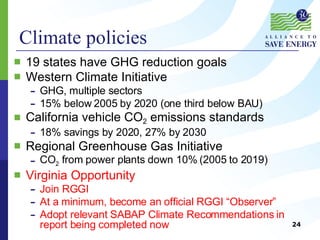
Climate policies 19 states have GHG reduction goals Western Climate Initiative GHG, multiple sectors  15% below 2005 by 2020 (one third below BAU) California vehicle CO 2  emissions standards 18% savings by 2020, 27% by 2030 Regional Greenhouse Gas Initiative  CO 2  from power plants down 10% (2005 to 2019) Virginia Opportunity  Join RGGI At a minimum, become an official RGGI “Observer” Adopt relevant SABAP Climate Recommendations in report being completed now
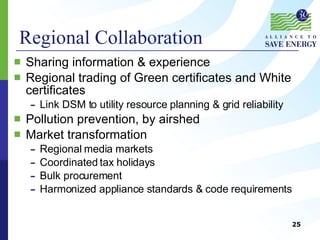
Regional Collaboration Sharing information & experience Regional trading of Green certificates and White certificates Link DSM to utility resource planning & grid reliability Pollution prevention, by airshed Market transformation Regional media markets Coordinated tax holidays Bulk procurement Harmonized appliance standards & code requirements
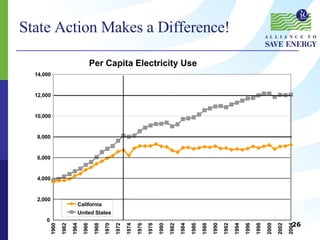
State Action Makes a Difference! Per Capita Electricity Use 0 2,000 4,000 6,000 8,000 10,000 12,000 14,000 1960 1962 1964 1966 1968 1970 1972 1974 1976 1978 1980 1982 1984 1986 1988 1990 1992 1994 1996 1998 2000 2002 2004 California United States
Brian T. Castelli (bcastelli@ase.org) 1850 M Street, NW, Suite 600 Washington, D.C.  20036 Phone:  202.857.0666 Website:  www.ase.org Thank You! Alliance to Save Energy

Generating Energy Through Efficiency

  • 1.
    Generating Energy throughEfficiency Commonwealth of Virginia Energy & Sustainability Conference September 18, 2007 Brian T. Castelli Executive Vice President & Chief Operating Officer
  • 2.
    What is the Alliance to Save Energy? An NGO whose mission is: To promote energy efficiency worldwide to achieve a healthier economy, a cleaner environment, and greater energy security Guided by a 37-Member, Elected Board of Directors Led by Sen. Mark Pryor (D-AR) & Jim Rogers, CEO of Duke Energy 9 Members of Congress – Bi-Cameral; Bi-Partisan Environmental, consumer, and trade associations heads, state and local policy makers, corporate executives
  • 3.
    Forging Alliances: Business, Govt. & Public Interest Alliance enjoys sponsorship by more than 150 businesses and organizations across a broad spectrum of economic sectors. Unique structure with expertise in research, policy advocacy, education, technology deployment, and communications
  • 4.
    What: TheAlliance to Save Energy’s Energy Efficiency Global Forum & Exposition, better known as “EE Global” When: April 27-29, 2008 Where: Palais des Congres de Paris, Paris, France About: EE Global will serve as the premier gathering and showcase for the energy-efficiency industry, attracting industry professionals, academics and policy makers from around the world, not only to exchange the latest technical, commercial and policy information, but to forge partnerships and develop “best practices” policies and strategies for global implementation. The conference will feature plenary sessions and in-depth executive dialogue sessions with high-level speakers representing all end-use sectors and regions of the world as well as an exposition hall where attendees can see the latest technological advances in energy efficiency. Web: www.eeglobalforum.org EE Global Forum
  • 5.
    Energy Efficiency: anAbundant & Affordable National Resource CHEAPER Each $1 invested in Energy Star program = $75 in energy cost savings and $15 of investment in new efficiency technologies Average cost of utility DSM programs = $0.02 -0.04/kWh QUICKER In 2001, California cut peak electricity use by 10% in less than a year CLEANER “ Negawatts” produce NO ENVIRONMENTAL FOOTPRINT IMPROVE THE ECONOMY and ENERGY SECURITY Minimize Needs for Imported Energy Create New Jobs Help Keep Energy Prices Lower by Reducing Demand Why Energy Efficiency?
  • 6.
  • 7.
    America’s Largest EnergySavers to Date* Appliance and Equipment Standards Energy Star Labeling Program Building Energy Codes Electric and Gas Utility Demand-Side Management (DSM) Programs [Also:] Tax incentives Public sector energy efficiency leadership * Excluding auto efficiency standards
  • 8.
    The Action Isin the States 45 Quads savings since 1973 ~ 20% resulting from intentional policy 80% from technology advances & market forces So the best policies encourage technology & complement markets Energy efficiency supports many policy objectives Reduce GHG emissions Lower criterion air pollutants (SIPs) Slow demand growth – reduce need to build power plants & transmission lines Reduce energy price increases & price volatility Economic development goals Energy costs for government operations
  • 9.
    Opportunities for States(& State-led Federal Policy) Building energy codes & “beyond-code” programs Appliance & equipment standards Utility programs and policies; Public Benefit Funds Tax incentives and project finance Public sector leadership “ Smart Growth” & Transportation System Management Climate policies and utility resource planning Public information campaigns EE workforce development Community-based initiatives
  • 10.
    National Benefits ofBuilding Energy Codes 41 US states have adopted model energy codes (BCAP website) $7.4 billion savings (cumulative) since 1991 Future potential if all states update energy codes CO 2 reductions over 50 million metric tons $7 billion in energy cost savings to consumers Avoid 32 new 400-MW power plants Cost-effectiveness of building codes DOE national program: $1 cost = $105 benefit Energy-saving measures: 2.5 - 6 years payback Opportunities for Virginia: Enforce the 2006 IECC model codes Advance the code (30% by 2010; TOU; commissioning) Compliance: training, dedicated fees, utility condition-of-service
  • 11.
  • 12.
    Beyond Code: ENERGYSTAR Homes Opportunities for Virginia : Design assistance Accelerate permits Tax incentives Public buildings 30% beyond code
  • 13.
    Delivering Energy EfficiencyThrough Appliance and Equipment Standards Sets minimum energy performance Refrigerators sold today use three-fourths less energy than in 1973 Demand reduction = 18 Nuclear Plants Refrigerator Price 72-03 Decrease = 64 % In 1983 $ Refrigerator Size 72-03 17.5 ft 3 to 22.5 ft 3 Increase = 29 % Energy Use 72-03 Decrease = 74 % Source: Graphic -- Collaborative Labeling and Appliance Standards Program Statistics – Art Rosenfeld (CEC) and David Goldstein (NRDC)
  • 14.
    Future Opportunities forState Appliance Standards Federal standards generally preempt states, but… 12 States have standards in place Priorities for actions in Virginia (according to ASAP) General Service and reflector light bulbs* Metal halide fixtures* Residential gas furnaces* Walk-in refrigerators/freezers Bottle-type water dispensers Hot food holding cabinets Audio products; DVD players/recorders External power supplies* Spas (hot tubs) and pool pumps Added annual savings by 2020 : (if all states adopted) 52 TWh (2% of buildings electricity) 100 Bcf natural gas 12 MMT carbon (= 8 million cars) Benefit/cost ratio 4.5:1
  • 15.
    Energy Star VoluntaryLabeling Program Environmental Protection Agency (EPA) and Department of Energy (DOE) with private sector partners Labels for energy efficient products: Appliances Lighting Furnaces and Air-Conditioners Computers and electronics Energy Star Homes Commercial Building Rating High levels of public awareness Actions for Virginia : information campaigns; incentives; codes & standards (?)
  • 16.
    Utility Energy EfficiencyPrograms & Policies Many kinds of DSM program (electricity, gas, peak load) Appliance rebates Technical assistance, training, energy audits Financing Consumer education; metering/billing feedback Current utility & PBF spending as percent of revenues US average 0.5% 10+ states above 1%; VT 3% EE portfolio standards (EERs); “clean energy loading order”
  • 17.
    National Action Planfor Energy Efficiency Goal One: Establishing Cost-Effective Energy Efficiency as a High Priority Resource Utilities and applicable state agencies are encouraged to: Create a process to explore the energy efficiency potential in the state and commit to its full development Regularly identify cost-effective energy efficiency potential in conjunction with state ratemaking bodies. Set energy savings goals consistent with the cost-effective potential Integrate energy efficiency into energy resource plans at the utility, state and regional levels
  • 18.
    National Action Planfor Energy Efficiency Goal Two: Developing Processes To Align Utilities Incentives Equally for Efficiency and Supply Resources Applicable state agencies are encouraged to: Work with utilities to implement revenue mechanisms to promote utility and shareholder indifference to supplying energy savings, as compared to energy generation options Remove utility disincentives to energy efficiency such as the utility throughput disincentive and other ratemaking ideas Ensure timely cost recovery in place for party(ies) that administer energy efficiency programs
  • 19.
    Utility Regulatory ActionsRegulatory incentives for utilities Direct cost recovery Rate case – 14 states SBC/surcharge – 13 states Fixed cost recovery Decoupling or rate adjustments – 15 states, additional states pending Performance Incentives – 11 states Return-on-investment: NV proposal; Duke “Save-a-Watt,” etc. Virginia – A State Corporation Commission proceeding developed a report to meet a 10% reduction in electricity consumption – Also filed a report with recommendations – Waiting for further guidance from the General Assembly (per the 4/4/2007 SB 1416)
  • 20.
    Funding: PublicBenefits Charge Dedicated funding for energy efficiency, low-income assistance, renewable energy, and/or R&D Usually 0.01-0.3 cent/kWh surcharge on electric bills Virginia Opportunity Create a Public Benefit Fund for efficient and clean energy Key: Red & Gold states have Public Benefit Funds
  • 21.
    Federal Tax Incentives– Buildings (2006-07) - Extension? New Homes Builder tax credit - up to $2,000 if 50% more efficient compared to 2004 IECCC code; $1,000 for an Energy Star manufactured home. Existing Homes Homeowner tax credit – 10% of cost of installing building envelope components consistent with IECC 2000; capped at $500; $200 can apply to windows. Commercial Buildings Deduction up to $1.80/sq.ft. for buildings designed to use 50% less energy than ASHRAE-90.1 (2001) Public Buildings: Assignable deduction!
  • 22.
    State Tax IncentivesOpportunities for Virginia 13 states have incentives New homes Homeowner - AZ, DC, MT, NM Builder - OK, OR Existing homes – CA, DC, ID, OR Commercial buildings – NM, NY, OR Property tax exemptions – MD local option, NV ENERGY STAR sales tax holidays – GA,CT, VA States using a Green Building Rating (LEED) MD, NV, NM, OR
  • 23.
    Energy Efficiency FinancingVirginia Opportunities – all of the below ESCO projects Revolving loan funds 20 states (e.g., Texas Loan Star, Iowa, CA…) Mostly government facilities, schools Energy development districts; municipal bond authority “ Cambridge Model” Goals, public leadership, $100 M partnership with lenders & ESCOs EE Partnership of Greater Washington – VA Tech, Pepco, Hannon-Armstrong – (H-A commits $500 million) Energy-efficient mortgages (?)
  • 24.
    Climate policies 19states have GHG reduction goals Western Climate Initiative GHG, multiple sectors 15% below 2005 by 2020 (one third below BAU) California vehicle CO 2 emissions standards 18% savings by 2020, 27% by 2030 Regional Greenhouse Gas Initiative CO 2 from power plants down 10% (2005 to 2019) Virginia Opportunity Join RGGI At a minimum, become an official RGGI “Observer” Adopt relevant SABAP Climate Recommendations in report being completed now
  • 25.
    Regional Collaboration Sharinginformation & experience Regional trading of Green certificates and White certificates Link DSM to utility resource planning & grid reliability Pollution prevention, by airshed Market transformation Regional media markets Coordinated tax holidays Bulk procurement Harmonized appliance standards & code requirements
  • 26.
    State Action Makesa Difference! Per Capita Electricity Use 0 2,000 4,000 6,000 8,000 10,000 12,000 14,000 1960 1962 1964 1966 1968 1970 1972 1974 1976 1978 1980 1982 1984 1986 1988 1990 1992 1994 1996 1998 2000 2002 2004 California United States
  • 27.
    Brian T. Castelli(bcastelli@ase.org) 1850 M Street, NW, Suite 600 Washington, D.C. 20036 Phone: 202.857.0666 Website: www.ase.org Thank You! Alliance to Save Energy