Laboratory Equipment Care and Maintenance
By Shivam Agarwal
The care and maintenance of laboratory equipment are an integral part of quality
assurance in the lab.
It’s advisable to
• Carry out a daily wipe down of all equipment exteriors
• Carry out a weekly deep clean of all equipment
• Carry out a regular deep clean of microscopes using a 70:30 mixture of ether and alcohol – this
ensures that they are sufficiently clean to yield most accurate results.
• Consult the manual or lab manager on any specific processes for cleaning demanding equipment.
• Consider outsourcing cleaning of challenging items to a qualified professional.
Various procedures and routines will ensure that your laboratory equipment is well-maintained and
cared for, this includes;
1. General Care Tips for Lab Equipment
2. Standard Operating Procedure for Maintenance of Lab Equipment.
3. Equipment Maintenance Documentation
4. Preventive Maintenance Program
5. Training Laboratory Staff on Equipment Maintenance
General Care Tips for Lab Equipment
1. Cleaning
• The equipment is always cleaned before and after each use.
• Cleaning reagents and cleaning aids used are specific for laboratory equipment care.
• In addition to cleaning lab equipment before and after each use, a schedule is required for more in-
depth cleaning. This might involve dissembling certain machines to clean hard-to-reach parts.
• Always follow instructions from the manufacturer on cleaning policy.
• Certain parts of the equipment might require very specific solvents, cleaning materials, or drying
procedures.
2. Calibration
Calibration involves comparing the measurements of equipment against the standard unit of
measure, for the purpose of verifying its accuracy and making necessary adjustments. Regular
calibration of laboratory equipment should be done because over time, biases develop in relation to
the standard unit of measure.
3. Repairs and Refurbishments
• Lab equipment is generally costly and repairs and refurbishment prolong the lifespan of equipment,
saving the lab the expense of new purchases.
• The following are points to consider;
• Repair and/or refurbish faulty or worn-out lab equipment without any delay. Faulty machines may stop
working suddenly in the middle of an experiment leading to losses and they can also be a source of
safety concerns.
• Minor repairs can be done by a dedicated staff, while major repairs should be directed to specialists
with knowledge of the specific machine or equipment.
• Refurbish old equipment to give them a new lease of life by cleaning thoroughly, polishing where
necessary, lubricating movable parts, and replacing small worn out bits.
Standard Operating Procedure for Maintenance of Lab Equipment.
Standard operating procedures (SOPs) are a must for all complex lab equipment. This ensures that the
correct use and maintenance of the equipment are integrated into routine work.
A proper SOP should contain the following;
• The title and description of the content/scope of the SOP.
• Definitions of all abbreviations used.
• An outline of the personnel responsible for the equipment or involved in its use, including their
qualifications and training requirements.
• Detailed instructions for the use of equipment, containing the do’s and don’ts of operating them.
• A description of quality control and maintenance.
• Instructions on waste management, where applicable.
• Reference documents, such as manuals used to prepare SOP and manufacturer’s websites, should be
outlined for use when further information is required.
Equipment Maintenance Documentation
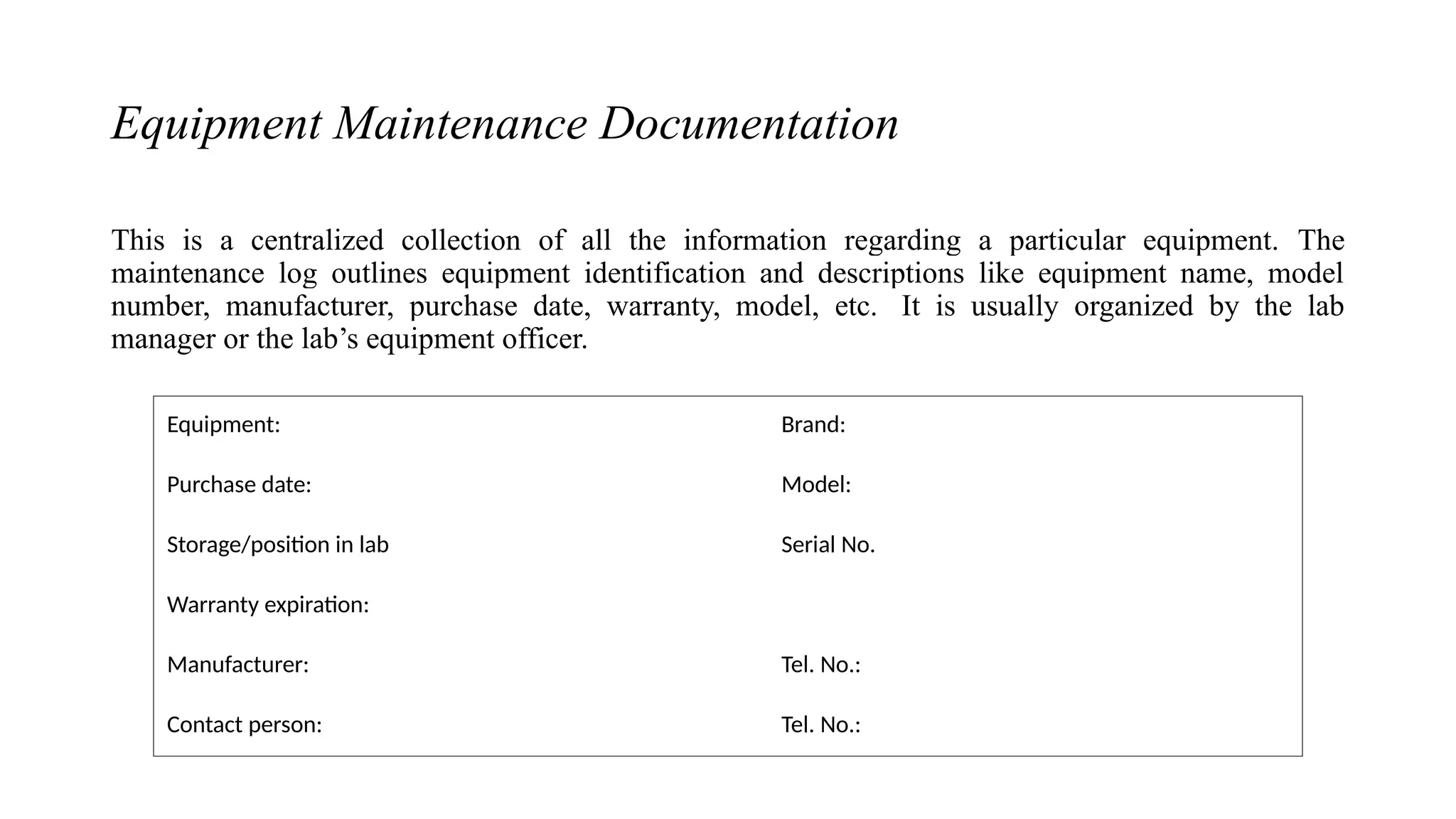
This is a centralized collection of all the information regarding a particular equipment. The
maintenance log outlines equipment identification and descriptions like equipment name, model
number, manufacturer, purchase date, warranty, model, etc. It is usually organized by the lab
manager or the lab’s equipment officer.
Equipment: Brand:
Purchase date: Model:
Storage/position in lab Serial No.
Warranty expiration:
Manufacturer: Tel. No.:
Contact person: Tel. No.:
Preventive Maintenance Program
A preventive maintenance program ensures that the equipment is functioning with minimal
interruptions and within the manufacturer’s specifications. It maximizes the equipment operational
efficiency and reduces overall costs.
A preventive maintenance file should detail;
• Error alerts on the equipment and subsequent action to be taken.
• Basic troubleshooting when the equipment malfunctions.
• Logs for error reports and failure events.
• The servicing and calibration done on the equipment and the dates for subsequent calibrations.
• Stickers should be used for equipment labelling to summarize the preventive maintenance actions
undertaken, the date, and the personnel involved.
Training Laboratory Staff on Equipment Maintenance
Training of both technical and managerial staff is not a one-time activity. It should be regular with
additional courses given when new equipment or improved models are bought. The lab manager or
lab quality control officer are responsible for ensuring all staff are well trained.
For proper staff training on equipment care and maintenance;
• Provide all necessary documentation including SOPs, maintenance logs, service manuals etc.
• Ensure that the staff have, along with the theoretical presentation, practical on-the-job training on
the use and maintenance of lab equipment.
• Train all staff on preventive maintenance, where they learn the general care of equipment like
lubrication and checking for possible damage.
• At the end of the training, a scoring system should be availed to evaluate the effectiveness of the
training.

Laboratory Equipment Care and Maintenance.pptx

  • 1.
    Laboratory Equipment Careand Maintenance By Shivam Agarwal
  • 2.
    The care andmaintenance of laboratory equipment are an integral part of quality assurance in the lab.
  • 3.
    It’s advisable to •Carry out a daily wipe down of all equipment exteriors • Carry out a weekly deep clean of all equipment • Carry out a regular deep clean of microscopes using a 70:30 mixture of ether and alcohol – this ensures that they are sufficiently clean to yield most accurate results. • Consult the manual or lab manager on any specific processes for cleaning demanding equipment. • Consider outsourcing cleaning of challenging items to a qualified professional.
  • 4.
    Various procedures androutines will ensure that your laboratory equipment is well-maintained and cared for, this includes; 1. General Care Tips for Lab Equipment 2. Standard Operating Procedure for Maintenance of Lab Equipment. 3. Equipment Maintenance Documentation 4. Preventive Maintenance Program 5. Training Laboratory Staff on Equipment Maintenance
  • 5.
    General Care Tipsfor Lab Equipment 1. Cleaning • The equipment is always cleaned before and after each use. • Cleaning reagents and cleaning aids used are specific for laboratory equipment care. • In addition to cleaning lab equipment before and after each use, a schedule is required for more in- depth cleaning. This might involve dissembling certain machines to clean hard-to-reach parts. • Always follow instructions from the manufacturer on cleaning policy. • Certain parts of the equipment might require very specific solvents, cleaning materials, or drying procedures.
  • 6.
    2. Calibration Calibration involvescomparing the measurements of equipment against the standard unit of measure, for the purpose of verifying its accuracy and making necessary adjustments. Regular calibration of laboratory equipment should be done because over time, biases develop in relation to the standard unit of measure.
  • 7.
    3. Repairs andRefurbishments • Lab equipment is generally costly and repairs and refurbishment prolong the lifespan of equipment, saving the lab the expense of new purchases. • The following are points to consider; • Repair and/or refurbish faulty or worn-out lab equipment without any delay. Faulty machines may stop working suddenly in the middle of an experiment leading to losses and they can also be a source of safety concerns. • Minor repairs can be done by a dedicated staff, while major repairs should be directed to specialists with knowledge of the specific machine or equipment. • Refurbish old equipment to give them a new lease of life by cleaning thoroughly, polishing where necessary, lubricating movable parts, and replacing small worn out bits.
  • 8.
    Standard Operating Procedurefor Maintenance of Lab Equipment. Standard operating procedures (SOPs) are a must for all complex lab equipment. This ensures that the correct use and maintenance of the equipment are integrated into routine work. A proper SOP should contain the following; • The title and description of the content/scope of the SOP. • Definitions of all abbreviations used. • An outline of the personnel responsible for the equipment or involved in its use, including their qualifications and training requirements. • Detailed instructions for the use of equipment, containing the do’s and don’ts of operating them. • A description of quality control and maintenance. • Instructions on waste management, where applicable. • Reference documents, such as manuals used to prepare SOP and manufacturer’s websites, should be outlined for use when further information is required.
  • 9.
    Equipment Maintenance Documentation Thisis a centralized collection of all the information regarding a particular equipment. The maintenance log outlines equipment identification and descriptions like equipment name, model number, manufacturer, purchase date, warranty, model, etc. It is usually organized by the lab manager or the lab’s equipment officer. Equipment: Brand: Purchase date: Model: Storage/position in lab Serial No. Warranty expiration: Manufacturer: Tel. No.: Contact person: Tel. No.:
  • 10.
    Preventive Maintenance Program Apreventive maintenance program ensures that the equipment is functioning with minimal interruptions and within the manufacturer’s specifications. It maximizes the equipment operational efficiency and reduces overall costs. A preventive maintenance file should detail; • Error alerts on the equipment and subsequent action to be taken. • Basic troubleshooting when the equipment malfunctions. • Logs for error reports and failure events. • The servicing and calibration done on the equipment and the dates for subsequent calibrations. • Stickers should be used for equipment labelling to summarize the preventive maintenance actions undertaken, the date, and the personnel involved.
  • 11.
    Training Laboratory Staffon Equipment Maintenance Training of both technical and managerial staff is not a one-time activity. It should be regular with additional courses given when new equipment or improved models are bought. The lab manager or lab quality control officer are responsible for ensuring all staff are well trained. For proper staff training on equipment care and maintenance; • Provide all necessary documentation including SOPs, maintenance logs, service manuals etc. • Ensure that the staff have, along with the theoretical presentation, practical on-the-job training on the use and maintenance of lab equipment. • Train all staff on preventive maintenance, where they learn the general care of equipment like lubrication and checking for possible damage. • At the end of the training, a scoring system should be availed to evaluate the effectiveness of the training.