Contact: Daveson700@gmail.com
Lab Exercise 12.1
Station 1
1. What can you say about its evolutionary relationships? That is, what kind of creature is
it? Be as detailed as possible, and classify it to as low a level as you can. Explain how
you can tell. (Be sure to first explain how you determined whether or not it is a primate.)
This is a primate. It belongs to the family adapoids who were ancestors of the
strepsirhines. This is most likely the Adapis from Europe. This deduction is based on
the relatively large brain size, the structure of the skull which has its eye orbits forward
facing and the presence of a shortened snout. In looking also at the jaw its canines are
the largest than the other teeth which is a common feature for the primates. The
scapula and humerus bones as shown is also more arboreally adapted.
What about the teeth? Does the dentition fit into one of the main functional classes you
learned about in Chapter 11 (folivore, frugivore, insectivore, carnivore)? Explain how
you know.
Insectivore- this is because it has small sharp pointy cusps that are used up to break
hard insect exoskeleton.
2. Was it an adult? (Hint: Look at tooth eruption and epiphyseal bone ends—refer to
Chapter 7 if needed.) Explain how you can tell.
The primate could have been aged between 16 and 20 years this is as aresult of
examination of the fusion of the epiphyseal plate at the humerus
3. Pretend you have found two such creatures of the same type, and the other is much larger
than this one, and has larger canine teeth. What might that tell you, and what is the
significance?
The larger canine may explain that due to increased growth of enamel and ridges that
the skull belongs to an older animal than the other one.
4. By looking at any postcranial bones present, can you make any inferences about the
locomotion of this species? (It may be helpful to refer to Chapter 11, Table 11.1.) Explain
your answer.
The humeral head is rounded and globular whereas the scapular is expanded at the
suprascapular area and its shorter and broader making it more mobile – arboreal.
Station 2: Paleoenvironment (Alternative to Specimens: Figures A through C) these faunal
remains were found with the specimen at Station 1. Interpret what you can about the
paleoenvironment based upon these remains and explain below. What are some types of
environments that may be eliminated from consideration?
The paleoenvironment explain in great how the animals lived. The specimens provided due to
the features of their teeth it can be seen that some were some were feeding on vegetation while
some were not. The major habitat to eliminate is living in a water source but it can be
estimated that they were also at proximity to a water source.
Station 3: Taphonomy (Alternative to Specimens: Figures A through C)
From the specimen(s) or photo(s) your instructor has selected, what hints can you uncover about
taphonomic processes—what happened to each of these animal(s) from death until the time you
found it/them—based on completeness and condition? Explain your answer.
In evaluating the taphonomy process it’s seen that the fossil remains are cracked and split
they indicate that the remains were weathered on land before burial. Some have marks on
them that indicate they were game animal and most probably were hunted as well.
Lab exercise 14.1
Station 1: Early Stone Tools (Alternative to Specimens: Figures A and B)
1. What would make you think these Oldowan tools (Figure A) are tools and not just rocks?
By looking at the tools it indicates that tools were used to butcher large mammals for
meat, and break into long bones in order to access the bone marrow.
2. In what specific ways do Oldowan tools differ from Acheulean tools? It may be helpful
to draw them as part of your answer.
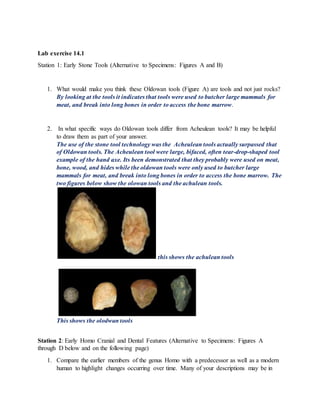
The use of the stone tool technology was the Acheulean tools actually surpassed that
of Oldowan tools. The Acheulean tool were large, bifaced, often tear-drop-shaped tool
example of the hand axe. Its been demonstrated that they probably were used on meat,
bone, wood, and hides while the oldowan tools were only used to butcher large
mammals for meat, and break into long bones in order to access the bone marrow. The
two figures below show the olowan tools and the achulean tools.
this shows the achulean tools
This shows the olodwan tools
Station 2: Early Homo Cranial and Dental Features (Alternative to Specimens: Figures A
through D below and on the following page)
1. Compare the earlier members of the genus Homo with a predecessor as well as a modern
human to highlight changes occurring over time. Many of your descriptions may be in
relative terms (larger, smaller, etc.). Use actual specimens when possible; all features
may not be visible from photos
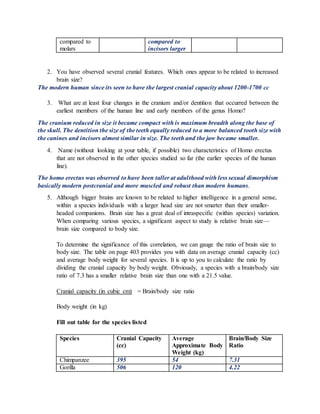
A. africanus
(or A.
afarensis)
H. habilis/
rudolfensis
H. erectus/
ergaster
Modern
Human
Size of
braincase
Small Larger than
A.africanus
was an aevareg
of 650 cc
Large with a
cranial
capacity of 850
– 1100 cc
Largest cranial
capacity about
1200-1700 cc
Cranial shape
(is skull
longer front-
to-back, or is
it higher?)
Less round More rounded
that
A.africanus
Long low skull Higher and
shorter skull
from front to
back
Location of
maximum
skull breadth
Inferior – more
pronounced on
the lower
Reduced Maximum
breadth near
base of the
skull
Maximum
breadth high o
parietals
Sagittal keel?
(thickening—
not crest—
along top of
skull)
Present Present There is
thickening
along the top
of the skull
Reduced
Shape of
occipital and
nuchal region
(nuchal
torus/thick
ridge?)
Thick ridge
present
Nuchal torus
present
Sharp nuchal
torus with set
high occipital
More angular
Amount of
postorbital
constriction
Higher post
orbital
constriction
Less postorbital
constriction
Less post
orbital
constriction
Reduced
Supraorbital
ridge size
Little Medium Larger supra
orbital torus
than the
H.habilis
Small
supraorbital
ridge
Amount of
prognathism
Average Reduced Little or none None
Shape of
dental arcade
Anterior with
presence of
chin
Smaller
thinner
mandible
Vertical or
receding
mandibular
symphysis with
no chin
Smaller teeth
and mandible
Size of
incisors
Larger
Incisors than
molars
Pre molars and
molars are
smaller
Molars appear
larger
Almost
relatively same
size
compared to
molars
compared to
incisors larger
2. You have observed several cranial features. Which ones appear to be related to increased
brain size?
The modern human since its seen to have the largest cranial capacity about 1200-1700 cc
3. What are at least four changes in the cranium and/or dentition that occurred between the
earliest members of the human line and early members of the genus Homo?
The cranium reduced in size it became compact with is maximum breadth along the base of
the skull. The dentition the size of the teeth equally reduced to a more balanced tooth size with
the canines and incisors almost similar in size. The teeth and the jaw became smaller.
4. Name (without looking at your table, if possible) two characteristics of Homo erectus
that are not observed in the other species studied so far (the earlier species of the human
line).
The homo erectus was observed to have been taller at adulthood with less sexual dimorphism
basically modern postcranial and more muscled and robust than modern humans.
5. Although bigger brains are known to be related to higher intelligence in a general sense,
within a species individuals with a larger head size are not smarter than their smaller-
headed companions. Brain size has a great deal of intraspecific (within species) variation.
When comparing various species, a significant aspect to study is relative brain size—
brain size compared to body size.
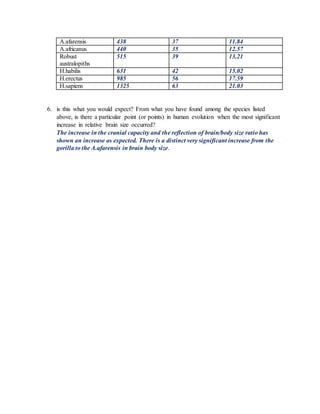
To determine the significance of this correlation, we can gauge the ratio of brain size to
body size. The table on page 403 provides you with data on average cranial capacity (cc)
and average body weight for several species. It is up to you to calculate the ratio by
dividing the cranial capacity by body weight. Obviously, a species with a brain/body size
ratio of 7.3 has a smaller relative brain size than one with a 21.5 value.
Cranial capacity (in cubic cm) = Brain/body size ratio
Body weight (in kg)
Fill out table for the species listed
Species Cranial Capacity
(cc)
Average
Approximate Body
Weight (kg)
Brain/Body Size
Ratio
Chimpanzee 395 54 7.31
Gorilla 506 120 4.22
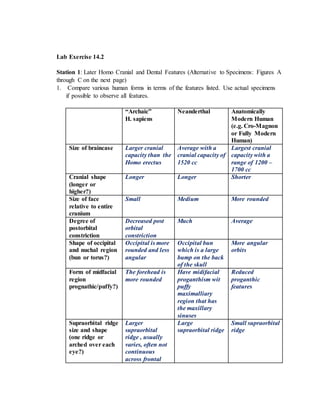
A.afarensis 438 37 11.84
A.africanus 440 35 12.57
Robust
australopiths
515 39 13.21
H.habilis 631 42 15.02
H.erectus 985 56 17.59
H.sapiens 1325 63 21.03
6. is this what you would expect? From what you have found among the species listed
above, is there a particular point (or points) in human evolution when the most significant
increase in relative brain size occurred?
The increase in the cranial capacity and the reflection of brain/body size ratio has
shown an increase as expected. There is a distinct very significant increase from the
gorilla to the A.afarensis in brain body size.
Lab Exercise 14.2
Station 1: Later Homo Cranial and Dental Features (Alternative to Specimens: Figures A
through C on the next page)
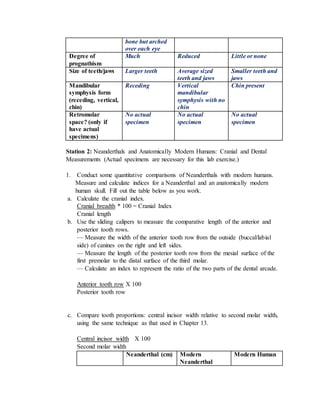
1. Compare various human forms in terms of the features listed. Use actual specimens
if possible to observe all features.
“Archaic”
H. sapiens
Neanderthal Anatomically
Modern Human
(e.g. Cro-Magnon
or Fully Modern
Human)
Size of braincase Larger cranial
capacity than the
Homo erectus
Average with a
cranial capacity of
1520 cc
Largest cranial
capacity with a
range of 1200 –
1700 cc
Cranial shape
(longer or
higher?)
Longer Longer Shorter
Size of face
relative to entire
cranium
Small Medium More rounded
Degree of
postorbital
constriction
Decreased post
orbital
constriction
Much Average
Shape of occipital
and nuchal region
(bun or torus?)
Occipital is more
rounded and less
angular
Occipital bun
which is a large
bump on the back
of the skull
More angular
orbits
Form of midfacial
region
prognathic/puffy?)
The forehead is
more rounded
Have midifacial
proganthism wit
puffy
maximalliary
region that has
the maxillary
sinuses
Reduced
proganthic
features
Supraorbital ridge
size and shape
(one ridge or
arched over each
eye?)
Larger
supraorbital
ridge , usually
varies, often not
continuous
across frontal
Large
supraorbital ridge
Small supraorbital
ridge
bone but arched
over each eye
Degree of
prognathism
Much Reduced Little or none
Size of teeth/jaws Larger teeth Average sized
teeth and jaws
Smaller teeth and
jaws
Mandibular
symphysis form
(receding, vertical,
chin)
Receding Vertical
mandibular
symphysis with no
chin
Chin present
Retromolar
space? (only if
have actual
specimens)
No actual
specimen
No actual
specimen
No actual
specimen
Station 2: Neanderthals and Anatomically Modern Humans: Cranial and Dental
Measurements (Actual specimens are necessary for this lab exercise.)
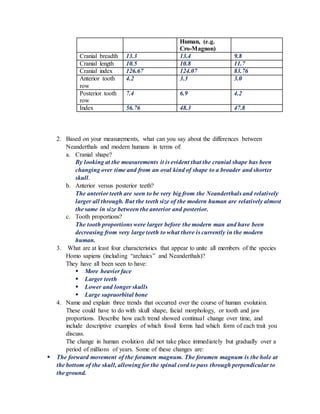
1. Conduct some quantitative comparisons of Neanderthals with modern humans.
Measure and calculate indices for a Neanderthal and an anatomically modern
human skull. Fill out the table below as you work.
a. Calculate the cranial index.
Cranial breadth * 100 = Cranial Index
Cranial length
b. Use the sliding calipers to measure the comparative length of the anterior and
posterior tooth rows.
— Measure the width of the anterior tooth row from the outside (buccal/labial
side) of canines on the right and left sides.
— Measure the length of the posterior tooth row from the mesial surface of the
first premolar to the distal surface of the third molar.
— Calculate an index to represent the ratio of the two parts of the dental arcade.
Anterior tooth row X 100
Posterior tooth row
c. Compare tooth proportions: central incisor width relative to second molar width,
using the same technique as that used in Chapter 13.
Central incisor width X 100
Second molar width
Neanderthal (cm) Modern
Neanderthal
Modern Human
Human, (e.g.
Cro-Magnon)
Cranial breadth 13.3 13.4 9.8
Cranial length 10.5 10.8 11.7
Cranial index 126.67 124.07 83.76
Anterior tooth
row
4.2 3.3 3.0
Posterior tooth
row
7.4 6.9 4.2
Index 56.76 48.3 47.8
2. Based on your measurements, what can you say about the differences between
Neanderthals and modern humans in terms of:
a. Cranial shape?
By looking at the measurements it is evident that the cranial shape has been
changing over time and from an oval kind of shape to a broader and shorter
skull.
b. Anterior versus posterior teeth?
The anterior teeth are seen to be very big from the Neanderthals and relatively
larger all through. But the teeth size of the modern human are relatively almost
the same in size between the anterior and posterior.
c. Tooth proportions?
The tooth proportions were larger before the modern man and have been
decreasing from very large teeth to what there is currently in the modern
human.
3. What are at least four characteristics that appear to unite all members of the species
Homo sapiens (including “archaics” and Neanderthals)?
They have all been seen to have:
 More heavier face
 Larger teeth
 Lower and longer skulls
 Large supraorbital bone
4. Name and explain three trends that occurred over the course of human evolution.
These could have to do with skull shape, facial morphology, or tooth and jaw
proportions. Describe how each trend showed continual change over time, and
include descriptive examples of which fossil forms had which form of each trait you
discuss.
The change in human evolution did not take place immediately but gradually over a
period of millions of years. Some of these changes are:
 The forward movement of the foramen magnum. The foramen magnum is the hole at
the bottom of the skull, allowing for the spinal cord to pass through perpendicular to
the ground.
 There has been a change in the shape of the jaw and the size of the teeth. Over the time
disappearance of the diastema which is the gap between the incisors and canines and
equally a reduction in the size of the canines and an increase in the size of the molars
 The brain case has reduced and has had increase in cranial capacity with significantly
reduced in prognathism which is the jutting forward of the bottom part of the face.

Lab exercise 12.1, 14.1 ,14.2 anthropology

  • 1.
    Contact: Daveson700@gmail.com Lab Exercise12.1 Station 1 1. What can you say about its evolutionary relationships? That is, what kind of creature is it? Be as detailed as possible, and classify it to as low a level as you can. Explain how you can tell. (Be sure to first explain how you determined whether or not it is a primate.) This is a primate. It belongs to the family adapoids who were ancestors of the strepsirhines. This is most likely the Adapis from Europe. This deduction is based on the relatively large brain size, the structure of the skull which has its eye orbits forward facing and the presence of a shortened snout. In looking also at the jaw its canines are the largest than the other teeth which is a common feature for the primates. The scapula and humerus bones as shown is also more arboreally adapted. What about the teeth? Does the dentition fit into one of the main functional classes you learned about in Chapter 11 (folivore, frugivore, insectivore, carnivore)? Explain how you know. Insectivore- this is because it has small sharp pointy cusps that are used up to break hard insect exoskeleton. 2. Was it an adult? (Hint: Look at tooth eruption and epiphyseal bone ends—refer to Chapter 7 if needed.) Explain how you can tell. The primate could have been aged between 16 and 20 years this is as aresult of examination of the fusion of the epiphyseal plate at the humerus 3. Pretend you have found two such creatures of the same type, and the other is much larger than this one, and has larger canine teeth. What might that tell you, and what is the significance? The larger canine may explain that due to increased growth of enamel and ridges that the skull belongs to an older animal than the other one. 4. By looking at any postcranial bones present, can you make any inferences about the locomotion of this species? (It may be helpful to refer to Chapter 11, Table 11.1.) Explain your answer. The humeral head is rounded and globular whereas the scapular is expanded at the suprascapular area and its shorter and broader making it more mobile – arboreal. Station 2: Paleoenvironment (Alternative to Specimens: Figures A through C) these faunal remains were found with the specimen at Station 1. Interpret what you can about the paleoenvironment based upon these remains and explain below. What are some types of environments that may be eliminated from consideration?
  • 2.
    The paleoenvironment explainin great how the animals lived. The specimens provided due to the features of their teeth it can be seen that some were some were feeding on vegetation while some were not. The major habitat to eliminate is living in a water source but it can be estimated that they were also at proximity to a water source. Station 3: Taphonomy (Alternative to Specimens: Figures A through C) From the specimen(s) or photo(s) your instructor has selected, what hints can you uncover about taphonomic processes—what happened to each of these animal(s) from death until the time you found it/them—based on completeness and condition? Explain your answer. In evaluating the taphonomy process it’s seen that the fossil remains are cracked and split they indicate that the remains were weathered on land before burial. Some have marks on them that indicate they were game animal and most probably were hunted as well.
  • 3.
    Lab exercise 14.1 Station1: Early Stone Tools (Alternative to Specimens: Figures A and B) 1. What would make you think these Oldowan tools (Figure A) are tools and not just rocks? By looking at the tools it indicates that tools were used to butcher large mammals for meat, and break into long bones in order to access the bone marrow. 2. In what specific ways do Oldowan tools differ from Acheulean tools? It may be helpful to draw them as part of your answer. The use of the stone tool technology was the Acheulean tools actually surpassed that of Oldowan tools. The Acheulean tool were large, bifaced, often tear-drop-shaped tool example of the hand axe. Its been demonstrated that they probably were used on meat, bone, wood, and hides while the oldowan tools were only used to butcher large mammals for meat, and break into long bones in order to access the bone marrow. The two figures below show the olowan tools and the achulean tools. this shows the achulean tools This shows the olodwan tools Station 2: Early Homo Cranial and Dental Features (Alternative to Specimens: Figures A through D below and on the following page) 1. Compare the earlier members of the genus Homo with a predecessor as well as a modern human to highlight changes occurring over time. Many of your descriptions may be in
  • 4.
    relative terms (larger,smaller, etc.). Use actual specimens when possible; all features may not be visible from photos A. africanus (or A. afarensis) H. habilis/ rudolfensis H. erectus/ ergaster Modern Human Size of braincase Small Larger than A.africanus was an aevareg of 650 cc Large with a cranial capacity of 850 – 1100 cc Largest cranial capacity about 1200-1700 cc Cranial shape (is skull longer front- to-back, or is it higher?) Less round More rounded that A.africanus Long low skull Higher and shorter skull from front to back Location of maximum skull breadth Inferior – more pronounced on the lower Reduced Maximum breadth near base of the skull Maximum breadth high o parietals Sagittal keel? (thickening— not crest— along top of skull) Present Present There is thickening along the top of the skull Reduced Shape of occipital and nuchal region (nuchal torus/thick ridge?) Thick ridge present Nuchal torus present Sharp nuchal torus with set high occipital More angular Amount of postorbital constriction Higher post orbital constriction Less postorbital constriction Less post orbital constriction Reduced Supraorbital ridge size Little Medium Larger supra orbital torus than the H.habilis Small supraorbital ridge Amount of prognathism Average Reduced Little or none None Shape of dental arcade Anterior with presence of chin Smaller thinner mandible Vertical or receding mandibular symphysis with no chin Smaller teeth and mandible Size of incisors Larger Incisors than molars Pre molars and molars are smaller Molars appear larger Almost relatively same size
  • 5.
    compared to molars compared to incisorslarger 2. You have observed several cranial features. Which ones appear to be related to increased brain size? The modern human since its seen to have the largest cranial capacity about 1200-1700 cc 3. What are at least four changes in the cranium and/or dentition that occurred between the earliest members of the human line and early members of the genus Homo? The cranium reduced in size it became compact with is maximum breadth along the base of the skull. The dentition the size of the teeth equally reduced to a more balanced tooth size with the canines and incisors almost similar in size. The teeth and the jaw became smaller. 4. Name (without looking at your table, if possible) two characteristics of Homo erectus that are not observed in the other species studied so far (the earlier species of the human line). The homo erectus was observed to have been taller at adulthood with less sexual dimorphism basically modern postcranial and more muscled and robust than modern humans. 5. Although bigger brains are known to be related to higher intelligence in a general sense, within a species individuals with a larger head size are not smarter than their smaller- headed companions. Brain size has a great deal of intraspecific (within species) variation. When comparing various species, a significant aspect to study is relative brain size— brain size compared to body size. To determine the significance of this correlation, we can gauge the ratio of brain size to body size. The table on page 403 provides you with data on average cranial capacity (cc) and average body weight for several species. It is up to you to calculate the ratio by dividing the cranial capacity by body weight. Obviously, a species with a brain/body size ratio of 7.3 has a smaller relative brain size than one with a 21.5 value. Cranial capacity (in cubic cm) = Brain/body size ratio Body weight (in kg) Fill out table for the species listed Species Cranial Capacity (cc) Average Approximate Body Weight (kg) Brain/Body Size Ratio Chimpanzee 395 54 7.31 Gorilla 506 120 4.22
  • 6.
    A.afarensis 438 3711.84 A.africanus 440 35 12.57 Robust australopiths 515 39 13.21 H.habilis 631 42 15.02 H.erectus 985 56 17.59 H.sapiens 1325 63 21.03 6. is this what you would expect? From what you have found among the species listed above, is there a particular point (or points) in human evolution when the most significant increase in relative brain size occurred? The increase in the cranial capacity and the reflection of brain/body size ratio has shown an increase as expected. There is a distinct very significant increase from the gorilla to the A.afarensis in brain body size.
  • 7.
    Lab Exercise 14.2 Station1: Later Homo Cranial and Dental Features (Alternative to Specimens: Figures A through C on the next page) 1. Compare various human forms in terms of the features listed. Use actual specimens if possible to observe all features. “Archaic” H. sapiens Neanderthal Anatomically Modern Human (e.g. Cro-Magnon or Fully Modern Human) Size of braincase Larger cranial capacity than the Homo erectus Average with a cranial capacity of 1520 cc Largest cranial capacity with a range of 1200 – 1700 cc Cranial shape (longer or higher?) Longer Longer Shorter Size of face relative to entire cranium Small Medium More rounded Degree of postorbital constriction Decreased post orbital constriction Much Average Shape of occipital and nuchal region (bun or torus?) Occipital is more rounded and less angular Occipital bun which is a large bump on the back of the skull More angular orbits Form of midfacial region prognathic/puffy?) The forehead is more rounded Have midifacial proganthism wit puffy maximalliary region that has the maxillary sinuses Reduced proganthic features Supraorbital ridge size and shape (one ridge or arched over each eye?) Larger supraorbital ridge , usually varies, often not continuous across frontal Large supraorbital ridge Small supraorbital ridge
  • 8.
    bone but arched overeach eye Degree of prognathism Much Reduced Little or none Size of teeth/jaws Larger teeth Average sized teeth and jaws Smaller teeth and jaws Mandibular symphysis form (receding, vertical, chin) Receding Vertical mandibular symphysis with no chin Chin present Retromolar space? (only if have actual specimens) No actual specimen No actual specimen No actual specimen Station 2: Neanderthals and Anatomically Modern Humans: Cranial and Dental Measurements (Actual specimens are necessary for this lab exercise.) 1. Conduct some quantitative comparisons of Neanderthals with modern humans. Measure and calculate indices for a Neanderthal and an anatomically modern human skull. Fill out the table below as you work. a. Calculate the cranial index. Cranial breadth * 100 = Cranial Index Cranial length b. Use the sliding calipers to measure the comparative length of the anterior and posterior tooth rows. — Measure the width of the anterior tooth row from the outside (buccal/labial side) of canines on the right and left sides. — Measure the length of the posterior tooth row from the mesial surface of the first premolar to the distal surface of the third molar. — Calculate an index to represent the ratio of the two parts of the dental arcade. Anterior tooth row X 100 Posterior tooth row c. Compare tooth proportions: central incisor width relative to second molar width, using the same technique as that used in Chapter 13. Central incisor width X 100 Second molar width Neanderthal (cm) Modern Neanderthal Modern Human
  • 9.
    Human, (e.g. Cro-Magnon) Cranial breadth13.3 13.4 9.8 Cranial length 10.5 10.8 11.7 Cranial index 126.67 124.07 83.76 Anterior tooth row 4.2 3.3 3.0 Posterior tooth row 7.4 6.9 4.2 Index 56.76 48.3 47.8 2. Based on your measurements, what can you say about the differences between Neanderthals and modern humans in terms of: a. Cranial shape? By looking at the measurements it is evident that the cranial shape has been changing over time and from an oval kind of shape to a broader and shorter skull. b. Anterior versus posterior teeth? The anterior teeth are seen to be very big from the Neanderthals and relatively larger all through. But the teeth size of the modern human are relatively almost the same in size between the anterior and posterior. c. Tooth proportions? The tooth proportions were larger before the modern man and have been decreasing from very large teeth to what there is currently in the modern human. 3. What are at least four characteristics that appear to unite all members of the species Homo sapiens (including “archaics” and Neanderthals)? They have all been seen to have:  More heavier face  Larger teeth  Lower and longer skulls  Large supraorbital bone 4. Name and explain three trends that occurred over the course of human evolution. These could have to do with skull shape, facial morphology, or tooth and jaw proportions. Describe how each trend showed continual change over time, and include descriptive examples of which fossil forms had which form of each trait you discuss. The change in human evolution did not take place immediately but gradually over a period of millions of years. Some of these changes are:  The forward movement of the foramen magnum. The foramen magnum is the hole at the bottom of the skull, allowing for the spinal cord to pass through perpendicular to the ground.
  • 10.
     There hasbeen a change in the shape of the jaw and the size of the teeth. Over the time disappearance of the diastema which is the gap between the incisors and canines and equally a reduction in the size of the canines and an increase in the size of the molars  The brain case has reduced and has had increase in cranial capacity with significantly reduced in prognathism which is the jutting forward of the bottom part of the face.