Contact: Daveson700@gmail.com
LAB EXERCISE 12.3
Section 1
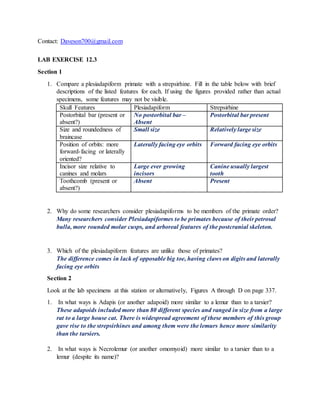
1. Compare a plesiadapiform primate with a strepsirhine. Fill in the table below with brief
descriptions of the listed features for each. If using the figures provided rather than actual
specimens, some features may not be visible.
Skull Features Plesiadapiform Strepsirhine
Postorbital bar (present or
absent?)
No postorbital bar –
Absent
Postorbital bar present
Size and roundedness of
braincase
Small size Relatively large size
Position of orbits: more
forward-facing or laterally
oriented?
Laterally facing eye orbits Forward facing eye orbits
Incisor size relative to
canines and molars
Large ever growing
incisors
Canine usually largest
tooth
Toothcomb (present or
absent?)
Absent Present
2. Why do some researchers consider plesiadapiforms to be members of the primate order?
Many researchers consider Plesiadapiformes to be primates because of their petrosal
bulla, more rounded molar cusps, and arboreal features of the postcranial skeleton.
3. Which of the plesiadapiform features are unlike those of primates?
The difference comes in lack of opposable big toe, having claws on digits and laterally
facing eye orbits
Section 2
Look at the lab specimens at this station or alternatively, Figures A through D on page 337.
1. In what ways is Adapis (or another adapoid) more similar to a lemur than to a tarsier?
These adapoids included more than 80 different species and ranged in size from a large
rat to a large house cat. There is widespread agreement of these members of this group
gave rise to the strepsirhines and among them were the lemurs hence more similarity
than the tarsiers.
2. In what ways is Necrolemur (or another omomyoid) more similar to a tarsier than to a
lemur (despite its name)?
It is similar in appearance to the modern tarsier, and the omomyoids are even more
numerous than the adapoids, with more than 90 species. They equally have a smaller
body size when compared together than a lemur.
3. Considering the relative size of orbits of the tarsier, what can we tell about activity
patterns (diurnal versus nocturnal) from fossilized remains?
The tarsier species are seen to be nocturnal. They possess a short-snouted, round head,
ranging between and middle-sized to very large, skinny, mobile ears. Their eyes sockets
have been seen to be very huge.
4. Adapoids are thought to be ancestral to what modern forms?
They are said to be ancestors of strepsirhines
5. Omomyoids may be ancestral to what modern group?
They are said to be possible ancestors of haplorhines
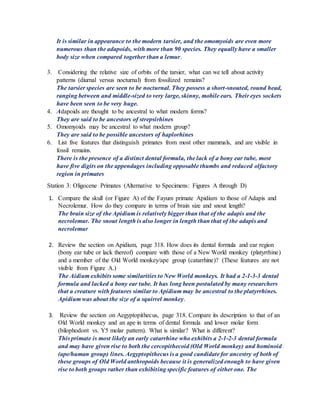
6. List five features that distinguish primates from most other mammals, and are visible in
fossil remains.
There is the presence of a distinct dental formula, the lack of a bony ear tube, most
have five digits on the appendages including opposable thumbs and reduced olfactory
region in primates
Station 3: Oligocene Primates (Alternative to Specimens: Figures A through D)
1. Compare the skull (or Figure A) of the Fayum primate Apidium to those of Adapis and
Necrolemur. How do they compare in terms of brain size and snout length?
The brain size of the Apidium is relatively bigger than that of the adapis and the
necrolemur. The snout length is also longer in length than that of the adapis and
necrolemur
2. Review the section on Apidium, page 318. How does its dental formula and ear region
(bony ear tube or lack thereof) compare with those of a New World monkey (platyrrhine)
and a member of the Old World monkey/ape group (catarrhine)? (These features are not
visible from Figure A.)
The Aidium exhibits some similarities to New World monkeys. It had a 2-1-3-3 dental
formula and lacked a bony ear tube. It has long been postulated by many researchers
that a creature with features similar to Apidium may be ancestral to the platyrrhines.
Apidium was about the size of a squirrel monkey.
3. Review the section on Aegyptopithecus, page 318. Compare its description to that of an
Old World monkey and an ape in terms of dental formula and lower molar form
(bilophodont vs. Y5 molar pattern). What is similar? What is different?
This primate is most likely an early catarrhine who exhibits a 2-1-2-3 dental formula
and may have given rise to both the cercopithecoid (Old World monkey) and hominoid
(ape/human group) lines. Aegyptopithecus is a good candidate for ancestry of both of
these groups of Old World anthropoids because it is generalized enough to have given
rise to both groups rather than exhibiting specific features of either one. The
Aegyptopithecus teeth are similar to those of hominoids and are the first in the fossil
record to exhibit the Y5 molar cusp pattern in the lower dentition. The tooth pattern of
the Old World monkey (bilophodonty) first appears after the hominoid Y5 molar
pattern, which then continued in modern apes and humans
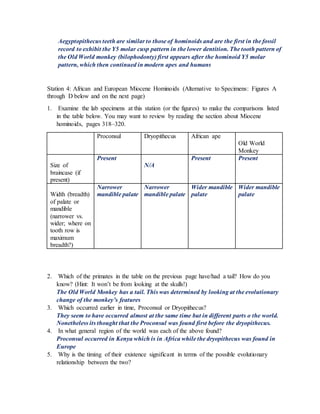
Station 4: African and European Miocene Hominoids (Alternative to Specimens: Figures A
through D below and on the next page)
1. Examine the lab specimens at this station (or the figures) to make the comparisons listed
in the table below. You may want to review by reading the section about Miocene
hominoids, pages 318–320.
Proconsul Dryopithecus African ape
Old World
Monkey
Size of
braincase (if
present)
Present
N/A
Present Present
Width (breadth)
of palate or
mandible
(narrower vs.
wider; where on
tooth row is
maximum
breadth?)
Narrower
mandible palate
Narrower
mandible palate
Wider mandible
palate
Wider mandible
palate
2. Which of the primates in the table on the previous page have/had a tail? How do you
know? (Hint: It won’t be from looking at the skulls!)
The Old World Monkey has a tail. This was determined by looking at the evolutionary
change of the monkey’s features
3. Which occurred earlier in time, Proconsul or Dryopithecus?
They seem to have occurred almost at the same time but in different parts o the world.
Nonetheless its thought that the Proconsul was found first before the dryopithecus.
4. In what general region of the world was each of the above found?
Proconsul occurred in Kenya which is in Africa while the dryopithecus was found in
Europe
5. Why is the timing of their existence significant in terms of the possible evolutionary
relationship between the two?
The timing seems to significant because has been it has been proposed by various
researchers that these species are possibly the ancestor of African apes and humans.
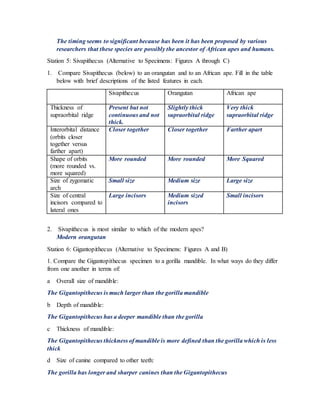
Station 5: Sivapithecus (Alternative to Specimens: Figures A through C)
1. Compare Sivapithecus (below) to an orangutan and to an African ape. Fill in the table
below with brief descriptions of the listed features in each.
Sivapithecus Orangutan African ape
Thickness of
supraorbital ridge
Present but not
continuous and not
thick.
Slightly thick
supraorbital ridge
Very thick
supraorbital ridge
Interorbital distance
(orbits closer
together versus
farther apart)
Closer together Closer together Farther apart
Shape of orbits
(more rounded vs.
more squared)
More rounded More rounded More Squared
Size of zygomatic
arch
Small size Medium size Large size
Size of central
incisors compared to
lateral ones
Large incisors Medium sized
incisors
Small incisors
2. Sivapithecus is most similar to which of the modern apes?
Modern orangutan
Station 6: Gigantopithecus (Alternative to Specimens: Figures A and B)
1. Compare the Gigantopithecus specimen to a gorilla mandible. In what ways do they differ
from one another in terms of:
a Overall size of mandible:
The Gigantopithecus is much larger than the gorilla mandible
b Depth of mandible:
The Gigantopithecus has a deeper mandible than the gorilla
c Thickness of mandible:
The Gigantopithecus thickness of mandible is more defined than the gorilla which is less
thick
d Size of canine compared to other teeth:
The gorilla has longer and sharper canines than the Gigantopithecus
e Size of molar teeth:
The Gigantopithecus has wider molar teeth than the gorilla
3. In which general region of the world was Gigantopithecus found?
Gigantopithecus was found in the Indian and Pakistan region

Lab exercise 12.3 anthropology

  • 1.
    Contact: Daveson700@gmail.com LAB EXERCISE12.3 Section 1 1. Compare a plesiadapiform primate with a strepsirhine. Fill in the table below with brief descriptions of the listed features for each. If using the figures provided rather than actual specimens, some features may not be visible. Skull Features Plesiadapiform Strepsirhine Postorbital bar (present or absent?) No postorbital bar – Absent Postorbital bar present Size and roundedness of braincase Small size Relatively large size Position of orbits: more forward-facing or laterally oriented? Laterally facing eye orbits Forward facing eye orbits Incisor size relative to canines and molars Large ever growing incisors Canine usually largest tooth Toothcomb (present or absent?) Absent Present 2. Why do some researchers consider plesiadapiforms to be members of the primate order? Many researchers consider Plesiadapiformes to be primates because of their petrosal bulla, more rounded molar cusps, and arboreal features of the postcranial skeleton. 3. Which of the plesiadapiform features are unlike those of primates? The difference comes in lack of opposable big toe, having claws on digits and laterally facing eye orbits Section 2 Look at the lab specimens at this station or alternatively, Figures A through D on page 337. 1. In what ways is Adapis (or another adapoid) more similar to a lemur than to a tarsier? These adapoids included more than 80 different species and ranged in size from a large rat to a large house cat. There is widespread agreement of these members of this group gave rise to the strepsirhines and among them were the lemurs hence more similarity than the tarsiers. 2. In what ways is Necrolemur (or another omomyoid) more similar to a tarsier than to a lemur (despite its name)?
  • 2.
    It is similarin appearance to the modern tarsier, and the omomyoids are even more numerous than the adapoids, with more than 90 species. They equally have a smaller body size when compared together than a lemur. 3. Considering the relative size of orbits of the tarsier, what can we tell about activity patterns (diurnal versus nocturnal) from fossilized remains? The tarsier species are seen to be nocturnal. They possess a short-snouted, round head, ranging between and middle-sized to very large, skinny, mobile ears. Their eyes sockets have been seen to be very huge. 4. Adapoids are thought to be ancestral to what modern forms? They are said to be ancestors of strepsirhines 5. Omomyoids may be ancestral to what modern group? They are said to be possible ancestors of haplorhines 6. List five features that distinguish primates from most other mammals, and are visible in fossil remains. There is the presence of a distinct dental formula, the lack of a bony ear tube, most have five digits on the appendages including opposable thumbs and reduced olfactory region in primates Station 3: Oligocene Primates (Alternative to Specimens: Figures A through D) 1. Compare the skull (or Figure A) of the Fayum primate Apidium to those of Adapis and Necrolemur. How do they compare in terms of brain size and snout length? The brain size of the Apidium is relatively bigger than that of the adapis and the necrolemur. The snout length is also longer in length than that of the adapis and necrolemur 2. Review the section on Apidium, page 318. How does its dental formula and ear region (bony ear tube or lack thereof) compare with those of a New World monkey (platyrrhine) and a member of the Old World monkey/ape group (catarrhine)? (These features are not visible from Figure A.) The Aidium exhibits some similarities to New World monkeys. It had a 2-1-3-3 dental formula and lacked a bony ear tube. It has long been postulated by many researchers that a creature with features similar to Apidium may be ancestral to the platyrrhines. Apidium was about the size of a squirrel monkey. 3. Review the section on Aegyptopithecus, page 318. Compare its description to that of an Old World monkey and an ape in terms of dental formula and lower molar form (bilophodont vs. Y5 molar pattern). What is similar? What is different? This primate is most likely an early catarrhine who exhibits a 2-1-2-3 dental formula and may have given rise to both the cercopithecoid (Old World monkey) and hominoid (ape/human group) lines. Aegyptopithecus is a good candidate for ancestry of both of these groups of Old World anthropoids because it is generalized enough to have given rise to both groups rather than exhibiting specific features of either one. The
  • 3.
    Aegyptopithecus teeth aresimilar to those of hominoids and are the first in the fossil record to exhibit the Y5 molar cusp pattern in the lower dentition. The tooth pattern of the Old World monkey (bilophodonty) first appears after the hominoid Y5 molar pattern, which then continued in modern apes and humans Station 4: African and European Miocene Hominoids (Alternative to Specimens: Figures A through D below and on the next page) 1. Examine the lab specimens at this station (or the figures) to make the comparisons listed in the table below. You may want to review by reading the section about Miocene hominoids, pages 318–320. Proconsul Dryopithecus African ape Old World Monkey Size of braincase (if present) Present N/A Present Present Width (breadth) of palate or mandible (narrower vs. wider; where on tooth row is maximum breadth?) Narrower mandible palate Narrower mandible palate Wider mandible palate Wider mandible palate 2. Which of the primates in the table on the previous page have/had a tail? How do you know? (Hint: It won’t be from looking at the skulls!) The Old World Monkey has a tail. This was determined by looking at the evolutionary change of the monkey’s features 3. Which occurred earlier in time, Proconsul or Dryopithecus? They seem to have occurred almost at the same time but in different parts o the world. Nonetheless its thought that the Proconsul was found first before the dryopithecus. 4. In what general region of the world was each of the above found? Proconsul occurred in Kenya which is in Africa while the dryopithecus was found in Europe 5. Why is the timing of their existence significant in terms of the possible evolutionary relationship between the two?
  • 4.
    The timing seemsto significant because has been it has been proposed by various researchers that these species are possibly the ancestor of African apes and humans. Station 5: Sivapithecus (Alternative to Specimens: Figures A through C) 1. Compare Sivapithecus (below) to an orangutan and to an African ape. Fill in the table below with brief descriptions of the listed features in each. Sivapithecus Orangutan African ape Thickness of supraorbital ridge Present but not continuous and not thick. Slightly thick supraorbital ridge Very thick supraorbital ridge Interorbital distance (orbits closer together versus farther apart) Closer together Closer together Farther apart Shape of orbits (more rounded vs. more squared) More rounded More rounded More Squared Size of zygomatic arch Small size Medium size Large size Size of central incisors compared to lateral ones Large incisors Medium sized incisors Small incisors 2. Sivapithecus is most similar to which of the modern apes? Modern orangutan Station 6: Gigantopithecus (Alternative to Specimens: Figures A and B) 1. Compare the Gigantopithecus specimen to a gorilla mandible. In what ways do they differ from one another in terms of: a Overall size of mandible: The Gigantopithecus is much larger than the gorilla mandible b Depth of mandible: The Gigantopithecus has a deeper mandible than the gorilla c Thickness of mandible: The Gigantopithecus thickness of mandible is more defined than the gorilla which is less thick d Size of canine compared to other teeth: The gorilla has longer and sharper canines than the Gigantopithecus
  • 5.
    e Size ofmolar teeth: The Gigantopithecus has wider molar teeth than the gorilla 3. In which general region of the world was Gigantopithecus found? Gigantopithecus was found in the Indian and Pakistan region