Signal Processing using
Pluto-SDR
Bhavna Singh, 15116012 Lab Based Project
Rohit Raushan, 14116058 B.Tech. 3rd yr, ECE
Under the supervision of : Dr. Meenakshi Rawat
Abstract
● Here we represent the basic idea about the Software Defined Radio (SDR) and
have demonstrated the fundamental digital modulation schemes.
● SDR is a technique which can be used to replace the current hardware.
● Implementation of simple modulation schemes like AM,FM and tested
different modulation circuits to test our Pluto-SDR connectivity with GNU
Radio signals and IIO-Oscilloscope..
Software Used: GNU Radio Companion,
IIO-Oscilloscope.
Presentation Flow:
1) Software Defined Radio
2) Hardware Platform( Pluto-SDR)
3) GNU Radio Companion
4) IIO-Oscilloscope
5) SDR Working Model
A) Transmit Test
B) FFT & Waterfall Sink Test
C) IIO Oscilloscope
6) GRC Implementation
A) Cyclic Sine Wave
B) Amplitude Modulation
C) FM Receiver
7) Conclusion & Reference
Software Defined Radio
● A complete software implementation of hardware processes.
● Hardware like filters, amplifiers, modulators etc are implemented in
embedding devices.
● Hardware complexity is widely reduced.
Software Defined Radio
● Dynamic nature of modifying the system parameters without changing the
hardware part.
● Effective solution to the very high cost and limited flexibility of hardware based
radios.
● Hardware Platforms: Adalm Pluto-SDR, RTL-SDR, FPGA Board.
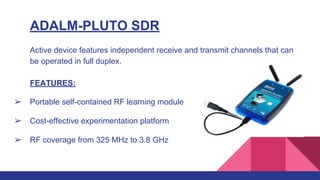
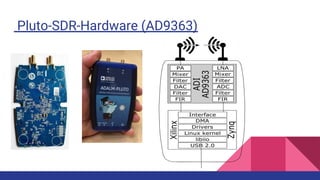
ADALM-PLUTO SDR
Active device features independent receive and transmit channels that can
be operated in full duplex.
FEATURES:
➢ Portable self-contained RF learning module
➢ Cost-effective experimentation platform
➢ RF coverage from 325 MHz to 3.8 GHz
FEATURES:
➢ Flexible rate, 12-bit ADC and DAC
➢ Small sized enough to put in a pocket
➢ GNU Radio sink and source blocks
➢ Up to 20 MHz of instantaneous bandwidth (complex I/Q)
➢ Two antennas (824 MHz to ~894 MHz/ 1710 MHz to ~2170 MHz)
Pluto-SDR-Hardware (AD9363)
GNU Radio Companion
● GNU Radio is a free & open-source software development toolkit.
● Provides signal processing blocks to implement software radios.
● It can be used with readily-available low-cost external RF hardware
to create software-defined radios, or without hardware in a
simulation-like environment.
● It’s a graphical tool for creating signal flow graphs and generating
flow-graph source code.
II0 Oscilloscope
● IIO Oscilloscope is a product from Analog Devices, Inc. that uses libiio to
interface with Linux IIO devices.
● It is a great tool not only for demonstrating capabilities of Analog Devices'
products but also for testing, debugging and fine-tuning an RF system.
SDR Working Model
● In SDR, signal is captured by an antenna which is further converted into
digital samples with regular intervals.
● These digital values are then processed in software.
● The resulting output can be then converted back into audio, video or required
form.
Testing on PlutoSDR
1) Transmit test
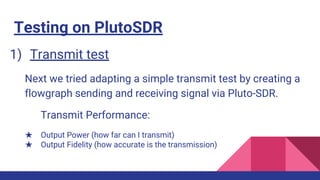
Next we tried adapting a simple transmit test by creating a
flowgraph sending and receiving signal via Pluto-SDR.
Transmit Performance:
★ Output Power (how far can I transmit)
★ Output Fidelity (how accurate is the transmission)
Transmit Test
2) FFT & Waterfall sink
● We tested a simple FFT and Waterfall sink using the Pluto SDR source.
● We set the sample rate to the maximum of 61.44 MSPS, and the RF
bandwidth to 60M. we were able to see the 900 MHz GSM band.
● It seemed the max sample rate is not used as the output is only 30 MHz, or
perhaps it’s only one ADC.
FFT & Waterfall Sink
IIO-OSCILLOSCOPE
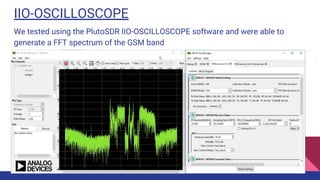
We tested using the PlutoSDR IIO-OSCILLOSCOPE software and were able to
generate a FFT spectrum of the GSM band
Cyclic Sine Wave
Block Diagram Constellation Plot
Cyclic Sine Wave Output Plots:
FFT PLOT Waterfall Plot
Amplitude modulation
The modulation of a wave by varying its amplitude, used especially as a means of
broadcasting an audio signal by combining it with a radio carrier wave.
Amplitude Modulation Plots:
FM Receiver Plot with GRC Block Diagram
CONCLUSION
● We have implemented simple modulation schemes and tested different
modulation circuits to test our Pluto-SDR connectivity with GNU Radio signals
and IIO-Oscilloscope.
● This concept of SDR using GNU Radio helps us to learn the concepts
practically.
● Our work is to get familiar with GRC open source software tool. The basic
demonstrations are done using the basic theories of communication
systems.
● One single Universal Software Radio Peripheral (USRP) can implement all the
modulations and multiplexing techniques in real time.
REFERENCE
1. https://www.mouser.in/new/Analog-Devices/adi-adalm-pluto/
2. http://www.csun.edu/~skatz/katzpage/sdr_project/sdr/grc_tutorial.pdf
3. https://www.sciencedirect.com/science/article/pii/S187770581200985X
4. http://oz9aec.net/radios/gnu-radio/grc-examples
5. Analog and Digital Modulation Toolkit for Software Defined Radio-paper
published by R.Gandhiraja , Ranjini Ramb , K.P.Somanb
6. Bard, John and Kovarik, Vincent, “Software Defined Radio: The Software
Communications Architecture,” Wiley Series in Software Radio, 2007
Thank You

Lab based ppt pluto-sdr_final

  • 1.
    Signal Processing using Pluto-SDR BhavnaSingh, 15116012 Lab Based Project Rohit Raushan, 14116058 B.Tech. 3rd yr, ECE Under the supervision of : Dr. Meenakshi Rawat
  • 2.
    Abstract ● Here werepresent the basic idea about the Software Defined Radio (SDR) and have demonstrated the fundamental digital modulation schemes. ● SDR is a technique which can be used to replace the current hardware. ● Implementation of simple modulation schemes like AM,FM and tested different modulation circuits to test our Pluto-SDR connectivity with GNU Radio signals and IIO-Oscilloscope.. Software Used: GNU Radio Companion, IIO-Oscilloscope.
  • 3.
    Presentation Flow: 1) SoftwareDefined Radio 2) Hardware Platform( Pluto-SDR) 3) GNU Radio Companion 4) IIO-Oscilloscope 5) SDR Working Model A) Transmit Test B) FFT & Waterfall Sink Test C) IIO Oscilloscope 6) GRC Implementation A) Cyclic Sine Wave B) Amplitude Modulation C) FM Receiver 7) Conclusion & Reference
  • 4.
    Software Defined Radio ●A complete software implementation of hardware processes. ● Hardware like filters, amplifiers, modulators etc are implemented in embedding devices. ● Hardware complexity is widely reduced.
  • 5.
    Software Defined Radio ●Dynamic nature of modifying the system parameters without changing the hardware part. ● Effective solution to the very high cost and limited flexibility of hardware based radios. ● Hardware Platforms: Adalm Pluto-SDR, RTL-SDR, FPGA Board.
  • 6.
    ADALM-PLUTO SDR Active devicefeatures independent receive and transmit channels that can be operated in full duplex. FEATURES: ➢ Portable self-contained RF learning module ➢ Cost-effective experimentation platform ➢ RF coverage from 325 MHz to 3.8 GHz
  • 7.
    FEATURES: ➢ Flexible rate,12-bit ADC and DAC ➢ Small sized enough to put in a pocket ➢ GNU Radio sink and source blocks ➢ Up to 20 MHz of instantaneous bandwidth (complex I/Q) ➢ Two antennas (824 MHz to ~894 MHz/ 1710 MHz to ~2170 MHz)
  • 8.
  • 9.
    GNU Radio Companion ●GNU Radio is a free & open-source software development toolkit. ● Provides signal processing blocks to implement software radios. ● It can be used with readily-available low-cost external RF hardware to create software-defined radios, or without hardware in a simulation-like environment. ● It’s a graphical tool for creating signal flow graphs and generating flow-graph source code.
  • 10.
    II0 Oscilloscope ● IIOOscilloscope is a product from Analog Devices, Inc. that uses libiio to interface with Linux IIO devices. ● It is a great tool not only for demonstrating capabilities of Analog Devices' products but also for testing, debugging and fine-tuning an RF system.
  • 11.
    SDR Working Model ●In SDR, signal is captured by an antenna which is further converted into digital samples with regular intervals. ● These digital values are then processed in software. ● The resulting output can be then converted back into audio, video or required form.
  • 12.
    Testing on PlutoSDR 1)Transmit test Next we tried adapting a simple transmit test by creating a flowgraph sending and receiving signal via Pluto-SDR. Transmit Performance: ★ Output Power (how far can I transmit) ★ Output Fidelity (how accurate is the transmission)
  • 13.
  • 14.
    2) FFT &Waterfall sink ● We tested a simple FFT and Waterfall sink using the Pluto SDR source. ● We set the sample rate to the maximum of 61.44 MSPS, and the RF bandwidth to 60M. we were able to see the 900 MHz GSM band. ● It seemed the max sample rate is not used as the output is only 30 MHz, or perhaps it’s only one ADC.
  • 15.
  • 16.
    IIO-OSCILLOSCOPE We tested usingthe PlutoSDR IIO-OSCILLOSCOPE software and were able to generate a FFT spectrum of the GSM band
  • 17.
    Cyclic Sine Wave BlockDiagram Constellation Plot
  • 18.
    Cyclic Sine WaveOutput Plots: FFT PLOT Waterfall Plot
  • 19.
    Amplitude modulation The modulationof a wave by varying its amplitude, used especially as a means of broadcasting an audio signal by combining it with a radio carrier wave.
  • 20.
  • 21.
    FM Receiver Plotwith GRC Block Diagram
  • 22.
    CONCLUSION ● We haveimplemented simple modulation schemes and tested different modulation circuits to test our Pluto-SDR connectivity with GNU Radio signals and IIO-Oscilloscope. ● This concept of SDR using GNU Radio helps us to learn the concepts practically. ● Our work is to get familiar with GRC open source software tool. The basic demonstrations are done using the basic theories of communication systems. ● One single Universal Software Radio Peripheral (USRP) can implement all the modulations and multiplexing techniques in real time.
  • 23.
    REFERENCE 1. https://www.mouser.in/new/Analog-Devices/adi-adalm-pluto/ 2. http://www.csun.edu/~skatz/katzpage/sdr_project/sdr/grc_tutorial.pdf 3.https://www.sciencedirect.com/science/article/pii/S187770581200985X 4. http://oz9aec.net/radios/gnu-radio/grc-examples 5. Analog and Digital Modulation Toolkit for Software Defined Radio-paper published by R.Gandhiraja , Ranjini Ramb , K.P.Somanb 6. Bard, John and Kovarik, Vincent, “Software Defined Radio: The Software Communications Architecture,” Wiley Series in Software Radio, 2007
  • 24.