EAU: Equipe Analgésie à lEAU: Equipe Analgésie à l’Urgence’Urgence
Marie Joëlle Doré-Bergeron, MD FRCPC Pédiatrie
Evelyne D Trottier, MD FRCPC Urgence Pédiatrique
Marisol Sanchez, MD FRCPC Urgence Pédiatrique
Presenters disclosures:
Potential for conflict(s) of interest: Not Applicable
Société Canadienne de Pédiatrie
26 juin 2014
Objectives
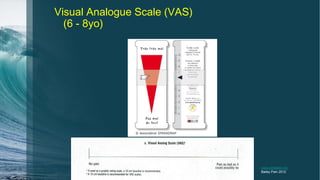
• Use of pharmacological methods for pain control in acute and
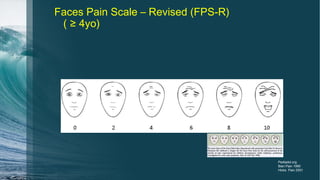
chronic conditions
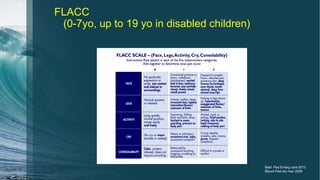
• Use of non-pharmacological methods to reduce pain and anxiety in
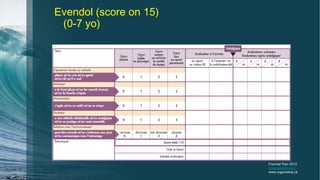
pediatric patients
• Reduce pain related to painful procedures
Pain in Pediatric
• Recommendation of leader association
‘‘Control of pain and stress for children who enter into the
emergency medical system… is a vital component of
emergency care.’’
• Multiples sources of pain and anxiety
•Pathologies (trauma, burn, abdo pain, headache, otitis…)
•Investigations (blood tests, LP, SPA…)
•Procedures (IV, immunisation, cast…)
•Hostile environment
AAP Fein Pediatrics 2012
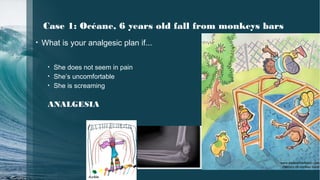
Case 1: Océane, 6 years old fall from monkeys bars
• What is your analgesic plan if...
• She does not seem in pain
• She’s uncomfortable
• She is screaming
ANALGESIA
www.eleanorharbison.com
memory-of-monkey-bars/
Aurélie
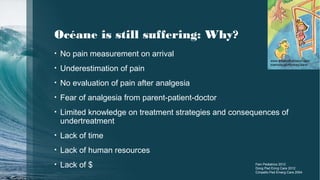
Océane is still suffering: Why?
• No pain measurement on arrival
• Underestimation of pain
• No evaluation of pain after analgesia
• Fear of analgesia from parent-patient-doctor
• Limited knowledge on treatment strategies and consequences of
undertreatment
• Lack of time
• Lack of human resources
• Lack of $ Fein Pediatrics 2012
Dong Ped Emrg Care 2012
Cimpello Ped Emerg Care 2004
www.eleanorharbison.com
memory-of-monkey-bars/
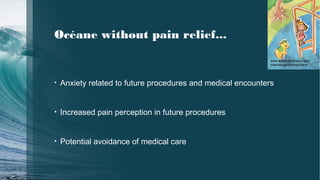
Océane without pain relief...
• Anxiety related to future procedures and medical encounters
• Increased pain perception in future procedures
• Potential avoidance of medical care
www.eleanorharbison.com
memory-of-monkey-bars/
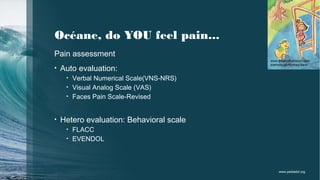
Océane, do YOU feel pain...
Pain assessment
• Auto evaluation:
• Verbal Numerical Scale(VNS-NRS)
• Visual Analog Scale (VAS)
• Faces Pain Scale-Revised
• Hetero evaluation: Behavioral scale
• FLACC
• EVENDOL
www.eleanorharbison.com
memory-of-monkey-bars/
www.pediadol.org
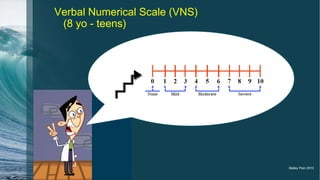
Verbal Numerical Scale (VNS)
(8 yo - teens)
Bailey Pain 2010
Visual Analogue Scale (VAS)
(6 - 8yo)
www.pediadol.org
Bailey Pain 2012
Faces Pain Scale – Revised (FPS-R)
( ≥ 4yo)
Pediadol.org
Bieri Pain 1990
Hicks Pain 2001
FLACC
(0-7yo, up to 19 yo in disabled children)
Babl Ped Emerg care 2012
Blount Ped res man 2009
Evendol (score on 15)
(0-7 yo)
Fournier Pain 2012
www.pediadol.org
www.urgencehsj.ca
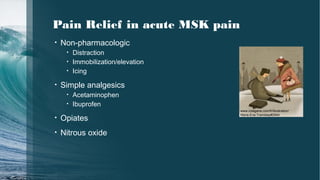
Pain Relief in acute MSK pain
• Non-pharmacologic
• Distraction
• Immobilization/elevation
• Icing
• Simple analgesics
• Acetaminophen
• Ibuprofen
• Opiates
• Nitrous oxide
www.colagene.com/fr/illustration/
Marie-Eve-Tremblay#2944
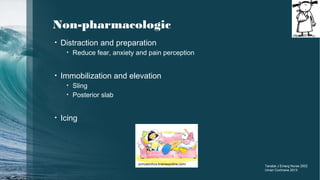
Non-pharmacologic
• Distraction and preparation
• Reduce fear, anxiety and pain perception
• Immobilization and elevation
• Sling
• Posterior slab
• Icing
clipart-2012.
princetonhcs.kramesonline.com/
Tanabe J Emerg Nurse 2002
Uman Cochrane 2013
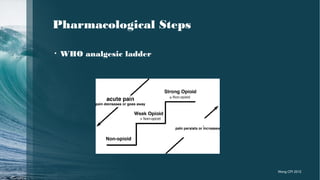
Pharmacological Steps
• WHO analgesic ladder
Wong CPI 2012
Simple Analgesics
• Ibuprofen
• NSAID: inhibits production of Pg (pro inflammatory)
• 10mg/kg (Max 400mg)
• Superior to
• Acetaminophen
• Codeine
• Equivalent to
• Acetaminophen /codeine
• Oxycodone
• No additional relief with codeine
• Acetaminophen
• Co-analgesia
• 15mg/kg (Max 650mg)
Lemay J Emerg Med 2013
Friday Acad Emerg Med 2009
Clark Pediatrics 2007
‘‘Weak’’ Opiate
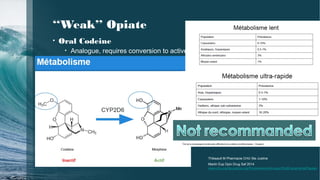
• Oral Codeine
• Analogue, requires conversion to active metabolite
Martin Exp Opin Drug Saf 2014
www.chu-sainte-justine.org/Pro/evenements.aspx?IndEvenementsPasses
Thibeault M Pharmacie CHU Ste Justine
‘‘Weak’’ Opiate
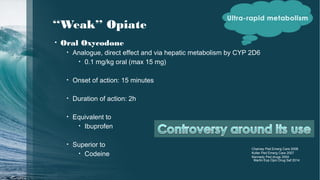
• Oral Oxycodone
• Analogue, direct effect and via hepatic metabolism by CYP 2D6
• 0.1 mg/kg oral (max 15 mg)
• Onset of action: 15 minutes
• Duration of action: 2h
• Equivalent to
• Ibuprofen
• Superior to
• Codeine
Charney Ped Emerg Care 2008
Koller Ped Emerg Care 2007
Kennedy Ped drugs 2004
Martin Exp Opin Drug Saf 2014
‘‘Strong’’ Opiate
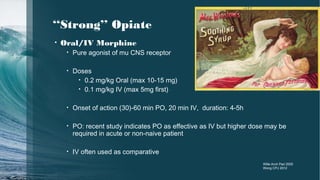
• Oral/IV Morphine
• Pure agonist of mu CNS receptor
• Doses
• 0.2 mg/kg Oral (max 10-15 mg)
• 0.1 mg/kg IV (max 5mg first)
• Onset of action (30)-60 min PO, 20 min IV, duration: 4-5h
• PO: recent study indicates PO as effective as IV but higher dose may be
required in acute or non-naive patient
• IV often used as comparative
Wille Arch Ped 2005
Wong CPJ 2012
www.urgencehsj.ca
‘‘Strong ’’Opiate
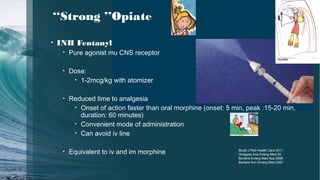
• INH Fentanyl
• Pure agonist mu CNS receptor
• Dose:
• 1-2mcg/kg with atomizer
• Reduced time to analgesia
• Onset of action faster than oral morphine (onset: 5 min, peak :15-20 min,
duration: 60 minutes)
• Convenient mode of administration
• Can avoid iv line
• Equivalent to iv and im morphine Mudd J Ped Health Care 2011
Holdgate Aca Emerg Med 20
Borland Emerg Med Aus 2008
Borland Ann Emerg Med 2007
Aurélie
www.urgencehsj.ca
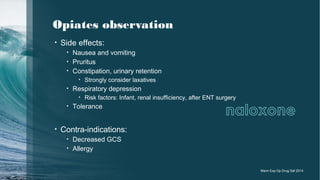
Opiates observation
• Side effects:
• Nausea and vomiting
• Pruritus
• Constipation, urinary retention
• Strongly consider laxatives
• Respiratory depression
• Risk factors: Infant, renal insufficiency, after ENT surgery
• Tolerance
• Contra-indications:
• Decreased GCS
• Allergy
Marin Exp Op Drug Saf 2014
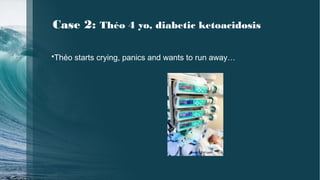
Case 2: Théo 4 yo, diabetic ketoacidosis
•Théo starts crying, panics and wants to run away…
www.123rf.com
• Explain the procedure
• What is going to happen
• What they will be allowed to do
• Be with parent
• Bring toy or teddy bear
• What will be done to help them
Preparation
«  It won’t hurt »
« I’m so sorry »
« It’s almost finished »
Minimizing their pain or anxiety
Sympathizing
Avoid
During procedure
Parent’s role
• Allow parental presence
• Build their confidence
• Contact with the child (visual, physical)
• Distraction
• Their focus should be on the child
• Recommendation of AAP:
• Prepares and supports child and parent
• Follows the child through his journey in hospital
• Helps with distraction during procedure
AAP Pediatrics 2012
AAP Pediatrics 2000
Hall Educational Play Therapy 2010
Cisternino 2005
www.rch.org.au/comfortkid
Childlife Specialist
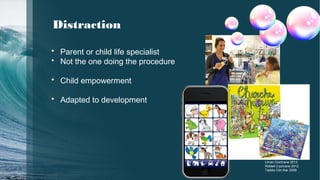
Distraction
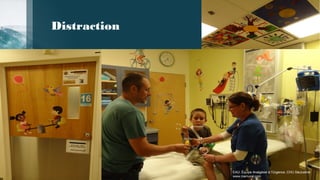
• Parent or child life specialist
• Not the one doing the procedure
• Child empowerment
• Adapted to development
Uman Cochrane 2013
Riddell Cochrane 2012
Taddio Clin ther 2009
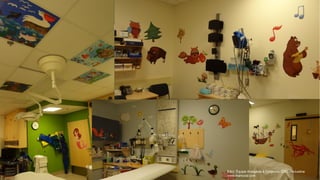
Distraction
EAU: Équipe Analgésie à l’Urgence, CHU SteJustine
www.mamural.com
Distraction
EAU: Équipe Analgésie à l’Urgence, CHU SteJustine
www.mamural.com
EAU: Équipe Analgésie à l’Urgence, CHU SteJustine
www.mamural.com
Advantages for the child
• More comfort
• Reduced anxiety
• Decreased pain perception
• Parent empowerment
Advantages for health care providers
• Reduces child movements (better cooparation)
• Larger work space
• Increases satisfaction
Sparks J Ped Nurse 2007
Wente J Emerg Nurse 2012
Stephens 1999
Van Aken 1989
Proper positioning
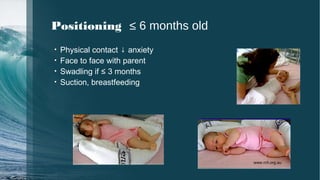
• Physical contact ↓ anxiety
• Face to face with parent
• Swadling if ≤ 3 months
• Suction, breastfeeding
Positioning ≤ 6 months old
www.rch.org.au
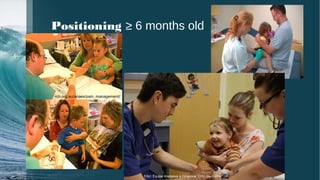
Positioning ≥ 6 months old
rch.org.au/anaes/pain_management/
EAU: Équipe Analgésie à l’Urgence, CHU SteJustine
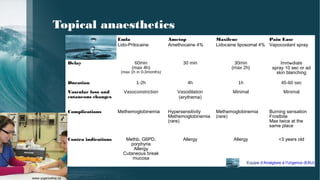
Topical anaesthetics
•Myth:
«Changes in underlying skin color and texture makes veins
harder to find»
•Reality:
• Decreased pain
• Higher first attempt success: 75-86% vs 50-76%
• Shorter procedure time
• Reduced perceived difficulty
• Increased satisfaction (patient, parent, nurse)
•Best if combined with non-pharmacological pain relief
Schreiber Eur J Pediatr 2013
Fein Pediatrics 2012
Kennedy Pediatrics 2008
Zempski Pediatrics 2004
Topical anaesthetics
Emla
Lido-Prilocaine
Ametop
Amethocaine 4%
Maxilene
Lidocaine liposomal 4%
Pain Ease
Vapocoolant spray
Delay 60min
(max 4h)
(max 1h in 0-3months)
30 min 30min
(max 2h)
Immediate
spray 10 sec or ad
skin blanching
Duration 1-2h 4h 1h 45-60 sec
Vascular loss and
cutaneous changes
Vasoconstriction Vasodilation
(erythema)
Minimal Minimal
Complications Methemoglobinemia Hypersensitivity
Methemoglobinemia
(rare)
Methemoglobinemia
(rare)
Burning sensation
Frostbite
Max twice at the
same place
Contra indications Methb, G6PD,
porphyria
Allergy
Cutaneous break
mucosa
Allergy Allergy <3 years old
Equipe d’Analgésie à l’Urgence (EAU)
www.urgencehsj.ca
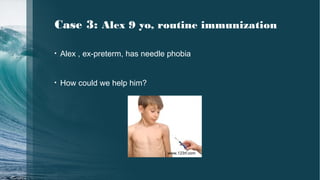
Case 3: Alex 9 yo, routine immunization
• Alex , ex-preterm, has needle phobia
• How could we help him?
www.123rf.com
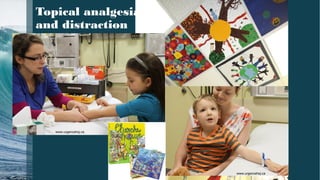
Topical analgesia
and distraction
www.urgencehsj.ca
www.urgencehsj.ca
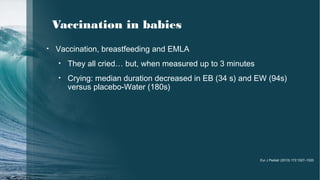
Vaccination in babies
• Vaccination, breastfeeding and EMLA
• They all cried… but, when measured up to 3 minutes
• Crying: median duration decreased in EB (34 s) and EW (94s)
versus placebo-Water (180s)
Eur J Pediatr (2013) 172:1527–1533
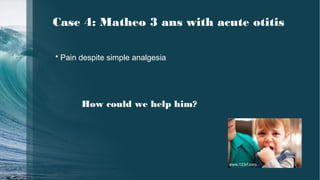
Case 4: Matheo 3 ans with acute otitis
• Pain despite simple analgesia
How could we help him?
www.123rf.com
Acute Otitis
• Combine simple analgesics
• Topical Lidocaine 2%
• Effective
• Not perforated
• Side effect: mild dizziness
Bolt Arch Dis Dnild 2008
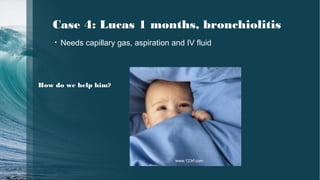
Case 4: Lucas 1 months, bronchiolitis
• Needs capillary gas, aspiration and IV fluid
How do we help him?
www.123rf.com
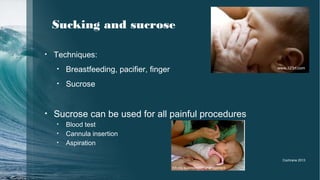
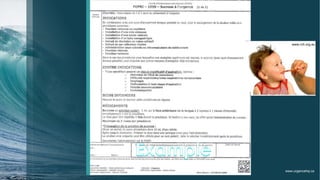
Sucking and sucrose
• Techniques:
• Breastfeeding, pacifier, finger
• Sucrose
• Sucrose can be used for all painful procedures
• Blood test
• Cannula insertion
• Aspiration
rch.org.au/anaes/pain_management
Cochrane 2013
www.123rf.com
www.urgencehsj.ca
www.rch.org.au
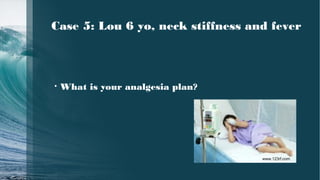
• What is your analgesia plan?
www.123rf.com
Case 5: Lou 6 yo, neck stiffness and fever
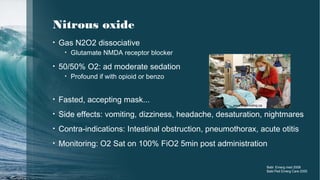
Nitrous oxide
• Gas N2O2 dissociative
• Glutamate NMDA receptor blocker
• 50/50% O2: ad moderate sedation
• Profound if with opioid or benzo
• Fasted, accepting mask...
• Side effects: vomiting, dizziness, headache, desaturation, nightmares
• Contra-indications: Intestinal obstruction, pneumothorax, acute otitis
• Monitoring: O2 Sat on 100% FiO2 5min post administration
Babl Emerg med 2008
Babl Ped Emerg Care 2005
www.urgencehsj.ca
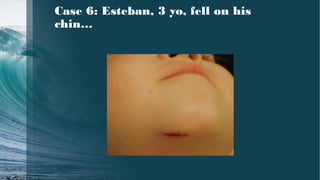
Case 6: Esteban, 3 yo, fell on his
chin…
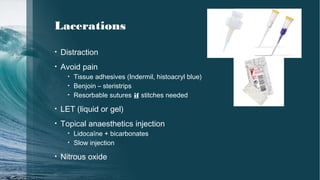
Lacerations
• Distraction
• Avoid pain
• Tissue adhesives (Indermil, histoacryl blue)
• Benjoin – steristrips
• Resorbable sutures if stitches needed
• LET (liquid or gel)
• Topical anaesthetics injection
• Lidocaïne + bicarbonates
• Slow injection
• Nitrous oxide
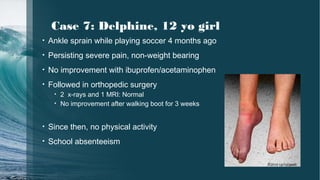
• Ankle sprain while playing soccer 4 months ago
• Persisting severe pain, non-weight bearing
• No improvement with ibuprofen/acetaminophen
• Followed in orthopedic surgery
• 2 x-rays and 1 MRI: Normal
• No improvement after walking boot for 3 weeks
• Since then, no physical activity
• School absenteeism
Case 7: Delphine, 12 yo girl
©2014 UpToDate®
Complex regional pain syndrome (CRPS)
Signs /symptoms
• Severe pain
• Allodynia and hyperalgesia
• Autonomic signs: edema, sweating, coolness, skin discoloration
• Motor signs: dystonia, tremors
• Trophic signs: changes in nail/hair growth
CRPS
• Pathophysiology not completely understood
• Clinical diagnosis, based on Budapest criteria for adults
• Several diagnoses and treatments (often including
immobilization) before the CRPS diagnosis
• Severe functional impairments quite common
CRPS in children
• Lower limbs more often that upper limbs
• More common in girls
• In general occurs in early teens (around 13 yo)
• Much better prognosis than in the adult population
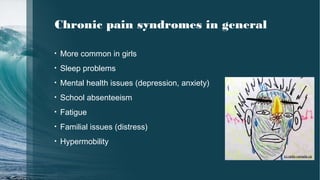
Chronic pain syndromes in general
• More common in girls
• Sleep problems
• Mental health issues (depression, anxiety)
• School absenteeism
• Fatigue
• Familial issues (distress)
• Hypermobility
ici.radio-canada.ca
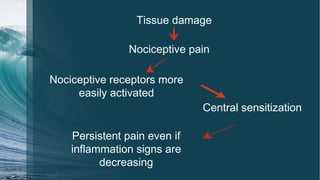
Tissue damage
Nociceptive pain
Nociceptive receptors more
easily activated
Central sensitization
Persistent pain even if
inflammation signs are
decreasing
Chronic pain syndromes
Initial discussion about diagnosis: Crucial!
• Similar explanations no matter what is the pain problem
• In general: Minimal investigations... but follow up is essential
• Acceptance of diagnosis by the family
• Active implication of the family in the treatment
• The pain becomes the disease in itself
• Patients are often told that the pain is in their head
Treatment of chronic pain syndromes
• Focus of treatment:
• learning how to restore functionality on a daily basis
• Combination of:
• physical therapy
• psychology
• pharmacology
Medications in Chronic pain
syndromes
• Opioids rarely used in the pediatric population
• Medications acting on brain neurotransmitters and calcium
channels
• gabapentin, pregabalin
• amitriptyline, nortriptyline (TCAs)
• Few studies regarding the efficacy of these medications in
chronic pain in the pediatric population
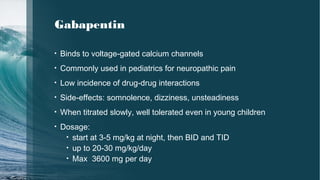
Gabapentin
• Binds to voltage-gated calcium channels
• Commonly used in pediatrics for neuropathic pain
• Low incidence of drug-drug interactions
• Side-effects: somnolence, dizziness, unsteadiness
• When titrated slowly, well tolerated even in young children
• Dosage:
• start at 3-5 mg/kg at night, then BID and TID
• up to 20-30 mg/kg/day
• Max 3600 mg per day
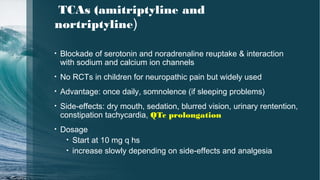
TCAs (amitriptyline and
nortriptyline)
• Blockade of serotonin and noradrenaline reuptake & interaction
with sodium and calcium ion channels
• No RCTs in children for neuropathic pain but widely used
• Advantage: once daily, somnolence (if sleeping problems)
• Side-effects: dry mouth, sedation, blurred vision, urinary rentention,
constipation tachycardia, QTc prolongation
• Dosage
• Start at 10 mg q hs
• increase slowly depending on side-effects and analgesia
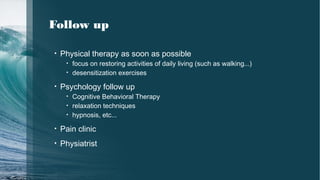
Follow up
• Physical therapy as soon as possible
• focus on restoring activities of daily living (such as walking...)
• desensitization exercises
• Psychology follow up
• Cognitive Behavioral Therapy
• relaxation techniques
• hypnosis, etc...
• Pain clinic
• Physiatrist
62
Conclusion
• Objective evaluation of pain
• Pharmacological and non-pharmacological analgesia
• For procedures
• For acute painful conditions
• For chronic painful conditions
• Think about it and take the TIME!
gettyimages.ca/Cysale

Ow! that hurts nov 2014

  • 1.
    EAU: Equipe Analgésieà lEAU: Equipe Analgésie à l’Urgence’Urgence Marie Joëlle Doré-Bergeron, MD FRCPC Pédiatrie Evelyne D Trottier, MD FRCPC Urgence Pédiatrique Marisol Sanchez, MD FRCPC Urgence Pédiatrique Presenters disclosures: Potential for conflict(s) of interest: Not Applicable Société Canadienne de Pédiatrie 26 juin 2014
  • 2.
    Objectives • Use ofpharmacological methods for pain control in acute and chronic conditions • Use of non-pharmacological methods to reduce pain and anxiety in pediatric patients • Reduce pain related to painful procedures
  • 3.
    Pain in Pediatric •Recommendation of leader association ‘‘Control of pain and stress for children who enter into the emergency medical system… is a vital component of emergency care.’’ • Multiples sources of pain and anxiety •Pathologies (trauma, burn, abdo pain, headache, otitis…) •Investigations (blood tests, LP, SPA…) •Procedures (IV, immunisation, cast…) •Hostile environment AAP Fein Pediatrics 2012
  • 4.
    Case 1: Océane,6 years old fall from monkeys bars • What is your analgesic plan if... • She does not seem in pain • She’s uncomfortable • She is screaming ANALGESIA www.eleanorharbison.com memory-of-monkey-bars/ Aurélie
  • 5.
    Océane is stillsuffering: Why? • No pain measurement on arrival • Underestimation of pain • No evaluation of pain after analgesia • Fear of analgesia from parent-patient-doctor • Limited knowledge on treatment strategies and consequences of undertreatment • Lack of time • Lack of human resources • Lack of $ Fein Pediatrics 2012 Dong Ped Emrg Care 2012 Cimpello Ped Emerg Care 2004 www.eleanorharbison.com memory-of-monkey-bars/
  • 6.
    Océane without painrelief... • Anxiety related to future procedures and medical encounters • Increased pain perception in future procedures • Potential avoidance of medical care www.eleanorharbison.com memory-of-monkey-bars/
  • 7.
    Océane, do YOUfeel pain... Pain assessment • Auto evaluation: • Verbal Numerical Scale(VNS-NRS) • Visual Analog Scale (VAS) • Faces Pain Scale-Revised • Hetero evaluation: Behavioral scale • FLACC • EVENDOL www.eleanorharbison.com memory-of-monkey-bars/ www.pediadol.org
  • 8.
    Verbal Numerical Scale(VNS) (8 yo - teens) Bailey Pain 2010
  • 9.
    Visual Analogue Scale(VAS) (6 - 8yo) www.pediadol.org Bailey Pain 2012
  • 10.
    Faces Pain Scale– Revised (FPS-R) ( ≥ 4yo) Pediadol.org Bieri Pain 1990 Hicks Pain 2001
  • 11.
    FLACC (0-7yo, up to19 yo in disabled children) Babl Ped Emerg care 2012 Blount Ped res man 2009
  • 12.
    Evendol (score on15) (0-7 yo) Fournier Pain 2012 www.pediadol.org www.urgencehsj.ca
  • 13.
    Pain Relief inacute MSK pain • Non-pharmacologic • Distraction • Immobilization/elevation • Icing • Simple analgesics • Acetaminophen • Ibuprofen • Opiates • Nitrous oxide www.colagene.com/fr/illustration/ Marie-Eve-Tremblay#2944
  • 14.
    Non-pharmacologic • Distraction andpreparation • Reduce fear, anxiety and pain perception • Immobilization and elevation • Sling • Posterior slab • Icing clipart-2012. princetonhcs.kramesonline.com/ Tanabe J Emerg Nurse 2002 Uman Cochrane 2013
  • 15.
    Pharmacological Steps • WHOanalgesic ladder Wong CPI 2012
  • 16.
    Simple Analgesics • Ibuprofen •NSAID: inhibits production of Pg (pro inflammatory) • 10mg/kg (Max 400mg) • Superior to • Acetaminophen • Codeine • Equivalent to • Acetaminophen /codeine • Oxycodone • No additional relief with codeine • Acetaminophen • Co-analgesia • 15mg/kg (Max 650mg) Lemay J Emerg Med 2013 Friday Acad Emerg Med 2009 Clark Pediatrics 2007
  • 17.
    ‘‘Weak’’ Opiate • OralCodeine • Analogue, requires conversion to active metabolite Martin Exp Opin Drug Saf 2014 www.chu-sainte-justine.org/Pro/evenements.aspx?IndEvenementsPasses Thibeault M Pharmacie CHU Ste Justine
  • 18.
    ‘‘Weak’’ Opiate • OralOxycodone • Analogue, direct effect and via hepatic metabolism by CYP 2D6 • 0.1 mg/kg oral (max 15 mg) • Onset of action: 15 minutes • Duration of action: 2h • Equivalent to • Ibuprofen • Superior to • Codeine Charney Ped Emerg Care 2008 Koller Ped Emerg Care 2007 Kennedy Ped drugs 2004 Martin Exp Opin Drug Saf 2014
  • 19.
    ‘‘Strong’’ Opiate • Oral/IVMorphine • Pure agonist of mu CNS receptor • Doses • 0.2 mg/kg Oral (max 10-15 mg) • 0.1 mg/kg IV (max 5mg first) • Onset of action (30)-60 min PO, 20 min IV, duration: 4-5h • PO: recent study indicates PO as effective as IV but higher dose may be required in acute or non-naive patient • IV often used as comparative Wille Arch Ped 2005 Wong CPJ 2012
  • 20.
  • 21.
    ‘‘Strong ’’Opiate • INHFentanyl • Pure agonist mu CNS receptor • Dose: • 1-2mcg/kg with atomizer • Reduced time to analgesia • Onset of action faster than oral morphine (onset: 5 min, peak :15-20 min, duration: 60 minutes) • Convenient mode of administration • Can avoid iv line • Equivalent to iv and im morphine Mudd J Ped Health Care 2011 Holdgate Aca Emerg Med 20 Borland Emerg Med Aus 2008 Borland Ann Emerg Med 2007 Aurélie
  • 22.
  • 23.
    Opiates observation • Sideeffects: • Nausea and vomiting • Pruritus • Constipation, urinary retention • Strongly consider laxatives • Respiratory depression • Risk factors: Infant, renal insufficiency, after ENT surgery • Tolerance • Contra-indications: • Decreased GCS • Allergy Marin Exp Op Drug Saf 2014
  • 24.
    Case 2: Théo4 yo, diabetic ketoacidosis •Théo starts crying, panics and wants to run away… www.123rf.com
  • 25.
    • Explain theprocedure • What is going to happen • What they will be allowed to do • Be with parent • Bring toy or teddy bear • What will be done to help them Preparation
  • 26.
    «  It won’t hurt » « I’mso sorry » « It’s almost finished » Minimizing their pain or anxiety Sympathizing Avoid
  • 27.
    During procedure Parent’s role •Allow parental presence • Build their confidence • Contact with the child (visual, physical) • Distraction • Their focus should be on the child
  • 28.
    • Recommendation ofAAP: • Prepares and supports child and parent • Follows the child through his journey in hospital • Helps with distraction during procedure AAP Pediatrics 2012 AAP Pediatrics 2000 Hall Educational Play Therapy 2010 Cisternino 2005 www.rch.org.au/comfortkid Childlife Specialist
  • 29.
    Distraction • Parent orchild life specialist • Not the one doing the procedure • Child empowerment • Adapted to development Uman Cochrane 2013 Riddell Cochrane 2012 Taddio Clin ther 2009
  • 30.
    Distraction EAU: Équipe Analgésieà l’Urgence, CHU SteJustine www.mamural.com
  • 31.
    Distraction EAU: Équipe Analgésieà l’Urgence, CHU SteJustine www.mamural.com EAU: Équipe Analgésie à l’Urgence, CHU SteJustine www.mamural.com
  • 32.
    Advantages for thechild • More comfort • Reduced anxiety • Decreased pain perception • Parent empowerment Advantages for health care providers • Reduces child movements (better cooparation) • Larger work space • Increases satisfaction Sparks J Ped Nurse 2007 Wente J Emerg Nurse 2012 Stephens 1999 Van Aken 1989 Proper positioning
  • 33.
    • Physical contact↓ anxiety • Face to face with parent • Swadling if ≤ 3 months • Suction, breastfeeding Positioning ≤ 6 months old www.rch.org.au
  • 34.
    Positioning ≥ 6months old rch.org.au/anaes/pain_management/ EAU: Équipe Analgésie à l’Urgence, CHU SteJustine
  • 35.
    Topical anaesthetics •Myth: «Changes inunderlying skin color and texture makes veins harder to find» •Reality: • Decreased pain • Higher first attempt success: 75-86% vs 50-76% • Shorter procedure time • Reduced perceived difficulty • Increased satisfaction (patient, parent, nurse) •Best if combined with non-pharmacological pain relief Schreiber Eur J Pediatr 2013 Fein Pediatrics 2012 Kennedy Pediatrics 2008 Zempski Pediatrics 2004
  • 36.
    Topical anaesthetics Emla Lido-Prilocaine Ametop Amethocaine 4% Maxilene Lidocaineliposomal 4% Pain Ease Vapocoolant spray Delay 60min (max 4h) (max 1h in 0-3months) 30 min 30min (max 2h) Immediate spray 10 sec or ad skin blanching Duration 1-2h 4h 1h 45-60 sec Vascular loss and cutaneous changes Vasoconstriction Vasodilation (erythema) Minimal Minimal Complications Methemoglobinemia Hypersensitivity Methemoglobinemia (rare) Methemoglobinemia (rare) Burning sensation Frostbite Max twice at the same place Contra indications Methb, G6PD, porphyria Allergy Cutaneous break mucosa Allergy Allergy <3 years old Equipe d’Analgésie à l’Urgence (EAU) www.urgencehsj.ca
  • 37.
    Case 3: Alex9 yo, routine immunization • Alex , ex-preterm, has needle phobia • How could we help him? www.123rf.com
  • 38.
  • 39.
    Vaccination in babies •Vaccination, breastfeeding and EMLA • They all cried… but, when measured up to 3 minutes • Crying: median duration decreased in EB (34 s) and EW (94s) versus placebo-Water (180s) Eur J Pediatr (2013) 172:1527–1533
  • 40.
    Case 4: Matheo3 ans with acute otitis • Pain despite simple analgesia How could we help him? www.123rf.com
  • 41.
    Acute Otitis • Combinesimple analgesics • Topical Lidocaine 2% • Effective • Not perforated • Side effect: mild dizziness Bolt Arch Dis Dnild 2008
  • 42.
    Case 4: Lucas1 months, bronchiolitis • Needs capillary gas, aspiration and IV fluid How do we help him? www.123rf.com
  • 43.
    Sucking and sucrose •Techniques: • Breastfeeding, pacifier, finger • Sucrose • Sucrose can be used for all painful procedures • Blood test • Cannula insertion • Aspiration rch.org.au/anaes/pain_management Cochrane 2013 www.123rf.com
  • 44.
  • 45.
    • What isyour analgesia plan? www.123rf.com Case 5: Lou 6 yo, neck stiffness and fever
  • 46.
    Nitrous oxide • GasN2O2 dissociative • Glutamate NMDA receptor blocker • 50/50% O2: ad moderate sedation • Profound if with opioid or benzo • Fasted, accepting mask... • Side effects: vomiting, dizziness, headache, desaturation, nightmares • Contra-indications: Intestinal obstruction, pneumothorax, acute otitis • Monitoring: O2 Sat on 100% FiO2 5min post administration Babl Emerg med 2008 Babl Ped Emerg Care 2005 www.urgencehsj.ca
  • 47.
    Case 6: Esteban,3 yo, fell on his chin…
  • 48.
    Lacerations • Distraction • Avoidpain • Tissue adhesives (Indermil, histoacryl blue) • Benjoin – steristrips • Resorbable sutures if stitches needed • LET (liquid or gel) • Topical anaesthetics injection • Lidocaïne + bicarbonates • Slow injection • Nitrous oxide
  • 49.
    • Ankle sprainwhile playing soccer 4 months ago • Persisting severe pain, non-weight bearing • No improvement with ibuprofen/acetaminophen • Followed in orthopedic surgery • 2 x-rays and 1 MRI: Normal • No improvement after walking boot for 3 weeks • Since then, no physical activity • School absenteeism Case 7: Delphine, 12 yo girl ©2014 UpToDate®
  • 50.
    Complex regional painsyndrome (CRPS) Signs /symptoms • Severe pain • Allodynia and hyperalgesia • Autonomic signs: edema, sweating, coolness, skin discoloration • Motor signs: dystonia, tremors • Trophic signs: changes in nail/hair growth
  • 51.
    CRPS • Pathophysiology notcompletely understood • Clinical diagnosis, based on Budapest criteria for adults • Several diagnoses and treatments (often including immobilization) before the CRPS diagnosis • Severe functional impairments quite common
  • 52.
    CRPS in children •Lower limbs more often that upper limbs • More common in girls • In general occurs in early teens (around 13 yo) • Much better prognosis than in the adult population
  • 54.
    Chronic pain syndromesin general • More common in girls • Sleep problems • Mental health issues (depression, anxiety) • School absenteeism • Fatigue • Familial issues (distress) • Hypermobility ici.radio-canada.ca
  • 55.
    Tissue damage Nociceptive pain Nociceptivereceptors more easily activated Central sensitization Persistent pain even if inflammation signs are decreasing
  • 56.
    Chronic pain syndromes Initialdiscussion about diagnosis: Crucial! • Similar explanations no matter what is the pain problem • In general: Minimal investigations... but follow up is essential • Acceptance of diagnosis by the family • Active implication of the family in the treatment • The pain becomes the disease in itself • Patients are often told that the pain is in their head
  • 57.
    Treatment of chronicpain syndromes • Focus of treatment: • learning how to restore functionality on a daily basis • Combination of: • physical therapy • psychology • pharmacology
  • 58.
    Medications in Chronicpain syndromes • Opioids rarely used in the pediatric population • Medications acting on brain neurotransmitters and calcium channels • gabapentin, pregabalin • amitriptyline, nortriptyline (TCAs) • Few studies regarding the efficacy of these medications in chronic pain in the pediatric population
  • 59.
    Gabapentin • Binds tovoltage-gated calcium channels • Commonly used in pediatrics for neuropathic pain • Low incidence of drug-drug interactions • Side-effects: somnolence, dizziness, unsteadiness • When titrated slowly, well tolerated even in young children • Dosage: • start at 3-5 mg/kg at night, then BID and TID • up to 20-30 mg/kg/day • Max 3600 mg per day
  • 60.
    TCAs (amitriptyline and nortriptyline) •Blockade of serotonin and noradrenaline reuptake & interaction with sodium and calcium ion channels • No RCTs in children for neuropathic pain but widely used • Advantage: once daily, somnolence (if sleeping problems) • Side-effects: dry mouth, sedation, blurred vision, urinary rentention, constipation tachycardia, QTc prolongation • Dosage • Start at 10 mg q hs • increase slowly depending on side-effects and analgesia
  • 61.
    Follow up • Physicaltherapy as soon as possible • focus on restoring activities of daily living (such as walking...) • desensitization exercises • Psychology follow up • Cognitive Behavioral Therapy • relaxation techniques • hypnosis, etc... • Pain clinic • Physiatrist
  • 62.
    62 Conclusion • Objective evaluationof pain • Pharmacological and non-pharmacological analgesia • For procedures • For acute painful conditions • For chronic painful conditions • Think about it and take the TIME! gettyimages.ca/Cysale

Editor's Notes