Headache – Practical Scenario
             Dr. Thomas Mathew
          MD,DNB,DM(Neurology)
             Associate Professor
         Department of Neurology
   St.John’s Medical College and Hospital
             Bangalore-560034
Case 1
On history…
• 24 year old lady

• Episodic vertigo lasting 30 minutes

• 1-2/ week for the past 2 years

• No history of tinnitus/deafness

• No history of loss of consciousness
On examination…


• No focal neurological deficits

• Fundus normal
What will you ask next ?
Options are…

A.   Postural variation
B.   Head trauma
C.   Alcohol intake
D.   History of headache
Diagnosis


Migraine related vertigo
How will you manage ?
Options are…
A. Cinnarizine
B. Prochlorperazine
C. Betahistine
D. None of the above
What you should do ?
• Flunarizine

• Topiramate

• Betablockers

• Amitriptyline

• Valproate
Flunarizine – Practical Scenario
              Prof. A.V. SRINIVASAN,
     MD, DM, Ph.D,DSc(HON) F.A.A.N, F.I.A.N.
               Emeritus Professor
  The Tamilnadu Dr. M.G.R. Medical University
                  Former Head
 Institute of Neurology, Madras Medical College
                  Adjunct Prof.
                    IIT Madras
Flunarizine: Indications

•   Prophylaxis of migraine
•   Symptomatic treatment of dizziness
•   (Peripheral vascular disease)
•   (Alternating hemiplegia)
•   (Epilepsy adjuvant)
Contra-indications
• Parkinson’s disease
• History of EP syndromes
• History of depression
• Breast feeding
• (Pregnancy)
Caution
• Elderly
• Hepatic disease
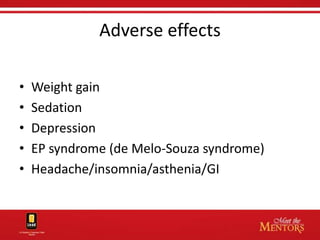
Adverse effects

•   Weight gain
•   Sedation
•   Depression
•   EP syndrome (de Melo-Souza syndrome)
•   Headache/insomnia/asthenia/GI
Interactions

•   Alcohol
•   Hypnotics /tranquilizers
•   COC
•   Anticholinergics
•   Anticonvulsants
HC Deiner et al
         Cephalalgia 2002;22:209-221
• 808 patients
• Double blind 16 week treatment phase
• Flunarizine 10mg(5days/week) v Flunarizine
  5mg v Propranolol 160mg
• Responders (50% reduction)
 5mg:46%. 10mg:53%. Propranolol:48%
• Drop out due to adverse effects
5mg:16.7%. 10mg: 19.3%. Propranolol:16.7%
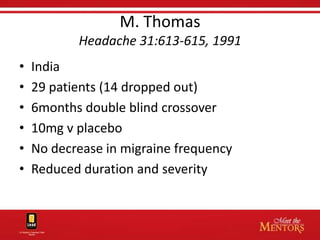
M. Thomas
           Headache 31:613-615, 1991
•   India
•   29 patients (14 dropped out)
•   6months double blind crossover
•   10mg v placebo
•   No decrease in migraine frequency
•   Reduced duration and severity
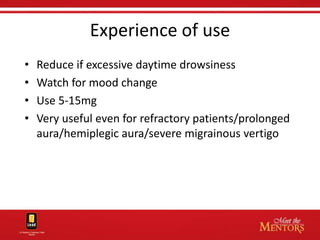
Experience of use
•   Reduce if excessive daytime drowsiness
•   Watch for mood change
•   Use 5-15mg
•   Very useful even for refractory patients/prolonged
    aura/hemiplegic aura/severe migrainous vertigo
Headache – Practical Scenario
             Dr. Thomas Mathew
          MD,DNB,DM(Neurology)
             Associate Professor
         Department of Neurology
   St.John’s Medical College and Hospital
             Bangalore-560034
Case 2
On history…
• 28 year old

• Episodic headaches

• 12 hours
• 4-5/week

• Severe/throbbing/worsens with exertion
On History…
• Photo/phonophobia/vomiting

• Family history of headache present

• Feels like crying/sad/thought of even suicide

• Takes vasograine 4-5/week
On examination…
• Obese . BP 130/90 mm of Hg

• BMI >35

• No deficits

• Fundus normal
What is the drug of choice?
A. Flunarizine
B. Betablocker
C. Amitriptyline
D. Valproate
E. Topiramate
Patient was started on topiramate
• 25 mg per day
What else you will advise ?
Options are…
A. Stop vasograine abuse

B. Identify precipitating factors

C. Life style modification

D. All the above
Patient comes back after 1 week of
            Topiramate

• “ I can’t see clearly from today morning”
What will you do ?
Options are…
A. Fundus examination

B. Urgent ophthalmological consult

C. Check Intraocular pressure

D. IV mannitol

E. All the above
Diagnosis


Topiramate induced acute angle closure glaucoma
Thank you
Practice Patterns in Headache
         Management
        E- Voting Module
When would you initiate prophylaxis
         for migraine?
 A. Patients with 4 or 5 migraine days per month
    with normal functioning
 B. 3 migraine days with some impairment
 C. 2 migraine days with severe impairment
 D. Any one of the above
What can be the duration of therapeutic
 trial for a migraine prophylactic drug?

  A.   Less than 1 week
  B.   2-4 weeks
  C.   2- 6 months
  D.   4-6 weeks
What are the ‘red flags’ in headache
              history?
A. New headache onset in an older patient
B. Rapid onset of headache
C. Systemic Symptoms such as fever or weight
   loss
D. All of the above
Which channels are blocked by
         Flunarizine?

A.   Calcium channels
B.   Sodium channels
C.   Both
D.   None of the above
What is the typical characteristic of
       migraine headache?

A.   Pulsating, throbbing
B.   Pressing, tightening but not pulsating
C.   Boring, searing
D.   None of the above
Thank you

Headache – practical scenario

  • 1.
    Headache – PracticalScenario Dr. Thomas Mathew MD,DNB,DM(Neurology) Associate Professor Department of Neurology St.John’s Medical College and Hospital Bangalore-560034
  • 2.
  • 3.
    On history… • 24year old lady • Episodic vertigo lasting 30 minutes • 1-2/ week for the past 2 years • No history of tinnitus/deafness • No history of loss of consciousness
  • 4.
    On examination… • Nofocal neurological deficits • Fundus normal
  • 5.
    What will youask next ?
  • 6.
    Options are… A. Postural variation B. Head trauma C. Alcohol intake D. History of headache
  • 7.
  • 8.
    How will youmanage ? Options are… A. Cinnarizine B. Prochlorperazine C. Betahistine D. None of the above
  • 9.
    What you shoulddo ? • Flunarizine • Topiramate • Betablockers • Amitriptyline • Valproate
  • 10.
    Flunarizine – PracticalScenario Prof. A.V. SRINIVASAN, MD, DM, Ph.D,DSc(HON) F.A.A.N, F.I.A.N. Emeritus Professor The Tamilnadu Dr. M.G.R. Medical University Former Head Institute of Neurology, Madras Medical College Adjunct Prof. IIT Madras
  • 11.
    Flunarizine: Indications • Prophylaxis of migraine • Symptomatic treatment of dizziness • (Peripheral vascular disease) • (Alternating hemiplegia) • (Epilepsy adjuvant)
  • 12.
    Contra-indications • Parkinson’s disease •History of EP syndromes • History of depression • Breast feeding • (Pregnancy) Caution • Elderly • Hepatic disease
  • 13.
    Adverse effects • Weight gain • Sedation • Depression • EP syndrome (de Melo-Souza syndrome) • Headache/insomnia/asthenia/GI
  • 14.
    Interactions • Alcohol • Hypnotics /tranquilizers • COC • Anticholinergics • Anticonvulsants
  • 15.
    HC Deiner etal Cephalalgia 2002;22:209-221 • 808 patients • Double blind 16 week treatment phase • Flunarizine 10mg(5days/week) v Flunarizine 5mg v Propranolol 160mg • Responders (50% reduction) 5mg:46%. 10mg:53%. Propranolol:48% • Drop out due to adverse effects 5mg:16.7%. 10mg: 19.3%. Propranolol:16.7%
  • 16.
    M. Thomas Headache 31:613-615, 1991 • India • 29 patients (14 dropped out) • 6months double blind crossover • 10mg v placebo • No decrease in migraine frequency • Reduced duration and severity
  • 17.
    Experience of use • Reduce if excessive daytime drowsiness • Watch for mood change • Use 5-15mg • Very useful even for refractory patients/prolonged aura/hemiplegic aura/severe migrainous vertigo
  • 19.
    Headache – PracticalScenario Dr. Thomas Mathew MD,DNB,DM(Neurology) Associate Professor Department of Neurology St.John’s Medical College and Hospital Bangalore-560034
  • 20.
  • 21.
    On history… • 28year old • Episodic headaches • 12 hours • 4-5/week • Severe/throbbing/worsens with exertion
  • 22.
    On History… • Photo/phonophobia/vomiting •Family history of headache present • Feels like crying/sad/thought of even suicide • Takes vasograine 4-5/week
  • 23.
    On examination… • Obese. BP 130/90 mm of Hg • BMI >35 • No deficits • Fundus normal
  • 24.
    What is thedrug of choice? A. Flunarizine B. Betablocker C. Amitriptyline D. Valproate E. Topiramate
  • 25.
    Patient was startedon topiramate • 25 mg per day
  • 26.
    What else youwill advise ?
  • 27.
    Options are… A. Stopvasograine abuse B. Identify precipitating factors C. Life style modification D. All the above
  • 28.
    Patient comes backafter 1 week of Topiramate • “ I can’t see clearly from today morning”
  • 29.
  • 30.
    Options are… A. Fundusexamination B. Urgent ophthalmological consult C. Check Intraocular pressure D. IV mannitol E. All the above
  • 31.
    Diagnosis Topiramate induced acuteangle closure glaucoma
  • 32.
  • 33.
    Practice Patterns inHeadache Management E- Voting Module
  • 34.
    When would youinitiate prophylaxis for migraine? A. Patients with 4 or 5 migraine days per month with normal functioning B. 3 migraine days with some impairment C. 2 migraine days with severe impairment D. Any one of the above
  • 35.
    What can bethe duration of therapeutic trial for a migraine prophylactic drug? A. Less than 1 week B. 2-4 weeks C. 2- 6 months D. 4-6 weeks
  • 36.
    What are the‘red flags’ in headache history? A. New headache onset in an older patient B. Rapid onset of headache C. Systemic Symptoms such as fever or weight loss D. All of the above
  • 37.
    Which channels areblocked by Flunarizine? A. Calcium channels B. Sodium channels C. Both D. None of the above
  • 38.
    What is thetypical characteristic of migraine headache? A. Pulsating, throbbing B. Pressing, tightening but not pulsating C. Boring, searing D. None of the above
  • 39.

Editor's Notes