La creación de una capa
operacional con MongoDB
Desayunos con MongoDB
ww.mongodb.com
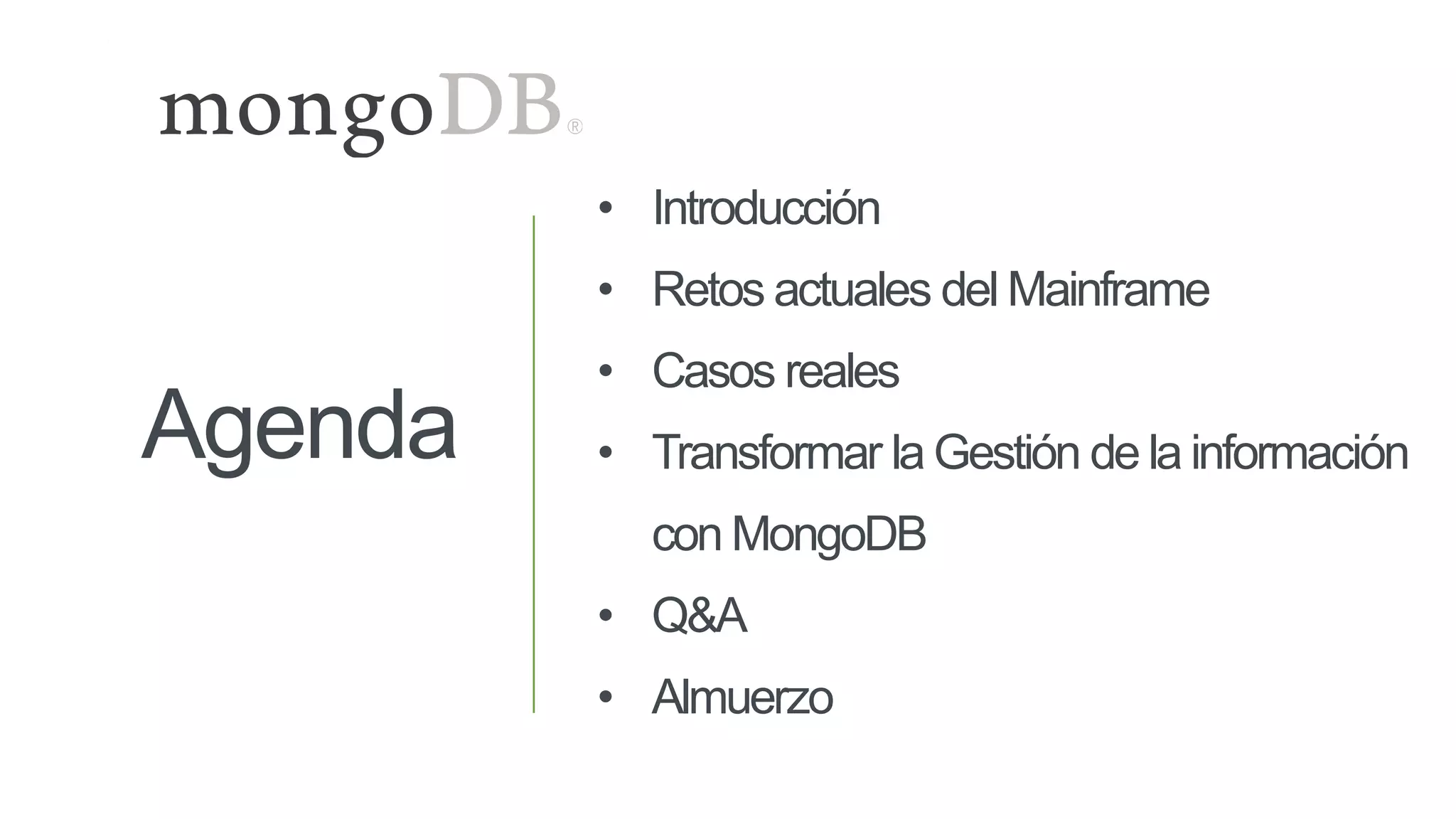
• Introducción
• Retos actuales del Mainframe
• Casos reales
• Transformar la Gestión de la información
con MongoDB
• Q&A
• Almuerzo
Agenda
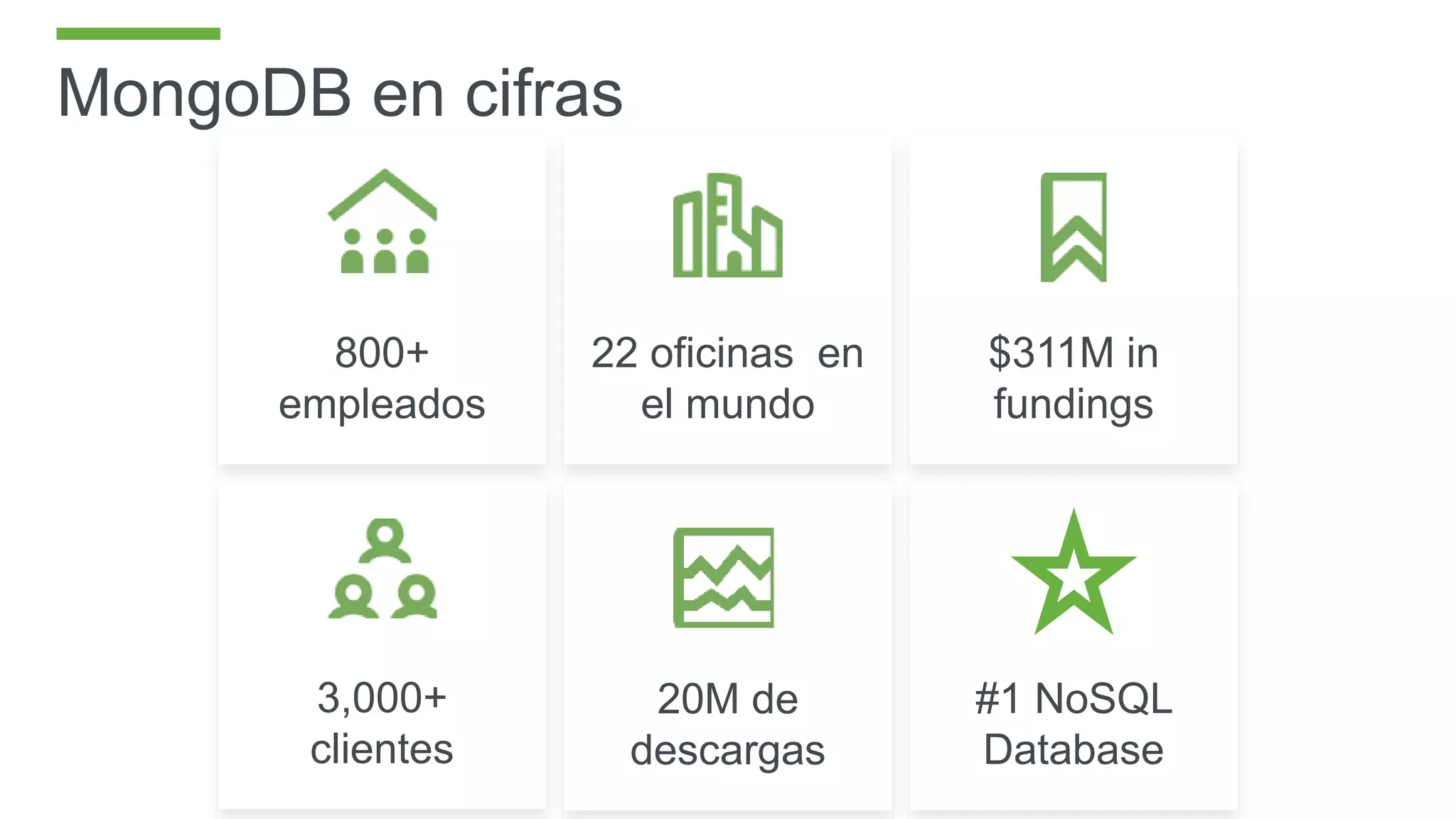
MongoDB en cifras
800+
empleados
3,000+
clientes
22 oficinas en
el mundo
$311M in
fundings
20M de
descargas
#1 NoSQL
Database
Let our team help you on your journey to efficiently leverage the capabilities of MongoDB, the data platform that
allows innovators to unleash the power of software and data for giant ideas.
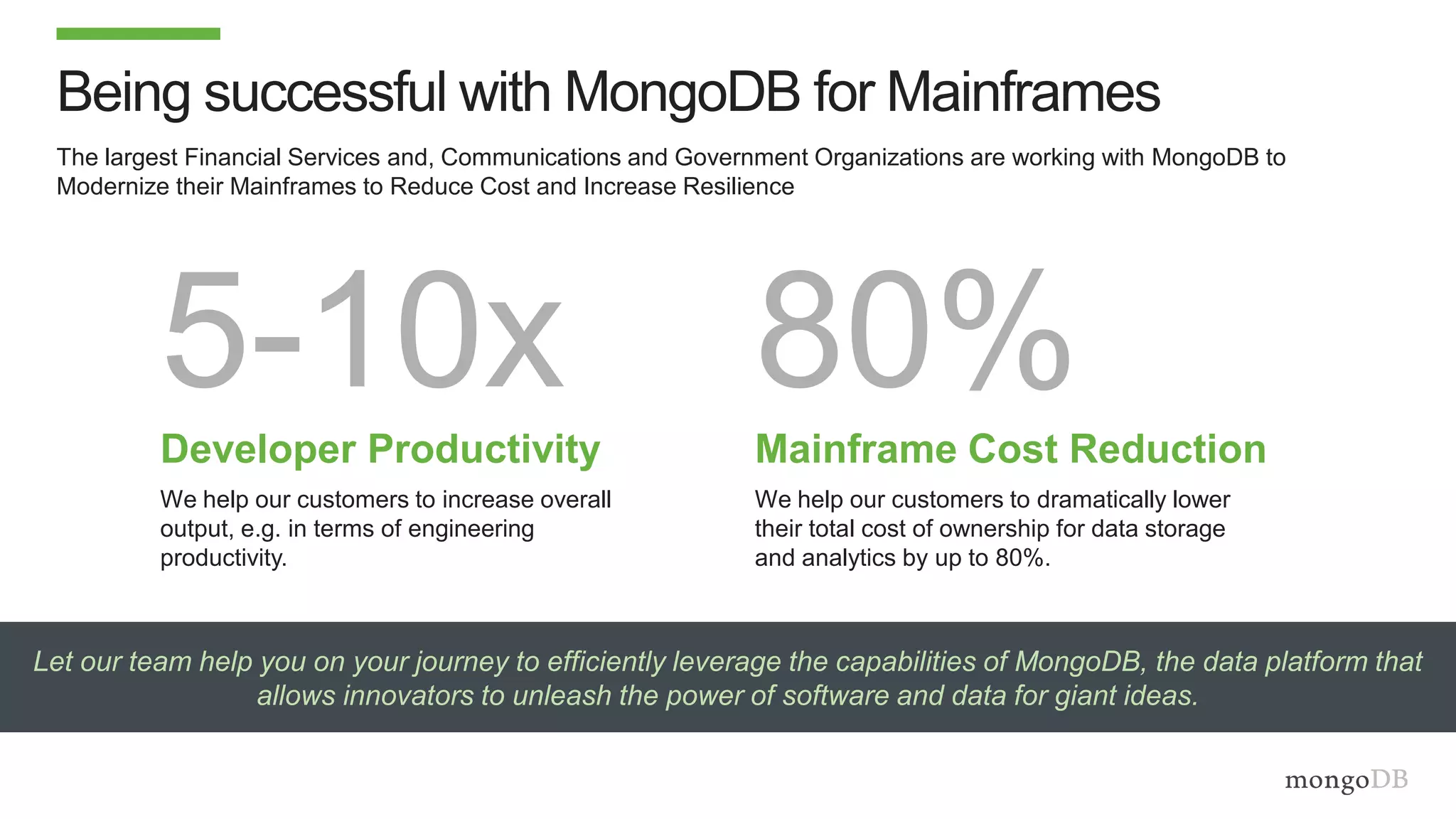
The largest Financial Services and, Communications and Government Organizations are working with MongoDB to
Modernize their Mainframes to Reduce Cost and Increase Resilience
Being successful with MongoDB for Mainframes
5-10xDeveloper Productivity
We help our customers to increase overall
output, e.g. in terms of engineering
productivity.
80%Mainframe Cost Reduction
We help our customers to dramatically lower
their total cost of ownership for data storage
and analytics by up to 80%.
Jim Duffy
Global Director of Information
Strategy, MongoDB
Retos actuales del
Mainframe
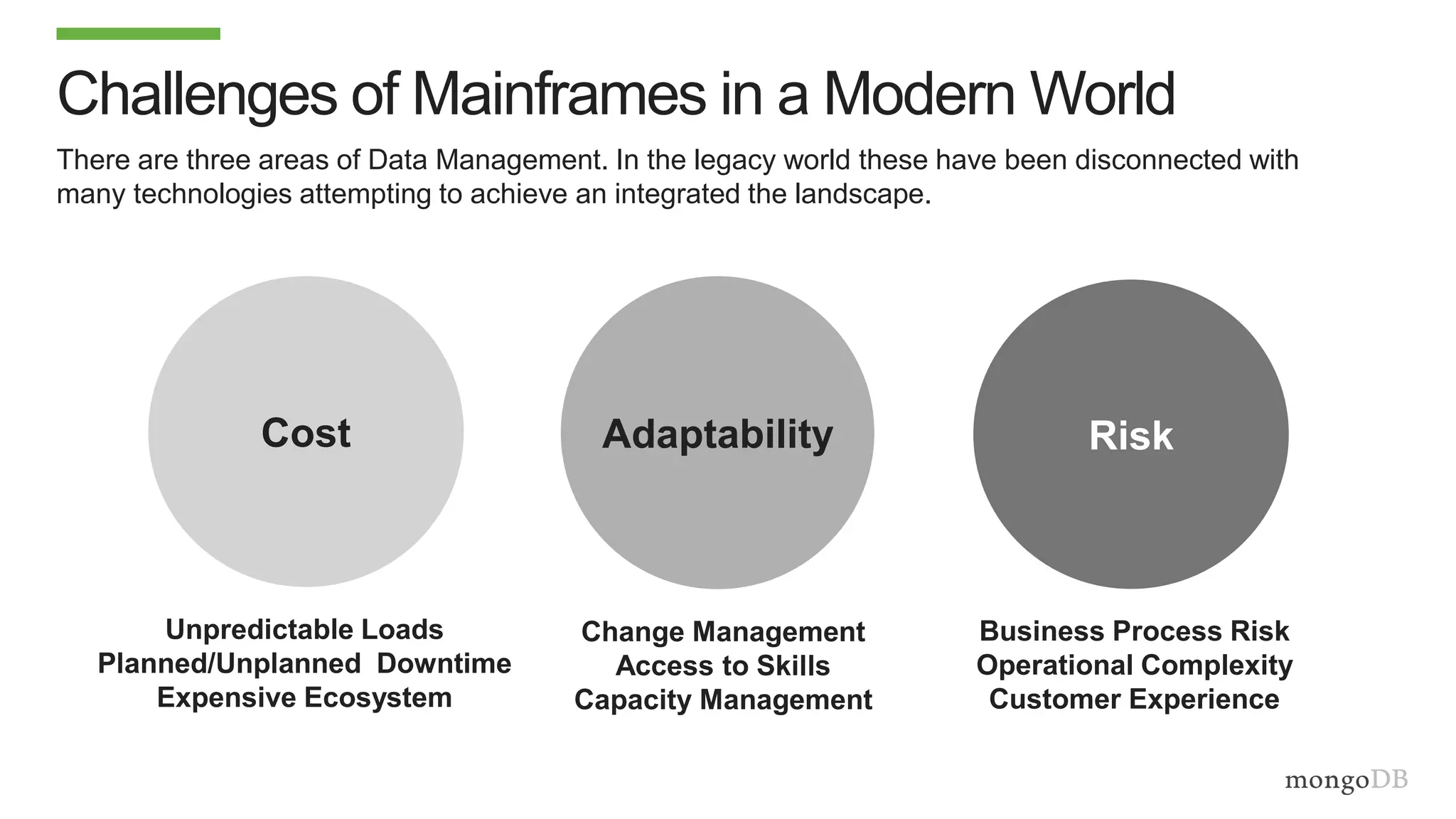
Challenges of Mainframes in a Modern World
There are three areas of Data Management. In the legacy world these have been disconnected with
many technologies attempting to achieve an integrated the landscape.
AdaptabilityCost Risk
Unpredictable Loads
Planned/Unplanned Downtime
Expensive Ecosystem
Change Management
Access to Skills
Capacity Management
Business Process Risk
Operational Complexity
Customer Experience
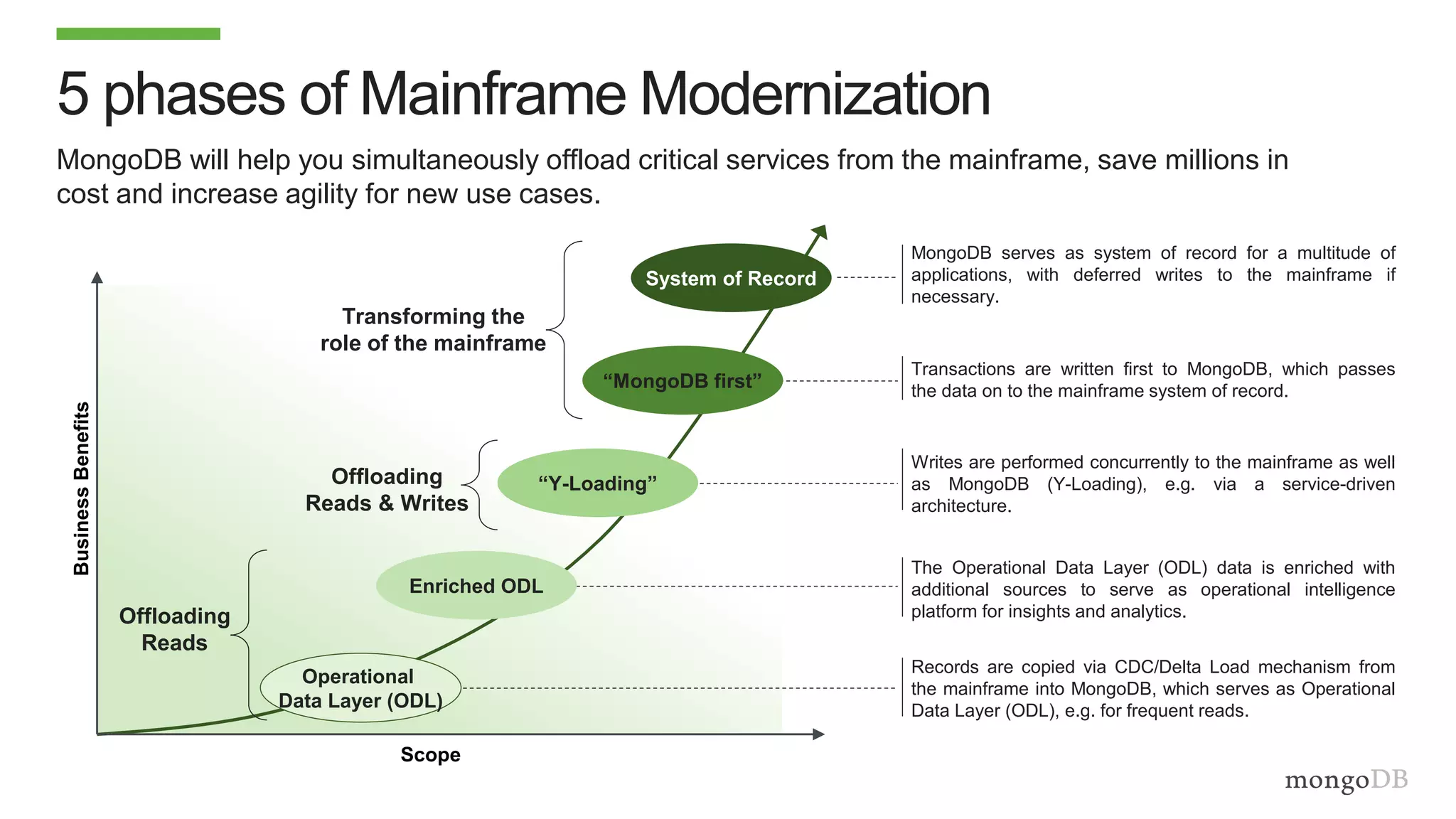
5 phases of Mainframe Modernization
MongoDB will help you simultaneously offload critical services from the mainframe, save millions in
cost and increase agility for new use cases.
Scope
BusinessBenefits
Transactions are written first to MongoDB, which passes
the data on to the mainframe system of record.
Writes are performed concurrently to the mainframe as well
as MongoDB (Y-Loading), e.g. via a service-driven
architecture.
The Operational Data Layer (ODL) data is enriched with
additional sources to serve as operational intelligence
platform for insights and analytics.
Enriched ODL
Records are copied via CDC/Delta Load mechanism from
the mainframe into MongoDB, which serves as Operational
Data Layer (ODL), e.g. for frequent reads.
Operational
Data Layer (ODL)
“MongoDB first”
“Y-Loading”
System of Record
MongoDB serves as system of record for a multitude of
applications, with deferred writes to the mainframe if
necessary.
Offloading
Reads
Transforming the
role of the mainframe
Offloading
Reads & Writes
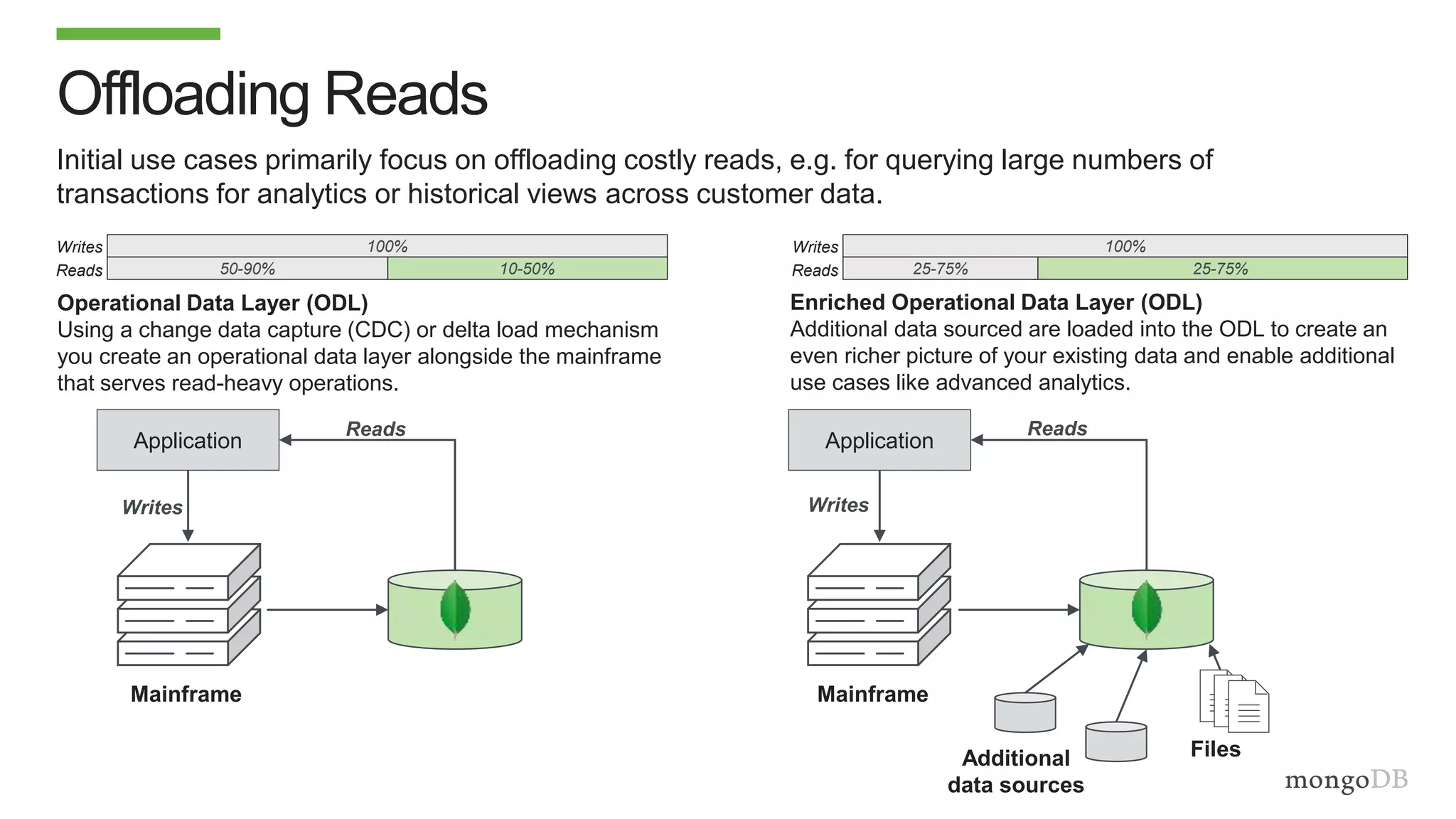
Offloading Reads
Initial use cases primarily focus on offloading costly reads, e.g. for querying large numbers of
transactions for analytics or historical views across customer data.
Application Application
Mainframe Mainframe
Operational Data Layer (ODL)
Using a change data capture (CDC) or delta load mechanism
you create an operational data layer alongside the mainframe
that serves read-heavy operations.
Additional
data sources
Files
Enriched Operational Data Layer (ODL)
Additional data sourced are loaded into the ODL to create an
even richer picture of your existing data and enable additional
use cases like advanced analytics.
Writes
Reads Reads
Writes
100%
10-50%50-90%
Writes
Reads
100%
25-75%25-75%
Writes
Reads
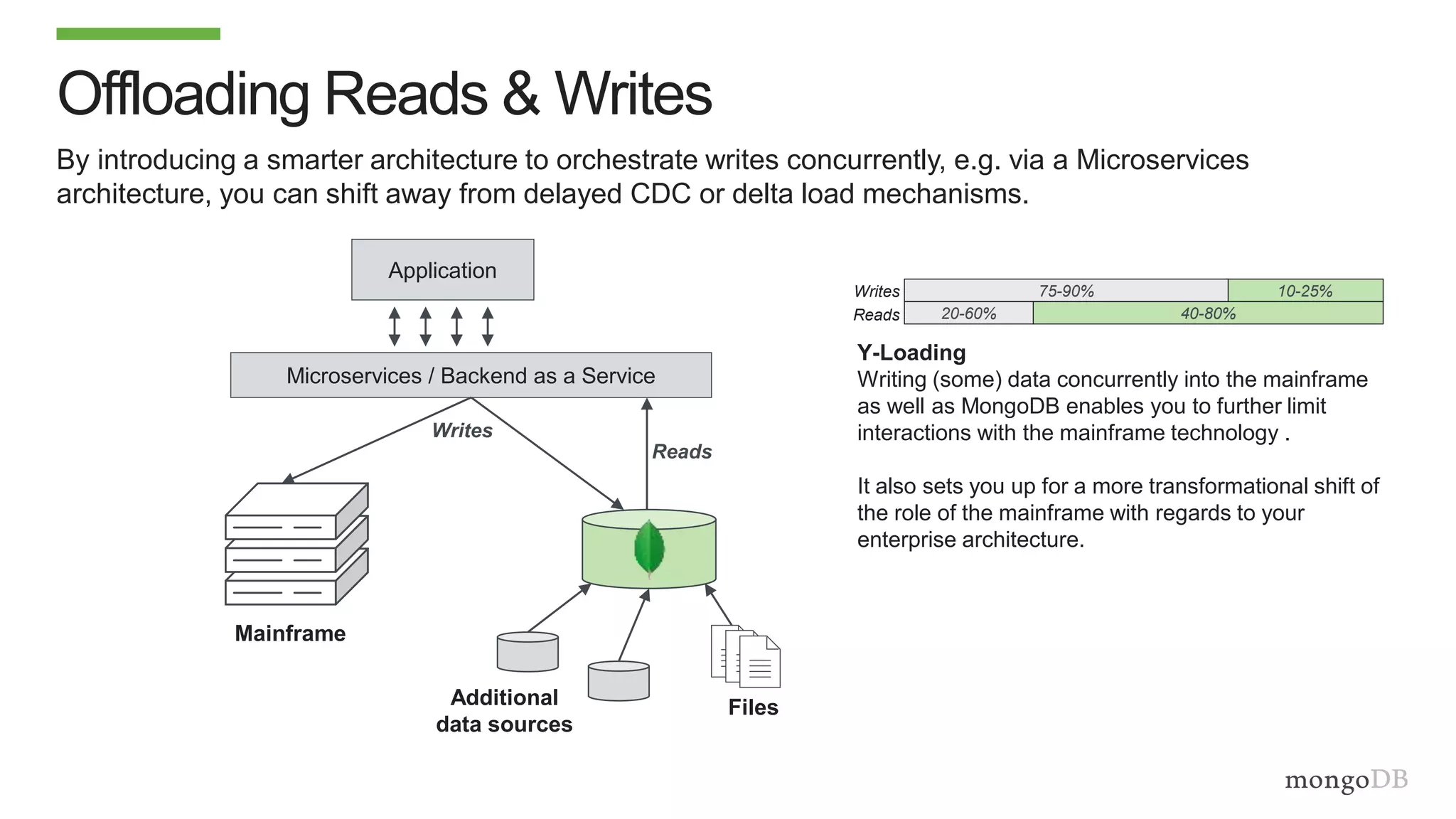
Offloading Reads & Writes
By introducing a smarter architecture to orchestrate writes concurrently, e.g. via a Microservices
architecture, you can shift away from delayed CDC or delta load mechanisms.
Mainframe
Additional
data sources
Files
Reads
Y-Loading
Writing (some) data concurrently into the mainframe
as well as MongoDB enables you to further limit
interactions with the mainframe technology .
It also sets you up for a more transformational shift of
the role of the mainframe with regards to your
enterprise architecture.
Application
10-25%75-90%
40-80%20-60%
Writes
Reads
Microservices / Backend as a Service
Writes
Transforming the role of the mainframe
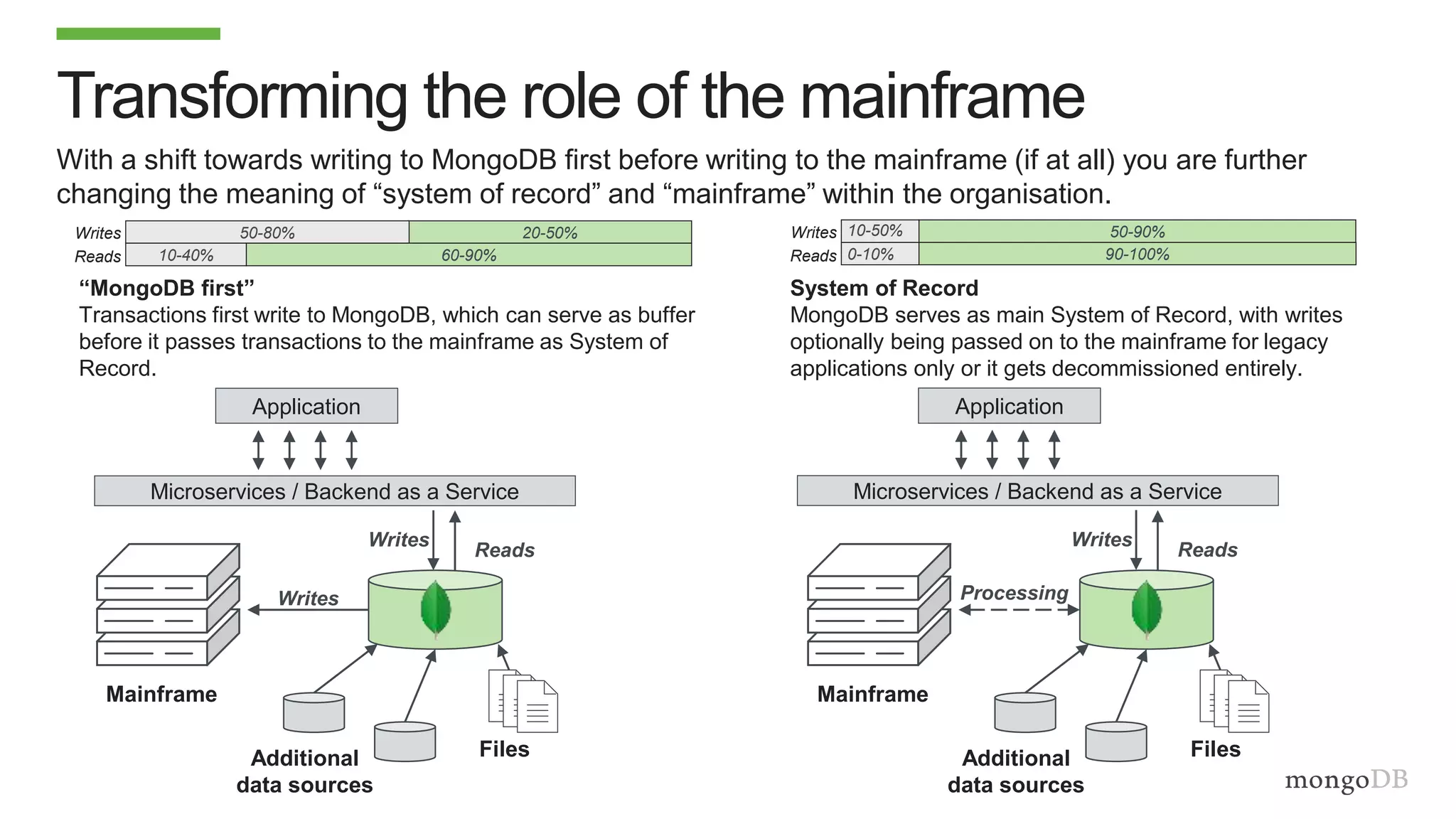
With a shift towards writing to MongoDB first before writing to the mainframe (if at all) you are further
changing the meaning of “system of record” and “mainframe” within the organisation.
Mainframe
Additional
data sources
Files
System of Record
MongoDB serves as main System of Record, with writes
optionally being passed on to the mainframe for legacy
applications only or it gets decommissioned entirely.
Mainframe
Additional
data sources
Files
“MongoDB first”
Transactions first write to MongoDB, which can serve as buffer
before it passes transactions to the mainframe as System of
Record.
Writes Processing
20-50%50-80%
60-90%10-40%
Writes
Reads
50-90%10-50%
90-100%0-10%
Writes
Reads
Application
Microservices / Backend as a Service
Reads
Writes
Application
Microservices / Backend as a Service
Reads
Writes
Rubén Terceño
Senior Solutions Architect,
MongoDB
Casos reales
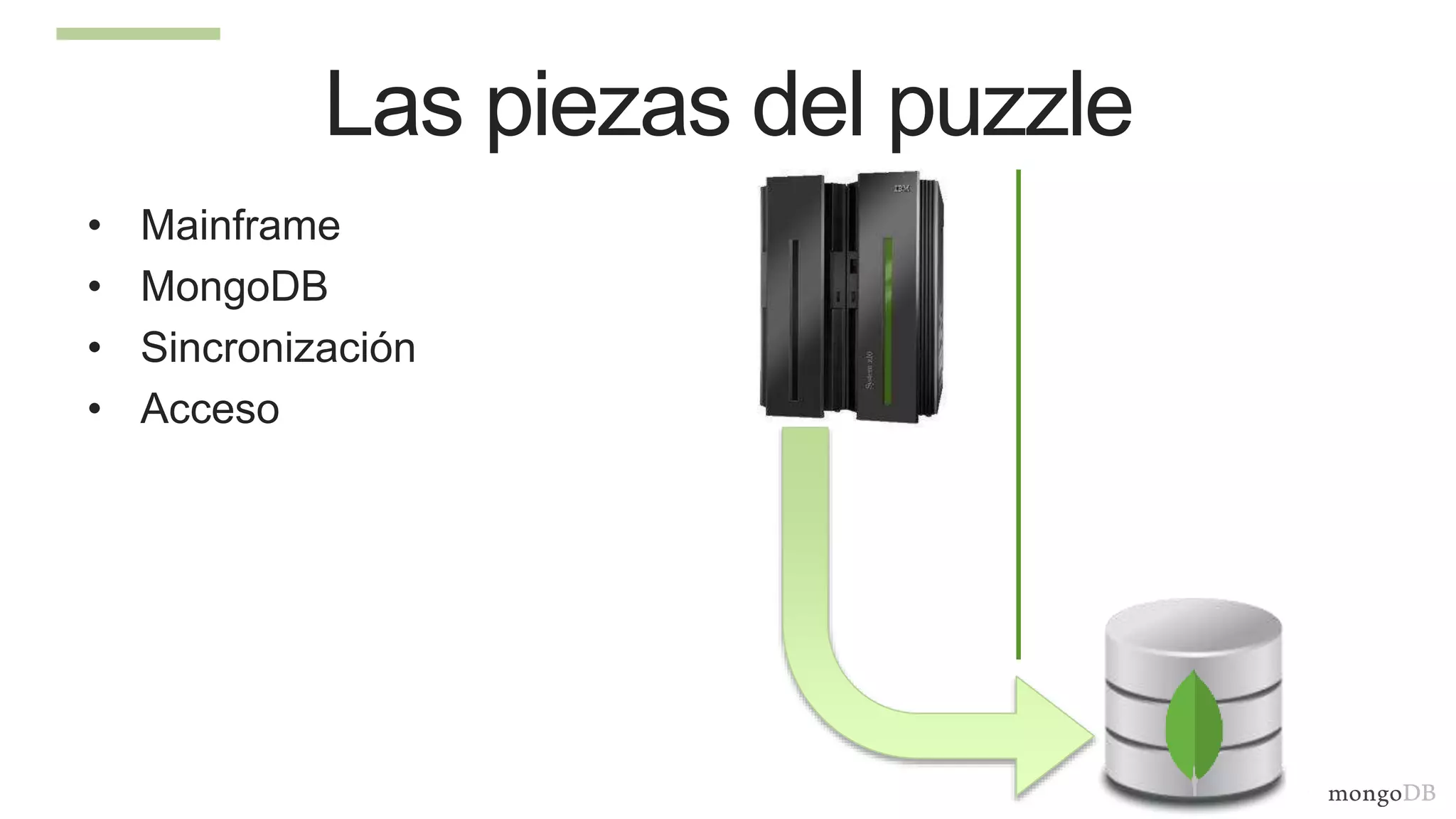
Las piezas del puzzle
• Mainframe
• MongoDB
• Sincronización
• Acceso
Experiencias
• Los proyectos sulen tener tres fases.
– Toma de contacto.
• Probamos las ideas y la tecnología
– Fase operativa
• Usamos la tecnología para implementar las ideas
– Fase creativa
• Usamos la tecnología con ideas qué no se nos habían
ocurrido antes
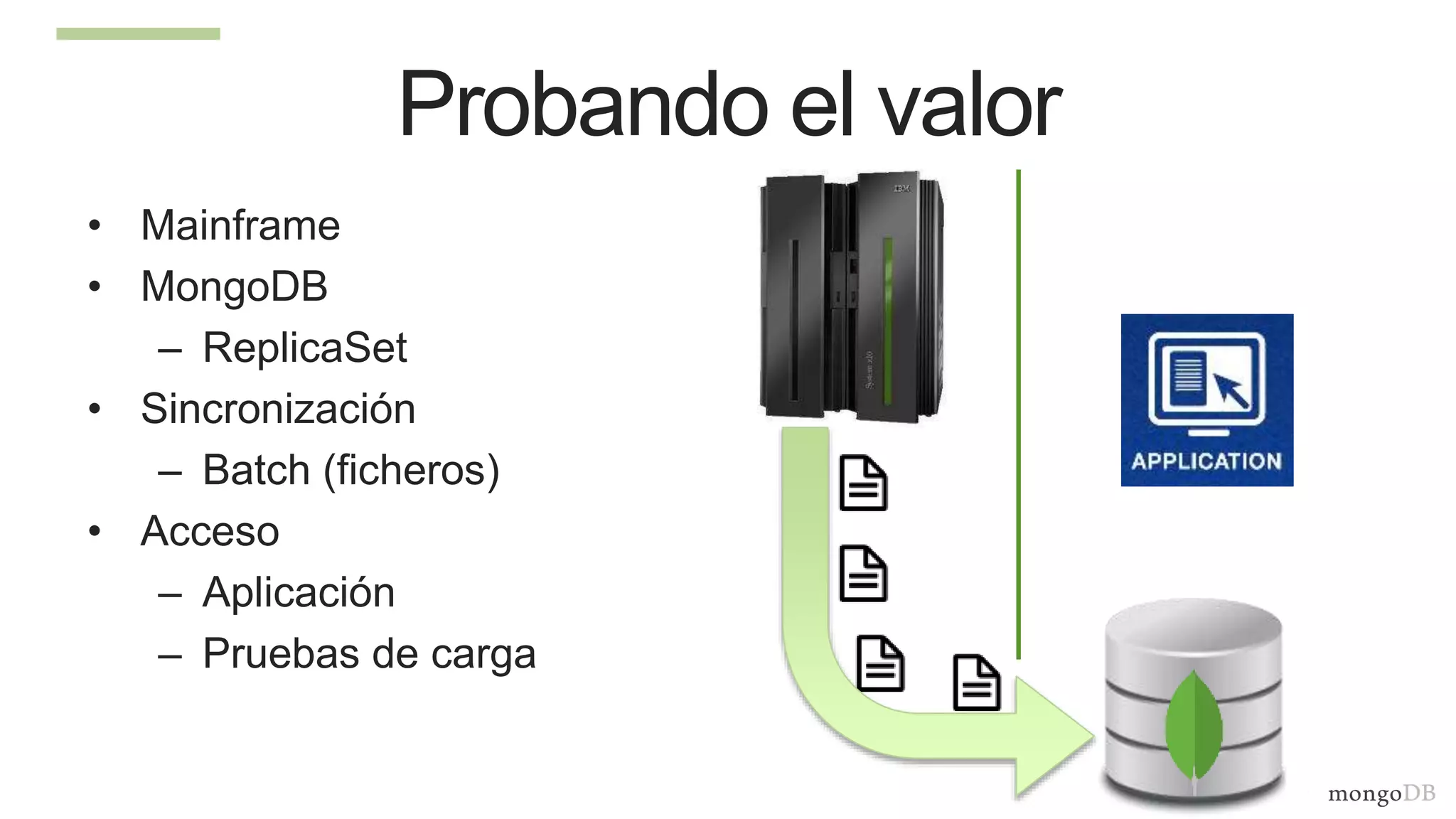
Probando el valor
• Mainframe
• MongoDB
– ReplicaSet
• Sincronización
– Batch (ficheros)
• Acceso
– Aplicación
– Pruebas de carga
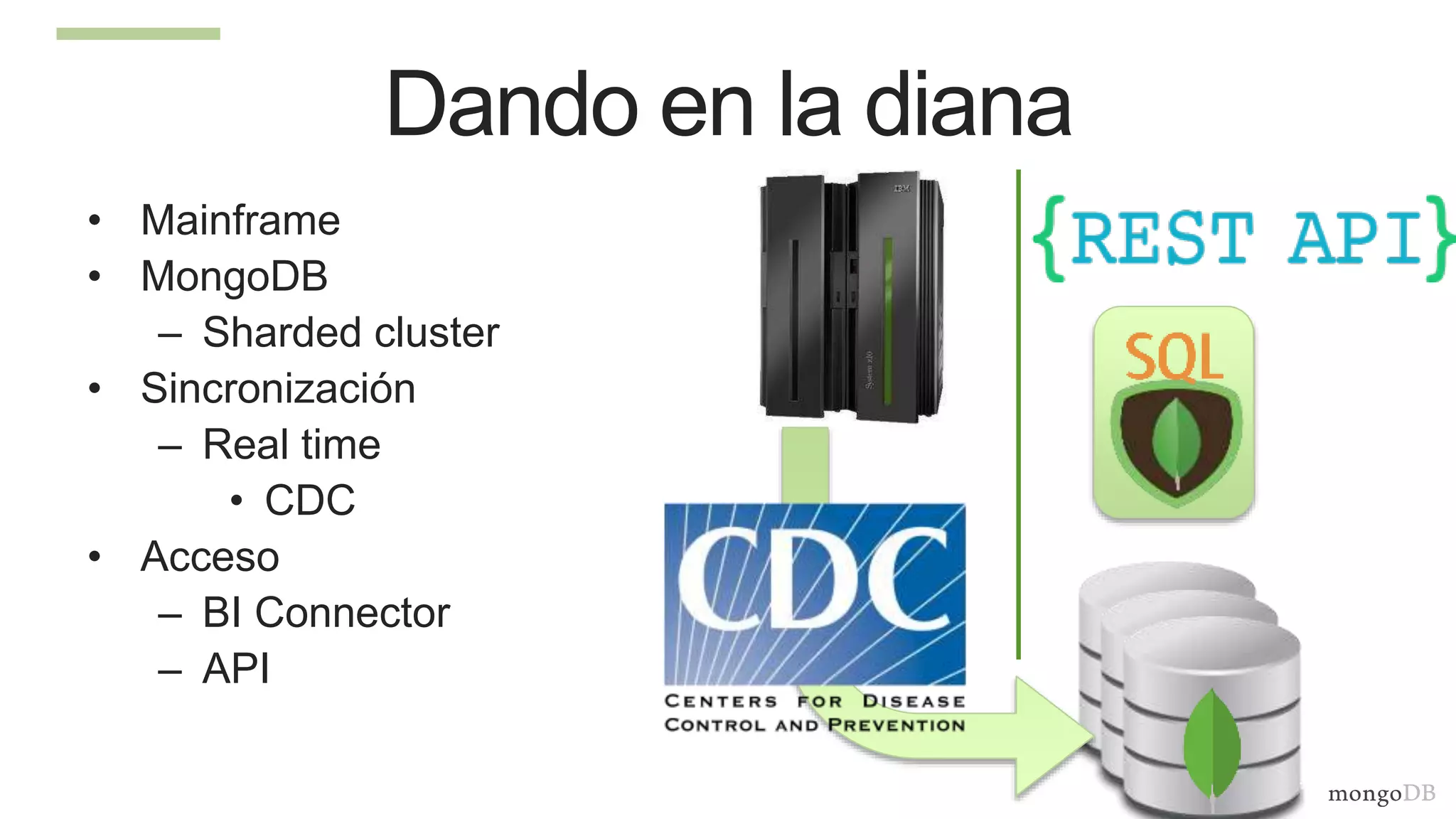
Dando en la diana
• Mainframe
• MongoDB
– Sharded cluster
• Sincronización
– Real time
• CDC
• Acceso
– BI Connector
– API
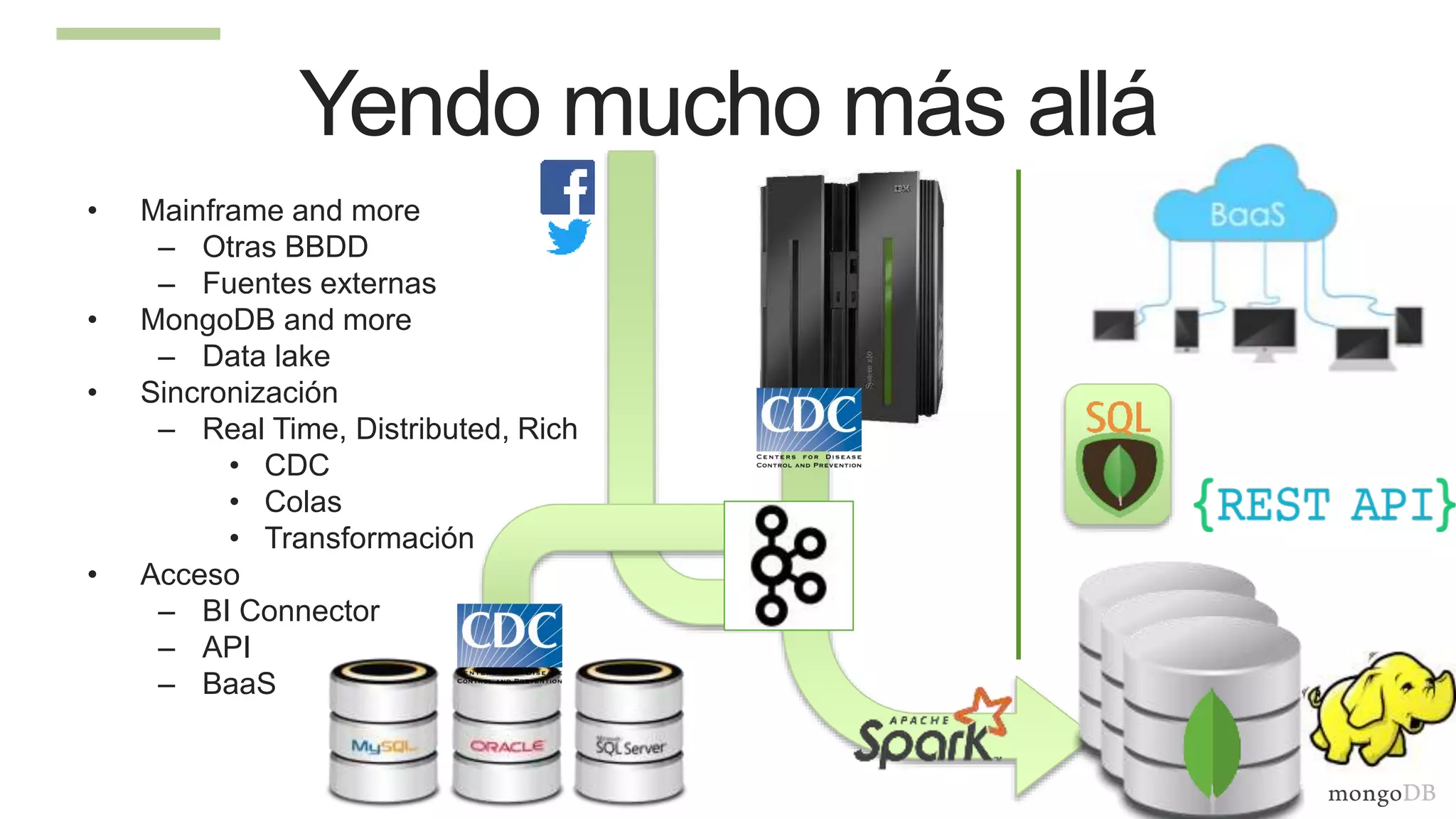
Yendo mucho más allá
• Mainframe and more
– Otras BBDD
– Fuentes externas
• MongoDB and more
– Data lake
• Sincronización
– Real Time, Distributed, Rich
• CDC
• Colas
• Transformación
• Acceso
– BI Connector
– API
– BaaS
Jim Duffy
Global Director of Information
Strategy, MongoDB
Transformar la
Gestión de la
información con
MongoDB
How best can we Navigate today’s complicated Technical Ecosystem
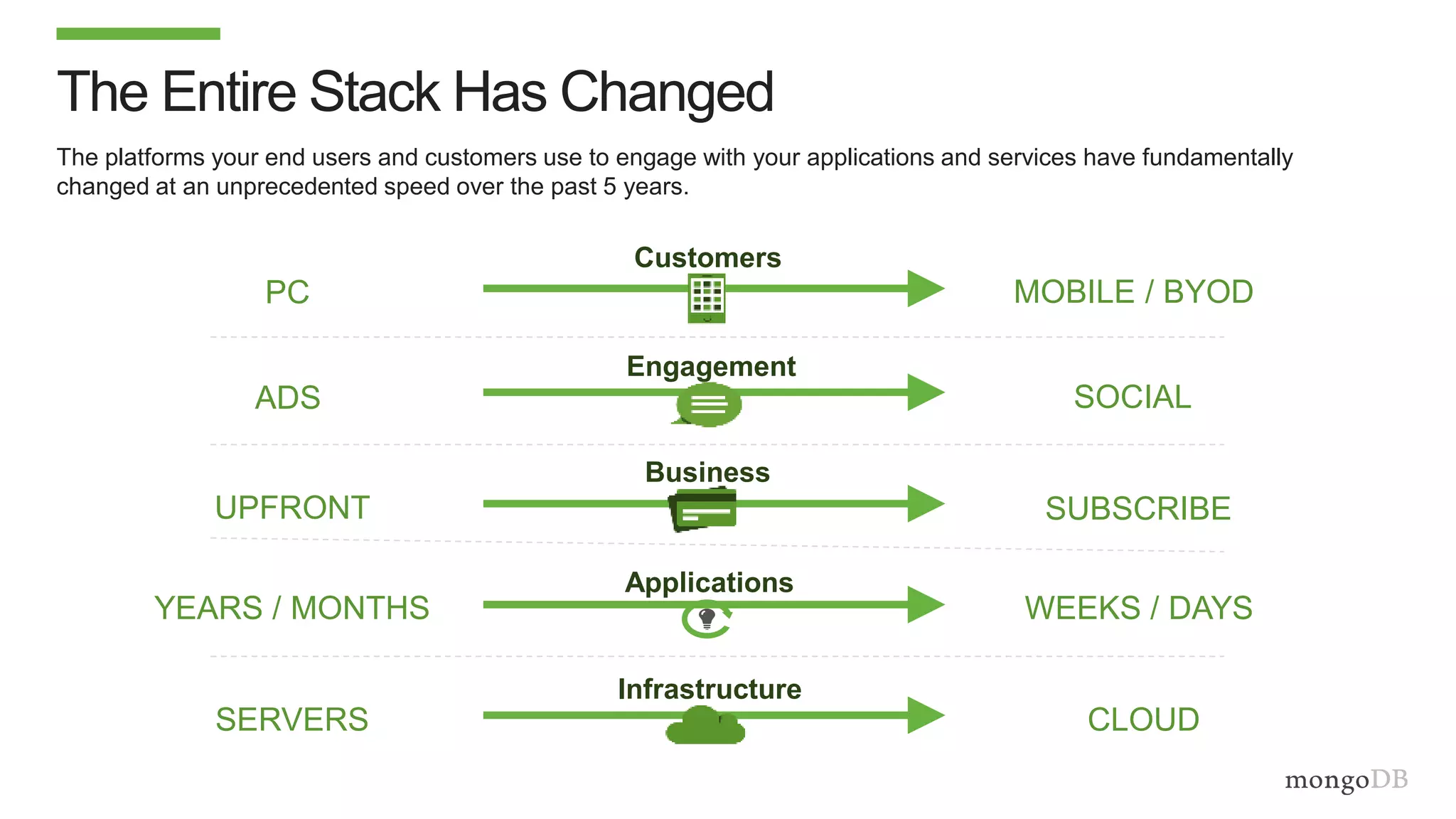
The Entire Stack Has Changed
The platforms your end users and customers use to engage with your applications and services have fundamentally
changed at an unprecedented speed over the past 5 years.
UPFRONT SUBSCRIBE
Business
YEARS / MONTHS WEEKS / DAYS
Applications
PC MOBILE / BYOD
Customers
ADS SOCIAL
Engagement
SERVERS CLOUD
Infrastructure
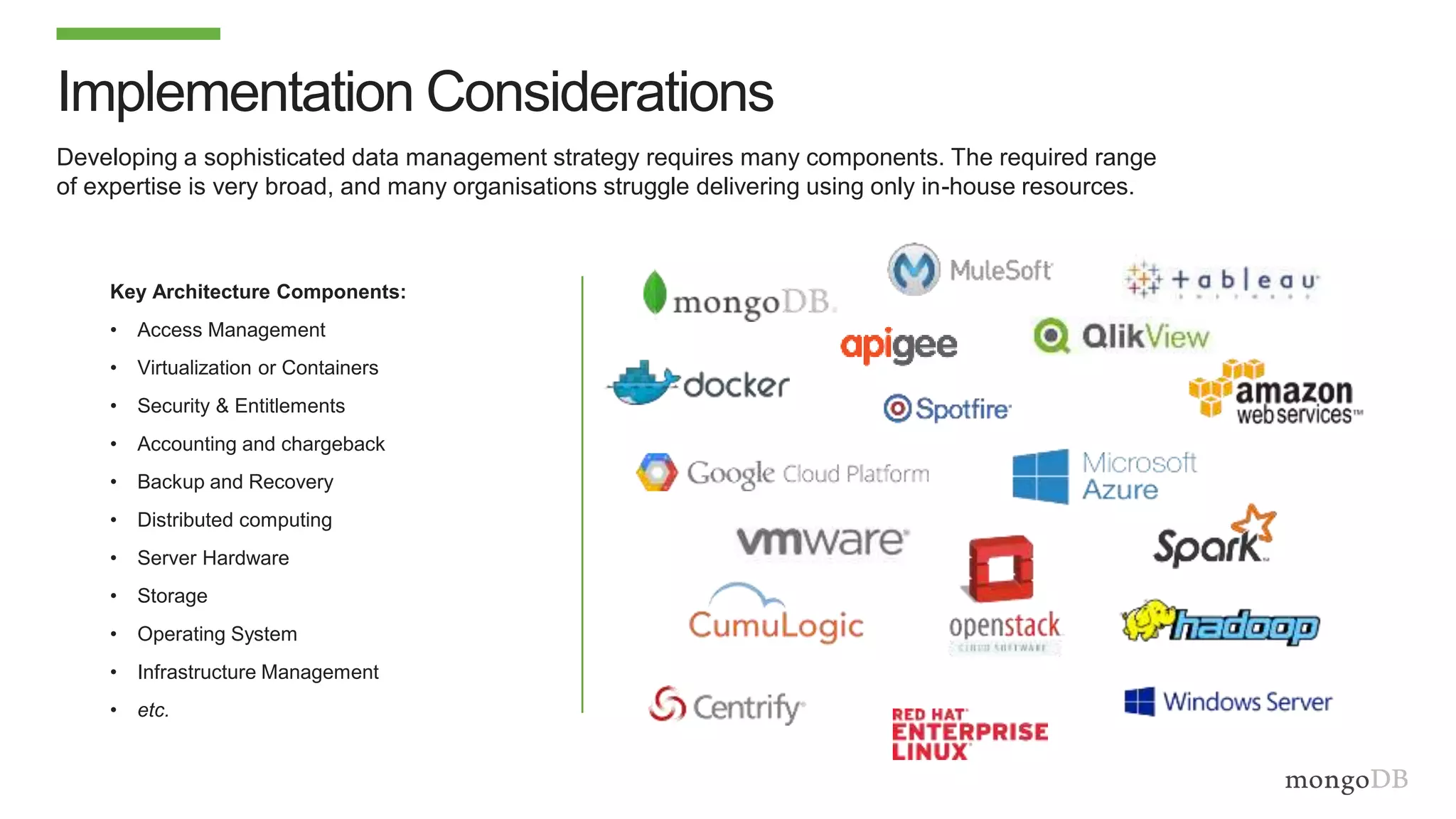
Developing a sophisticated data management strategy requires many components. The required range
of expertise is very broad, and many organisations struggle delivering using only in-house resources.
Implementation Considerations
Key Architecture Components:
• Access Management
• Virtualization or Containers
• Security & Entitlements
• Accounting and chargeback
• Backup and Recovery
• Distributed computing
• Server Hardware
• Storage
• Operating System
• Infrastructure Management
• etc.
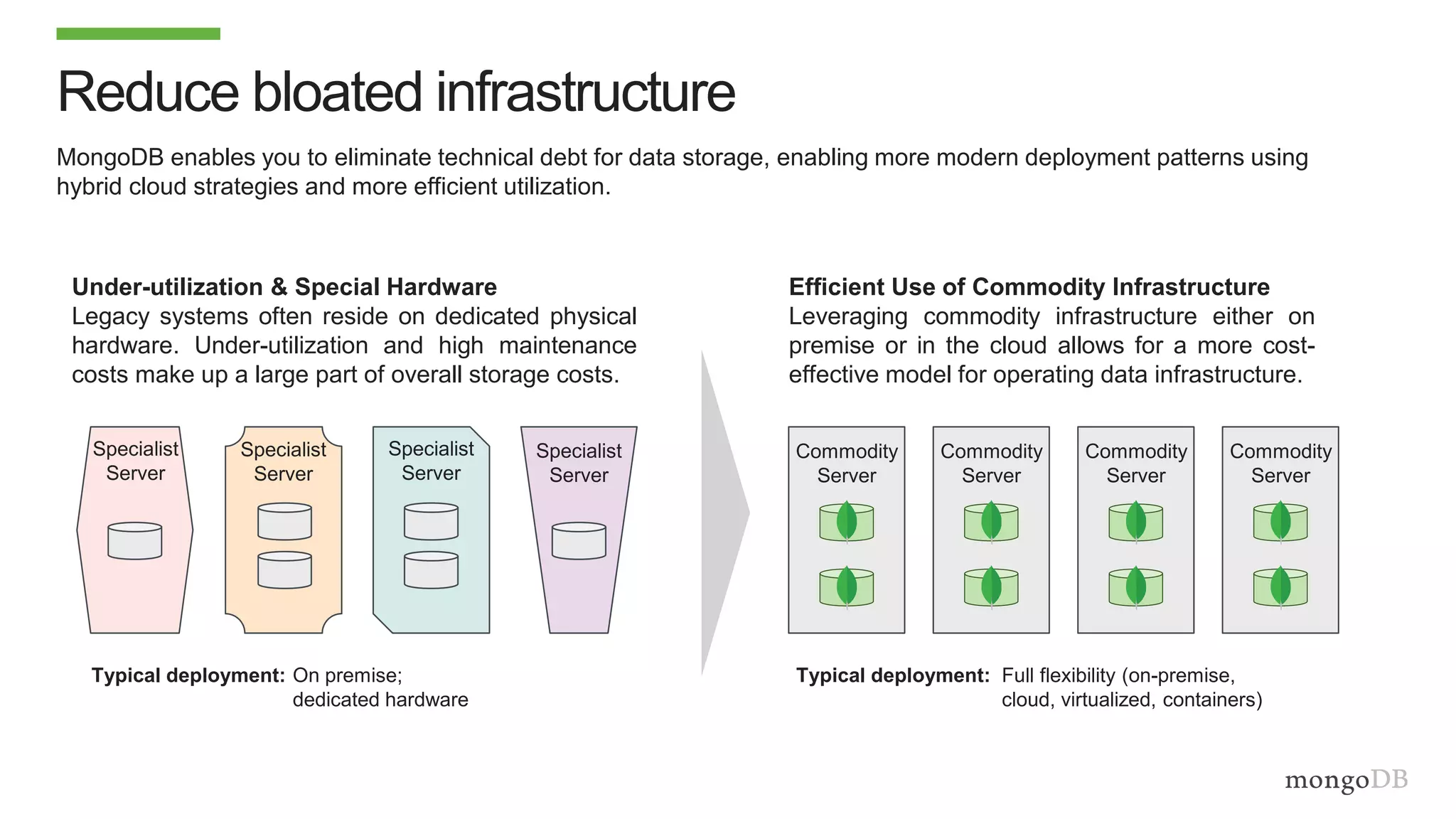
Reduce bloated infrastructure
MongoDB enables you to eliminate technical debt for data storage, enabling more modern deployment patterns using
hybrid cloud strategies and more efficient utilization.
Under-utilization & Special Hardware
Legacy systems often reside on dedicated physical
hardware. Under-utilization and high maintenance
costs make up a large part of overall storage costs.
Specialist
Server
Specialist
Server
Specialist
Server
Specialist
Server
Typical deployment:
Efficient Use of Commodity Infrastructure
Leveraging commodity infrastructure either on
premise or in the cloud allows for a more cost-
effective model for operating data infrastructure.
Commodity
Server
Commodity
Server
Commodity
Server
Commodity
Server
Typical deployment: Full flexibility (on-premise,
cloud, virtualized, containers)
On premise;
dedicated hardware
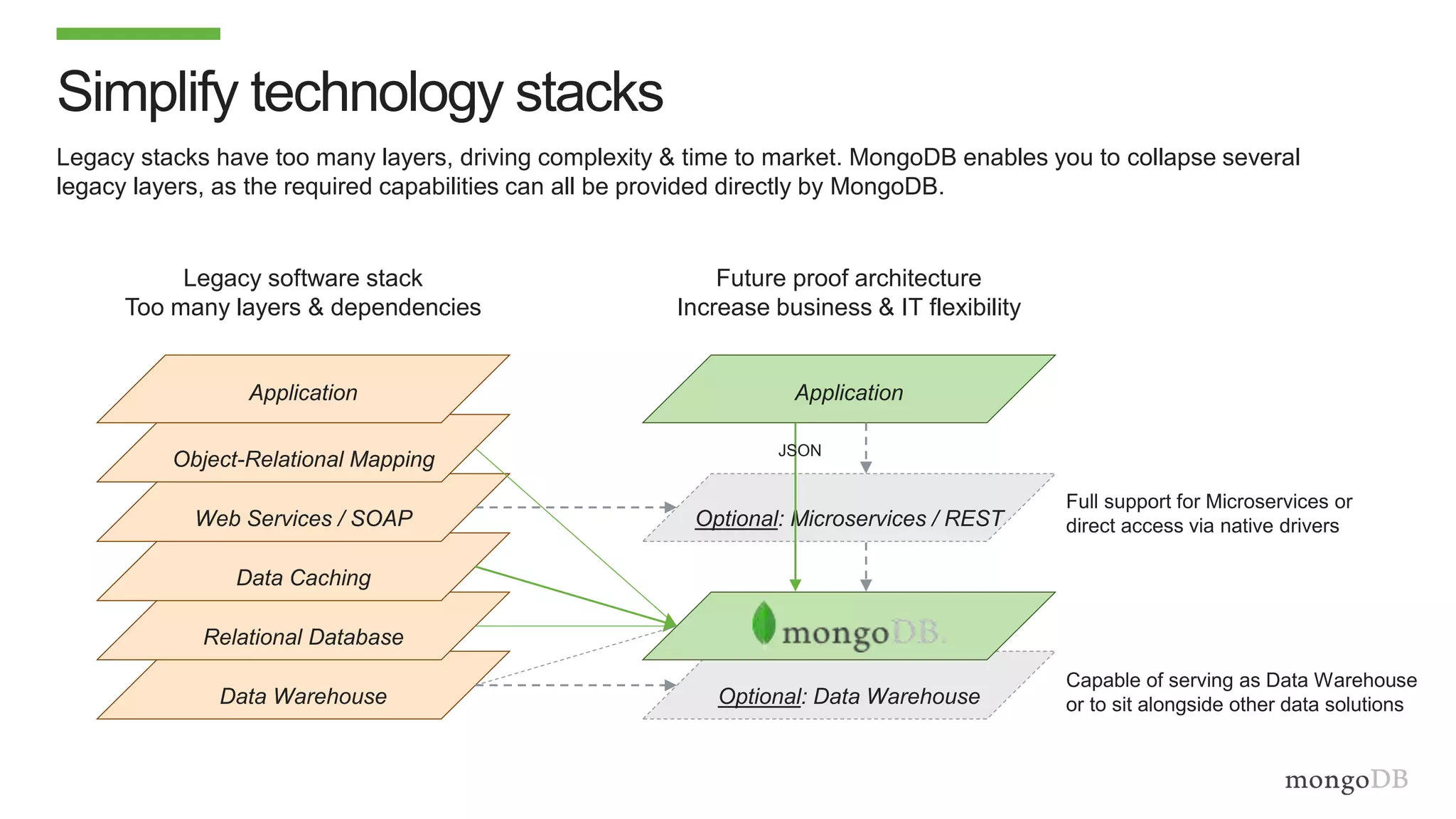
Simplify technology stacks
Legacy stacks have too many layers, driving complexity & time to market. MongoDB enables you to collapse several
legacy layers, as the required capabilities can all be provided directly by MongoDB.
Data Warehouse
Relational Database
Data Caching
Web Services / SOAP
Object-Relational Mapping
Application
Legacy software stack
Too many layers & dependencies
Optional: Data Warehouse
Optional: Microservices / REST
Application
Capable of serving as Data Warehouse
or to sit alongside other data solutions
Full support for Microservices or
direct access via native drivers
Future proof architecture
Increase business & IT flexibility
JSON
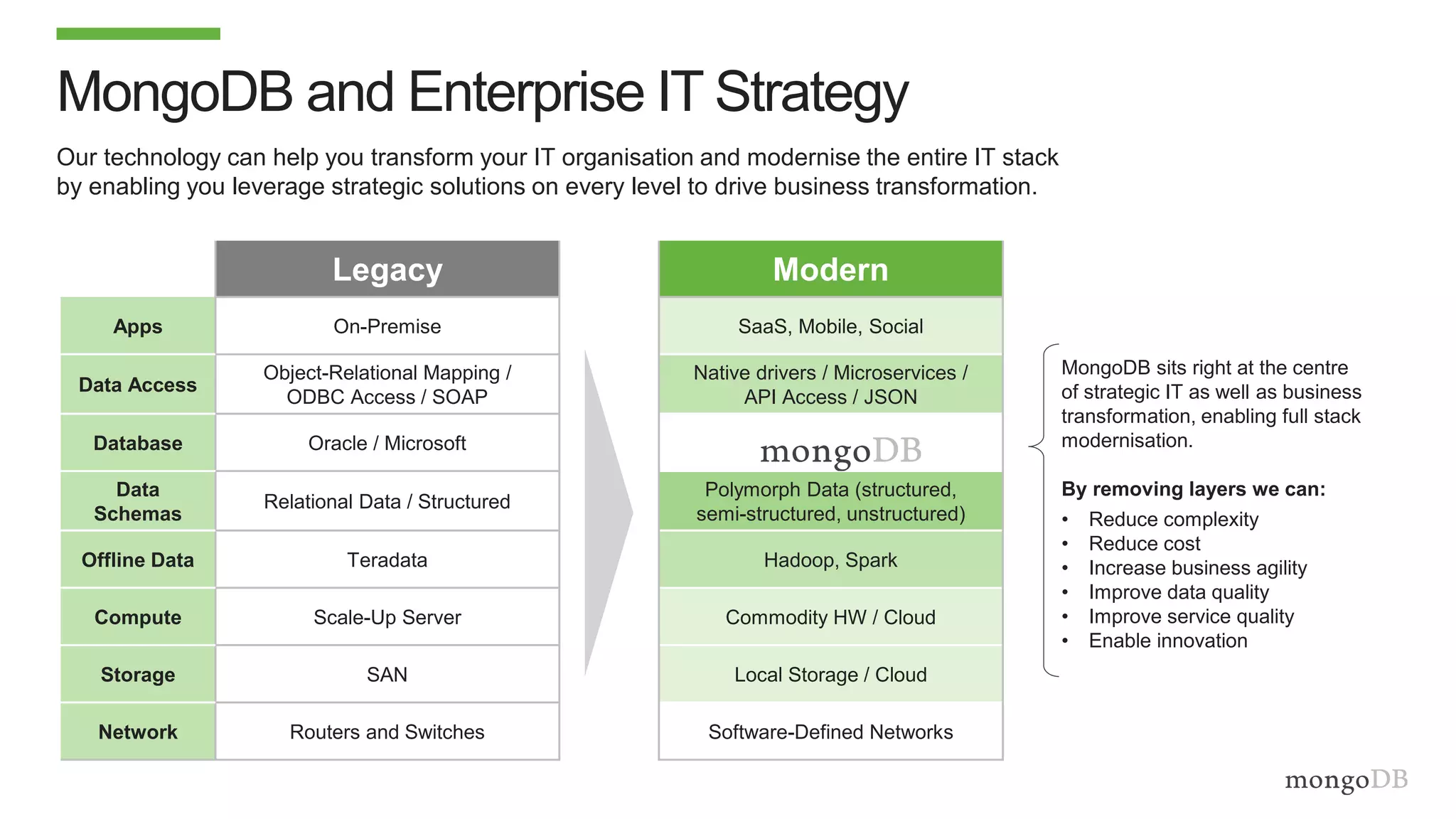
Modern
SaaS, Mobile, Social
Native drivers / Microservices /
API Access / JSON
Polymorph Data (structured,
semi-structured, unstructured)
Hadoop, Spark
Commodity HW / Cloud
Local Storage / Cloud
Software-Defined Networks
Our technology can help you transform your IT organisation and modernise the entire IT stack
by enabling you leverage strategic solutions on every level to drive business transformation.
MongoDB and Enterprise IT Strategy
Legacy
Apps On-Premise
Data Access
Object-Relational Mapping /
ODBC Access / SOAP
Database Oracle / Microsoft
Data
Schemas
Relational Data / Structured
Offline Data Teradata
Compute Scale-Up Server
Storage SAN
Network Routers and Switches
MongoDB sits right at the centre
of strategic IT as well as business
transformation, enabling full stack
modernisation.
By removing layers we can:
• Reduce complexity
• Reduce cost
• Increase business agility
• Improve data quality
• Improve service quality
• Enable innovation
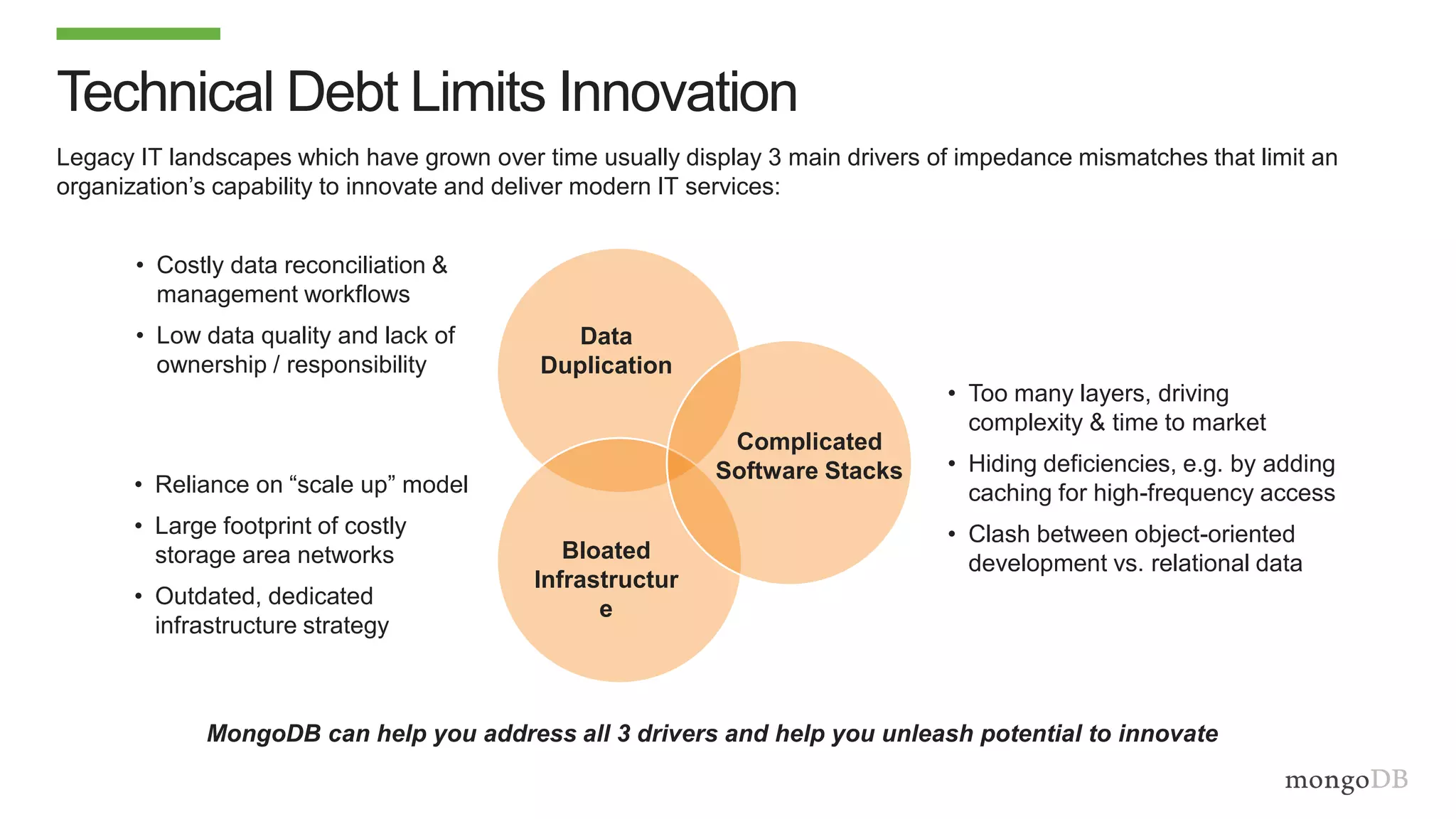
Technical Debt Limits Innovation
Legacy IT landscapes which have grown over time usually display 3 main drivers of impedance mismatches that limit an
organization’s capability to innovate and deliver modern IT services:
Data
Duplication
Bloated
Infrastructur
e
Complicated
Software Stacks
• Costly data reconciliation &
management workflows
• Low data quality and lack of
ownership / responsibility
• Reliance on “scale up” model
• Large footprint of costly
storage area networks
• Outdated, dedicated
infrastructure strategy
• Too many layers, driving
complexity & time to market
• Hiding deficiencies, e.g. by adding
caching for high-frequency access
• Clash between object-oriented
development vs. relational data
MongoDB can help you address all 3 drivers and help you unleash potential to innovate
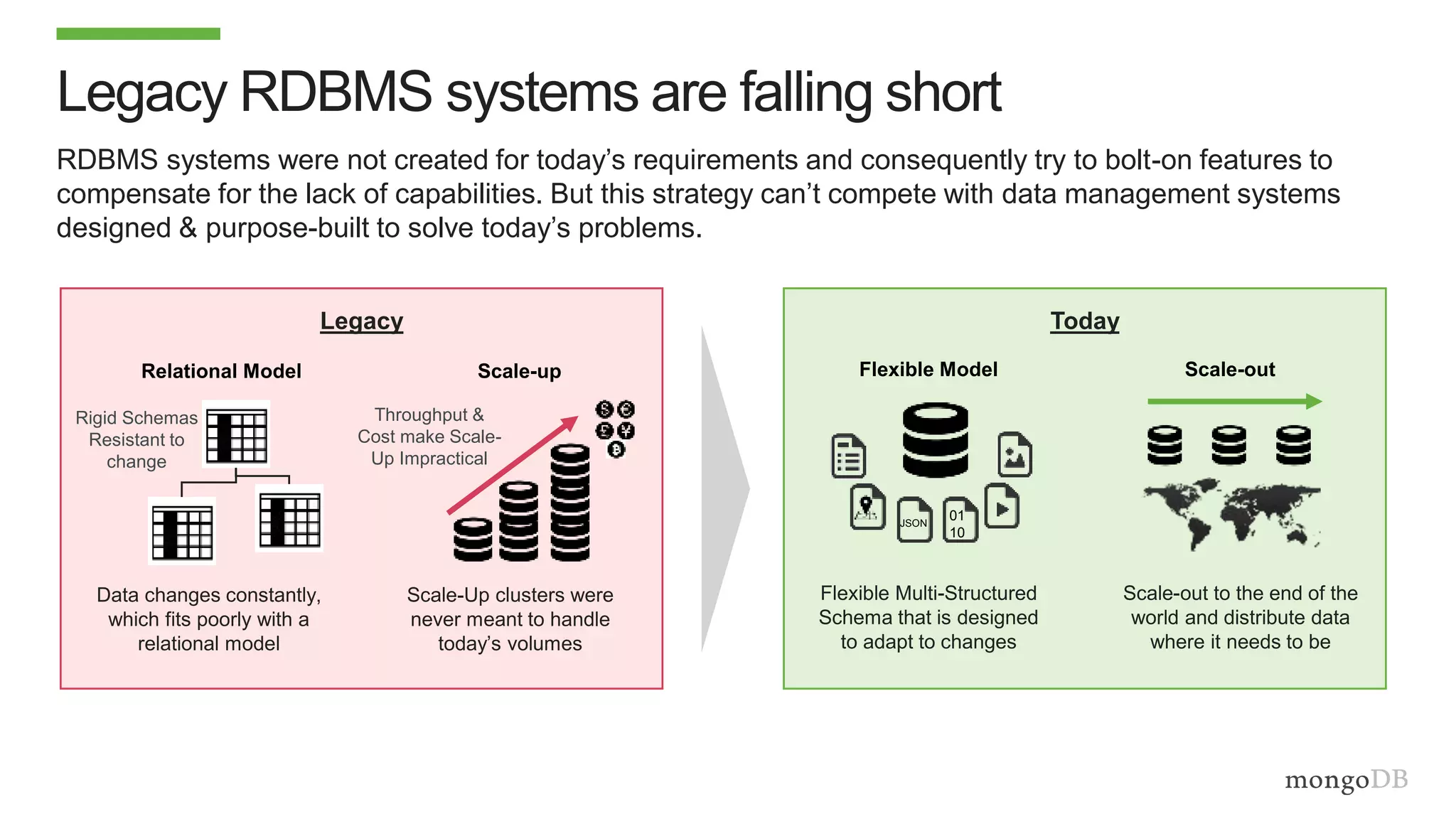
Legacy
Legacy RDBMS systems are falling short
RDBMS systems were not created for today’s requirements and consequently try to bolt-on features to
compensate for the lack of capabilities. But this strategy can’t compete with data management systems
designed & purpose-built to solve today’s problems.
Rigid Schemas
Resistant to
change
Throughput &
Cost make Scale-
Up Impractical
Relational Model Scale-up
Data changes constantly,
which fits poorly with a
relational model
Scale-Up clusters were
never meant to handle
today’s volumes
Today
Flexible Model
01
10
JSON
Scale-out
Flexible Multi-Structured
Schema that is designed
to adapt to changes
Scale-out to the end of the
world and distribute data
where it needs to be
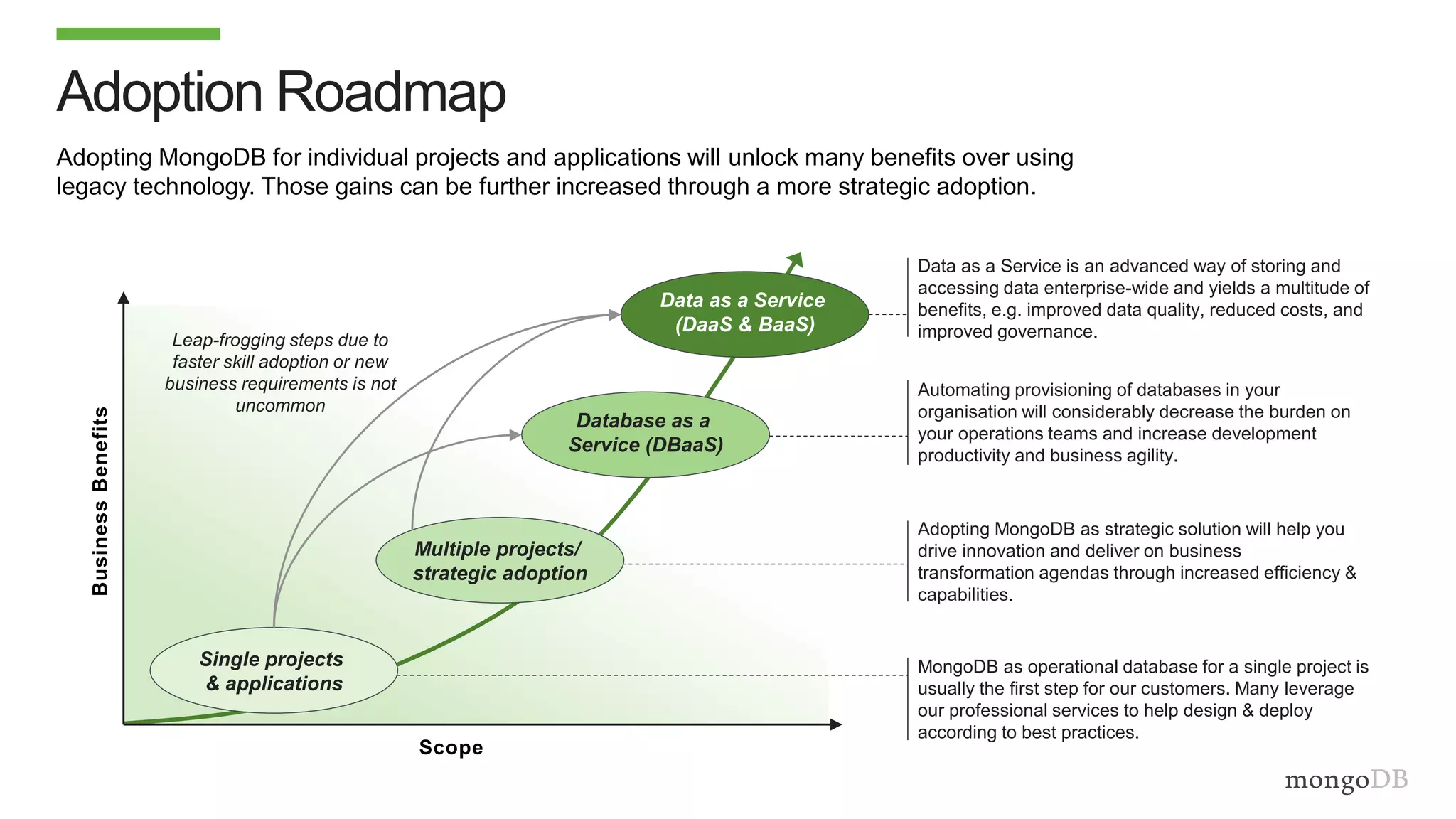
Scope
BusinessBenefitsAdoption Roadmap
Adopting MongoDB for individual projects and applications will unlock many benefits over using
legacy technology. Those gains can be further increased through a more strategic adoption.
Data as a Service
(DaaS & BaaS)
Data as a Service is an advanced way of storing and
accessing data enterprise-wide and yields a multitude of
benefits, e.g. improved data quality, reduced costs, and
improved governance.
Database as a
Service (DBaaS)
Automating provisioning of databases in your
organisation will considerably decrease the burden on
your operations teams and increase development
productivity and business agility.
Adopting MongoDB as strategic solution will help you
drive innovation and deliver on business
transformation agendas through increased efficiency &
capabilities.
Multiple projects/
strategic adoption
MongoDB as operational database for a single project is
usually the first step for our customers. Many leverage
our professional services to help design & deploy
according to best practices.
Single projects
& applications
Leap-frogging steps due to
faster skill adoption or new
business requirements is not
uncommon
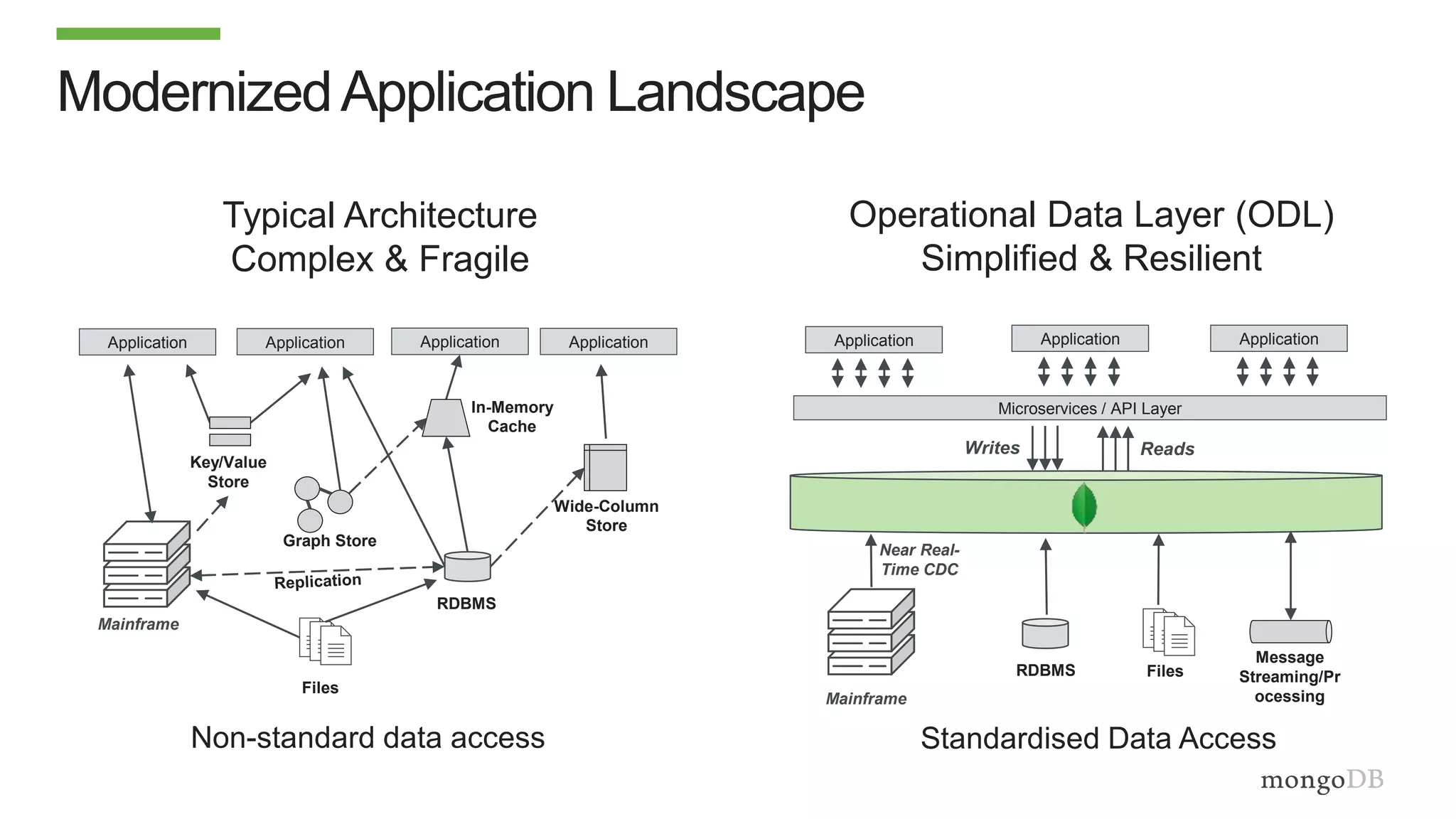
ModernizedApplication Landscape
RDBMS Files
Mainframe
Application
Microservices / API Layer
ReadsWrites
Key/Value
Store
Files
Mainframe
Application
Typical Architecture
Complex & Fragile
Operational Data Layer (ODL)
Simplified & Resilient
Application Application Application
In-Memory
Cache
RDBMS
Wide-Column
Store
Application Application
Non-standard data access Standardised Data Access
Near Real-
Time CDC
Message
Streaming/Pr
ocessing
Graph Store
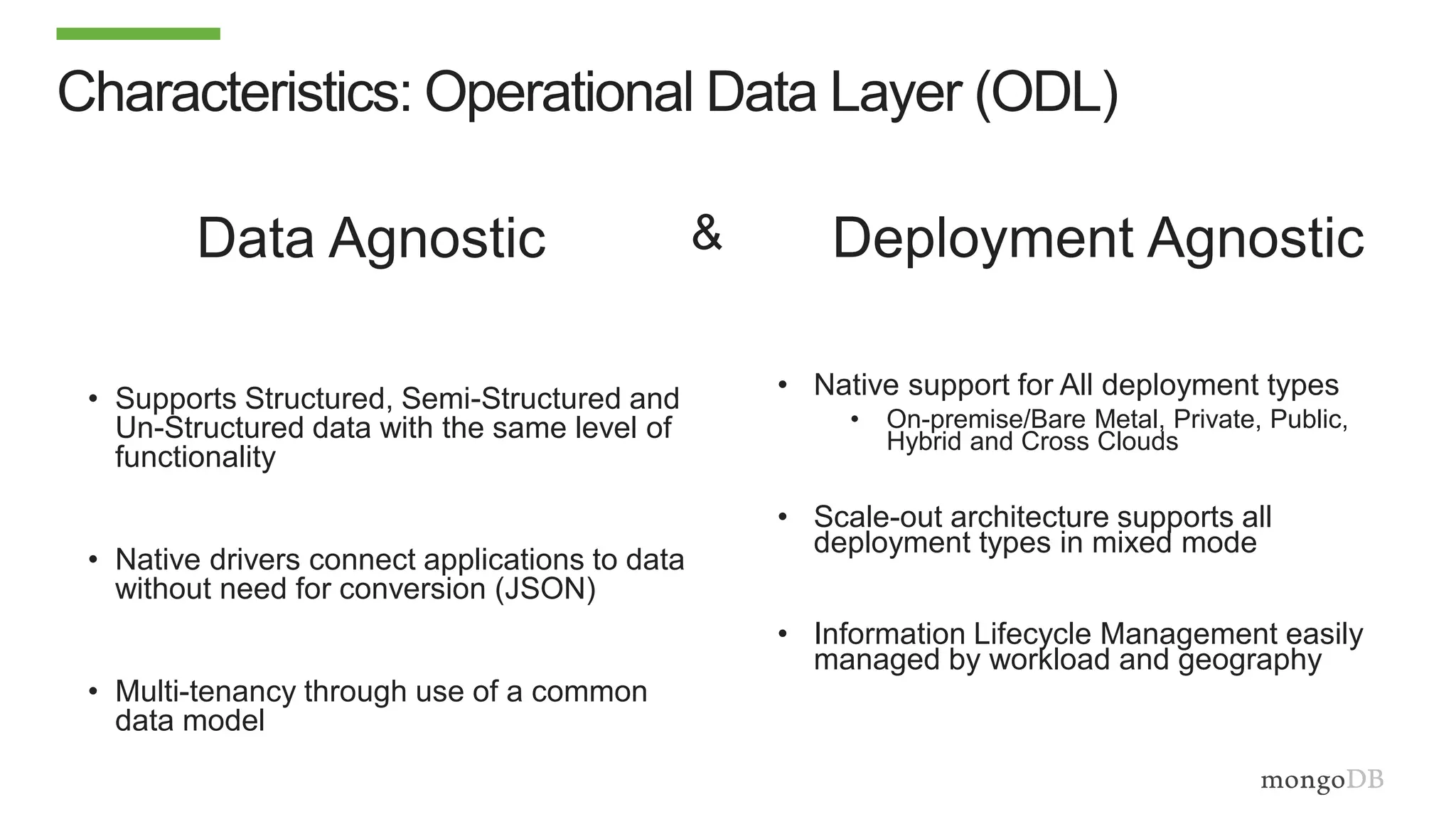
Characteristics: Operational Data Layer (ODL)
• Supports Structured, Semi-Structured and
Un-Structured data with the same level of
functionality
• Native drivers connect applications to data
without need for conversion (JSON)
• Multi-tenancy through use of a common
data model
• Native support for All deployment types
• On-premise/Bare Metal, Private, Public,
Hybrid and Cross Clouds
• Scale-out architecture supports all
deployment types in mixed mode
• Information Lifecycle Management easily
managed by workload and geography
Data Agnostic Deployment Agnostic&
Customer Success Stories:
Legacy Modernization
29
Problem Why MongoDB ResultsProblem Solution Results
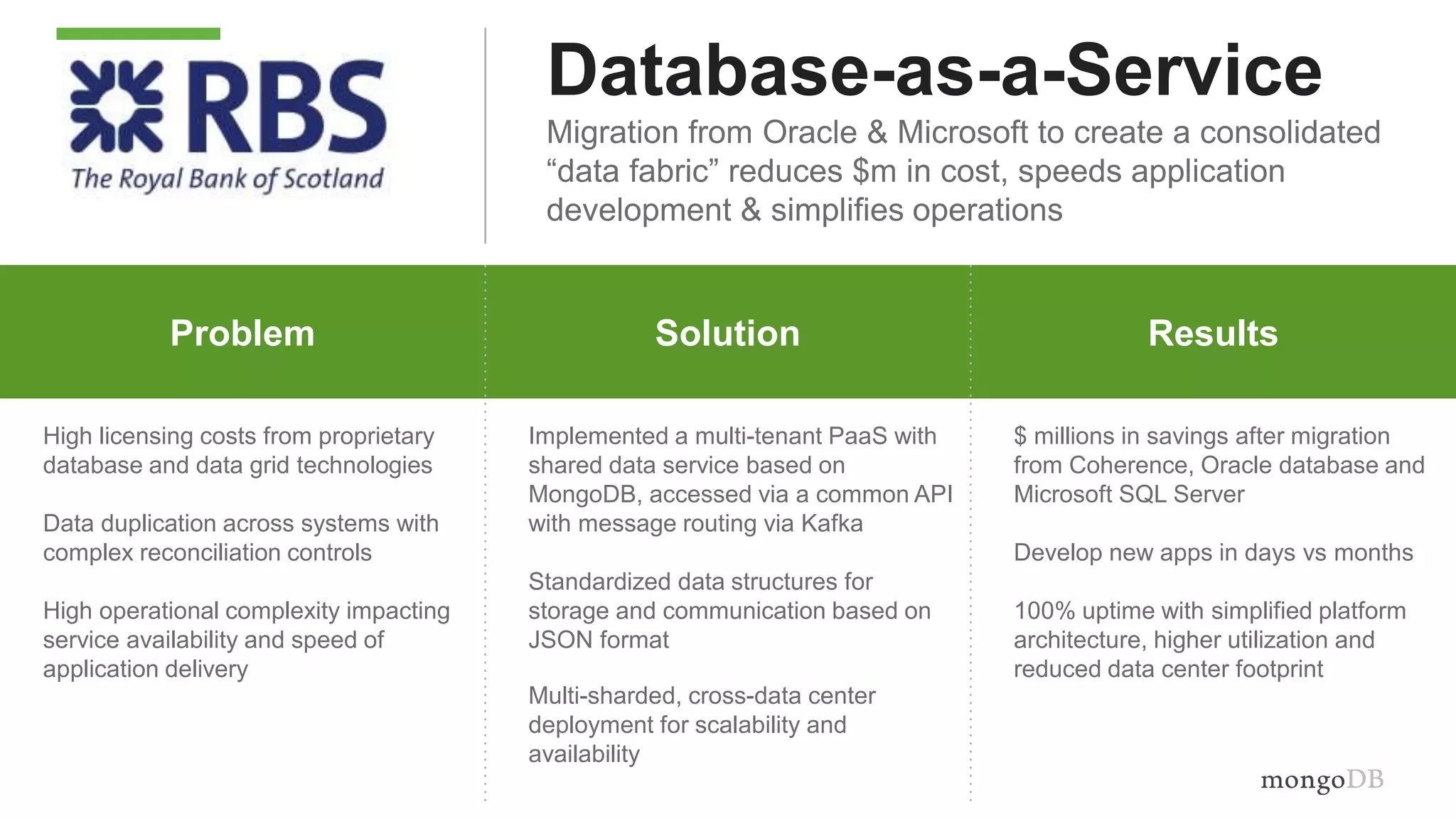
High licensing costs from proprietary
database and data grid technologies
Data duplication across systems with
complex reconciliation controls
High operational complexity impacting
service availability and speed of
application delivery
Implemented a multi-tenant PaaS with
shared data service based on
MongoDB, accessed via a common API
with message routing via Kafka
Standardized data structures for
storage and communication based on
JSON format
Multi-sharded, cross-data center
deployment for scalability and
availability
$ millions in savings after migration
from Coherence, Oracle database and
Microsoft SQL Server
Develop new apps in days vs months
100% uptime with simplified platform
architecture, higher utilization and
reduced data center footprint
Database-as-a-Service
Migration from Oracle & Microsoft to create a consolidated
“data fabric” reduces $m in cost, speeds application
development & simplifies operations
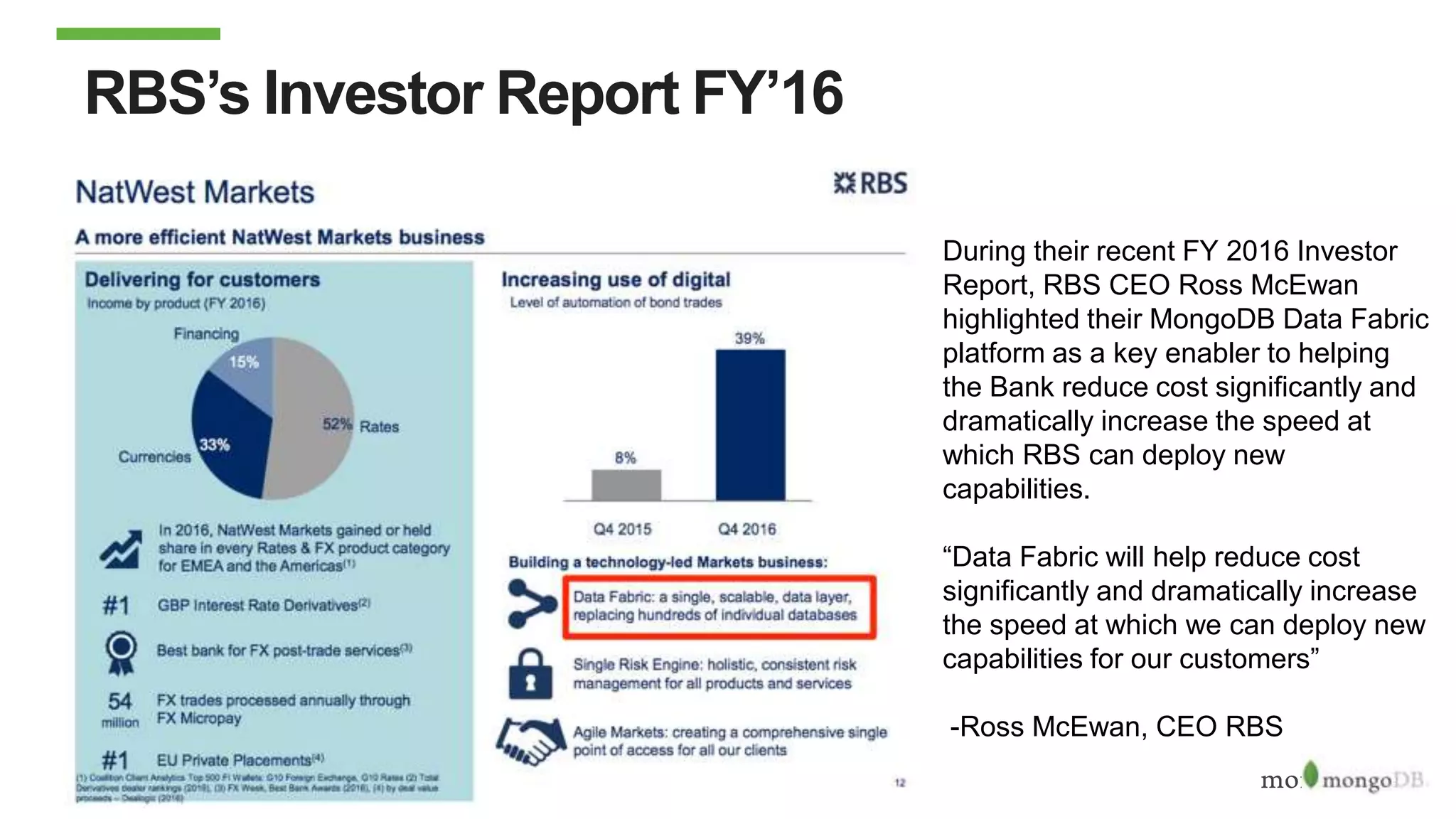
During their recent FY 2016 Investor
Report, RBS CEO Ross McEwan
highlighted their MongoDB Data Fabric
platform as a key enabler to helping
the Bank reduce cost significantly and
dramatically increase the speed at
which RBS can deploy new
capabilities.
“Data Fabric will help reduce cost
significantly and dramatically increase
the speed at which we can deploy new
capabilities for our customers”
-Ross McEwan, CEO RBS
RBS’s Investor Report FY’16
Problem Why MongoDB ResultsProblem Solution Results
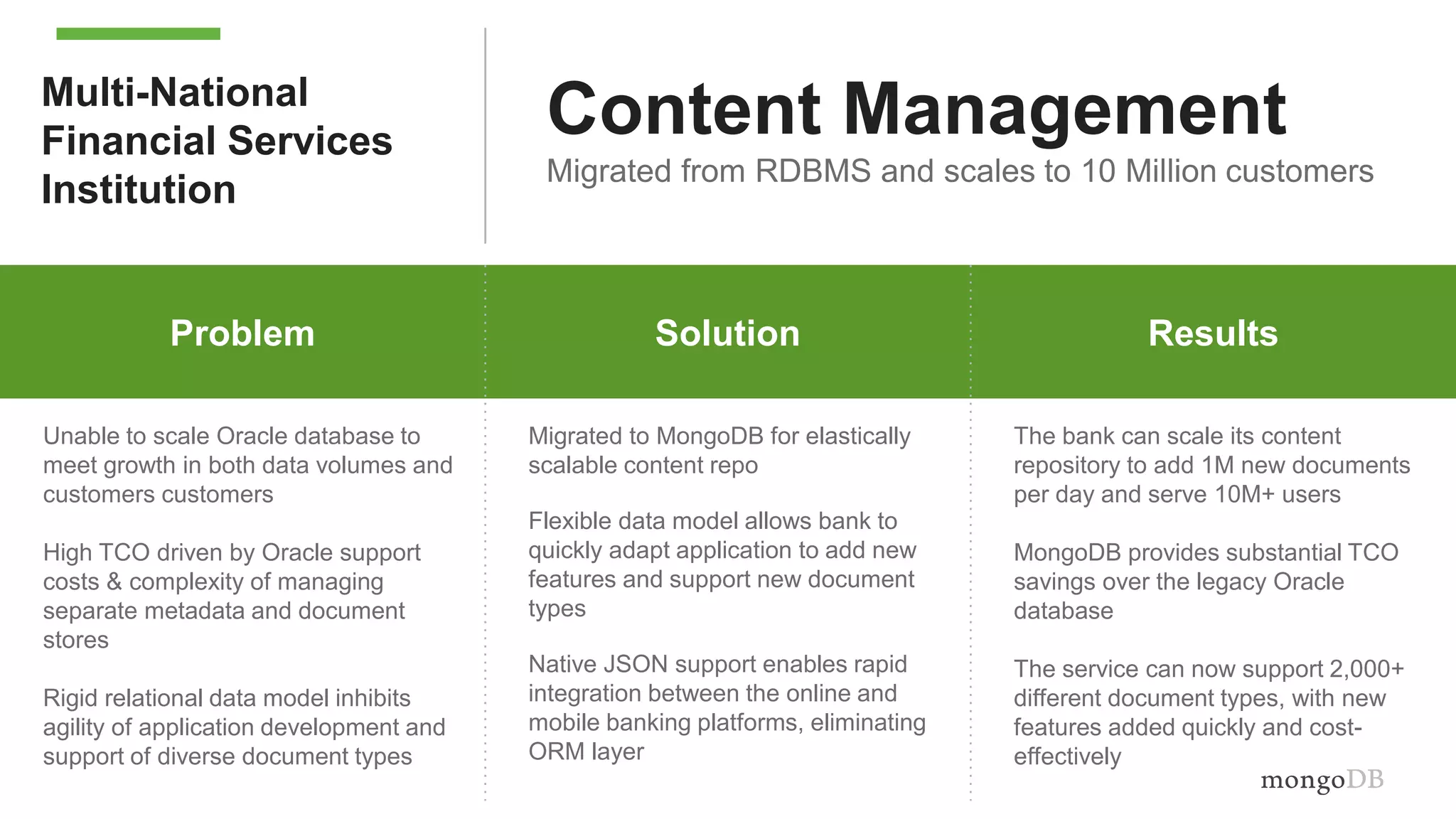
Unable to scale Oracle database to
meet growth in both data volumes and
customers customers
High TCO driven by Oracle support
costs & complexity of managing
separate metadata and document
stores
Rigid relational data model inhibits
agility of application development and
support of diverse document types
Migrated to MongoDB for elastically
scalable content repo
Flexible data model allows bank to
quickly adapt application to add new
features and support new document
types
Native JSON support enables rapid
integration between the online and
mobile banking platforms, eliminating
ORM layer
The bank can scale its content
repository to add 1M new documents
per day and serve 10M+ users
MongoDB provides substantial TCO
savings over the legacy Oracle
database
The service can now support 2,000+
different document types, with new
features added quickly and cost-
effectively
Content Management
Migrated from RDBMS and scales to 10 Million customers
Multi-National
Financial Services
Institution
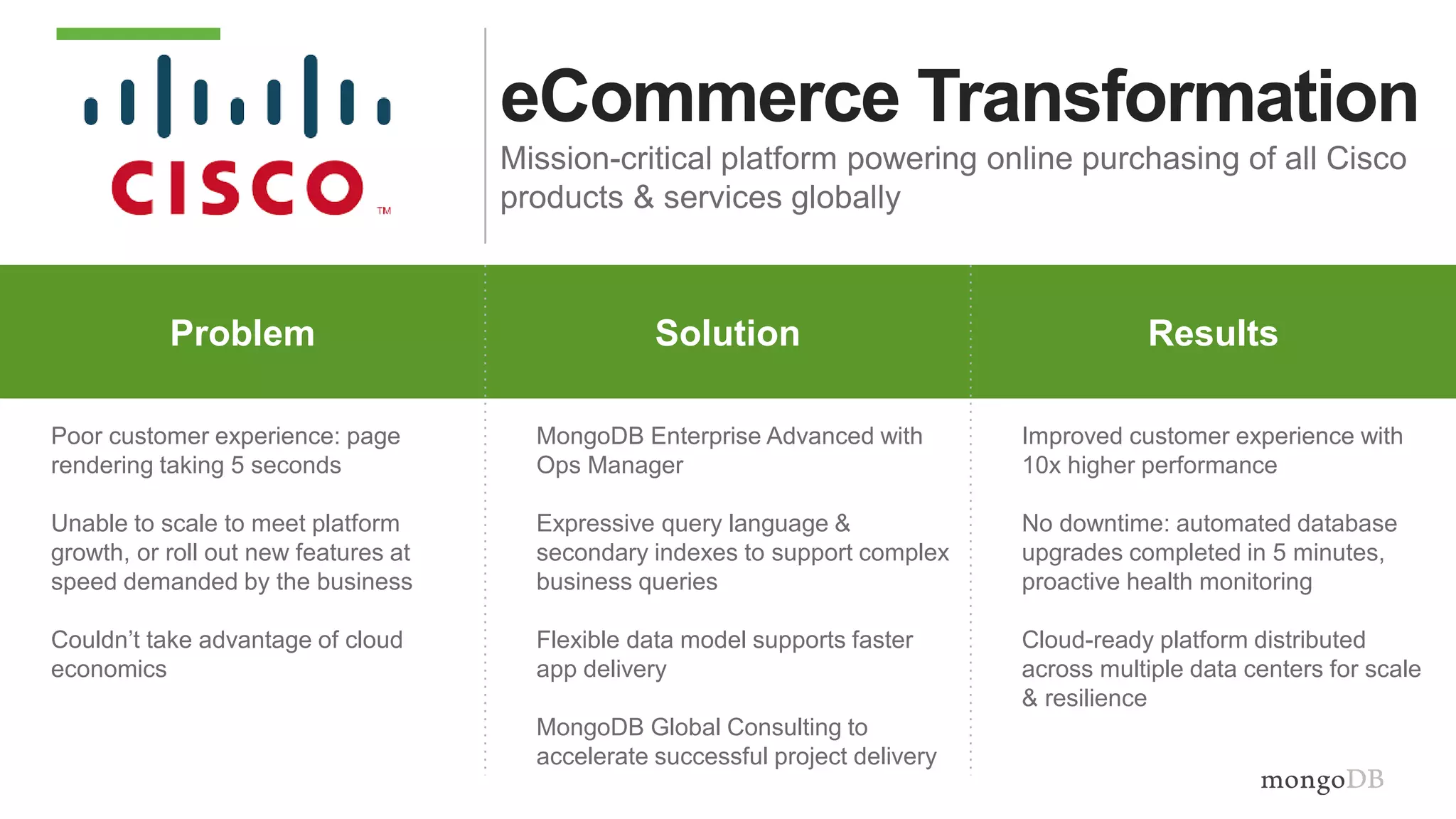
eCommerce Transformation
Mission-critical platform powering online purchasing of all Cisco
products & services globally
Problem Why MongoDB ResultsProblem Solution Results
Poor customer experience: page
rendering taking 5 seconds
Unable to scale to meet platform
growth, or roll out new features at
speed demanded by the business
Couldn’t take advantage of cloud
economics
MongoDB Enterprise Advanced with
Ops Manager
Expressive query language &
secondary indexes to support complex
business queries
Flexible data model supports faster
app delivery
MongoDB Global Consulting to
accelerate successful project delivery
Improved customer experience with
10x higher performance
No downtime: automated database
upgrades completed in 5 minutes,
proactive health monitoring
Cloud-ready platform distributed
across multiple data centers for scale
& resilience
• www.mongodb.com
• ruben@mongodb.com
• Francisco.molero@mongodb.com
Gracias.
La creación de una capa operacional con MongoDB

La creación de una capa operacional con MongoDB

  • 1.
    La creación deuna capa operacional con MongoDB Desayunos con MongoDB ww.mongodb.com
  • 2.
    • Introducción • Retosactuales del Mainframe • Casos reales • Transformar la Gestión de la información con MongoDB • Q&A • Almuerzo Agenda
  • 3.
    MongoDB en cifras 800+ empleados 3,000+ clientes 22oficinas en el mundo $311M in fundings 20M de descargas #1 NoSQL Database
  • 4.
    Let our teamhelp you on your journey to efficiently leverage the capabilities of MongoDB, the data platform that allows innovators to unleash the power of software and data for giant ideas. The largest Financial Services and, Communications and Government Organizations are working with MongoDB to Modernize their Mainframes to Reduce Cost and Increase Resilience Being successful with MongoDB for Mainframes 5-10xDeveloper Productivity We help our customers to increase overall output, e.g. in terms of engineering productivity. 80%Mainframe Cost Reduction We help our customers to dramatically lower their total cost of ownership for data storage and analytics by up to 80%.
  • 5.
    Jim Duffy Global Directorof Information Strategy, MongoDB Retos actuales del Mainframe
  • 6.
    Challenges of Mainframesin a Modern World There are three areas of Data Management. In the legacy world these have been disconnected with many technologies attempting to achieve an integrated the landscape. AdaptabilityCost Risk Unpredictable Loads Planned/Unplanned Downtime Expensive Ecosystem Change Management Access to Skills Capacity Management Business Process Risk Operational Complexity Customer Experience
  • 7.
    5 phases ofMainframe Modernization MongoDB will help you simultaneously offload critical services from the mainframe, save millions in cost and increase agility for new use cases. Scope BusinessBenefits Transactions are written first to MongoDB, which passes the data on to the mainframe system of record. Writes are performed concurrently to the mainframe as well as MongoDB (Y-Loading), e.g. via a service-driven architecture. The Operational Data Layer (ODL) data is enriched with additional sources to serve as operational intelligence platform for insights and analytics. Enriched ODL Records are copied via CDC/Delta Load mechanism from the mainframe into MongoDB, which serves as Operational Data Layer (ODL), e.g. for frequent reads. Operational Data Layer (ODL) “MongoDB first” “Y-Loading” System of Record MongoDB serves as system of record for a multitude of applications, with deferred writes to the mainframe if necessary. Offloading Reads Transforming the role of the mainframe Offloading Reads & Writes
  • 8.
    Offloading Reads Initial usecases primarily focus on offloading costly reads, e.g. for querying large numbers of transactions for analytics or historical views across customer data. Application Application Mainframe Mainframe Operational Data Layer (ODL) Using a change data capture (CDC) or delta load mechanism you create an operational data layer alongside the mainframe that serves read-heavy operations. Additional data sources Files Enriched Operational Data Layer (ODL) Additional data sourced are loaded into the ODL to create an even richer picture of your existing data and enable additional use cases like advanced analytics. Writes Reads Reads Writes 100% 10-50%50-90% Writes Reads 100% 25-75%25-75% Writes Reads
  • 9.
    Offloading Reads &Writes By introducing a smarter architecture to orchestrate writes concurrently, e.g. via a Microservices architecture, you can shift away from delayed CDC or delta load mechanisms. Mainframe Additional data sources Files Reads Y-Loading Writing (some) data concurrently into the mainframe as well as MongoDB enables you to further limit interactions with the mainframe technology . It also sets you up for a more transformational shift of the role of the mainframe with regards to your enterprise architecture. Application 10-25%75-90% 40-80%20-60% Writes Reads Microservices / Backend as a Service Writes
  • 10.
    Transforming the roleof the mainframe With a shift towards writing to MongoDB first before writing to the mainframe (if at all) you are further changing the meaning of “system of record” and “mainframe” within the organisation. Mainframe Additional data sources Files System of Record MongoDB serves as main System of Record, with writes optionally being passed on to the mainframe for legacy applications only or it gets decommissioned entirely. Mainframe Additional data sources Files “MongoDB first” Transactions first write to MongoDB, which can serve as buffer before it passes transactions to the mainframe as System of Record. Writes Processing 20-50%50-80% 60-90%10-40% Writes Reads 50-90%10-50% 90-100%0-10% Writes Reads Application Microservices / Backend as a Service Reads Writes Application Microservices / Backend as a Service Reads Writes
  • 11.
    Rubén Terceño Senior SolutionsArchitect, MongoDB Casos reales
  • 12.
    Las piezas delpuzzle • Mainframe • MongoDB • Sincronización • Acceso
  • 13.
    Experiencias • Los proyectossulen tener tres fases. – Toma de contacto. • Probamos las ideas y la tecnología – Fase operativa • Usamos la tecnología para implementar las ideas – Fase creativa • Usamos la tecnología con ideas qué no se nos habían ocurrido antes
  • 14.
    Probando el valor •Mainframe • MongoDB – ReplicaSet • Sincronización – Batch (ficheros) • Acceso – Aplicación – Pruebas de carga
  • 15.
    Dando en ladiana • Mainframe • MongoDB – Sharded cluster • Sincronización – Real time • CDC • Acceso – BI Connector – API
  • 16.
    Yendo mucho másallá • Mainframe and more – Otras BBDD – Fuentes externas • MongoDB and more – Data lake • Sincronización – Real Time, Distributed, Rich • CDC • Colas • Transformación • Acceso – BI Connector – API – BaaS
  • 17.
    Jim Duffy Global Directorof Information Strategy, MongoDB Transformar la Gestión de la información con MongoDB
  • 18.
    How best canwe Navigate today’s complicated Technical Ecosystem
  • 19.
    The Entire StackHas Changed The platforms your end users and customers use to engage with your applications and services have fundamentally changed at an unprecedented speed over the past 5 years. UPFRONT SUBSCRIBE Business YEARS / MONTHS WEEKS / DAYS Applications PC MOBILE / BYOD Customers ADS SOCIAL Engagement SERVERS CLOUD Infrastructure
  • 20.
    Developing a sophisticateddata management strategy requires many components. The required range of expertise is very broad, and many organisations struggle delivering using only in-house resources. Implementation Considerations Key Architecture Components: • Access Management • Virtualization or Containers • Security & Entitlements • Accounting and chargeback • Backup and Recovery • Distributed computing • Server Hardware • Storage • Operating System • Infrastructure Management • etc.
  • 21.
    Reduce bloated infrastructure MongoDBenables you to eliminate technical debt for data storage, enabling more modern deployment patterns using hybrid cloud strategies and more efficient utilization. Under-utilization & Special Hardware Legacy systems often reside on dedicated physical hardware. Under-utilization and high maintenance costs make up a large part of overall storage costs. Specialist Server Specialist Server Specialist Server Specialist Server Typical deployment: Efficient Use of Commodity Infrastructure Leveraging commodity infrastructure either on premise or in the cloud allows for a more cost- effective model for operating data infrastructure. Commodity Server Commodity Server Commodity Server Commodity Server Typical deployment: Full flexibility (on-premise, cloud, virtualized, containers) On premise; dedicated hardware
  • 22.
    Simplify technology stacks Legacystacks have too many layers, driving complexity & time to market. MongoDB enables you to collapse several legacy layers, as the required capabilities can all be provided directly by MongoDB. Data Warehouse Relational Database Data Caching Web Services / SOAP Object-Relational Mapping Application Legacy software stack Too many layers & dependencies Optional: Data Warehouse Optional: Microservices / REST Application Capable of serving as Data Warehouse or to sit alongside other data solutions Full support for Microservices or direct access via native drivers Future proof architecture Increase business & IT flexibility JSON
  • 23.
    Modern SaaS, Mobile, Social Nativedrivers / Microservices / API Access / JSON Polymorph Data (structured, semi-structured, unstructured) Hadoop, Spark Commodity HW / Cloud Local Storage / Cloud Software-Defined Networks Our technology can help you transform your IT organisation and modernise the entire IT stack by enabling you leverage strategic solutions on every level to drive business transformation. MongoDB and Enterprise IT Strategy Legacy Apps On-Premise Data Access Object-Relational Mapping / ODBC Access / SOAP Database Oracle / Microsoft Data Schemas Relational Data / Structured Offline Data Teradata Compute Scale-Up Server Storage SAN Network Routers and Switches MongoDB sits right at the centre of strategic IT as well as business transformation, enabling full stack modernisation. By removing layers we can: • Reduce complexity • Reduce cost • Increase business agility • Improve data quality • Improve service quality • Enable innovation
  • 24.
    Technical Debt LimitsInnovation Legacy IT landscapes which have grown over time usually display 3 main drivers of impedance mismatches that limit an organization’s capability to innovate and deliver modern IT services: Data Duplication Bloated Infrastructur e Complicated Software Stacks • Costly data reconciliation & management workflows • Low data quality and lack of ownership / responsibility • Reliance on “scale up” model • Large footprint of costly storage area networks • Outdated, dedicated infrastructure strategy • Too many layers, driving complexity & time to market • Hiding deficiencies, e.g. by adding caching for high-frequency access • Clash between object-oriented development vs. relational data MongoDB can help you address all 3 drivers and help you unleash potential to innovate
  • 25.
    Legacy Legacy RDBMS systemsare falling short RDBMS systems were not created for today’s requirements and consequently try to bolt-on features to compensate for the lack of capabilities. But this strategy can’t compete with data management systems designed & purpose-built to solve today’s problems. Rigid Schemas Resistant to change Throughput & Cost make Scale- Up Impractical Relational Model Scale-up Data changes constantly, which fits poorly with a relational model Scale-Up clusters were never meant to handle today’s volumes Today Flexible Model 01 10 JSON Scale-out Flexible Multi-Structured Schema that is designed to adapt to changes Scale-out to the end of the world and distribute data where it needs to be
  • 26.
    Scope BusinessBenefitsAdoption Roadmap Adopting MongoDBfor individual projects and applications will unlock many benefits over using legacy technology. Those gains can be further increased through a more strategic adoption. Data as a Service (DaaS & BaaS) Data as a Service is an advanced way of storing and accessing data enterprise-wide and yields a multitude of benefits, e.g. improved data quality, reduced costs, and improved governance. Database as a Service (DBaaS) Automating provisioning of databases in your organisation will considerably decrease the burden on your operations teams and increase development productivity and business agility. Adopting MongoDB as strategic solution will help you drive innovation and deliver on business transformation agendas through increased efficiency & capabilities. Multiple projects/ strategic adoption MongoDB as operational database for a single project is usually the first step for our customers. Many leverage our professional services to help design & deploy according to best practices. Single projects & applications Leap-frogging steps due to faster skill adoption or new business requirements is not uncommon
  • 27.
    ModernizedApplication Landscape RDBMS Files Mainframe Application Microservices/ API Layer ReadsWrites Key/Value Store Files Mainframe Application Typical Architecture Complex & Fragile Operational Data Layer (ODL) Simplified & Resilient Application Application Application In-Memory Cache RDBMS Wide-Column Store Application Application Non-standard data access Standardised Data Access Near Real- Time CDC Message Streaming/Pr ocessing Graph Store
  • 28.
    Characteristics: Operational DataLayer (ODL) • Supports Structured, Semi-Structured and Un-Structured data with the same level of functionality • Native drivers connect applications to data without need for conversion (JSON) • Multi-tenancy through use of a common data model • Native support for All deployment types • On-premise/Bare Metal, Private, Public, Hybrid and Cross Clouds • Scale-out architecture supports all deployment types in mixed mode • Information Lifecycle Management easily managed by workload and geography Data Agnostic Deployment Agnostic&
  • 29.
  • 30.
    Problem Why MongoDBResultsProblem Solution Results High licensing costs from proprietary database and data grid technologies Data duplication across systems with complex reconciliation controls High operational complexity impacting service availability and speed of application delivery Implemented a multi-tenant PaaS with shared data service based on MongoDB, accessed via a common API with message routing via Kafka Standardized data structures for storage and communication based on JSON format Multi-sharded, cross-data center deployment for scalability and availability $ millions in savings after migration from Coherence, Oracle database and Microsoft SQL Server Develop new apps in days vs months 100% uptime with simplified platform architecture, higher utilization and reduced data center footprint Database-as-a-Service Migration from Oracle & Microsoft to create a consolidated “data fabric” reduces $m in cost, speeds application development & simplifies operations
  • 31.
    During their recentFY 2016 Investor Report, RBS CEO Ross McEwan highlighted their MongoDB Data Fabric platform as a key enabler to helping the Bank reduce cost significantly and dramatically increase the speed at which RBS can deploy new capabilities. “Data Fabric will help reduce cost significantly and dramatically increase the speed at which we can deploy new capabilities for our customers” -Ross McEwan, CEO RBS RBS’s Investor Report FY’16
  • 32.
    Problem Why MongoDBResultsProblem Solution Results Unable to scale Oracle database to meet growth in both data volumes and customers customers High TCO driven by Oracle support costs & complexity of managing separate metadata and document stores Rigid relational data model inhibits agility of application development and support of diverse document types Migrated to MongoDB for elastically scalable content repo Flexible data model allows bank to quickly adapt application to add new features and support new document types Native JSON support enables rapid integration between the online and mobile banking platforms, eliminating ORM layer The bank can scale its content repository to add 1M new documents per day and serve 10M+ users MongoDB provides substantial TCO savings over the legacy Oracle database The service can now support 2,000+ different document types, with new features added quickly and cost- effectively Content Management Migrated from RDBMS and scales to 10 Million customers Multi-National Financial Services Institution
  • 33.
    eCommerce Transformation Mission-critical platformpowering online purchasing of all Cisco products & services globally Problem Why MongoDB ResultsProblem Solution Results Poor customer experience: page rendering taking 5 seconds Unable to scale to meet platform growth, or roll out new features at speed demanded by the business Couldn’t take advantage of cloud economics MongoDB Enterprise Advanced with Ops Manager Expressive query language & secondary indexes to support complex business queries Flexible data model supports faster app delivery MongoDB Global Consulting to accelerate successful project delivery Improved customer experience with 10x higher performance No downtime: automated database upgrades completed in 5 minutes, proactive health monitoring Cloud-ready platform distributed across multiple data centers for scale & resilience
  • 34.
    • www.mongodb.com • ruben@mongodb.com •Francisco.molero@mongodb.com Gracias.