SQL Server 2008 R2 Parallel Data Warehouse<Name><Title, Group>
Agenda	Microsoft Data Warehousing VisionSQL Server 2008 R2 Parallel Data WarehouseHub & Spoke ArchitectureTechnology PreviewsData Warehousing Roadmap ServiceSummary
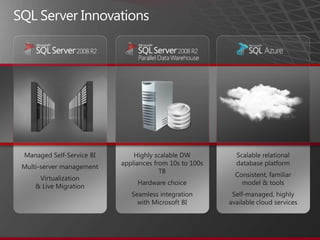
Scalable relational database platformConsistent, familiar model & toolsSelf-managed, highly available cloud servicesHighly scalable DW appliances from 10s to 100s TBHardware choiceSeamless integration with Microsoft BI SQL Server InnovationsManaged Self-Service BIMulti-server managementVirtualization & Live Migration
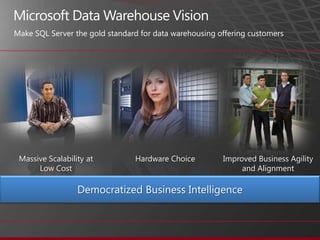
Microsoft Data Warehouse VisionMake SQL Server the gold standard for data warehousing offering customersMassive Scalability at Low CostImproved Business Agility and AlignmentHardware ChoiceDemocratized Business Intelligence
Customer ChallengesApproximate data volume managed by data warehouseIncreased volumes of dataNeed to reduce costsIncreased adoption of DW appliancesMove to MPPDemand for flexibility and mixed workloads across the enterpriseDesire for real-time analyticsGrowing importance of data qualityTodayIn 3 Years21%Less than 500 GB5%20%500 GB – 1 TB12%21%1 – 3 TB18%19%3 – 10 TB25%17%More than 10 TB34%2%Don’t Know6%Source: TDWI Report – Next Generation DW5Microsoft Confidential—Preliminary Information Subject to Change
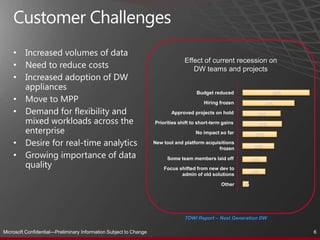
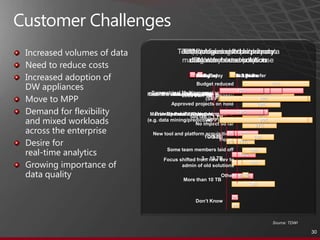
Customer ChallengesIncreased volumes of dataNeed to reduce costsIncreased adoption of DW appliancesMove to MPPDemand for flexibility and mixed workloads across the enterpriseDesire for real-time analyticsGrowing importance of data qualityEffect of current recession on DW teams and projectsBudget reduced57%Hiring frozen41%Approved projects on hold30%Priorities shift to short-term gains31%No impact so far27%New tool and platform acquisitions frozen25%Some team members laid off19%Focus shifted from new dev to admin of old solutions18%Other3%TDWI Report – Next Generation DW6Microsoft Confidential—Preliminary Information Subject to Change
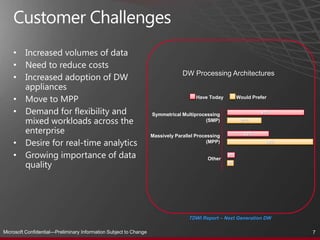
Customer ChallengesDW Processing ArchitecturesIncreased volumes of dataNeed to reduce costsIncreased adoption of DW appliancesMove to MPPDemand for flexibility and mixed workloads across the enterpriseDesire for real-time analyticsGrowing importance of data qualityHave TodayWould PreferSymmetrical Multiprocessing (SMP)61%27%Massively Parallel Processing (MPP)33%68%6%Other5%TDWI Report – Next Generation DWMicrosoft Confidential—Preliminary Information Subject to Change7
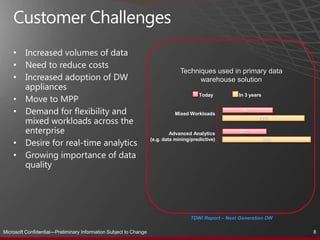
Customer ChallengesTechniques used in primary data warehouse solutionIncreased volumes of dataNeed to reduce costsIncreased adoption of DW appliancesMove to MPPDemand for flexibility and mixed workloads across the enterpriseDesire for real-time analyticsGrowing importance of data qualityTodayIn 3 years46%Mixed Workloads72%Advanced Analytics(e.g. data mining/predictive)38%85%TDWI Report – Next Generation DW8Microsoft Confidential—Preliminary Information Subject to Change
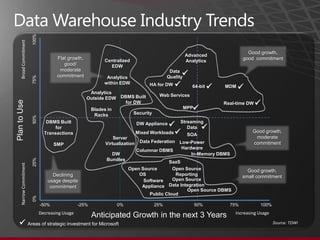
Data Warehouse Industry TrendsGood growth, good  commitment100%Advanced AnalyticsFlat growth, good/moderate commitmentCentralized EDWAnalytics within EDWBroad CommitmentData QualityHA for DW64-bitMDM75%Analytics Outside EDWBlades in RacksWeb ServicesDBMS Built for DWReal-time DWMPPSecurityStreaming DataSOALow-Power HardwareDBMS Built for TransactionsSMPDW AppliancePlan to UseGood growth, moderate commitment50%Mixed WorkloadsServer VirtualizationData FederationColumnar DBMSDW BundlesIn-Memory DBMSSaaSGood growth, small commitmentOpen Source OSOpen SourceReportingDeclining usage despite commitment25%Open SourceData IntegrationSoftware ApplianceOpen Source DBMSNarrow CommitmentPublic Cloud0%-50%-25%0%25%50%75%100% Areas of strategic investment for MicrosoftAnticipated Growth in the next 3 YearsDecreasing UsageIncreasing UsageSource: TDWI
SQL Server Parallel Data WarehouseA data warehouse appliance with massive scalabilityHigh Scalability from 10s to 100s of TB
High scale through Massively Parallel Processing (MPP) system
Choice of hardware vendor
Low cost through industry standard hardware
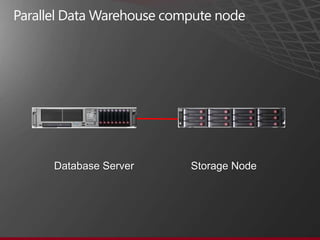
Deep integration with Microsoft BIParallel Data Warehouse compute node Database Server     		   Storage Node
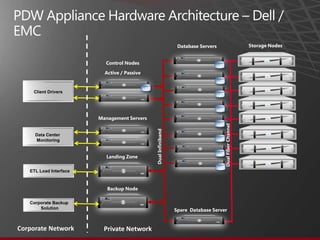
Parallel Data Warehouse Appliance - Hardware ArchitectureDatabase ServersStorage NodesSQLSQLSQLSQLSQLSQLSQLSQLSQLSQLSQLControl NodesActive / PassiveClient DriversManagement ServersData Center MonitoringDual Fiber ChannelDual InfinibandLanding ZoneETL Load InterfaceBackup NodeCorporate Backup SolutionSpare  Database ServerCorporate NetworkPrivate Network
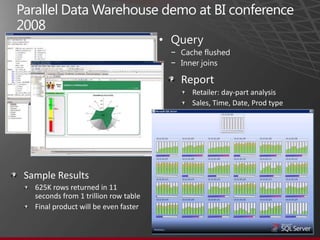
Parallel Data Warehouse demo at BI conference 2008QueryCache flushedInner joinsReportRetailer: day-part analysisSales, Time, Date, Prod typeSample Results625K rows returned in 11 seconds from 1 trillion row table Final product will be even faster
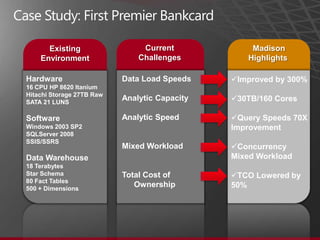
Case Study: First Premier Bankcard MadisonHighlights Current ChallengesExistingEnvironmentImproved by 300%
30TB/160 Cores
Query Speeds 70X            Improvement
Concurrency Mixed Workload
TCO Lowered by 50%Hardware16 CPU HP 8620 ItaniumHitachi Storage 27TB Raw SATA 21 LUNSSoftwareWindows 2003 SP2SQLServer 2008 SSIS/SSRSData Warehouse18 TerabytesStar Schema80 Fact Tables500 + DimensionsData Load SpeedsAnalytic CapacityAnalytic Speed Mixed Workload Total Cost of Ownership
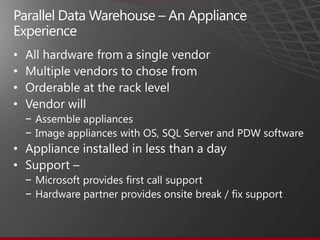
Parallel Data Warehouse – An Appliance ExperienceAll hardware from a single vendorMultiple vendors to chose fromOrderable at the rack levelVendor will Assemble appliancesImage appliances with OS, SQL Server and PDW softwareAppliance installed in less than a daySupport – Microsoft provides first call supportHardware partner provides onsite break / fix support
Pricing for Parallel Data WarehouseNotes:Software prices include Windows Server licenses.   *Discounted Software price is estimated at this stage.  Actual discounts will be available when the Pricing waterfall for Parallel Data Warehouse is completedSoftware price excludes Support.  Only License prices includedHW Price includes estimated HW Support.  The actual HW support costs will vary by Vendor and regionAssume 2.5X Compression ratio for Parallel Data Warehouse and Netezza TwinFinPrices for other HW Vendors will be available laterMicrosoft  Confidential - Internal Use Only
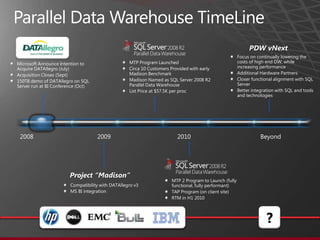
Parallel Data Warehouse TimeLinePDW vNextFocus on continually lowering the costs of high end DW, while increasing performanceAdditional Hardware PartnersCloser functional alignment with SQL ServerBetter integration with SQL and tools and technologiesMTP Program LaunchedCirca 10 Customers Provided with early Madison BenchmarkMadison Named as SQL Server 2008 R2 Parallel Data WarehouseList Price at $57.5K per procMicrosoft Announce Intention to Acquire DATAllegro (July)Acquisition Closes (Sept)150TB demo of DATAllegro on SQL Server run at BI Conference (Oct)Project “Madison”MTP 2 Program to Launch (fully functional, fully performant)TAP Program (on client site)RTM in H1 2010Compatibility with DATAllegro v3MS BI integration2008Beyond20092010?
Hub & Spoke Architecture
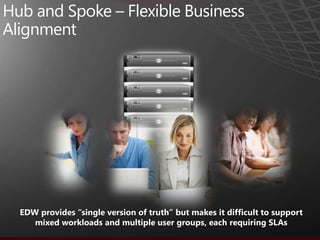
Hub and Spoke – Flexible Business AlignmentEDW provides “single version of truth” but makes it difficult to support mixed workloads and multiple user groups, each requiring SLAs
Hub and Spoke – Flexible Business AlignmentDepartmental data marts enable mixed workloads, but make it difficult to consolidate information across the enterprise
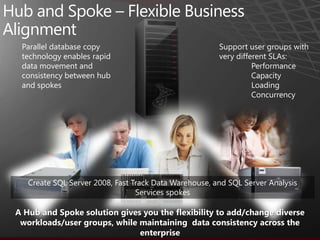
Hub and Spoke – Flexible Business AlignmentParallel database copy technology enables rapid data movement and consistency between hub and spokesSupport user groups with very different SLAs:	Performance	Capacity	Loading	ConcurrencyCreate SQL Server 2008, Fast Track Data Warehouse, and SQL Server Analysis Services spokesA Hub and Spoke solution gives you the flexibility to add/change diverse workloads/user groups, while maintaining  data consistency across the enterprise
Technology Previews for Parallel Data WarehouseMTP & TAP programs
Beta Programs for Parallel Data WarehouseTwo ProgramsMTP – Madison Technology Preview20 – 30 participantsDuration of 4 to 6 weeksTAP – Beta production implementation6 – 8 customersFirst iteration 9 to 12 weeks
Beta Programs for Parallel Data WarehouseRequirementsFocus on EDW and large data martsMigration projects, not green fieldOpen to customers & prospects30+ TB of dataAt least 4 customers with 100+ TB Hub-and-spoke in only a select few casesMTP2 and TAP slots are available
Getting you there
Data Warehouse Roadmap Service RequirementsExisting DWVolume of end-user data 1TB+Considering change to BI or DW infrastructureOn site surveyInterview of key stake holders in Data Warehouse environmentPerformed by Microsoft Architect Service also available from selected Microsoft partners with deep Data Warehouse expertise2-5 days durationDeliverablesPresentation of key findingsReport detailing findingsResults delivered approximately 10 days after survey
Next StepsLearn More:Visit  the Microsoft Data Warehousing portalVisit the Fast Track and Parallel Data Warehouse web pagesVisit the SQL Server DW Portal on TechNetTry Now:Talk to your Microsoft representative to schedule:Data Warehouse roadmap service Joining the Technology Preview or TAP program for Parallel Data Warehouse

Microsoft SQL Server - Parallel Data Warehouse Presentation

  • 1.
    SQL Server 2008R2 Parallel Data Warehouse<Name><Title, Group>
  • 2.
    Agenda Microsoft Data WarehousingVisionSQL Server 2008 R2 Parallel Data WarehouseHub & Spoke ArchitectureTechnology PreviewsData Warehousing Roadmap ServiceSummary
  • 3.
    Scalable relational databaseplatformConsistent, familiar model & toolsSelf-managed, highly available cloud servicesHighly scalable DW appliances from 10s to 100s TBHardware choiceSeamless integration with Microsoft BI SQL Server InnovationsManaged Self-Service BIMulti-server managementVirtualization & Live Migration
  • 4.
    Microsoft Data WarehouseVisionMake SQL Server the gold standard for data warehousing offering customersMassive Scalability at Low CostImproved Business Agility and AlignmentHardware ChoiceDemocratized Business Intelligence
  • 5.
    Customer ChallengesApproximate datavolume managed by data warehouseIncreased volumes of dataNeed to reduce costsIncreased adoption of DW appliancesMove to MPPDemand for flexibility and mixed workloads across the enterpriseDesire for real-time analyticsGrowing importance of data qualityTodayIn 3 Years21%Less than 500 GB5%20%500 GB – 1 TB12%21%1 – 3 TB18%19%3 – 10 TB25%17%More than 10 TB34%2%Don’t Know6%Source: TDWI Report – Next Generation DW5Microsoft Confidential—Preliminary Information Subject to Change
  • 6.
    Customer ChallengesIncreased volumesof dataNeed to reduce costsIncreased adoption of DW appliancesMove to MPPDemand for flexibility and mixed workloads across the enterpriseDesire for real-time analyticsGrowing importance of data qualityEffect of current recession on DW teams and projectsBudget reduced57%Hiring frozen41%Approved projects on hold30%Priorities shift to short-term gains31%No impact so far27%New tool and platform acquisitions frozen25%Some team members laid off19%Focus shifted from new dev to admin of old solutions18%Other3%TDWI Report – Next Generation DW6Microsoft Confidential—Preliminary Information Subject to Change
  • 7.
    Customer ChallengesDW ProcessingArchitecturesIncreased volumes of dataNeed to reduce costsIncreased adoption of DW appliancesMove to MPPDemand for flexibility and mixed workloads across the enterpriseDesire for real-time analyticsGrowing importance of data qualityHave TodayWould PreferSymmetrical Multiprocessing (SMP)61%27%Massively Parallel Processing (MPP)33%68%6%Other5%TDWI Report – Next Generation DWMicrosoft Confidential—Preliminary Information Subject to Change7
  • 8.
    Customer ChallengesTechniques usedin primary data warehouse solutionIncreased volumes of dataNeed to reduce costsIncreased adoption of DW appliancesMove to MPPDemand for flexibility and mixed workloads across the enterpriseDesire for real-time analyticsGrowing importance of data qualityTodayIn 3 years46%Mixed Workloads72%Advanced Analytics(e.g. data mining/predictive)38%85%TDWI Report – Next Generation DW8Microsoft Confidential—Preliminary Information Subject to Change
  • 9.
    Data Warehouse IndustryTrendsGood growth, good commitment100%Advanced AnalyticsFlat growth, good/moderate commitmentCentralized EDWAnalytics within EDWBroad CommitmentData QualityHA for DW64-bitMDM75%Analytics Outside EDWBlades in RacksWeb ServicesDBMS Built for DWReal-time DWMPPSecurityStreaming DataSOALow-Power HardwareDBMS Built for TransactionsSMPDW AppliancePlan to UseGood growth, moderate commitment50%Mixed WorkloadsServer VirtualizationData FederationColumnar DBMSDW BundlesIn-Memory DBMSSaaSGood growth, small commitmentOpen Source OSOpen SourceReportingDeclining usage despite commitment25%Open SourceData IntegrationSoftware ApplianceOpen Source DBMSNarrow CommitmentPublic Cloud0%-50%-25%0%25%50%75%100% Areas of strategic investment for MicrosoftAnticipated Growth in the next 3 YearsDecreasing UsageIncreasing UsageSource: TDWI
  • 10.
    SQL Server ParallelData WarehouseA data warehouse appliance with massive scalabilityHigh Scalability from 10s to 100s of TB
  • 11.
    High scale throughMassively Parallel Processing (MPP) system
  • 12.
  • 13.
    Low cost throughindustry standard hardware
  • 14.
    Deep integration withMicrosoft BIParallel Data Warehouse compute node Database Server Storage Node
  • 15.
    Parallel Data WarehouseAppliance - Hardware ArchitectureDatabase ServersStorage NodesSQLSQLSQLSQLSQLSQLSQLSQLSQLSQLSQLControl NodesActive / PassiveClient DriversManagement ServersData Center MonitoringDual Fiber ChannelDual InfinibandLanding ZoneETL Load InterfaceBackup NodeCorporate Backup SolutionSpare Database ServerCorporate NetworkPrivate Network
  • 16.
    Parallel Data Warehousedemo at BI conference 2008QueryCache flushedInner joinsReportRetailer: day-part analysisSales, Time, Date, Prod typeSample Results625K rows returned in 11 seconds from 1 trillion row table Final product will be even faster
  • 17.
    Case Study: FirstPremier Bankcard MadisonHighlights Current ChallengesExistingEnvironmentImproved by 300%
  • 18.
  • 19.
    Query Speeds 70X Improvement
  • 20.
  • 21.
    TCO Lowered by50%Hardware16 CPU HP 8620 ItaniumHitachi Storage 27TB Raw SATA 21 LUNSSoftwareWindows 2003 SP2SQLServer 2008 SSIS/SSRSData Warehouse18 TerabytesStar Schema80 Fact Tables500 + DimensionsData Load SpeedsAnalytic CapacityAnalytic Speed Mixed Workload Total Cost of Ownership
  • 22.
    Parallel Data Warehouse– An Appliance ExperienceAll hardware from a single vendorMultiple vendors to chose fromOrderable at the rack levelVendor will Assemble appliancesImage appliances with OS, SQL Server and PDW softwareAppliance installed in less than a daySupport – Microsoft provides first call supportHardware partner provides onsite break / fix support
  • 23.
    Pricing for ParallelData WarehouseNotes:Software prices include Windows Server licenses. *Discounted Software price is estimated at this stage. Actual discounts will be available when the Pricing waterfall for Parallel Data Warehouse is completedSoftware price excludes Support. Only License prices includedHW Price includes estimated HW Support. The actual HW support costs will vary by Vendor and regionAssume 2.5X Compression ratio for Parallel Data Warehouse and Netezza TwinFinPrices for other HW Vendors will be available laterMicrosoft Confidential - Internal Use Only
  • 24.
    Parallel Data WarehouseTimeLinePDW vNextFocus on continually lowering the costs of high end DW, while increasing performanceAdditional Hardware PartnersCloser functional alignment with SQL ServerBetter integration with SQL and tools and technologiesMTP Program LaunchedCirca 10 Customers Provided with early Madison BenchmarkMadison Named as SQL Server 2008 R2 Parallel Data WarehouseList Price at $57.5K per procMicrosoft Announce Intention to Acquire DATAllegro (July)Acquisition Closes (Sept)150TB demo of DATAllegro on SQL Server run at BI Conference (Oct)Project “Madison”MTP 2 Program to Launch (fully functional, fully performant)TAP Program (on client site)RTM in H1 2010Compatibility with DATAllegro v3MS BI integration2008Beyond20092010?
  • 25.
    Hub & SpokeArchitecture
  • 26.
    Hub and Spoke– Flexible Business AlignmentEDW provides “single version of truth” but makes it difficult to support mixed workloads and multiple user groups, each requiring SLAs
  • 27.
    Hub and Spoke– Flexible Business AlignmentDepartmental data marts enable mixed workloads, but make it difficult to consolidate information across the enterprise
  • 28.
    Hub and Spoke– Flexible Business AlignmentParallel database copy technology enables rapid data movement and consistency between hub and spokesSupport user groups with very different SLAs: Performance Capacity Loading ConcurrencyCreate SQL Server 2008, Fast Track Data Warehouse, and SQL Server Analysis Services spokesA Hub and Spoke solution gives you the flexibility to add/change diverse workloads/user groups, while maintaining data consistency across the enterprise
  • 29.
    Technology Previews forParallel Data WarehouseMTP & TAP programs
  • 30.
    Beta Programs forParallel Data WarehouseTwo ProgramsMTP – Madison Technology Preview20 – 30 participantsDuration of 4 to 6 weeksTAP – Beta production implementation6 – 8 customersFirst iteration 9 to 12 weeks
  • 31.
    Beta Programs forParallel Data WarehouseRequirementsFocus on EDW and large data martsMigration projects, not green fieldOpen to customers & prospects30+ TB of dataAt least 4 customers with 100+ TB Hub-and-spoke in only a select few casesMTP2 and TAP slots are available
  • 32.
  • 33.
    Data Warehouse RoadmapService RequirementsExisting DWVolume of end-user data 1TB+Considering change to BI or DW infrastructureOn site surveyInterview of key stake holders in Data Warehouse environmentPerformed by Microsoft Architect Service also available from selected Microsoft partners with deep Data Warehouse expertise2-5 days durationDeliverablesPresentation of key findingsReport detailing findingsResults delivered approximately 10 days after survey
  • 34.
    Next StepsLearn More:Visit the Microsoft Data Warehousing portalVisit the Fast Track and Parallel Data Warehouse web pagesVisit the SQL Server DW Portal on TechNetTry Now:Talk to your Microsoft representative to schedule:Data Warehouse roadmap service Joining the Technology Preview or TAP program for Parallel Data Warehouse

Editor's Notes

  • #4 SQL Server 2008 R2 is our next generation database platform
  • #6 Now let’s take a look at the challenges facing data warehouse industry as a whole. The Data Warehouse Institute (TDWI) recently published a report entitled “Next Generation Data Warehouse Platforms”, which identified a number of common challenges.[Click to reveal each bullet and chart]Increased Volumes of Data – today’s largest data warehouses are in the 100’s of terabytes scale, but data volumes in many organizations are rising dramatically. Within 3 years, there will be significantly more organizations with 100’s of terabytes of data, and many organizations will be breaking into the petabyte range.Need to reduce costs – The global economic recession of 2009 has affected companies of all sizes all over the world. Now more than ever, budgets are being squeezed and there is a growing requirement for IT services to do more with less.Increased adoption of hardware appliances – more and more organizations are purchasing data warehouse appliances rather than building their own bespoke data warehouse server infrastructure and installing software.Move to Massively Parallel Processing (MPP) – while symmetric multi-processing works well for today’s data warehouses and data marts, as data volume and data warehouse utilization grows, many organizations are looking to MPP processing architectures to increase scalability and performance.Demand for flexibility and mixed workloads – Data Warehouses are now serving an increasing range and number of user groups, each with their own requirements and workloads. Organizations are trying to find ways to meet the needs of a diverse range of users while maintaining the overall consistency of enterprise data an the ability to adapt to changes in the business.Desire for real-time analytics – While historical reporting and analysis continue to be important, organizations are increasingly looking for real-time analysis solutions that will enable them to be more responsive and informed when making critical business decisions.Growing importance of data quality – Organizations are increasingly aware of the need for the data in their data warehouse to be accurate and consistent, so many data warehouse professionals are looking for data quality tools that will help them improve the overall quality of their data.
  • #7 Now let’s take a look at the challenges facing data warehouse industry as a whole. The Data Warehouse Institute (TDWI) recently published a report entitled “Next Generation Data Warehouse Platforms”, which identified a number of common challenges.[Click to reveal each bullet and chart]Increased Volumes of Data – today’s largest data warehouses are in the 100’s of terabytes scale, but data volumes in many organizations are rising dramatically. Within 3 years, there will be significantly more organizations with 100’s of terabytes of data, and many organizations will be breaking into the petabyte range.Need to reduce costs – The global economic recession of 2009 has affected companies of all sizes all over the world. Now more than ever, budgets are being squeezed and there is a growing requirement for IT services to do more with less.Increased adoption of hardware appliances – more and more organizations are purchasing data warehouse appliances rather than building their own bespoke data warehouse server infrastructure and installing software.Move to Massively Parallel Processing (MPP) – while symmetric multi-processing works well for today’s data warehouses and data marts, as data volume and data warehouse utilization grows, many organizations are looking to MPP processing architectures to increase scalability and performance.Demand for flexibility and mixed workloads – Data Warehouses are now serving an increasing range and number of user groups, each with their own requirements and workloads. Organizations are trying to find ways to meet the needs of a diverse range of users while maintaining the overall consistency of enterprise data an the ability to adapt to changes in the business.Desire for real-time analytics – While historical reporting and analysis continue to be important, organizations are increasingly looking for real-time analysis solutions that will enable them to be more responsive and informed when making critical business decisions.Growing importance of data quality – Organizations are increasingly aware of the need for the data in their data warehouse to be accurate and consistent, so many data warehouse professionals are looking for data quality tools that will help them improve the overall quality of their data.
  • #8 Now let’s take a look at the challenges facing data warehouse industry as a whole. The Data Warehouse Institute (TDWI) recently published a report entitled “Next Generation Data Warehouse Platforms”, which identified a number of common challenges.[Click to reveal each bullet and chart]Increased Volumes of Data – today’s largest data warehouses are in the 100’s of terabytes scale, but data volumes in many organizations are rising dramatically. Within 3 years, there will be significantly more organizations with 100’s of terabytes of data, and many organizations will be breaking into the petabyte range.Need to reduce costs – The global economic recession of 2009 has affected companies of all sizes all over the world. Now more than ever, budgets are being squeezed and there is a growing requirement for IT services to do more with less.Increased adoption of hardware appliances – more and more organizations are purchasing data warehouse appliances rather than building their own bespoke data warehouse server infrastructure and installing software.Move to Massively Parallel Processing (MPP) – while symmetric multi-processing works well for today’s data warehouses and data marts, as data volume and data warehouse utilization grows, many organizations are looking to MPP processing architectures to increase scalability and performance.Demand for flexibility and mixed workloads – Data Warehouses are now serving an increasing range and number of user groups, each with their own requirements and workloads. Organizations are trying to find ways to meet the needs of a diverse range of users while maintaining the overall consistency of enterprise data an the ability to adapt to changes in the business.Desire for real-time analytics – While historical reporting and analysis continue to be important, organizations are increasingly looking for real-time analysis solutions that will enable them to be more responsive and informed when making critical business decisions.Growing importance of data quality – Organizations are increasingly aware of the need for the data in their data warehouse to be accurate and consistent, so many data warehouse professionals are looking for data quality tools that will help them improve the overall quality of their data.
  • #9 Now let’s take a look at the challenges facing data warehouse industry as a whole. The Data Warehouse Institute (TDWI) recently published a report entitled “Next Generation Data Warehouse Platforms”, which identified a number of common challenges.[Click to reveal each bullet and chart]Increased Volumes of Data – today’s largest data warehouses are in the 100’s of terabytes scale, but data volumes in many organizations are rising dramatically. Within 3 years, there will be significantly more organizations with 100’s of terabytes of data, and many organizations will be breaking into the petabyte range.Need to reduce costs – The global economic recession of 2009 has affected companies of all sizes all over the world. Now more than ever, budgets are being squeezed and there is a growing requirement for IT services to do more with less.Increased adoption of hardware appliances – more and more organizations are purchasing data warehouse appliances rather than building their own bespoke data warehouse server infrastructure and installing software.Move to Massively Parallel Processing (MPP) – while symmetric multi-processing works well for today’s data warehouses and data marts, as data volume and data warehouse utilization grows, many organizations are looking to MPP processing architectures to increase scalability and performance.Demand for flexibility and mixed workloads – Data Warehouses are now serving an increasing range and number of user groups, each with their own requirements and workloads. Organizations are trying to find ways to meet the needs of a diverse range of users while maintaining the overall consistency of enterprise data an the ability to adapt to changes in the business.Desire for real-time analytics – While historical reporting and analysis continue to be important, organizations are increasingly looking for real-time analysis solutions that will enable them to be more responsive and informed when making critical business decisions.Growing importance of data quality – Organizations are increasingly aware of the need for the data in their data warehouse to be accurate and consistent, so many data warehouse professionals are looking for data quality tools that will help them improve the overall quality of their data.
  • #10 This chart, taken from the TDWI Next Generation Data Warehouse Platforms report, shows data warehouse features and techniques plotted for delta (growth) and plan to use (commitment).As you’ll see in the rest of this presentation, Microsoft’s strategy for data warehousing aligns extremely well with the features and techniques that have broadcommitment and good growth. The green ticks show specific technology areas Microsoft is strategically investing in.
  • #11 SQL Server Parallel Data Warehouse is a data warehouse appliance that offers massive scalability at low cost.[Click to reveal components of SQL Server Parallel Data Warehouse]SQL Server Parallel Data Warehouse is built on the MPP technology acquired with Datallegro, and is provided as an appliance running SQL Server on Windows Server, with standard hardware components from a number of hardware vendors – HP, IBM, Dell, Bull, and EMC. This provides a balanced solution consisting of software and hardware working together.SQL Server Parallel Data Warehouse will support data warehouses that store 100’s of terabytes, and beyond into the petabyte range while offering a low total cost of ownership, previously unseen at this end of the market.SQL Server Parallel Data Warehouse will empower business by providing enterprise class performance and the flexibility of a hub and spoke architecture that enables organizations to implement a data warehouse and data mart ecosystem that meets their needs.
  • #20 The Enterprise Data Warehouse (EDW) is a common way to centralize business data for all BI needs throughout the organization. In this case, the EDW is a “single version of the truth”. The centralized architecture simplifies data governance, making it straightforward to track and audit data. Yet as the EDW becomes successful and adoption increases, it becomes inflexible, expensive, and unresponsive to business needs since it is harder to make changes to the data warehouse.
  • #21 Independent data marts, each serving the needs of a single user group (e.g. The sales team, the HR team, etc.) provide a decentralized alternative to the EDW model, enabling business units to create and tune data marts to suit their own needs. However, data governance can be difficult because it is harder to link data across the company. Though it is more responsive, this approach often causes serious management issues for IT departments that have to deal with compliance and IT governance across the organization.
  • #22 A hub and spoke solution, such as that supported by SQL Server Parallel Data Warehouse, comprises a centralized EDW and a set of loosely coupled data marts. For many years, this has been the preferred approach for enterprise-wide data warehousing, and numerous studies since 2003 confirm that hub and spoke is the most popular data warehouse architecture among DW professionals. Traditionally, implementing a hub and spoke architecture has been challenging due to practical limitations of the database engine and network resources.[Click to display types of spoke]With SQL Server Parallel Data Warehouse, you can create a diverse range of types of spoke, from SQL Server Parallel Data Warehouse MPP appliances for user groups with extreme scalability requirements, fast track data warehouse implementations, SQL Server 2008 Enterprise data warehouses, and even SQL Server 2008 Analysis Services OLAP databases.[Click to display parallel database copy point]However,SQL Server Parallel Data Warehouse’s parallel database copy technology enables rapid data integration between spokes and the SQL Server Parallel Data Warehouse hub, making it easier to build hub and spoke solutions that integrate your diverse data marts and the enterprise data warehouse.[Click to display multiple user SLA point]SQL Server Parallel Data Warehouse’s Hub and Spoke architecture enables you to support user groups with very different SLAs; supports hot, warm and cold data; different requirements on data Loading, etc.
  • #24 MTPAs mentioned earlier, the Madison Technology Preview or MTP is our method of supporting customer or prospective client interested in test driving the MPP Appliance technology.The MTP program requires a minimal investment by the end user as Microsoft supplies the Appliance hardware platform in our data center and the technical resources from the initial scoping effort to the actual execution of the MTP. The end user identifies the existing DW subject area for the MTP, provides test data, DDL, queries and existing benchmarks. Microsoft Madison specialist will write the MTP scope document presents it to the customer for our joint review and approvalCustomers are responsible for providing the data, queries and metrics on the existing load times and queries so we can make comparisons during the MTP process. In very large data capacity situations we would most likely ask for sample seed data and then agree on data expansion rules to eliminate any bottle necks with data transfer. Microsoft goes to great lengths with regard to data security and can assure customers that their data is secure. Once we have the data loaded and queries tested at our Data Center the customer is invited to join us to test drive the Madison appliance. We do have MTP2 slots available and to start the process a short MTP questionnaire needs to be completed by the end user and submitted to the MSFT DW SSP who will then enter the request into a web based nomination form. Clients would be notified shortly thereafter if their nomination has been accepted. TAPThe Technology Adoption Program or TAP requires customers acquire the Madison Reference Hardware and Microsoft supplies all software required at no charge along with technical resources to work with the client to stand up the Madison DW in production. Once the Madison product in Released to Manufacturing (RTM) then the customer would purchase the required software and maintenance. Microsoft DW SSP’s have access to more details on this process including the Reference Hardware architectures, their estimated list price and the software costs should this detailed due diligence step be required. We expect TAP to start late this CY 2009.
  • #25 The requirements are very straight forward with the exception of an exclusive feature in the Madison DW Appliance – Hub and Spoke Distributed DW Architecture.Traditionally an Enterprise DW or EDW is implemented in a single monolithic architecture where a Single Version of the Truth is maintained and spawns multiple Data Marts (typically for Dimensional reporting) and supporting bulk ETL feeds - daily loads or more frequent loads based on the latency of the data (near real time loads). Madison supports EDW architectures and we are in general agnostic to the type of data model (3NF, Kimball Dimensional, Corporate Inmon Information Factory or hybrids of all).However, as data capacities grow so do the number of concurrent end users, their query workloads and the complexity of the workloads with more and more ad-hoc analysis and eventually predictive analysis and when combined with the ever increasing ETL feeds the existing EDW infrastructure is stressed – not to mention the stress IT gets when the end users get the bill for more expensive EDW Hardware/Software upgrades. Many times additional capacity is not needed just more performance and competing MPP platforms (read Teradata, Exadata, Neoview, Netezza, Greenplum etc…) there are no alternatives but to buy more MPP nodes just to get more performance and the cost to capital and on going support is very expensive. This drives end users to start up their own data marts and then data consistency is an issue and the integrity of the single version of the truth is compromised.Madison’s Hub and Spoke EDW Architecture uniquely provides a viable solution for this situation as it preserves the Single Version of the Truth in the Madison HUB and yet offers flexibly sized SQL 2008 Fast Track Data Mart spokes that are sized for the business’s performance requirements and BUDGET! The IT group preserves the integrity of the Single Version of the Truth on the Madison HUB and simply spawns the DATA Marts as they would in the traditional EDW architecture but then publish them to the Madison enabled SQL 2008 Fast Track spokes using a combination of DATAllegro IP for high speed HUB to Spoke parallel database copy and a dedicated very high speed Infiniband network fabric to populate the spoke with the needed data to perform its function. A DW SSP can supply existing examples of this technology in production and more details on the implementation of Hub and Spoke architecture in a follow up session. Whitepapers are also available on http://www.microsoft.com/sqlserver/2008/en/us/madison.aspx for both Introduction and Implementing Hub and Spoke architectures. Once again this is a Microsoft exclusive supporting both traditional EDW and distributed Hub and Spoke architectures!
  • #31 Now let’s take a look at the challenges facing data warehouse industry as a whole. The Data Warehouse Institute (TDWI) recently published a report entitled “Next Generation Data Warehouse Platforms”, which identified a number of common challenges.[Click to reveal each bullet and chart]Increased Volumes of Data – today’s largest data warehouses are in the 100’s of terabytes scale, but data volumes in many organizations are rising dramatically. Within 3 years, there will be significantly more organizations with 100’s of terabytes of data, and many organizations will be breaking into the petabyte range.Need to reduce costs – The global economic recession of 2009 has affected companies of all sizes all over the world. Now more than ever, budgets are being squeezed and there is a growing requirement for IT services to do more with less.Increased adoption of hardware appliances – more and more organizations are purchasing data warehouse appliances rather than building their own bespoke data warehouse server infrastructure and installing software.Move to Massively Parallel Processing (MPP) – while symmetric multi-processing works well for today’s data warehouses and data marts, as data volume and data warehouse utilization grows, many organizations are looking to MPP processing architectures to increase scalability and performance.Demand for flexibility and mixed workloads – Data Warehouses are now serving an increasing range and number of user groups, each with their own requirements and workloads. Organizations are trying to find ways to meet the needs of a diverse range of users while maintaining the overall consistency of enterprise data an the ability to adapt to changes in the business.Desire for real-time analytics – While historical reporting and analysis continue to be important, organizations are increasingly looking for real-time analysis solutions that will enable them to be more responsive and informed when making critical business decisions.Growing importance of data quality – Organizations are increasingly aware of the need for the data in their data warehouse to be accurate and consistent, so many data warehouse professionals are looking for data quality tools that will help them improve the overall quality of their data.