Media Institutions
   You will understand how the proliferation in
    technology has affected audience patterns of
    consumption and production of media
   You will be able to explain some of the issues raised in
    the targeting of national and local audiences
    (specifically, British) by international or global
    institutions.
How to think about Audiences
•   The Hypodermic needle model
•   Two-step flow
•   Uses and Gratifications
•   Maslow’s hierarchy of needs
•   Reception theory
•   Cultural hegemony, representation and
    ideology
Effects theories
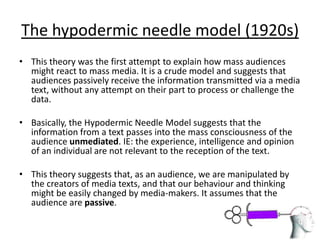
The hypodermic needle model (1920s)
• This theory was the first attempt to explain how mass audiences
  might react to mass media. It is a crude model and suggests that
  audiences passively receive the information transmitted via a media
  text, without any attempt on their part to process or challenge the
  data.

• Basically, the Hypodermic Needle Model suggests that the
  information from a text passes into the mass consciousness of the
  audience unmediated. IE: the experience, intelligence and opinion
  of an individual are not relevant to the reception of the text.

• This theory suggests that, as an audience, we are manipulated by
  the creators of media texts, and that our behaviour and thinking
  might be easily changed by media-makers. It assumes that the
  audience are passive.
Two-step flow
• Is a basic extension of the hypodermic needle model. It
  differs because:

   – It assumes that the audience are not as passive as they are in
     the hypodermic needle model
   – It suggests that the audience members will discuss the ideas
     that are transmitted in the media with an “opinion leader” –
     someone they trust
   – After discussing with an opinion leader, it assumes the audience
     are passive enough to accept the message at this point.

   – It seems simplistic, but think about the number of TV critics that
     audiences base their opinions of films on…is criticism of your
     films going to be relevant in your exam answer and in an
     application of the two-step flow theory?
Uses and Gratifications: Blumler and Katz (1974)
• “The audience is conceived as active”

• “In the mass communication process much initiative in linking need
  gratification and media choice lies with the audience member.” (The
  receiver determines what is going to be absorbed and does not allow the
  media to influence them otherwise).

• “the media competes with other sources of need satisfaction.”This focuses
  on the idea that each individual has several needs. In response to
  this, they have created a wide range of choices that will meet these
  needs. The strongest rival to media based sources include face-to-face
  communication.

• “Many of the goals media use can be derived from data supplied by the
  individual audience members themselves.”

• It is the individual audience members who make the decision to view the
  media; therefore, they place the value on it by their individual decision to
  view it.
Melvin DeFleur & Sandra Ball-Rokeach:
  The Dependency Theory (1976).
It was, in a sense, an extension or addition to the Uses
and Gratifications Approach brought about a few years
earlier.

The theory is in essence an explanation of the
correlating relationship between the media content,
the nature of society, and the behaviour of the
audiences.

It states that people in an urban society have become
dependent on mass communication to assist them in
receiving the information that they need, in order to
make a variety of decisions concerning their everyday
lives.
Reception theory
Assumes that individual members of an audience will
     have different responses to media texts.

Roland Barthes famously claimed that meaning from
 text rested with the audience rather than creators.
Is the audience always going to read things in the
                         same way?

• Preferred reading
  The preferred reading is when the audience accepts the message the clip
  is trying to give. So if a Sitcom is supposed to be funny, the preferred
  reading of a whole episode is that it is funny.

• Oppositional reading
  An oppositional reading is the opposite to a preferred reading. If the
  preferred reading is that the Sitcom is funny, then an oppositional reading
  says that it isn’t. The fact some people find it funny proves that the “one
  hat fits all” approach of the hypodermic needle theory cannot work.

• Negotiated reading
  Is somewhere between the two. In the Sitcom example, a negotiated
  reading would suggest that it is supposed to be funny, but not all the jokes
  are successful. A good negotiated reader might suggest canned laughter
  is trying to prove a part of the Sitcom should be funny.
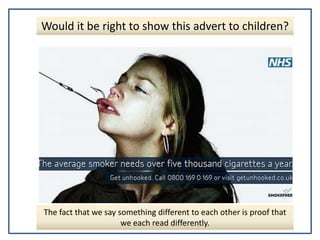
Would it be right to show this advert to children?


The fact that we say something different to each other is proof that
                      we each read differently.
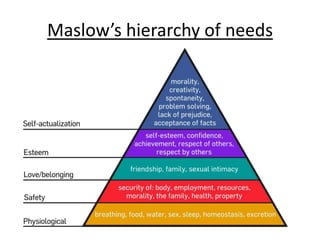
Maslow’s hierarchy of needs
Cultural hegemony,
representation and ideology
How does your film industry represent groups and how
     does this reflect or promote an ideology?

• Ideology is a set of dominant values or beliefs.
• Examining ideology in the film industry is
  concerned with how your film presents or
  seems to enforce a set of values.
• Does your film set up an idealisation –
  perhaps an ideal of beauty (the beauty myth)
  or an ideal about what true love is?
Technological convergence and its
impact targeting local, national and
     international audiences.
Convergence
• What is convergence?

• Convergence has an impact on both institutions
  and audiences:
  – For institutions, diversification means they are able to
    distribute across several media (e.g. a newspaper with
    online versions)
  – For audiences, it means the coming together of
    technology that creates new ways to access and
    produce media content.

  For audiences, technological convergence changes consumption habits
 that, inevitably, produces a new kind of “audience”. Audience are active
                                  users.
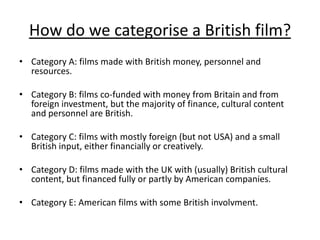
How do we categorise a British film?
• Category A: films made with British money, personnel and
  resources.

• Category B: films co-funded with money from Britain and from
  foreign investment, but the majority of finance, cultural content
  and personnel are British.

• Category C: films with mostly foreign (but not USA) and a small
  British input, either financially or creatively.

• Category D: films made with the UK with (usually) British cultural
  content, but financed fully or partly by American companies.

• Category E: American films with some British involvment.
‘Anticipated for almost as long as the second
coming, the digital media era is finally upon us
and that much misused word ‘convergence’
has become meaningful. Newspapers are
talking about video journalism; broadcasters
are talking downloads and web companies?’
(Gibson, 2007)
‘You can’t be expected to feel the pace of
change as you will have grown up with online
media as the norm, but for this part of your
studies you do need to acquire a sense of how
rapidly institutions and audiences are being
transformed by digital technology’.
(McDougall, 2008: 124)
Technological convergence
• How has technological convergence changed
  audience’s consumption habits?

• How do audiences now interact with media?

• To what extent are audiences involved in the
  creation of media rather than simply its
  consumption?
Homework
Successful media products depend as much on
audience consumption habits as they do good
production practices. To what extent do you
agree with this statement?

L4A&1

  • 1.
    Media Institutions  You will understand how the proliferation in technology has affected audience patterns of consumption and production of media  You will be able to explain some of the issues raised in the targeting of national and local audiences (specifically, British) by international or global institutions.
  • 2.
    How to thinkabout Audiences • The Hypodermic needle model • Two-step flow • Uses and Gratifications • Maslow’s hierarchy of needs • Reception theory • Cultural hegemony, representation and ideology
  • 3.
  • 4.
    The hypodermic needlemodel (1920s) • This theory was the first attempt to explain how mass audiences might react to mass media. It is a crude model and suggests that audiences passively receive the information transmitted via a media text, without any attempt on their part to process or challenge the data. • Basically, the Hypodermic Needle Model suggests that the information from a text passes into the mass consciousness of the audience unmediated. IE: the experience, intelligence and opinion of an individual are not relevant to the reception of the text. • This theory suggests that, as an audience, we are manipulated by the creators of media texts, and that our behaviour and thinking might be easily changed by media-makers. It assumes that the audience are passive.
  • 5.
    Two-step flow • Isa basic extension of the hypodermic needle model. It differs because: – It assumes that the audience are not as passive as they are in the hypodermic needle model – It suggests that the audience members will discuss the ideas that are transmitted in the media with an “opinion leader” – someone they trust – After discussing with an opinion leader, it assumes the audience are passive enough to accept the message at this point. – It seems simplistic, but think about the number of TV critics that audiences base their opinions of films on…is criticism of your films going to be relevant in your exam answer and in an application of the two-step flow theory?
  • 6.
    Uses and Gratifications:Blumler and Katz (1974) • “The audience is conceived as active” • “In the mass communication process much initiative in linking need gratification and media choice lies with the audience member.” (The receiver determines what is going to be absorbed and does not allow the media to influence them otherwise). • “the media competes with other sources of need satisfaction.”This focuses on the idea that each individual has several needs. In response to this, they have created a wide range of choices that will meet these needs. The strongest rival to media based sources include face-to-face communication. • “Many of the goals media use can be derived from data supplied by the individual audience members themselves.” • It is the individual audience members who make the decision to view the media; therefore, they place the value on it by their individual decision to view it.
  • 7.
    Melvin DeFleur &Sandra Ball-Rokeach: The Dependency Theory (1976). It was, in a sense, an extension or addition to the Uses and Gratifications Approach brought about a few years earlier. The theory is in essence an explanation of the correlating relationship between the media content, the nature of society, and the behaviour of the audiences. It states that people in an urban society have become dependent on mass communication to assist them in receiving the information that they need, in order to make a variety of decisions concerning their everyday lives.
  • 8.
    Reception theory Assumes thatindividual members of an audience will have different responses to media texts. Roland Barthes famously claimed that meaning from text rested with the audience rather than creators.
  • 9.
    Is the audiencealways going to read things in the same way? • Preferred reading The preferred reading is when the audience accepts the message the clip is trying to give. So if a Sitcom is supposed to be funny, the preferred reading of a whole episode is that it is funny. • Oppositional reading An oppositional reading is the opposite to a preferred reading. If the preferred reading is that the Sitcom is funny, then an oppositional reading says that it isn’t. The fact some people find it funny proves that the “one hat fits all” approach of the hypodermic needle theory cannot work. • Negotiated reading Is somewhere between the two. In the Sitcom example, a negotiated reading would suggest that it is supposed to be funny, but not all the jokes are successful. A good negotiated reader might suggest canned laughter is trying to prove a part of the Sitcom should be funny.
  • 10.
    Would it beright to show this advert to children? The fact that we say something different to each other is proof that we each read differently.
  • 11.
  • 12.
  • 13.
    How does yourfilm industry represent groups and how does this reflect or promote an ideology? • Ideology is a set of dominant values or beliefs. • Examining ideology in the film industry is concerned with how your film presents or seems to enforce a set of values. • Does your film set up an idealisation – perhaps an ideal of beauty (the beauty myth) or an ideal about what true love is?
  • 14.
    Technological convergence andits impact targeting local, national and international audiences.
  • 15.
    Convergence • What isconvergence? • Convergence has an impact on both institutions and audiences: – For institutions, diversification means they are able to distribute across several media (e.g. a newspaper with online versions) – For audiences, it means the coming together of technology that creates new ways to access and produce media content. For audiences, technological convergence changes consumption habits that, inevitably, produces a new kind of “audience”. Audience are active users.
  • 16.
    How do wecategorise a British film? • Category A: films made with British money, personnel and resources. • Category B: films co-funded with money from Britain and from foreign investment, but the majority of finance, cultural content and personnel are British. • Category C: films with mostly foreign (but not USA) and a small British input, either financially or creatively. • Category D: films made with the UK with (usually) British cultural content, but financed fully or partly by American companies. • Category E: American films with some British involvment.
  • 17.
    ‘Anticipated for almostas long as the second coming, the digital media era is finally upon us and that much misused word ‘convergence’ has become meaningful. Newspapers are talking about video journalism; broadcasters are talking downloads and web companies?’ (Gibson, 2007)
  • 18.
    ‘You can’t beexpected to feel the pace of change as you will have grown up with online media as the norm, but for this part of your studies you do need to acquire a sense of how rapidly institutions and audiences are being transformed by digital technology’. (McDougall, 2008: 124)
  • 19.
    Technological convergence • Howhas technological convergence changed audience’s consumption habits? • How do audiences now interact with media? • To what extent are audiences involved in the creation of media rather than simply its consumption?
  • 20.
    Homework Successful media productsdepend as much on audience consumption habits as they do good production practices. To what extent do you agree with this statement?