Media Institutions
   You will have reviewed your essay question and
    considered its strengths and weaknesses
   You will understand
    production, distribution, marketing and exhibition and
    relate this to Working Title
Review of task –Discuss the advantages and disadvantages of being a
commercial or independent film company and how this impacts audiences.
Refer to your case studies and give examples from your case studies and
your wider knowledge.

      Mostly a good understanding of the advantages and
      disadvantages of being a commercial or independent
      company.
      Some good knowledge of the impact of different
      budgets, though this was limited to production and
      marketing, with little explanation given about the impact
      on exhibition and distribution.
      You need to refer continually to your case studies – it is
      evident that, at the moment, you don’t know enough about
      them. How did they market for example? Who made the
      marketing etc?
Working Title Films
The facts
•   1984: Founded by Tim Bevan and Sarah Radclyffe. First investment: £500,000 in My Beautiful
    Laundrette, the first of a series of collaborations with Channel Four Films. Overall, 15 films
    produced in the 1980s.

[Synergy]
• 1991: Sets up a Hollywood office, developing production deals with Tim Robbins.

[Conglomerate]
• 1992: Working Title bought by PolyGram (a European music company).

•   1998: PolyGram bought by Universal, a subsidiary of Seagram. Universal allows Working Title
    to greenlight films up to a budget of $35m. One of the first films produced was Billy Elliot
    (Stephen Daldry, 1999).

[Vertical and Horizontal integration]
• 2000: Seagram bought by Vivendi, the French multimedia conglomerate with extensive
    interests in film, TV, video games, music publishing, telecommunications and the internet.

•   2004: Vivendi sells 80% share of Universal to GE (General Electric Company).
The facts
• In 1999 – WORKING TITLE 2 PRODUCTIONS was launched which is an
  independent arm of Working Title.

• It has limited budgets – e.g. Billy Eliot (200) was made with a budget of
  $5,000,000 unlike WORKING TITLE films (which are funded as a
  commercial company under working title) which has larger budgets; e.g.
  Johnny English Reborn (2011) which was made with a budget of
  $45,000,000.

   REMEMBER THIS
   Working Title was an independent company that became frustrated with
   the smaller budgets offered when they sought external funding (usually
   from Channel 4). As a result they were bought by Universal (80%) and GE
   (20%) in 2004. They now operate as part of a conglomerate and in a
   commercial way. This is part of their institutional context.
Films you could watch and be familiar
                    with:
•   The Boat That Rocked (2009)                •   About a Boy (2002)
•   Frost/Nixon (2008)                         •   Captain Corelli's Mandolin (2001)
•   Atonement (2007)                           •   Bridget Jones's Diary (2001)
•   Nanny McPhee (2005)                        •   Billy Elliot (2000)
•   Bridget Jones: The Edge of Reason (2004)   •   Notting Hill (1999)
•   Wimbledon (2004)                           •   Elizabeth (1998)
•   Shaun of the Dead (2004)                   •   The Big Lebowski (1998)
•   Love Actually (2003)                       •   Bean (1997)
•   Thirteen (2003)                            •   Fargo (1996)
•   Ali G Indahouse (2002)


            Examples for the exam that you cite as case studies
            and now in depth should be recent (within the last 5
            years, preferably the last 3).
Issues with Media Ownership and Practice
Company structure (Practice)

•    At first, WT enjoyed its freedom as a small independent UK company, thanks to
     Channel Four. Formed in 1982, Ch4 had a government remit to commission
     and show programme content from independent production companies.


•    Within two years Channel Four had co-produced over 20 feature films with UK
     production companies for its regular “Film on Four” slot. Guaranteed
     exhibition meant independent WT could take greater risks.

•    WT’s Channel Four debut, My Beautiful Laundrette (1984) featured life in
     London’s Asian community, with two of the main characters having a
     homosexual affair.

•    WT continually faced difficulties in raising the money needed for their
     productions, unless they were low budget collaborations with Ch4.


•    My Beautiful Laundrette only had a budget of £500,000 from Ch4 in 1984.

•    Universal’s protective umbrella has meant that WT now has a green light to
     make films up to £40,000,000 without Universal’s permission.
Issues with Media Ownership and Practice

Loss of national identity
• A study of Working Title’s output suggests one of the issues raised
  by ownership patterns and trends is that Working Title’s success has
  been built upon making films with both British and American stars
  to appeal to an international market, starting with Four Weddings
  and a Funeral (1994).

• However, this approach has provoked criticism about the 'mid-
  Atlantic' nature of its films. Working Title thus exemplifies the
  ongoing debate in the British film industry – whether to make
  culturally specific films which appeal to a more limited audience, or
  to make broader, generic films aimed at a much wider, international
  audience.
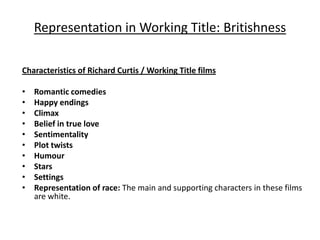
Representation in Working Title: Britishness

Characteristics of Richard Curtis / Working Title films

•   Romantic comedies
•   Happy endings
•   Climax
•   Belief in true love
•   Sentimentality
•   Plot twists
•   Humour
•   Stars
•   Settings
•   Representation of race: The main and supporting characters in these films
    are white.
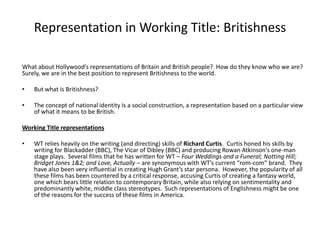
Representation in Working Title: Britishness

What about Hollywood’s representations of Britain and British people? How do they know who we are?
Surely, we are in the best position to represent Britishness to the world.

•   But what is Britishness?

•   The concept of national identity is a social construction, a representation based on a particular view
    of what it means to be British.

Working Title representations

•   WT relies heavily on the writing (and directing) skills of Richard Curtis. Curtis honed his skills by
    writing for Blackadder (BBC), The Vicar of Dibley (BBC) and producing Rowan Atkinson's one-man
    stage plays. Several films that he has written for WT – Four Weddings and a Funeral; Notting Hill;
    Bridget Jones 1&2; and Love, Actually – are synonymous with WT’s current “rom-com” brand. They
    have also been very influential in creating Hugh Grant’s star persona. However, the popularity of all
    these films has been countered by a critical response, accusing Curtis of creating a fantasy world,
    one which bears little relation to contemporary Britain, while also relying on sentimentality and
    predominantly white, middle class stereotypes. Such representations of Englishness might be one
    of the reasons for the success of these films in America.
However, there is a major down-side here for the British
 economy. Although WT films can be classified as British at
the production stage, they are distributed by Universal, who
  then claw back a huge chunk of the worldwide box office
 profits. So, is WT really a success story for the British Film
                           Industry?
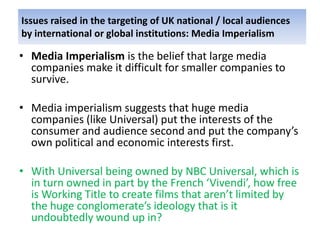
Issues raised in the targeting of UK national / local audiences
by international or global institutions: Media Imperialism

• Media Imperialism is the belief that large media
  companies make it difficult for smaller companies to
  survive.

• Media imperialism suggests that huge media
  companies (like Universal) put the interests of the
  consumer and audience second and put the company’s
  own political and economic interests first.

• With Universal being owned by NBC Universal, which is
  in turn owned in part by the French ‘Vivendi’, how free
  is Working Title to create films that aren’t limited by
  the huge conglomerate’s ideology that is it
  undoubtedly wound up in?
Ongoing debate
• British cinema should be a resolutely national
  cinema, representing British culture to a British
  audience. To do this, British films need to be
  publicly funded.

Or

• British cinema should be a profitable
  business, competing in the international
  marketplace, particularly with Hollywood, by
  attracting a wide audience.
Importance of cross media convergence / ownership
and synergy in production, distribution and marketing
• WT got its first break by using television to guarantee a
  nationwide première for its films, starting with My
  Beautiful Laundrette, the first of a series of successful
  collaborations with Channel Four Films throughout the
  1980s. WT is now owned by Universal Studios, who are
  now owned by Vivendi and General Electric.

• Vivendi has guaranteed European film and television
  distribution through its Canal+ Group, with ready access to
  its wealth of record companies, and video games interests.

• General Electric has guaranteed US and South American
  television distribution through its extensive NBC network.
Synergy Partnerships
• WT has developed a number of synergy partnerships across the
  production, distribution and marketing stages, eg:

• Billy Elliot (in collaboration with BBC Films & Tiger Aspect)
• Oh Brother, Where Art Thou (in collaboration with Touchstone
  Pictures)
• Captain Corelli's Mandolin (in collaboration with Studio Canal &
  Miramax )
• Bridget Jones's Diary (in collaboration with Studio Canal &
  Miramax)
• Love Actually (in collaboration with Studio Canal)
• Bridget Jones: The Edge of Reason (in collaboration with Miramax)
• Mr Bean's Holiday (in collaboration with StudioCanal)
• Frost/Nixon (in collaboration with Imagine Entertainment)
NEW TECHNOLOGY: Impact in recent years
(production, marketing, distribution & exchange) on
institutions and audiences.
Production:
• Computer-generated imagery (CGI)
• Non-linear (digital) editing
• HD video
• Digital film production issues

Digital distribution & exchange / exhibition:
• DVD / Blu-ray markets
• Digital TV
• Digital cinemas(inc IMAX)
• Digital film distribution & exchange / exhibition issues
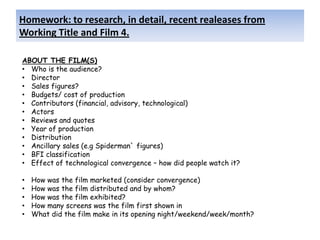
Homework: to research, in detail, recent realeases from
Working Title and Film 4.

ABOUT THE FILM(S)
• Who is the audience?
• Director
• Sales figures?
• Budgets/ cost of production
• Contributors (financial, advisory, technological)
• Actors
• Reviews and quotes
• Year of production
• Distribution
• Ancillary sales (e.g Spiderman` figures)
• BFI classification
• Effect of technological convergence – how did people watch it?

•   How was the film marketed (consider convergence)
•   How was the film distributed and by whom?
•   How was the film exhibited?
•   How many screens was the film first shown in
•   What did the film make in its opening night/weekend/week/month?

L3A&1

  • 1.
    Media Institutions  You will have reviewed your essay question and considered its strengths and weaknesses  You will understand production, distribution, marketing and exhibition and relate this to Working Title
  • 2.
    Review of task–Discuss the advantages and disadvantages of being a commercial or independent film company and how this impacts audiences. Refer to your case studies and give examples from your case studies and your wider knowledge. Mostly a good understanding of the advantages and disadvantages of being a commercial or independent company. Some good knowledge of the impact of different budgets, though this was limited to production and marketing, with little explanation given about the impact on exhibition and distribution. You need to refer continually to your case studies – it is evident that, at the moment, you don’t know enough about them. How did they market for example? Who made the marketing etc?
  • 3.
  • 4.
    The facts • 1984: Founded by Tim Bevan and Sarah Radclyffe. First investment: £500,000 in My Beautiful Laundrette, the first of a series of collaborations with Channel Four Films. Overall, 15 films produced in the 1980s. [Synergy] • 1991: Sets up a Hollywood office, developing production deals with Tim Robbins. [Conglomerate] • 1992: Working Title bought by PolyGram (a European music company). • 1998: PolyGram bought by Universal, a subsidiary of Seagram. Universal allows Working Title to greenlight films up to a budget of $35m. One of the first films produced was Billy Elliot (Stephen Daldry, 1999). [Vertical and Horizontal integration] • 2000: Seagram bought by Vivendi, the French multimedia conglomerate with extensive interests in film, TV, video games, music publishing, telecommunications and the internet. • 2004: Vivendi sells 80% share of Universal to GE (General Electric Company).
  • 5.
    The facts • In1999 – WORKING TITLE 2 PRODUCTIONS was launched which is an independent arm of Working Title. • It has limited budgets – e.g. Billy Eliot (200) was made with a budget of $5,000,000 unlike WORKING TITLE films (which are funded as a commercial company under working title) which has larger budgets; e.g. Johnny English Reborn (2011) which was made with a budget of $45,000,000. REMEMBER THIS Working Title was an independent company that became frustrated with the smaller budgets offered when they sought external funding (usually from Channel 4). As a result they were bought by Universal (80%) and GE (20%) in 2004. They now operate as part of a conglomerate and in a commercial way. This is part of their institutional context.
  • 6.
    Films you couldwatch and be familiar with: • The Boat That Rocked (2009) • About a Boy (2002) • Frost/Nixon (2008) • Captain Corelli's Mandolin (2001) • Atonement (2007) • Bridget Jones's Diary (2001) • Nanny McPhee (2005) • Billy Elliot (2000) • Bridget Jones: The Edge of Reason (2004) • Notting Hill (1999) • Wimbledon (2004) • Elizabeth (1998) • Shaun of the Dead (2004) • The Big Lebowski (1998) • Love Actually (2003) • Bean (1997) • Thirteen (2003) • Fargo (1996) • Ali G Indahouse (2002) Examples for the exam that you cite as case studies and now in depth should be recent (within the last 5 years, preferably the last 3).
  • 7.
    Issues with MediaOwnership and Practice Company structure (Practice) • At first, WT enjoyed its freedom as a small independent UK company, thanks to Channel Four. Formed in 1982, Ch4 had a government remit to commission and show programme content from independent production companies. • Within two years Channel Four had co-produced over 20 feature films with UK production companies for its regular “Film on Four” slot. Guaranteed exhibition meant independent WT could take greater risks. • WT’s Channel Four debut, My Beautiful Laundrette (1984) featured life in London’s Asian community, with two of the main characters having a homosexual affair. • WT continually faced difficulties in raising the money needed for their productions, unless they were low budget collaborations with Ch4. • My Beautiful Laundrette only had a budget of £500,000 from Ch4 in 1984. • Universal’s protective umbrella has meant that WT now has a green light to make films up to £40,000,000 without Universal’s permission.
  • 8.
    Issues with MediaOwnership and Practice Loss of national identity • A study of Working Title’s output suggests one of the issues raised by ownership patterns and trends is that Working Title’s success has been built upon making films with both British and American stars to appeal to an international market, starting with Four Weddings and a Funeral (1994). • However, this approach has provoked criticism about the 'mid- Atlantic' nature of its films. Working Title thus exemplifies the ongoing debate in the British film industry – whether to make culturally specific films which appeal to a more limited audience, or to make broader, generic films aimed at a much wider, international audience.
  • 9.
    Representation in WorkingTitle: Britishness Characteristics of Richard Curtis / Working Title films • Romantic comedies • Happy endings • Climax • Belief in true love • Sentimentality • Plot twists • Humour • Stars • Settings • Representation of race: The main and supporting characters in these films are white.
  • 10.
    Representation in WorkingTitle: Britishness What about Hollywood’s representations of Britain and British people? How do they know who we are? Surely, we are in the best position to represent Britishness to the world. • But what is Britishness? • The concept of national identity is a social construction, a representation based on a particular view of what it means to be British. Working Title representations • WT relies heavily on the writing (and directing) skills of Richard Curtis. Curtis honed his skills by writing for Blackadder (BBC), The Vicar of Dibley (BBC) and producing Rowan Atkinson's one-man stage plays. Several films that he has written for WT – Four Weddings and a Funeral; Notting Hill; Bridget Jones 1&2; and Love, Actually – are synonymous with WT’s current “rom-com” brand. They have also been very influential in creating Hugh Grant’s star persona. However, the popularity of all these films has been countered by a critical response, accusing Curtis of creating a fantasy world, one which bears little relation to contemporary Britain, while also relying on sentimentality and predominantly white, middle class stereotypes. Such representations of Englishness might be one of the reasons for the success of these films in America.
  • 11.
    However, there isa major down-side here for the British economy. Although WT films can be classified as British at the production stage, they are distributed by Universal, who then claw back a huge chunk of the worldwide box office profits. So, is WT really a success story for the British Film Industry?
  • 12.
    Issues raised inthe targeting of UK national / local audiences by international or global institutions: Media Imperialism • Media Imperialism is the belief that large media companies make it difficult for smaller companies to survive. • Media imperialism suggests that huge media companies (like Universal) put the interests of the consumer and audience second and put the company’s own political and economic interests first. • With Universal being owned by NBC Universal, which is in turn owned in part by the French ‘Vivendi’, how free is Working Title to create films that aren’t limited by the huge conglomerate’s ideology that is it undoubtedly wound up in?
  • 13.
    Ongoing debate • Britishcinema should be a resolutely national cinema, representing British culture to a British audience. To do this, British films need to be publicly funded. Or • British cinema should be a profitable business, competing in the international marketplace, particularly with Hollywood, by attracting a wide audience.
  • 14.
    Importance of crossmedia convergence / ownership and synergy in production, distribution and marketing • WT got its first break by using television to guarantee a nationwide première for its films, starting with My Beautiful Laundrette, the first of a series of successful collaborations with Channel Four Films throughout the 1980s. WT is now owned by Universal Studios, who are now owned by Vivendi and General Electric. • Vivendi has guaranteed European film and television distribution through its Canal+ Group, with ready access to its wealth of record companies, and video games interests. • General Electric has guaranteed US and South American television distribution through its extensive NBC network.
  • 15.
    Synergy Partnerships • WThas developed a number of synergy partnerships across the production, distribution and marketing stages, eg: • Billy Elliot (in collaboration with BBC Films & Tiger Aspect) • Oh Brother, Where Art Thou (in collaboration with Touchstone Pictures) • Captain Corelli's Mandolin (in collaboration with Studio Canal & Miramax ) • Bridget Jones's Diary (in collaboration with Studio Canal & Miramax) • Love Actually (in collaboration with Studio Canal) • Bridget Jones: The Edge of Reason (in collaboration with Miramax) • Mr Bean's Holiday (in collaboration with StudioCanal) • Frost/Nixon (in collaboration with Imagine Entertainment)
  • 16.
    NEW TECHNOLOGY: Impactin recent years (production, marketing, distribution & exchange) on institutions and audiences. Production: • Computer-generated imagery (CGI) • Non-linear (digital) editing • HD video • Digital film production issues Digital distribution & exchange / exhibition: • DVD / Blu-ray markets • Digital TV • Digital cinemas(inc IMAX) • Digital film distribution & exchange / exhibition issues
  • 17.
    Homework: to research,in detail, recent realeases from Working Title and Film 4. ABOUT THE FILM(S) • Who is the audience? • Director • Sales figures? • Budgets/ cost of production • Contributors (financial, advisory, technological) • Actors • Reviews and quotes • Year of production • Distribution • Ancillary sales (e.g Spiderman` figures) • BFI classification • Effect of technological convergence – how did people watch it? • How was the film marketed (consider convergence) • How was the film distributed and by whom? • How was the film exhibited? • How many screens was the film first shown in • What did the film make in its opening night/weekend/week/month?