INHERENT
POWER
of the
STATE PREPARED BY:
Philip SJ. Soberano
Subject Instructor
Essential or Inherent Power of Government
 There are three great powers that are inherent in government
these are;
Police Power
Power of Eminent Domain
Power of Taxation
Essential or Inherent Power of Government
1. Totality of governmental power it is contained in
three (3) great powers namely; power of eminent
domain, police power, and power of taxation.
2. Similarities these powers are similar in the following
respect
(a) they all rest upon necessity because there can be
no effective government without them.
b they are inherent is sovereignty, hence, they can be
exercise even without being expressly granted in the
constitution although the conditions for their exercise
may be regulated and limited by the constitution and
by law.
c. they are ways by which the State interferes with
private rights and property.
Similarities these powers are similar in the
following respect
d. They all legislative in character; and
e. They all presuppose an equivalent compensation
received, directly or indirectly, by the person affected b
the exercise of these powers by the government.
Similarities these powers are similar in the
following respect
POLICE POWER
Has been referred to as the power of the State to
enact such laws or regulations in relation to persons
and property as may promote public health, public
morals, public safety and the general welfare and
convenience of the people.
BASIS OF POLICE POWER
Salus populi est suprema lex the welfare of the
people is the supreme law
Sic utere tuo ut alienum non laedas so use your own
as not to injure another’s peoperty
Living in a civilized society demands that an individual must part
with some rights and privileges for the common good.
ILLUSTRATION OF POLICE POWER LAW
 Public health
Public safety
Public welfare
Public morals
ILLUSTRATION OF POLICE POWER LAW
PUBLIC HEALTH
 Those regulating the medical profession.
 Providing maternity leave for working women.
 Limiting the working hours to eight.
 Requiring every building or premises to be connected
with sanitary sewer.
 Prohibiting the sale of fresh meat except refrigerated
establishment.
ILLUSTRATION OF POLICE POWER LAW
PUBLIC MORAL
 those punishing vagrancy and prostitution.
 prohibiting gambling
 Providing a license tax for maintenance or operation
of public dance halls.
 punishing usury (5/6)
ILLUSTRATION OF POLICE POWER LAW
PUBLIC SAFETY
 Those requiring a license for the right to drive motor
vehicles.
 Providing for closure certain streets to traffic.
 Requiring compulsory military service.
 Authorizing the demolition of buildings or
improvements which constitute a fire hazards.
ILLUSTRATION OF POLICE POWER LAW
GENERAL WELFARE AND CONVENIENCE
 those requiring compulsory registration of lands.
 Authorizing the removal of billboards offensive to
sight.
 Regulating distance between gasoline stations
 regulating of prices of commodities and rents
houses.
POWER OF EMINENT DOMAIN
Meaning of eminent domain
Eminent domain is the right or power of the State or of
those to whom the power has been lawfully delegated
to take (or expropriate) private property for public use
upon paying the owner a just compensation to be
ascertained according to law. (see ART. XII, SEC 18)
NATIONAL ECONOMY AND PATRIMONY
ARTICLE XII
Section 18
The State may, in the interest of national welfare or
defense, establish and operate vital industries and,
upon payment of just compensation, transfer to public
ownership utilities, and other private enterprises to be
operated by the government.
POWER OF EMINENT DOMAIN
Conditions for or limitations upon its exercise
1. Existence of Public Use
 public use may be identified with public benefit
 beneficially employed for the community
 If property is taken by a private corporation (e.g
Meralco)
POWER OF EMINENT DOMAIN
Conditions for or limitations upon its exercise
2. Payment of Just compensation
 the amount to be expropriated property shall be
determined by the court. (RA7610)
 Based on the fair market value
 The owner may contest in court the value determined
by the assessor
POWER OF EMINENT DOMAIN
Conditions for or limitations upon its exercise
3. Observance of due process of law in the taking
 Procedural due process requires that the owner shall
have due notice and hearing in the expropriation
proceedings.
 taking (1) actual physical seizure not essential (2) the
taking must be direct.
POWER OF TAXATION
Is the power of the State to impose charge or burden
upon persons, property, or property rights, for the
use and support of the government and to enable it
to discharge its appropriate functions.
POWER OF TAXATION
Theory and Basis of Taxation
1. The power of taxation proceeds upon the theory that
the existence of government is necessity, that it cannot
continue with means to pay its expenses, and that for
these means it has a right to compel all its citizens and
property within its limits to contribute.
POWER OF TAXATION
Theory and Basis of Taxation
2. The basis of taxation is found in the reciprocal duties
of protection and support between the State and its
inhabitants.
Taxation is necessary to enable the State to exercise its
police power to promote general welfare.
Any Questions
CONCEPT OF STATE
AND
GOVERNMENT
Meaning of State
 A State is a community of persons more or less
numerous, permanently occupying a definite
portion of territory, having a government of their
own to which the great body of inhabitants render
obedience, and enjoying freedom from external
control.
Elements of State
 The modern state has four essential elements;
1. People
2. Territory
3. government
4. Sovereignty
Elements of State
 The modern state has four essential elements;
1. People
 refers to inhabitants living within the state
 There is no requirement as to the number of people
that should compos a state.
 Ideally, it neither be too small nor too large small
enough to be well govern and large enough to be
self sufficing.
Elements of State
 The modern state has four essential elements;
2. territory
 it includes not only the fixed portion of land over
which the jurisdiction of the state extends (territorial
domain).
 Fluvial domain
 Aerial domain
Elements of State
 The modern state has four essential elements;
3. government
 refers to the agency through which the will of the
State is formulated, expressed and carried out.
 Sometimes used to refer to the person or
aggregate of those persons in whose hands for the
time being the functions of political control.
Elements of State
 The modern state has four essential elements;
3. government
 This “body of men” is usually spoken of as
“administration. The ordinary citizens of a country
are part of the state, but are not of the government.
Elements of State
 The modern state has four essential elements;
4. Sovereignty
 The term may be defined as the supreme power of
the State to command and enforce obedience to its
will from people within its jurisdiction and corollarily,
to have freedom from foreign control. It has
therefore, two (2) manifistations:
Elements of State
 Sovereignty
 internal or power of the state to rule within its territory.
 external or the freedom of the state to carry out its
activities without subjection to or control by other state.
External sovereignty is often referred to as
Independence.
These internal and external aspects of sovereignty are not absolute true in
practice because of the development of international relations and consequently
of international law.
Origin of the State
there are several theories concerning the origin of states;
1. Divine right theory – it holds that the state is of
divine creation and the ruler is ordained by God to
govern the people.
2. Necessity or force theory – it maintains that states
must have been created through force, by some
great warriors who imposed their will upon the
weak.
Origin of the State
there are several theories concerning the origin of states;
3. Paternalistic theory – it attributes the origin of states to
the enlargement of family which remained under the
authority of the father or mother. (family-clan-tribe-nation)
4. Social contract theory – it asserts that early states must
have been formed by deliberate and voluntary compact
among the people to form a society and organize
government for their common good. (right of the people
to revolt against a bad ruler.
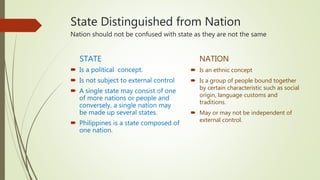
State Distinguished from Nation
Nation should not be confused with state as they are not the same
STATE
 Is a political concept.
 Is not subject to external control
 A single state may consist of one
of more nations or people and
conversely, a single nation may
be made up several states.
 Philippines is a state composed of
one nation.
NATION
 Is an ethnic concept
 Is a group of people bound together
by certain characteristic such as social
origin, language customs and
traditions.
 May or may not be independent of
external control.
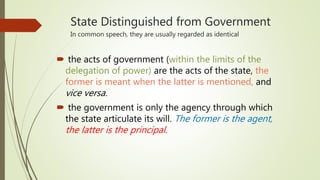
State Distinguished from Government
In common speech, they are usually regarded as identical
 the acts of government (within the limits of the
delegation of power) are the acts of the state, the
former is meant when the latter is mentioned, and
vice versa.
 the government is only the agency through which
the state articulate its will. The former is the agent,
the latter is the principal.
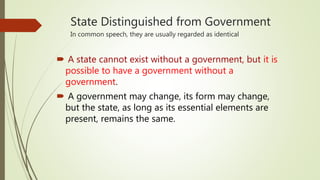
State Distinguished from Government
In common speech, they are usually regarded as identical
 A state cannot exist without a government, but it is
possible to have a government without a
government.
 A government may change, its form may change,
but the state, as long as its essential elements are
present, remains the same.
Purpose and Necessity of Government
 advancement of the public welfare. – government
exists and should continue to exist for the benefit of
the people governed. Its necessary for;
(a) protection of society and its member.
(b) the advancement of the physical, economic,
social, and cultural well being of the people. (ministrant
functions)
Forms of Government
the principal forms are the following:
 As to number of persons exercising sovereign
powers:
 as to extent of power exercised by the central or
national government:
 as to relationship between the executive and the
legislative branches of government:
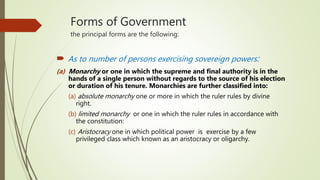
Forms of Government
the principal forms are the following:
 As to number of persons exercising sovereign powers:
(a) Monarchy or one in which the supreme and final authority is in the
hands of a single person without regards to the source of his election
or duration of his tenure. Monarchies are further classified into:
(a) absolute monarchy one or more in which the ruler rules by divine
right.
(b) limited monarchy or one in which the ruler rules in accordance with
the constitution:
(c) Aristocracy one in which political power is exercise by a few
privileged class which known as an aristocracy or oligarchy.
Forms of Government
the principal forms are the following:
 As to number of persons exercising sovereign powers:
(a) Democracy one in which political power is exercise by a majority of
the people. Democracy governments are further classified into:
(a) Direct or pure democracy one in which the will of the state is
formulated or expressed directly and immediately through the people
in a mass meeting or primary assembly rather than through the
medium of delegates or representatives chosen to act for them.
Forms of Government
the principal forms are the following:
 As to number of persons exercising sovereign powers:
(a) Democracy one in which political power is exercise by a majority of
the people. Democracy governments are further classified into:
(b) In direct, representative or republican democracy or one in which the
will of the state is formulated and expressed through agency of relatively
small and selected body of persons chosen to act as their representatives.
Forms of Government
the principal forms are the following:
 As to extent of powers exercised by the central and national
government:
(a) Unitary government or one in which the control of national and local
affairs is exercised by the central or national government:
(b) Federal government one in which the powers of government are
divided between two (2) sets of organs, one for national affairs and the
other for local affairs, each organ being supreme within its own sphere.
The united states is federal government.
Forms of Government
the principal forms are the following:
 As to relationship between the executive and legislative
branches of the government:
(a) Parliamentary government one in which the state confers upon the
legislature the power to terminate the tenure of office of the real
executive.
(b) Presidential government one in which that state makes the executive
constitutionally independent of the legislature as regards his tenure and
to a large extents as regards his policies and acts furnishes him with
sufficient power to prevent the legislature from trenching upon the
sphere marked out by the constitution as executive independence and
prerogative.
DISCLAIMER
The following content above is intended for general
information and educational purposes only.
All copyrights, images and trademark belongs to the
respective rightful owner.
Thank you!!!
Good luck…

L4 power and state

  • 1.
    INHERENT POWER of the STATE PREPAREDBY: Philip SJ. Soberano Subject Instructor
  • 2.
    Essential or InherentPower of Government  There are three great powers that are inherent in government these are; Police Power Power of Eminent Domain Power of Taxation
  • 3.
    Essential or InherentPower of Government 1. Totality of governmental power it is contained in three (3) great powers namely; power of eminent domain, police power, and power of taxation. 2. Similarities these powers are similar in the following respect (a) they all rest upon necessity because there can be no effective government without them.
  • 4.
    b they areinherent is sovereignty, hence, they can be exercise even without being expressly granted in the constitution although the conditions for their exercise may be regulated and limited by the constitution and by law. c. they are ways by which the State interferes with private rights and property. Similarities these powers are similar in the following respect
  • 5.
    d. They alllegislative in character; and e. They all presuppose an equivalent compensation received, directly or indirectly, by the person affected b the exercise of these powers by the government. Similarities these powers are similar in the following respect
  • 6.
    POLICE POWER Has beenreferred to as the power of the State to enact such laws or regulations in relation to persons and property as may promote public health, public morals, public safety and the general welfare and convenience of the people.
  • 7.
    BASIS OF POLICEPOWER Salus populi est suprema lex the welfare of the people is the supreme law Sic utere tuo ut alienum non laedas so use your own as not to injure another’s peoperty Living in a civilized society demands that an individual must part with some rights and privileges for the common good.
  • 8.
    ILLUSTRATION OF POLICEPOWER LAW  Public health Public safety Public welfare Public morals
  • 9.
    ILLUSTRATION OF POLICEPOWER LAW PUBLIC HEALTH  Those regulating the medical profession.  Providing maternity leave for working women.  Limiting the working hours to eight.  Requiring every building or premises to be connected with sanitary sewer.  Prohibiting the sale of fresh meat except refrigerated establishment.
  • 10.
    ILLUSTRATION OF POLICEPOWER LAW PUBLIC MORAL  those punishing vagrancy and prostitution.  prohibiting gambling  Providing a license tax for maintenance or operation of public dance halls.  punishing usury (5/6)
  • 11.
    ILLUSTRATION OF POLICEPOWER LAW PUBLIC SAFETY  Those requiring a license for the right to drive motor vehicles.  Providing for closure certain streets to traffic.  Requiring compulsory military service.  Authorizing the demolition of buildings or improvements which constitute a fire hazards.
  • 12.
    ILLUSTRATION OF POLICEPOWER LAW GENERAL WELFARE AND CONVENIENCE  those requiring compulsory registration of lands.  Authorizing the removal of billboards offensive to sight.  Regulating distance between gasoline stations  regulating of prices of commodities and rents houses.
  • 13.
    POWER OF EMINENTDOMAIN Meaning of eminent domain Eminent domain is the right or power of the State or of those to whom the power has been lawfully delegated to take (or expropriate) private property for public use upon paying the owner a just compensation to be ascertained according to law. (see ART. XII, SEC 18)
  • 14.
    NATIONAL ECONOMY ANDPATRIMONY ARTICLE XII Section 18 The State may, in the interest of national welfare or defense, establish and operate vital industries and, upon payment of just compensation, transfer to public ownership utilities, and other private enterprises to be operated by the government.
  • 15.
    POWER OF EMINENTDOMAIN Conditions for or limitations upon its exercise 1. Existence of Public Use  public use may be identified with public benefit  beneficially employed for the community  If property is taken by a private corporation (e.g Meralco)
  • 16.
    POWER OF EMINENTDOMAIN Conditions for or limitations upon its exercise 2. Payment of Just compensation  the amount to be expropriated property shall be determined by the court. (RA7610)  Based on the fair market value  The owner may contest in court the value determined by the assessor
  • 17.
    POWER OF EMINENTDOMAIN Conditions for or limitations upon its exercise 3. Observance of due process of law in the taking  Procedural due process requires that the owner shall have due notice and hearing in the expropriation proceedings.  taking (1) actual physical seizure not essential (2) the taking must be direct.
  • 18.
    POWER OF TAXATION Isthe power of the State to impose charge or burden upon persons, property, or property rights, for the use and support of the government and to enable it to discharge its appropriate functions.
  • 19.
    POWER OF TAXATION Theoryand Basis of Taxation 1. The power of taxation proceeds upon the theory that the existence of government is necessity, that it cannot continue with means to pay its expenses, and that for these means it has a right to compel all its citizens and property within its limits to contribute.
  • 20.
    POWER OF TAXATION Theoryand Basis of Taxation 2. The basis of taxation is found in the reciprocal duties of protection and support between the State and its inhabitants. Taxation is necessary to enable the State to exercise its police power to promote general welfare.
  • 21.
  • 22.
  • 23.
    Meaning of State A State is a community of persons more or less numerous, permanently occupying a definite portion of territory, having a government of their own to which the great body of inhabitants render obedience, and enjoying freedom from external control.
  • 24.
    Elements of State The modern state has four essential elements; 1. People 2. Territory 3. government 4. Sovereignty
  • 25.
    Elements of State The modern state has four essential elements; 1. People  refers to inhabitants living within the state  There is no requirement as to the number of people that should compos a state.  Ideally, it neither be too small nor too large small enough to be well govern and large enough to be self sufficing.
  • 26.
    Elements of State The modern state has four essential elements; 2. territory  it includes not only the fixed portion of land over which the jurisdiction of the state extends (territorial domain).  Fluvial domain  Aerial domain
  • 27.
    Elements of State The modern state has four essential elements; 3. government  refers to the agency through which the will of the State is formulated, expressed and carried out.  Sometimes used to refer to the person or aggregate of those persons in whose hands for the time being the functions of political control.
  • 28.
    Elements of State The modern state has four essential elements; 3. government  This “body of men” is usually spoken of as “administration. The ordinary citizens of a country are part of the state, but are not of the government.
  • 29.
    Elements of State The modern state has four essential elements; 4. Sovereignty  The term may be defined as the supreme power of the State to command and enforce obedience to its will from people within its jurisdiction and corollarily, to have freedom from foreign control. It has therefore, two (2) manifistations:
  • 30.
    Elements of State Sovereignty  internal or power of the state to rule within its territory.  external or the freedom of the state to carry out its activities without subjection to or control by other state. External sovereignty is often referred to as Independence. These internal and external aspects of sovereignty are not absolute true in practice because of the development of international relations and consequently of international law.
  • 31.
    Origin of theState there are several theories concerning the origin of states; 1. Divine right theory – it holds that the state is of divine creation and the ruler is ordained by God to govern the people. 2. Necessity or force theory – it maintains that states must have been created through force, by some great warriors who imposed their will upon the weak.
  • 32.
    Origin of theState there are several theories concerning the origin of states; 3. Paternalistic theory – it attributes the origin of states to the enlargement of family which remained under the authority of the father or mother. (family-clan-tribe-nation) 4. Social contract theory – it asserts that early states must have been formed by deliberate and voluntary compact among the people to form a society and organize government for their common good. (right of the people to revolt against a bad ruler.
  • 33.
    State Distinguished fromNation Nation should not be confused with state as they are not the same STATE  Is a political concept.  Is not subject to external control  A single state may consist of one of more nations or people and conversely, a single nation may be made up several states.  Philippines is a state composed of one nation. NATION  Is an ethnic concept  Is a group of people bound together by certain characteristic such as social origin, language customs and traditions.  May or may not be independent of external control.
  • 34.
    State Distinguished fromGovernment In common speech, they are usually regarded as identical  the acts of government (within the limits of the delegation of power) are the acts of the state, the former is meant when the latter is mentioned, and vice versa.  the government is only the agency through which the state articulate its will. The former is the agent, the latter is the principal.
  • 35.
    State Distinguished fromGovernment In common speech, they are usually regarded as identical  A state cannot exist without a government, but it is possible to have a government without a government.  A government may change, its form may change, but the state, as long as its essential elements are present, remains the same.
  • 36.
    Purpose and Necessityof Government  advancement of the public welfare. – government exists and should continue to exist for the benefit of the people governed. Its necessary for; (a) protection of society and its member. (b) the advancement of the physical, economic, social, and cultural well being of the people. (ministrant functions)
  • 37.
    Forms of Government theprincipal forms are the following:  As to number of persons exercising sovereign powers:  as to extent of power exercised by the central or national government:  as to relationship between the executive and the legislative branches of government:
  • 38.
    Forms of Government theprincipal forms are the following:  As to number of persons exercising sovereign powers: (a) Monarchy or one in which the supreme and final authority is in the hands of a single person without regards to the source of his election or duration of his tenure. Monarchies are further classified into: (a) absolute monarchy one or more in which the ruler rules by divine right. (b) limited monarchy or one in which the ruler rules in accordance with the constitution: (c) Aristocracy one in which political power is exercise by a few privileged class which known as an aristocracy or oligarchy.
  • 39.
    Forms of Government theprincipal forms are the following:  As to number of persons exercising sovereign powers: (a) Democracy one in which political power is exercise by a majority of the people. Democracy governments are further classified into: (a) Direct or pure democracy one in which the will of the state is formulated or expressed directly and immediately through the people in a mass meeting or primary assembly rather than through the medium of delegates or representatives chosen to act for them.
  • 40.
    Forms of Government theprincipal forms are the following:  As to number of persons exercising sovereign powers: (a) Democracy one in which political power is exercise by a majority of the people. Democracy governments are further classified into: (b) In direct, representative or republican democracy or one in which the will of the state is formulated and expressed through agency of relatively small and selected body of persons chosen to act as their representatives.
  • 41.
    Forms of Government theprincipal forms are the following:  As to extent of powers exercised by the central and national government: (a) Unitary government or one in which the control of national and local affairs is exercised by the central or national government: (b) Federal government one in which the powers of government are divided between two (2) sets of organs, one for national affairs and the other for local affairs, each organ being supreme within its own sphere. The united states is federal government.
  • 42.
    Forms of Government theprincipal forms are the following:  As to relationship between the executive and legislative branches of the government: (a) Parliamentary government one in which the state confers upon the legislature the power to terminate the tenure of office of the real executive. (b) Presidential government one in which that state makes the executive constitutionally independent of the legislature as regards his tenure and to a large extents as regards his policies and acts furnishes him with sufficient power to prevent the legislature from trenching upon the sphere marked out by the constitution as executive independence and prerogative.
  • 43.
    DISCLAIMER The following contentabove is intended for general information and educational purposes only. All copyrights, images and trademark belongs to the respective rightful owner.
  • 44.