L3
SOCIOCULTURAL
EVOLUTION
L
LESSON 1
CULTURAL, SOCIAL,
POLITICAL, AND
ECONOMIC SYMBOLS
Here starts
the lesson!
After going through this lesson,
you are expected to:
1. Identify cultural, social,
political, and economic symbols.
2. Discuss cultural, social,
political, and economic practices
3. Analyze the significance of
cultural, social, political, and
economic symbols and practices.
Symbols
• Symbols are the basis of
culture. A symbol is an
object, word, or action
that stands for something
else with no natural
relationship that is
culturally defined. (We
give a meaning that a
certain of the object)
Symbolisms can take
various forms. Besides
images and objects,
occasions and words can
also represent meaning.
• For example, when
a flag from a
country is
raised, people
who are
affiliated with
that country will
stand in honor of
that flag as it
represents
nationalism.
Functions of Symbols and Symbolism
• Social symbols are used to transfer
culture, ideologies, or beliefs
from group to another group of
people.
• Symbols are also used to preserve
traditions or beliefs of a certain
group of people.
• All symbols contain the “face” and
“hidden” values, the hidden value,
in a functional perspective, holds
greater meaning and importance than
the face value.
• Symbols and symbolism have been
used to create movements, spread
ideas, and share advocacies that
surpasses time and distance.
Types of Symbols
• Cultural Symbols – manifestation
that signifies ideology of a
particular culture that has
meaning within that culture.
• Social symbols – relating to human
societies and its modes of
organization (i.e., social
classes, social problems, social
issues, etc.)
• Political symbols – used to
represent a political standpoint;
seen in various media and forms such
as banners, flag, motto, etc.
• Economic symbols – used in
production, distribution, and
consumption of goods and services
like currency, market, labor,
demands and other economic
activities.
General Examples of Cultural
Symbols and Practices
Objects, figures, sounds and
colors
Facial expressions, word
interpretations, or gestures
such as handshakes and hand
signals, instead of symbols and
signs
Cultural Practices are the
manifestation of a culture or sub-
culture, especially concerning the
traditional and customary practices
of a particular ethnic or other
cultural group. Examples: religious
and spiritual, medical treatment,
forms of artistic expressions,
culinary, housing and child- rearing
practices.
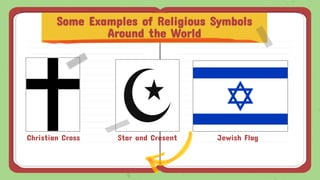
Some Examples of Religious Symbols
Around the World
Christian Cross Star and Cresent Jewish Flag
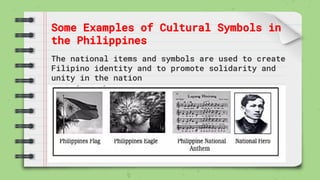
Some Examples of Cultural Symbols in
the Philippines
The national items and symbols are used to create
Filipino identity and to promote solidarity and
unity in the nation
Some Examples of Cultural Practices in the
Philippines
Traditional Medical Practices – belief in “albularyo”, herbal
medicines, alternative medicines, and other home remedies
Religious/ Spiritual Practices – Obando Festival in Bulacan for
fertility, Panaad sa Camiguin as act of penance and pilgrim.
Feast of the Black Nazarene in Manila, etc.
Culinary Practices- Rice 3 meals a day, Adobo, Sinigang, street
foods, Balut, rice cakes, etc.
Child-rearing Practices- respectful (used of the words mano, po
at opo), obedience to parents and elders, no talking back to
elders, removing foot wear before entering the house, family
mealtime, ninong/ninang, ate/Kuya, punishment using
belt/tsinelas
Social Symbols and Practices
It is a visible, external denotation of one’s social
position, indicator of one’s social or economic status.
Status Symbol relates to how individuals and groups
interact and interpret various cultural symbols. It can be
seen in clothing and possessions, societal recognition,
material possessions and other recognized symbols used
worldwide such as white dove for peace, red heart for love,
etc.
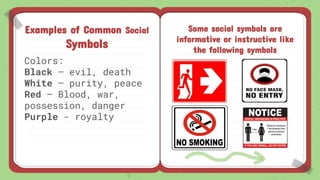
Examples of Common Social
Symbols
Colors:
Black – evil, death
White – purity, peace
Red – Blood, war,
possession, danger
Purple - royalty
Some social symbols are
informative or instructive like
the following symbols
Political Symbols and
Practices
The artifacts or
objectifications of different
political meanings especially
related to power. Political
symbols are usually used to
embody an ideology, an
advocacy, or a group of people
with same principles.
Political practices are common
things that are done within a
state or country. It is
related to the practices done
in the administration,
distribution and attainment of
power, bureaucratic
composition, etc.
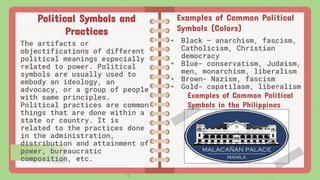
Examples of Common Political
Symbols (Colors)
• Black – anarchism, fascism,
Catholicism, Christian
democracy
• Blue- conservatism, Judaism,
men, monarchism, liberalism
• Brown- Nazism, fascism
• Gold- capatilasm, liberalism
Examples of Common Political
Symbols in the Philippines
Political Practices in the Philippines
• Political Dynasties – it is the concentration,
consolidation or perpetuation of public office and
political power by persons related to one another.
• Filipino Clans
• Celebrities turned Politicians
• Palakasan system
• Trapo (Traditional Politics)
• Catholic Church Influence
• Power Revolt
Economic Symbols
This represents economic standpoint. It can be
seen in various media such as Stock Exchange,
Money, and Currency, Gold and Petroleum, Life
Insurance, Banking, etc.
Examples:
New Zealand $ New Zealand dollar
Philippines ₱ Philippine peso
South Korea ₩ South Korean won
Thailand ฿ Thai baht
Philippine Economic Practices
In terms of savings, one of the traditional way
of saving money in Filipino is using
“alakansya”. It is where they Filipino use
bamboo as a vault to their money until it
becomes full and ready to be withdrawn by its
owner. Another way of economic practice of
Filipino is “paluwagan”. It is a group savings
where group of people agrees to give money to a
money manager who is also part of this group
and manages the money. The money will cycle
throughout the group.
Significance of Symbols and
Symbolism
As rational thinkers, we have been making
and giving meaning to symbols for a long
time. Symbols have been part of our lives
and growth as humankind. The usage of
symbols and symbolism have given mankind an
avenue to communicate with different group
of people, influence others of different
ideologies, and preserve values that were
transferred from generations and generations.
Here starts
the lesson!
TYPES OF SOCIETY
1. Hunting and gathering
societies
2. Pastoral societies
3. Horticultural societies
4. Agricultural societies
5. Industrial societies
6. Post- industrial societies
Sociocultural evolution
is an umbrella term for theories of cultural
evolution and social evolution, describing how
cultures and societies have developed over time.
Although such theories typically provide models
for understanding the relationship between
technologies, social structure, the values of a
society, and how and why they change with time,
they vary as to the extent to which they
describe specific mechanisms of variation and
social change.
1. Hunting and gathering societies
- are the earliest form of society. The members
survive primarily by hunting, trapping, fishing, and
gathering edible plants. The majority of the members' time is
spent looking for and gathering food A hunting and gathering
society have five characteristics:
1. Family is the society's primary institution. Family
determines the distribution of food and how to socialize
children.
2. These societies are small compared to the others. They
generally have less than 50 members.
3. Hunting and gathering societies are nomadic, which means
that they move constantly in order to find food and water.
4. Members of hunting and gathering societies are mutually
dependent upon each other.
5. Although there is an equal division of labor among the
members of hunting and gathering societies, there is a
division of labor based on sex. Men are typically responsible
for hunting, and women are typically gatherers.
2. Horticultural and Pastoral
Societies
Horticultural societies formed in areas where rainfall and
other conditions allowed them to grow stable crops. They
were similar to hunter-gatherers in that they largely
depended on the environment for survival, but since they
didn’t have to abandon their location to follow resources,
they were able to start permanent settlements. This created
more stability and more material goods and became the basis
for the first revolution in human survival.
Pastoral societies rely on the domestication of animals as
a resource for survival. Pastoral groups were able to breed
livestock for food, clothing, and transportation, and they
created a surplus of goods. Herding, or pastoral, societies
remained nomadic because they were forced to follow their
animals to fresh feeding grounds.
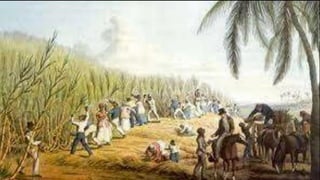
3. Agarian Society
- They produced
cultivation tools and
developed farming/
domestication skills
that can support and
sustain a town with the
population of over
thousand.
4. Industrial Society
-These societies start with
industrial revolution
around 1750, as production
began to shift from human
and animal power to machine
power.
5. Post- Industrial Society
-Societies that focused on the
use and application of new
information technology rather
than factories. “centers on
computers and other devices
that create, process, and apply
ideas and information. “Daniel
Bell.

L3-SOCIOCULTURAL EVOLUTION.pdf

  • 1.
  • 2.
    LESSON 1 CULTURAL, SOCIAL, POLITICAL,AND ECONOMIC SYMBOLS Here starts the lesson!
  • 3.
    After going throughthis lesson, you are expected to: 1. Identify cultural, social, political, and economic symbols. 2. Discuss cultural, social, political, and economic practices 3. Analyze the significance of cultural, social, political, and economic symbols and practices.
  • 4.
    Symbols • Symbols arethe basis of culture. A symbol is an object, word, or action that stands for something else with no natural relationship that is culturally defined. (We give a meaning that a certain of the object) Symbolisms can take various forms. Besides images and objects, occasions and words can also represent meaning. • For example, when a flag from a country is raised, people who are affiliated with that country will stand in honor of that flag as it represents nationalism.
  • 5.
    Functions of Symbolsand Symbolism • Social symbols are used to transfer culture, ideologies, or beliefs from group to another group of people. • Symbols are also used to preserve traditions or beliefs of a certain group of people.
  • 6.
    • All symbolscontain the “face” and “hidden” values, the hidden value, in a functional perspective, holds greater meaning and importance than the face value. • Symbols and symbolism have been used to create movements, spread ideas, and share advocacies that surpasses time and distance.
  • 7.
    Types of Symbols •Cultural Symbols – manifestation that signifies ideology of a particular culture that has meaning within that culture. • Social symbols – relating to human societies and its modes of organization (i.e., social classes, social problems, social issues, etc.)
  • 8.
    • Political symbols– used to represent a political standpoint; seen in various media and forms such as banners, flag, motto, etc. • Economic symbols – used in production, distribution, and consumption of goods and services like currency, market, labor, demands and other economic activities.
  • 9.
    General Examples ofCultural Symbols and Practices Objects, figures, sounds and colors Facial expressions, word interpretations, or gestures such as handshakes and hand signals, instead of symbols and signs
  • 10.
    Cultural Practices arethe manifestation of a culture or sub- culture, especially concerning the traditional and customary practices of a particular ethnic or other cultural group. Examples: religious and spiritual, medical treatment, forms of artistic expressions, culinary, housing and child- rearing practices.
  • 11.
    Some Examples ofReligious Symbols Around the World Christian Cross Star and Cresent Jewish Flag
  • 12.
    Some Examples ofCultural Symbols in the Philippines The national items and symbols are used to create Filipino identity and to promote solidarity and unity in the nation
  • 13.
    Some Examples ofCultural Practices in the Philippines Traditional Medical Practices – belief in “albularyo”, herbal medicines, alternative medicines, and other home remedies Religious/ Spiritual Practices – Obando Festival in Bulacan for fertility, Panaad sa Camiguin as act of penance and pilgrim. Feast of the Black Nazarene in Manila, etc. Culinary Practices- Rice 3 meals a day, Adobo, Sinigang, street foods, Balut, rice cakes, etc. Child-rearing Practices- respectful (used of the words mano, po at opo), obedience to parents and elders, no talking back to elders, removing foot wear before entering the house, family mealtime, ninong/ninang, ate/Kuya, punishment using belt/tsinelas
  • 14.
    Social Symbols andPractices It is a visible, external denotation of one’s social position, indicator of one’s social or economic status. Status Symbol relates to how individuals and groups interact and interpret various cultural symbols. It can be seen in clothing and possessions, societal recognition, material possessions and other recognized symbols used worldwide such as white dove for peace, red heart for love, etc.
  • 15.
    Examples of CommonSocial Symbols Colors: Black – evil, death White – purity, peace Red – Blood, war, possession, danger Purple - royalty Some social symbols are informative or instructive like the following symbols
  • 16.
    Political Symbols and Practices Theartifacts or objectifications of different political meanings especially related to power. Political symbols are usually used to embody an ideology, an advocacy, or a group of people with same principles. Political practices are common things that are done within a state or country. It is related to the practices done in the administration, distribution and attainment of power, bureaucratic composition, etc. Examples of Common Political Symbols (Colors) • Black – anarchism, fascism, Catholicism, Christian democracy • Blue- conservatism, Judaism, men, monarchism, liberalism • Brown- Nazism, fascism • Gold- capatilasm, liberalism Examples of Common Political Symbols in the Philippines
  • 17.
    Political Practices inthe Philippines • Political Dynasties – it is the concentration, consolidation or perpetuation of public office and political power by persons related to one another. • Filipino Clans • Celebrities turned Politicians • Palakasan system • Trapo (Traditional Politics) • Catholic Church Influence • Power Revolt
  • 18.
    Economic Symbols This representseconomic standpoint. It can be seen in various media such as Stock Exchange, Money, and Currency, Gold and Petroleum, Life Insurance, Banking, etc. Examples: New Zealand $ New Zealand dollar Philippines ₱ Philippine peso South Korea ₩ South Korean won Thailand ฿ Thai baht
  • 19.
    Philippine Economic Practices Interms of savings, one of the traditional way of saving money in Filipino is using “alakansya”. It is where they Filipino use bamboo as a vault to their money until it becomes full and ready to be withdrawn by its owner. Another way of economic practice of Filipino is “paluwagan”. It is a group savings where group of people agrees to give money to a money manager who is also part of this group and manages the money. The money will cycle throughout the group.
  • 20.
    Significance of Symbolsand Symbolism As rational thinkers, we have been making and giving meaning to symbols for a long time. Symbols have been part of our lives and growth as humankind. The usage of symbols and symbolism have given mankind an avenue to communicate with different group of people, influence others of different ideologies, and preserve values that were transferred from generations and generations.
  • 21.
    Here starts the lesson! TYPESOF SOCIETY 1. Hunting and gathering societies 2. Pastoral societies 3. Horticultural societies 4. Agricultural societies 5. Industrial societies 6. Post- industrial societies
  • 22.
    Sociocultural evolution is anumbrella term for theories of cultural evolution and social evolution, describing how cultures and societies have developed over time. Although such theories typically provide models for understanding the relationship between technologies, social structure, the values of a society, and how and why they change with time, they vary as to the extent to which they describe specific mechanisms of variation and social change.
  • 24.
    1. Hunting andgathering societies - are the earliest form of society. The members survive primarily by hunting, trapping, fishing, and gathering edible plants. The majority of the members' time is spent looking for and gathering food A hunting and gathering society have five characteristics: 1. Family is the society's primary institution. Family determines the distribution of food and how to socialize children. 2. These societies are small compared to the others. They generally have less than 50 members. 3. Hunting and gathering societies are nomadic, which means that they move constantly in order to find food and water. 4. Members of hunting and gathering societies are mutually dependent upon each other. 5. Although there is an equal division of labor among the members of hunting and gathering societies, there is a division of labor based on sex. Men are typically responsible for hunting, and women are typically gatherers.
  • 25.
    2. Horticultural andPastoral Societies Horticultural societies formed in areas where rainfall and other conditions allowed them to grow stable crops. They were similar to hunter-gatherers in that they largely depended on the environment for survival, but since they didn’t have to abandon their location to follow resources, they were able to start permanent settlements. This created more stability and more material goods and became the basis for the first revolution in human survival. Pastoral societies rely on the domestication of animals as a resource for survival. Pastoral groups were able to breed livestock for food, clothing, and transportation, and they created a surplus of goods. Herding, or pastoral, societies remained nomadic because they were forced to follow their animals to fresh feeding grounds.
  • 28.
    3. Agarian Society -They produced cultivation tools and developed farming/ domestication skills that can support and sustain a town with the population of over thousand.
  • 29.
    4. Industrial Society -Thesesocieties start with industrial revolution around 1750, as production began to shift from human and animal power to machine power.
  • 30.
    5. Post- IndustrialSociety -Societies that focused on the use and application of new information technology rather than factories. “centers on computers and other devices that create, process, and apply ideas and information. “Daniel Bell.