Traffic Control Devices
CIVL 4162/6162
Traffic Control Devices
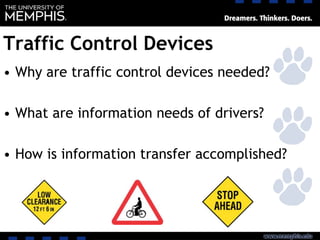
• Why are traffic control devices needed?
• What are information needs of drivers?
• How is information transfer accomplished?
Traffic Control Devices
• Three levels of driver information
– Navigation – planning and execution
(guide signs)
– Guidance – selecting a safe speed and
path (pavement markings, regulatory and
warning signs)
– Control – physical manipulation of vehicle
(primarily from vehicle itself)
Traffic Control Devices
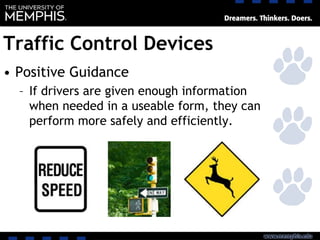
• Positive Guidance
– If drivers are given enough information
when needed in a useable form, they can
perform more safely and efficiently.
Traffic Control Devices
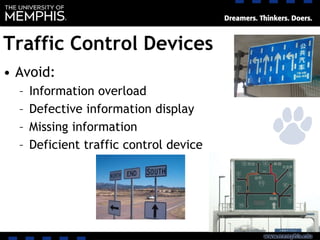
• Avoid:
– Information overload
– Defective information display
– Missing information
– Deficient traffic control device
Traffic Control Devices
• Traffic Signs
• Pavement Markings
• Traffic Signals
Manual on Uniform Traffic Control Devices (MUTCD)
http://mutcd.fhwa.dot.gov/
Promotes uniformity in design and application.
Traffic Control Devices
• Principles of the MUTCD
– Fulfill a need
– Command attention
– Convey a clear, simple message
– Command respect of road users
– Give adequate time for a proper response
Traffic Control Devices
• Contents of the MUTCD
– Detailed standards for physical design of
device
– Detailed standards and guidelines for
placement of device
– Warrants that justify use of a particular
device
Traffic Control Devices
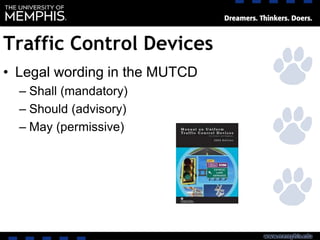
• Legal wording in the MUTCD
– Shall (mandatory)
– Should (advisory)
– May (permissive)
Traffic Control Devices
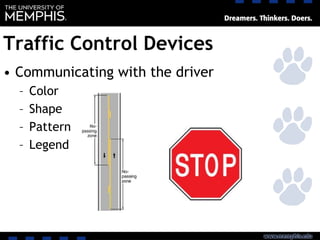
• Communicating with the driver
– Color
– Shape
– Pattern
– Legend
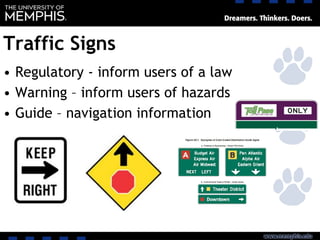
Traffic Signs
• Regulatory - inform users of a law
• Warning – inform users of hazards
• Guide – navigation information
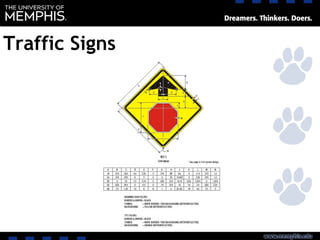
Traffic Signs
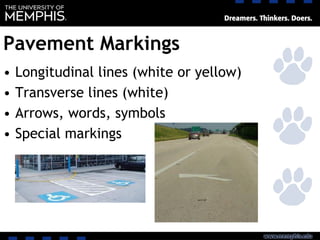
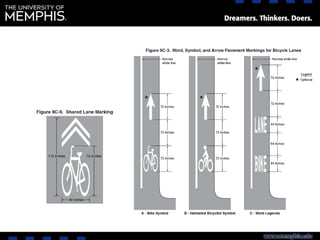
Pavement Markings
• Longitudinal lines (white or yellow)
• Transverse lines (white)
• Arrows, words, symbols
• Special markings
Traffic Signals
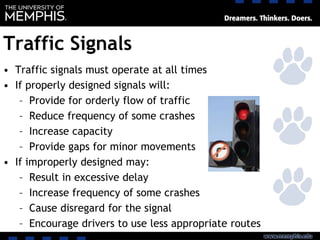
• Traffic signals must operate at all times
• If properly designed signals will:
– Provide for orderly flow of traffic
– Reduce frequency of some crashes
– Increase capacity
– Provide gaps for minor movements
• If improperly designed may:
– Result in excessive delay
– Increase frequency of some crashes
– Cause disregard for the signal
– Encourage drivers to use less appropriate routes
Traffic Signals
• Warrants
– Warrant 1, Eight-Hour Vehicular Volume.
– Warrant 2, Four-Hour Vehicular Volume.
– Warrant 3, Peak Hour.
– Warrant 4, Pedestrian Volume.
– Warrant 5, School Crossing.
– Warrant 6, Coordinated Signal System.
– Warrant 7, Crash Experience.
– Warrant 8, Roadway Network.
Traffic Signals
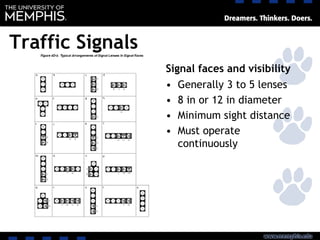
Signal faces and visibility
• Generally 3 to 5 lenses
• 8 in or 12 in diameter
• Minimum sight distance
• Must operate
continuously
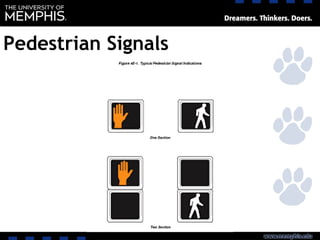
Pedestrian Signals
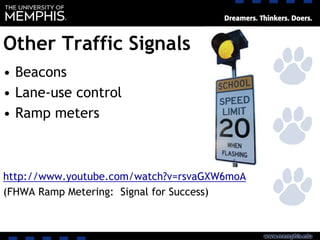
Other Traffic Signals
• Beacons
• Lane-use control
• Ramp meters
http://www.youtube.com/watch?v=rsvaGXW6moA
(FHWA Ramp Metering: Signal for Success)
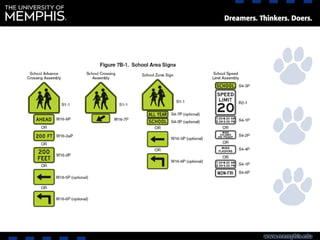
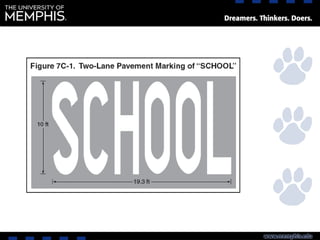
Traffic Control in School Zones
http://mutcd.fhwa.dot.gov/kno_2009r1r2.htm

L10 Traffic Control Devices

  • 1.
  • 2.
    Traffic Control Devices •Why are traffic control devices needed? • What are information needs of drivers? • How is information transfer accomplished?
  • 3.
    Traffic Control Devices •Three levels of driver information – Navigation – planning and execution (guide signs) – Guidance – selecting a safe speed and path (pavement markings, regulatory and warning signs) – Control – physical manipulation of vehicle (primarily from vehicle itself)
  • 4.
    Traffic Control Devices •Positive Guidance – If drivers are given enough information when needed in a useable form, they can perform more safely and efficiently.
  • 5.
    Traffic Control Devices •Avoid: – Information overload – Defective information display – Missing information – Deficient traffic control device
  • 6.
    Traffic Control Devices •Traffic Signs • Pavement Markings • Traffic Signals Manual on Uniform Traffic Control Devices (MUTCD) http://mutcd.fhwa.dot.gov/ Promotes uniformity in design and application.
  • 7.
    Traffic Control Devices •Principles of the MUTCD – Fulfill a need – Command attention – Convey a clear, simple message – Command respect of road users – Give adequate time for a proper response
  • 8.
    Traffic Control Devices •Contents of the MUTCD – Detailed standards for physical design of device – Detailed standards and guidelines for placement of device – Warrants that justify use of a particular device
  • 9.
    Traffic Control Devices •Legal wording in the MUTCD – Shall (mandatory) – Should (advisory) – May (permissive)
  • 10.
    Traffic Control Devices •Communicating with the driver – Color – Shape – Pattern – Legend
  • 11.
    Traffic Signs • Regulatory- inform users of a law • Warning – inform users of hazards • Guide – navigation information
  • 12.
  • 14.
    Pavement Markings • Longitudinallines (white or yellow) • Transverse lines (white) • Arrows, words, symbols • Special markings
  • 17.
    Traffic Signals • Trafficsignals must operate at all times • If properly designed signals will: – Provide for orderly flow of traffic – Reduce frequency of some crashes – Increase capacity – Provide gaps for minor movements • If improperly designed may: – Result in excessive delay – Increase frequency of some crashes – Cause disregard for the signal – Encourage drivers to use less appropriate routes
  • 18.
    Traffic Signals • Warrants –Warrant 1, Eight-Hour Vehicular Volume. – Warrant 2, Four-Hour Vehicular Volume. – Warrant 3, Peak Hour. – Warrant 4, Pedestrian Volume. – Warrant 5, School Crossing. – Warrant 6, Coordinated Signal System. – Warrant 7, Crash Experience. – Warrant 8, Roadway Network.
  • 19.
    Traffic Signals Signal facesand visibility • Generally 3 to 5 lenses • 8 in or 12 in diameter • Minimum sight distance • Must operate continuously
  • 20.
  • 21.
    Other Traffic Signals •Beacons • Lane-use control • Ramp meters http://www.youtube.com/watch?v=rsvaGXW6moA (FHWA Ramp Metering: Signal for Success)
  • 22.
    Traffic Control inSchool Zones http://mutcd.fhwa.dot.gov/kno_2009r1r2.htm