Case 11-2 LVMH & Luxury Goods Marketing Case Study By-Group No.5 Rakesh DhalBisoi-90 Kunal Banthia-75 Mangesh gade-23 Chinoy Mehata-09 Amit Vishwakarma-04 MNC-Prof. Manoj Das EMBA,Batch-XIII,ITM,Kharghar
 
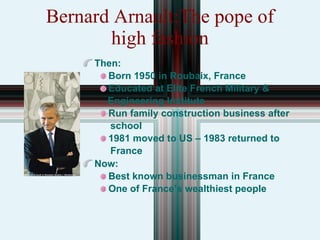
Bernard Arnault:The pope of high fashion Then: Born 1950 in Roubaix, France Educated at Elite French Military &  Engineering Institute Run family construction business after  school 1981 moved to US – 1983 returned to  France Now: Best known businessman in France One of France’s wealthiest people
What is LVMH  ? A world leader in luxury goods created in 1987 More than 2300 stores worldwide 77,000 employees worldwide A unique portfolio of 60 prestigious brands US$ 15 billionn in 2003
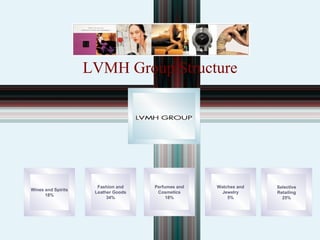
LVMH Group Structure Wines and Spirits 18% Watches and Jewelry 5% Selective Retailing 25% Fashion and Leather Goods 34% Perfumes and Cosmetics 18%
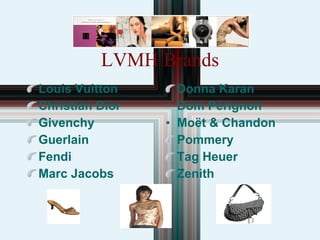
LVMH Brands Louis Vuitton Christian Dior Givenchy Guerlain Fendi Marc Jacobs Donna Karan Dom P érignon Mo ët & Chandon Pommery Tag Heuer Zenith
Discussion Q. Bernard Arnault has built LVMH into a luxury goods empire by  making numerous acquisitions. What strategy is evident here ? Answer : A multi brand strategies, brand extension. A Selective acquisition strategies -concentrating on external  growth. Acquisition means killing of competitors i.e, lesser competition Increase market share leads to monopoly
Discussion Q. How do LVMH executives adjust prices in response to changing  economic conditions ? Answer: Raised wholesale prices in individual Asian markets . There by discourage discount retailers from stocking up with  designer products and then selling them to down-market consumers. Advertising expenses on perfume and cosmetics reduced. Cancel plans of opening new store. Raised prices to counteract the effect of currency devaluation. When tourism is at peak, increase prices by 10-12%
Discussion Q. Do you think the high retail prices charged for luxury goods are worth paying ? Answer : YES Affluent consumers eagerly seekout luxury brands such as Armani, Christian Dior,gucci,louis Vuitton,Prada, and Versace etc They are willing & able to pay high prices for top quality merchandise from fashion houses whose names are synonymous with status, good taste, and prestige  If the prices are diluted then every one can afford such goods as a result there will not be any aristocracy,status, and prestige involve with it  Luxury goods are percieve not as a product , as an image- a Lifestyle. In short if you want status symbol then if you have to pay more
Discussion Q. How will luxury goods marketers be affected by the slowdown in tourism that  followed the terror attacks of September 11, 2001 ? Answer : In Europe and USA , the economy plays a greater role in consumer behavior  Japanese tourists are significant factor Heavy taxes are levied on luxury goods in Japan,making prices about 40 %  higher  than in  many other countries  So Japanese buy these goods abroad . In the wake of Terrorist attack they were less keen to travel which affected the luxury  good sales  If Japanese will travel more then they spend more .  Local market sales in Japan picked up Serious impact on sales to tourist in most countries .
Questions ?
Thank You

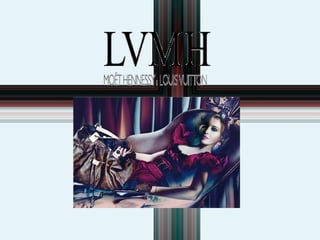
L V M H

  • 1.
    Case 11-2 LVMH& Luxury Goods Marketing Case Study By-Group No.5 Rakesh DhalBisoi-90 Kunal Banthia-75 Mangesh gade-23 Chinoy Mehata-09 Amit Vishwakarma-04 MNC-Prof. Manoj Das EMBA,Batch-XIII,ITM,Kharghar
  • 2.
  • 3.
    Bernard Arnault:The popeof high fashion Then: Born 1950 in Roubaix, France Educated at Elite French Military & Engineering Institute Run family construction business after school 1981 moved to US – 1983 returned to France Now: Best known businessman in France One of France’s wealthiest people
  • 4.
    What is LVMH ? A world leader in luxury goods created in 1987 More than 2300 stores worldwide 77,000 employees worldwide A unique portfolio of 60 prestigious brands US$ 15 billionn in 2003
  • 5.
    LVMH Group StructureWines and Spirits 18% Watches and Jewelry 5% Selective Retailing 25% Fashion and Leather Goods 34% Perfumes and Cosmetics 18%
  • 6.
    LVMH Brands LouisVuitton Christian Dior Givenchy Guerlain Fendi Marc Jacobs Donna Karan Dom P érignon Mo ët & Chandon Pommery Tag Heuer Zenith
  • 7.
    Discussion Q. BernardArnault has built LVMH into a luxury goods empire by making numerous acquisitions. What strategy is evident here ? Answer : A multi brand strategies, brand extension. A Selective acquisition strategies -concentrating on external growth. Acquisition means killing of competitors i.e, lesser competition Increase market share leads to monopoly
  • 8.
    Discussion Q. Howdo LVMH executives adjust prices in response to changing economic conditions ? Answer: Raised wholesale prices in individual Asian markets . There by discourage discount retailers from stocking up with designer products and then selling them to down-market consumers. Advertising expenses on perfume and cosmetics reduced. Cancel plans of opening new store. Raised prices to counteract the effect of currency devaluation. When tourism is at peak, increase prices by 10-12%
  • 9.
    Discussion Q. Doyou think the high retail prices charged for luxury goods are worth paying ? Answer : YES Affluent consumers eagerly seekout luxury brands such as Armani, Christian Dior,gucci,louis Vuitton,Prada, and Versace etc They are willing & able to pay high prices for top quality merchandise from fashion houses whose names are synonymous with status, good taste, and prestige If the prices are diluted then every one can afford such goods as a result there will not be any aristocracy,status, and prestige involve with it Luxury goods are percieve not as a product , as an image- a Lifestyle. In short if you want status symbol then if you have to pay more
  • 10.
    Discussion Q. Howwill luxury goods marketers be affected by the slowdown in tourism that followed the terror attacks of September 11, 2001 ? Answer : In Europe and USA , the economy plays a greater role in consumer behavior Japanese tourists are significant factor Heavy taxes are levied on luxury goods in Japan,making prices about 40 % higher than in many other countries So Japanese buy these goods abroad . In the wake of Terrorist attack they were less keen to travel which affected the luxury good sales If Japanese will travel more then they spend more . Local market sales in Japan picked up Serious impact on sales to tourist in most countries .
  • 11.
  • 12.