THE DEAL JPMorgan Investment Banking Competition Anirban Ray | Sumit Thawrani | Akash Gehani MDI Gurgaon LVMH BVLGARI
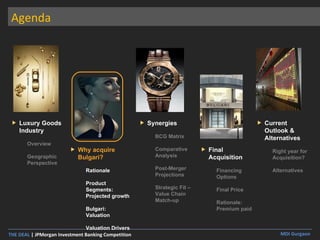
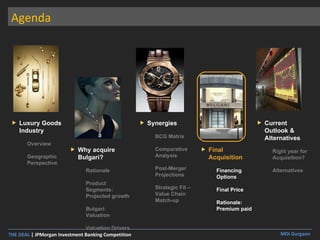
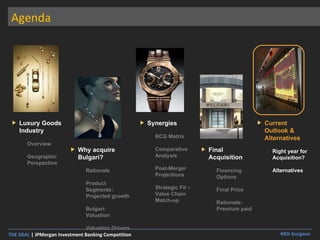
Agenda Luxury Goods Industry Overview Geographic Perspective Why acquire Bulgari? Rationale Product Segments: Projected growth Bulgari: Valuation Valuation Drivers Synergies BCG Matrix Comparative Analysis Post-Merger Projections Strategic Fit – Value Chain Match-up  Final Acquisition Financing Options Final Price Rationale: Premium paid Current Outlook & Alternatives Right year for Acquisition? Alternatives
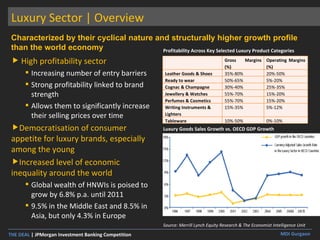
Luxury Sector | Overview High profitability sector Increasing number of entry barriers Strong profitability linked to brand strength Allows them to significantly increase their selling prices over time Democratisation of consumer appetite for luxury brands, especially among the young Increased level of economic inequality around the world Global wealth of HNWIs is poised to grow by 6.8% p.a. until 2011 9.5% in the Middle East and 8.5% in Asia, but only 4.3% in Europe Characterized by their cyclical nature and structurally higher growth profile than the world economy Profitability Across Key Selected Luxury Product Categories Luxury Goods Sales Growth vs. OECD GDP Growth Source: Merrill Lynch Equity Research & The Economist Intelligence Unit Gross Margins (%) Operating Margins (%) Leather Goods & Shoes 35%-80% 20%-50% Ready to wear 50%-65% 5%-20% Cognac & Champagne 30%-40% 25%-35% Jewellery & Watches 55%-70% 15%-20% Perfumes & Cosmetics 55%-70% 15%-20% Writing Instruments & Lighters 15%-35% 5%-12% Tableware 10%-50% 0%-10%
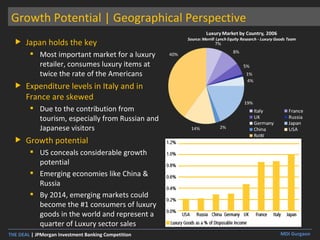
Growth Potential | Geographical Perspective Japan holds the key Most important market for a luxury retailer, consumes luxury items at twice the rate of the Americans Expenditure levels in Italy and in France are skewed Due to the contribution from tourism, especially from Russian and Japanese visitors Growth potential US conceals considerable growth potential Emerging economies like China & Russia By 2014, emerging markets could become the #1 consumers of luxury goods in the world and represent a quarter of Luxury sector sales
Agenda Luxury Goods Industry Overview Geographic Perspective Why acquire Bulgari? Rationale Product Segments: Projected growth Bulgari: Valuation Valuation Drivers Synergies BCG Matrix Comparative Analysis Post-Merger Projections Strategic Fit – Value Chain Match-up  Final Acquisition Financing Options Final Price Rationale: Premium paid Current Outlook & Alternatives Right year for Acquisition? Alternatives
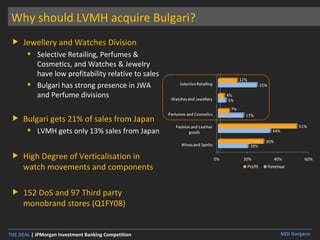
Why should LVMH acquire Bulgari? Jewellery and Watches Division Selective Retailing, Perfumes & Cosmetics, and Watches & Jewelry have low profitability relative to sales Bulgari has strong presence in JWA and Perfume divisions Bulgari gets 21% of sales from Japan LVMH gets only 13% sales from Japan High Degree of Verticalisation in watch movements and components 152 DoS and 97 Third party monobrand stores (Q1FY08)
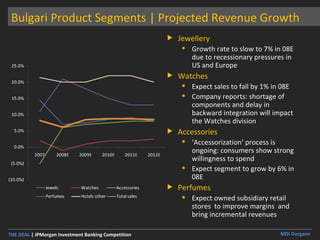
Bulgari Product Segments | Projected Revenue Growth Jewellery Growth rate to slow to 7% in 08E due to recessionary pressures in US and Europe Watches Expect sales to fall by 1% in 08E  Company reports: shortage of components and delay in backward integration will impact the Watches division Accessories ‘ Accessorization’ process is ongoing: consumers show strong willingness to spend Expect segment to grow by 6% in 08E Perfumes Expect owned subsidiary retail stores  to improve margins  and bring incremental revenues
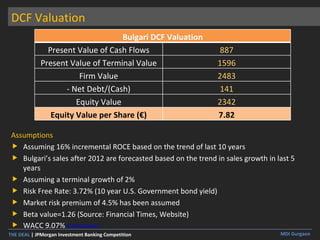
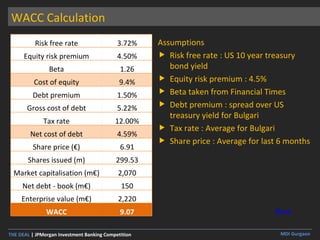
DCF Valuation Assumptions Assuming 16% incremental ROCE based on the trend of last 10 years Bulgari’s sales after 2012 are forecasted based on the trend in sales growth in last 5 years Assuming a terminal growth of 2% Risk Free Rate: 3.72% (10 year U.S. Government bond yield) Market risk premium of 4.5% has been assumed Beta value=1.26 (Source: Financial Times, Website) WACC 9.07%  (Calculation) Bulgari DCF Valuation Present Value of Cash Flows 887 Present Value of Terminal Value 1596 Firm Value 2483 - Net Debt/(Cash) 141 Equity Value 2342 Equity Value per Share (€) 7.82
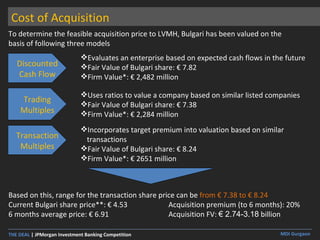
Cost of Acquisition To determine the feasible acquisition price to LVMH, Bulgari has been valued on the basis of following three models  Discounted Cash Flow Evaluates an enterprise based on expected cash flows in the future Fair Value of Bulgari share: € 7.82 Firm Value*: € 2,482 million Uses ratios to value a company based on similar listed companies Fair Value of Bulgari share: € 7.38 Firm Value*: € 2,284 million Trading Multiples Transaction Multiples Incorporates target premium into valuation based on similar transactions Fair Value of Bulgari share: € 8.24 Firm Value*: € 2651 million Based on this, range for the transaction share price can be  from € 7.38 to € 8.24 Current Bulgari share price**: € 4.53 Acquisition premium (to 6 months): 20% 6 months average price: € 6.91  Acquisition FV:  € 2.74-3.18  billion
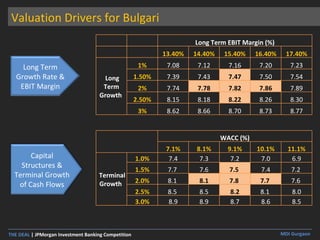
Valuation Drivers for Bulgari     Long Term EBIT Margin (%)    13.40% 14.40% 15.40% 16.40% 17.40% Long Term Growth  1% 7.08 7.12 7.16 7.20 7.23 1.50% 7.39 7.43 7.47 7.50 7.54 2% 7.74 7.78 7.82 7.86 7.89 2.50% 8.15 8.18 8.22 8.26 8.30 3% 8.62 8.66 8.70 8.73 8.77 WACC (%)  7.1% 8.1% 9.1% 10.1% 11.1% Terminal Growth  1.0% 7.4 7.3 7.2 7.0 6.9 1.5% 7.7  7.6 7.5  7.4 7.2  2.0% 8.1  8.1 7.8  7.7  7.6  2.5% 8.5  8.5 8.2  8.1  8.0 3.0% 8.9 8.9 8.7 8.6 8.5 Long Term Growth Rate & EBIT Margin Capital Structures & Terminal Growth of Cash Flows
Agenda Luxury Goods Industry Overview Geographic Perspective Why acquire Bulgari? Rationale Product Segments: Projected growth Bulgari: Valuation Valuation Drivers Synergies BCG Matrix Comparative Analysis Post-Merger Projections Strategic Fit – Value Chain Match-up  Final Acquisition Financing Options Final Price Rationale: Premium paid Current Outlook & Alternatives Right year for Acquisition? Alternatives
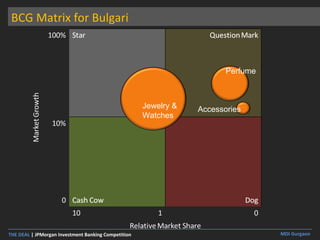
BCG Matrix for Bulgari Jewelry & Watches Perfume Accessories
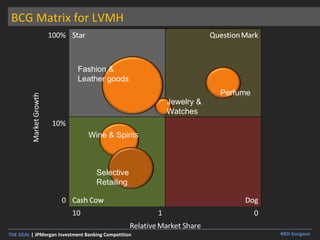
BCG Matrix for LVMH Jewelry & Watches Perfume Wine & Spirits Fashion & Leather goods Selective Retailing
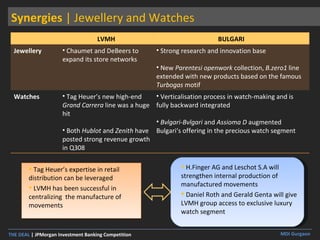
Synergies  | Jewellery and Watches Tag Heuer’s expertise in retail distribution can be leveraged LVMH has been successful in centralizing  the manufacture of movements H.Finger AG and Leschot S.A will strengthen internal production of manufactured movements Daniel Roth and Gerald Genta will give LVMH group access to exclusive luxury watch segment LVMH BULGARI Jewellery Chaumet and DeBeers to expand its store networks Strong research and innovation base New  Parentesi openwork  collection,  B.zero1  line extended with new products based on the famous  Turbogas  motif Watches Tag Heuer’s new high-end  Grand Carrera  line was a huge hit Both  Hublot  and  Zenith  have posted strong revenue growth in Q308 Verticalisation process in watch-making and is fully backward integrated Bvlgari-Bvlgari  and  Assioma D  augmented Bulgari‘s offering in the precious watch segment
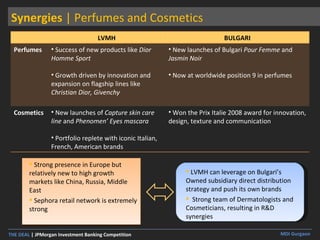
Synergies  | Perfumes and Cosmetics Strong presence in Europe but relatively new to high growth markets like China, Russia, Middle East Sephora retail network is extremely strong LVMH can leverage on Bulgari’s Owned subsidiary direct distribution strategy and push its own brands  Strong team of Dermatologists and Cosmeticians, resulting in R&D synergies LVMH BULGARI Perfumes Success of new products like  Dior Homme Sport   Growth driven by innovation and expansion on flagship lines like  Christian Dior, Givenchy New launches of Bulgari  Pour Femme  and  Jasmin Noir Now at worldwide position 9 in perfumes Cosmetics New launches of  Capture skin care line  and  Phenomen’ Eyes mascara Portfolio replete with iconic Italian, French, American brands Won the Prix Italie 2008 award for innovation, design, texture and communication
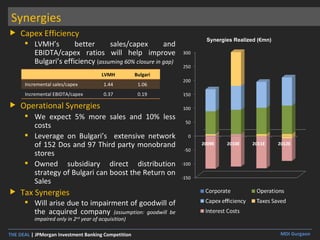
Synergies Capex Efficiency LVMH’s better sales/capex and EBIDTA/capex ratios will help improve Bulgari’s efficiency  ( assuming 60% closure in gap) Operational Synergies We expect 5% more sales and 10% less costs  Leverage on Bulgari’s  extensive network of 152 Dos and 97 Third party monobrand stores Owned subsidiary direct distribution strategy of Bulgari can boost the Return on Sales Tax Synergies Will arise due to impairment of goodwill of the acquired company  (assumption: goodwill be impaired only in 2 nd  year of acquisition) LVMH Bulgari Incremental sales/capex 1.44 1.06 Incremental EBIDTA/capex 0.37 0.19 Synergies Realized (€mn)
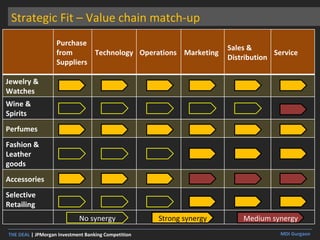
Strategic Fit – Value chain match-up Purchase from Suppliers Technology Operations Marketing Sales & Distribution Service Jewelry & Watches Wine & Spirits Perfumes Fashion & Leather goods Accessories Selective Retailing No synergy Strong synergy Medium synergy
Agenda Luxury Goods Industry Overview Geographic Perspective Why acquire Bulgari? Rationale Product Segments: Projected growth Bulgari: Valuation Valuation Drivers Synergies BCG Matrix Comparative Analysis Post-Merger Projections Strategic Fit – Value Chain Match-up  Final Acquisition Financing Options Final Price Rationale: Premium paid Current Outlook & Alternatives Right year for Acquisition? Alternatives
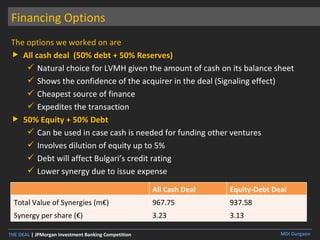
Financing Options  The options we worked on are  All cash deal  (50% debt + 50% Reserves) Natural choice for LVMH given the amount of cash on its balance sheet Shows the confidence of the acquirer in the deal (Signaling effect) Cheapest source of finance  Expedites the transaction 50% Equity + 50% Debt Can be used in case cash is needed for funding other ventures Involves dilution of equity up to 5% Debt will affect Bulgari’s credit rating Lower synergy due to issue expense All Cash Deal Equity-Debt Deal Total Value of Synergies (m€) 967.75 937.58 Synergy per share (€) 3.23 3.13
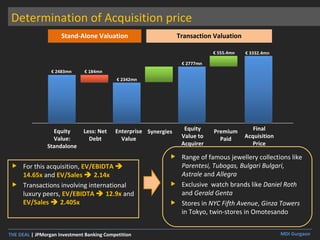
Determination of Acquisition price For this acquisition,   EV/EBIDTA    14.65x   and   EV/Sales    2.14x Transactions involving international luxury peers,  EV/EBIDTA    12.9x   and   EV/Sales    2.405x Range of famous jewellery collections  like  Parentesi, Tubogas, Bulgari Bulgari, Astrale  and  Allegra Exclusive  watch brands like  Daniel Roth  and  Gerald Genta Stores in  NYC Fifth Avenue ,  Ginza Towers  in Tokyo, twin-stores in Omotesando Final Acquisition Price Equity Value to Acquirer Equity Value: Standalone €  3332.4mn €  555.4mn €  2777mn €  2342mn €  184mn €  2483mn Premium Paid Less: Net Debt Enterprise Value Synergies Stand-Alone Valuation Transaction Valuation
Agenda Luxury Goods Industry Overview Geographic Perspective Why acquire Bulgari? Rationale Product Segments: Projected growth Bulgari: Valuation Valuation Drivers Synergies BCG Matrix Comparative Analysis Post-Merger Projections Strategic Fit – Value Chain Match-up  Final Acquisition Financing Options Final Price Rationale: Premium paid Current Outlook & Alternatives Right year for Acquisition? Alternatives
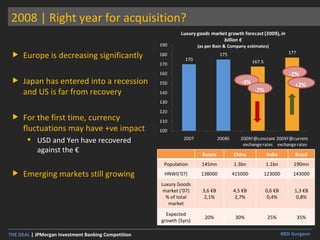
2008 | Right year for acquisition? Europe is decreasing significantly Japan has entered into a recession and US is far from recovery For the first time, currency fluctuations may have +ve impact USD and Yen have recovered against the € Emerging markets still growing -3% -7% -2% +2% Russia China India Brazil Population 145mn 1.3bn 1.1bn 190mn HNWI(‘07) 138000 415000 123000 143000 Luxury Goods market (‘07) % of total market 3,6 €B 2,1% 4,5 €B 2,7% 0,6 €B 0,4% 1,3 €B 0,8% Expected growth (5yrs) 20% 30% 25% 35%
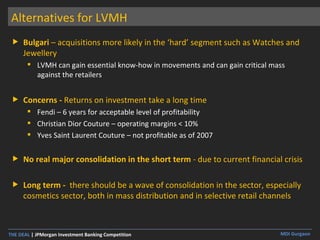
Alternatives for LVMH Bulgari  – acquisitions more likely in the ‘hard’ segment such as Watches and Jewellery LVMH can gain essential know-how in movements and can gain critical mass against the retailers Concerns -  Returns on investment take a long time Fendi – 6 years for acceptable level of profitability Christian Dior Couture – operating margins < 10% Yves Saint Laurent Couture – not profitable as of 2007 No real major consolidation in the short term  - due to current financial crisis Long term -  there should be a wave of consolidation in the sector, especially cosmetics sector, both in mass distribution and in selective retail channels
Thank You
References “ The Deal” Case Study – JPMorgan The Brave New World of M&A – Boston Consulting Group, July 2007 World Wealth Report  - CapGemini & Merrill Lynch, 2008 Merrill Lynch Luxury and Lifestyle Certificate - April 2007 Bulgari Group First Half 2008 Results – August 2008 LVMH Group First Half 2008 Results – August 2008 “ Eurozone – Long Term Strategy” Research report – Natixis Securities, October 2007 “ Analyst Research Report – Bulgari SpA” – Citigroup, May 2008 “ Analyst Research Report – Bulgari SpA Q208 Results Preview” – JPMC, July 2008
WACC Calculation Assumptions Risk free rate : US 10 year treasury bond yield Equity risk premium : 4.5% Beta taken from Financial Times  Debt premium : spread over US treasury yield for Bulgari Tax rate : Average for Bulgari Share price : Average for last 6 months Back Risk free rate 3.72% Equity risk premium 4.50% Beta 1.26 Cost of equity 9.4% Debt premium 1.50% Gross cost of debt 5.22% Tax rate 12.00% Net cost of debt 4.59% Share price ( € ) 6.91 Shares issued (m) 299.53 Market capitalisation (m € ) 2,070 Net debt - book (m € ) 150 Enterprise value (m € ) 2,220 WACC 9.07

The Deal

  • 1.
    THE DEAL JPMorganInvestment Banking Competition Anirban Ray | Sumit Thawrani | Akash Gehani MDI Gurgaon LVMH BVLGARI
  • 2.
    Agenda Luxury GoodsIndustry Overview Geographic Perspective Why acquire Bulgari? Rationale Product Segments: Projected growth Bulgari: Valuation Valuation Drivers Synergies BCG Matrix Comparative Analysis Post-Merger Projections Strategic Fit – Value Chain Match-up Final Acquisition Financing Options Final Price Rationale: Premium paid Current Outlook & Alternatives Right year for Acquisition? Alternatives
  • 3.
    Agenda Luxury GoodsIndustry Overview Geographic Perspective Why acquire Bulgari? Rationale Product Segments: Projected growth Bulgari: Valuation Valuation Drivers Synergies BCG Matrix Comparative Analysis Post-Merger Projections Strategic Fit – Value Chain Match-up Final Acquisition Financing Options Final Price Rationale: Premium paid Current Outlook & Alternatives Right year for Acquisition? Alternatives
  • 4.
    Luxury Sector |Overview High profitability sector Increasing number of entry barriers Strong profitability linked to brand strength Allows them to significantly increase their selling prices over time Democratisation of consumer appetite for luxury brands, especially among the young Increased level of economic inequality around the world Global wealth of HNWIs is poised to grow by 6.8% p.a. until 2011 9.5% in the Middle East and 8.5% in Asia, but only 4.3% in Europe Characterized by their cyclical nature and structurally higher growth profile than the world economy Profitability Across Key Selected Luxury Product Categories Luxury Goods Sales Growth vs. OECD GDP Growth Source: Merrill Lynch Equity Research & The Economist Intelligence Unit Gross Margins (%) Operating Margins (%) Leather Goods & Shoes 35%-80% 20%-50% Ready to wear 50%-65% 5%-20% Cognac & Champagne 30%-40% 25%-35% Jewellery & Watches 55%-70% 15%-20% Perfumes & Cosmetics 55%-70% 15%-20% Writing Instruments & Lighters 15%-35% 5%-12% Tableware 10%-50% 0%-10%
  • 5.
    Growth Potential |Geographical Perspective Japan holds the key Most important market for a luxury retailer, consumes luxury items at twice the rate of the Americans Expenditure levels in Italy and in France are skewed Due to the contribution from tourism, especially from Russian and Japanese visitors Growth potential US conceals considerable growth potential Emerging economies like China & Russia By 2014, emerging markets could become the #1 consumers of luxury goods in the world and represent a quarter of Luxury sector sales
  • 6.
    Agenda Luxury GoodsIndustry Overview Geographic Perspective Why acquire Bulgari? Rationale Product Segments: Projected growth Bulgari: Valuation Valuation Drivers Synergies BCG Matrix Comparative Analysis Post-Merger Projections Strategic Fit – Value Chain Match-up Final Acquisition Financing Options Final Price Rationale: Premium paid Current Outlook & Alternatives Right year for Acquisition? Alternatives
  • 7.
    Why should LVMHacquire Bulgari? Jewellery and Watches Division Selective Retailing, Perfumes & Cosmetics, and Watches & Jewelry have low profitability relative to sales Bulgari has strong presence in JWA and Perfume divisions Bulgari gets 21% of sales from Japan LVMH gets only 13% sales from Japan High Degree of Verticalisation in watch movements and components 152 DoS and 97 Third party monobrand stores (Q1FY08)
  • 8.
    Bulgari Product Segments| Projected Revenue Growth Jewellery Growth rate to slow to 7% in 08E due to recessionary pressures in US and Europe Watches Expect sales to fall by 1% in 08E Company reports: shortage of components and delay in backward integration will impact the Watches division Accessories ‘ Accessorization’ process is ongoing: consumers show strong willingness to spend Expect segment to grow by 6% in 08E Perfumes Expect owned subsidiary retail stores to improve margins and bring incremental revenues
  • 9.
    DCF Valuation AssumptionsAssuming 16% incremental ROCE based on the trend of last 10 years Bulgari’s sales after 2012 are forecasted based on the trend in sales growth in last 5 years Assuming a terminal growth of 2% Risk Free Rate: 3.72% (10 year U.S. Government bond yield) Market risk premium of 4.5% has been assumed Beta value=1.26 (Source: Financial Times, Website) WACC 9.07% (Calculation) Bulgari DCF Valuation Present Value of Cash Flows 887 Present Value of Terminal Value 1596 Firm Value 2483 - Net Debt/(Cash) 141 Equity Value 2342 Equity Value per Share (€) 7.82
  • 10.
    Cost of AcquisitionTo determine the feasible acquisition price to LVMH, Bulgari has been valued on the basis of following three models Discounted Cash Flow Evaluates an enterprise based on expected cash flows in the future Fair Value of Bulgari share: € 7.82 Firm Value*: € 2,482 million Uses ratios to value a company based on similar listed companies Fair Value of Bulgari share: € 7.38 Firm Value*: € 2,284 million Trading Multiples Transaction Multiples Incorporates target premium into valuation based on similar transactions Fair Value of Bulgari share: € 8.24 Firm Value*: € 2651 million Based on this, range for the transaction share price can be from € 7.38 to € 8.24 Current Bulgari share price**: € 4.53 Acquisition premium (to 6 months): 20% 6 months average price: € 6.91 Acquisition FV: € 2.74-3.18 billion
  • 11.
    Valuation Drivers forBulgari     Long Term EBIT Margin (%)   13.40% 14.40% 15.40% 16.40% 17.40% Long Term Growth 1% 7.08 7.12 7.16 7.20 7.23 1.50% 7.39 7.43 7.47 7.50 7.54 2% 7.74 7.78 7.82 7.86 7.89 2.50% 8.15 8.18 8.22 8.26 8.30 3% 8.62 8.66 8.70 8.73 8.77 WACC (%) 7.1% 8.1% 9.1% 10.1% 11.1% Terminal Growth 1.0% 7.4 7.3 7.2 7.0 6.9 1.5% 7.7 7.6 7.5 7.4 7.2 2.0% 8.1 8.1 7.8 7.7 7.6 2.5% 8.5 8.5 8.2 8.1 8.0 3.0% 8.9 8.9 8.7 8.6 8.5 Long Term Growth Rate & EBIT Margin Capital Structures & Terminal Growth of Cash Flows
  • 12.
    Agenda Luxury GoodsIndustry Overview Geographic Perspective Why acquire Bulgari? Rationale Product Segments: Projected growth Bulgari: Valuation Valuation Drivers Synergies BCG Matrix Comparative Analysis Post-Merger Projections Strategic Fit – Value Chain Match-up Final Acquisition Financing Options Final Price Rationale: Premium paid Current Outlook & Alternatives Right year for Acquisition? Alternatives
  • 13.
    BCG Matrix forBulgari Jewelry & Watches Perfume Accessories
  • 14.
    BCG Matrix forLVMH Jewelry & Watches Perfume Wine & Spirits Fashion & Leather goods Selective Retailing
  • 15.
    Synergies |Jewellery and Watches Tag Heuer’s expertise in retail distribution can be leveraged LVMH has been successful in centralizing the manufacture of movements H.Finger AG and Leschot S.A will strengthen internal production of manufactured movements Daniel Roth and Gerald Genta will give LVMH group access to exclusive luxury watch segment LVMH BULGARI Jewellery Chaumet and DeBeers to expand its store networks Strong research and innovation base New Parentesi openwork collection, B.zero1 line extended with new products based on the famous Turbogas motif Watches Tag Heuer’s new high-end Grand Carrera line was a huge hit Both Hublot and Zenith have posted strong revenue growth in Q308 Verticalisation process in watch-making and is fully backward integrated Bvlgari-Bvlgari and Assioma D augmented Bulgari‘s offering in the precious watch segment
  • 16.
    Synergies |Perfumes and Cosmetics Strong presence in Europe but relatively new to high growth markets like China, Russia, Middle East Sephora retail network is extremely strong LVMH can leverage on Bulgari’s Owned subsidiary direct distribution strategy and push its own brands Strong team of Dermatologists and Cosmeticians, resulting in R&D synergies LVMH BULGARI Perfumes Success of new products like Dior Homme Sport Growth driven by innovation and expansion on flagship lines like Christian Dior, Givenchy New launches of Bulgari Pour Femme and Jasmin Noir Now at worldwide position 9 in perfumes Cosmetics New launches of Capture skin care line and Phenomen’ Eyes mascara Portfolio replete with iconic Italian, French, American brands Won the Prix Italie 2008 award for innovation, design, texture and communication
  • 17.
    Synergies Capex EfficiencyLVMH’s better sales/capex and EBIDTA/capex ratios will help improve Bulgari’s efficiency ( assuming 60% closure in gap) Operational Synergies We expect 5% more sales and 10% less costs Leverage on Bulgari’s extensive network of 152 Dos and 97 Third party monobrand stores Owned subsidiary direct distribution strategy of Bulgari can boost the Return on Sales Tax Synergies Will arise due to impairment of goodwill of the acquired company (assumption: goodwill be impaired only in 2 nd year of acquisition) LVMH Bulgari Incremental sales/capex 1.44 1.06 Incremental EBIDTA/capex 0.37 0.19 Synergies Realized (€mn)
  • 18.
    Strategic Fit –Value chain match-up Purchase from Suppliers Technology Operations Marketing Sales & Distribution Service Jewelry & Watches Wine & Spirits Perfumes Fashion & Leather goods Accessories Selective Retailing No synergy Strong synergy Medium synergy
  • 19.
    Agenda Luxury GoodsIndustry Overview Geographic Perspective Why acquire Bulgari? Rationale Product Segments: Projected growth Bulgari: Valuation Valuation Drivers Synergies BCG Matrix Comparative Analysis Post-Merger Projections Strategic Fit – Value Chain Match-up Final Acquisition Financing Options Final Price Rationale: Premium paid Current Outlook & Alternatives Right year for Acquisition? Alternatives
  • 20.
    Financing Options The options we worked on are All cash deal (50% debt + 50% Reserves) Natural choice for LVMH given the amount of cash on its balance sheet Shows the confidence of the acquirer in the deal (Signaling effect) Cheapest source of finance Expedites the transaction 50% Equity + 50% Debt Can be used in case cash is needed for funding other ventures Involves dilution of equity up to 5% Debt will affect Bulgari’s credit rating Lower synergy due to issue expense All Cash Deal Equity-Debt Deal Total Value of Synergies (m€) 967.75 937.58 Synergy per share (€) 3.23 3.13
  • 21.
    Determination of Acquisitionprice For this acquisition, EV/EBIDTA  14.65x and EV/Sales  2.14x Transactions involving international luxury peers, EV/EBIDTA  12.9x and EV/Sales  2.405x Range of famous jewellery collections like Parentesi, Tubogas, Bulgari Bulgari, Astrale and Allegra Exclusive watch brands like Daniel Roth and Gerald Genta Stores in NYC Fifth Avenue , Ginza Towers in Tokyo, twin-stores in Omotesando Final Acquisition Price Equity Value to Acquirer Equity Value: Standalone € 3332.4mn € 555.4mn € 2777mn € 2342mn € 184mn € 2483mn Premium Paid Less: Net Debt Enterprise Value Synergies Stand-Alone Valuation Transaction Valuation
  • 22.
    Agenda Luxury GoodsIndustry Overview Geographic Perspective Why acquire Bulgari? Rationale Product Segments: Projected growth Bulgari: Valuation Valuation Drivers Synergies BCG Matrix Comparative Analysis Post-Merger Projections Strategic Fit – Value Chain Match-up Final Acquisition Financing Options Final Price Rationale: Premium paid Current Outlook & Alternatives Right year for Acquisition? Alternatives
  • 23.
    2008 | Rightyear for acquisition? Europe is decreasing significantly Japan has entered into a recession and US is far from recovery For the first time, currency fluctuations may have +ve impact USD and Yen have recovered against the € Emerging markets still growing -3% -7% -2% +2% Russia China India Brazil Population 145mn 1.3bn 1.1bn 190mn HNWI(‘07) 138000 415000 123000 143000 Luxury Goods market (‘07) % of total market 3,6 €B 2,1% 4,5 €B 2,7% 0,6 €B 0,4% 1,3 €B 0,8% Expected growth (5yrs) 20% 30% 25% 35%
  • 24.
    Alternatives for LVMHBulgari – acquisitions more likely in the ‘hard’ segment such as Watches and Jewellery LVMH can gain essential know-how in movements and can gain critical mass against the retailers Concerns - Returns on investment take a long time Fendi – 6 years for acceptable level of profitability Christian Dior Couture – operating margins < 10% Yves Saint Laurent Couture – not profitable as of 2007 No real major consolidation in the short term - due to current financial crisis Long term - there should be a wave of consolidation in the sector, especially cosmetics sector, both in mass distribution and in selective retail channels
  • 25.
  • 26.
    References “ TheDeal” Case Study – JPMorgan The Brave New World of M&A – Boston Consulting Group, July 2007 World Wealth Report - CapGemini & Merrill Lynch, 2008 Merrill Lynch Luxury and Lifestyle Certificate - April 2007 Bulgari Group First Half 2008 Results – August 2008 LVMH Group First Half 2008 Results – August 2008 “ Eurozone – Long Term Strategy” Research report – Natixis Securities, October 2007 “ Analyst Research Report – Bulgari SpA” – Citigroup, May 2008 “ Analyst Research Report – Bulgari SpA Q208 Results Preview” – JPMC, July 2008
  • 27.
    WACC Calculation AssumptionsRisk free rate : US 10 year treasury bond yield Equity risk premium : 4.5% Beta taken from Financial Times Debt premium : spread over US treasury yield for Bulgari Tax rate : Average for Bulgari Share price : Average for last 6 months Back Risk free rate 3.72% Equity risk premium 4.50% Beta 1.26 Cost of equity 9.4% Debt premium 1.50% Gross cost of debt 5.22% Tax rate 12.00% Net cost of debt 4.59% Share price ( € ) 6.91 Shares issued (m) 299.53 Market capitalisation (m € ) 2,070 Net debt - book (m € ) 150 Enterprise value (m € ) 2,220 WACC 9.07