Introduction
• Louis Vuitton, fashion and leather goods business unit of
LVMH Group headquartered in Paris, France luxury
goods conglomerate targeting the “super rich” people.
• For seven decades Louis Vuitton remained a single-
product brand of the company which produced only
handmade leather bags before diversifying into leather
accessories.
• In 1987, Louis Vuitton merged with Moët Hennessy, a
French wine maker of 1743 vintage, to form LVMH
Group.
• LVMH went on an acquisition spree during the 1990s,
targeting heritage brands. By 2000, the company had
over 60 brands in its portfolio
• Louis Vuitton, was the flagship brand of the
company’s fashion and leather goods business
segment generating over half of the group’s profits.
• Louis Vuitton was keen on projecting itself as a luxury
brand with a distinguished heritage and not a fashion
brand that changed with the times.
• The fashion and leather goods business had 14
production workshops 12 in France and 1 in Spain and
1 in California
• Some of the brands other than Louis Vuitton the
company has: Fendi, Donna Karan, Loewe, Marc
Jacobs, Celine, Kenzo, Givenchy, Thomas Pink, Pucci,
Berluti, Stefanobi, Rossimoda and eLuxury
• By year 2007, 2,048 stores worldwide, over 2000
stores worldwide, 71,000+ employees, sales revenue
of €16.5 billion and a net profit of €2.3 billion for the
year
Why do people buy luxury goods?
Social Assertion
Exclusivity
Status Symbol
"Money in the bank when you die means you have not enjoyed life.“
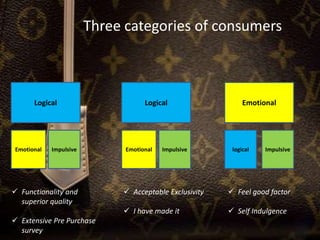
Logical
ImpulsiveEmotional
 Functionality and
superior quality
 Extensive Pre Purchase
survey
Logical
ImpulsiveEmotional
Emotional
Impulsivelogical
 Acceptable Exclusivity
 I have made it
 Feel good factor
 Self Indulgence
Three categories of consumers
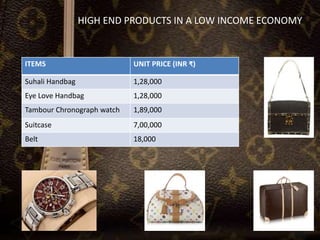
HIGH END PRODUCTS IN A LOW INCOME ECONOMY
ITEMS UNIT PRICE (INR ₹)
Suhali Handbag 1,28,000
Eye Love Handbag 1,28,000
Tambour Chronograph watch 1,89,000
Suitcase 7,00,000
Belt 18,000
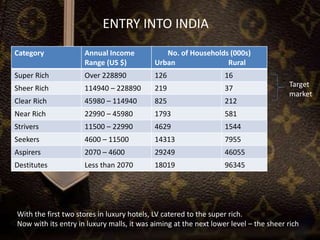
ENTRY INTO INDIA
Category Annual Income
Range (US $)
No. of Households (000s)
Urban Rural
Super Rich Over 228890 126 16
Sheer Rich 114940 – 228890 219 37
Clear Rich 45980 – 114940 825 212
Near Rich 22990 – 45980 1793 581
Strivers 11500 – 22990 4629 1544
Seekers 4600 – 11500 14313 7955
Aspirers 2070 – 4600 29249 46055
Destitutes Less than 2070 18019 96345
With the first two stores in luxury hotels, LV catered to the super rich.
Now with its entry in luxury malls, it was aiming at the next lower level – the sheer rich
Target
market
Target Groups
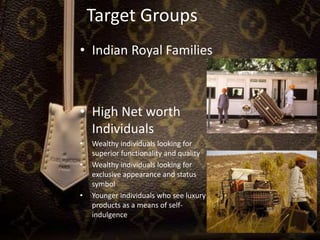
• Indian Royal Families
• High Net worth
Individuals
• Wealthy individuals looking for
superior functionality and quality
• Wealthy individuals looking for
exclusive appearance and status
symbol
• Younger individuals who see luxury
products as a means of self-
indulgence
MARKET SIZE
Product Segment
Potential Customers
New Customer Group
FACTORS HINDERING THE PURCHASE OF LUXURY
GOODS IN INDIA
CHALLENGES
• 87% of population lived on less than Rs.165 per day
• 266.5 million people bellow poverty line
EXTERNAL FACTORS
• High customs duties on imports
• Official ban on imports of leather goods
• Concern entry of MNC would place domestic leather
trade at risk
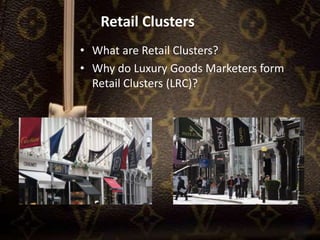
Retail Clusters
• What are Retail Clusters?
• Why do Luxury Goods Marketers form
Retail Clusters (LRC)?
• Louis Vuitton & LRC
Pros Cons
Exclusivity Very few LRC in India
Visibility More expensive
Control over Store Design High investment
Ownership of Store
Success in the West
Why do certain luxury brands look for store
locations in luxury hotels?
• Luxury Hotels – Social hub
• First halt for tourists
• Target segment availability
• Premium ambience
• Next best option after High Streets
• Adjacencies of other exclusive
brands
• Good security facilities
Alternatives and the way ahead
• Luxury nibbling
• ‘Brand conscious but Price conscious’
• Lack of single main streets and luxury
malls
• Brands targeting heritage buildings
 High street location: Rs. 450-550/sq.ft*
 Luxury Malls: Rs. 350-450/sq.ft
 Luxury hotels: Rs. 600-800/sq.ft
• 10-12 footfalls in a mall/day while 2-3 in
a luxury hotel/day**
• Emphasis on attracting various
customer segments
• Creating an exclusive environment
How does luxury malls work for luxury
markets?
• India has three such malls—DLF Emporio in
Delhi, Palladium in Mumbai and UB City in
Bangalore.
• Malls specially cater to luxury brands:
Ambience, Space and Footfalls
• Five-star hotels: footfalls remain a challenge
The key statistic is the number of visitors that stores
get.
“As far as footfalls go, if a brand store gets 10-12
footfalls in a day in a mall, the same would get
two or three in a hotel and sales per sq. ft also
would be in that proportion,” said Kapoor of
Genesis.
We get customers from all sorts of places. They
could be people from across India and even
tourists from South Africa visiting the city. The
number of walk-ins are at least 10 times higher
(compared with five-star hotels) and customers
who are visiting the mall are curious to check out
the brand, know the prices and see the
collection,” said a store executive at Jimmy
Choo’s Palladium store.
Developers aren’t all that enthusiastic because of the limited number of potential
tenants. Most luxury brands plan to expand their presence to anywhere between
two and six stores and not much more beyond that
Louis Vuitton_Case Study_Retail Management

Louis Vuitton_Case Study_Retail Management

  • 2.
    Introduction • Louis Vuitton,fashion and leather goods business unit of LVMH Group headquartered in Paris, France luxury goods conglomerate targeting the “super rich” people. • For seven decades Louis Vuitton remained a single- product brand of the company which produced only handmade leather bags before diversifying into leather accessories. • In 1987, Louis Vuitton merged with Moët Hennessy, a French wine maker of 1743 vintage, to form LVMH Group.
  • 3.
    • LVMH wenton an acquisition spree during the 1990s, targeting heritage brands. By 2000, the company had over 60 brands in its portfolio • Louis Vuitton, was the flagship brand of the company’s fashion and leather goods business segment generating over half of the group’s profits. • Louis Vuitton was keen on projecting itself as a luxury brand with a distinguished heritage and not a fashion brand that changed with the times.
  • 4.
    • The fashionand leather goods business had 14 production workshops 12 in France and 1 in Spain and 1 in California • Some of the brands other than Louis Vuitton the company has: Fendi, Donna Karan, Loewe, Marc Jacobs, Celine, Kenzo, Givenchy, Thomas Pink, Pucci, Berluti, Stefanobi, Rossimoda and eLuxury • By year 2007, 2,048 stores worldwide, over 2000 stores worldwide, 71,000+ employees, sales revenue of €16.5 billion and a net profit of €2.3 billion for the year
  • 5.
    Why do peoplebuy luxury goods? Social Assertion Exclusivity Status Symbol "Money in the bank when you die means you have not enjoyed life.“
  • 6.
    Logical ImpulsiveEmotional  Functionality and superiorquality  Extensive Pre Purchase survey Logical ImpulsiveEmotional Emotional Impulsivelogical  Acceptable Exclusivity  I have made it  Feel good factor  Self Indulgence Three categories of consumers
  • 7.
    HIGH END PRODUCTSIN A LOW INCOME ECONOMY ITEMS UNIT PRICE (INR ₹) Suhali Handbag 1,28,000 Eye Love Handbag 1,28,000 Tambour Chronograph watch 1,89,000 Suitcase 7,00,000 Belt 18,000
  • 8.
    ENTRY INTO INDIA CategoryAnnual Income Range (US $) No. of Households (000s) Urban Rural Super Rich Over 228890 126 16 Sheer Rich 114940 – 228890 219 37 Clear Rich 45980 – 114940 825 212 Near Rich 22990 – 45980 1793 581 Strivers 11500 – 22990 4629 1544 Seekers 4600 – 11500 14313 7955 Aspirers 2070 – 4600 29249 46055 Destitutes Less than 2070 18019 96345 With the first two stores in luxury hotels, LV catered to the super rich. Now with its entry in luxury malls, it was aiming at the next lower level – the sheer rich Target market
  • 9.
    Target Groups • IndianRoyal Families • High Net worth Individuals • Wealthy individuals looking for superior functionality and quality • Wealthy individuals looking for exclusive appearance and status symbol • Younger individuals who see luxury products as a means of self- indulgence
  • 10.
    MARKET SIZE Product Segment PotentialCustomers New Customer Group
  • 11.
    FACTORS HINDERING THEPURCHASE OF LUXURY GOODS IN INDIA CHALLENGES • 87% of population lived on less than Rs.165 per day • 266.5 million people bellow poverty line EXTERNAL FACTORS • High customs duties on imports • Official ban on imports of leather goods • Concern entry of MNC would place domestic leather trade at risk
  • 12.
    Retail Clusters • Whatare Retail Clusters? • Why do Luxury Goods Marketers form Retail Clusters (LRC)?
  • 13.
    • Louis Vuitton& LRC Pros Cons Exclusivity Very few LRC in India Visibility More expensive Control over Store Design High investment Ownership of Store Success in the West
  • 14.
    Why do certainluxury brands look for store locations in luxury hotels? • Luxury Hotels – Social hub • First halt for tourists • Target segment availability • Premium ambience • Next best option after High Streets • Adjacencies of other exclusive brands • Good security facilities
  • 15.
    Alternatives and theway ahead • Luxury nibbling • ‘Brand conscious but Price conscious’ • Lack of single main streets and luxury malls • Brands targeting heritage buildings  High street location: Rs. 450-550/sq.ft*  Luxury Malls: Rs. 350-450/sq.ft  Luxury hotels: Rs. 600-800/sq.ft • 10-12 footfalls in a mall/day while 2-3 in a luxury hotel/day** • Emphasis on attracting various customer segments • Creating an exclusive environment
  • 16.
    How does luxurymalls work for luxury markets? • India has three such malls—DLF Emporio in Delhi, Palladium in Mumbai and UB City in Bangalore. • Malls specially cater to luxury brands: Ambience, Space and Footfalls • Five-star hotels: footfalls remain a challenge
  • 17.
    The key statisticis the number of visitors that stores get. “As far as footfalls go, if a brand store gets 10-12 footfalls in a day in a mall, the same would get two or three in a hotel and sales per sq. ft also would be in that proportion,” said Kapoor of Genesis. We get customers from all sorts of places. They could be people from across India and even tourists from South Africa visiting the city. The number of walk-ins are at least 10 times higher (compared with five-star hotels) and customers who are visiting the mall are curious to check out the brand, know the prices and see the collection,” said a store executive at Jimmy Choo’s Palladium store. Developers aren’t all that enthusiastic because of the limited number of potential tenants. Most luxury brands plan to expand their presence to anywhere between two and six stores and not much more beyond that