THE DEVELOPMENT OF A CLINICAL PORTFOLIO AS A
LEARNING APPROACH FOR INTENSIVE CARE
NURSES IN A PRIVATE NURSING EDUCATION
INSTITUTION IN GAUTENG.
Presenter: L Potgieter
Supervisor: Dr. Sue J. Armstrong
20 September 2016
Research Day – 20 September 2016
1
Introduction and background
• The use of portfolios in education is well accepted as
a learning approach and assessment strategy.
• There are generic guidelines on how a portfolio
should be structured to maximize the benefit of such
a learning approach.
• If the portfolio is used as an assessment strategy
there are important factors that the participants
must be mindful of.
2
Summarized problem statement
• The portfolio used currently at the private NEI is not
adequately structured or used to meet the
educational needs of the ICU students.
3
Purpose of the study
• The purpose of the study is to improve the structure
and enhance the use of clinical portfolios as…
– a learning approach,
– as an assessment strategy in intensive care
nursing education.
4
Objectives of the study
• Stage 1: to solicit the opinion of students and their
educators on,
– the quality of the existing clinical portfolio,
– their recommendations for the design and
utilization of a revised clinical portfolio;
• Stage 2: to design a revised clinical portfolio for
intensive care nursing students based on
– educator and student opinion,
– literature review;
5
Objectives of the study
• Stage 3: to solicit the opinion of nursing education
experts on the revised clinical portfolio and to make
changes as required.
6
Research design
• This study used an intervention research
methodology with qualitative methods for data
collection including focus groups, literature study
and an expert group for the purposes of validation.
7
Population and sample
• Diploma in Critical Care Nursing (General) students
and educators of a private nursing education
institution in Gauteng where clinical portfolios are
used as evidence of competence of clinical learning
outcomes.
8
Data collection
• Researcher interviewed the focus groups and used
the same interview protocol with the respective
focus groups namely the educators and the students.
9
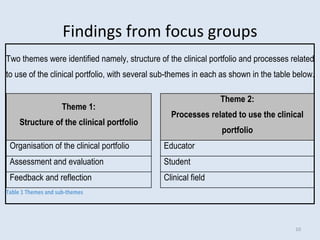
Findings from focus groups
Two themes were identified namely, structure of the clinical portfolio and processes related
to use of the clinical portfolio, with several sub-themes in each as shown in the table below.
Theme 1:
Structure of the clinical portfolio
Theme 2:
Processes related to use the clinical
portfolio
Organisation of the clinical portfolio Educator
Assessment and evaluation Student
Feedback and reflection Clinical field
Table 1 Themes and sub-themes
10
Theme 1 – Structure of the portfolio
11
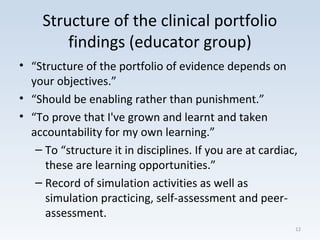
Structure of the clinical portfolio
findings (educator group)
• “Structure of the portfolio of evidence depends on
your objectives.”
• “Should be enabling rather than punishment.”
• “To prove that I've grown and learnt and taken
accountability for my own learning.”
– To “structure it in disciplines. If you are at cardiac,
these are learning opportunities.”
– Record of simulation activities as well as
simulation practicing, self-assessment and peer-
assessment.
12
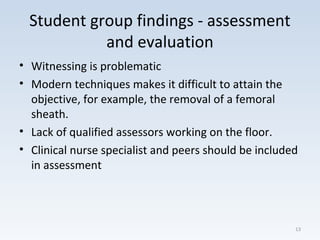
Student group findings - assessment
and evaluation
• Witnessing is problematic
• Modern techniques makes it difficult to attain the
objective, for example, the removal of a femoral
sheath.
• Lack of qualified assessors working on the floor.
• Clinical nurse specialist and peers should be included
in assessment
13
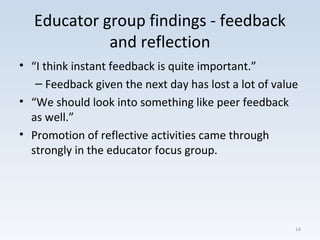
Educator group findings - feedback
and reflection
• “I think instant feedback is quite important.”
– Feedback given the next day has lost a lot of value
• “We should look into something like peer feedback
as well.”
• Promotion of reflective activities came through
strongly in the educator focus group.
14
Theme 2 – Processes for use of portfolio
15
Processes related to the use of the
clinical portfolio
• Student group: “I don’t want somebody to just sign
my procedures. No, I want to be a competent ICU
sister”
– Clinical support is of greater importance than the
amount of time spent in the intensive care unit,
but not always available
• Educator group: "Part of the problem is us. How do
we utilize the portfolio with them?”
– Guidelines needed on how to use the portfolios &
students & new staff need to be orientated to
their use 16
Processes related to the use of the
clinical portfolio
Student group findings:
•“Clinical field is divorced from students”
– Students were seen as the responsibility of the
educator.
•“It is not my educator I need. I need the people that
I'm working with.”
•“The portfolio is not an issue. It's the people behind
the portfolio.”
17
Student group: Processes related to
the use of the clinical portfolio
• The staff in the clinical field: “they will assist you but
is there any clear understanding what I need, as a
student, when I'm in the unit?”
• Students need someone to guide them through the
initial processes, showing what they have learnt in
the workshop.
• “You work weekends; you work night duty whereby
you are unable to see the educators.”
18
The intervention
19
Discussion of the Intervention
• The purpose of the focus groups was to identify areas
needed for change or additions to the existing
portfolio.
– To ensure that the recommendations made by the
participants were valid, confirmation of their
suggestions was sought in the literature.
• The portfolio was developed taking these suggestions
into consideration and also included administrative
and regulatory requirements for a portfolio of this
nature.
– The researcher decided to include aspects in the
revised portfolio that proved useful in the past 20
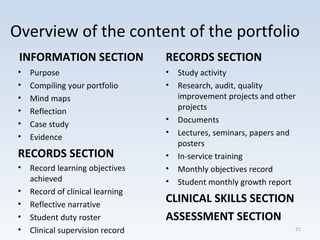
Overview of the content of the portfolio
INFORMATION SECTION
• Purpose
• Compiling your portfolio
• Mind maps
• Reflection
• Case study
• Evidence
RECORDS SECTION
• Record learning objectives
achieved
• Record of clinical learning
• Reflective narrative
• Student duty roster
• Clinical supervision record
RECORDS SECTION
• Study activity
• Research, audit, quality
improvement projects and other
projects
• Documents
• Lectures, seminars, papers and
posters
• In-service training
• Monthly objectives record
• Student monthly growth report
CLINICAL SKILLS SECTION
ASSESSMENT SECTION
21
Feedback from the expert group
22
Feedback from the expert educators
• Educationally sound as a learning approach and an
assessment strategy.
• “The focus on reflection is commendable.”
• The involvement of compiling documents was
deemed to be a good addition to the portfolio.
• Commented positively on the student monthly
growth rubric.
• Positive feedback received on the learning contract
at the beginning of every discipline and the inclusion
of peer assessments.
23
Feedback from the expert educators
• Two additional initiatives were suggested to improve
learning, e.g. the use of podcasts or YouTube clips.
• Extra uses for mind maps e.g. to map out their study
programme or time management.
• Addition of quality improvement projects were
suggested under “Research, Audit and Project Work”
section.
• An additional measurement criteria on “taking action”
was suggested in the student monthly growth report.
• The inclusion of continuous professional development
(CPD) points was suggested as evidence in the
portfolio. 24
Lessons learned about educational
portfolios
25
Lessons learned about educational
portfolios
• Enhance the students’ ability to reflect on their own
experience and performance.
• The student should be granted as much freedom as
possible in the compilation of his/ her portfolio
evidence, to allow interaction and creativity during
his or her learning.
• Students acquire knowledge, skill and values whilst
compiling their portfolio.
• Portfolio should encourage a student to find
information, to test its credibility and to try different
learning methods. 26
Recommendations for future research
• Future research should include a larger sample of
educators and experts to validate the improved
structure of a clinical portfolio.
• The sample should include educators from the
private and public sector and the area could be
widened to a nationwide study.
• Each focus group category should have their own
interview guide with different questions to improve
understanding and the experts should be sent a
rubric for their feedback.
27
28
Bibliography
• Alsop, A. (2002). Continuing professional development: a guide for therapists. London: Blackwell Science Ltd.
• Andre, K.E. (2011). Nursing and midwifery portfolios: evidence of continuing competence. Australia: Elsevier.
• Birks, M., Hartin, P., Woods, C., Emmanual, E. and Hitchens, M. (2016). Students’ perceptions of the use of e-portfolios in
nursing and midwifery education. Nurse Education in Practice, 18, 46-51.
• Brink, H., Van der Walt, C. and Van Rensburg, G. (2012). Fundamentals of Research Methodology for Healthcare
Professionals. (3rd
ed.) Cape Town: Juta and Company Ltd.
• Byrne, M., Delarose, T., King, C.A., Leske, J., Sapnas, K.G. and Schroeter, K. (2007). Continued Professional Competence and
Portfolios. Journal of Trauma Nursing, 14(1), 24-31.
• Byrne, M., Schroeter, K., Carter, S. and Mower, J. (2009).The Professional Portfolio: An Evidence Based Assessment Method.
The Journal of Continuing Education in Nursing, 40(12), 545-552.
• Casey, D.C. and Egan, D. (2010). The use of professional portfolios and profiles for career enhancement. British Journal of
Community Nursing, 15(11), 547-552.
• Cayne, J.V. (1995). Portfolios: a developmental influence? Journal of Advanced Nursing, 21, 395-405.
• Challis, M. (1999). AMEE Medical Education Guide No.11 (revised): Portfolio-based learning and assessment in medical
education. Medical Teacher, 21(4), 370-386.
• Clark, A.C. (2010). How to compile a professional portfolio 1: aims and intended learning outcomes. Nursing Times, 106, 41.
• Coffey, A. (2005). The clinical learning portfolio: a practice development experience in gerontological nursing. Journal of
Clinical Nursing, 14(8b), 75-83.
• Davies, C. (2015). Developing a professional nursing portfolio. Nursing Made Incredibly Easy! 13(1), 4.
• De Vos, A.S., Strydom, H., Fouché, C.B. and Delport, C.S.L. (2011). Research at grass roots. For the social sciences and human
service professions. (4th
ed.) Pretoria: Van Schaik Publishers.
• Domac, S., Anderson, A.S. and Smith, R. (2016). Learning to be interprofessional through the use of reflective portfolios?
Social Work Education, 35(5), 530-546, accessed at http://dx.doi.org/10.1080/03615479.2016.1178717.
• Elango, S., Jutti, R.C. and Lee, L. (2005). Portfolio as a Learning Tool: Students’ Perspective. Malaysia: Department of
Community Medicine.
• Endacott, R., Gray, M.A., Jasper, M.A., McMullan, M., Miller, C., Scholes, J. and Webb, C. (2004). Using portfolios in the
assessment of learning and competence: the impact of four models. Nurse Education in Practice, 4, 250-257.
29
Bibliography
• Garrett, B.M., MacPhee, M. and Jackson, C. (2013). Evaluation of an e-portfolio for the assessment of clinical competence in
a baccalaureate nursing program. Nurse Education Today, 33(10), 1207 – 1213.
• Gibbs, G. (1988). Learning by doing: a guide to teaching and learning methods. Oxford: Further Education Unit.
• Glen, S. and Hight, N. (1992). Portfolios: An ‘affective’ assessment strategy? Nursing Education Today, 12, 416-423.
• Green, J., Wyllie, A. and Jackson, D. (2013). Electronic portfolios in nursing education: A review of the literature, Nurse
Education in Practice (2013), accessed at http://dx.doi.org/10.1016/j.nepr.2013.08.011.
• Grove, S.K., Burns, N. and Gray, J.R. (2013). The Practice of Nursing Research. Appraisal, Synthesis, and Generation of
Evidence. (7th
ed.) St. Louis: Elsevier Inc.
• Gwele, N.S. (2001). Reflections of graduate nursing education students on their experiences in developing portfolios. South
African Journal of Higher Education, 15(1), 92-99.
• Hall, D. (1992) Professional development portfolios for teachers and lecturers. British Journal of In Service Education, 18, 81-
86.
• Haverkamp, J.J. and Vogt, M. (2015). Beyond Academic Evidence: Innovative Uses of Technology within e-portfolios in a
Doctor of Nursing Practice Program. Journal of Professional Nursing, 31(4), 284 – 289.
• Hespenheide, M., Cottingham, T. and Mueller, G. (2011). Portfolio Use as a Tool to Demonstrate Professional development
in Advanced Nursing Practice. Clinical Nurse Specialist, 25(6), 312-320.
• Joyce, P. (2005). A framework for portfolio development in postgraduate nursing practice. Journal of Clinical Nursing, 14,
456-463.
• Karlowicz, K.A. (2000). The value of student portfolios to evaluate undergraduate nursing programs. Nurse Educator, 25(2),
82-87.
• Khaw, C., Raw, L., Tonkin, A. and Kildea, H. (2012). Evaluation of student-prepared portfolio of guidelines in undergraduate
clinical skills using a mixed methods study. International Journal of Medical Education, 3, 183-189.
• Knowles, M. (1984). Andragogy in Action. San Francisco: Jossey-Bass.
• Knowles, M.S. (1970). The Modern Practice of Adult Education; Andragogy versus Pedagogy. New York: Association Press.
• Knowles, M.S. (1980). The Modern Practice of Adult Education; From Pedagogy to Andragogy. (2nd
ed.) New York: Cambridge
Books.
30
Bibliography
• Knowles, M.S., Elwood, R., Holton III, R. and Swanson, A. (1998). The Adult Learner: The Definitive Classic in Adult Education
and Human Resource Development. (5th
ed.) New York: Heinemann.
• Kolb, D.A. (1984). Experiential learning: experience as the source of learning and development. Englewood Cliffs: NJ:
Prentice Hall.
• Kuh, G.D., Cruce, T.M., Shoup, R., Kinzie, J. and Gonyea, R.M. (2008). Unmasking the Effects of Student Engagement on
First-Year College Grades and Persistence. The Journal of Higher Education, 79(5), 540-563.
• Lincoln, Y.S. and Guba, E.G. (1985). Naturalistic inquiry. Thousand Oaks: Sage Publications Inc.
• Love, T. and Cooper, T. (2004). Designing Online Information Systems for Portfolio-based assessment: Design Criteria and
Heuristics. Journal of Information Technology Education, 3, 65-81.
• McCready, T. (2007). Portfolios and the assessment of competence in nursing: A literature review. International Journal of
Nursing Studies, 44, 143-151.
• McMullan, M. (2006). Student’s perceptions on the use of portfolios in pre-registration nursing education: A questionnaire
survey. International Journal of Nursing Studies, 43, 333-343.
• McMullan, M. (2007). Using portfolios for clinical practice learning and assessment: The pre-registration nursing student’s
perspective. Nurse Education Today, 28, 873-879.
• McMullan, M., Endacott, R., Gray, M., Jasper, M, Miller, C., Scholes, J. and Webb, C. (2003). Portfolios and assessment of
competence: A Review of the Literature. Journal of Advanced Nursing, 41(3), 283-294.
• Miller, P.A., Tuekam, R. (2011). The Feasibility and Acceptability of Using a Portfolio to Assess Professional Competence.
Physiother Can, Winter; 63(1), 78–85.
• Mitchell, M. (1994). The views of students and teachers on the use of portfolios as a learning and assessment tool in
midwifery education. Nurse Education Today, 14, 38-45.
• Mueller, J.F. (2014). Authentic Assessment Toolbox, accessed 2016/06/16 [Online] at
http://jfmueller.faculty.noctrl.edu/toolbox/portfolios.htm.
• Norman, K. (Ed.). (2008). Portfolios in the Nursing Profession Use in assessment and professional development. London: MA
Healthcare Limited.
• Norris, T.L., Webb, S.S., McKeon, L.M., Jacob, S.R. and Herrin-Griffith, D. (2012). Using Portfolios to introduce the Clinical
Nurse Leader to the Job Market. The Journal of Nursing Administration, 42(1), 47-51. 31
Bibliography
• Oermann, M.H. (2002). Developing a Professional Portfolio in Nursing. Orthopaedic Nursing, 21(2), 73-78.
• Quinn, F.M., and Hughes, S.J. (2007). Quinn’s Principles and Practice of Nurse Education. (5th
ed.) United Kingdom: Nelson
Thornes.
• Rassin, M., Silner, D. and Ehrenfeld, M. (2006). Departmental portfolio in nursing – An advanced instrument. Nurse
education in practice, 6(1):55-60.
• Rothman, J., and Thomas, E. J. (Eds.). (1994). Intervention research: Design and development for human services. New York:
Haworth Press.
• SANC. (1993). Regulation R212 of 19 February 1993 as amended by regulation R.74 of 17 January 1997. Pretoria, South
African Nursing Council.
• South African Qualifications Authority (2001)
• Scholes, J., Webb, C., Gray, M., Endacott, R., Miller, C., Jasper, M. and McMullan, M. (2004). Making portfolios work in
practice. Journal of Advanced Nursing, 46(6), 595–603.
• Schön, D. (1991). The Reflective Practitioner: How Professionals Think in Action. Ashgate Arena: Aldershot.
• Simosko, S. (1991). APL: A Practical Guide for Professionals. London: Kogan Page.
• Snadden, D. and Thomas, M. (1998). The use of portfolio learning in medical education. Medical Teacher, 20(3).
• South African Qualifications Authority. (2001). [Online] Available at: http://www.saqa.co.za/ [Accessed 06/06/2013].
• Sowter, J., Cortis, J. and Clarke, D. (2011). The development of evidence based guidelines for clinical practice portfolios.
United Kingdom: School of Healthcare, University of Leeds.
• Stidworthy, J.J. (2013). The implementation of a portfolio assessment system for a Rural Clinical School in South Africa.
What can be learned from the implementation of portfolios as an assessment system in a rural clinical school? Stellenbosch
University.
• Strasser, S., London, L. and Kortenbout, E. (2005). Developing a Competence Framework and Evaluation Tool for Primary
Care Nursing in South Africa. Education for Health, 18(2), 133-144.
• Tesch, R. (1990). Qualitative research: Analysis Types and Software Tools. New York: Falmer.
32
Bibliography
• Timmins, F. (2008). Making Sense of Nursing Portfolios: A Guide for Students. Maidenhead: Open University Press.
• Timmins, F. and Dunne, P. (2009). An exploration of the current use and benefit of nursing student portfolios. Nurse
Education Today, 29, 330-341.
• Twaddell, J.W. and Johnson, J.L. (2007). A Time for Nursing Portfolios: A Tool for Career Development. Advances in
Neonatal Care, 7(3), 146-150.
• United Kingdom Central Council for Nursing, Midwifery and Health Visiting. (1990). Discussion Paper on Post-Registration
Education and Practice, UKCC, London.
• Williams, M. and Jordan, K. (2007). The nursing professional portfolio: a pathway to career development. Journal of Nurses
in Staff Development, 23, 125-131.
33

L Potgieter Final Post Research Presentation

  • 1.
    THE DEVELOPMENT OFA CLINICAL PORTFOLIO AS A LEARNING APPROACH FOR INTENSIVE CARE NURSES IN A PRIVATE NURSING EDUCATION INSTITUTION IN GAUTENG. Presenter: L Potgieter Supervisor: Dr. Sue J. Armstrong 20 September 2016 Research Day – 20 September 2016 1
  • 2.
    Introduction and background •The use of portfolios in education is well accepted as a learning approach and assessment strategy. • There are generic guidelines on how a portfolio should be structured to maximize the benefit of such a learning approach. • If the portfolio is used as an assessment strategy there are important factors that the participants must be mindful of. 2
  • 3.
    Summarized problem statement •The portfolio used currently at the private NEI is not adequately structured or used to meet the educational needs of the ICU students. 3
  • 4.
    Purpose of thestudy • The purpose of the study is to improve the structure and enhance the use of clinical portfolios as… – a learning approach, – as an assessment strategy in intensive care nursing education. 4
  • 5.
    Objectives of thestudy • Stage 1: to solicit the opinion of students and their educators on, – the quality of the existing clinical portfolio, – their recommendations for the design and utilization of a revised clinical portfolio; • Stage 2: to design a revised clinical portfolio for intensive care nursing students based on – educator and student opinion, – literature review; 5
  • 6.
    Objectives of thestudy • Stage 3: to solicit the opinion of nursing education experts on the revised clinical portfolio and to make changes as required. 6
  • 7.
    Research design • Thisstudy used an intervention research methodology with qualitative methods for data collection including focus groups, literature study and an expert group for the purposes of validation. 7
  • 8.
    Population and sample •Diploma in Critical Care Nursing (General) students and educators of a private nursing education institution in Gauteng where clinical portfolios are used as evidence of competence of clinical learning outcomes. 8
  • 9.
    Data collection • Researcherinterviewed the focus groups and used the same interview protocol with the respective focus groups namely the educators and the students. 9
  • 10.
    Findings from focusgroups Two themes were identified namely, structure of the clinical portfolio and processes related to use of the clinical portfolio, with several sub-themes in each as shown in the table below. Theme 1: Structure of the clinical portfolio Theme 2: Processes related to use the clinical portfolio Organisation of the clinical portfolio Educator Assessment and evaluation Student Feedback and reflection Clinical field Table 1 Themes and sub-themes 10
  • 11.
    Theme 1 –Structure of the portfolio 11
  • 12.
    Structure of theclinical portfolio findings (educator group) • “Structure of the portfolio of evidence depends on your objectives.” • “Should be enabling rather than punishment.” • “To prove that I've grown and learnt and taken accountability for my own learning.” – To “structure it in disciplines. If you are at cardiac, these are learning opportunities.” – Record of simulation activities as well as simulation practicing, self-assessment and peer- assessment. 12
  • 13.
    Student group findings- assessment and evaluation • Witnessing is problematic • Modern techniques makes it difficult to attain the objective, for example, the removal of a femoral sheath. • Lack of qualified assessors working on the floor. • Clinical nurse specialist and peers should be included in assessment 13
  • 14.
    Educator group findings- feedback and reflection • “I think instant feedback is quite important.” – Feedback given the next day has lost a lot of value • “We should look into something like peer feedback as well.” • Promotion of reflective activities came through strongly in the educator focus group. 14
  • 15.
    Theme 2 –Processes for use of portfolio 15
  • 16.
    Processes related tothe use of the clinical portfolio • Student group: “I don’t want somebody to just sign my procedures. No, I want to be a competent ICU sister” – Clinical support is of greater importance than the amount of time spent in the intensive care unit, but not always available • Educator group: "Part of the problem is us. How do we utilize the portfolio with them?” – Guidelines needed on how to use the portfolios & students & new staff need to be orientated to their use 16
  • 17.
    Processes related tothe use of the clinical portfolio Student group findings: •“Clinical field is divorced from students” – Students were seen as the responsibility of the educator. •“It is not my educator I need. I need the people that I'm working with.” •“The portfolio is not an issue. It's the people behind the portfolio.” 17
  • 18.
    Student group: Processesrelated to the use of the clinical portfolio • The staff in the clinical field: “they will assist you but is there any clear understanding what I need, as a student, when I'm in the unit?” • Students need someone to guide them through the initial processes, showing what they have learnt in the workshop. • “You work weekends; you work night duty whereby you are unable to see the educators.” 18
  • 19.
  • 20.
    Discussion of theIntervention • The purpose of the focus groups was to identify areas needed for change or additions to the existing portfolio. – To ensure that the recommendations made by the participants were valid, confirmation of their suggestions was sought in the literature. • The portfolio was developed taking these suggestions into consideration and also included administrative and regulatory requirements for a portfolio of this nature. – The researcher decided to include aspects in the revised portfolio that proved useful in the past 20
  • 21.
    Overview of thecontent of the portfolio INFORMATION SECTION • Purpose • Compiling your portfolio • Mind maps • Reflection • Case study • Evidence RECORDS SECTION • Record learning objectives achieved • Record of clinical learning • Reflective narrative • Student duty roster • Clinical supervision record RECORDS SECTION • Study activity • Research, audit, quality improvement projects and other projects • Documents • Lectures, seminars, papers and posters • In-service training • Monthly objectives record • Student monthly growth report CLINICAL SKILLS SECTION ASSESSMENT SECTION 21
  • 22.
    Feedback from theexpert group 22
  • 23.
    Feedback from theexpert educators • Educationally sound as a learning approach and an assessment strategy. • “The focus on reflection is commendable.” • The involvement of compiling documents was deemed to be a good addition to the portfolio. • Commented positively on the student monthly growth rubric. • Positive feedback received on the learning contract at the beginning of every discipline and the inclusion of peer assessments. 23
  • 24.
    Feedback from theexpert educators • Two additional initiatives were suggested to improve learning, e.g. the use of podcasts or YouTube clips. • Extra uses for mind maps e.g. to map out their study programme or time management. • Addition of quality improvement projects were suggested under “Research, Audit and Project Work” section. • An additional measurement criteria on “taking action” was suggested in the student monthly growth report. • The inclusion of continuous professional development (CPD) points was suggested as evidence in the portfolio. 24
  • 25.
    Lessons learned abouteducational portfolios 25
  • 26.
    Lessons learned abouteducational portfolios • Enhance the students’ ability to reflect on their own experience and performance. • The student should be granted as much freedom as possible in the compilation of his/ her portfolio evidence, to allow interaction and creativity during his or her learning. • Students acquire knowledge, skill and values whilst compiling their portfolio. • Portfolio should encourage a student to find information, to test its credibility and to try different learning methods. 26
  • 27.
    Recommendations for futureresearch • Future research should include a larger sample of educators and experts to validate the improved structure of a clinical portfolio. • The sample should include educators from the private and public sector and the area could be widened to a nationwide study. • Each focus group category should have their own interview guide with different questions to improve understanding and the experts should be sent a rubric for their feedback. 27
  • 28.
  • 29.
    Bibliography • Alsop, A.(2002). Continuing professional development: a guide for therapists. London: Blackwell Science Ltd. • Andre, K.E. (2011). Nursing and midwifery portfolios: evidence of continuing competence. Australia: Elsevier. • Birks, M., Hartin, P., Woods, C., Emmanual, E. and Hitchens, M. (2016). Students’ perceptions of the use of e-portfolios in nursing and midwifery education. Nurse Education in Practice, 18, 46-51. • Brink, H., Van der Walt, C. and Van Rensburg, G. (2012). Fundamentals of Research Methodology for Healthcare Professionals. (3rd ed.) Cape Town: Juta and Company Ltd. • Byrne, M., Delarose, T., King, C.A., Leske, J., Sapnas, K.G. and Schroeter, K. (2007). Continued Professional Competence and Portfolios. Journal of Trauma Nursing, 14(1), 24-31. • Byrne, M., Schroeter, K., Carter, S. and Mower, J. (2009).The Professional Portfolio: An Evidence Based Assessment Method. The Journal of Continuing Education in Nursing, 40(12), 545-552. • Casey, D.C. and Egan, D. (2010). The use of professional portfolios and profiles for career enhancement. British Journal of Community Nursing, 15(11), 547-552. • Cayne, J.V. (1995). Portfolios: a developmental influence? Journal of Advanced Nursing, 21, 395-405. • Challis, M. (1999). AMEE Medical Education Guide No.11 (revised): Portfolio-based learning and assessment in medical education. Medical Teacher, 21(4), 370-386. • Clark, A.C. (2010). How to compile a professional portfolio 1: aims and intended learning outcomes. Nursing Times, 106, 41. • Coffey, A. (2005). The clinical learning portfolio: a practice development experience in gerontological nursing. Journal of Clinical Nursing, 14(8b), 75-83. • Davies, C. (2015). Developing a professional nursing portfolio. Nursing Made Incredibly Easy! 13(1), 4. • De Vos, A.S., Strydom, H., Fouché, C.B. and Delport, C.S.L. (2011). Research at grass roots. For the social sciences and human service professions. (4th ed.) Pretoria: Van Schaik Publishers. • Domac, S., Anderson, A.S. and Smith, R. (2016). Learning to be interprofessional through the use of reflective portfolios? Social Work Education, 35(5), 530-546, accessed at http://dx.doi.org/10.1080/03615479.2016.1178717. • Elango, S., Jutti, R.C. and Lee, L. (2005). Portfolio as a Learning Tool: Students’ Perspective. Malaysia: Department of Community Medicine. • Endacott, R., Gray, M.A., Jasper, M.A., McMullan, M., Miller, C., Scholes, J. and Webb, C. (2004). Using portfolios in the assessment of learning and competence: the impact of four models. Nurse Education in Practice, 4, 250-257. 29
  • 30.
    Bibliography • Garrett, B.M.,MacPhee, M. and Jackson, C. (2013). Evaluation of an e-portfolio for the assessment of clinical competence in a baccalaureate nursing program. Nurse Education Today, 33(10), 1207 – 1213. • Gibbs, G. (1988). Learning by doing: a guide to teaching and learning methods. Oxford: Further Education Unit. • Glen, S. and Hight, N. (1992). Portfolios: An ‘affective’ assessment strategy? Nursing Education Today, 12, 416-423. • Green, J., Wyllie, A. and Jackson, D. (2013). Electronic portfolios in nursing education: A review of the literature, Nurse Education in Practice (2013), accessed at http://dx.doi.org/10.1016/j.nepr.2013.08.011. • Grove, S.K., Burns, N. and Gray, J.R. (2013). The Practice of Nursing Research. Appraisal, Synthesis, and Generation of Evidence. (7th ed.) St. Louis: Elsevier Inc. • Gwele, N.S. (2001). Reflections of graduate nursing education students on their experiences in developing portfolios. South African Journal of Higher Education, 15(1), 92-99. • Hall, D. (1992) Professional development portfolios for teachers and lecturers. British Journal of In Service Education, 18, 81- 86. • Haverkamp, J.J. and Vogt, M. (2015). Beyond Academic Evidence: Innovative Uses of Technology within e-portfolios in a Doctor of Nursing Practice Program. Journal of Professional Nursing, 31(4), 284 – 289. • Hespenheide, M., Cottingham, T. and Mueller, G. (2011). Portfolio Use as a Tool to Demonstrate Professional development in Advanced Nursing Practice. Clinical Nurse Specialist, 25(6), 312-320. • Joyce, P. (2005). A framework for portfolio development in postgraduate nursing practice. Journal of Clinical Nursing, 14, 456-463. • Karlowicz, K.A. (2000). The value of student portfolios to evaluate undergraduate nursing programs. Nurse Educator, 25(2), 82-87. • Khaw, C., Raw, L., Tonkin, A. and Kildea, H. (2012). Evaluation of student-prepared portfolio of guidelines in undergraduate clinical skills using a mixed methods study. International Journal of Medical Education, 3, 183-189. • Knowles, M. (1984). Andragogy in Action. San Francisco: Jossey-Bass. • Knowles, M.S. (1970). The Modern Practice of Adult Education; Andragogy versus Pedagogy. New York: Association Press. • Knowles, M.S. (1980). The Modern Practice of Adult Education; From Pedagogy to Andragogy. (2nd ed.) New York: Cambridge Books. 30
  • 31.
    Bibliography • Knowles, M.S.,Elwood, R., Holton III, R. and Swanson, A. (1998). The Adult Learner: The Definitive Classic in Adult Education and Human Resource Development. (5th ed.) New York: Heinemann. • Kolb, D.A. (1984). Experiential learning: experience as the source of learning and development. Englewood Cliffs: NJ: Prentice Hall. • Kuh, G.D., Cruce, T.M., Shoup, R., Kinzie, J. and Gonyea, R.M. (2008). Unmasking the Effects of Student Engagement on First-Year College Grades and Persistence. The Journal of Higher Education, 79(5), 540-563. • Lincoln, Y.S. and Guba, E.G. (1985). Naturalistic inquiry. Thousand Oaks: Sage Publications Inc. • Love, T. and Cooper, T. (2004). Designing Online Information Systems for Portfolio-based assessment: Design Criteria and Heuristics. Journal of Information Technology Education, 3, 65-81. • McCready, T. (2007). Portfolios and the assessment of competence in nursing: A literature review. International Journal of Nursing Studies, 44, 143-151. • McMullan, M. (2006). Student’s perceptions on the use of portfolios in pre-registration nursing education: A questionnaire survey. International Journal of Nursing Studies, 43, 333-343. • McMullan, M. (2007). Using portfolios for clinical practice learning and assessment: The pre-registration nursing student’s perspective. Nurse Education Today, 28, 873-879. • McMullan, M., Endacott, R., Gray, M., Jasper, M, Miller, C., Scholes, J. and Webb, C. (2003). Portfolios and assessment of competence: A Review of the Literature. Journal of Advanced Nursing, 41(3), 283-294. • Miller, P.A., Tuekam, R. (2011). The Feasibility and Acceptability of Using a Portfolio to Assess Professional Competence. Physiother Can, Winter; 63(1), 78–85. • Mitchell, M. (1994). The views of students and teachers on the use of portfolios as a learning and assessment tool in midwifery education. Nurse Education Today, 14, 38-45. • Mueller, J.F. (2014). Authentic Assessment Toolbox, accessed 2016/06/16 [Online] at http://jfmueller.faculty.noctrl.edu/toolbox/portfolios.htm. • Norman, K. (Ed.). (2008). Portfolios in the Nursing Profession Use in assessment and professional development. London: MA Healthcare Limited. • Norris, T.L., Webb, S.S., McKeon, L.M., Jacob, S.R. and Herrin-Griffith, D. (2012). Using Portfolios to introduce the Clinical Nurse Leader to the Job Market. The Journal of Nursing Administration, 42(1), 47-51. 31
  • 32.
    Bibliography • Oermann, M.H.(2002). Developing a Professional Portfolio in Nursing. Orthopaedic Nursing, 21(2), 73-78. • Quinn, F.M., and Hughes, S.J. (2007). Quinn’s Principles and Practice of Nurse Education. (5th ed.) United Kingdom: Nelson Thornes. • Rassin, M., Silner, D. and Ehrenfeld, M. (2006). Departmental portfolio in nursing – An advanced instrument. Nurse education in practice, 6(1):55-60. • Rothman, J., and Thomas, E. J. (Eds.). (1994). Intervention research: Design and development for human services. New York: Haworth Press. • SANC. (1993). Regulation R212 of 19 February 1993 as amended by regulation R.74 of 17 January 1997. Pretoria, South African Nursing Council. • South African Qualifications Authority (2001) • Scholes, J., Webb, C., Gray, M., Endacott, R., Miller, C., Jasper, M. and McMullan, M. (2004). Making portfolios work in practice. Journal of Advanced Nursing, 46(6), 595–603. • Schön, D. (1991). The Reflective Practitioner: How Professionals Think in Action. Ashgate Arena: Aldershot. • Simosko, S. (1991). APL: A Practical Guide for Professionals. London: Kogan Page. • Snadden, D. and Thomas, M. (1998). The use of portfolio learning in medical education. Medical Teacher, 20(3). • South African Qualifications Authority. (2001). [Online] Available at: http://www.saqa.co.za/ [Accessed 06/06/2013]. • Sowter, J., Cortis, J. and Clarke, D. (2011). The development of evidence based guidelines for clinical practice portfolios. United Kingdom: School of Healthcare, University of Leeds. • Stidworthy, J.J. (2013). The implementation of a portfolio assessment system for a Rural Clinical School in South Africa. What can be learned from the implementation of portfolios as an assessment system in a rural clinical school? Stellenbosch University. • Strasser, S., London, L. and Kortenbout, E. (2005). Developing a Competence Framework and Evaluation Tool for Primary Care Nursing in South Africa. Education for Health, 18(2), 133-144. • Tesch, R. (1990). Qualitative research: Analysis Types and Software Tools. New York: Falmer. 32
  • 33.
    Bibliography • Timmins, F.(2008). Making Sense of Nursing Portfolios: A Guide for Students. Maidenhead: Open University Press. • Timmins, F. and Dunne, P. (2009). An exploration of the current use and benefit of nursing student portfolios. Nurse Education Today, 29, 330-341. • Twaddell, J.W. and Johnson, J.L. (2007). A Time for Nursing Portfolios: A Tool for Career Development. Advances in Neonatal Care, 7(3), 146-150. • United Kingdom Central Council for Nursing, Midwifery and Health Visiting. (1990). Discussion Paper on Post-Registration Education and Practice, UKCC, London. • Williams, M. and Jordan, K. (2007). The nursing professional portfolio: a pathway to career development. Journal of Nurses in Staff Development, 23, 125-131. 33