LAURENCE BERARDUCCI, MD, FACC
PUEBLO CARDIOLOGY ASSOCIATES
PUEBLO, COLORADO
Update in Cardiovascular Risk
Reduction
Educational Objectives
Review Current Guidelines
Review New Therapies
Real-world Perspective of a Clinical
Cardiologist
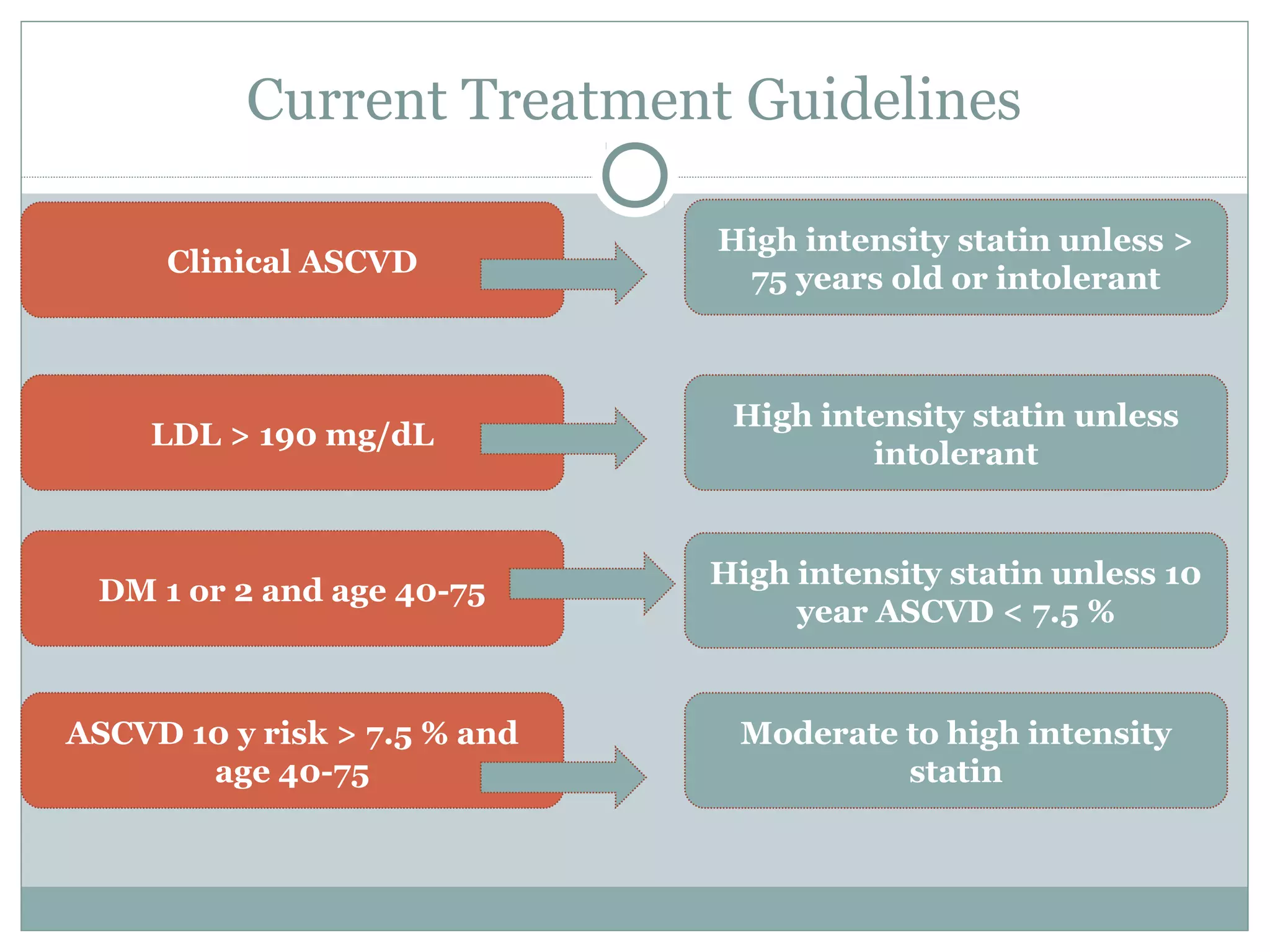
Current Treatment Guidelines
Clinical ASCVD
High intensity statin unless >
75 years old or intolerant
LDL > 190 mg/dL
High intensity statin unless
intolerant
DM 1 or 2 and age 40-75
High intensity statin unless 10
year ASCVD < 7.5 %
ASCVD 10 y risk > 7.5 % and
age 40-75
Moderate to high intensity
statin
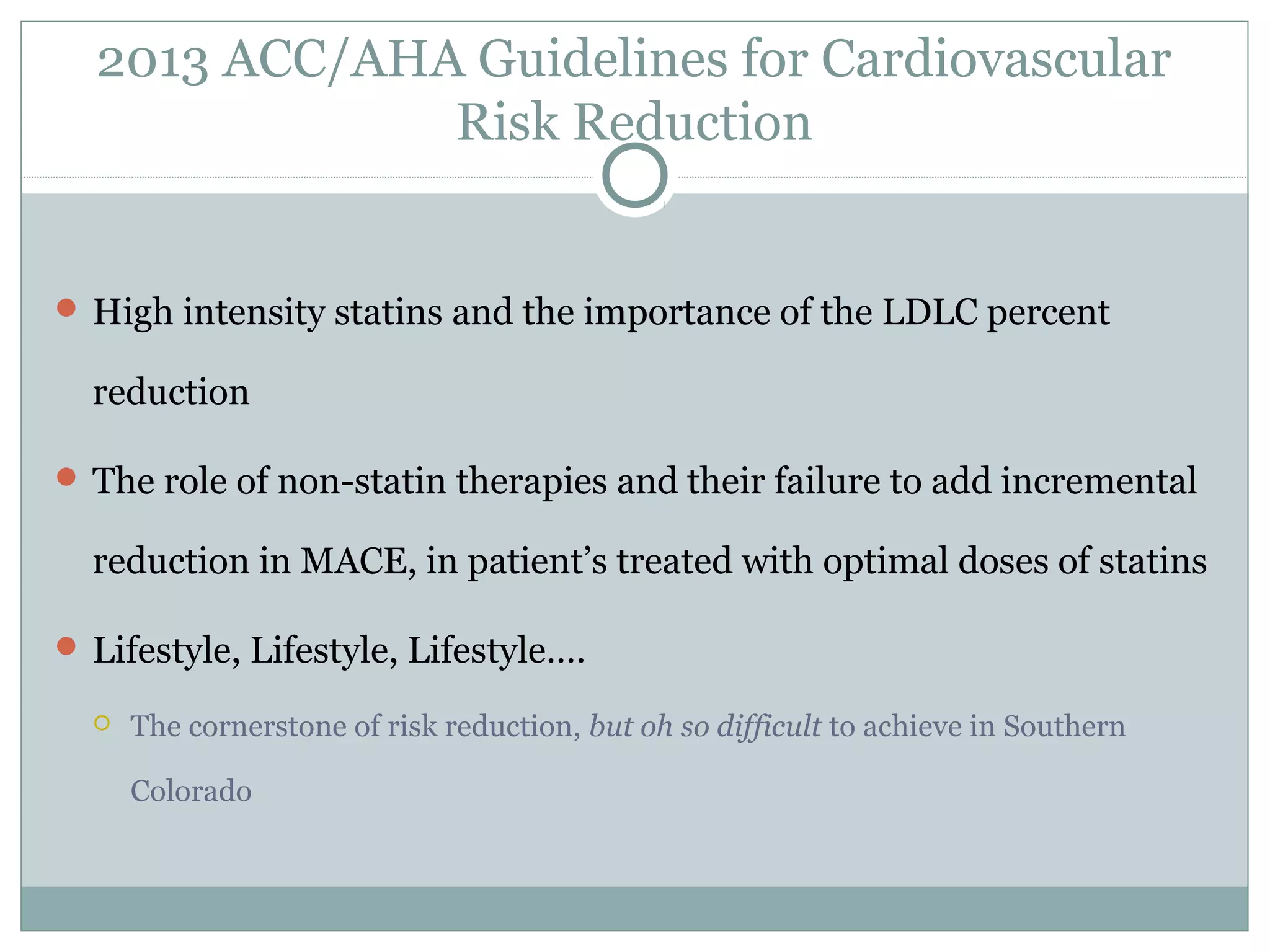
2013 ACC/AHA Guidelines for Cardiovascular
Risk Reduction
 High intensity statins and the importance of the LDLC percent
reduction
 The role of non-statin therapies and their failure to add incremental
reduction in MACE, in patient’s treated with optimal doses of statins
 Lifestyle, Lifestyle, Lifestyle….
 The cornerstone of risk reduction, but oh so difficult to achieve in Southern
Colorado
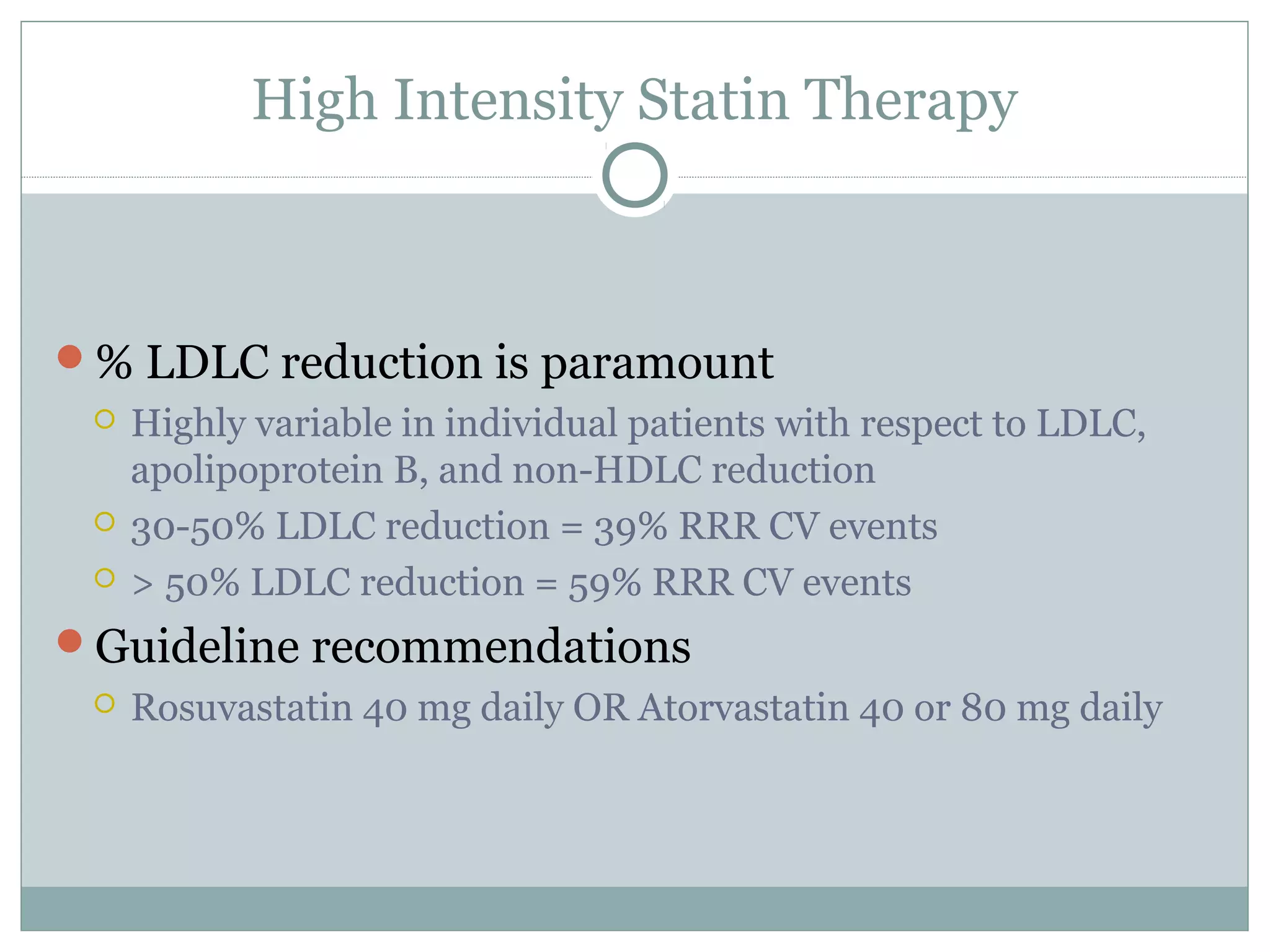
High Intensity Statin Therapy
% LDLC reduction is paramount
 Highly variable in individual patients with respect to LDLC,
apolipoprotein B, and non-HDLC reduction
 30-50% LDLC reduction = 39% RRR CV events
 > 50% LDLC reduction = 59% RRR CV events
Guideline recommendations
 Rosuvastatin 40 mg daily OR Atorvastatin 40 or 80 mg daily
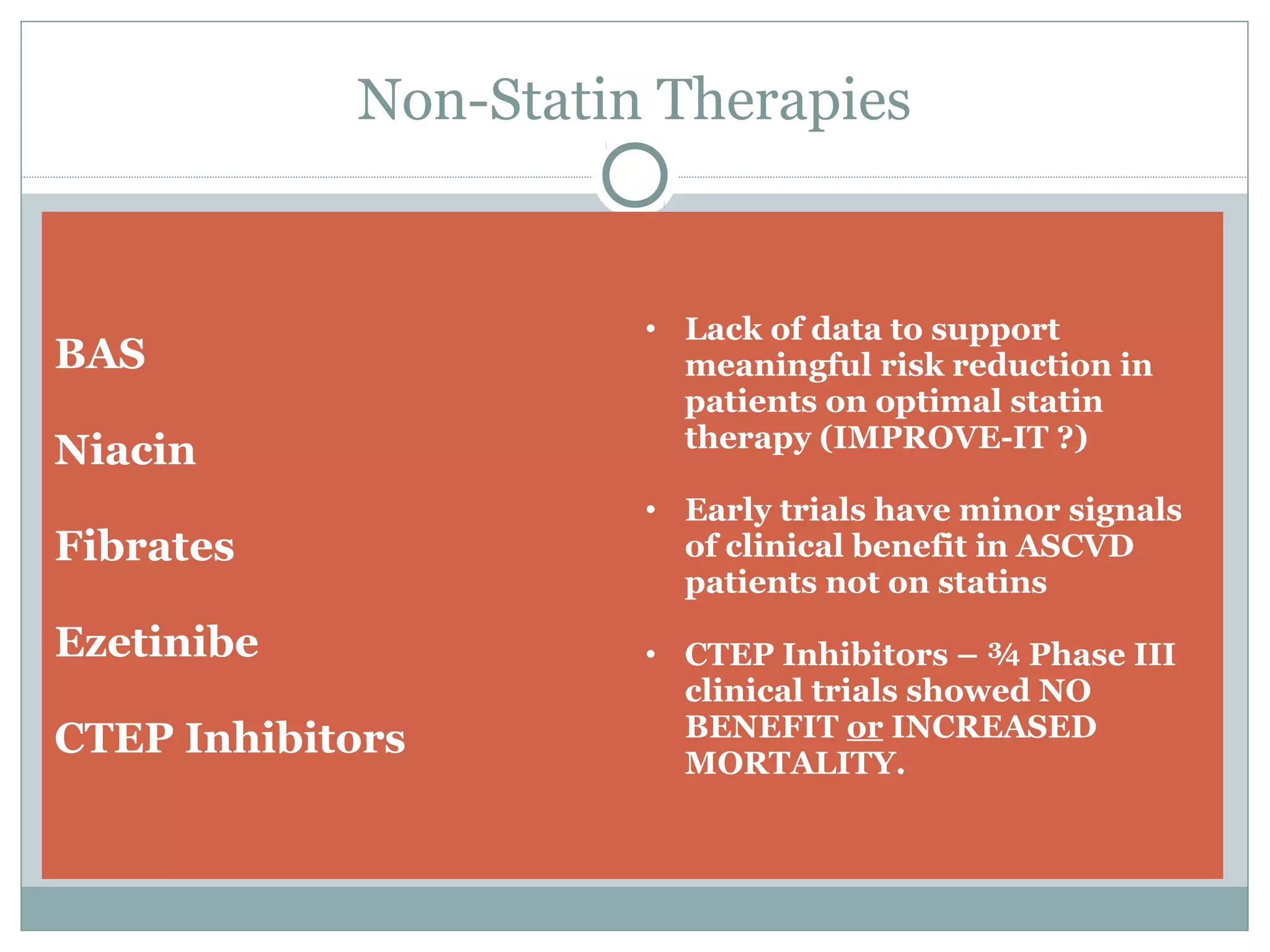
Non-Statin Therapies
BAS
Niacin
Fibrates
Ezetinibe
CTEP Inhibitors
• Lack of data to support
meaningful risk reduction in
patients on optimal statin
therapy (IMPROVE-IT ?)
• Early trials have minor signals
of clinical benefit in ASCVD
patients not on statins
• CTEP Inhibitors – ¾ Phase III
clinical trials showed NO
BENEFIT or INCREASED
MORTALITY.
PCSK 9 Inhibitors
(Proprotein Convertase Subtillisin/kexin type 9)
PCSK9 Inhibitors
 Alivocumab (Praluent) and Evolocumab (Repatha)
 Development
 Mechanism of Action
 Efficacy
 Clinical Trial Data to Date
 Questions that remain
PCSK9 is a Regulator of LDL Metabolism
PCSK9 Binds to the LDL Receptor and Targets
the LDL Receptor for Degradation
Familial Hypercholesterolemia (FH)
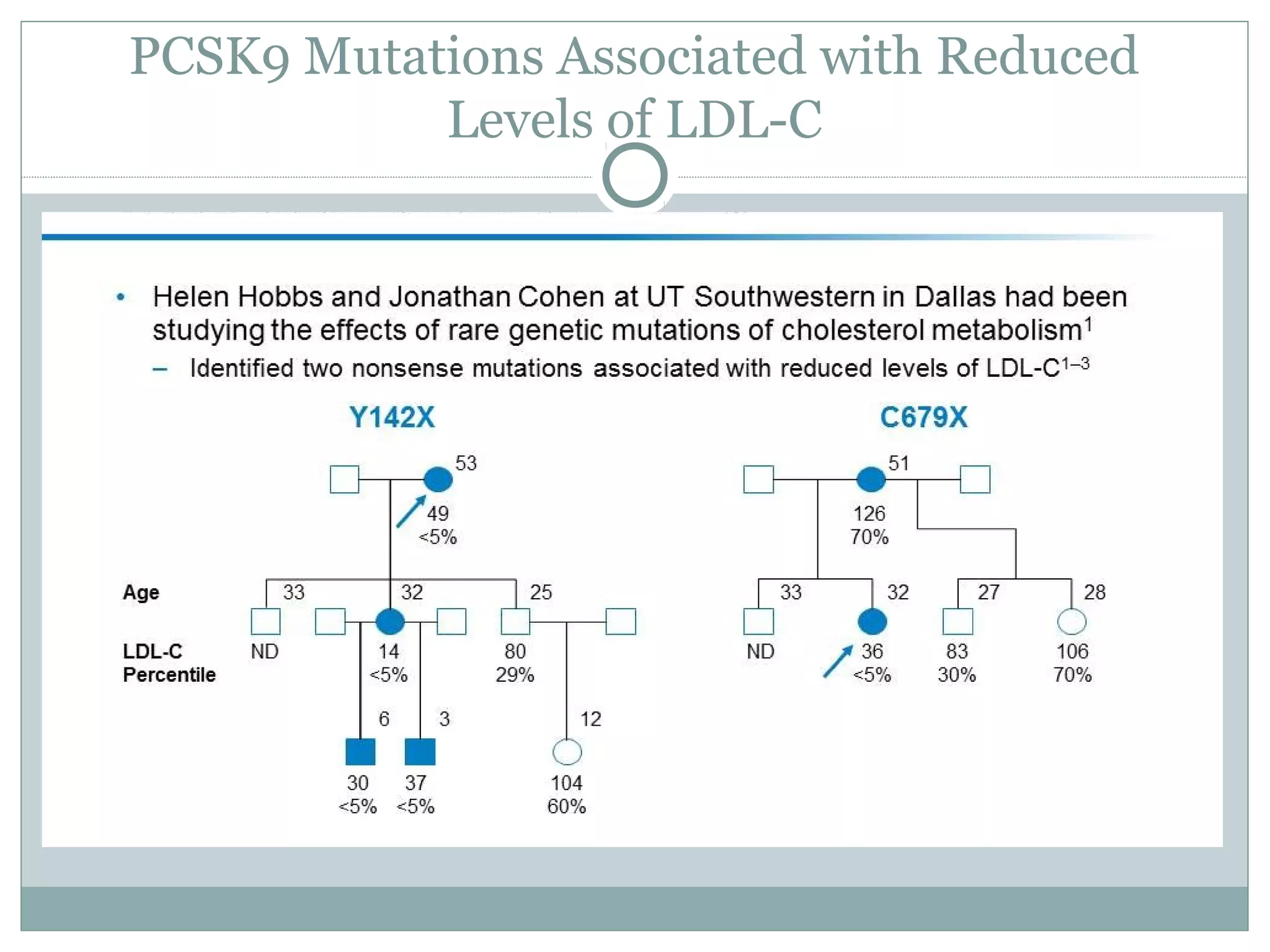
PCSK9 Mutations Associated with Reduced
Levels of LDL-C
Genetic Variants Establish PCSK9 as a Modulator
of LDL-C
Phase 3 Program to Support LDL-C
Reduction in Targeted Populations
High CV Risk Patients
 Patients not at LDL-C goal with currently available LLT (even
high doses of potent statins) = >persistent risk
Familial Hypercholesterolemia
LDL-C levels often far from goal, even with potent statins and
combination Tx
Life-long exposure to high LDL-C; considered high risk even w/o
additional risk factors
Statin Intolerant Patients
LDL-C levels often far from goal, due to intolerance
Definition: unable to tolerate at least 2 statins, including one at
the lowest dose
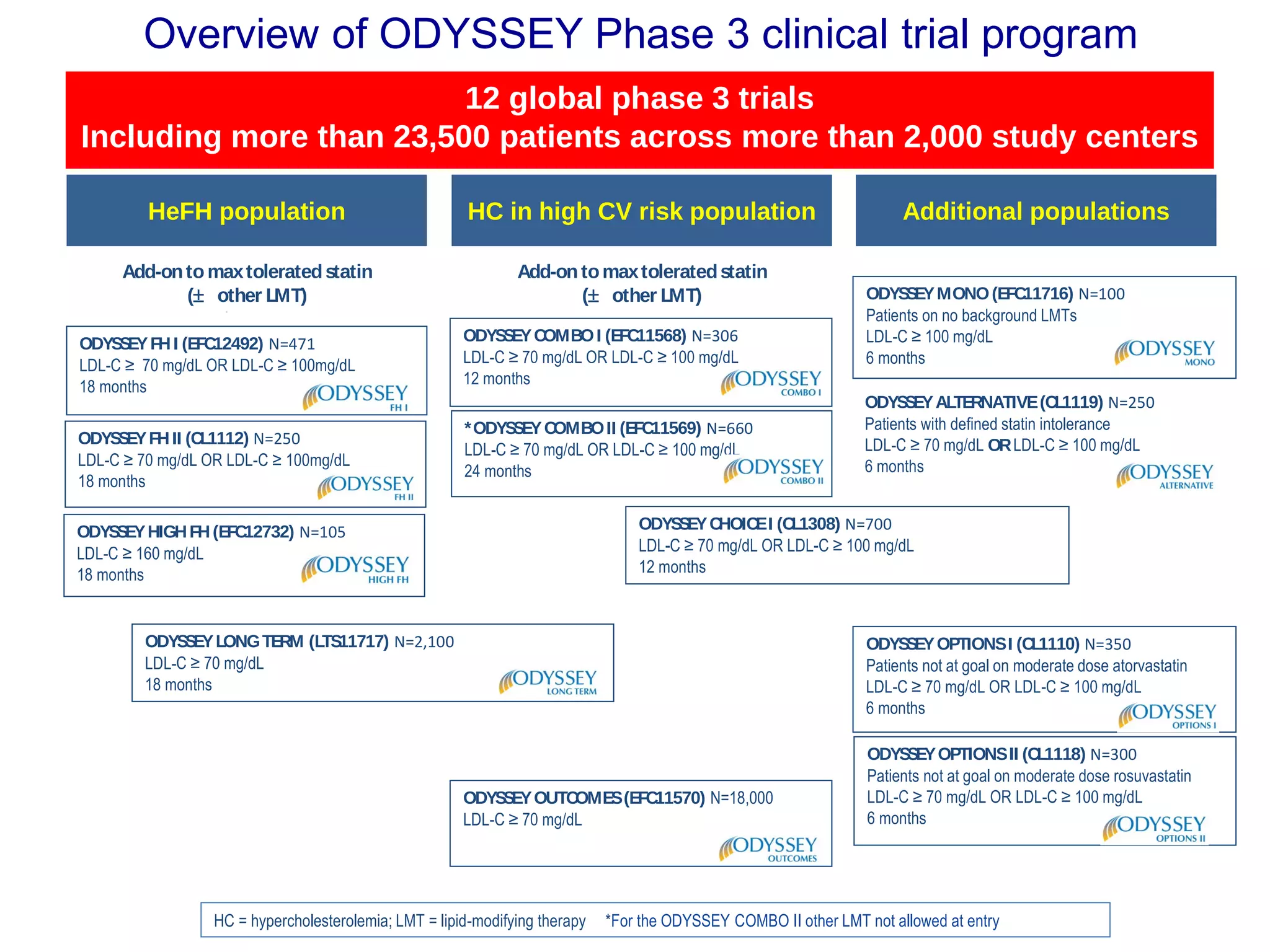
Overview of ODYSSEY Phase 3 clinical trial program
ODYSSEYALTERNATIVE(CL1119) N=250
Patients with defined statin intolerance
LDL- ORLDL-
6 months
ODYSSEYOPTIONSI (CL1110) N=350
Patients not at goal on moderate dose atorvastatin
LDL- -
6 months
ODYSSEYFHII (CL1112) N=250
LDL- -
18 months
ODYSSEYHIGHFH(EFC12732) N=105
LDL-
18 months
12 global phase 3 trials
Including more than 23,500 patients across more than 2,000 study centers
HeFH population HC in high CV risk population Additional populations
ODYSSEYFHI (EFC12492) N=471
LDL- -
18 months
ODYSSEYLONGTERM (LTS11717) N=2,100
LDL-
18 months
ODYSSEYCOMBOI (EFC11568) N=306
LDL- -
12 months
ODYSSEYMONO(EFC11716) N=100
Patients on no background LMTs
LDL-
6 months
ODYSSEYOPTIONSII (CL1118) N=300
Patients not at goal on moderate dose rosuvastatin
LDL- -
6 months
ODYSSEYOUTCOMES(EFC11570) N=18,000
LDL-
Add-onto maxtoleratedstatin
(± other LMT)
Add-on tomaxtoleratedstatin
(± other LMT)
*ODYSSEYCOMBOII (EFC11569) N=660
LDL- -
24 months
HC = hypercholesterolemia; LMT = lipid-modifying therapy *For the ODYSSEY COMBO II other LMT not allowed at entry
ODYSSEYCHOICEI (CL1308) N=700
LDL- -
12 months
99
HeFH
Phase 3
(N = 300)5
Combo-
therapy
Phase 3
(N = 1,700)5
HoFH
Phase 3
(N = 125)5
Mono-
therapy
Phase 3
(N = 600)5
Phase 3
(N = 22,500)5
Secondary
Prevention
Phase 3
(N = 950)5Athero
PROFICIO
Program to Reduce LDL-C and Cardiovascular Outcomes
Following Inhibition of PCSK9 In Different Populations
1. Giugliano RP, et al. Lancet. 2012;380:2007-2017. 2. Koren MJ, et al. Lancet. 2012;380:1995-2006. 3. Sullivan D, et al. JAMA. 2012;308:2497-2506.
4. Raal F, et al. Circulation. 2012;126:2408-2417. 5. Clinical Trials.gov. Available at: http://www.clinicaltrials.gov. Accessed Oct. 2, 2013.
6. Data on file, Amgen; [AMG 145 Protocol 20120332].
Open-label
Extension
Phase 3
(N ~ 3,515)5
Non-Commercial Class D Materials for Investigator Communications. Not for Reproduction or Distribution
Phase 3
(N = 300)5
Statin-
intolerant
Long-term
safety and
efficacy
Phase 3
(N = 905)5
*Subjects completed a qualifying Phase 2 study. Subjects completed a qualifying Phase 3 study.
10
SPIREPhase 3 Bococizumab Clinical Development Program:
DesignedtoAddressUnmet Needsinthe Management of CVDin
HighRiskPatients
SPIRE(Studiesof PCSK9 Inhibition and
the Reduction of Vascular Events) N=~30,000
SPIREHR(n=300)
On statin
High risk of CV event
LDL-
SPIRELDL(n=1,932)
On statin
High risk of CV event
LDL-
SPIREFH(n=300)
HeFH (genetic diagnosis or
Simon Broome Criteria),
LDL >70 mg/dL
SPIRELipidLoweringStudies SPIRECVOutcome Studies
SPIRELL(n=690)
On statin
High / very high risk of
CV event
LDL-
SPIRESI (n=150)
Statin intolerant
LDL-
SPIRE-1 (n=17,000)
High Risk Primary and
Secondary Prevention
LDL-
on statins (or statin
intolerant)
SPIRE-2 (n=9,000)
High Risk Primary and
Secondary Prevention
LDL-
statins (or statin intolerant)
NCT#: https://clinicaltrials.gov
SPIRE HR: NCT01968954
SPIRE LDL: NCT01968967
SPIRE HF: NCT01968980
SPIRE-LL: NCT02100514
SPIRE-SI: NCT02135029
SPIRE-1: NCT01975376
SPIRE-2: NCT01975389
Studieson PCSK9Inhibition and the
Reduction of Vascular Events
Recommended Use of PCSK9I’s
Based on current guidelines, available evidence, and
economic considerations:
 Patients with FH or ASCVD and statin resistance (on max
dose) for additional LDL lowering is a reasonable strategy.
 Discuss with patient costs vs uncertain clinical benefit
 In FH patients to avoid apheresis
 Consider in statin intolerant patients
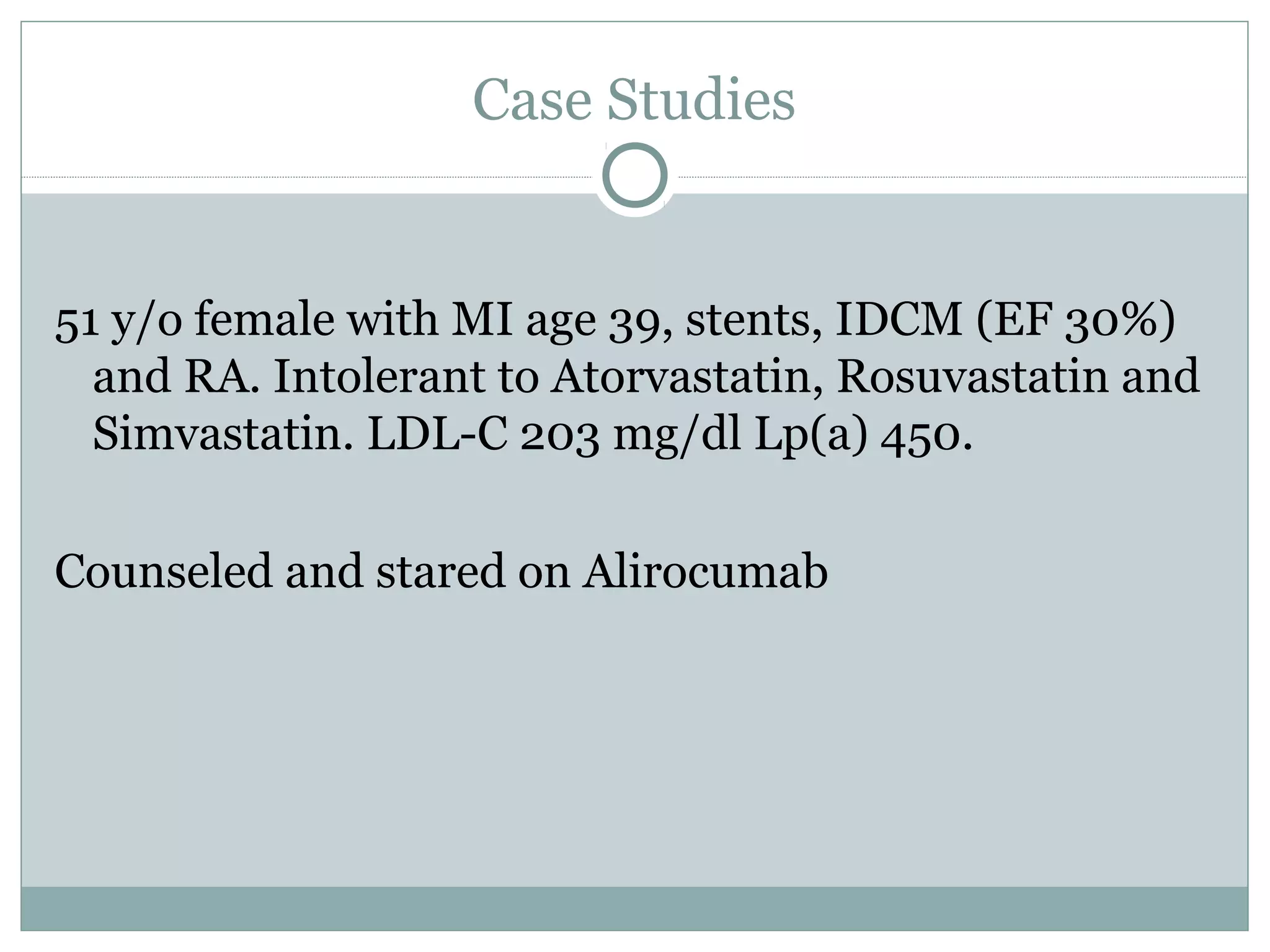
Case Studies
51 y/o female with MI age 39, stents, IDCM (EF 30%)
and RA. Intolerant to Atorvastatin, Rosuvastatin and
Simvastatin. LDL-C 203 mg/dl Lp(a) 450.
Counseled and stared on Alirocumab
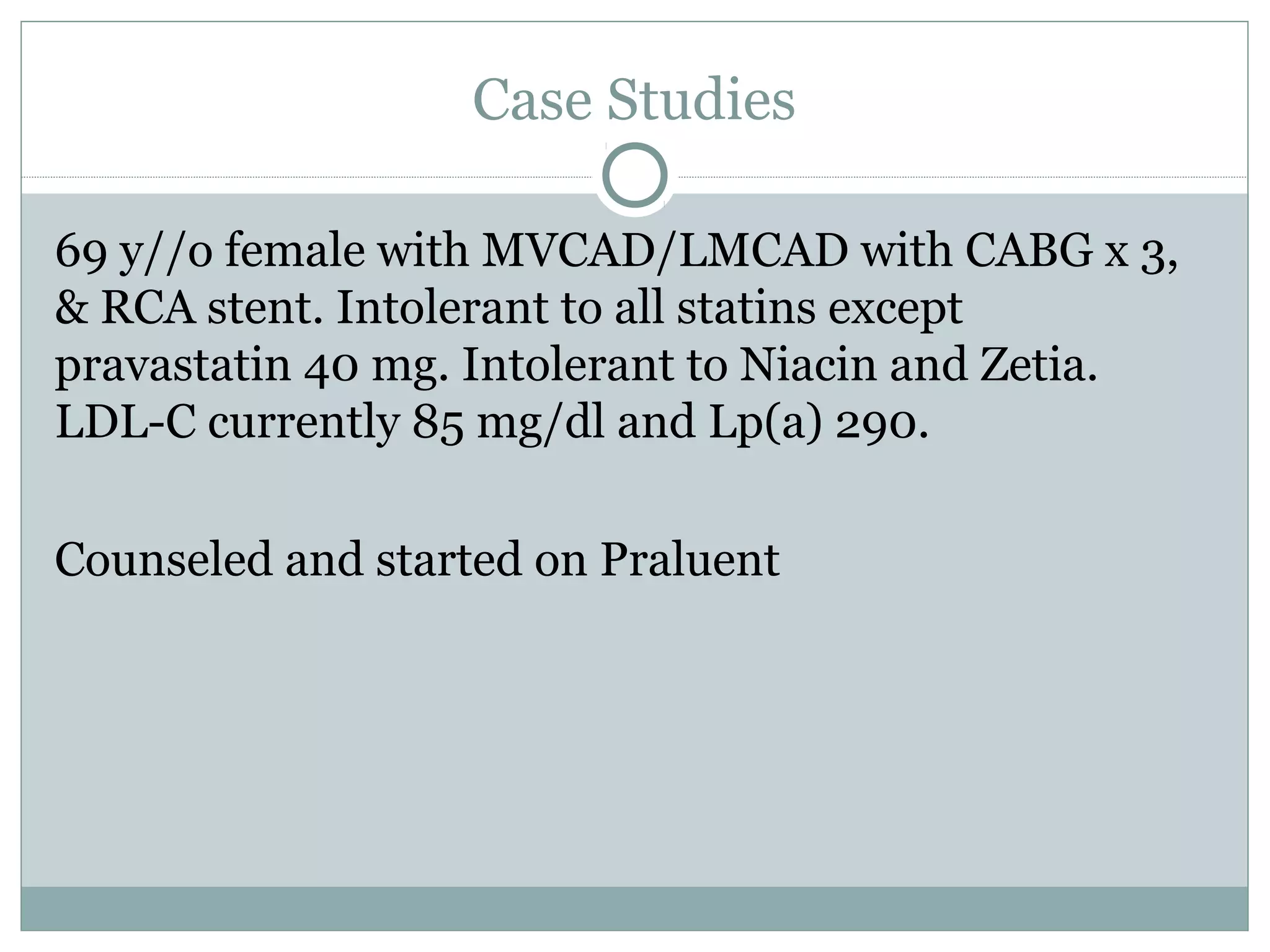
Case Studies
69 y//o female with MVCAD/LMCAD with CABG x 3,
& RCA stent. Intolerant to all statins except
pravastatin 40 mg. Intolerant to Niacin and Zetia.
LDL-C currently 85 mg/dl and Lp(a) 290.
Counseled and started on Praluent
Non-Medical Issues
Cost ~ $1,000/month
Requires insurance preauthorization
Both pharmaceutical companies (Sanofi and Amgen)
have robust bridge programs and patient support.

L. berarducci new cholesterol management guidelines

  • 1.
    LAURENCE BERARDUCCI, MD,FACC PUEBLO CARDIOLOGY ASSOCIATES PUEBLO, COLORADO Update in Cardiovascular Risk Reduction
  • 2.
    Educational Objectives Review CurrentGuidelines Review New Therapies Real-world Perspective of a Clinical Cardiologist
  • 3.
    Current Treatment Guidelines ClinicalASCVD High intensity statin unless > 75 years old or intolerant LDL > 190 mg/dL High intensity statin unless intolerant DM 1 or 2 and age 40-75 High intensity statin unless 10 year ASCVD < 7.5 % ASCVD 10 y risk > 7.5 % and age 40-75 Moderate to high intensity statin
  • 4.
    2013 ACC/AHA Guidelinesfor Cardiovascular Risk Reduction  High intensity statins and the importance of the LDLC percent reduction  The role of non-statin therapies and their failure to add incremental reduction in MACE, in patient’s treated with optimal doses of statins  Lifestyle, Lifestyle, Lifestyle….  The cornerstone of risk reduction, but oh so difficult to achieve in Southern Colorado
  • 5.
    High Intensity StatinTherapy % LDLC reduction is paramount  Highly variable in individual patients with respect to LDLC, apolipoprotein B, and non-HDLC reduction  30-50% LDLC reduction = 39% RRR CV events  > 50% LDLC reduction = 59% RRR CV events Guideline recommendations  Rosuvastatin 40 mg daily OR Atorvastatin 40 or 80 mg daily
  • 6.
    Non-Statin Therapies BAS Niacin Fibrates Ezetinibe CTEP Inhibitors •Lack of data to support meaningful risk reduction in patients on optimal statin therapy (IMPROVE-IT ?) • Early trials have minor signals of clinical benefit in ASCVD patients not on statins • CTEP Inhibitors – ¾ Phase III clinical trials showed NO BENEFIT or INCREASED MORTALITY.
  • 7.
    PCSK 9 Inhibitors (ProproteinConvertase Subtillisin/kexin type 9) PCSK9 Inhibitors  Alivocumab (Praluent) and Evolocumab (Repatha)  Development  Mechanism of Action  Efficacy  Clinical Trial Data to Date  Questions that remain
  • 9.
    PCSK9 is aRegulator of LDL Metabolism
  • 10.
    PCSK9 Binds tothe LDL Receptor and Targets the LDL Receptor for Degradation
  • 11.
  • 12.
    PCSK9 Mutations Associatedwith Reduced Levels of LDL-C
  • 13.
    Genetic Variants EstablishPCSK9 as a Modulator of LDL-C
  • 14.
    Phase 3 Programto Support LDL-C Reduction in Targeted Populations High CV Risk Patients  Patients not at LDL-C goal with currently available LLT (even high doses of potent statins) = >persistent risk Familial Hypercholesterolemia LDL-C levels often far from goal, even with potent statins and combination Tx Life-long exposure to high LDL-C; considered high risk even w/o additional risk factors Statin Intolerant Patients LDL-C levels often far from goal, due to intolerance Definition: unable to tolerate at least 2 statins, including one at the lowest dose
  • 15.
    Overview of ODYSSEYPhase 3 clinical trial program ODYSSEYALTERNATIVE(CL1119) N=250 Patients with defined statin intolerance LDL- ORLDL- 6 months ODYSSEYOPTIONSI (CL1110) N=350 Patients not at goal on moderate dose atorvastatin LDL- - 6 months ODYSSEYFHII (CL1112) N=250 LDL- - 18 months ODYSSEYHIGHFH(EFC12732) N=105 LDL- 18 months 12 global phase 3 trials Including more than 23,500 patients across more than 2,000 study centers HeFH population HC in high CV risk population Additional populations ODYSSEYFHI (EFC12492) N=471 LDL- - 18 months ODYSSEYLONGTERM (LTS11717) N=2,100 LDL- 18 months ODYSSEYCOMBOI (EFC11568) N=306 LDL- - 12 months ODYSSEYMONO(EFC11716) N=100 Patients on no background LMTs LDL- 6 months ODYSSEYOPTIONSII (CL1118) N=300 Patients not at goal on moderate dose rosuvastatin LDL- - 6 months ODYSSEYOUTCOMES(EFC11570) N=18,000 LDL- Add-onto maxtoleratedstatin (± other LMT) Add-on tomaxtoleratedstatin (± other LMT) *ODYSSEYCOMBOII (EFC11569) N=660 LDL- - 24 months HC = hypercholesterolemia; LMT = lipid-modifying therapy *For the ODYSSEY COMBO II other LMT not allowed at entry ODYSSEYCHOICEI (CL1308) N=700 LDL- - 12 months
  • 16.
    99 HeFH Phase 3 (N =300)5 Combo- therapy Phase 3 (N = 1,700)5 HoFH Phase 3 (N = 125)5 Mono- therapy Phase 3 (N = 600)5 Phase 3 (N = 22,500)5 Secondary Prevention Phase 3 (N = 950)5Athero PROFICIO Program to Reduce LDL-C and Cardiovascular Outcomes Following Inhibition of PCSK9 In Different Populations 1. Giugliano RP, et al. Lancet. 2012;380:2007-2017. 2. Koren MJ, et al. Lancet. 2012;380:1995-2006. 3. Sullivan D, et al. JAMA. 2012;308:2497-2506. 4. Raal F, et al. Circulation. 2012;126:2408-2417. 5. Clinical Trials.gov. Available at: http://www.clinicaltrials.gov. Accessed Oct. 2, 2013. 6. Data on file, Amgen; [AMG 145 Protocol 20120332]. Open-label Extension Phase 3 (N ~ 3,515)5 Non-Commercial Class D Materials for Investigator Communications. Not for Reproduction or Distribution Phase 3 (N = 300)5 Statin- intolerant Long-term safety and efficacy Phase 3 (N = 905)5 *Subjects completed a qualifying Phase 2 study. Subjects completed a qualifying Phase 3 study.
  • 17.
    10 SPIREPhase 3 BococizumabClinical Development Program: DesignedtoAddressUnmet Needsinthe Management of CVDin HighRiskPatients SPIRE(Studiesof PCSK9 Inhibition and the Reduction of Vascular Events) N=~30,000 SPIREHR(n=300) On statin High risk of CV event LDL- SPIRELDL(n=1,932) On statin High risk of CV event LDL- SPIREFH(n=300) HeFH (genetic diagnosis or Simon Broome Criteria), LDL >70 mg/dL SPIRELipidLoweringStudies SPIRECVOutcome Studies SPIRELL(n=690) On statin High / very high risk of CV event LDL- SPIRESI (n=150) Statin intolerant LDL- SPIRE-1 (n=17,000) High Risk Primary and Secondary Prevention LDL- on statins (or statin intolerant) SPIRE-2 (n=9,000) High Risk Primary and Secondary Prevention LDL- statins (or statin intolerant) NCT#: https://clinicaltrials.gov SPIRE HR: NCT01968954 SPIRE LDL: NCT01968967 SPIRE HF: NCT01968980 SPIRE-LL: NCT02100514 SPIRE-SI: NCT02135029 SPIRE-1: NCT01975376 SPIRE-2: NCT01975389 Studieson PCSK9Inhibition and the Reduction of Vascular Events
  • 18.
    Recommended Use ofPCSK9I’s Based on current guidelines, available evidence, and economic considerations:  Patients with FH or ASCVD and statin resistance (on max dose) for additional LDL lowering is a reasonable strategy.  Discuss with patient costs vs uncertain clinical benefit  In FH patients to avoid apheresis  Consider in statin intolerant patients
  • 19.
    Case Studies 51 y/ofemale with MI age 39, stents, IDCM (EF 30%) and RA. Intolerant to Atorvastatin, Rosuvastatin and Simvastatin. LDL-C 203 mg/dl Lp(a) 450. Counseled and stared on Alirocumab
  • 20.
    Case Studies 69 y//ofemale with MVCAD/LMCAD with CABG x 3, & RCA stent. Intolerant to all statins except pravastatin 40 mg. Intolerant to Niacin and Zetia. LDL-C currently 85 mg/dl and Lp(a) 290. Counseled and started on Praluent
  • 21.
    Non-Medical Issues Cost ~$1,000/month Requires insurance preauthorization Both pharmaceutical companies (Sanofi and Amgen) have robust bridge programs and patient support.