
김근동
Rockplace
Azure
SQL Database
Azure SQL Introduction
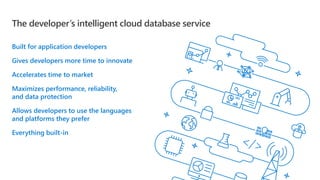
The developer’s intelligent cloud database service
Built for application developers
Gives developers more time to innovate
Accelerates time to market
Maximizes performance, reliability,
and data protection
Allows developers to use the languages
and platforms they prefer
Everything built-in
The Modern Data Problem
How to derive value from data:
What happened historically?
What is happening now?
What is going to happen?
Each dimension of data is
constantly expanding
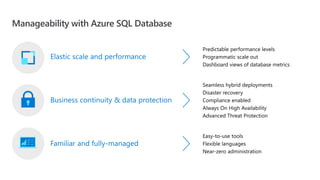
Manageability with Azure SQL Database
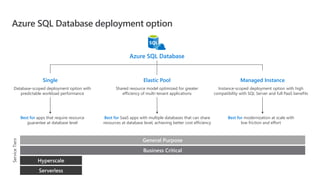
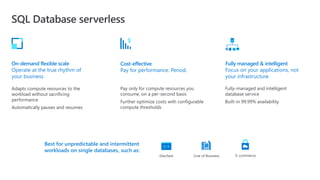
Azure SQL Database deployment option
Azure SQL Database
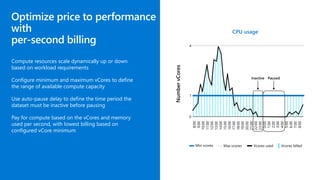
Database-scoped deployment option with
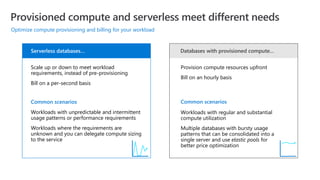
predictable workload performance
Shared resource model optimized for greater
efficiency of multi-tenant applications
Best for apps that require resource
guarantee at database level
Best for SaaS apps with multiple databases that can share
resources at database level, achieving better cost efficiency
Best for modernization at scale with
low friction and effort
Elastic PoolSingle Managed Instance
Instance-scoped deployment option with high
compatibility with SQL Server and full PaaS benefits
ServiceTiers
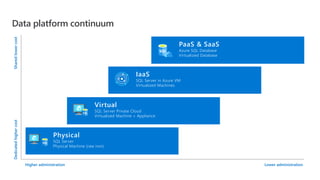
Data platform continuum
SharedlowercostDedicatedhighercost
Higher administration Lower administration
Physical
SQL Server
Physical Machine (raw iron)
IaaS
SQL Server in Azure VM
Virtualized Machines
Virtual
SQL Server Private Cloud
Virtualized Machine + Appliance
PaaS & SaaS
Azure SQL Database
Virtualized Database
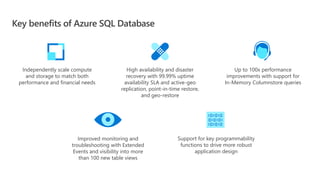
Key benefits of Azure SQL Database
Independently scale compute
and storage to match both
performance and financial needs
High availability and disaster
recovery with 99.99% uptime
availability SLA and active-geo
replication, point-in-time restore,
and geo-restore
Up to 100x performance
improvements with support for
In-Memory Columnstore queries
Improved monitoring and
troubleshooting with Extended
Events and visibility into more
than 100 new table views
Support for key programmability
functions to drive more robust
application design
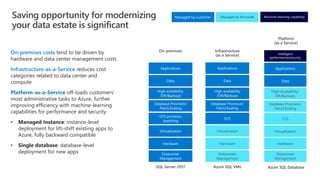
On-premises
Datacenter
Management
Hardware
O/S provision
/patching
Database Provision/
Patch/Scaling
Virtualization
Data
Applications
High availability
/DR/Backups
SQL Server 2017
Infrastructure
(as a Service)
Datacenter
Management
Hardware
Virtualization
O/S
Database Provision/
Patch/Scaling
Data
Applications
High availability
/DR/Backups
Azure SQL VMs
Platform
(as a Service)
Data
Applications
Datacenter
Management
Hardware
Virtualization
O/S
Database Provision/
Patch/Scaling
High Availability/
DR/Backups
Azure SQL Database
On-premises costs tend to be driven by
hardware and data center management costs
Infrastructure-as-a-Service reduces cost
categories related to data center and
compute
Platform-as-a-Service off-loads customers’
most administrative tasks to Azure, further
improving efficiency with machine-learning
capabilities for performance and security
• Managed Instance: instance-level
deployment for lift-shift existing apps to
Azure, fully backward compatible
• Single database: database-level
deployment for new apps
Saving opportunity for modernizing
your data estate is significant
Intelligent
performance/security
Managed by MicrosoftManaged by customer Machine-learning capability
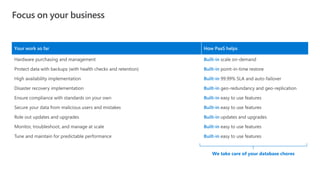
Focus on your business
We take care of your database chores
Your work so far How PaaS helps
Hardware purchasing and management Built-in scale on-demand
Protect data with backups (with health checks and retention) Built-in point-in-time restore
High availability implementation Built-in 99.99% SLA and auto-failover
Disaster recovery implementation Built-in geo-redundancy and geo-replication
Ensure compliance with standards on your own Built-in easy to use features
Secure your data from malicious users and mistakes Built-in easy to use features
Role out updates and upgrades Built-in updates and upgrades
Monitor, troubleshoot, and manage at scale Built-in easy to use features
Tune and maintain for predictable performance Built-in easy to use features
Updates to Azure SQL Database
Hybrid Performance & scale Security Intelligence
Azure Hybrid Benefit​
Managed Instance Business
Critical – GA​
Managed Instance General
Purpose - GA​
vCore Purchasing Model - GA​
Reserved Capacity Pricing - GA​
Data Sync – GA​
More vCore compute levels -
GA
Zone Redundancy - Prev​
Elastic DB library for Java - GA​
Columnstore in Standard tier - GA​
Long Term backup retention - GA​
Zone Redundancy - GA​
Read Scale - Prev​
.Net/ODBC and SSDT - Prev​
Resumable Online Index Create –
GA​
Storage add-ons - GA​
Adding DTU Standard perf levels-
GA​
Elastic Jobs - Prev​
Auto Failover - GA​
Hyperscale – Prev​
Dev/test pricing for MI, single DB-
GA
Serverless - Prev
TDE with Azure Key Vault –
GA​
Information Protection – Prev
Vulnerability Assessment - GA
Automatic Tuning
Improvements - GA​
Intelligent QP updates - Prev
For latest information:
https://azure.microsoft.com/en-us/updates/?product=sql-database
https://docs.microsoft.com/en-us/azure/sql-database/sql-database-release-notes
Previous updates to Azure SQL Database
Learn & Adapt Privacy & trust
Business
Continuity
Seamless and
Compatible
Operational analytics
• Columnstore
• In-Memory OLTP
Predictable performance
• Query Store
• Index Optimization
• Automatic tuning
• Auto query
plan correction
• Performance Insight
in OMS
• Adaptive Query
Processing
SQL Graph Advanced analytics
• Native PREDICT
• R Services
Activity monitoring
• Engine Audit
• Threat Detection
• Centralized dashboard OMS
Access control
• SQL Firewall
• RLS, Dynamic data masking
• AAD and MFA
Data protection
• Encrypt in motion (TLS)
• Always Encrypted (equality)
• TDE & BYOK
• Service endpoint
• Always Encrypted
(secure enclave)
Discovery & assessment
• Vulnerability assessment
HA-DR built-in
• 99.99% SLA
• Geo-restore
• Active geo replicas (4)
• Multi-AZ
• Zone-redundant
Backup and restore
• Backup with health check
• 35 days PITR
• 10 years data retention
Distributed application
• Change Tracking
• Transaction replication
• Data sync
• SSIS service
• Read scale-out
• VNET endpoints
Biz model & SKUs
• DTU/eDTU
• <=1TB
• Bigger std: S4-S12
• Separate compute and
storage
• Azure Hybrid Benefit
• vCore-based purchasing
Cost optimization
• Intelligent PaaS
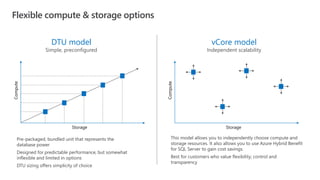
Flexible compute & storage options
Pre-packaged, bundled unit that represents the
database power
Designed for predictable performance, but somewhat
inflexible and limited in options
DTU sizing offers simplicity of choice
Storage
Compute
Storage
Compute
vCore model
Independent scalability
DTU model
Simple, preconfigured
This model allows you to independently choose compute and
storage resources. It also allows you to use Azure Hybrid Benefit
for SQL Server to gain cost savings.
Best for customers who value flexibility; control and
transparency
Simplicity
We remain committed to the DTU-
based model and the simplicity it
offers customers who want a pre-
configured solution
Flexibility:
The vCore-based model reflects our
commitment to customer choice
and to simplify the hybrid benefit
for customers migrating from on-
premises
Customers pay for:
Service tier + number of vCores
Type and amount of data storage
Number of IO
Backup storage (RA-GRS)
Flexible compute, storage & performance options
Service tier General purpose Business critical Hyperscale
Best for Most budget-oriented workloads
Critical business applications with high
IO requirements.
VLDB OLTP and HTAP workloads
with highly scalable storage and
read-scale requirements
Deployment
option
Single /
Elastic Pools
Managed
Instance
Single /
Elastic Pools
Managed
Instance
Single
Compute tiers
Gen4: 1 to 24 vCore
Gen5: 2 to 80 vCore
Gen4: 4 to 24 vCore
Gen5: 4 to 80 vCore
Gen4: 1 to 24 vCore
Gen5: 2 to 80 vCore
Gen4: 4 to 24 vCore
Gen5: 4 to 80 vCore
Gen4: 1 to 24 vCore
Gen5: 2 to 80 vCore
Storage
Premium remote Local SSD Local SSD Cache
32GB – 8TB per
instance
32GB – 8TB per
instance
32GB – 4TB per
instance
32GB – 8TB per
instance
Scale from 5GB to 100TB of storage in
1GB increments
In-Memory Not supported Supported Not supported
Read-write IO ~2ms for all data access <0.5ms for all data access
<0.5ms for hot data access
~2ms otherwise
Availability 2 read replicas
3 replicas, 1 read-scale replica, zone-
redundant HA
Primary read/write replica + up to 4
read replicas
Backups RA-GRS, 7-35 days (7 days by default) RA-GRS, 7-35 days (7 days by default)
LRS, ZRS, RA-GRS, 7-35 days (7 days
by default)
https://azure.microsoft.com/en-us/pricing/details/sql-database/
Balance performance requirements and price
with two hardware generations
Match your on-premise application behavior
Choose from two hardware generations
Gen 4 Gen 5
Hardware Intel E5-2673 v3 (Haswell) 2.4 GHz
processors
vCore = 1 PP (physical core)
Intel E5-2673 v4 (Broadwell) 2.3 GHz
processors, fast eNVM SSD
vCore=1 LP (hyper-thread)
Performance
levels
1, 2, 3, 4, 5, 6, 7, 8, 9, 10, 16, 24
vCores
2, 4, 6, 10, 12, 14, 16, 18, 20, 24, 32, 40,
80 vCores
Memory 7 GB per vCore 5.1 GB per vCore
Storage 5 GB to 4 TB with 1 GB increments.
Premium blob storage
5 GB to 4 TB with 1GB increments.
Local SSD storage.
Hyperscale tier 5 GB to 100 TB with
1GB increments and only charge for
storage based on usage.
https://azure.microsoft.com/en-us/pricing/details/sql-database/
Pay only for what you need
Business continuity and data protection: A spectrum of business-continuity features across tiers lets you dial up control over
data recovery and failover
Familiar and fully-managed: Near-complete SQL Server compatibility and unprecedented efficiencies as your applications scale
with a near-zero maintenance service and a variety of familiar management tools and programmatic APIs
Elastic scale and performance: Three service tiers within DTU-based model, and two tiers within vCore-based model let you
scale up and down based on throughput needs, and offer better resource isolation and an improved billing experience
DTUs vCores
Basic Standard Premium General Purpose Business Critical Hyperscale
Small databases
particularly those in
development
phases
General purpose
databases with
moderate
performance
requirements
Mission-critical
databases with high
performance and
high-availability
requirements
Data applications
with basic IO and
basic availability
requirements
Business critical
data applications
with fast IO and
high availability
requirements
VLDB OLTP and
HTAP workloads
with highly scalable
storage and read-
scale requirements
Azure SQL Database — Everything built-in
Scales
on the fly
Intelligent
performance
Works in your
environment
Advanced threat
pprotection
Business
continuity
Realize automatic
performance improvements
from continuous
assessment and innovation
Change service tiers,
performance levels,
and storage dynamically
without downtime
Easily manage and
monitor business critical
functions for reliable
operations
Develop your app
and connect to SQL
Database with the tools
and platforms you prefer
Build security-enhanced
apps with built-in
protection and industry-
leading compliance
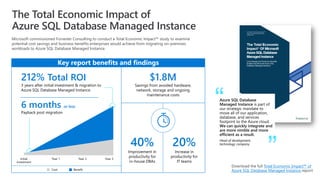
The Total Economic Impact of
Azure SQL Database Managed Instance
Microsoft commissioned Forrester Consulting to conduct a Total Economic Impact™ study to examine
potential cost savings and business benefits enterprises would achieve from migrating on-premises
workloads to Azure SQL Database Managed Instance.
Total Economic Impact™ of
Azure SQL Database Managed Instance report
$1.8M
40%
Savings from avoided hardware,
network, storage and ongoing
maintenance costs
Improvement in
productivity for
in-house DBAs
20%
Increase in
productivity for
IT teams
212% Total ROI
3 years after initial investment & migration to
Azure SQL Database Managed Instance
6 months or less
Payback post migration
Key report benefits and findings
““
The growing need for
serverless databases
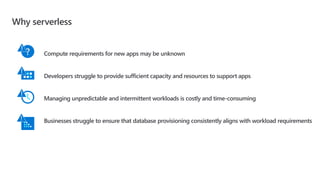
Why serverless
Compute requirements for new apps may be unknown
Developers struggle to provide sufficient capacity and resources to support apps
Managing unpredictable and intermittent workloads is costly and time-consuming
Businesses struggle to ensure that database provisioning consistently aligns with workload requirements
?
Existing offerings cannot
solve the problem
Provisioned compute databases are designed for
predictable patterns and higher compute utilization
They struggle to meet high peaks in demand
They contribute to over-allocation of resources and costs
during periods of inactivity or low usage
Lead to precious resources spent managing,
not building
vCores billed
vCores used
Provisioned compute with unpredictable
and intermittent workloads
Unused compute
resources
On-demand flexible scale
Operate at the true rhythm of
your business
Fully managed & intelligent
Focus on your applications, not
your infrastructure
Cost-effective
Pay for performance. Period.
Adapts compute resources to the
workload without sacrificing
performance
Automatically pauses and resumes
Fully-managed and intelligent
database service
Built-in 99.99% availability
Pay only for compute resources you
consume, on a per-second basis
Further optimize costs with configurable
compute thresholds
Best for unpredictable and intermittent
workloads on single databases, such as:
Dev/test E-commerceLine of Business
Line of business apps
Expense reporting and employee tracking apps
Procurement systems
E-commerce
Opening new marketplaces, marketing campaigns,
sales promotions
Content management systems
Updating and publishing web content
Content clearinghouses that pull select content
by third parties
Dev/test workloads
Handling unpredictable workload needs
Optimize price to performance
with
per-second billing
Compute resources scale dynamically up or down
based on workload requirements
Configure minimum and maximum vCores to define
the range of available compute capacity
Use auto-pause delay to define the time period the
dataset must be inactive before pausing
Pay for compute based on the vCores and memory
used per second, with lowest billing based on
configured vCore minimum
Min vcores
CPU usage
Inactive Paused
Max vcores Vcores used Vcores billed
Workloads with unpredictable and intermittent
usage patterns or performance requirements
Workloads where the requirements are
unknown and you can delegate compute sizing
to the service
Common scenarios
Scale up or down to meet workload
requirements, instead of pre-provisioning
Bill on a per-second basis
Optimize compute provisioning and billing for your workload
Serverless databases…
Workloads with regular and substantial
compute utilization
Multiple databases with bursty usage
patterns that can be consolidated into a
single server and use elastic pools for
better price optimization
Common scenarios
Provision compute resources upfront
Bill on an hourly basis
Databases with provisioned compute…
More uniform resource utilization
Need for higher compute responsiveness
Scenarios where hourly billing granularity is ideal
Desire to maintain resource allocation
Interested in reserved capacity, Azure Hybrid Benefit, or
elastic pools
Characteristics for
provisioned compute
Characteristics for
serverless compute
Large shifts in usage and periods of inactivity
Comfort with resume delay and memory reclamation
Scenarios where per second billing granularity is ideal
Desire to delegate resource allocation
Currently using single databases on General Purpose service tier
Price optimization
will help drive the
decision between
provisioned and
serverless compute
Resources
•Announcement blog post
•SQL Database serverless documentation
•Azure SQL Database pricing information
•Pricing calculator
Scaling multiple databases across
shared resources with elastic pools
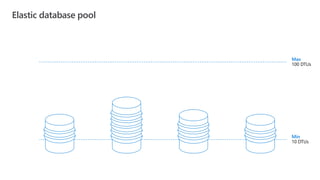
Elastic databases in elastic database pools
Pooled resources are used by many databases
Standard elastic database pools provide 50-3000
database throughput units (DTUs) for up to 500
databases
Max eDTUs per database can be set if available based
on utilization by other database in the pool
Create/configure pools using portal, Azure PowerShell,
REST APIs
Move databases in/out using portal, Azure PowerShell,
REST APIs, and T-SQL
Databases remain online throughout
Monitoring and alerting available on both pools and
databases
Elastic database model
DTUs
Max per-database
burst level
1,200800400200
S0 S1 S2 S3
S0 S1 S2 S3
Elastic database pool
Max
Min
Elastic database pool
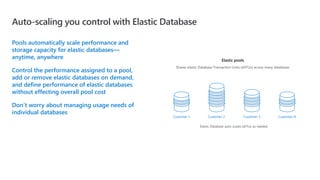
Pools automatically scale performance and
storage capacity for elastic databases—
anytime, anywhere
Control the performance assigned to a pool,
add or remove elastic databases on demand,
and define performance of elastic databases
without effecting overall pool cost
Don’t worry about managing usage needs of
individual databases
Auto-scaling you control with Elastic Database
Elastic pools
Shares elastic Database Transaction Units (eDTUs) across many databases
Customer 1 Customer NCustomer 3Customer 2
Elastic Database auto-scales eDTUs as needed
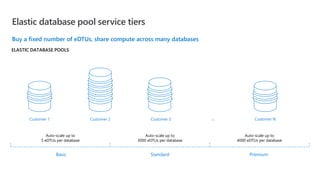
ELASTIC DATABASE POOLS
Buy a fixed number of eDTUs, share compute across many databases
Elastic database pool service tiers
Basic Standard Premium
Auto-scale up to
5 eDTUs per database
Auto-scale up to
3000 eDTUs per database
Auto-scale up to
4000 eDTUs per database
Customer 1 Customer NCustomer 3Customer 2 …
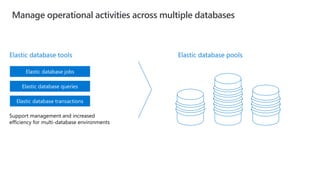
Elastic database tools
Elastic database jobs
Elastic database queries
Elastic database transactions
Elastic database pools
Manage operational activities across multiple databases
Azure SQL Database
Managed Instance
Who is Managed
Instance for?
Customers looking to migrate a large
number of apps from on-premise or IaaS,
self-built or ISV provided, with as low
migration effort as possible & cost being
a crucial factor
SQL
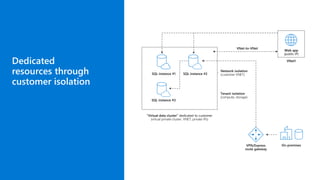
Dedicated
resources through
customer isolation
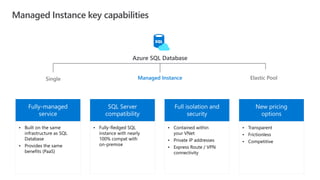
Managed Instance key capabilities
Azure SQL Database
Managed InstanceSingle Elastic Pool
• Fully-fledged SQL
instance with nearly
100% compat with
on-premise
• Built on the same
infrastructure as SQL
Database
• Provides the same
benefits (PaaS)
• Contained within
your VNet
• Private IP addresses
• Express Route / VPN
connectivity
• Transparent
• Frictionless
• Competitive
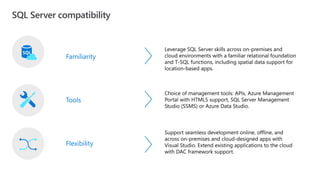
SQL Server compatibility
Flexibility
Tools
Familiarity
Online index rebuild capability for clustered
and non-clustered indexes for greater
availability
Build highly optimized schemas to improve
query processing with table partitioning
support
Access Common Language Runtime (CLR) and
define CLR types, aggregates, functions, and
procedures written in C#
In-Memory Columnstore index for data marts
Support for additional Dynamic Management
Views (DMVs) for deeper insight into
application health
Broader SQL Server support for improved compatibility on Azure
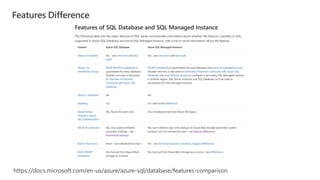
Features Difference
https://docs.microsoft.com/en-us/azure/azure-sql/database/features-comparison

Azure SQL Database

  • 1.
  • 2.
  • 3.
    The developer’s intelligentcloud database service Built for application developers Gives developers more time to innovate Accelerates time to market Maximizes performance, reliability, and data protection Allows developers to use the languages and platforms they prefer Everything built-in
  • 4.
    The Modern DataProblem How to derive value from data: What happened historically? What is happening now? What is going to happen? Each dimension of data is constantly expanding
  • 5.
  • 6.
    Azure SQL Databasedeployment option Azure SQL Database Database-scoped deployment option with predictable workload performance Shared resource model optimized for greater efficiency of multi-tenant applications Best for apps that require resource guarantee at database level Best for SaaS apps with multiple databases that can share resources at database level, achieving better cost efficiency Best for modernization at scale with low friction and effort Elastic PoolSingle Managed Instance Instance-scoped deployment option with high compatibility with SQL Server and full PaaS benefits ServiceTiers
  • 7.
    Data platform continuum SharedlowercostDedicatedhighercost Higheradministration Lower administration Physical SQL Server Physical Machine (raw iron) IaaS SQL Server in Azure VM Virtualized Machines Virtual SQL Server Private Cloud Virtualized Machine + Appliance PaaS & SaaS Azure SQL Database Virtualized Database
  • 8.
    Key benefits ofAzure SQL Database Independently scale compute and storage to match both performance and financial needs High availability and disaster recovery with 99.99% uptime availability SLA and active-geo replication, point-in-time restore, and geo-restore Up to 100x performance improvements with support for In-Memory Columnstore queries Improved monitoring and troubleshooting with Extended Events and visibility into more than 100 new table views Support for key programmability functions to drive more robust application design
  • 9.
    On-premises Datacenter Management Hardware O/S provision /patching Database Provision/ Patch/Scaling Virtualization Data Applications Highavailability /DR/Backups SQL Server 2017 Infrastructure (as a Service) Datacenter Management Hardware Virtualization O/S Database Provision/ Patch/Scaling Data Applications High availability /DR/Backups Azure SQL VMs Platform (as a Service) Data Applications Datacenter Management Hardware Virtualization O/S Database Provision/ Patch/Scaling High Availability/ DR/Backups Azure SQL Database On-premises costs tend to be driven by hardware and data center management costs Infrastructure-as-a-Service reduces cost categories related to data center and compute Platform-as-a-Service off-loads customers’ most administrative tasks to Azure, further improving efficiency with machine-learning capabilities for performance and security • Managed Instance: instance-level deployment for lift-shift existing apps to Azure, fully backward compatible • Single database: database-level deployment for new apps Saving opportunity for modernizing your data estate is significant Intelligent performance/security Managed by MicrosoftManaged by customer Machine-learning capability
  • 10.
    Focus on yourbusiness We take care of your database chores Your work so far How PaaS helps Hardware purchasing and management Built-in scale on-demand Protect data with backups (with health checks and retention) Built-in point-in-time restore High availability implementation Built-in 99.99% SLA and auto-failover Disaster recovery implementation Built-in geo-redundancy and geo-replication Ensure compliance with standards on your own Built-in easy to use features Secure your data from malicious users and mistakes Built-in easy to use features Role out updates and upgrades Built-in updates and upgrades Monitor, troubleshoot, and manage at scale Built-in easy to use features Tune and maintain for predictable performance Built-in easy to use features
  • 11.
    Updates to AzureSQL Database Hybrid Performance & scale Security Intelligence Azure Hybrid Benefit​ Managed Instance Business Critical – GA​ Managed Instance General Purpose - GA​ vCore Purchasing Model - GA​ Reserved Capacity Pricing - GA​ Data Sync – GA​ More vCore compute levels - GA Zone Redundancy - Prev​ Elastic DB library for Java - GA​ Columnstore in Standard tier - GA​ Long Term backup retention - GA​ Zone Redundancy - GA​ Read Scale - Prev​ .Net/ODBC and SSDT - Prev​ Resumable Online Index Create – GA​ Storage add-ons - GA​ Adding DTU Standard perf levels- GA​ Elastic Jobs - Prev​ Auto Failover - GA​ Hyperscale – Prev​ Dev/test pricing for MI, single DB- GA Serverless - Prev TDE with Azure Key Vault – GA​ Information Protection – Prev Vulnerability Assessment - GA Automatic Tuning Improvements - GA​ Intelligent QP updates - Prev For latest information: https://azure.microsoft.com/en-us/updates/?product=sql-database https://docs.microsoft.com/en-us/azure/sql-database/sql-database-release-notes
  • 12.
    Previous updates toAzure SQL Database Learn & Adapt Privacy & trust Business Continuity Seamless and Compatible Operational analytics • Columnstore • In-Memory OLTP Predictable performance • Query Store • Index Optimization • Automatic tuning • Auto query plan correction • Performance Insight in OMS • Adaptive Query Processing SQL Graph Advanced analytics • Native PREDICT • R Services Activity monitoring • Engine Audit • Threat Detection • Centralized dashboard OMS Access control • SQL Firewall • RLS, Dynamic data masking • AAD and MFA Data protection • Encrypt in motion (TLS) • Always Encrypted (equality) • TDE & BYOK • Service endpoint • Always Encrypted (secure enclave) Discovery & assessment • Vulnerability assessment HA-DR built-in • 99.99% SLA • Geo-restore • Active geo replicas (4) • Multi-AZ • Zone-redundant Backup and restore • Backup with health check • 35 days PITR • 10 years data retention Distributed application • Change Tracking • Transaction replication • Data sync • SSIS service • Read scale-out • VNET endpoints Biz model & SKUs • DTU/eDTU • <=1TB • Bigger std: S4-S12 • Separate compute and storage • Azure Hybrid Benefit • vCore-based purchasing Cost optimization • Intelligent PaaS
  • 13.
    Flexible compute &storage options Pre-packaged, bundled unit that represents the database power Designed for predictable performance, but somewhat inflexible and limited in options DTU sizing offers simplicity of choice Storage Compute Storage Compute vCore model Independent scalability DTU model Simple, preconfigured This model allows you to independently choose compute and storage resources. It also allows you to use Azure Hybrid Benefit for SQL Server to gain cost savings. Best for customers who value flexibility; control and transparency
  • 14.
    Simplicity We remain committedto the DTU- based model and the simplicity it offers customers who want a pre- configured solution Flexibility: The vCore-based model reflects our commitment to customer choice and to simplify the hybrid benefit for customers migrating from on- premises Customers pay for: Service tier + number of vCores Type and amount of data storage Number of IO Backup storage (RA-GRS) Flexible compute, storage & performance options Service tier General purpose Business critical Hyperscale Best for Most budget-oriented workloads Critical business applications with high IO requirements. VLDB OLTP and HTAP workloads with highly scalable storage and read-scale requirements Deployment option Single / Elastic Pools Managed Instance Single / Elastic Pools Managed Instance Single Compute tiers Gen4: 1 to 24 vCore Gen5: 2 to 80 vCore Gen4: 4 to 24 vCore Gen5: 4 to 80 vCore Gen4: 1 to 24 vCore Gen5: 2 to 80 vCore Gen4: 4 to 24 vCore Gen5: 4 to 80 vCore Gen4: 1 to 24 vCore Gen5: 2 to 80 vCore Storage Premium remote Local SSD Local SSD Cache 32GB – 8TB per instance 32GB – 8TB per instance 32GB – 4TB per instance 32GB – 8TB per instance Scale from 5GB to 100TB of storage in 1GB increments In-Memory Not supported Supported Not supported Read-write IO ~2ms for all data access <0.5ms for all data access <0.5ms for hot data access ~2ms otherwise Availability 2 read replicas 3 replicas, 1 read-scale replica, zone- redundant HA Primary read/write replica + up to 4 read replicas Backups RA-GRS, 7-35 days (7 days by default) RA-GRS, 7-35 days (7 days by default) LRS, ZRS, RA-GRS, 7-35 days (7 days by default) https://azure.microsoft.com/en-us/pricing/details/sql-database/
  • 15.
    Balance performance requirementsand price with two hardware generations Match your on-premise application behavior Choose from two hardware generations Gen 4 Gen 5 Hardware Intel E5-2673 v3 (Haswell) 2.4 GHz processors vCore = 1 PP (physical core) Intel E5-2673 v4 (Broadwell) 2.3 GHz processors, fast eNVM SSD vCore=1 LP (hyper-thread) Performance levels 1, 2, 3, 4, 5, 6, 7, 8, 9, 10, 16, 24 vCores 2, 4, 6, 10, 12, 14, 16, 18, 20, 24, 32, 40, 80 vCores Memory 7 GB per vCore 5.1 GB per vCore Storage 5 GB to 4 TB with 1 GB increments. Premium blob storage 5 GB to 4 TB with 1GB increments. Local SSD storage. Hyperscale tier 5 GB to 100 TB with 1GB increments and only charge for storage based on usage. https://azure.microsoft.com/en-us/pricing/details/sql-database/
  • 16.
    Pay only forwhat you need Business continuity and data protection: A spectrum of business-continuity features across tiers lets you dial up control over data recovery and failover Familiar and fully-managed: Near-complete SQL Server compatibility and unprecedented efficiencies as your applications scale with a near-zero maintenance service and a variety of familiar management tools and programmatic APIs Elastic scale and performance: Three service tiers within DTU-based model, and two tiers within vCore-based model let you scale up and down based on throughput needs, and offer better resource isolation and an improved billing experience DTUs vCores Basic Standard Premium General Purpose Business Critical Hyperscale Small databases particularly those in development phases General purpose databases with moderate performance requirements Mission-critical databases with high performance and high-availability requirements Data applications with basic IO and basic availability requirements Business critical data applications with fast IO and high availability requirements VLDB OLTP and HTAP workloads with highly scalable storage and read- scale requirements
  • 17.
    Azure SQL Database— Everything built-in Scales on the fly Intelligent performance Works in your environment Advanced threat pprotection Business continuity Realize automatic performance improvements from continuous assessment and innovation Change service tiers, performance levels, and storage dynamically without downtime Easily manage and monitor business critical functions for reliable operations Develop your app and connect to SQL Database with the tools and platforms you prefer Build security-enhanced apps with built-in protection and industry- leading compliance
  • 18.
    The Total EconomicImpact of Azure SQL Database Managed Instance Microsoft commissioned Forrester Consulting to conduct a Total Economic Impact™ study to examine potential cost savings and business benefits enterprises would achieve from migrating on-premises workloads to Azure SQL Database Managed Instance. Total Economic Impact™ of Azure SQL Database Managed Instance report $1.8M 40% Savings from avoided hardware, network, storage and ongoing maintenance costs Improvement in productivity for in-house DBAs 20% Increase in productivity for IT teams 212% Total ROI 3 years after initial investment & migration to Azure SQL Database Managed Instance 6 months or less Payback post migration Key report benefits and findings ““
  • 19.
    The growing needfor serverless databases
  • 20.
    Why serverless Compute requirementsfor new apps may be unknown Developers struggle to provide sufficient capacity and resources to support apps Managing unpredictable and intermittent workloads is costly and time-consuming Businesses struggle to ensure that database provisioning consistently aligns with workload requirements ?
  • 21.
    Existing offerings cannot solvethe problem Provisioned compute databases are designed for predictable patterns and higher compute utilization They struggle to meet high peaks in demand They contribute to over-allocation of resources and costs during periods of inactivity or low usage Lead to precious resources spent managing, not building vCores billed vCores used Provisioned compute with unpredictable and intermittent workloads Unused compute resources
  • 22.
    On-demand flexible scale Operateat the true rhythm of your business Fully managed & intelligent Focus on your applications, not your infrastructure Cost-effective Pay for performance. Period. Adapts compute resources to the workload without sacrificing performance Automatically pauses and resumes Fully-managed and intelligent database service Built-in 99.99% availability Pay only for compute resources you consume, on a per-second basis Further optimize costs with configurable compute thresholds Best for unpredictable and intermittent workloads on single databases, such as: Dev/test E-commerceLine of Business
  • 23.
    Line of businessapps Expense reporting and employee tracking apps Procurement systems E-commerce Opening new marketplaces, marketing campaigns, sales promotions Content management systems Updating and publishing web content Content clearinghouses that pull select content by third parties Dev/test workloads Handling unpredictable workload needs
  • 24.
    Optimize price toperformance with per-second billing Compute resources scale dynamically up or down based on workload requirements Configure minimum and maximum vCores to define the range of available compute capacity Use auto-pause delay to define the time period the dataset must be inactive before pausing Pay for compute based on the vCores and memory used per second, with lowest billing based on configured vCore minimum Min vcores CPU usage Inactive Paused Max vcores Vcores used Vcores billed
  • 25.
    Workloads with unpredictableand intermittent usage patterns or performance requirements Workloads where the requirements are unknown and you can delegate compute sizing to the service Common scenarios Scale up or down to meet workload requirements, instead of pre-provisioning Bill on a per-second basis Optimize compute provisioning and billing for your workload Serverless databases… Workloads with regular and substantial compute utilization Multiple databases with bursty usage patterns that can be consolidated into a single server and use elastic pools for better price optimization Common scenarios Provision compute resources upfront Bill on an hourly basis Databases with provisioned compute…
  • 26.
    More uniform resourceutilization Need for higher compute responsiveness Scenarios where hourly billing granularity is ideal Desire to maintain resource allocation Interested in reserved capacity, Azure Hybrid Benefit, or elastic pools Characteristics for provisioned compute Characteristics for serverless compute Large shifts in usage and periods of inactivity Comfort with resume delay and memory reclamation Scenarios where per second billing granularity is ideal Desire to delegate resource allocation Currently using single databases on General Purpose service tier Price optimization will help drive the decision between provisioned and serverless compute
  • 27.
    Resources •Announcement blog post •SQLDatabase serverless documentation •Azure SQL Database pricing information •Pricing calculator
  • 28.
    Scaling multiple databasesacross shared resources with elastic pools
  • 29.
    Elastic databases inelastic database pools Pooled resources are used by many databases Standard elastic database pools provide 50-3000 database throughput units (DTUs) for up to 500 databases Max eDTUs per database can be set if available based on utilization by other database in the pool Create/configure pools using portal, Azure PowerShell, REST APIs Move databases in/out using portal, Azure PowerShell, REST APIs, and T-SQL Databases remain online throughout Monitoring and alerting available on both pools and databases Elastic database model DTUs Max per-database burst level 1,200800400200
  • 30.
  • 31.
  • 32.
  • 33.
  • 34.
    Pools automatically scaleperformance and storage capacity for elastic databases— anytime, anywhere Control the performance assigned to a pool, add or remove elastic databases on demand, and define performance of elastic databases without effecting overall pool cost Don’t worry about managing usage needs of individual databases Auto-scaling you control with Elastic Database Elastic pools Shares elastic Database Transaction Units (eDTUs) across many databases Customer 1 Customer NCustomer 3Customer 2 Elastic Database auto-scales eDTUs as needed
  • 35.
    ELASTIC DATABASE POOLS Buya fixed number of eDTUs, share compute across many databases Elastic database pool service tiers Basic Standard Premium Auto-scale up to 5 eDTUs per database Auto-scale up to 3000 eDTUs per database Auto-scale up to 4000 eDTUs per database Customer 1 Customer NCustomer 3Customer 2 …
  • 36.
    Elastic database tools Elasticdatabase jobs Elastic database queries Elastic database transactions Elastic database pools Manage operational activities across multiple databases
  • 37.
  • 38.
    Who is Managed Instancefor? Customers looking to migrate a large number of apps from on-premise or IaaS, self-built or ISV provided, with as low migration effort as possible & cost being a crucial factor SQL
  • 39.
  • 40.
    Managed Instance keycapabilities Azure SQL Database Managed InstanceSingle Elastic Pool • Fully-fledged SQL instance with nearly 100% compat with on-premise • Built on the same infrastructure as SQL Database • Provides the same benefits (PaaS) • Contained within your VNet • Private IP addresses • Express Route / VPN connectivity • Transparent • Frictionless • Competitive
  • 41.
  • 42.
    Online index rebuildcapability for clustered and non-clustered indexes for greater availability Build highly optimized schemas to improve query processing with table partitioning support Access Common Language Runtime (CLR) and define CLR types, aggregates, functions, and procedures written in C# In-Memory Columnstore index for data marts Support for additional Dynamic Management Views (DMVs) for deeper insight into application health Broader SQL Server support for improved compatibility on Azure
  • 43.