FMCG
 Prepared by:
 Kumar
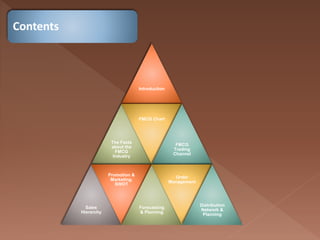
Contents
Introduction
The Facts
about the
FMCG
Industry
FMCG Chart
FMCG
Trading
Channel
Sales
Hierarchy
Promotion &
Marketing.
SWOT
Forecasting
& Planning
Order
Management
Distribution
Network &
Planning
Facts about FMCG Industry
FMCG Is the Largest sector in the Indian Economy
Growing Awareness, easier access and Changing Lifestyle have been the key growth
drivers for the sector.
Retail Market in India is estimated to reach USD 1 Trillion by 2020 with Modern trade to
grow at 20% Per annum this is likely to boost revenues of FMCG Companies.
The FMCG Sector in India generated revenues worth USD 49.03 Billion in 2016
Asia Drives Growth for Global FMCG Brands
Asia Contributed the most Purchasing power among Households
China, India and Indonesia are the Biggest Contributors of Global Growth
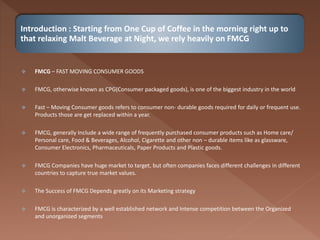
Introduction : Starting from One Cup of Coffee in the morning right up to
that relaxing Malt Beverage at Night, we rely heavily on FMCG
 FMCG – FAST MOVING CONSUMER GOODS
 FMCG, otherwise known as CPG(Consumer packaged goods), is one of the biggest industry in the world
 Fast – Moving Consumer goods refers to consumer non- durable goods required for daily or frequent use.
Products those are get replaced within a year.
 FMCG, generally Include a wide range of frequently purchased consumer products such as Home care/
Personal care, Food & Beverages, Alcohol, Cigarette and other non – durable items like as glassware,
Consumer Electronics, Pharmaceuticals, Paper Products and Plastic goods.
 FMCG Companies have huge market to target, but often companies faces different challenges in different
countries to capture true market values.
 The Success of FMCG Depends greatly on its Marketing strategy
 FMCG is characterized by a well established network and Intense competition between the Organized
and unorganized segments
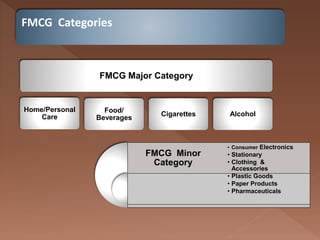
FMCG Categories
FMCG Major Category
Home/Personal
Care
Food/
Beverages
Cigarettes Alcohol
FMCG Minor
Category
• Consumer Electronics
• Stationary
• Clothing &
Accessories
• Plastic Goods
• Paper Products
• Pharmaceuticals
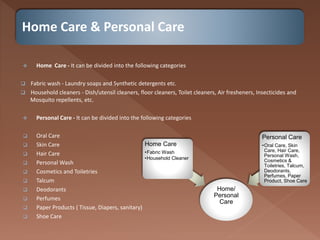
Home Care & Personal Care
 Home Care - It can be divided into the following categories
 Fabric wash - Laundry soaps and Synthetic detergents etc.
 Household cleaners - Dish/utensil cleaners, floor cleaners, Toilet cleaners, Air fresheners, Insecticides and
Mosquito repellents, etc.
 Personal Care - It can be divided into the following categories
 Oral Care
 Skin Care
 Hair Care
 Personal Wash
 Cosmetics and Toiletries
 Talcum
 Deodorants
 Perfumes
 Paper Products ( Tissue, Diapers, sanitary)
 Shoe Care
Home/
Personal
Care
Home Care
•Fabric Wash
•Household Cleaner
Personal Care
•Oral Care, Skin
Care, Hair Care,
Personal Wash,
Cosmetics &
Toiletries, Talcum,
Deodorants,
Perfumes, Paper
Product, Shoe Care
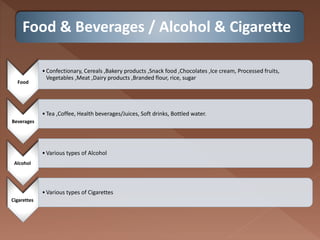
Food & Beverages / Alcohol & Cigarette
Food
•Confectionary, Cereals ,Bakery products ,Snack food ,Chocolates ,Ice cream, Processed fruits,
Vegetables ,Meat ,Dairy products ,Branded flour, rice, sugar
Beverages
•Tea ,Coffee, Health beverages/Juices, Soft drinks, Bottled water.
Alcohol
•Various types of Alcohol
Cigarettes
•Various types of Cigarettes
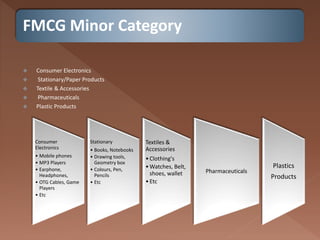
FMCG Minor Category
 Consumer Electronics
 Stationary/Paper Products
 Textile & Accessories
 Pharmaceuticals
 Plastic Products
Consumer
Electronics
• Mobile phones
• MP3 Players
• Earphone,
Headphones,
• OTG Cables, Game
Players
• Etc
Stationary
• Books, Notebooks
• Drawing tools,
Geometry box
• Colours, Pen,
Pencils
• Etc
Textiles &
Accessories
•Clothing's
•Watches, Belt,
shoes, wallet
•Etc
Pharmaceuticals
Plastics
Products
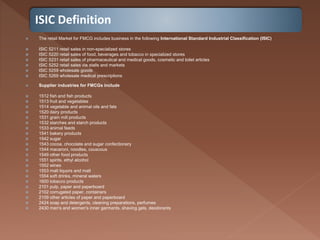
ISIC Definition
 The retail Market for FMCG includes business in the following International Standard Industrial Classification (ISIC)
 ISIC 5211 retail sales in non-specialized stores
 ISIC 5220 retail sales of food, beverages and tobacco in specialized stores
 ISIC 5231 retail sales of pharmaceutical and medical goods, cosmetic and toilet articles
 ISIC 5252 retail sales via stalls and markets
 ISIC 5259 wholesale goods
 ISIC 5269 wholesale medical prescriptions
 Supplier industries for FMCGs include
 1512 fish and fish products
 1513 fruit and vegetables
 1514 vegetable and animal oils and fats
 1520 dairy products
 1531 grain mill products
 1532 starches and starch products
 1533 animal feeds
 1541 bakery products
 1542 sugar
 1543 cocoa, chocolate and sugar confectionery
 1544 macaroni, noodles, couscous
 1549 other food products
 1551 spirits, ethyl alcohol
 1552 wines
 1553 malt liquors and malt
 1554 soft drinks, mineral waters
 1600 tobacco products
 2101 pulp, paper and paperboard
 2102 corrugated paper, containers
 2109 other articles of paper and paperboard
 2424 soap and detergents, cleaning preparations, perfumes
 2430 men's and women's inner garments, shaving gels, deodorants
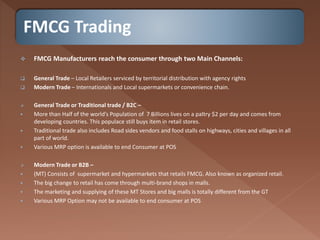
FMCG Trading
 FMCG Manufacturers reach the consumer through two Main Channels:
 General Trade – Local Retailers serviced by territorial distribution with agency rights
 Modern Trade – Internationals and Local supermarkets or convenience chain.
 General Trade or Traditional trade / B2C –
 More than Half of the world’s Population of 7 Billions lives on a paltry $2 per day and comes from
developing countries. This populace still buys item in retail stores.
 Traditional trade also includes Road sides vendors and food stalls on highways, cities and villages in all
part of world.
 Various MRP option is available to end Consumer at POS
 Modern Trade or B2B –
 (MT) Consists of supermarket and hypermarkets that retails FMCG. Also known as organized retail.
 The big change to retail has come through multi-brand shops in malls.
 The marketing and supplying of these MT Stores and big malls is totally different from the GT
 Various MRP Option may not be available to end consumer at POS
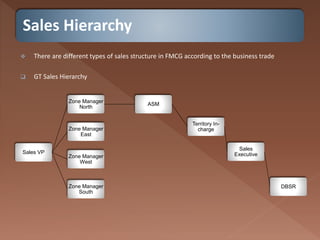
Sales Hierarchy
 There are different types of sales structure in FMCG according to the business trade
 GT Sales Hierarchy
Sales VP
Zone Manager
North
ASM
Territory In-
charge
Sales
Executive
DBSR
Zone Manager
East
Zone Manager
West
Zone Manager
South
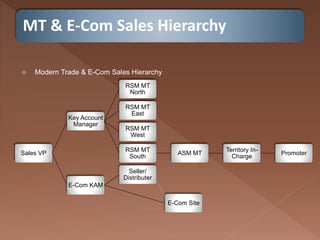
MT & E-Com Sales Hierarchy
 Modern Trade & E-Com Sales Hierarchy
Sales VP
Key Account
Manager
RSM MT
North
RSM MT
East
RSM MT
West
RSM MT
South
ASM MT
Territory In-
Charge
Promoter
E-Com KAM
Seller/
Distributer
E-Com Site
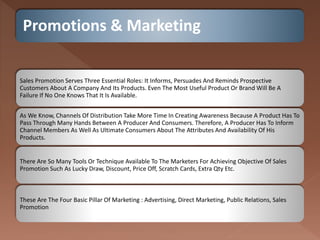
Promotions & Marketing
Sales Promotion Serves Three Essential Roles: It Informs, Persuades And Reminds Prospective
Customers About A Company And Its Products. Even The Most Useful Product Or Brand Will Be A
Failure If No One Knows That It Is Available.
As We Know, Channels Of Distribution Take More Time In Creating Awareness Because A Product Has To
Pass Through Many Hands Between A Producer And Consumers. Therefore, A Producer Has To Inform
Channel Members As Well As Ultimate Consumers About The Attributes And Availability Of His
Products.
There Are So Many Tools Or Technique Available To The Marketers For Achieving Objective Of Sales
Promotion Such As Lucky Draw, Discount, Price Off, Scratch Cards, Extra Qty Etc.
These Are The Four Basic Pillar Of Marketing : Advertising, Direct Marketing, Public Relations, Sales
Promotion
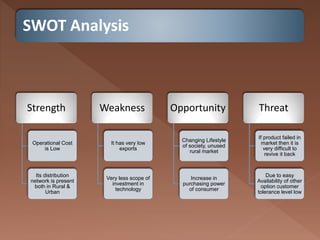
SWOT Analysis
Strength
Operational Cost
is Low
Its distribution
network is present
both in Rural &
Urban
Weakness
It has very low
exports
Very less scope of
investment in
technology
Opportunity
Changing Lifestyle
of society, unused
rural market
Increase in
purchasing power
of consumer
Threat
If product failed in
market then it is
very difficult to
revive it back
Due to easy
Availability of other
option customer
tolerance level low
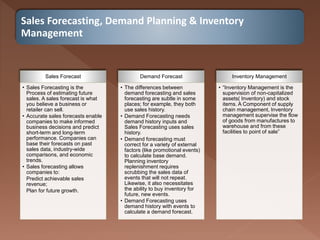
Sales Forecasting, Demand Planning & Inventory
Management
Sales Forecast
• Sales Forecasting is the
Process of estimating future
sales. A sales forecast is what
you believe a business or
retailer can sell.
• Accurate sales forecasts enable
companies to make informed
business decisions and predict
short-term and long-term
performance. Companies can
base their forecasts on past
sales data, industry-wide
comparisons, and economic
trends.
• Sales forecasting allows
companies to:
Predict achievable sales
revenue;
Plan for future growth.
Demand Forecast
• The differences between
demand forecasting and sales
forecasting are subtle in some
places; for example, they both
use sales history.
• Demand Forecasting needs
demand history inputs and
Sales Forecasting uses sales
history.
• Demand forecasting must
correct for a variety of external
factors (like promotional events)
to calculate base demand.
Planning inventory
replenishment requires
scrubbing the sales data of
events that will not repeat.
Likewise, it also necessitates
the ability to buy inventory for
future, new events.
• Demand Forecasting uses
demand history with events to
calculate a demand forecast.
Inventory Management
• “Inventory Management is the
supervision of non-capitalized
assets( Inventory) and stock
items. A Component of supply
chain management, Inventory
management supervise the flow
of goods from manufactures to
warehouse and from these
facilities to point of sale”
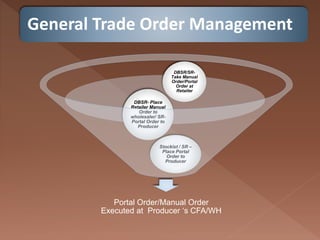
General Trade Order Management
Portal Order/Manual Order
Executed at Producer ‘s CFA/WH
Stockist / SR –
Place Portal
Order to
Producer
DBSR- Place
Retailer Manual
Order to
wholesaler/ SR-
Portal Order to
Producer
DBSR/SR-
Take Manual
Order/Portal
Order at
Retailer
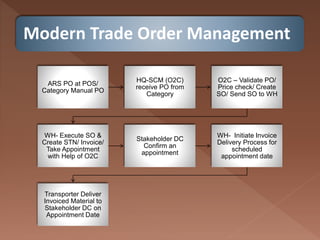
Modern Trade Order Management
ARS PO at POS/
Category Manual PO
HQ-SCM (O2C)
receive PO from
Category
O2C – Validate PO/
Price check/ Create
SO/ Send SO to WH
WH- Execute SO &
Create STN/ Invoice/
Take Appointment
with Help of O2C
Stakeholder DC
Confirm an
appointment
WH- Initiate Invoice
Delivery Process for
scheduled
appointment date
Transporter Deliver
Invoiced Material to
Stakeholder DC on
Appointment Date
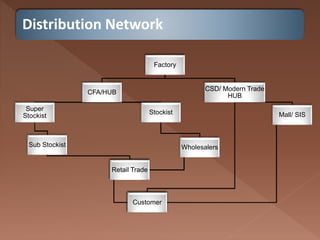
Distribution Network
Factory
CFA/HUB
Stockist
Wholesalers
Retail TradeRetail Trade
Super
Stockist
Sub Stockist
Retail Trade
Customer
CSD/ Modern Trade
HUB
Customer
Mall/ SIS
Customer
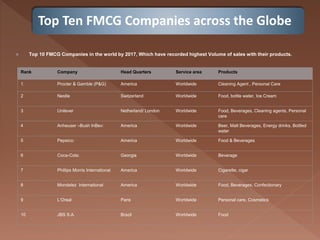
Top Ten FMCG Companies across the Globe
 Top 10 FMCG Companies in the world by 2017, Which have recorded highest Volume of sales with their products.
Rank Company Head Quarters Service area Products
1. Procter & Gamble (P&G) America Worldwide Cleaning Agent , Personal Care
2 Nestle Switzerland Worldwide Food, bottle water, Ice Cream
3 Unilever Netherland/ London Worldwide Food, Beverages, Cleaning agents, Personal
care
4 Anheuser –Bush InBev: America Worldwide Beer, Malt Beverages, Energy drinks, Bottled
water
5 Pepsico: America Worldwide Food & Beverages
6 Coca-Cola: Georgia Worldwide Beverage
7 Phillips Morris International America Worldwide Cigarette, cigar
8 Mondelez International America Worldwide Food, Beverages, Confectionary
9 L’Oreal Paris Worldwide Personal care, Cosmetics
10 JBS S.A. Brazil Worldwide Food
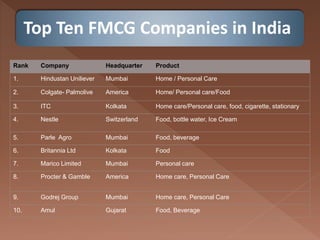
Top Ten FMCG Companies in India
Rank Company Headquarter Product
1. Hindustan Uniliever Mumbai Home / Personal Care
2. Colgate- Palmolive America Home/ Personal care/Food
3. ITC Kolkata Home care/Personal care, food, cigarette, stationary
4. Nestle Switzerland Food, bottle water, Ice Cream
5. Parle Agro Mumbai Food, beverage
6. Britannia Ltd Kolkata Food
7. Marico Limited Mumbai Personal care
8. Procter & Gamble America Home care, Personal Care
9. Godrej Group Mumbai Home care, Personal Care
10. Amul Gujarat Food, Beverage
Thank You

Kumar FMCG

  • 1.
  • 2.
    Contents Introduction The Facts about the FMCG Industry FMCGChart FMCG Trading Channel Sales Hierarchy Promotion & Marketing. SWOT Forecasting & Planning Order Management Distribution Network & Planning
  • 3.
    Facts about FMCGIndustry FMCG Is the Largest sector in the Indian Economy Growing Awareness, easier access and Changing Lifestyle have been the key growth drivers for the sector. Retail Market in India is estimated to reach USD 1 Trillion by 2020 with Modern trade to grow at 20% Per annum this is likely to boost revenues of FMCG Companies. The FMCG Sector in India generated revenues worth USD 49.03 Billion in 2016 Asia Drives Growth for Global FMCG Brands Asia Contributed the most Purchasing power among Households China, India and Indonesia are the Biggest Contributors of Global Growth
  • 4.
    Introduction : Startingfrom One Cup of Coffee in the morning right up to that relaxing Malt Beverage at Night, we rely heavily on FMCG  FMCG – FAST MOVING CONSUMER GOODS  FMCG, otherwise known as CPG(Consumer packaged goods), is one of the biggest industry in the world  Fast – Moving Consumer goods refers to consumer non- durable goods required for daily or frequent use. Products those are get replaced within a year.  FMCG, generally Include a wide range of frequently purchased consumer products such as Home care/ Personal care, Food & Beverages, Alcohol, Cigarette and other non – durable items like as glassware, Consumer Electronics, Pharmaceuticals, Paper Products and Plastic goods.  FMCG Companies have huge market to target, but often companies faces different challenges in different countries to capture true market values.  The Success of FMCG Depends greatly on its Marketing strategy  FMCG is characterized by a well established network and Intense competition between the Organized and unorganized segments
  • 5.
    FMCG Categories FMCG MajorCategory Home/Personal Care Food/ Beverages Cigarettes Alcohol FMCG Minor Category • Consumer Electronics • Stationary • Clothing & Accessories • Plastic Goods • Paper Products • Pharmaceuticals
  • 6.
    Home Care &Personal Care  Home Care - It can be divided into the following categories  Fabric wash - Laundry soaps and Synthetic detergents etc.  Household cleaners - Dish/utensil cleaners, floor cleaners, Toilet cleaners, Air fresheners, Insecticides and Mosquito repellents, etc.  Personal Care - It can be divided into the following categories  Oral Care  Skin Care  Hair Care  Personal Wash  Cosmetics and Toiletries  Talcum  Deodorants  Perfumes  Paper Products ( Tissue, Diapers, sanitary)  Shoe Care Home/ Personal Care Home Care •Fabric Wash •Household Cleaner Personal Care •Oral Care, Skin Care, Hair Care, Personal Wash, Cosmetics & Toiletries, Talcum, Deodorants, Perfumes, Paper Product, Shoe Care
  • 7.
    Food & Beverages/ Alcohol & Cigarette Food •Confectionary, Cereals ,Bakery products ,Snack food ,Chocolates ,Ice cream, Processed fruits, Vegetables ,Meat ,Dairy products ,Branded flour, rice, sugar Beverages •Tea ,Coffee, Health beverages/Juices, Soft drinks, Bottled water. Alcohol •Various types of Alcohol Cigarettes •Various types of Cigarettes
  • 8.
    FMCG Minor Category Consumer Electronics  Stationary/Paper Products  Textile & Accessories  Pharmaceuticals  Plastic Products Consumer Electronics • Mobile phones • MP3 Players • Earphone, Headphones, • OTG Cables, Game Players • Etc Stationary • Books, Notebooks • Drawing tools, Geometry box • Colours, Pen, Pencils • Etc Textiles & Accessories •Clothing's •Watches, Belt, shoes, wallet •Etc Pharmaceuticals Plastics Products
  • 9.
    ISIC Definition  Theretail Market for FMCG includes business in the following International Standard Industrial Classification (ISIC)  ISIC 5211 retail sales in non-specialized stores  ISIC 5220 retail sales of food, beverages and tobacco in specialized stores  ISIC 5231 retail sales of pharmaceutical and medical goods, cosmetic and toilet articles  ISIC 5252 retail sales via stalls and markets  ISIC 5259 wholesale goods  ISIC 5269 wholesale medical prescriptions  Supplier industries for FMCGs include  1512 fish and fish products  1513 fruit and vegetables  1514 vegetable and animal oils and fats  1520 dairy products  1531 grain mill products  1532 starches and starch products  1533 animal feeds  1541 bakery products  1542 sugar  1543 cocoa, chocolate and sugar confectionery  1544 macaroni, noodles, couscous  1549 other food products  1551 spirits, ethyl alcohol  1552 wines  1553 malt liquors and malt  1554 soft drinks, mineral waters  1600 tobacco products  2101 pulp, paper and paperboard  2102 corrugated paper, containers  2109 other articles of paper and paperboard  2424 soap and detergents, cleaning preparations, perfumes  2430 men's and women's inner garments, shaving gels, deodorants
  • 10.
    FMCG Trading  FMCGManufacturers reach the consumer through two Main Channels:  General Trade – Local Retailers serviced by territorial distribution with agency rights  Modern Trade – Internationals and Local supermarkets or convenience chain.  General Trade or Traditional trade / B2C –  More than Half of the world’s Population of 7 Billions lives on a paltry $2 per day and comes from developing countries. This populace still buys item in retail stores.  Traditional trade also includes Road sides vendors and food stalls on highways, cities and villages in all part of world.  Various MRP option is available to end Consumer at POS  Modern Trade or B2B –  (MT) Consists of supermarket and hypermarkets that retails FMCG. Also known as organized retail.  The big change to retail has come through multi-brand shops in malls.  The marketing and supplying of these MT Stores and big malls is totally different from the GT  Various MRP Option may not be available to end consumer at POS
  • 11.
    Sales Hierarchy  Thereare different types of sales structure in FMCG according to the business trade  GT Sales Hierarchy Sales VP Zone Manager North ASM Territory In- charge Sales Executive DBSR Zone Manager East Zone Manager West Zone Manager South
  • 12.
    MT & E-ComSales Hierarchy  Modern Trade & E-Com Sales Hierarchy Sales VP Key Account Manager RSM MT North RSM MT East RSM MT West RSM MT South ASM MT Territory In- Charge Promoter E-Com KAM Seller/ Distributer E-Com Site
  • 13.
    Promotions & Marketing SalesPromotion Serves Three Essential Roles: It Informs, Persuades And Reminds Prospective Customers About A Company And Its Products. Even The Most Useful Product Or Brand Will Be A Failure If No One Knows That It Is Available. As We Know, Channels Of Distribution Take More Time In Creating Awareness Because A Product Has To Pass Through Many Hands Between A Producer And Consumers. Therefore, A Producer Has To Inform Channel Members As Well As Ultimate Consumers About The Attributes And Availability Of His Products. There Are So Many Tools Or Technique Available To The Marketers For Achieving Objective Of Sales Promotion Such As Lucky Draw, Discount, Price Off, Scratch Cards, Extra Qty Etc. These Are The Four Basic Pillar Of Marketing : Advertising, Direct Marketing, Public Relations, Sales Promotion
  • 14.
    SWOT Analysis Strength Operational Cost isLow Its distribution network is present both in Rural & Urban Weakness It has very low exports Very less scope of investment in technology Opportunity Changing Lifestyle of society, unused rural market Increase in purchasing power of consumer Threat If product failed in market then it is very difficult to revive it back Due to easy Availability of other option customer tolerance level low
  • 15.
    Sales Forecasting, DemandPlanning & Inventory Management Sales Forecast • Sales Forecasting is the Process of estimating future sales. A sales forecast is what you believe a business or retailer can sell. • Accurate sales forecasts enable companies to make informed business decisions and predict short-term and long-term performance. Companies can base their forecasts on past sales data, industry-wide comparisons, and economic trends. • Sales forecasting allows companies to: Predict achievable sales revenue; Plan for future growth. Demand Forecast • The differences between demand forecasting and sales forecasting are subtle in some places; for example, they both use sales history. • Demand Forecasting needs demand history inputs and Sales Forecasting uses sales history. • Demand forecasting must correct for a variety of external factors (like promotional events) to calculate base demand. Planning inventory replenishment requires scrubbing the sales data of events that will not repeat. Likewise, it also necessitates the ability to buy inventory for future, new events. • Demand Forecasting uses demand history with events to calculate a demand forecast. Inventory Management • “Inventory Management is the supervision of non-capitalized assets( Inventory) and stock items. A Component of supply chain management, Inventory management supervise the flow of goods from manufactures to warehouse and from these facilities to point of sale”
  • 16.
    General Trade OrderManagement Portal Order/Manual Order Executed at Producer ‘s CFA/WH Stockist / SR – Place Portal Order to Producer DBSR- Place Retailer Manual Order to wholesaler/ SR- Portal Order to Producer DBSR/SR- Take Manual Order/Portal Order at Retailer
  • 17.
    Modern Trade OrderManagement ARS PO at POS/ Category Manual PO HQ-SCM (O2C) receive PO from Category O2C – Validate PO/ Price check/ Create SO/ Send SO to WH WH- Execute SO & Create STN/ Invoice/ Take Appointment with Help of O2C Stakeholder DC Confirm an appointment WH- Initiate Invoice Delivery Process for scheduled appointment date Transporter Deliver Invoiced Material to Stakeholder DC on Appointment Date
  • 18.
    Distribution Network Factory CFA/HUB Stockist Wholesalers Retail TradeRetailTrade Super Stockist Sub Stockist Retail Trade Customer CSD/ Modern Trade HUB Customer Mall/ SIS Customer
  • 19.
    Top Ten FMCGCompanies across the Globe  Top 10 FMCG Companies in the world by 2017, Which have recorded highest Volume of sales with their products. Rank Company Head Quarters Service area Products 1. Procter & Gamble (P&G) America Worldwide Cleaning Agent , Personal Care 2 Nestle Switzerland Worldwide Food, bottle water, Ice Cream 3 Unilever Netherland/ London Worldwide Food, Beverages, Cleaning agents, Personal care 4 Anheuser –Bush InBev: America Worldwide Beer, Malt Beverages, Energy drinks, Bottled water 5 Pepsico: America Worldwide Food & Beverages 6 Coca-Cola: Georgia Worldwide Beverage 7 Phillips Morris International America Worldwide Cigarette, cigar 8 Mondelez International America Worldwide Food, Beverages, Confectionary 9 L’Oreal Paris Worldwide Personal care, Cosmetics 10 JBS S.A. Brazil Worldwide Food
  • 20.
    Top Ten FMCGCompanies in India Rank Company Headquarter Product 1. Hindustan Uniliever Mumbai Home / Personal Care 2. Colgate- Palmolive America Home/ Personal care/Food 3. ITC Kolkata Home care/Personal care, food, cigarette, stationary 4. Nestle Switzerland Food, bottle water, Ice Cream 5. Parle Agro Mumbai Food, beverage 6. Britannia Ltd Kolkata Food 7. Marico Limited Mumbai Personal care 8. Procter & Gamble America Home care, Personal Care 9. Godrej Group Mumbai Home care, Personal Care 10. Amul Gujarat Food, Beverage
  • 21.