Network policy
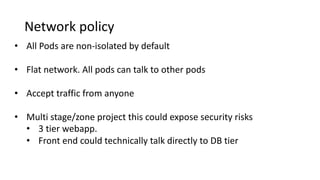
• All Pods are non-isolated by default
• Flat network. All pods can talk to other pods
• Accept traffic from anyone
• Multi stage/zone project this could expose security risks
• 3 tier webapp.
• Front end could technically talk directly to DB tier
Azure Kubernetes Network Policies
• Provides micro-segmentation for containers –
like NSGs for VMs
• Label-based selection of Pods
• Policy resource yaml file specifies Ingress and
Egress policies
• Policies defined for a label
• Works in conjunction with Azure CNI
• Supports Linux hosts
• Supported in aks-engine
• Set networkPolicy setting to azure in cluster
definition file
• Supported on AKS in Preview
Azure Policy
Manager
Azure Policy
Manager
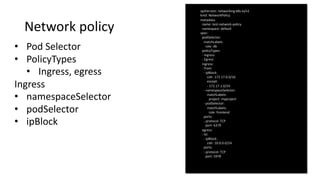
Network policy
• Pod Selector
• PolicyTypes
• Ingress, egress
Ingress
• namespaceSelector
• podSelector
• ipBlock
apiVersion: networking.k8s.io/v1
kind: NetworkPolicy
metadata:
name: test-network-policy
namespace: default
spec:
podSelector:
matchLabels:
role: db
policyTypes:
- Ingress
- Egress
ingress:
- from:
- ipBlock:
cidr: 172.17.0.0/16
except:
- 172.17.1.0/24
- namespaceSelector:
matchLabels:
project: myproject
- podSelector:
matchLabels:
role: frontend
ports:
- protocol: TCP
port: 6379
egress:
- to:
- ipBlock:
cidr: 10.0.0.0/24
ports:
- protocol: TCP
port: 5978
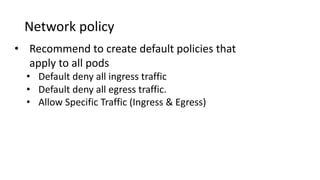
Network policy
• Recommend to create default policies that
apply to all pods
• Default deny all ingress traffic
• Default deny all egress traffic.
• Allow Specific Traffic (Ingress & Egress)
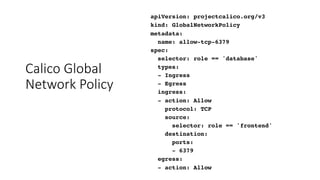
Calico Global
Network Policy
apiVersion: projectcalico.org/v3
kind: GlobalNetworkPolicy
metadata:
name: allow-tcp-6379
spec:
selector: role == 'database'
types:
- Ingress
- Egress
ingress:
- action: Allow
protocol: TCP
source:
selector: role == 'frontend'
destination:
ports:
- 6379
egress:
- action: Allow
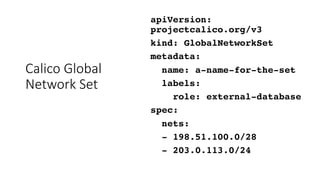
Calico Global
Network Set
apiVersion:
projectcalico.org/v3
kind: GlobalNetworkSet
metadata:
name: a-name-for-the-set
labels:
role: external-database
spec:
nets:
- 198.51.100.0/28
- 203.0.113.0/24
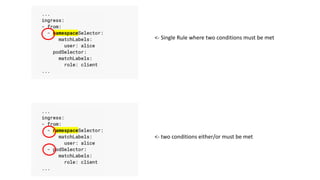
<- Single Rule where two conditions must be met
<- two conditions either/or must be met
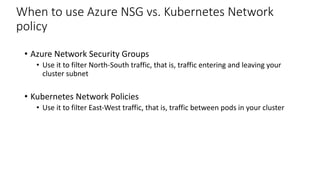
When to use Azure NSG vs. Kubernetes Network
policy
• Azure Network Security Groups
• Use it to filter North-South traffic, that is, traffic entering and leaving your
cluster subnet
• Kubernetes Network Policies
• Use it to filter East-West traffic, that is, traffic between pods in your cluster
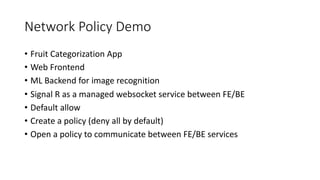
Network Policy Demo
• Fruit Categorization App
• Web Frontend
• ML Backend for image recognition
• Signal R as a managed websocket service between FE/BE
• Default allow
• Create a policy (deny all by default)
• Open a policy to communicate between FE/BE services
Open Policy Agent
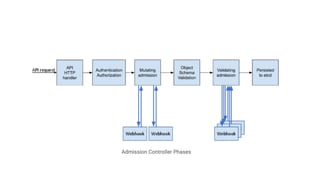
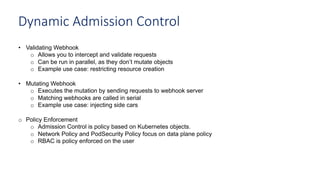
Dynamic Admission Control
• Validating Webhook
o Allows you to intercept and validate requests
o Can be run in parallel, as they don’t mutate objects
o Example use case: restricting resource creation
• Mutating Webhook
o Executes the mutation by sending requests to webhook server
o Matching webhooks are called in serial
o Example use case: injecting side cars
o Policy Enforcement
o Admission Control is policy based on Kubernetes objects.
o Network Policy and PodSecurity Policy focus on data plane policy
o RBAC is policy enforced on the user
That’s awesome! But…
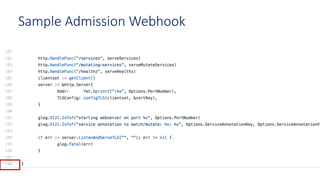
Sample Admission Webhook
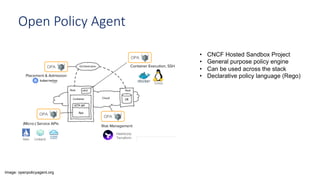
Open Policy Agent
Image: openpolicyagent.org
• CNCF Hosted Sandbox Project
• General purpose policy engine
• Can be used across the stack
• Declarative policy language (Rego)
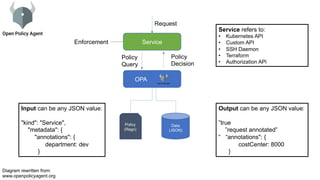
Service refers to:
• Kubernetes API
• Custom API
• SSH Daemon
• Terraform
• Authorization APi
Output can be any JSON value:
”true
”request annotated”
“ “annotations": {
costCenter: 8000
}
Input can be any JSON value:
"kind": "Service",
"metadata": {
"annotations": {
department: dev
}
Service
OPA
Policy
(Rego)
Data
(JSON)
Request
Enforcement
Policy
Query
Policy
Decision
Diagram rewritten from:
www.openpolicyagent.org
Example Rego Policy
• Rego is a policy language and not a programing language, so don’t think about sockets, methods, binary
trees, etc.
• Think about two things: Logic and Data
• Rego logic is all queries. A query finds values for variables that make boolean conditions true.
• You write logic to search and combine JSON/YAML data from different sources.
deny[{
"id": "conditional-annotation",
"resource": {"kind": kind, "namespace": namespace, "name": name},
"resolution": {"patches": p, "message" : "conditional annotation"}, }] {
matches[[kind, namespace, name, matched_object]] matched_object.metadata.annotations[”Mr-T"]
p = [{"op": "add", "path": "/metadata/annotations/cost-center", "value": ”A-Team"}] }
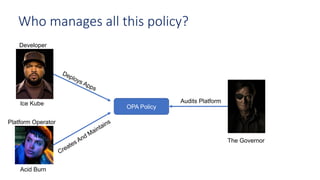
Who manages all this policy?
Ice Kube
Acid Burn
The Governor
Platform Operator
Developer
OPA Policy
Creates And Maintains
Deploys Apps
Audits Platform
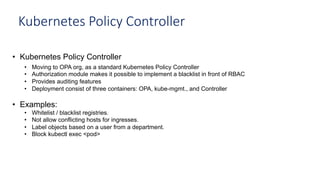
Kubernetes Policy Controller
• Kubernetes Policy Controller
• Moving to OPA org, as a standard Kubernetes Policy Controller
• Authorization module makes it possible to implement a blacklist in front of RBAC
• Provides auditing features
• Deployment consist of three containers: OPA, kube-mgmt., and Controller
• Examples:
• Whitelist / blacklist registries.
• Not allow conflicting hosts for ingresses.
• Label objects based on a user from a department.
• Block kubectl exec <pod>
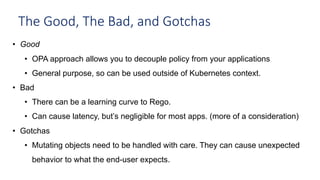
The Good, The Bad, and Gotchas
• Good
• OPA approach allows you to decouple policy from your applications
• General purpose, so can be used outside of Kubernetes context.
• Bad
• There can be a learning curve to Rego.
• Can cause latency, but’s negligible for most apps. (more of a consideration)
• Gotchas
• Mutating objects need to be handled with care. They can cause unexpected
behavior to what the end-user expects.
Takeaways
• Focus on security is a must in any Kubernetes deployment.
• Help educate Security Teams on how to extend Kubernetes to integrate custom
policies.
• Treat the Kubernetes cluster as immutable, just like you do with applications.
• Multiple ways to accomplish policy
• Build all your own logic and utilize dynamic admission control
• Utilize Open Policy Agent to simplify deployment and logic for rule sets.
Example Policies
• https://github.com/open-policy-agent/contrib

Kubernetes Security with Calico and Open Policy Agent

  • 2.
    Network policy • AllPods are non-isolated by default • Flat network. All pods can talk to other pods • Accept traffic from anyone • Multi stage/zone project this could expose security risks • 3 tier webapp. • Front end could technically talk directly to DB tier
  • 3.
    Azure Kubernetes NetworkPolicies • Provides micro-segmentation for containers – like NSGs for VMs • Label-based selection of Pods • Policy resource yaml file specifies Ingress and Egress policies • Policies defined for a label • Works in conjunction with Azure CNI • Supports Linux hosts • Supported in aks-engine • Set networkPolicy setting to azure in cluster definition file • Supported on AKS in Preview Azure Policy Manager Azure Policy Manager
  • 4.
    Network policy • PodSelector • PolicyTypes • Ingress, egress Ingress • namespaceSelector • podSelector • ipBlock apiVersion: networking.k8s.io/v1 kind: NetworkPolicy metadata: name: test-network-policy namespace: default spec: podSelector: matchLabels: role: db policyTypes: - Ingress - Egress ingress: - from: - ipBlock: cidr: 172.17.0.0/16 except: - 172.17.1.0/24 - namespaceSelector: matchLabels: project: myproject - podSelector: matchLabels: role: frontend ports: - protocol: TCP port: 6379 egress: - to: - ipBlock: cidr: 10.0.0.0/24 ports: - protocol: TCP port: 5978
  • 5.
    Network policy • Recommendto create default policies that apply to all pods • Default deny all ingress traffic • Default deny all egress traffic. • Allow Specific Traffic (Ingress & Egress)
  • 6.
    Calico Global Network Policy apiVersion:projectcalico.org/v3 kind: GlobalNetworkPolicy metadata: name: allow-tcp-6379 spec: selector: role == 'database' types: - Ingress - Egress ingress: - action: Allow protocol: TCP source: selector: role == 'frontend' destination: ports: - 6379 egress: - action: Allow
  • 7.
    Calico Global Network Set apiVersion: projectcalico.org/v3 kind:GlobalNetworkSet metadata: name: a-name-for-the-set labels: role: external-database spec: nets: - 198.51.100.0/28 - 203.0.113.0/24
  • 8.
    <- Single Rulewhere two conditions must be met <- two conditions either/or must be met
  • 9.
    When to useAzure NSG vs. Kubernetes Network policy • Azure Network Security Groups • Use it to filter North-South traffic, that is, traffic entering and leaving your cluster subnet • Kubernetes Network Policies • Use it to filter East-West traffic, that is, traffic between pods in your cluster
  • 10.
    Network Policy Demo •Fruit Categorization App • Web Frontend • ML Backend for image recognition • Signal R as a managed websocket service between FE/BE • Default allow • Create a policy (deny all by default) • Open a policy to communicate between FE/BE services
  • 11.
  • 13.
    Dynamic Admission Control •Validating Webhook o Allows you to intercept and validate requests o Can be run in parallel, as they don’t mutate objects o Example use case: restricting resource creation • Mutating Webhook o Executes the mutation by sending requests to webhook server o Matching webhooks are called in serial o Example use case: injecting side cars o Policy Enforcement o Admission Control is policy based on Kubernetes objects. o Network Policy and PodSecurity Policy focus on data plane policy o RBAC is policy enforced on the user
  • 14.
  • 15.
  • 16.
    Open Policy Agent Image:openpolicyagent.org • CNCF Hosted Sandbox Project • General purpose policy engine • Can be used across the stack • Declarative policy language (Rego)
  • 17.
    Service refers to: •Kubernetes API • Custom API • SSH Daemon • Terraform • Authorization APi Output can be any JSON value: ”true ”request annotated” “ “annotations": { costCenter: 8000 } Input can be any JSON value: "kind": "Service", "metadata": { "annotations": { department: dev } Service OPA Policy (Rego) Data (JSON) Request Enforcement Policy Query Policy Decision Diagram rewritten from: www.openpolicyagent.org
  • 18.
    Example Rego Policy •Rego is a policy language and not a programing language, so don’t think about sockets, methods, binary trees, etc. • Think about two things: Logic and Data • Rego logic is all queries. A query finds values for variables that make boolean conditions true. • You write logic to search and combine JSON/YAML data from different sources. deny[{ "id": "conditional-annotation", "resource": {"kind": kind, "namespace": namespace, "name": name}, "resolution": {"patches": p, "message" : "conditional annotation"}, }] { matches[[kind, namespace, name, matched_object]] matched_object.metadata.annotations[”Mr-T"] p = [{"op": "add", "path": "/metadata/annotations/cost-center", "value": ”A-Team"}] }
  • 19.
    Who manages allthis policy? Ice Kube Acid Burn The Governor Platform Operator Developer OPA Policy Creates And Maintains Deploys Apps Audits Platform
  • 20.
    Kubernetes Policy Controller •Kubernetes Policy Controller • Moving to OPA org, as a standard Kubernetes Policy Controller • Authorization module makes it possible to implement a blacklist in front of RBAC • Provides auditing features • Deployment consist of three containers: OPA, kube-mgmt., and Controller • Examples: • Whitelist / blacklist registries. • Not allow conflicting hosts for ingresses. • Label objects based on a user from a department. • Block kubectl exec <pod>
  • 21.
    The Good, TheBad, and Gotchas • Good • OPA approach allows you to decouple policy from your applications • General purpose, so can be used outside of Kubernetes context. • Bad • There can be a learning curve to Rego. • Can cause latency, but’s negligible for most apps. (more of a consideration) • Gotchas • Mutating objects need to be handled with care. They can cause unexpected behavior to what the end-user expects.
  • 22.
    Takeaways • Focus onsecurity is a must in any Kubernetes deployment. • Help educate Security Teams on how to extend Kubernetes to integrate custom policies. • Treat the Kubernetes cluster as immutable, just like you do with applications. • Multiple ways to accomplish policy • Build all your own logic and utilize dynamic admission control • Utilize Open Policy Agent to simplify deployment and logic for rule sets.
  • 23.