12/8/2019 1Dev Prasad Pandit
2
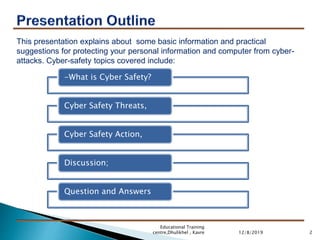
This presentation explains about some basic information and practical
suggestions for protecting your personal information and computer from cyber-
attacks. Cyber-safety topics covered include:
-What is Cyber Safety?
Cyber Safety Threats,
Cyber Safety Action,
Discussion;
Question and Answers
12/8/2019
Educational Training
centre,Dhulikhel , Kavre
3
 Cyber-safety is a common term used to describe a set
of practices, measures and/or actions you can take to
protect personal information and your computer
systems from attacks.
12/8/2019
Educational Training
centre,Dhulikhel , Kavre
 Information security means protecting
information and information systems from
unauthorized access, use, disclosure,
disruption, modification or destruction.
 Information Security is not just technology, It
is a process, a policy, and a culture.
12/8/2019 4
Educational Training
centre,Dhulikhel , Kavre
5
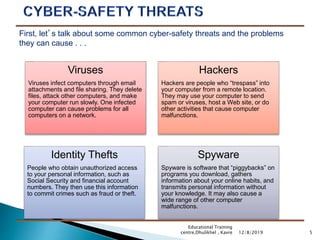
Viruses
Viruses infect computers through email
attachments and file sharing. They delete
files, attack other computers, and make
your computer run slowly. One infected
computer can cause problems for all
computers on a network.
Hackers
Hackers are people who “trespass” into
your computer from a remote location.
They may use your computer to send
spam or viruses, host a Web site, or do
other activities that cause computer
malfunctions.
Identity Thefts
People who obtain unauthorized access
to your personal information, such as
Social Security and financial account
numbers. They then use this information
to commit crimes such as fraud or theft.
Spyware
Spyware is software that “piggybacks” on
programs you download, gathers
information about your online habits, and
transmits personal information without
your knowledge. It may also cause a
wide range of other computer
malfunctions.
First, let’s talk about some common cyber-safety threats and the problems
they can cause . . .
12/8/2019
Educational Training
centre,Dhulikhel , Kavre
 The following slides describe the top seven actions you can take to protect
personal information and your computer.
 By implementing all seven of these security measures, you will protect
yourself, others, and your computer from many common threats.
 In most cases, implementing each of these security measures will only take
a few minutes.
612/8/2019
Educational Training
centre,Dhulikhel , Kavre
7
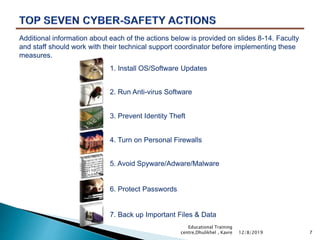
1. Install OS/Software Updates
2. Run Anti-virus Software
3. Prevent Identity Theft
4. Turn on Personal Firewalls
5. Avoid Spyware/Adware/Malware
7. Back up Important Files & Data
Additional information about each of the actions below is provided on slides 8-14. Faculty
and staff should work with their technical support coordinator before implementing these
measures.
6. Protect Passwords
12/8/2019
Educational Training
centre,Dhulikhel , Kavre
 Updates-sometimes called patches-fix problems with your operating
system (OS) (e.g., Windows XP, Windows Vista, Mac OS X) and
software programs (e.g., Microsoft Office applications).
 Most new operating systems are set to download updates by default.
After updates are downloaded, you will be asked to install them. Click
yes!
 Be sure to restart your computer after updates are installed so that the
patches can be applied immediately.
812/8/2019
Educational Training
centre,Dhulikhel , Kavre
9
 To avoid computer problems caused by viruses, install and run an anti-virus
program
 Periodically, check to see if your anti-virus is up to date by opening your anti-
virus program and checking the Last updated: date.
 Anti-virus software removes viruses, quarantines and repairs infected files,
and can help prevent future viruses.
12/8/2019
Educational Training
centre,Dhulikhel , Kavre
10
 Don't give out financial account numbers, Social Security numbers, driver’s license
numbers or other personal identity information unless you know exactly who's receiving
it. Protect others people’s information as you would your own.
 Never send personal or confidential information via email or instant messages as these
can be easily intercepted.
 Beware of phishing scams - a form of fraud that uses email messages that appear to be
from a reputable business (often a financial institution) in an attempt to gain personal or
account information. These often do not include a personal salutation. Never enter
personal information into an online form you accessed via a link in an email you were
not expecting. Legitimate businesses will not ask for personal information online.
12/8/2019
Educational Training
centre,Dhulikhel , Kavre
 Check your computer's security settings for a built-in personal firewall. If you have
one, turn it on. Microsoft Vista and Mac OSX have built-in firewalls. For more
information.
 Firewalls act as protective barriers between computers and the internet.
 Hackers search the Internet by sending out pings (calls) to random computers and
wait for responses. Firewalls prevent your computer from responding to these calls.
1112/8/2019
Educational Training
centre,Dhulikhel , Kavre
12
 Spyware and adware take up memory and can slow down your computer or
cause other problems.
 Use Spybot and Ad-Aware to remove spyware/adware from your computer.
UC Davis students, faculty and staff can get Spybot and Ad-Aware for free on
the Internet Tools CD (available from IT Express in Shields Library).
 Watch for allusions to spyware and adware in user agreements before
installing free software programs.
 Be wary of invitations to download software from unknown internet sources.
12/8/2019
Educational Training
centre,Dhulikhel , Kavre
13
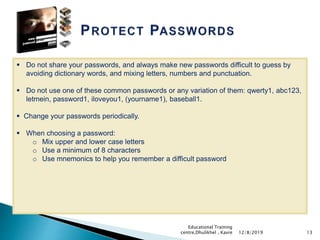
 Do not share your passwords, and always make new passwords difficult to guess by
avoiding dictionary words, and mixing letters, numbers and punctuation.
 Do not use one of these common passwords or any variation of them: qwerty1, abc123,
letmein, password1, iloveyou1, (yourname1), baseball1.
 Change your passwords periodically.
 When choosing a password:
o Mix upper and lower case letters
o Use a minimum of 8 characters
o Use mnemonics to help you remember a difficult password
12/8/2019
Educational Training
centre,Dhulikhel , Kavre
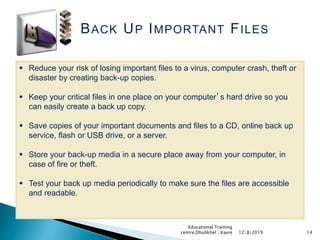
BACK UP IMPORTANT FILES
 Reduce your risk of losing important files to a virus, computer crash, theft or
disaster by creating back-up copies.
 Keep your critical files in one place on your computer’s hard drive so you
can easily create a back up copy.
 Save copies of your important documents and files to a CD, online back up
service, flash or USB drive, or a server.
 Store your back-up media in a secure place away from your computer, in
case of fire or theft.
 Test your back up media periodically to make sure the files are accessible
and readable.
1412/8/2019
Educational Training
centre,Dhulikhel , Kavre
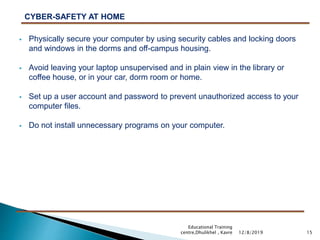
 Physically secure your computer by using security cables and locking doors
and windows in the dorms and off-campus housing.
 Avoid leaving your laptop unsupervised and in plain view in the library or
coffee house, or in your car, dorm room or home.
 Set up a user account and password to prevent unauthorized access to your
computer files.
 Do not install unnecessary programs on your computer.
15
CYBER-SAFETY AT HOME
12/8/2019
Educational Training
centre,Dhulikhel , Kavre
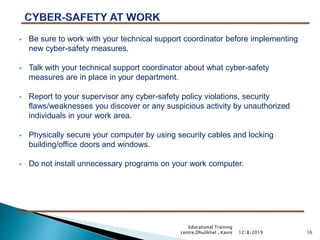
 Be sure to work with your technical support coordinator before implementing
new cyber-safety measures.
 Talk with your technical support coordinator about what cyber-safety
measures are in place in your department.
 Report to your supervisor any cyber-safety policy violations, security
flaws/weaknesses you discover or any suspicious activity by unauthorized
individuals in your work area.
 Physically secure your computer by using security cables and locking
building/office doors and windows.
 Do not install unnecessary programs on your work computer.
1612/8/2019
Educational Training
centre,Dhulikhel , Kavre
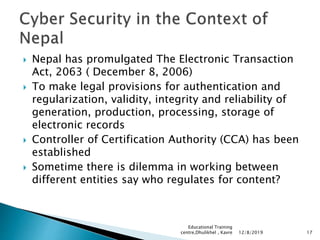
 Nepal has promulgated The Electronic Transaction
Act, 2063 ( December 8, 2006)
 To make legal provisions for authentication and
regularization, validity, integrity and reliability of
generation, production, processing, storage of
electronic records
 Controller of Certification Authority (CCA) has been
established
 Sometime there is dilemma in working between
different entities say who regulates for content?
1712/8/2019
Educational Training
centre,Dhulikhel , Kavre
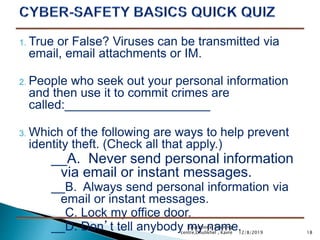
1. True or False? Viruses can be transmitted via
email, email attachments or IM.
2. People who seek out your personal information
and then use it to commit crimes are
called:_____________________
3. Which of the following are ways to help prevent
identity theft. (Check all that apply.)
__A. Never send personal information
via email or instant messages.
__B. Always send personal information via
email or instant messages.
__C. Lock my office door.
__D. Don’t tell anybody my name. 1812/8/2019
Educational Training
centre,Dhulikhel , Kavre
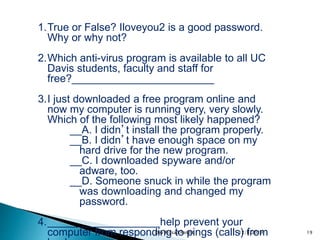
1.True or False? Iloveyou2 is a good password.
Why or why not?
2.Which anti-virus program is available to all UC
Davis students, faculty and staff for
free?________________________
3.I just downloaded a free program online and
now my computer is running very, very slowly.
Which of the following most likely happened?
__A. I didn’t install the program properly.
__B. I didn’t have enough space on my
hard drive for the new program.
__C. I downloaded spyware and/or
adware, too.
__D. Someone snuck in while the program
was downloading and changed my
password.
4.___________________help prevent your
computer from responding to pings (calls) from12/8/2019 19Dev Prasad Pandit
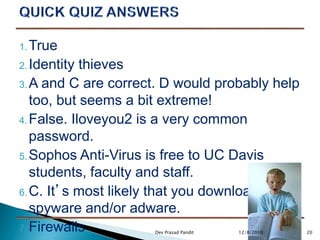
1. True
2. Identity thieves
3. A and C are correct. D would probably help
too, but seems a bit extreme!
4. False. Iloveyou2 is a very common
password.
5. Sophos Anti-Virus is free to UC Davis
students, faculty and staff.
6. C. It’s most likely that you downloaded
spyware and/or adware.
7. Firewalls 2012/8/2019Dev Prasad Pandit
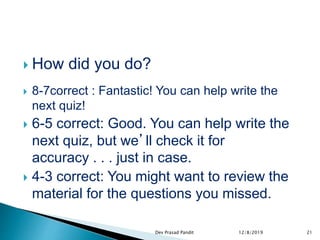
 How did you do?
 8-7correct : Fantastic! You can help write the
next quiz!
 6-5 correct: Good. You can help write the
next quiz, but we’ll check it for
accuracy . . . just in case.
 4-3 correct: You might want to review the
material for the questions you missed.
12/8/2019 21Dev Prasad Pandit
Thank you
Q & A
12/8/2019 22Dev Prasad Pandit

Krishna cyber safety

  • 1.
  • 2.
    2 This presentation explainsabout some basic information and practical suggestions for protecting your personal information and computer from cyber- attacks. Cyber-safety topics covered include: -What is Cyber Safety? Cyber Safety Threats, Cyber Safety Action, Discussion; Question and Answers 12/8/2019 Educational Training centre,Dhulikhel , Kavre
  • 3.
    3  Cyber-safety isa common term used to describe a set of practices, measures and/or actions you can take to protect personal information and your computer systems from attacks. 12/8/2019 Educational Training centre,Dhulikhel , Kavre
  • 4.
     Information securitymeans protecting information and information systems from unauthorized access, use, disclosure, disruption, modification or destruction.  Information Security is not just technology, It is a process, a policy, and a culture. 12/8/2019 4 Educational Training centre,Dhulikhel , Kavre
  • 5.
    5 Viruses Viruses infect computersthrough email attachments and file sharing. They delete files, attack other computers, and make your computer run slowly. One infected computer can cause problems for all computers on a network. Hackers Hackers are people who “trespass” into your computer from a remote location. They may use your computer to send spam or viruses, host a Web site, or do other activities that cause computer malfunctions. Identity Thefts People who obtain unauthorized access to your personal information, such as Social Security and financial account numbers. They then use this information to commit crimes such as fraud or theft. Spyware Spyware is software that “piggybacks” on programs you download, gathers information about your online habits, and transmits personal information without your knowledge. It may also cause a wide range of other computer malfunctions. First, let’s talk about some common cyber-safety threats and the problems they can cause . . . 12/8/2019 Educational Training centre,Dhulikhel , Kavre
  • 6.
     The followingslides describe the top seven actions you can take to protect personal information and your computer.  By implementing all seven of these security measures, you will protect yourself, others, and your computer from many common threats.  In most cases, implementing each of these security measures will only take a few minutes. 612/8/2019 Educational Training centre,Dhulikhel , Kavre
  • 7.
    7 1. Install OS/SoftwareUpdates 2. Run Anti-virus Software 3. Prevent Identity Theft 4. Turn on Personal Firewalls 5. Avoid Spyware/Adware/Malware 7. Back up Important Files & Data Additional information about each of the actions below is provided on slides 8-14. Faculty and staff should work with their technical support coordinator before implementing these measures. 6. Protect Passwords 12/8/2019 Educational Training centre,Dhulikhel , Kavre
  • 8.
     Updates-sometimes calledpatches-fix problems with your operating system (OS) (e.g., Windows XP, Windows Vista, Mac OS X) and software programs (e.g., Microsoft Office applications).  Most new operating systems are set to download updates by default. After updates are downloaded, you will be asked to install them. Click yes!  Be sure to restart your computer after updates are installed so that the patches can be applied immediately. 812/8/2019 Educational Training centre,Dhulikhel , Kavre
  • 9.
    9  To avoidcomputer problems caused by viruses, install and run an anti-virus program  Periodically, check to see if your anti-virus is up to date by opening your anti- virus program and checking the Last updated: date.  Anti-virus software removes viruses, quarantines and repairs infected files, and can help prevent future viruses. 12/8/2019 Educational Training centre,Dhulikhel , Kavre
  • 10.
    10  Don't giveout financial account numbers, Social Security numbers, driver’s license numbers or other personal identity information unless you know exactly who's receiving it. Protect others people’s information as you would your own.  Never send personal or confidential information via email or instant messages as these can be easily intercepted.  Beware of phishing scams - a form of fraud that uses email messages that appear to be from a reputable business (often a financial institution) in an attempt to gain personal or account information. These often do not include a personal salutation. Never enter personal information into an online form you accessed via a link in an email you were not expecting. Legitimate businesses will not ask for personal information online. 12/8/2019 Educational Training centre,Dhulikhel , Kavre
  • 11.
     Check yourcomputer's security settings for a built-in personal firewall. If you have one, turn it on. Microsoft Vista and Mac OSX have built-in firewalls. For more information.  Firewalls act as protective barriers between computers and the internet.  Hackers search the Internet by sending out pings (calls) to random computers and wait for responses. Firewalls prevent your computer from responding to these calls. 1112/8/2019 Educational Training centre,Dhulikhel , Kavre
  • 12.
    12  Spyware andadware take up memory and can slow down your computer or cause other problems.  Use Spybot and Ad-Aware to remove spyware/adware from your computer. UC Davis students, faculty and staff can get Spybot and Ad-Aware for free on the Internet Tools CD (available from IT Express in Shields Library).  Watch for allusions to spyware and adware in user agreements before installing free software programs.  Be wary of invitations to download software from unknown internet sources. 12/8/2019 Educational Training centre,Dhulikhel , Kavre
  • 13.
    13  Do notshare your passwords, and always make new passwords difficult to guess by avoiding dictionary words, and mixing letters, numbers and punctuation.  Do not use one of these common passwords or any variation of them: qwerty1, abc123, letmein, password1, iloveyou1, (yourname1), baseball1.  Change your passwords periodically.  When choosing a password: o Mix upper and lower case letters o Use a minimum of 8 characters o Use mnemonics to help you remember a difficult password 12/8/2019 Educational Training centre,Dhulikhel , Kavre
  • 14.
    BACK UP IMPORTANTFILES  Reduce your risk of losing important files to a virus, computer crash, theft or disaster by creating back-up copies.  Keep your critical files in one place on your computer’s hard drive so you can easily create a back up copy.  Save copies of your important documents and files to a CD, online back up service, flash or USB drive, or a server.  Store your back-up media in a secure place away from your computer, in case of fire or theft.  Test your back up media periodically to make sure the files are accessible and readable. 1412/8/2019 Educational Training centre,Dhulikhel , Kavre
  • 15.
     Physically secureyour computer by using security cables and locking doors and windows in the dorms and off-campus housing.  Avoid leaving your laptop unsupervised and in plain view in the library or coffee house, or in your car, dorm room or home.  Set up a user account and password to prevent unauthorized access to your computer files.  Do not install unnecessary programs on your computer. 15 CYBER-SAFETY AT HOME 12/8/2019 Educational Training centre,Dhulikhel , Kavre
  • 16.
     Be sureto work with your technical support coordinator before implementing new cyber-safety measures.  Talk with your technical support coordinator about what cyber-safety measures are in place in your department.  Report to your supervisor any cyber-safety policy violations, security flaws/weaknesses you discover or any suspicious activity by unauthorized individuals in your work area.  Physically secure your computer by using security cables and locking building/office doors and windows.  Do not install unnecessary programs on your work computer. 1612/8/2019 Educational Training centre,Dhulikhel , Kavre
  • 17.
     Nepal haspromulgated The Electronic Transaction Act, 2063 ( December 8, 2006)  To make legal provisions for authentication and regularization, validity, integrity and reliability of generation, production, processing, storage of electronic records  Controller of Certification Authority (CCA) has been established  Sometime there is dilemma in working between different entities say who regulates for content? 1712/8/2019 Educational Training centre,Dhulikhel , Kavre
  • 18.
    1. True orFalse? Viruses can be transmitted via email, email attachments or IM. 2. People who seek out your personal information and then use it to commit crimes are called:_____________________ 3. Which of the following are ways to help prevent identity theft. (Check all that apply.) __A. Never send personal information via email or instant messages. __B. Always send personal information via email or instant messages. __C. Lock my office door. __D. Don’t tell anybody my name. 1812/8/2019 Educational Training centre,Dhulikhel , Kavre
  • 19.
    1.True or False?Iloveyou2 is a good password. Why or why not? 2.Which anti-virus program is available to all UC Davis students, faculty and staff for free?________________________ 3.I just downloaded a free program online and now my computer is running very, very slowly. Which of the following most likely happened? __A. I didn’t install the program properly. __B. I didn’t have enough space on my hard drive for the new program. __C. I downloaded spyware and/or adware, too. __D. Someone snuck in while the program was downloading and changed my password. 4.___________________help prevent your computer from responding to pings (calls) from12/8/2019 19Dev Prasad Pandit
  • 20.
    1. True 2. Identitythieves 3. A and C are correct. D would probably help too, but seems a bit extreme! 4. False. Iloveyou2 is a very common password. 5. Sophos Anti-Virus is free to UC Davis students, faculty and staff. 6. C. It’s most likely that you downloaded spyware and/or adware. 7. Firewalls 2012/8/2019Dev Prasad Pandit
  • 21.
     How didyou do?  8-7correct : Fantastic! You can help write the next quiz!  6-5 correct: Good. You can help write the next quiz, but we’ll check it for accuracy . . . just in case.  4-3 correct: You might want to review the material for the questions you missed. 12/8/2019 21Dev Prasad Pandit
  • 22.
    Thank you Q &A 12/8/2019 22Dev Prasad Pandit