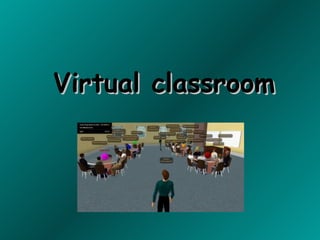
Virtual classroom
Virtual classroom a learning environment where teacher and student are separated by time or space, or both, and the teacher provides course content through course management applications ,  multimedia   resources, the   internet ,  videoconferencing ,  etc. Students receive the content and communicate with the teacher via the same technologies
Objectives provide a platform for educators to experiment with designing spaces for learning provide students with a stimulating, positive and enjoyable environment along with the opportunity to develop skills and communication
Framework of Evaluation  Access How accessible is VC a particular technology for learners? How flexible is VC for a particular target group? -Ability to show all course details/ qualification aims  -Measurable Assessment methods (formative and summative)  -Test & Quiz applications/Question/Answer/Feedback
Framework of Evaluation Cost What is the  cost structure of the VC? -Lesson -Semester -Application
Framework of Evaluation Teaching and learning functions Does VC meet the standards or objectives of teaching? -Provides support for the information. -Information update  -Quality and information sources What skills does the VC technology develop?
Framework of Evaluation Interactivity and user friendliness What kind of interaction does the VC technology enable?  Discussion groups  -Chat room  -Bulletin board  -E-mail functions  -Conferencing facilities How easy is VC to use and learn? Be able to personalise interface  Track & record own progress  Visually attractive interface  Secure access and log-ins
Framework of Evaluation Speed How quickly can courses be created and distributed with the VC technology? How quickly can VC materials be changed? How easy is VC to upload files?  Ability to add links to the web?  -Send and receive files  -Different types of files & multimedia accepted and supported
 

Kricpatric

  • 1.
  • 2.
    Virtual classroom alearning environment where teacher and student are separated by time or space, or both, and the teacher provides course content through course management applications , multimedia resources, the internet , videoconferencing , etc. Students receive the content and communicate with the teacher via the same technologies
  • 3.
    Objectives provide aplatform for educators to experiment with designing spaces for learning provide students with a stimulating, positive and enjoyable environment along with the opportunity to develop skills and communication
  • 4.
    Framework of Evaluation Access How accessible is VC a particular technology for learners? How flexible is VC for a particular target group? -Ability to show all course details/ qualification aims -Measurable Assessment methods (formative and summative) -Test & Quiz applications/Question/Answer/Feedback
  • 5.
    Framework of EvaluationCost What is the cost structure of the VC? -Lesson -Semester -Application
  • 6.
    Framework of EvaluationTeaching and learning functions Does VC meet the standards or objectives of teaching? -Provides support for the information. -Information update -Quality and information sources What skills does the VC technology develop?
  • 7.
    Framework of EvaluationInteractivity and user friendliness What kind of interaction does the VC technology enable? Discussion groups -Chat room -Bulletin board -E-mail functions -Conferencing facilities How easy is VC to use and learn? Be able to personalise interface Track & record own progress Visually attractive interface Secure access and log-ins
  • 8.
    Framework of EvaluationSpeed How quickly can courses be created and distributed with the VC technology? How quickly can VC materials be changed? How easy is VC to upload files? Ability to add links to the web? -Send and receive files -Different types of files & multimedia accepted and supported
  • 9.