{
TCA Cycle
(Krebs cycle / Citric acid cycle)
Dr. Saman Hina
Assistant Professor (Biochemistry)
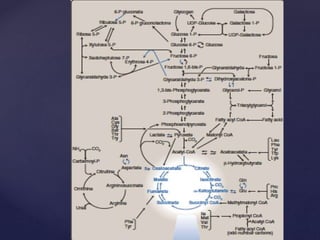
 It is the final pathway where the oxidative metabolism
of carbohydrates, amino acids and fatty acids joins,
their carbon skeletons are converted to CO2
 This oxidation provides energy for the production of
the majority of ATP
 The cycle occurs totally in the mitochondria
 It occurs in close proximity to the reactions of electron
transport chain, which oxidize the reduced coenzymes
(NADH and FADH2) produced by the cycle
 The TCA cycle is an aerobic pathway, because O2 is
required as the final electron acceptor
Overview
 The TCA cycle is not a closed circle
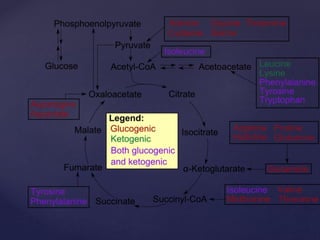
 catabolism of some amino acids generate
intermediates of the cycle and are called
anaplerotic (“filling up”) reactions
 It supplies intermediates for a number of
important synthetic reactions
 E.g. formation of glucose from the carbon
skeletons of some amino acids,
 It provides building blocks for the synthesis of
some amino acids
Overview
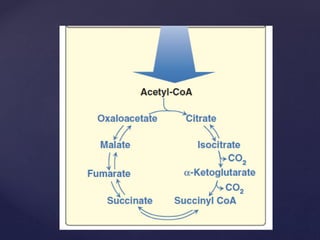
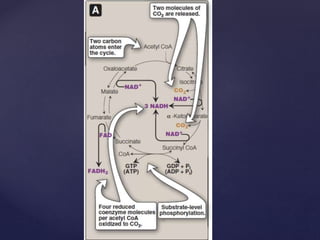
 In the TCA cycle, oxaloacetate is first
condensed with an acetyl group from acetyl
coenzyme A (CoA), and then is regenerated as
the cycle is completed
 Two carbons entering the cycle as acetyl CoA
are balanced by two CO2 exiting
Reactions of the TCA cycle
 Pyruvate, the end-product of aerobic glycolysis, must
be transported into the mitochondrion before it can
enter the TCA cycle
 This is accomplished by a specific pyruvate transporter
that helps pyruvate cross the inner mitochondrial
membrane
 Once in the matrix, pyruvate is converted to acetyl CoA
by the pyruvate dehydrogenase (PDH) complex,
which is a multienzyme complex
 PDH complex is not part of the TCA cycle, but it
supplies substrate for the cycle
Oxidative decarboxylation of
pyruvate
PDH complex Consists of 3 Enzymes which require 5 coenzymes:
Enzymes
1. Pyruvate dehydrogenase (PDH or E1, also called a decarboxylase)
2. Dihydrolipoyl transacetylase (E2)
3. Dihydrolipoyl dehydrogenase (E3)
 two tightly bound regulatory enzymes, pyruvate dehydrogenase kinase
(PDH kinase) and pyruvate dehydrogenase phosphatase (PDH
phosphatase)
Coenzymes
 E1 requires thiamine pyrophosphate (Vitsamin B1 or TPP)
 E2 requires lipoic acid and CoA ( Vitamin B5/Pantothenate)
 E3 requires FAD (Vitamin B2/Riboflavin) and NAD+ ( Vitamin B3/
Niacin)
Pyruvate Dehydrogenase (PDH)
complex
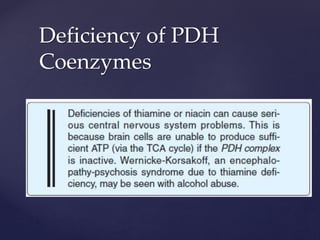
Deficiency of PDH
Coenzymes
 A deficiency in the E1 component of the PDH complex,
although rare, is the most common biochemical cause of
congenital lactic acidosis
 This enzyme deficiency results in an inability to convert
pyruvate to acetyl CoA, causing pyruvate to be shunted
to lactic acid via lactate dehydrogenase
 This causes particular problems for the brain, which
relies on the TCA cycle for most of its energy, and is
particularly sensitive to acidosis
 Symptoms are variable and include
neurodegeneration; muscle spasticity; and, in the
neonatal onset form, early death
 Dietary restriction of carbohydrate and
supplementation with thiamine may reduce
symptoms
Pyruvate dehydrogenase deficiency
 Pentavalent arsenic (arsenate) can interfere with
glycolysis at the glyceraldehyde 3-phosphate step 
less ATP production
 It inhibits of enzymes that require lipoic acid as a
coenzyme
 Arsenite forms a stable complex with the thiol (–SH)
groups of lipoic acid, making that compound
unavailable to serve as a coenzyme.
 When it binds to lipoic acid in the PDH complex,
pyruvate (and consequently lactate) accumulates.
Like pyruvate dehydrogenase deficiency, this
particularly affects the brain, causing neurologic
disturbances and death
Arsenic poisoning
Citrate synthase condenses Acetyl CoA
and OAA
citrate synthase is not an allosteric
enzyme but It is inhibited by its
product, citrate
The binding of OAA causes a
conformational change in the enzyme
that generates a binding site for acetyl
CoA
Synthesis of citrate from
acetyl coenzyme A and
oxaloacetate
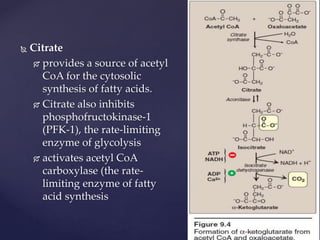
 Citrate
 provides a source of acetyl
CoA for the cytosolic
synthesis of fatty acids.
 Citrate also inhibits
phosphofructokinase-1
(PFK-1), the rate-limiting
enzyme of glycolysis
 activates acetyl CoA
carboxylase (the rate-
limiting enzyme of fatty
acid synthesis
 Isomerization of citrate
 Citrate is isomerized to isocitrate by aconitase
(aconitate hydratase)
 Note: Aconitase is inhibited by fluoroacetate, a
plant pesticide resulting in citrate accumulation
 Oxidative decarboxylation of isocitrate
 Isocitrate dehydrogenase catalyzes the
irreversible oxidative decarboxylation of
isocitrate, yielding the first of three NADH
molecules produced by the cycle and the first
release of CO2.
 This is one of the rate limiting steps of the TCA
cycle. The enzyme is allosterically activated by
ADP (a low-energy signal) and Ca2+ and is
inhibited by ATP and NADH, (a high energy
signal)
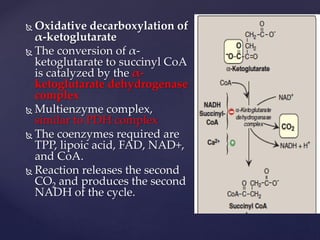
 Oxidative decarboxylation of
α-ketoglutarate
 The conversion of α-
ketoglutarate to succinyl CoA
is catalyzed by the α-
ketoglutarate dehydrogenase
complex
 Multienzyme complex,
similar to PDH complex
 The coenzymes required are
TPP, lipoic acid, FAD, NAD+,
and CoA.
 Reaction releases the second
CO2 and produces the second
NADH of the cycle.
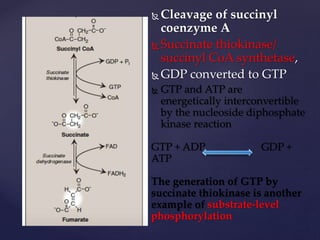
 Cleavage of succinyl
coenzyme A
 Succinate thiokinase/
succinyl CoA synthetase,
 GDP converted to GTP
 GTP and ATP are
energetically interconvertible
by the nucleoside diphosphate
kinase reaction
GTP + ADP GDP +
ATP
The generation of GTP by
succinate thiokinase is another
example of substrate-level
phosphorylation
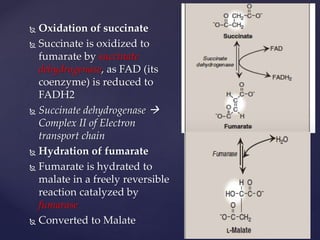
 Oxidation of succinate
 Succinate is oxidized to
fumarate by succinate
dehydrogenase, as FAD (its
coenzyme) is reduced to
FADH2
 Succinate dehydrogenase 
Complex II of Electron
transport chain
 Hydration of fumarate
 Fumarate is hydrated to
malate in a freely reversible
reaction catalyzed by
fumarase
 Converted to Malate
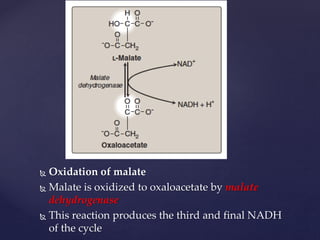
 Oxidation of malate
 Malate is oxidized to oxaloacetate by malate
dehydrogenase
 This reaction produces the third and final NADH
of the cycle
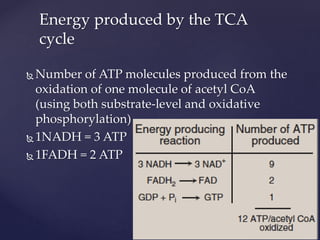
 Number of ATP molecules produced from the
oxidation of one molecule of acetyl CoA
(using both substrate-level and oxidative
phosphorylation)
 1NADH = 3 ATP
 1FADH = 2 ATP
Energy produced by the TCA
cycle
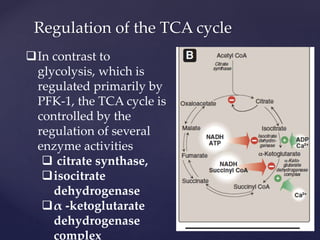
Regulation of the TCA cycle
In contrast to
glycolysis, which is
regulated primarily by
PFK-1, the TCA cycle is
controlled by the
regulation of several
enzyme activities
 citrate synthase,
isocitrate
dehydrogenase
α -ketoglutarate
dehydrogenase
complex

Krebs cycle/Citric acid cycle

  • 1.
    { TCA Cycle (Krebs cycle/ Citric acid cycle) Dr. Saman Hina Assistant Professor (Biochemistry)
  • 2.
     It isthe final pathway where the oxidative metabolism of carbohydrates, amino acids and fatty acids joins, their carbon skeletons are converted to CO2  This oxidation provides energy for the production of the majority of ATP  The cycle occurs totally in the mitochondria  It occurs in close proximity to the reactions of electron transport chain, which oxidize the reduced coenzymes (NADH and FADH2) produced by the cycle  The TCA cycle is an aerobic pathway, because O2 is required as the final electron acceptor Overview
  • 3.
     The TCAcycle is not a closed circle  catabolism of some amino acids generate intermediates of the cycle and are called anaplerotic (“filling up”) reactions  It supplies intermediates for a number of important synthetic reactions  E.g. formation of glucose from the carbon skeletons of some amino acids,  It provides building blocks for the synthesis of some amino acids Overview
  • 6.
     In theTCA cycle, oxaloacetate is first condensed with an acetyl group from acetyl coenzyme A (CoA), and then is regenerated as the cycle is completed  Two carbons entering the cycle as acetyl CoA are balanced by two CO2 exiting Reactions of the TCA cycle
  • 8.
     Pyruvate, theend-product of aerobic glycolysis, must be transported into the mitochondrion before it can enter the TCA cycle  This is accomplished by a specific pyruvate transporter that helps pyruvate cross the inner mitochondrial membrane  Once in the matrix, pyruvate is converted to acetyl CoA by the pyruvate dehydrogenase (PDH) complex, which is a multienzyme complex  PDH complex is not part of the TCA cycle, but it supplies substrate for the cycle Oxidative decarboxylation of pyruvate
  • 9.
    PDH complex Consistsof 3 Enzymes which require 5 coenzymes: Enzymes 1. Pyruvate dehydrogenase (PDH or E1, also called a decarboxylase) 2. Dihydrolipoyl transacetylase (E2) 3. Dihydrolipoyl dehydrogenase (E3)  two tightly bound regulatory enzymes, pyruvate dehydrogenase kinase (PDH kinase) and pyruvate dehydrogenase phosphatase (PDH phosphatase) Coenzymes  E1 requires thiamine pyrophosphate (Vitsamin B1 or TPP)  E2 requires lipoic acid and CoA ( Vitamin B5/Pantothenate)  E3 requires FAD (Vitamin B2/Riboflavin) and NAD+ ( Vitamin B3/ Niacin) Pyruvate Dehydrogenase (PDH) complex
  • 10.
  • 11.
     A deficiencyin the E1 component of the PDH complex, although rare, is the most common biochemical cause of congenital lactic acidosis  This enzyme deficiency results in an inability to convert pyruvate to acetyl CoA, causing pyruvate to be shunted to lactic acid via lactate dehydrogenase  This causes particular problems for the brain, which relies on the TCA cycle for most of its energy, and is particularly sensitive to acidosis  Symptoms are variable and include neurodegeneration; muscle spasticity; and, in the neonatal onset form, early death  Dietary restriction of carbohydrate and supplementation with thiamine may reduce symptoms Pyruvate dehydrogenase deficiency
  • 12.
     Pentavalent arsenic(arsenate) can interfere with glycolysis at the glyceraldehyde 3-phosphate step  less ATP production  It inhibits of enzymes that require lipoic acid as a coenzyme  Arsenite forms a stable complex with the thiol (–SH) groups of lipoic acid, making that compound unavailable to serve as a coenzyme.  When it binds to lipoic acid in the PDH complex, pyruvate (and consequently lactate) accumulates. Like pyruvate dehydrogenase deficiency, this particularly affects the brain, causing neurologic disturbances and death Arsenic poisoning
  • 13.
    Citrate synthase condensesAcetyl CoA and OAA citrate synthase is not an allosteric enzyme but It is inhibited by its product, citrate The binding of OAA causes a conformational change in the enzyme that generates a binding site for acetyl CoA Synthesis of citrate from acetyl coenzyme A and oxaloacetate
  • 14.
     Citrate  providesa source of acetyl CoA for the cytosolic synthesis of fatty acids.  Citrate also inhibits phosphofructokinase-1 (PFK-1), the rate-limiting enzyme of glycolysis  activates acetyl CoA carboxylase (the rate- limiting enzyme of fatty acid synthesis
  • 15.
     Isomerization ofcitrate  Citrate is isomerized to isocitrate by aconitase (aconitate hydratase)  Note: Aconitase is inhibited by fluoroacetate, a plant pesticide resulting in citrate accumulation  Oxidative decarboxylation of isocitrate  Isocitrate dehydrogenase catalyzes the irreversible oxidative decarboxylation of isocitrate, yielding the first of three NADH molecules produced by the cycle and the first release of CO2.  This is one of the rate limiting steps of the TCA cycle. The enzyme is allosterically activated by ADP (a low-energy signal) and Ca2+ and is inhibited by ATP and NADH, (a high energy signal)
  • 16.
     Oxidative decarboxylationof α-ketoglutarate  The conversion of α- ketoglutarate to succinyl CoA is catalyzed by the α- ketoglutarate dehydrogenase complex  Multienzyme complex, similar to PDH complex  The coenzymes required are TPP, lipoic acid, FAD, NAD+, and CoA.  Reaction releases the second CO2 and produces the second NADH of the cycle.
  • 17.
     Cleavage ofsuccinyl coenzyme A  Succinate thiokinase/ succinyl CoA synthetase,  GDP converted to GTP  GTP and ATP are energetically interconvertible by the nucleoside diphosphate kinase reaction GTP + ADP GDP + ATP The generation of GTP by succinate thiokinase is another example of substrate-level phosphorylation
  • 18.
     Oxidation ofsuccinate  Succinate is oxidized to fumarate by succinate dehydrogenase, as FAD (its coenzyme) is reduced to FADH2  Succinate dehydrogenase  Complex II of Electron transport chain  Hydration of fumarate  Fumarate is hydrated to malate in a freely reversible reaction catalyzed by fumarase  Converted to Malate
  • 19.
     Oxidation ofmalate  Malate is oxidized to oxaloacetate by malate dehydrogenase  This reaction produces the third and final NADH of the cycle
  • 20.
     Number ofATP molecules produced from the oxidation of one molecule of acetyl CoA (using both substrate-level and oxidative phosphorylation)  1NADH = 3 ATP  1FADH = 2 ATP Energy produced by the TCA cycle
  • 22.
    Regulation of theTCA cycle In contrast to glycolysis, which is regulated primarily by PFK-1, the TCA cycle is controlled by the regulation of several enzyme activities  citrate synthase, isocitrate dehydrogenase α -ketoglutarate dehydrogenase complex

Editor's Notes

  • #10 Coenzyme: a non-protein compound that is necessary for the functioning of an enzyme.  
  • #13 Arsenic (arsenate) can prevent net ATP and NADH production by glycolysis, without inhibiting the pathway itself The poison does so by competing with inorganic phosphate as a substrate for glyceraldehyde 3-phosphate dehydrogenase, forming a complex that spontaneously hydrolyzes to form 3-phosphoglycerate