Mergers & Acquisitions
Cadbury
• Started by John Cadbury in 1824
• Headquartered in Cadbury House in the
  Uxbridge Business Park in Uxbridge, London
  Borough of Hillingdon
• Started producing the world famous Dairy
  Milk Chocolate in 1905
• In 1969 the Cadbury Group merged with
  Schweppes
• Taken over by Kraft foods on 19 jan, 2010
Kraft Foods
• World’s second largest food company after Nestle
  with presence in more than 150 countries
• Headquartered at Northfield, Illinois, US
• Current Chairman and CEO : Irene Rosenfeld
• Kraft Foods was formed on December 10, 1923
  by Thomas H. McInnerney
• Famous Brands include - Philadelphia cheese,
  Oreo biscuits and Trident gum
• Eleven $1 billion brands with operations in about
  70 countries
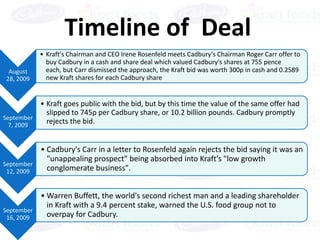
Timeline of Deal
            • Kraft's Chairman and CEO Irene Rosenfeld meets Cadbury's Chairman Roger Carr offer to
              buy Cadbury in a cash and share deal which valued Cadbury's shares at 755 pence
  August      each, but Carr dismissed the approach, the Kraft bid was worth 300p in cash and 0.2589
 28, 2009     new Kraft shares for each Cadbury share


          • Kraft goes public with the bid, but by this time the value of the same offer had
            slipped to 745p per Cadbury share, or 10.2 billion pounds. Cadbury promptly
September
  7, 2009
            rejects the bid.


            • Cadbury's Carr in a letter to Rosenfeld again rejects the bid saying it was an
              "unappealing prospect" being absorbed into Kraft's "low growth
September
 12, 2009     conglomerate business".


            • Warren Buffett, the world's second richest man and a leading shareholder
              in Kraft with a 9.4 percent stake, warned the U.S. food group not to
September
 16, 2009     overpay for Cadbury.
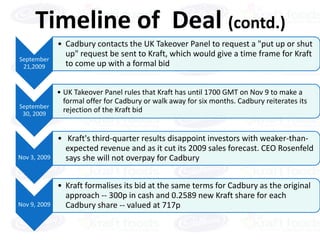
Timeline of Deal (contd.)
              • Cadbury contacts the UK Takeover Panel to request a "put up or shut
                up" request be sent to Kraft, which would give a time frame for Kraft
September
 21,2009        to come up with a formal bid


          • UK Takeover Panel rules that Kraft has until 1700 GMT on Nov 9 to make a
            formal offer for Cadbury or walk away for six months. Cadbury reiterates its
September
 30, 2009
            rejection of the Kraft bid


              • Kraft's third-quarter results disappoint investors with weaker-than-
                expected revenue and as it cut its 2009 sales forecast. CEO Rosenfeld
Nov 3, 2009     says she will not overpay for Cadbury


              • Kraft formalises its bid at the same terms for Cadbury as the original
                approach -- 300p in cash and 0.2589 new Kraft share for each
Nov 9, 2009     Cadbury share -- valued at 717p
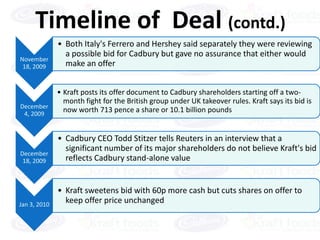
Timeline of Deal (contd.)
              • Both Italy's Ferrero and Hershey said separately they were reviewing
                a possible bid for Cadbury but gave no assurance that either would
November
 18, 2009       make an offer


              • Kraft posts its offer document to Cadbury shareholders starting off a two-
                month fight for the British group under UK takeover rules. Kraft says its bid is
December
 4, 2009
                now worth 713 pence a share or 10.1 billion pounds


              • Cadbury CEO Todd Stitzer tells Reuters in an interview that a
                significant number of its major shareholders do not believe Kraft's bid
December
 18, 2009       reflects Cadbury stand-alone value


              • Kraft sweetens bid with 60p more cash but cuts shares on offer to
Jan 3, 2010
                keep offer price unchanged
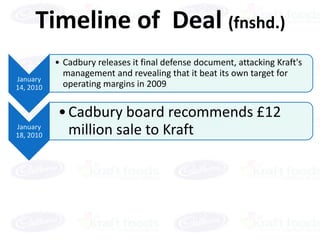
Timeline of Deal (fnshd.)
           • Cadbury releases it final defense document, attacking Kraft's
             management and revealing that it beat its own target for
January
14, 2010     operating margins in 2009


           • Cadbury board recommends £12
January
18, 2010     million sale to Kraft
Reasons for the Deal
Entering Emerging market through cross
 border Acquisitions
Overcoming Entry Barriers in New Markets
Increased Market Power
Valuation of Cadbury by 50% more than
 market value
Breaking new grounds by Cadbury
Entering
      Emerging
      Markets
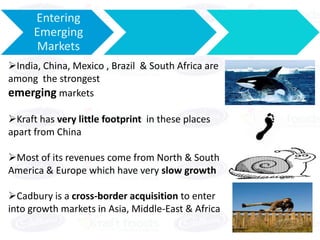
India, China, Mexico , Brazil & South Africa are
among the strongest
emerging markets

Kraft has very little footprint in these places
apart from China

Most of its revenues come from North & South
America & Europe which have very slow growth

Cadbury is a cross-border acquisition to enter
into growth markets in Asia, Middle-East & Africa
Entering             Overcoming
       Emerging                Entry
        Markets              Barriers
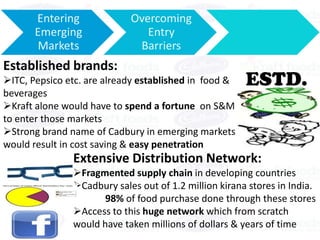
Established brands:
ITC, Pepsico etc. are already established in food &   ESTD.
beverages
Kraft alone would have to spend a fortune on S&M
to enter those markets
Strong brand name of Cadbury in emerging markets
would result in cost saving & easy penetration
               Extensive Distribution Network:
               Fragmented supply chain in developing countries
               Cadbury sales out of 1.2 million kirana stores in India.
                      98% of food purchase done through these stores
               Access to this huge network which from scratch
               would have taken millions of dollars & years of time
Entering              Overcoming
     Emerging                 Entry
      Markets               Barriers
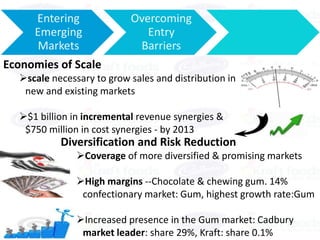
Economies of Scale
  scale necessary to grow sales and distribution in
   new and existing markets

  $1 billion in incremental revenue synergies &
   $750 million in cost synergies - by 2013
           Diversification and Risk Reduction
               Coverage of more diversified & promising markets

               High margins --Chocolate & chewing gum. 14%
                confectionary market: Gum, highest growth rate:Gum

               Increased presence in the Gum market: Cadbury
                market leader: share 29%, Kraft: share 0.1%
Entering              Overcoming                 Increased
      Emerging                 Entry                    Market
       Markets               Barriers                    Power
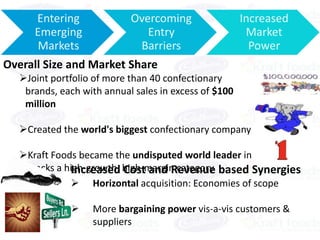
Overall Size and Market Share
   Joint portfolio of more than 40 confectionary
    brands, each with annual sales in excess of $100
    million

   Created the world's biggest confectionary company

   Kraft Foods became the undisputed world leader in
    Snacks a high-growth, high-margin category based Synergies
              Increased Cost and Revenue
               Horizontal acquisition: Economies of scope

                  More bargaining power vis-a-vis customers &
                   suppliers
Problems
Inadequate Evaluation of Target:
500p in cash and 0.1874 Kraft shares for each Cadbury
share. According to Buffet which was “a pretty full price” i.e.
much higher than actual & Kraft shares undervalued
Large Debt:
 Debt of $ 9.5 billion. Recoverable within 13 years at the
then income level (3.25, 6, 10, 30 year bonds through
DB, HSBC, RBS, BNP Paribus)
Too much diversification?
 Not really
Managers Overly Focused on Acquisition?
Possibly
Too Large? Should not be a problem
Integration
   Kraft
      Mananged radically different from Cadbury
      How much can Kraft be expected to change its own
       culture.
      Honouring Cadbury's Fair Trade credentials
      Unreliable precedents:
          Closed the Terry's factory in York after buying it in
          1993, despite promising to keep it open. Kraft is, in
          fact, known to have integrity issues.
          Habit of taking over great national institutions –
          Danone, Cadbury
          Did not close biscuit manufacturing facilities in
          France for at least three years and increased
          investments also
Cultural
• Sir Dominic and Sir Adrian Cadbury said: "In the context of
  a bid, the high percentage that fail to live up to the claims
  of the bidder are well documented. The risks of relative
  failure in takeovers are therefore clear. Those risks are
  considerably increased if the bidder fails to win the loyalty
  and support of the employees on whom the continuing
  fortunes of the enterprise depend."
Cultural (contd.)
   Softer cultural problems crucial impediments to effective integration

   Successful creation of leadership team is led by the CEO: requires
    commitment and focus on the part of CEO to get beyond just hitting
    ‘synergy targets' and set time aside to develop the leadership team early on

            Leadership team developed most effectively by involving employees from both the merged
            entities in specific business planning activities

   Building a leadership team following an acquisition is an important, painful
    process that sets the tone for the wider integration

   Fears at Cadbury

            About taste of chocolates to work environment

            Kraft's bureaucratic work structures

            Orwellian feel
Other Aspects
   Working Relationship
          Irene Rosenfeld's remote management style
   Turnover of Key Personnel
          Exodus of experienced Cadbury management
   HR Integration
          Job Redundancies
          Changes to compensation package
   Non-resolution of Uncertainty
          Lack of clear communication with acquired employees
Implications of Cultural
        Change
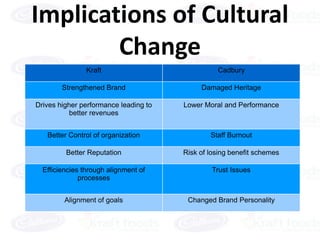
                Kraft                            Cadbury

        Strengthened Brand                  Damaged Heritage

Drives higher performance leading to   Lower Moral and Performance
           better revenues


   Better Control of organization              Staff Burnout

         Better Reputation             Risk of losing benefit schemes

  Efficiencies through alignment of            Trust Issues
              processes


         Alignment of goals             Changed Brand Personality
IT
Kraft hoped to save £430m annually, largely by integrating the companies' IT systems

Both Kraft and Cadbury rely on systems provided by SAP, one of the world leaders in
enterprise resource planning (ERP) systems

Due diligence process in any merger should include an assessment of the target company's
IT to quantify any risks to business continuity, outline the required operational and capital
expenditure for the first 12 months following the acquisition, identify the opportunities for
synergy and define the high level integration plan

Unfortunately CIO is often the last person to know about the deal!

Where a larger company takes over a smaller one, it is common to export data from the
smaller company system and merge it into the larger one

Both Kraft and Cadbury relied on SAP giving them a slight advantage, but SAP and other
ERP systems are usually heavily customised to suit different situations, so integration was
an issue
Market Presence


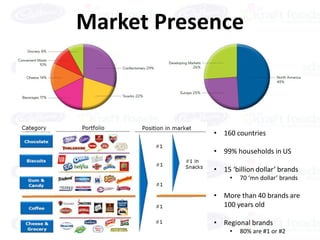
            • 160 countries

            • 99% households in US

            • 15 ‘billion dollar’ brands
                 •   70 ‘mn dollar’ brands

            • More than 40 brands are
              100 years old

            • Regional brands
                 •   80% are #1 or #2
Recommendations
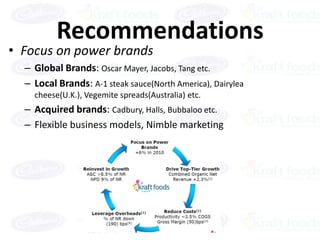
• Focus on power brands
  – Global Brands: Oscar Mayer, Jacobs, Tang etc.
  – Local Brands: A-1 steak sauce(North America), Dairylea
    cheese(U.K.), Vegemite spreads(Australia) etc.
  – Acquired brands: Cadbury, Halls, Bubbaloo etc.
  – Flexible business models, Nimble marketing
Recommendations (contd.)
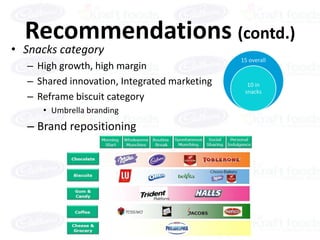
• Snacks category
                                              15 overall
  – High growth, high margin
  – Shared innovation, Integrated marketing     10 in
                                               snacks
  – Reframe biscuit category
     • Umbrella branding
  – Brand repositioning
Recommendations (contd.)
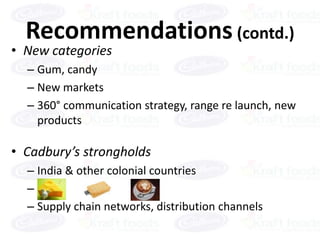
• New categories
  – Gum, candy
  – New markets
  – 360° communication strategy, range re launch, new
    products

• Cadbury’s strongholds
  – India & other colonial countries
  –o
  – Supply chain networks, distribution channels
Recommendations (contd.)
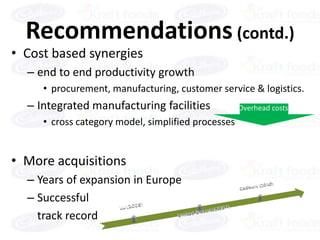
• Cost based synergies
  – end to end productivity growth
     • procurement, manufacturing, customer service & logistics.
  – Integrated manufacturing facilities             Overhead costs
     • cross category model, simplified processes


• More acquisitions
  – Years of expansion in Europe
  – Successful
    track record
Kraft   cadbury merger

Kraft cadbury merger

  • 1.
  • 2.
    Cadbury • Started byJohn Cadbury in 1824 • Headquartered in Cadbury House in the Uxbridge Business Park in Uxbridge, London Borough of Hillingdon • Started producing the world famous Dairy Milk Chocolate in 1905 • In 1969 the Cadbury Group merged with Schweppes • Taken over by Kraft foods on 19 jan, 2010
  • 3.
    Kraft Foods • World’ssecond largest food company after Nestle with presence in more than 150 countries • Headquartered at Northfield, Illinois, US • Current Chairman and CEO : Irene Rosenfeld • Kraft Foods was formed on December 10, 1923 by Thomas H. McInnerney • Famous Brands include - Philadelphia cheese, Oreo biscuits and Trident gum • Eleven $1 billion brands with operations in about 70 countries
  • 4.
    Timeline of Deal • Kraft's Chairman and CEO Irene Rosenfeld meets Cadbury's Chairman Roger Carr offer to buy Cadbury in a cash and share deal which valued Cadbury's shares at 755 pence August each, but Carr dismissed the approach, the Kraft bid was worth 300p in cash and 0.2589 28, 2009 new Kraft shares for each Cadbury share • Kraft goes public with the bid, but by this time the value of the same offer had slipped to 745p per Cadbury share, or 10.2 billion pounds. Cadbury promptly September 7, 2009 rejects the bid. • Cadbury's Carr in a letter to Rosenfeld again rejects the bid saying it was an "unappealing prospect" being absorbed into Kraft's "low growth September 12, 2009 conglomerate business". • Warren Buffett, the world's second richest man and a leading shareholder in Kraft with a 9.4 percent stake, warned the U.S. food group not to September 16, 2009 overpay for Cadbury.
  • 5.
    Timeline of Deal(contd.) • Cadbury contacts the UK Takeover Panel to request a "put up or shut up" request be sent to Kraft, which would give a time frame for Kraft September 21,2009 to come up with a formal bid • UK Takeover Panel rules that Kraft has until 1700 GMT on Nov 9 to make a formal offer for Cadbury or walk away for six months. Cadbury reiterates its September 30, 2009 rejection of the Kraft bid • Kraft's third-quarter results disappoint investors with weaker-than- expected revenue and as it cut its 2009 sales forecast. CEO Rosenfeld Nov 3, 2009 says she will not overpay for Cadbury • Kraft formalises its bid at the same terms for Cadbury as the original approach -- 300p in cash and 0.2589 new Kraft share for each Nov 9, 2009 Cadbury share -- valued at 717p
  • 6.
    Timeline of Deal(contd.) • Both Italy's Ferrero and Hershey said separately they were reviewing a possible bid for Cadbury but gave no assurance that either would November 18, 2009 make an offer • Kraft posts its offer document to Cadbury shareholders starting off a two- month fight for the British group under UK takeover rules. Kraft says its bid is December 4, 2009 now worth 713 pence a share or 10.1 billion pounds • Cadbury CEO Todd Stitzer tells Reuters in an interview that a significant number of its major shareholders do not believe Kraft's bid December 18, 2009 reflects Cadbury stand-alone value • Kraft sweetens bid with 60p more cash but cuts shares on offer to Jan 3, 2010 keep offer price unchanged
  • 7.
    Timeline of Deal(fnshd.) • Cadbury releases it final defense document, attacking Kraft's management and revealing that it beat its own target for January 14, 2010 operating margins in 2009 • Cadbury board recommends £12 January 18, 2010 million sale to Kraft
  • 8.
    Reasons for theDeal Entering Emerging market through cross border Acquisitions Overcoming Entry Barriers in New Markets Increased Market Power Valuation of Cadbury by 50% more than market value Breaking new grounds by Cadbury
  • 9.
    Entering Emerging Markets India, China, Mexico , Brazil & South Africa are among the strongest emerging markets Kraft has very little footprint in these places apart from China Most of its revenues come from North & South America & Europe which have very slow growth Cadbury is a cross-border acquisition to enter into growth markets in Asia, Middle-East & Africa
  • 10.
    Entering Overcoming Emerging Entry Markets Barriers Established brands: ITC, Pepsico etc. are already established in food & ESTD. beverages Kraft alone would have to spend a fortune on S&M to enter those markets Strong brand name of Cadbury in emerging markets would result in cost saving & easy penetration Extensive Distribution Network: Fragmented supply chain in developing countries Cadbury sales out of 1.2 million kirana stores in India. 98% of food purchase done through these stores Access to this huge network which from scratch would have taken millions of dollars & years of time
  • 11.
    Entering Overcoming Emerging Entry Markets Barriers Economies of Scale scale necessary to grow sales and distribution in new and existing markets $1 billion in incremental revenue synergies & $750 million in cost synergies - by 2013 Diversification and Risk Reduction Coverage of more diversified & promising markets High margins --Chocolate & chewing gum. 14% confectionary market: Gum, highest growth rate:Gum Increased presence in the Gum market: Cadbury market leader: share 29%, Kraft: share 0.1%
  • 12.
    Entering Overcoming Increased Emerging Entry Market Markets Barriers Power Overall Size and Market Share Joint portfolio of more than 40 confectionary brands, each with annual sales in excess of $100 million Created the world's biggest confectionary company Kraft Foods became the undisputed world leader in Snacks a high-growth, high-margin category based Synergies Increased Cost and Revenue  Horizontal acquisition: Economies of scope  More bargaining power vis-a-vis customers & suppliers
  • 13.
    Problems Inadequate Evaluation ofTarget: 500p in cash and 0.1874 Kraft shares for each Cadbury share. According to Buffet which was “a pretty full price” i.e. much higher than actual & Kraft shares undervalued Large Debt:  Debt of $ 9.5 billion. Recoverable within 13 years at the then income level (3.25, 6, 10, 30 year bonds through DB, HSBC, RBS, BNP Paribus) Too much diversification?  Not really Managers Overly Focused on Acquisition? Possibly Too Large? Should not be a problem
  • 14.
    Integration  Kraft  Mananged radically different from Cadbury  How much can Kraft be expected to change its own culture.  Honouring Cadbury's Fair Trade credentials  Unreliable precedents: Closed the Terry's factory in York after buying it in 1993, despite promising to keep it open. Kraft is, in fact, known to have integrity issues. Habit of taking over great national institutions – Danone, Cadbury Did not close biscuit manufacturing facilities in France for at least three years and increased investments also
  • 15.
    Cultural • Sir Dominicand Sir Adrian Cadbury said: "In the context of a bid, the high percentage that fail to live up to the claims of the bidder are well documented. The risks of relative failure in takeovers are therefore clear. Those risks are considerably increased if the bidder fails to win the loyalty and support of the employees on whom the continuing fortunes of the enterprise depend."
  • 16.
    Cultural (contd.)  Softer cultural problems crucial impediments to effective integration  Successful creation of leadership team is led by the CEO: requires commitment and focus on the part of CEO to get beyond just hitting ‘synergy targets' and set time aside to develop the leadership team early on Leadership team developed most effectively by involving employees from both the merged entities in specific business planning activities  Building a leadership team following an acquisition is an important, painful process that sets the tone for the wider integration  Fears at Cadbury About taste of chocolates to work environment Kraft's bureaucratic work structures Orwellian feel
  • 17.
    Other Aspects  Working Relationship Irene Rosenfeld's remote management style  Turnover of Key Personnel Exodus of experienced Cadbury management  HR Integration Job Redundancies Changes to compensation package  Non-resolution of Uncertainty Lack of clear communication with acquired employees
  • 18.
    Implications of Cultural Change Kraft Cadbury Strengthened Brand Damaged Heritage Drives higher performance leading to Lower Moral and Performance better revenues Better Control of organization Staff Burnout Better Reputation Risk of losing benefit schemes Efficiencies through alignment of Trust Issues processes Alignment of goals Changed Brand Personality
  • 19.
    IT Kraft hoped tosave £430m annually, largely by integrating the companies' IT systems Both Kraft and Cadbury rely on systems provided by SAP, one of the world leaders in enterprise resource planning (ERP) systems Due diligence process in any merger should include an assessment of the target company's IT to quantify any risks to business continuity, outline the required operational and capital expenditure for the first 12 months following the acquisition, identify the opportunities for synergy and define the high level integration plan Unfortunately CIO is often the last person to know about the deal! Where a larger company takes over a smaller one, it is common to export data from the smaller company system and merge it into the larger one Both Kraft and Cadbury relied on SAP giving them a slight advantage, but SAP and other ERP systems are usually heavily customised to suit different situations, so integration was an issue
  • 20.
    Market Presence • 160 countries • 99% households in US • 15 ‘billion dollar’ brands • 70 ‘mn dollar’ brands • More than 40 brands are 100 years old • Regional brands • 80% are #1 or #2
  • 21.
    Recommendations • Focus onpower brands – Global Brands: Oscar Mayer, Jacobs, Tang etc. – Local Brands: A-1 steak sauce(North America), Dairylea cheese(U.K.), Vegemite spreads(Australia) etc. – Acquired brands: Cadbury, Halls, Bubbaloo etc. – Flexible business models, Nimble marketing
  • 22.
    Recommendations (contd.) • Snackscategory 15 overall – High growth, high margin – Shared innovation, Integrated marketing 10 in snacks – Reframe biscuit category • Umbrella branding – Brand repositioning
  • 23.
    Recommendations (contd.) • Newcategories – Gum, candy – New markets – 360° communication strategy, range re launch, new products • Cadbury’s strongholds – India & other colonial countries –o – Supply chain networks, distribution channels
  • 24.
    Recommendations (contd.) • Costbased synergies – end to end productivity growth • procurement, manufacturing, customer service & logistics. – Integrated manufacturing facilities Overhead costs • cross category model, simplified processes • More acquisitions – Years of expansion in Europe – Successful track record