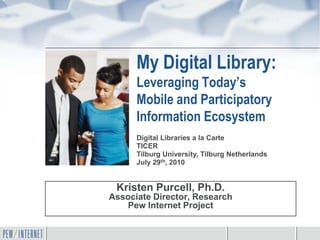
My Digital Library:
      Leveraging Today’s
      Mobile and Participatory
      Information Ecosystem
      Digital Libraries a la Carte
      TICER
      Tilburg University, Tilburg Netherlands
      July 29th, 2010


 Kristen Purcell, Ph.D.
Associate Director, Research
    Pew Internet Project
Pew Internet Project
• Part of the Pew Research Center, a
  nonpartisan “fact tank” based in Washington,
  DC
• Provide high quality, objective data to
  thought leaders and policy makers
• Funded by the Pew Charitable Trusts
• All US findings are based on nationally
  representative telephone surveys of…
   – US adults age 18+, or
   – US teens ages 12-17
   – Drawn from dual-frame (RDD/cell) samples
Today’s Discussion
1)       What’s Mobile Got to Do With It?
     –        Global cell phone use trends
     –        US cell phone and internet use trends
     –        The importance of social media

2)       Highlights of the New Information Ecology
     –        What are the hallmarks of the new information ecology?
     –        Online information consumers
          •       who they are
          •       how they behave
          •       what they like

3)       Leveraging New Technologies
     –        Tips for success in the new information ecology
What’s Mobile Got to Do With It?
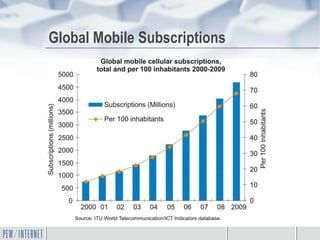
Global Mobile Subscriptions
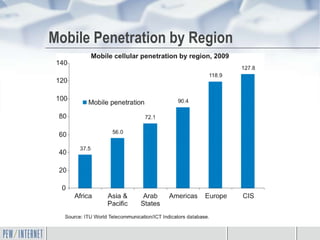
Mobile Penetration by Region
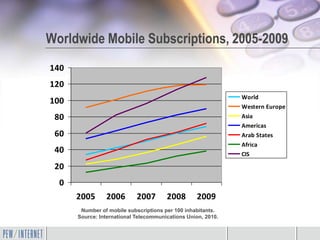
Worldwide Mobile Subscriptions, 2005-2009
140
120
                                                              World
100
                                                              Western Europe
 80                                                           Asia
                                                              Americas
 60                                                           Arab States
                                                              Africa
 40                                                           CIS

 20
  0
      2005      2006        2007       2008       2009
       Number of mobile subscriptions per 100 inhabitants.
      Source: International Telecommunications Union, 2010.
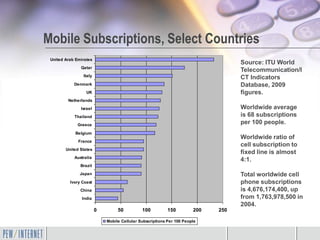
Mobile Subscriptions, Select Countries
 United Arab Emirates
                                                                                  Source: ITU World
               Qatar
                                                                                  Telecommunication/I
                Italy
                                                                                  CT Indicators
            Denmark                                                               Database, 2009
                  UK                                                              figures.
         Netherlands
               Israel                                                             Worldwide average
            Thailand                                                              is 68 subscriptions
              Greece
                                                                                  per 100 people.
             Belgium
                                                                                  Worldwide ratio of
              France
                                                                                  cell subscription to
        United States
                                                                                  fixed line is almost
            Australia
                                                                                  4:1.
               Brazil
               Japan                                                              Total worldwide cell
          Ivory Coast                                                             phone subscriptions
               China                                                              is 4,676,174,400, up
                India                                                             from 1,763,978,500 in
                                                                                  2004.
                        0        50          100          150         200   250

                            Mobile Cellular Subscriptions Per 100 People
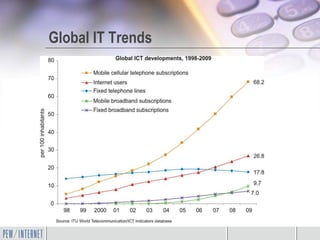
Global IT Trends
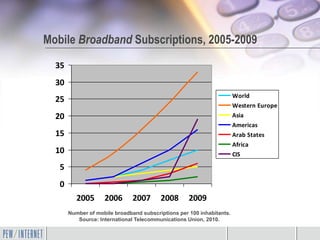
Mobile Broadband Subscriptions, 2005-2009
  35
  30
                                                                       World
  25
                                                                       Western Europe
  20                                                                   Asia
                                                                       Americas
  15                                                                   Arab States
                                                                       Africa
  10                                                                   CIS

   5
   0
          2005      2006       2007      2008       2009
       Number of mobile broadband subscriptions per 100 inhabitants.
          Source: International Telecommunications Union, 2010.
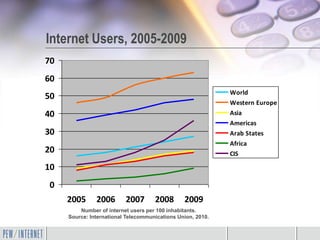
Internet Users, 2005-2009
70
60
                                                             World
50
                                                             Western Europe
40                                                           Asia
                                                             Americas
30                                                           Arab States
                                                             Africa
20                                                           CIS

10
0
     2005      2006       2007       2008       2009
         Number of internet users per 100 inhabitants.
     Source: International Telecommunications Union, 2010.
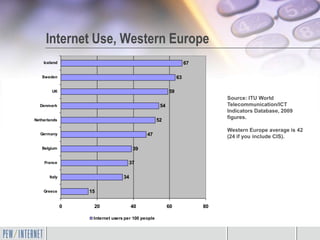
Internet Use, Western Europe
    Iceland                                                         67

   Sweden                                                      63

        UK                                                59
                                                                              Source: ITU World
  Denmark                                            54                       Telecommunication/ICT
                                                                              Indicators Database, 2009
                                                                              figures.
Netherlands                                         52

                                                                              Western Europe average is 42
  Germany                                    47                               (24 if you include CIS).

   Belgium                             39

    France                          37

       Italy                      34

    Greece         15


               0    20                 40                 60             80

                    Internet users per 100 people
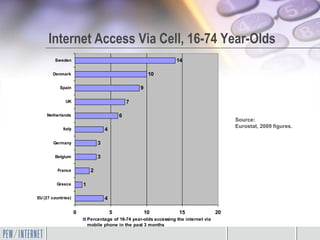
Internet Access Via Cell, 16-74 Year-Olds
        Sweden                                                      14

       Denmark                                            10

           Spain                                     9

              UK                                 7

    Netherlands                              6
                                                                                            Source:
                                                                                            Eurostat, 2009 figures.
            Italy                    4

        Germany                  3

        Belgium                  3

          France             2

         Greece         1

EU (27 countries)                    4

                    0                    5               10          15                20
                            Percentage of 16-74 year-olds accessing the internet via
                            mobile phone in the past 3 months
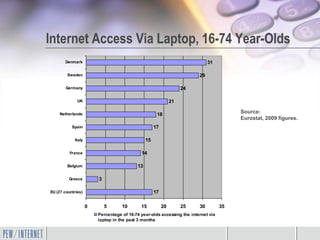
Internet Access Via Laptop, 16-74 Year-Olds
       Denmark                                                               31

        Sweden                                                          29

        Germany                                                    24

              UK                                              21

    Netherlands                                      18
                                                                                        Source:
                                                                                        Eurostat, 2009 figures.
           Spain                                    17

            Italy                              15

          France                            14

        Belgium                           13

         Greece         3

EU (27 countries)                                   17

                    0       5      10       15           20        25   30         35
                        Percentage of 16-74 year-olds accessing the internet via
                        laptop in the past 3 months
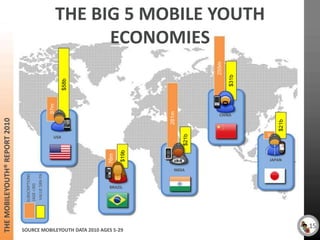
THE BIG 5 MOBILE YOUTH
                                                                           ECONOMIES


                                                                                                         255m

                                                                                                                $31b
                                                                       $58b
                                                               97m


                                                                                           281m
                                                                                                          CHINA
THE MOBILEYOUTH® REPORT 2010


                                                                                                                            $21b
                                                                                                                       32
                                                                                                  $21b
                                                                 USA
                                                                                    $19b
                                                                              76m


                                                                                                                        JAPAN

                                                                                             INDIA
                                SUBSCRIPTIONS

                                                VALUE $BN PA
                                (AGE <30)


                                                                              BRAZIL


                                                                                                                                   15
                               SOURCE MOBILEYOUTH DATA 2010 AGES 5-29
                                         SNS, Youth & Health
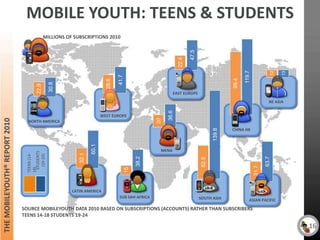
MOBILE YOUTH: TEENS & STUDENTS
                                            MILLIONS OF SUBSCRIPTIONS 2010


                                                                                                                          47.5
                                                                                                                   22.4


                                                                                                                                                        119.7


                                                                                                                                                                          12

                                                                                                                                                                               13
                                                                                    41.7


                                                                                                                                                 99.4
                                                                             28.6
                                              30.8
                                     22.9


                                                                                                               EAST EUROPE
                                                                                                                                                                         NE ASIA


                                                                                                            36.6
                                                                           WEST EUROPE
THE MOBILEYOUTH® REPORT 2010


                                                                                                       20
                                 NORTH AMERICA
                                                                                                                                                 CHINA HK


                                                                                                                                         139.8
                                                                    60.1


                                                                                                        MENA
                                 STUDENTS


                                                             32.1
                                TEENS (14-


                                    (19-24)


                                                                                                38.2


                                                                                                                                                                       63.7
                                                                                                                                  52.9


                                                                                                                                                                31.7
                                18)


                                                                                           15


                                                         LATIN AMERICA
                                                                                    SUB SAH AFRICA                               SOUTH ASIA                 ASIAN PACIFIC

                               SOURCE MOBILEYOUTH DATA 2010 BASED ON SUBSCRIPTIONS (ACCOUNTS) RATHER THAN SUBSCRIBERS
                               TEENS 14-18 STUDENTS 19-24

                                                                                                                                                                                    16
                                                SNS, Youth & Health
www.mobileYouthreport.com
         Published by mobileYouth
      Statistics on youth mobile usage

           Available for download
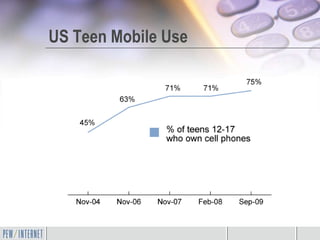
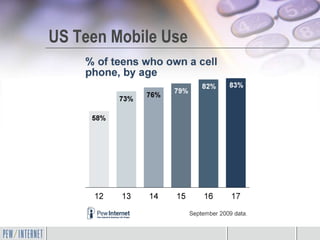
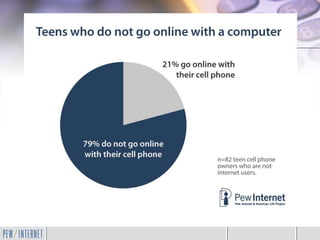
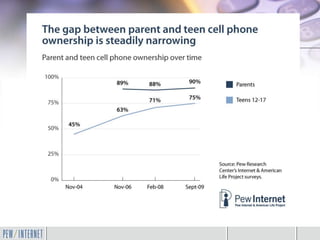
US Teen Mobile Use
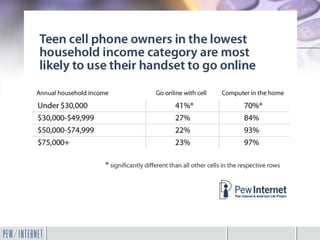
US Teen Mobile Use
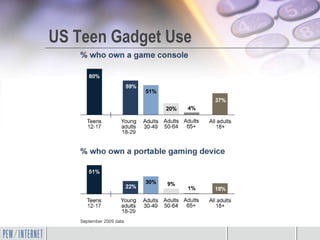
US Teen Gadget Use
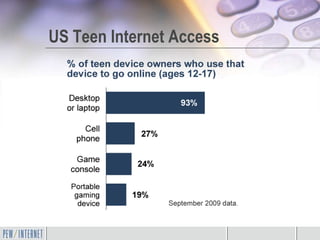
US Teen Internet Access
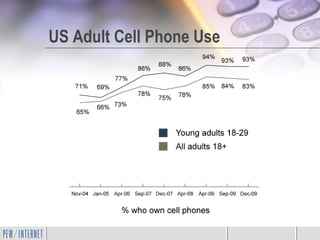
US Adult Cell Phone Use
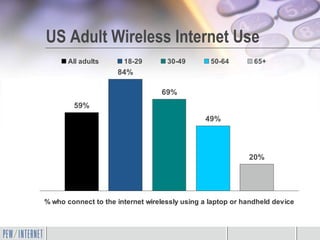
US Adult Wireless Internet Use
       All adults      18-29        30-49        50-64        65+
                     84%

                                  69%
        59%
                                               49%


                                                            20%


% who connect to the internet wirelessly using a laptop or handheld device
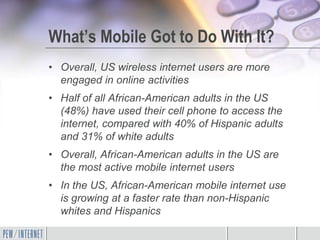
What’s Mobile Got to Do With It?
• Overall, US wireless internet users are more
  engaged in online activities
• Half of all African-American adults in the US
  (48%) have used their cell phone to access the
  internet, compared with 40% of Hispanic adults
  and 31% of white adults
• Overall, African-American adults in the US are
  the most active mobile internet users
• In the US, African-American mobile internet use
  is growing at a faster rate than non-Hispanic
  whites and Hispanics
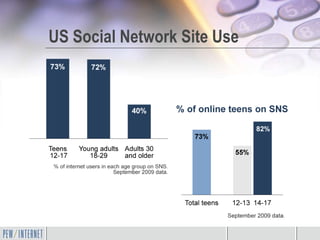
US Social Network Site Use
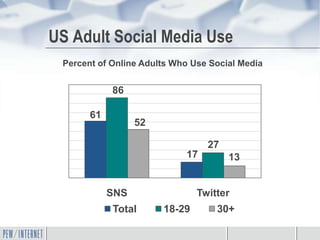
US Adult Social Media Use
 Percent of Online Adults Who Use Social Media


            86

       61
                  52

                                 27
                            17        13


            SNS                Twitter
            Total      18-29       30+
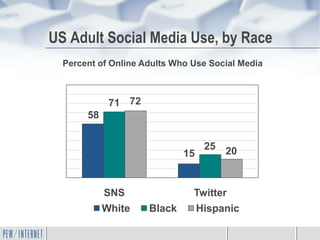
US Adult Social Media Use, by Race
  Percent of Online Adults Who Use Social Media


             71 72
       58


                                25 20
                             15


            SNS                Twitter
            White    Black      Hispanic
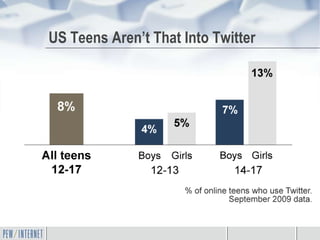
US Teens Aren’t That Into Twitter
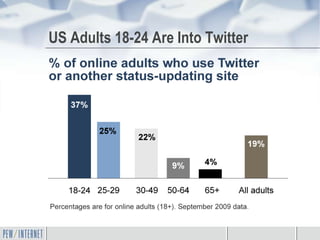
US Adults 18-24 Are Into Twitter
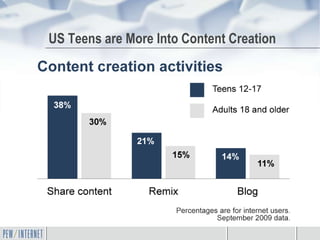
US Teens are More Into Content Creation
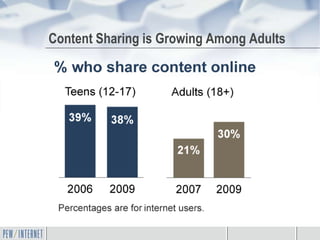
Content Sharing is Growing Among Adults
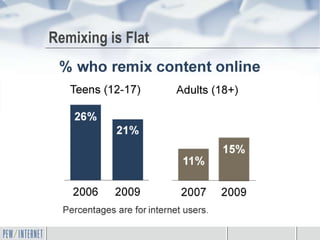
Remixing is Flat
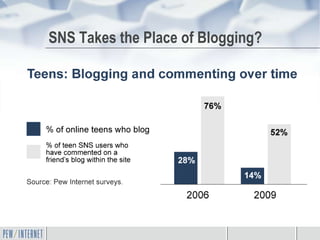
SNS Takes the Place of Blogging?
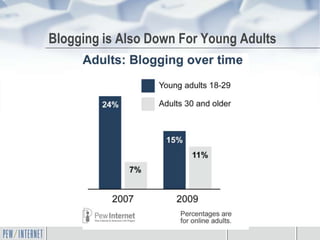
Blogging is Also Down For Young Adults
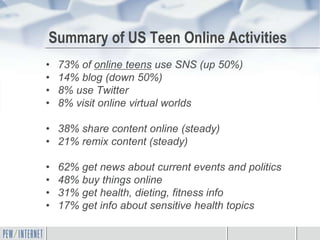
Summary of US Teen Online Activities
•   73% of online teens use SNS (up 50%)
•   14% blog (down 50%)
•   8% use Twitter
•   8% visit online virtual worlds

• 38% share content online (steady)
• 21% remix content (steady)

•   62% get news about current events and politics
•   48% buy things online
•   31% get health, dieting, fitness info
•   17% get info about sensitive health topics
Hallmarks of the New Information Ecology
Then and Now
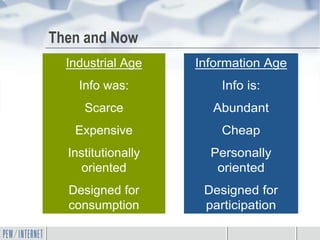
  Industrial Age    Information Age
    Info was:           Info is:
     Scarce           Abundant
   Expensive            Cheap
  Institutionally     Personally
     oriented          oriented
  Designed for       Designed for
  consumption        participation
The “New” Information Ecology
• Blurring line between “news” and
  “information”
• Information is “free”
• Information is “at my fingertips”
• Information is available when I want it
• Information is available from multiple
  sources
The “New” Information Ecology


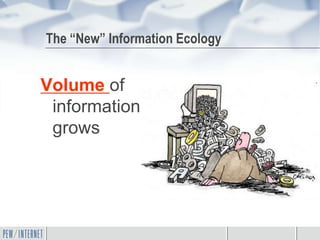
Volume of
 information
 grows
The “New” Information Ecology

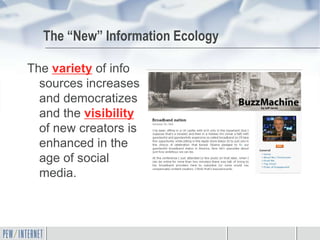
The variety of info
  sources increases
  and democratizes
  and the visibility
  of new creators is
  enhanced in the
  age of social
  media.
The “New” Information Ecology

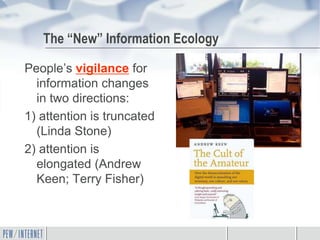
People’s vigilance for
  information changes
  in two directions:
1) attention is truncated
  (Linda Stone)
2) attention is
  elongated (Andrew
  Keen; Terry Fisher)
The “New” Information Ecology

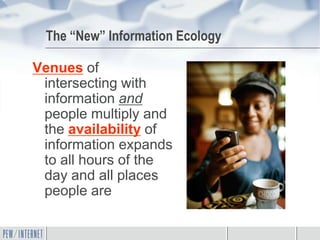
Venues of
 intersecting with
 information and
 people multiply and
 the availability of
 information expands
 to all hours of the
 day and all places
 people are
The “New” Information Ecology
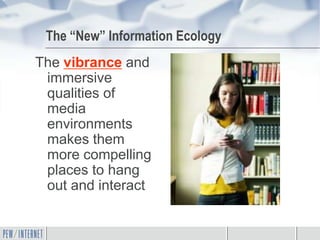
The vibrance and
 immersive
 qualities of
 media
 environments
 makes them
 more compelling
 places to hang
 out and interact
The “New” Information Ecology

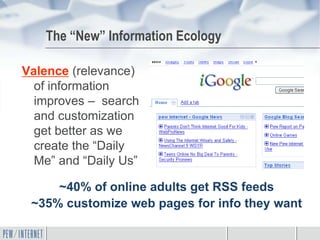
Valence (relevance)
  of information
  improves – search
  and customization
  get better as we
  create the “Daily
  Me” and “Daily Us”

     ~40% of online adults get RSS feeds
 ~35% customize web pages for info they want
The “New” Information Ecology
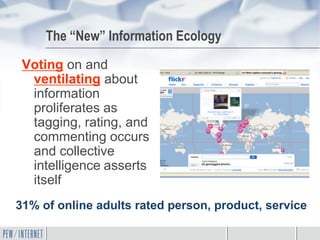
 Voting on and
  ventilating about
  information
  proliferates as
  tagging, rating, and
  commenting occurs
  and collective
  intelligence asserts
  itself
31% of online adults rated person, product, service
The “New” Information Ecology
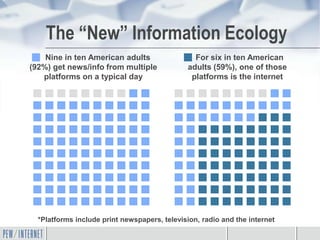
    Nine in ten American adults                 For six in ten American
(92%) get news/info from multiple             adults (59%), one of those
   platforms on a typical day                  platforms is the internet


  *Platforms include print newspapers, television, radio and the internet
The “New” Information Ecology

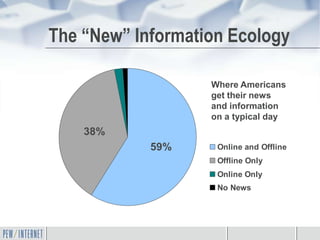
                   Where Americans
                   get their news
                   and information
                   on a typical day
    38%
            59%     Online and Offline
                    Offline Only
                    Online Only
                    No News
The “New” Information Ecology
• The internet has not replaced/
  displaced traditional media
but…
• It is fundamentally changing the way
  people consume and interact with
  information
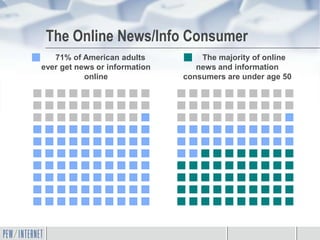
The Online News/Info Consumer
   71% of American adults          The majority of online
ever get news or information      news and information
           online              consumers are under age 50
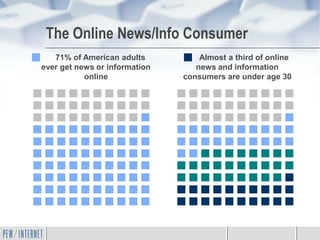
The Online News/Info Consumer
   71% of American adults          Almost a third of online
ever get news or information      news and information
           online              consumers are under age 30
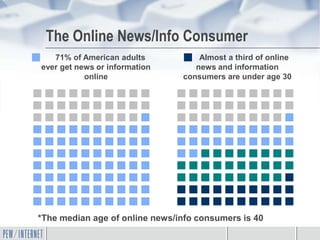
The Online News/Info Consumer
   71% of American adults           Almost a third of online
ever get news or information       news and information
           online               consumers are under age 30


*The median age of online news/info consumers is 40
Online News/Information Consumers in the US…

•    Are more educated than other online
     adults and other adults in general
•    Have higher incomes than other online
     adults and other adults in general
•    Are disproportionately white and
     Hispanic
•    Are much more likely than other online
     adults to have home broadband access
     and to have premium broadband service
The Online News/Info Consumer
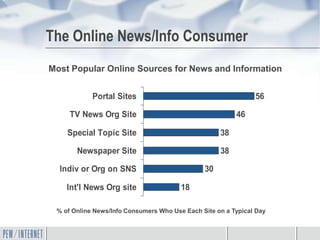
Most Popular Online Sources for News and Information


            Portal Sites                                       56

     TV News Org Site                                    46

    Special Topic Site                              38

       Newspaper Site                               38

  Indiv or Org on SNS                          30

    Int'l News Org site                 18

 % of Online News/Info Consumers Who Use Each Site on a Typical Day
The Online News/Info Consumer
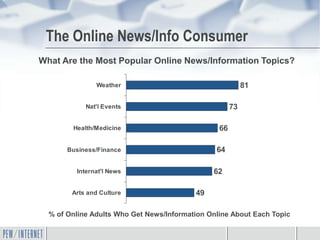
What Are the Most Popular Online News/Information Topics?

               Weather                                     81

            Nat'l Events                              73

        Health/Medicine                          66

       Business/Finance                         64

         Internat'l News                       62

        Arts and Culture                  49

  % of Online Adults Who Get News/Information Online About Each Topic
The Online News/Info Consumer
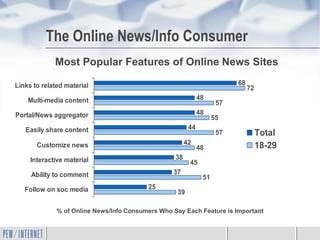
             Most Popular Features of Online News Sites

Links to related material                                                 68
                                                                               72
    Multi-media content                                       48
                                                                     57
Portal/News aggregator                                        48
                                                                    55
   Easily share content                                  44
                                                                     57             Total
                                                        42
       Customize news                                         48                    18-29
     Interactive material                          38
                                                         45
     Ability to comment                           37
                                                               51
   Follow on soc media                    25
                                                    39

              % of Online News/Info Consumers Who Say Each Feature is Important
The Online News/Info Consumer

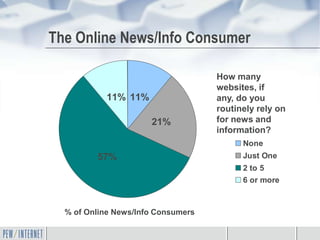
                                    How many
                                    websites, if
            11% 11%                 any, do you
                                    routinely rely on
                      21%           for news and
                                    information?
                                          None
         57%                              Just One
                                          2 to 5
                                          6 or more


  % of Online News/Info Consumers
The Online News/Info Consumer
Online News/Info Consumers are…
•    Efficient Grazers
•    Hunters and Gatherers (71% go online specifically
     to get news/information at least a few times a week)
•    Serendipitous News/Info Discoverers (80% come
     across news/information at least a few times a week
     while they are online doing other things)
•    News/Info Receivers (44% get news/information
     forwarded to them through email, automatic updates
     and alerts, or posts on social networking sites at least
     a few times a week)
Online News and Information
              Online News and
              Information is…
              •    Portable
              •    Participatory
              •    Personalized
Online information is portable
• “On the Go” News/Info Consumers
   – 26% of adults access news/information on their cell
     phones
   – Among this population, 73% use social networking
     sites and 29% use Twitter
   – Typically a white male, age 34, employed full-time
   – One in ten adults gets news alerts sent to his or her
     phone

• The mobile phone allows anytime/anywhere
  access to information
• Info is consumed on the individual’s terms,
  when they want, where they want
Online information is participatory
• “News Participators”
   – 37% of internet users have contributed to the creation of
     news, commented on it, or disseminated it via postings
     on social media sites like Facebook or Twitter
   – Half of all online African-Americans (46%) are news
     participators (disproportionately high SNS use)
   – Overall, 71% of internet users get news and information
     through email or posts on social networking sites

   Remember…
   – 42% of online news consumers say being able to easily share
     material with others is something they look for in a news site
   – 65% look for news sites with links to related material
   – 36% look for news sites with interactive material
   – 35% look for news sites where they can comment on stories.
Online information is participatory
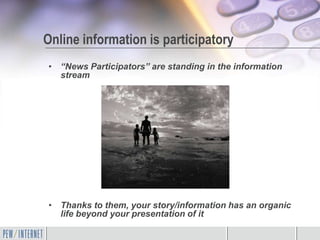
• “News Participators” are standing in the information
  stream


• Thanks to them, your story/information has an organic
  life beyond your presentation of it
Online information is personalized
• “The Daily Me” Takes Shape

   – 28% of internet users have customized their
     homepage to include news and information of
     particular interest to them

   – 39% say being able to customize content is
     something they look for in an online news site
Leveraging New Technologies
1996 Benton Foundation report:
         “Buildings, books, and bytes”


 "If you plopped a library down. . .30 years from
      now. . .there would be cobwebs growing
everywhere because people would look at it and
   wouldn't think of it as a legitimate institution
       because it would be so far behind. . ."
              -- Experienced library user.
How Technology Changes the Role of Libraries

• Makes it possible for organizations like
  libraries to become “nodes” in people’s
  networks that can help them solve problems
  and make decisions
• Allows for immediate, spontaneous creation of
  networks that can include libraries
• Gives people a sense that there are more
  “friends” in their networks like librarians that
  they can access when they have needs
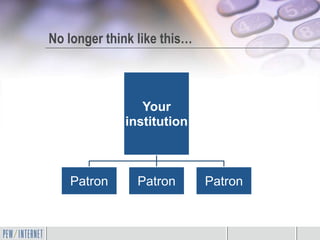
No longer think like this…


                Your
             institution


   Patron       Patron       Patron
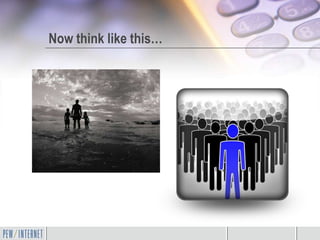
Now think like this…
How to become a
node in people’s
social networks
Tips on becoming a node in a social network

• Think like a friend, not an institution
• Play to your strengths by being an expert, a filter,
  a recommender (linker), and a facilitator
• Be aware that your audience is bigger than the
  available evidence provides – lurkers and future
  arrivals are part of the mix
• Remember that your information can (will, should)
  have an organic life beyond your presentation of it
• Look for opportunities to build communities with
  your material
More tips on becoming a node in a social network

• Participate in the Web 2.0 world
• Embrace the move towards mobility, constant
  connectivity, perpetual contact
   – This changes the realities of time and space
     and presence
• Ask for feedback
• Act on/respond to that feedback
• Provide opportunities for interaction with and
  customization of material
• Facilitate information sharing
The 4-Step Flow of Information

•   Attention
•   Acquisition
•   Assessment
•   Action
The Four A’s of Online Information Flow
• Get Attention
   –   Leverage your services and knowledge
   –   Offer alerts, updates, feeds
   –   Have a presence in relevant places
   –   Find pathways to people through their social network
• Enable Acquisition
   –   Offer services and media in many places
   –   Pursue new distribution methods for your collections
   –   Point people to good material through links
   –   Participate in conversations about your work with your
       patrons
The Four A’s of Online Information Flow
• Help with Information Assessment
   – Exploit your skills in knowing the highest quality
     material
   – Aggregate the best related work


• Facilitate Action
   – Offer opportunities for feedback
   – Offer opportunities for remixing, customization,
     interaction
   – Offer opportunities for community building
   – Offer opportunities to learn how to use social media
Finally….
    BE READY FOR THE SPOTLIGHT!!
 You never know when your material will go viral, be
picked up by a major organization, or create/mobilize
              a community or following
Finally….
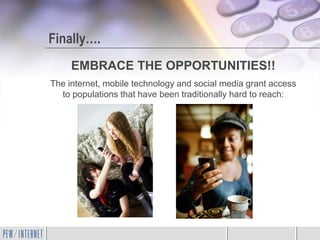
     EMBRACE THE OPPORTUNITIES!!
The internet, mobile technology and social media grant access
  to populations that have been traditionally hard to reach:
Remember…


It’s not about cobwebs.... It’s
  about social webs …. And
libraries can be at the center
           of them!
Available at www.pewinternet.org...
• Understanding the Participatory News Consumer
  http://www.pewinternet.org/Press-Releases/2010/Online-News.aspx

• Social Media and Young Adults
  http://www.pewinternet.org/Reports/2010/Social-Media-and-Young-Adults.aspx

• Teens and Mobile Phones 2004-2009
  http://www.pewinternet.org/Reports/2009/14--Teens-and-Mobile-Phones-Data-Memo.aspx

• Wireless Internet Use
  http://www.pewinternet.org/Reports/2009/12-Wireless-Internet-Use.aspx

• Chronic Disease and the Internet
  http://www.pewinternet.org/Reports/2010/Chronic-Disease.aspx

• The Social Life of Health Information
  http://www.pewinternet.org/Reports/2009/8-The-Social-Life-of-Health-Information.aspx
Thank you!
Kristen Purcell, Ph.D.
Associate Director, Research
Pew Research Center’s Internet & American Life
   Project
1615 L Street NW
Suite 700
Washington, DC 20036
Email: kpurcell@pewinternet.org
Twitter: http://twitter.com/kristenpurcell
202-419-4500

My Digital Library: 100720103330-phpapp01

  • 1.
    My Digital Library: Leveraging Today’s Mobile and Participatory Information Ecosystem Digital Libraries a la Carte TICER Tilburg University, Tilburg Netherlands July 29th, 2010 Kristen Purcell, Ph.D. Associate Director, Research Pew Internet Project
  • 2.
    Pew Internet Project •Part of the Pew Research Center, a nonpartisan “fact tank” based in Washington, DC • Provide high quality, objective data to thought leaders and policy makers • Funded by the Pew Charitable Trusts • All US findings are based on nationally representative telephone surveys of… – US adults age 18+, or – US teens ages 12-17 – Drawn from dual-frame (RDD/cell) samples
  • 3.
    Today’s Discussion 1) What’s Mobile Got to Do With It? – Global cell phone use trends – US cell phone and internet use trends – The importance of social media 2) Highlights of the New Information Ecology – What are the hallmarks of the new information ecology? – Online information consumers • who they are • how they behave • what they like 3) Leveraging New Technologies – Tips for success in the new information ecology
  • 4.
    What’s Mobile Gotto Do With It?
  • 5.
  • 6.
  • 7.
    Worldwide Mobile Subscriptions,2005-2009 140 120 World 100 Western Europe 80 Asia Americas 60 Arab States Africa 40 CIS 20 0 2005 2006 2007 2008 2009 Number of mobile subscriptions per 100 inhabitants. Source: International Telecommunications Union, 2010.
  • 8.
    Mobile Subscriptions, SelectCountries United Arab Emirates Source: ITU World Qatar Telecommunication/I Italy CT Indicators Denmark Database, 2009 UK figures. Netherlands Israel Worldwide average Thailand is 68 subscriptions Greece per 100 people. Belgium Worldwide ratio of France cell subscription to United States fixed line is almost Australia 4:1. Brazil Japan Total worldwide cell Ivory Coast phone subscriptions China is 4,676,174,400, up India from 1,763,978,500 in 2004. 0 50 100 150 200 250 Mobile Cellular Subscriptions Per 100 People
  • 9.
  • 10.
    Mobile Broadband Subscriptions,2005-2009 35 30 World 25 Western Europe 20 Asia Americas 15 Arab States Africa 10 CIS 5 0 2005 2006 2007 2008 2009 Number of mobile broadband subscriptions per 100 inhabitants. Source: International Telecommunications Union, 2010.
  • 11.
    Internet Users, 2005-2009 70 60 World 50 Western Europe 40 Asia Americas 30 Arab States Africa 20 CIS 10 0 2005 2006 2007 2008 2009 Number of internet users per 100 inhabitants. Source: International Telecommunications Union, 2010.
  • 12.
    Internet Use, WesternEurope Iceland 67 Sweden 63 UK 59 Source: ITU World Denmark 54 Telecommunication/ICT Indicators Database, 2009 figures. Netherlands 52 Western Europe average is 42 Germany 47 (24 if you include CIS). Belgium 39 France 37 Italy 34 Greece 15 0 20 40 60 80 Internet users per 100 people
  • 13.
    Internet Access ViaCell, 16-74 Year-Olds Sweden 14 Denmark 10 Spain 9 UK 7 Netherlands 6 Source: Eurostat, 2009 figures. Italy 4 Germany 3 Belgium 3 France 2 Greece 1 EU (27 countries) 4 0 5 10 15 20 Percentage of 16-74 year-olds accessing the internet via mobile phone in the past 3 months
  • 14.
    Internet Access ViaLaptop, 16-74 Year-Olds Denmark 31 Sweden 29 Germany 24 UK 21 Netherlands 18 Source: Eurostat, 2009 figures. Spain 17 Italy 15 France 14 Belgium 13 Greece 3 EU (27 countries) 17 0 5 10 15 20 25 30 35 Percentage of 16-74 year-olds accessing the internet via laptop in the past 3 months
  • 15.
    THE BIG 5MOBILE YOUTH ECONOMIES 255m $31b $58b 97m 281m CHINA THE MOBILEYOUTH® REPORT 2010 $21b 32 $21b USA $19b 76m JAPAN INDIA SUBSCRIPTIONS VALUE $BN PA (AGE <30) BRAZIL 15 SOURCE MOBILEYOUTH DATA 2010 AGES 5-29 SNS, Youth & Health
  • 16.
    MOBILE YOUTH: TEENS& STUDENTS MILLIONS OF SUBSCRIPTIONS 2010 47.5 22.4 119.7 12 13 41.7 99.4 28.6 30.8 22.9 EAST EUROPE NE ASIA 36.6 WEST EUROPE THE MOBILEYOUTH® REPORT 2010 20 NORTH AMERICA CHINA HK 139.8 60.1 MENA STUDENTS 32.1 TEENS (14- (19-24) 38.2 63.7 52.9 31.7 18) 15 LATIN AMERICA SUB SAH AFRICA SOUTH ASIA ASIAN PACIFIC SOURCE MOBILEYOUTH DATA 2010 BASED ON SUBSCRIPTIONS (ACCOUNTS) RATHER THAN SUBSCRIBERS TEENS 14-18 STUDENTS 19-24 16 SNS, Youth & Health
  • 17.
    www.mobileYouthreport.com Published by mobileYouth Statistics on youth mobile usage Available for download
  • 18.
  • 19.
  • 23.
  • 24.
  • 28.
    US Adult CellPhone Use
  • 30.
    US Adult WirelessInternet Use All adults 18-29 30-49 50-64 65+ 84% 69% 59% 49% 20% % who connect to the internet wirelessly using a laptop or handheld device
  • 31.
    What’s Mobile Gotto Do With It? • Overall, US wireless internet users are more engaged in online activities • Half of all African-American adults in the US (48%) have used their cell phone to access the internet, compared with 40% of Hispanic adults and 31% of white adults • Overall, African-American adults in the US are the most active mobile internet users • In the US, African-American mobile internet use is growing at a faster rate than non-Hispanic whites and Hispanics
  • 32.
  • 33.
    US Adult SocialMedia Use Percent of Online Adults Who Use Social Media 86 61 52 27 17 13 SNS Twitter Total 18-29 30+
  • 34.
    US Adult SocialMedia Use, by Race Percent of Online Adults Who Use Social Media 71 72 58 25 20 15 SNS Twitter White Black Hispanic
  • 35.
    US Teens Aren’tThat Into Twitter
  • 36.
    US Adults 18-24Are Into Twitter
  • 37.
    US Teens areMore Into Content Creation
  • 38.
    Content Sharing isGrowing Among Adults
  • 39.
  • 40.
    SNS Takes thePlace of Blogging?
  • 41.
    Blogging is AlsoDown For Young Adults
  • 42.
    Summary of USTeen Online Activities • 73% of online teens use SNS (up 50%) • 14% blog (down 50%) • 8% use Twitter • 8% visit online virtual worlds • 38% share content online (steady) • 21% remix content (steady) • 62% get news about current events and politics • 48% buy things online • 31% get health, dieting, fitness info • 17% get info about sensitive health topics
  • 43.
    Hallmarks of theNew Information Ecology
  • 44.
    Then and Now Industrial Age Information Age Info was: Info is: Scarce Abundant Expensive Cheap Institutionally Personally oriented oriented Designed for Designed for consumption participation
  • 45.
    The “New” InformationEcology • Blurring line between “news” and “information” • Information is “free” • Information is “at my fingertips” • Information is available when I want it • Information is available from multiple sources
  • 46.
    The “New” InformationEcology Volume of information grows
  • 47.
    The “New” InformationEcology The variety of info sources increases and democratizes and the visibility of new creators is enhanced in the age of social media.
  • 48.
    The “New” InformationEcology People’s vigilance for information changes in two directions: 1) attention is truncated (Linda Stone) 2) attention is elongated (Andrew Keen; Terry Fisher)
  • 49.
    The “New” InformationEcology Venues of intersecting with information and people multiply and the availability of information expands to all hours of the day and all places people are
  • 50.
    The “New” InformationEcology The vibrance and immersive qualities of media environments makes them more compelling places to hang out and interact
  • 51.
    The “New” InformationEcology Valence (relevance) of information improves – search and customization get better as we create the “Daily Me” and “Daily Us” ~40% of online adults get RSS feeds ~35% customize web pages for info they want
  • 52.
    The “New” InformationEcology Voting on and ventilating about information proliferates as tagging, rating, and commenting occurs and collective intelligence asserts itself 31% of online adults rated person, product, service
  • 53.
    The “New” InformationEcology Nine in ten American adults For six in ten American (92%) get news/info from multiple adults (59%), one of those platforms on a typical day platforms is the internet *Platforms include print newspapers, television, radio and the internet
  • 54.
    The “New” InformationEcology Where Americans get their news and information on a typical day 38% 59% Online and Offline Offline Only Online Only No News
  • 55.
    The “New” InformationEcology • The internet has not replaced/ displaced traditional media but… • It is fundamentally changing the way people consume and interact with information
  • 56.
    The Online News/InfoConsumer 71% of American adults The majority of online ever get news or information news and information online consumers are under age 50
  • 57.
    The Online News/InfoConsumer 71% of American adults Almost a third of online ever get news or information news and information online consumers are under age 30
  • 58.
    The Online News/InfoConsumer 71% of American adults Almost a third of online ever get news or information news and information online consumers are under age 30 *The median age of online news/info consumers is 40
  • 59.
    Online News/Information Consumersin the US… • Are more educated than other online adults and other adults in general • Have higher incomes than other online adults and other adults in general • Are disproportionately white and Hispanic • Are much more likely than other online adults to have home broadband access and to have premium broadband service
  • 60.
    The Online News/InfoConsumer Most Popular Online Sources for News and Information Portal Sites 56 TV News Org Site 46 Special Topic Site 38 Newspaper Site 38 Indiv or Org on SNS 30 Int'l News Org site 18 % of Online News/Info Consumers Who Use Each Site on a Typical Day
  • 61.
    The Online News/InfoConsumer What Are the Most Popular Online News/Information Topics? Weather 81 Nat'l Events 73 Health/Medicine 66 Business/Finance 64 Internat'l News 62 Arts and Culture 49 % of Online Adults Who Get News/Information Online About Each Topic
  • 62.
    The Online News/InfoConsumer Most Popular Features of Online News Sites Links to related material 68 72 Multi-media content 48 57 Portal/News aggregator 48 55 Easily share content 44 57 Total 42 Customize news 48 18-29 Interactive material 38 45 Ability to comment 37 51 Follow on soc media 25 39 % of Online News/Info Consumers Who Say Each Feature is Important
  • 63.
    The Online News/InfoConsumer How many websites, if 11% 11% any, do you routinely rely on 21% for news and information? None 57% Just One 2 to 5 6 or more % of Online News/Info Consumers
  • 64.
    The Online News/InfoConsumer Online News/Info Consumers are… • Efficient Grazers • Hunters and Gatherers (71% go online specifically to get news/information at least a few times a week) • Serendipitous News/Info Discoverers (80% come across news/information at least a few times a week while they are online doing other things) • News/Info Receivers (44% get news/information forwarded to them through email, automatic updates and alerts, or posts on social networking sites at least a few times a week)
  • 65.
    Online News andInformation Online News and Information is… • Portable • Participatory • Personalized
  • 66.
    Online information isportable • “On the Go” News/Info Consumers – 26% of adults access news/information on their cell phones – Among this population, 73% use social networking sites and 29% use Twitter – Typically a white male, age 34, employed full-time – One in ten adults gets news alerts sent to his or her phone • The mobile phone allows anytime/anywhere access to information • Info is consumed on the individual’s terms, when they want, where they want
  • 67.
    Online information isparticipatory • “News Participators” – 37% of internet users have contributed to the creation of news, commented on it, or disseminated it via postings on social media sites like Facebook or Twitter – Half of all online African-Americans (46%) are news participators (disproportionately high SNS use) – Overall, 71% of internet users get news and information through email or posts on social networking sites Remember… – 42% of online news consumers say being able to easily share material with others is something they look for in a news site – 65% look for news sites with links to related material – 36% look for news sites with interactive material – 35% look for news sites where they can comment on stories.
  • 68.
    Online information isparticipatory • “News Participators” are standing in the information stream • Thanks to them, your story/information has an organic life beyond your presentation of it
  • 69.
    Online information ispersonalized • “The Daily Me” Takes Shape – 28% of internet users have customized their homepage to include news and information of particular interest to them – 39% say being able to customize content is something they look for in an online news site
  • 70.
  • 71.
    1996 Benton Foundationreport: “Buildings, books, and bytes” "If you plopped a library down. . .30 years from now. . .there would be cobwebs growing everywhere because people would look at it and wouldn't think of it as a legitimate institution because it would be so far behind. . ." -- Experienced library user.
  • 72.
    How Technology Changesthe Role of Libraries • Makes it possible for organizations like libraries to become “nodes” in people’s networks that can help them solve problems and make decisions • Allows for immediate, spontaneous creation of networks that can include libraries • Gives people a sense that there are more “friends” in their networks like librarians that they can access when they have needs
  • 73.
    No longer thinklike this… Your institution Patron Patron Patron
  • 74.
  • 75.
    How to becomea node in people’s social networks
  • 76.
    Tips on becominga node in a social network • Think like a friend, not an institution • Play to your strengths by being an expert, a filter, a recommender (linker), and a facilitator • Be aware that your audience is bigger than the available evidence provides – lurkers and future arrivals are part of the mix • Remember that your information can (will, should) have an organic life beyond your presentation of it • Look for opportunities to build communities with your material
  • 77.
    More tips onbecoming a node in a social network • Participate in the Web 2.0 world • Embrace the move towards mobility, constant connectivity, perpetual contact – This changes the realities of time and space and presence • Ask for feedback • Act on/respond to that feedback • Provide opportunities for interaction with and customization of material • Facilitate information sharing
  • 78.
    The 4-Step Flowof Information • Attention • Acquisition • Assessment • Action
  • 79.
    The Four A’sof Online Information Flow • Get Attention – Leverage your services and knowledge – Offer alerts, updates, feeds – Have a presence in relevant places – Find pathways to people through their social network • Enable Acquisition – Offer services and media in many places – Pursue new distribution methods for your collections – Point people to good material through links – Participate in conversations about your work with your patrons
  • 80.
    The Four A’sof Online Information Flow • Help with Information Assessment – Exploit your skills in knowing the highest quality material – Aggregate the best related work • Facilitate Action – Offer opportunities for feedback – Offer opportunities for remixing, customization, interaction – Offer opportunities for community building – Offer opportunities to learn how to use social media
  • 81.
    Finally…. BE READY FOR THE SPOTLIGHT!! You never know when your material will go viral, be picked up by a major organization, or create/mobilize a community or following
  • 82.
    Finally…. EMBRACE THE OPPORTUNITIES!! The internet, mobile technology and social media grant access to populations that have been traditionally hard to reach:
  • 83.
    Remember… It’s not aboutcobwebs.... It’s about social webs …. And libraries can be at the center of them!
  • 84.
    Available at www.pewinternet.org... •Understanding the Participatory News Consumer http://www.pewinternet.org/Press-Releases/2010/Online-News.aspx • Social Media and Young Adults http://www.pewinternet.org/Reports/2010/Social-Media-and-Young-Adults.aspx • Teens and Mobile Phones 2004-2009 http://www.pewinternet.org/Reports/2009/14--Teens-and-Mobile-Phones-Data-Memo.aspx • Wireless Internet Use http://www.pewinternet.org/Reports/2009/12-Wireless-Internet-Use.aspx • Chronic Disease and the Internet http://www.pewinternet.org/Reports/2010/Chronic-Disease.aspx • The Social Life of Health Information http://www.pewinternet.org/Reports/2009/8-The-Social-Life-of-Health-Information.aspx
  • 85.
    Thank you! Kristen Purcell,Ph.D. Associate Director, Research Pew Research Center’s Internet & American Life Project 1615 L Street NW Suite 700 Washington, DC 20036 Email: kpurcell@pewinternet.org Twitter: http://twitter.com/kristenpurcell 202-419-4500